
Once Saved Always Saved?

The Holy Scriptures definitely support eternal security, as made clear by our Lord:
My sheep listen to my voice; I know them, and they follow me. 28I give them eternal life, and they shall never perish; no one will snatch them out of my hand. 29My Father, who has given them to me, is greater than all; no one can snatch them out of my Father’s hand. 30I and the Father are one.”
John 10:27-30
We were marked in Christ with a seal, the Holy Spirit, which the Bible says is a deposit guaranteeing what is to come (Ephesians 1:13; 2 Corinthians 1:22). This is awesome and comforting news!
The question we want to answer in this article is whether or not this eternal security is unconditional or conditional. If it’s unconditional, it would support the idea of ‘once saved always saved,’ which argues that, since salvation is by faith and not by works, believers can never lose their salvation, even if they live like the devil with no care of penitence year after year, decade after decade.
Since this is a nonsectarian study we are only interested in what the rightly-divided Scriptures teach on the topic. This corresponds to Paul’s charge to his young protégé, Timothy:
Do your best to present yourself to God as one approved, a worker who does not need to be ashamed and who correctly handles the word of truth.
2 Timothy 2:15
If the word of truth can be correctly handled, it can also be incorrectly handled. People who incorrectly handle the Bible end up unrightly dividing it. They do this by stressing a few verses that support their favored belief while ignoring relevant passages that offer important balance to the topic. The goal here is to be honest and balanced in our study. Whatever the truth is, there can be no loopholes; all the “pieces” have to fit. If someone comes up with an argument that ignores multiple biblical passages then that position is dubious at best. Their theology is askew somehow.
I realize there are loads of believers out there who are fervent about their belief in unconditional eternal security—aka ‘once saved always saved’—even stubborn. Several people have either written me or spoken with me seriously on the topic. In none of these cases were they able to explain clear passages where the biblical writers warn believers of the necessity of “continuing in the faith” and guarding one’s heart of things that have the potential to choke the Word of God and therefore rob faith. Then there’s the “deceptiveness of sin,” and the dire consequences of an unrepentant sinful lifestyle, which includes the ensuing falling away.
Let’s consider several examples from key New Testament personages. I’ll comment on each passage but will keep it brief. We’re going to start with Paul because there are some sincere believers who mistakenly feel Gentile believers can only receive from Paul’s ministry and, specifically, his epistles Romans through Philemon, as well as his statements in Acts that relate to Gentile believers (a false doctrine that is addressed in here).
What Paul Taught
The acts of the flesh are obvious: sexual immorality, impurity and debauchery; 20 idolatry and witchcraft; hatred, discord, jealousy, fits of rage, selfish ambition, dissensions, factions 21 and envy; drunkenness, orgies, and the like. I warn you [believers], as I did before, that those who live like this will not inherit the kingdom of God.
Galatians 5:19-21
The apostle was talking about those who walk in the flesh with no concern of penitence. For those not in the know, repentance is the first doctrine of Christianity (Hebrews 6:1-2) and believers are required to “keep with repentance” (Matthew & Luke 3:8), as detailed in 1 John 1:8-9. You can read details here.
Here are four other relevant passages from Paul…
Do not be deceived: God cannot be mocked. A man reaps what he sows. 8 Whoever sows to please their flesh, from the flesh will reap destruction; whoever sows to please the Spirit, from the Spirit will reap eternal life.
Galatians 6:7-8
This corresponds to the biblical fact that “the wages of sin is death, but the gift of God is eternal life in Christ Jesus our Lord” (Romans 6:23). Sin always produces death. The first thing impenitent sin will kill is your fellowship with God (Romans 8:6-8). If stubbornly persisted in, it will eventually kill your faith and, hence, your relationship with God.
You [believers] will say then, “Branches were broken off so that I could be grafted in.” 20Granted. But they were broken off because of unbelief, and you stand by faith. Do not be arrogant, but tremble. 21For if God did not spare the natural branches, he will not spare you either.
22 Consider therefore the kindness and sternness of God: sternness to those who fell, but kindness to you, provided that you continue in his kindness. Otherwise, you also will be cut off. 23 And if they [Hebrews] do not persist in unbelief, they will be grafted in, for God is able to graft them in again. 24 After all, if you [believers] were cut out of an olive tree that is wild by nature, and contrary to nature were grafted into a cultivated olive tree, how much more readily will these, the natural branches [Hebrews], be grafted into their own olive tree!
Romans 11:19-24
Paul was saying that the LORD took the “wild branches” of Gentiles and grafted them into covenant with him through repentance and faith (Acts 20:21). If the “natural branches” of Israelites were broken off due to unbelief, the same can happen to Gentile believers. Therefore, don’t cop an arrogant attitude, but rather tremble in humility as you “continue in God’s kindness,” which means to persevere in faith, as detailed here:
Once you were alienated from God and were enemies in your minds because of your evil behavior. 22But now he has reconciled you by Christ’s physical body through death to present you holy in his sight, without blemish and free from accusation— 23 if you continue in your faith, established and firm, and do not move from the hope held out in the gospel.
Colossians 1:21-23a
We are regularly instructed in Scripture to add patience or perseverance to our faith (Hebrews 6:12; 2 Peter 1:5-9). Why? Because anyone who foolishly doesn’t add perseverance to their faith will come to the point of no longer believing. If you no longer believe you won’t receive that for which you are believing (Mark 11:24). This includes salvation. Remember, “without faith it is impossible to please God, because anyone who comes to him must believe that he exists and that he rewards those who earnestly seek him” (Hebrews 11:6).
This is why Paul encouraged continuing in faith, which can also be observed here:
if we endure,
we will also reign with him.
If we disown him,
he will also disown us;
2 Timothy 2:12
Only those who endure in faith with reign with the Lord in eternal life. Anyone who disowns him will be disowned, which means that they lose their salvation.
Someone might argue that a person has to verbally disown Christ in order for the Lord to disown him or her. This is a legit point except that Paul elsewhere referenced those who “claim to know God, but by their actions they deny him” (Titus 1:16).
What Peter Taught
If they have escaped the corruption of the world by knowing our Lord and Savior Jesus Christ and are again entangled in it and are overcome, they are worse off at the end than they were at the beginning. 21 It would have been better for them not to have known the way of righteousness, than to have known it and then to turn their backs on the sacred command that was passed on to them.
2 Peter 2:20-21
Peter wasn’t talking about people who had mere mental assent of our Lord and Savior, but rather people who knew Jesus Christ. In other words, they were genuinely saved and experienced spiritual rebirth (Titus 3:5). Unfortunately, they foolishly allowed themselves to be “again entangled” in the corruption of the world and overcome, turning their backs on their Lord and Savior.
What Jesus Christ Taught
“but the worries of this life, the deceitfulness of wealth and the desires for other things come in and choke the word, making it unfruitful.”
Mark 4:19
It’s important to guard your heart as the wellspring of life (Proverbs 4:23) in order to protect it from things entering in that will “choke the Word.” Those three things are:
- The anxieties or worries of this life
- The deceitfulness of wealth
- The desires for other things, aka various pleasures of this earthly life.
The Lord also stressed this in Luke 8:14 and Matthew 13:22.
“Those on the rocky ground are the ones who receive the word with joy when they hear it, but they have no root. They believe for a while, but in the time of testing they fall away.”
Luke 8:13
This verse offers balance to what the apostle John says in 1 John 2:19 (which we’ll examine in chapter 5). The LORD Himself plainly says that there will be people who “believe for a while, but in the time of testing they fall away.” He did not say they didn’t really believe. No, they believed for a while, but eventually fell away because they didn’t add perseverance; or, as noted above, they allowed something in their hearts that choked the word.
“Believe” here is the verb form of the Greek word for faith, pistis (PISS-tis), which is the word used in the key passages that stress salvation by faith (e.g. Ephesians 2:8). The verb form, pisteuó (pist-YOO-oh), is used in the most famous passage of the Bible:
For God so loved the world that he gave his one and only Son, that whoever believes in him shall not perish but have eternal life.
John 3:16
The point? Because the Lord plainly said that these people believed for a while, it cannot be argued that he was referring to people who never really believed and therefore were never saved.
Now there were some present at that time who told Jesus about the Galileans whose blood Pilate had mixed with their sacrifices. 2 Jesus answered, “Do you think that these Galileans were worse sinners than all the other Galileans because they suffered this way? 3 I tell you, no! But unless you repent, you too will all perish. 4 Or those eighteen who died when the tower in Siloam fell on them—do you think they were more guilty than all the others living in Jerusalem? 5 I tell you, no! But unless you repent, you too will all perish.”
6 Then he told this parable: “A man had a fig tree growing in his vineyard, and he went to look for fruit on it but did not find any. 7 So he said to the man who took care of the vineyard, ‘For three years now I’ve been coming to look for fruit on this fig tree and haven’t found any. Cut it down! Why should it use up the soil?’
8 “ ‘Sir,’ the man replied, ‘leave it alone for one more year, and I’ll dig around it and fertilize it. 9If it bears fruit next year, fine! If not, then cut it down.’ ”
Luke 13:1-9
Twice the Lord stresses that those who refuse to repent of their sins will reap the wages of sin, which is death (Romans 6:23). This is why the first word of John the Baptist’s first sermon was “repent” (Matthew 3:1-2); the same with Jesus Christ’s first sermon (Matthew 4:17).
The Lord then gives a parable in verses 6-9 to illustrate his point.
Please note Jesus’ preceding statement to giving this parable in verse 5: “unless you repent, you too will all perish.” There is a condition to not perishing—not suffering eternal death—and that condition is humble penitence. Christ holds people responsible for adhering to this condition. God doesn’t force anyone to repent; that is, change your mind and the corresponding actions. It’s up to the individual person. God does his part, of course, but we are obligated to do our part. Genuine penitence, by the way isn’t just confessing past sins, but also the resolve to no longer sin and to keep with repentance when we do.
The symbolism of the parable is obvious:
- The owner of the vineyard represents God;
- The fruitless fig tree refers to an individual in covenant with God who’s not bearing fruit.
- The caretaker represents Yeshua, the mediator between the owner and the fig tree (1 Timothy 2:5).
The owner wants to cut the fig tree down because it hasn’t produced fruit in three years, but the caretaker intercedes and convinces the owner to give the tree one more year wherein the caretaker will do everything he can to get it to be fruitful. If the tree still hasn’t produced fruit by the end of the fourth year the owner and caretaker agree to cut it down and remove it from the vineyard.
What we see here is patience, mercy and grace. The owner of the vineyard and the caretaker, who represent the heavenly Father and the Son, are willing to give the tree a total of four years to be fruitful before ultimately cutting it down, if they must. The story is figurative so we can’t take it strictly literal, i.e. that God will pluck someone out of the kingdom if they’re fruitless for exactly four years. What we can get from it, however, is that God’s patience, mercy and grace are awesome and he will do everything he can to get us to be fruitful by adhering to the conditions of our covenant, i.e. repentance & faith. He’s invested in us greatly and understandably wants us to be productive.
Another thing we can get from the parable is that when the Lord’s mercy ends his judgment begins and he’ll cut off when/if necessary. Why be foolish and incur such judgment?
Here’s a somewhat similar symbolic teaching from the Lord:
“I am the true vine, and my Father is the gardener. 2 He cuts off every branch in me that bears no fruit, while every branch that does bear fruit he prunes so that it will be even more fruitful. 3 You are already clean because of the word I have spoken to you. 4 Remain in me, as I also remain in you. No branch can bear fruit by itself; it must remain in the vine. Neither can you bear fruit unless you remain in me.
5 “I am the vine; you are the branches. If you remain in me and I in you, you will bear much fruit; apart from me you can do nothing. 6 If you do not remain in me, you are like a branch that is thrown away and withers; such branches are picked up, thrown into the fire and burned.”
John 15:1-6
Christ is the vine and believers are the branches. The Lord emphasizes the vitalness of remaining in him. Those who opt not to persevere, but rather separate from Christ are no longer part of the vine. They are “picked up, thrown into the fire and burned.” As the Lord elsewhere said, “Do not be afraid of those who kill the body but cannot kill the soul. Rather, be afraid of the One who can destroy both soul and body in hell” (Matthew 10:28).
What the Writer of Hebrews Taught
See to it, brothers and sisters, that none of you has a sinful, unbelieving heart that turns away from the living God.
Hebrews 3:12
Since the writer of this epistle is addressing fellow believers—led of the Holy Spirit (2 Peter 1:21)—this proves beyond any shadow of doubt that a believer can foolishly allow his/her heart to become corrupted and thus turn away from the LORD.
It is impossible for those who have once been enlightened, who have tasted the heavenly gift, who have shared in the Holy Spirit, 5who have tasted the goodness of the word of God and the powers of the coming age 6and who have fallen away, to be brought back to repentance. To their loss they are crucifying the Son of God all over again and subjecting him to public disgrace. 7Land that drinks in the rain often falling on it and that produces a crop useful to those for whom it is farmed receives the blessing of God. 8But land that produces thorns and thistles is worthless and is in danger of being cursed. In the end it will be burned.
9Even though we speak like this, dear friends, we are convinced of better things in your case—the things that have to do with salvation.
Hebrews 6:4-9
Verses 4-5 make it clear that this is referring to people who were once genuine believers. Regrettably, they have “fallen away” and therefore cannot “be brought back to repentance” (verse 6), which means they’ve become apostate.
If we [believers] deliberately keep on sinning after we have received the knowledge of the truth, no sacrifice for sins is left, 27 but only a fearful expectation of judgment and of raging fire that will consume the enemies of God.
Hebrews 10:26-27
Believers of course miss it now and then, but appropriate God’s forgiveness as they ’fess up (1 John 1:8-9). This is humbly “keeping with repentance” (Matthew & Luke 3:8). There’s a difference between this and brazenly living in sin as a lifestyle. Unless they wisely repent, such people can expect judgment and “raging fire that will consume the enemies of God,” which is a reference to the “second death” detailed here:
Then I saw a great white throne and him who was seated on it. The earth and the heavens fled from his presence, and there was no place for them. 12And I saw the dead, great and small, standing before the throne, and books were opened. Another book was opened, which is the book of life. The dead were judged according to what they had done as recorded in the books. 13The sea gave up the dead that were in it, and death and Hades gave up the dead that were in them, and each person was judged according to what they had done. 14Then death and Hades were thrown into the lake of fire. The lake of fire is the second death. 15Anyone whose name was not found written in the book of life was thrown into the lake of fire.
Revelation 20:11-15
There are other New Testament passages that illustrate the same as the ones we’ve looked at, but this is enough for this article.
Those who embrace unconditional eternal security have to address these pertinent passages. The fact that they won’t—or they unconvincingly write them off—testifies against their doctrine.
Conclusion
Those who rigidly advocate the ‘once saved always saved’ doctrine argue that, if people fall away from the Lord, they were never really saved in the first place. They contend that such people merely dabbled in Christianity and their faith was never really sincere; consequently, any positive changes in their lifestyles were superficial, the result of practicing some Scriptural principles, but not actually knowing the Lord. Surely this is true, but the numerous passages above also show that Christians can abort their salvation if they choose to neglect their faith. After all, if it takes faith to be saved it naturally follows that people cannot be saved if they come to a point where they no longer have faith. That’s simple enough to understand, isn’t it? Let’s not make the issue more complicated than it is.
Suffice to say, don’t play foolish games with God. You can draw whatever conclusion on the matter that gives you peace and helps you sleep at night, just be careful not to play around with “the deceitfulness of sin” or encourage others to do so either. We’re all going to stand before the Lord and give an account one day.
For those who argue that salvation is a gift, not something you work for, this is true. However, consider this: You can graciously give someone a forever gift, but the receiver still has the option of throwing it back at you… and spitting in your face.
The obvious weakness of the “once saved always saved” teaching is that it can create spiritual complacency, whereas the weakness of the opposite extreme – that believers can lose their salvation at any moment – creates anxiety. The sensible middle position is the biblical position: The believer’s salvation is secure as he or she walks in faith and trusts God’s Word, avoiding both complacency and insecurity. If you miss it, be quick to repent, and God will forgive you. Then keep moving forward knowing that “The path of the righteous is like the first gleam of dawn, shining ever brighter till the full light of day” (Proverbs 4:18).
So the Bible teaches eternal security, but it clearly does not teach unconditional eternal security.
For more details, see the second part of this article Once Saved Always Saved? — Answering the Best Arguments.
This article is also available in book form (edited) as chapter 1 of…


Related Topics:
False Grace — “Hyper-Grace Cotton Candy”
The Six Basic Doctrines of Christianity
When Did THE NEW TESTAMENT Start? When Did THE CHURCH Begin?

When I was a young believer years ago a brother in the Lord insisted that “the four Gospels are Old Testament not New Testament.” This struck me as odd and inaccurate, but since I didn’t have enough information at the time I didn’t contest his position. While what he said was understandable in light of the fact that the Church did not technically begin until the Day of Pentecost (more on this below), I’ve since discovered that what he said was patently false. Notice what Jesus Christ Himself said on the topic:
“The Law and the Prophets [i.e. the Old Covenant] were proclaimed until John. Since that time, the good news of the kingdom of God is being preached”
12From the days of John the Baptist until now, the kingdom of heaven has been subjected to violence, and violent people have been raiding it. 13For all the Prophets and the Law prophesied until John.
Matthew 11:12-23
This answers the question in plain language: The Old Testament ended with John the Baptist who prepared the way for the Messiah via a baptism of repentance (Luke 3:2-19). With the ministries of John and Christ, the kingdom of God was preached, not the Law and the Prophets.
“The Law,” incidentally, refers to the Torah, the first five books of the Bible—Genesis, Exodus, Leviticus, Numbers and Deuteronomy—whereas “the Prophets” refers to the prophetic books of the Old Testament. Combining “the Law and the Prophets” together, like Jesus did in Luke 16:16, was/is a reference to the Old Testament in general—the Old Covenant (contract) that God had with the Israelites.
“The Kingdom of God Is Near”
So the Old Testament was proclaimed until the time of John the Baptist’s public ministry. From that time forward “the good news of the kingdom of God is being preached.” “The “Good News” refers, of course, to the awesome message of Christ—the gospel. Notice what John the Baptist, Jesus Christ, the 12 disciples and the other 72 disciples preached:
In those days John the Baptist came, preaching in the wilderness of Judea (2) and saying, “Repent, for the kingdom of heaven is near.”
Matthew 3:1-2
From that time on Jesus began to preach, “Repent, for the kingdom of heaven is near.”
Matthew 4:17
These twelve Jesus sent out with the following instructions: “Do not go onto the road of the Gentiles or enter any town of the Samaritans. (6) Go rather to the lost sheep of Israel. (7) As you go, preach this message: ‘The kingdom of heaven is near.’ “
Matthew 10:5-6
“If you enter a town and they welcome you, eat whatever is set before you. (9) Heal the sick who are there and tell them, ‘The kingdom of God is near you.’ ”
Luke 10:8-9
As you can see, John, Jesus, the 12 disciples, and the other 72 disciples all preached that “the kingdom of God is near.” Other translation say “the kingdom of God is at hand.” The words “near” and “at hand” are translated from the Greek eggizó (eng-ID-zoh), which means “extreme closeness, immediate imminence—even a presence.” Whether extremely close or even present to a degree, they preached the kingdom of God and not the Law and the Prophets, which agrees with Jesus’ plain declaration in Luke 16:16 above.
The kingdom of God is essentially synonymous with the Church (Matthew 16:18-19), but only if “kingdom of God” is defined in a narrow sense, as in “a spiritual rule over the hearts and lives of those who willingly submit to God’s authority during this present age.” Those who rebel against God’s authority and refuse to submit are obviously not part of the kingdom of God (“the kingdom of God” being the Church in this current era). By contrast, those who acknowledge the lordship of Christ and gladly surrender to God’s rule in their hearts are part of the kingdom of God and therefore part of the Church.
The Four Gospels Are the “Prologue” to the New Testament
So the four Gospels are not Old Testament, but are rather the “prologue” to the New Testament and therefore PART OF the New Testament, even though the Church didn’t technically start until the Day of Pentecost after the Lord’s death & resurrection (Hebrews 9:17). Notice how Christ spoke AS IF the Church was already in function in this passage where he addressed dealing with offending believers with his disciples:
“If they [the offending believers] still refuse to listen, tell it to the church; and if they refuse to listen even to the church, treat them as you would a pagan or a tax collector.”
As you can see, Jesus spoke as if the Church was already in existence to believing Hebrews even though he didn’t die for our sins yet and was raised to life for our justification. You could say that the Church was already alive but not birthed yet, like a baby in a mother’s womb.
What Is “the Church”?
The word ‘church’ in the Greek is ekklesia (ee-KLEE-see-ah), meaning “called out of ” or “the called-out ones.” It refers to people who have been called out of the darkness of this world and consecrated to the LORD via responding in faith & repentance to the good news of the message of Christ, whether Jew or Gentile (Acts 20:21) and the ensuing spiritual rebirth (1 Peter 1:3,23; James 1:18). The Church is synonymous with “the body of Christ” (Colossians 1:18) and includes every genuine believer who’s experienced spiritual regeneration regardless of what sectarian tag they favor (John 3:3,6 & Titus 3:5).*
* Always remember this about sectarian tags: Putting a label of ‘corn’ on a can of beans doesn’t make the beans a can of corn.
In its singular form ekklesia is always used to describe all people across the globe who know Christ and not to a specific sect—like, say, the Baptists, Nazarenes or Assemblies of God. When pluralized, the word ekklesia is used in reference to specific assemblies of believers who meet together. In the Bible this was often at a person’s house (Acts 20:20; Romans 16:3,5). It should be noted that the word ‘church’ is never used in the Scriptures to describe either a physical facility or a human-organized group—i.e. a sect or denomination—although the people of such an organization may, of course, be the Church (“called-out ones”); and usually are if it’s a legitimate (i.e. biblical) ministry organization.
No specific assembly or denomination is necessarily the “one true Church” because the body of Christ is not a human-organized institution, but rather a spiritual entity comprised of those who have been reconciled to the LORD by grace through faith (Ephesians 2:8–9; 2 Corinthians 5:18-20). Such people—no matter what structure they meet at, no matter which sect they’re a part of, and no matter what nation they happen to live in—are the true Church.
Any time you hear a minister or believer talk about his or her sect/assembly as the “one true Church” it’s an indication of the infection of staunch sectarianism, which is a spiritually immature mindset, as witnessed in Jesus’s disciples in Luke 9:49-50. And, worse, it’s actually a work of the flesh, as shown in Galatians 5:19-21 where “factions” is listed as one of the works of the flesh, also translated as “sects” (and sometimes dubiously translated as “heresies”). “Factions” or “sects” is a translation of the Greek word hairesis (HAH-ee-res-is), which means “a religious or philosophical sect” and the resulting division, discord or contention in the body of Christ.
With the understanding of the above, I am the Church and you are the Church; that is, if you’re a genuinely born-anew believer.
When Did the Church Begin?
The actual historical formation of the Church occurred in Jerusalem on the Day of Pentecost, which was 50 days after the Passover when Christ died and was resurrected three days later. Notice how Peter referred to the Day of Pentecost as “the beginning” as he testifies to Jewish believers about the Holy Spirit coming upon Gentile believers:
“As I began to speak, the Holy Spirit came on them [the Gentile believers] as he had come on us at the beginning. (16) Then I remembered what the Lord had said: ‘John baptized with water, but you will be baptized with the Holy Spirit.’ ”
Acts 11:15-16
“The beginning” obviously refers to the Day of Pentecost when believers where empowered by the Holy Spirit (Acts 2:1-13). So Pentecost marks the beginning of the Church as the spiritual reality of the body of Christ.
Didn’t the Church Begin With Paul, as Some Evangelicals Teach?
No, when the Church officially started on the Day of Pentecost Saul (who became Paul) wouldn’t even be saved for 3-6 years, which followed his potent encounter with the Risen Lord on the Road to Damascus (Acts 9:1-22). Christ’s Church — the “called-out ones” or “body of Christ” (Colossians 1:18) — is referenced several times before this happened, such as Acts 5:11.
After Paul’s conversion he preached mightily in both Damascus and Jerusalem, wherein he was greatly persecuted with the threat of murder. Notice what Scripture says about the Church just after this when the believers sent Paul to Tarsus to avoid being killed for this bold service:
Then the church throughout Judea, Galilee and Samaria enjoyed a time of peace and was strengthened. Living in the fear of the Lord and encouraged by the Holy Spirit, it increased in numbers.
You see? The Church or ekklesia existed throughout Judea, Galilee and Samaria at the time Paul first started preaching.
The false doctrine that the Church started with Paul is based on the erroneous idea that he taught a separate gospel to that of Jesus Christ and his apostles, namely James, Peter & John. You can read details of why this is a grossly false doctrine here.
What Did Jesus Mean by “On This Rock I Will Build My Church”?
The Messiah made this well-known statement after asking his disciples if they knew who he truly was. Simon Peter answered, “You are the Christ, the Son of the living God” (verse 16).
Jesus replied, “Blessed are you, Simon son of Jonah, for this was not revealed to you by man, but by my Father in heaven. (18) And I tell you that you are Peter, and on this rock I will build my church, and the gates of Hades will not overcome it.
Matthew 16:17-18
What is the “rock” on which Christ said he would build his Church? It’s not Peter whose name in Greek, petros, means “stone.” The “rock” on which Jesus will build his Church is petra in the Greek, meaning “large rock” or “bedrock.” When you’re driving down an interstate highway and pass through a section with sheer rock cliffs on either side it’s obvious that the road-workers literally blasted through a big hill or mountain. When I see this I often marvel at the solid mass of rock underlying the topsoil. This is petra or bedrock. Christ figuratively said his Church would be built on such bedrock—an incredible mass of solid rock. What is this “rock”? It’s the revelation of the fact that Jesus is the Christ or Messiah, which literally means “anointed one.” It’s a revelation because Jesus said it was “revealed” to Peter by Father God.
What’s the big deal about having a revelation that Jesus is the Christ? Please understand that “Christ” is not the last name of Jesus. “Christ” is translated from the Greek word Christos (khris-TOS), which means “anointed one” and comes from the Hebrew mashach (maw-SHAKH) meaning “anointed” or “chosen one.” A good example of this Hebrew word used in reference to Jesus in the Scriptures is Psalm 45:7.
“Jesus” was simply the name the angel Gabriel gave to Mary, as shown in Luke 1:31. This name was specifically given because ‘Jesus’ is the transliteration of a Hebrew term meaning “Yahweh [God] saves” (or “Yahweh is salvation”). So ‘Jesus’ is the Lord’s God-given proper name while ‘Christ’ is his title, signifying that Jesus was sent from God as humanity’s King and Deliverer. With this understanding, ‘Jesus Christ’ means “Jesus the Anointed One” and could be translated as “God saves through His Anointed One.”
While the meaning of mashach—“anointed”—literally refers to the pouring of oil, it can also refer to one’s separation unto God, even if literal oil is not actually used (Hebrews 1:9). You see, when someone was promoted to a position of authority in the Old Testament, oil was smeared on the person’s head to signify being consecrated (separated) for God’s work. See 1 Samuel 10:1 for a good example. Anointing was a ritualistic act indicating God’s choosing (e.g., 1 Samuel 24:6). Kings, priests, and prophets were all set apart for the LORD’s ministry in this manner.
I explained all that so you’ll fully grasp what Peter was saying when he answered Jesus’ question. When Peter replied “You are the Christ, the Son of the Living God” he was acknowledging that Jesus was the anointed prophet that God would raise up as the savior of the world. This was prophesied repeatedly in the Hebraic Scriptures (e.g. Genesis 3:15, Deuteronomy 18:18, Isaiah 7:14 & 9:6). In short, Peter had a revelation that Jesus was humanity’s Savior, the Messiah or Christ. And this revelation is the “bedrock” upon which Christ would build his Church, his “called-out ones.” This makes perfect sense when you understand that it’s this very revelation—this belief inspired by God—that prompts people to embrace the gospel and enables them to be reconciled to the Creator through spiritual regeneration and, hence, obtain eternal life (John 3:3,6,16,36). You can only be a “called-out one” — a member of Christ’s Church — if you have this revelation and act on it, like Peter. As such, it’s the bedrock upon which Christ builds his Church. Anyone who doesn’t have this revelation can’t be a “called-out one” and therefore the Lord cannot use that person to build his Church. Are you with me? This explains this passage:
Everyone who believes that Jesus is the Christ is born of God
1 John 5:1
Since you have to believe that Jesus is the Anointed Savior in order to be “born of God,” this revelation is the rock upon which Christ builds his Church, his called-out ones.
Why did Jesus emphasize Peter’s name, petros? Because, although Peter was a little “stone,” he would become a part of the bedrock of the Church of Jesus Christ, which is comprised of all genuine believers regardless of sectarian tag. We’re all little “stones” that together make up the bedrock of the Church, Christ’s body on Earth!
Christ adds in verse 18 that the “gates of Hades” would not overcome his Church. The “gates of Hades” was a colloquial Jewish phrase for death, which makes sense since Hades (or Sheol in Hebrew) is the realm of the DEAD and consequently a person would have to die to go there. Jesus was saying that even death, Satan’s ultimate weapon (Hebrews 2:14-15), could not stop the Messiah from birthing and unleashing his Church. And it didn’t. He was raised to life and the rest is history. Furthermore, death has no power to destroy the Church, period. Every Satanic attempt to wipe out believers and stop the Church’s spread has failed; in fact, the blood of martyrs has always served to advance God’s kingdom rather than diminish it (e.g. Acts 7:59-8:4). In addition, when a spiritually-regenerated believer physically dies their soul doesn’t go to Hades/Sheol, the realm of the DEAD, but rather goes to be with the Lord in heaven to await his or her bodily resurrection (Philippians 1:20-24, 2 Corinthians 5:1-10, 1 Thessalonians 5:10, Revelation 6:9-11 & 7:9-17). See this article for details.
Related Topics:
What Is the MYSTERY OF THE AGES?
Sectarianism — What is It? What’s Wrong with It?
The Five Earths of the Bible (and the Eight Ages)
Understanding HUMILITY

In this article we’re going to see what genuine humility is as opposed to false humility (Colossians 2:18-23), such as self-loathing or pretending to be meek. And then we’ll observe how humility is key to receiving God’s favor, i.e. grace.
This passage is a good starting point:
Or do you think Scripture says without reason that he [God] jealously longs for the spirit he has caused to dwell in us? 6 But he gives us more grace (charis). That is why Scripture says:
“God opposes the proud
but shows favor (charis) to the humble.”
7 Submit yourselves, then, to God. Resist the devil, and he will flee from you. 8 Come near to God and he will come near to you. Wash your hands, you sinners, and purify your hearts, you double-minded. 9 Grieve, mourn and wail. Change your laughter to mourning and your joy to gloom. 10 Humble yourselves before the Lord, and he will lift you up.
James 4:5-10
Verse 6 stresses that God shows graciousness to the humble and is a quote of Proverbs 3:34, which Peter also quotes in his first epistle (1 Peter 5:5). As such, this truth is conveyed three times in the Bible, which means it’s something God wants to get through to us. It reveals a vital axiom about the importance of humility and how to unlock God’s favor (i.e. grace) in your life.
‘Humility’ in the Greek is tapeinophrosune (tap-i-nof-ros-OO-nay), which means “inner lowliness” or “lowliness of mind.” It’s not self-loathing or self-belittlement, but rather a healthy sense of one’s littleness in the grand scheme of things regardless of position, possessions or talents. It’s a modest opinion of oneself and describes a person who depends on the LORD above self. You could describe humility as an inside-out virtue that is naturally produced when comparing oneself to the Almighty Creator rather than to other people, which of course helps keep one from being a self-exalting, self-inflated blowhard.
Have you ever met someone who regularly brags on himself or herself? It’s a huge turn-off, isn’t it? If it’s a turn-off to you, how do you think the LORD feels about it? This explains the words of wisdom:
Let someone else praise you, and not your own mouth;
an outsider, and not your own lips
Proverbs 27:2
Two good examples of humility in the Bible are Moses (Numbers 12:3) and David (1 Samuel 18:23). It goes without saying that God used these men greatly, which is why 3000-3500 years after their passing people all over the world still talk about them and their exploits, like us right now. They were mighty men—very talented individuals—but they were also genuinely humble, which is what attracted God’s favor — his grace — and explains why the LORD was able to use them so mightily.
Humility Attracts God’s Grace
God’s favor/graciousness/kindness is wonderful and he offers this grace to everyone, regardless of race, ethnicity or location—which indicates that God has no favoritism—but the LORD does not give favor to the proud who are too proud or too stubborn (one way or another) to recognize it, let alone receive it.
Now someone might point out that Christ taught that God “is kind to the ungrateful and wicked” (Luke 6:35) and “He causes His sun to rise on the evil and the good, and sends rain on the righteous and the unrighteous” (Matthew 5:45). This shows the LORD’s general grace — kindness — toward fallen creation, which is intended to attract people to the Creator and his grace of salvation. Unfortunately, many proud souls disregard God’s general grace and scoff at the Almighty, even denying his existence; some palpably hate the LORD or any notion of an Almighty Maker (Psalm 14:1 & 53:1).
God is greatly patient with such people (2 Peter 3:9) and we’re called to intercede for them (Matthew 5:44), but if they stubbornly continue in their arrogance, hatred and unbelief—disregarding God’s general grace, not to mention any additional grace offered to them through the intercession of the saints—they’re not going to receive God’s grace of salvation. And, if they’re too stubborn to recognize and receive the LORD’s grace of salvation they’re certainly not going to grow in personal grace, like Jesus did (Luke 2:52) and Peter instructed us to do (2 Peter 3:18). Why not? Because—again—God opposes the proud, but gives his grace to the humble!
Humility—and the Corresponding Repentance & Faith—Is What Makes People “Worthy of the Kingdom of God”
The New Testament speaks of those “worthy” of the gift of eternal life. Notice for yourself from the very words of the Mighty Christ and apostle Paul:
Jesus replied, “The people of this age marry and are given in marriage. 35 But those who are considered worthy of taking part in the age to come and in the resurrection from the dead will neither marry nor be given in marriage, 36 and they can no longer die; for they are like the angels. They are God’s children, since they are children of the resurrection.
Luke 20:34-36
Therefore, among God’s churches we boast about your perseverance and faith in all the persecutions and trials you are enduring.
5 All this is evidence that God’s judgment is right, and as a result you will be counted worthy of the kingdom of God, for which you are suffering.
2 Thessalonians 1:4-5
As you can see, Christ spoke of those considered “worthy of taking part in the age to come and in the resurrection of the dead” while Paul spoke of those “worthy of the kingdom of God.” In both cases they were talking about genuine believers worthy of the kingdom of God and the resurrection unto eternal life (1 Corinthians 15:42-44). The Greek word for ‘worth’ in each passage is kataxioó (kat-ax-ee-OH-o), which simply means to “deem worthy.” This of course does not refer to being deemed worthy of eternal salvation due to religious works or rituals (Ephesians 2:8-10), but rather being “deemed worthy” due to genuine humility characterized in repentance and faith (Acts 20:21).
Anyone who wants God’s grace of salvation, it’s free and you don’t have to work for it or purchase it, but it can only be received through humility; and humility is reflected in the willingness to repent and believe in response to God’s revelation, in this case the message of Christ. This is how you “obey the gospel of our Lord Jesus” (2 Thessalonians 1:8) as opposed to disobeying the gospel of God (1 Peter 4:17). These kinds of verses send “radical grace” preachers into coronary because they hate the word ‘obey’ in conjunction with God’s grace of salvation. But obeying the message of Christ does not mean working for salvation or trying to buy it; however, it does mean responding with humility to God’s gracious offer of salvation—which is manifested in repentance and faith. Why? Because it’s humility that attracts God’s grace as opposed to pride which naturally repels His favor (James 4:6, 1 Peter 5:5 & Proverbs 3:34).
The Key to Growing in God’s Grace
If you want to grow in God’s grace — as we are instructed to do in the Scriptures (2 Peter 3:18) — the key is humility, which means not being a pompous, self-praising, bloviating fool who thinks he/she is all that and a bag of chips. Paul put it like this: “Do not think of yourself more highly than you ought, but rather think of yourself with sober judgment, in accordance with the faith God has distributed to each of you” (Romans 12:3).
Two Kinds of Pride
There are two types of pride, one is bad and the other good, which can be observed here:
3 If anyone thinks they are something when they are not, they deceive themselves. 4 Each one should test their own actions. Then they can take pride in themselves alone, without comparing themselves to someone else, 5 for each one should carry their own load.
Galatians 6:3-5
Verse 3 details the negative kind of pride wherein the individual is full of himself/herself. Those infected by this kind of pride revel in boasting and putting others down, which is arrogance. Gossip/slander is their favorite weapon since it allows them to destroy others behind their backs and poisons people’s minds against them.
This is contrasted by the positive kind of pride conveyed in the remainder of the passage characterized by the individual taking pride in doing a good job, which is a spirit of excellence (this includes taking pride in keeping a nice yard/home, properly raising children, etc).
These two kinds of pride correspond to…
Two Kinds of Wisdom
The earthly kind of “wisdom” is unspiritual, selfish and demonic whereas true wisdom is pure, peace-loving and godly. Arrogance has to do with the former and humility the latter. See for yourself:
13 Who is wise and understanding among you? Let them show it by their good life, by deeds done in the humility that comes from wisdom. 14 But if you harbor bitter envy and selfish ambition in your hearts, do not boast about it or deny the truth. 15 Such “wisdom” does not come down from heaven but is earthly, unspiritual, demonic. 16 For where you have envy and selfish ambition, there you find disorder and every evil practice.
17 But the wisdom that comes from heaven is first of all pure; then peace-loving, considerate, submissive, full of mercy and good fruit, impartial and sincere. 18 Peacemakers who sow in peace reap a harvest of righteousness.
James 3:13-18
Enough said!
Related Topics:
Is Christianity a “Relationship with God”?
GRACE — What Is God’s Grace? How Do You Receive It? How Do You Grow In It?
False Grace — “Hyper-Grace Cotton Candy”
Altars & Altar Calls and how they’re Relevant
The Six Basic Doctrines of Christianity
The Four Types of LOVE in the Bible
Spirituality — How to be Spirit-Controlled Rather than Flesh-Ruled
ALTARS & ALTAR CALLS and How They’re Relevant

An altar in the Old Testament was typically a raised platform used for offering sacrifices. It’s not surprising therefore that the Hebrew word for ‘altar’ stems from the root zabach (zaw-BAKH), which means “to slaughter for sacrifice.” The LORD instructed that these structures be made from either earth or rock/rocks, albeit uncut likely to avoid the temptation of pride over craftsmanship or viewing the altar itself as an idol (Exodus 20:24-25, Deuteronomy 27:5-6, Joshua 8:31, Judges 6:20-21 & 13:19).
There was, of course, an altar at the Temple and tent Tabernacle that was used for regular sacrifices, such as the annual Day of Atonement (Leviticus 16:34 & Hebrews 10:3), as well as individual offerings (Leviticus 4 & Luke 2:24). But we’re going to focus on “altar experiences,” which involved significant moments for worship (Genesis 8:20), receiving a divine commission (Judges 6:12-24), commemoration (Exodus 17:14–15 & Joshua 22:26–27) and establishing a covenant (Exodus 24:4–8). These somewhat overlap and mark a notable sequence in one’s life (Genesis 12:7). Taken together, they point to a potent encounter with the LORD and the revelation or new directive thereof coupled with the appropriate sacrifice and of course the decision/resolve to comply.
God is omnipresent, of course, but an “altar experience” is when the LORD manifests his presence to the individual and it naturally results in reverent awe, some kind of profound change, a sacrifice and a fresh directive (2 Chronicles 7:1-3).
With this understanding, there are arguable “altar experiences” in the Old Testament that don’t mention an actual altar, like when Jacob wrestled with God and is renamed Israel (Genesis 32:27-32), Moses’ divine meeting at the burning bush (Exodus 3) and Joshua’s awesome encounter with the Commander of the LORD’s Army (Joshua 5:13-15).
Altars in the New Testament
Since the need to sacrifice animals ceased with the spilling of Christ’s blood (Hebrews 9:23-10:12) we have no need for physical altars in the New Covenant era in the sense of sacrificing animals, which is why you won’t find believers doing this in the New Testament.
Rather, believers are themselves to be “living sacrifices” (Romans 12:1) because we “are not [our] own” since we were “bought at a price” via the blood of Christ (1 Corinthians 6:19-20). In other words, our whole lives are God’s possession, not just 10% of our financial earnings. Our bodies, our thoughts, our material possessions, our incomes — they’re all God’s already.
Of course people have to grow into this mind-blowing truth and this is where altars have their place in the New Covenant. The altar is invisible, but a personal “altar call” is when we encounter God by the Spirit wherein we receive new revelation and make the decision to comply. Usually a sacrifice is involved whereby we cut something out of our lives and consecrate – set apart – ourselves to serve the Lord in a new capacity. This becomes an important moment in our lives, which we’ll naturally commemorate sorta like we commemorate our birthdays and anniversaries.
Every believer’s first “altar experience” is when we receive the Lord and partake of spiritual regeneration (Titus 3:5). Once saved, the LORD works with us through the leading of the Spirit (John 16:13), the feeding of the Word (Matthew 4:4) and the service of the fivefold ministry (Ephesians 4:11-13).
We’ll continue to have “altar experiences” throughout our spiritual journeys, just as Old Testament saints did, except that believers have the benefit of a vastly superior covenant (Hebrews 8:6). Again, these altar experiences are encounters with God where we receive a potent revelation and make the necessary sacrifices. Such encounters are separate from – and should not be confused with – one’s daily fellowship with the LORD where the believer has (or, at least, can have) a 24/7 rapport with God by the Spirit (1 Thessalonians 5:17), which you can read about here. They are also distinguished from entering into the Lord’s presence during Praise & Worship. How so? Simply that “altar experiences” naturally involve a sacrifice, physical or mental (which we’ll address momentarily). That said, one can certainly have an “altar experience” during praise & worship when encountering God’s “manifest presence.”
Consider the salvation experience: An individual hears the gospel and is moved by the Spirit to believe and repent. The sacrifice is the old self — the sinful nature — and the person resolves to walk in newness of life reconciled with the Lord while “keeping with repentance” (Matthew & Luke 3:8; 1 John 1:8-9). This is an altar experience, a critical turning point in one’s life. Paul’s powerful conversion on the road to Damascus is a great example (Acts 9:1-22).
Or take a genuine believer who backslides, the Spirit will inevitably move that person to rededicate his/her life to the Lord. This is likewise an altar experience.
Yet all growing believers – that means every one of us – will have altar experiences from time to time during our spiritual growth; this goes with the lifelong process of sanctification.
Altar experiences can involve some type of pruning, like the removal of a piece of flesh that’s hanging on (John 15:1-4), a new directive or a release to serve in greater capacity. These encounters with God are between you and your Creator. They can take place at an assembly gathering, but they can actually occur anywhere, as was the case in the Old Testament examples noted earlier. For instance, when I was 20 I had an altar experience in a woman’s shower while working at a fitness center, which I’ll share momentarily.
Speaking of altar experiences at church services, let’s look at…
Altar Calls
An “altar call,” as it is known today, is an invitation to come forward and pray the sinner’s prayer or rededicate one’s life. The altar is the area in front of the assembly. Methodist preachers began practicing this circa 1800 as a method to help determine who had been converted at their gatherings. Charles Finney made altar calls more popular in the 1830s. You can read details here.
Because of this, I’ve heard ministers say that altar calls have only been around for a couple hundred years, which suggests that altar calls didn’t exist in the Church prior to about 1800. Really? Like there was never a call to repentance/consecration at any assembly in the previous 1800 years anywhere on Earth? Why Sure!
Biblical support for altar calls includes Christ’s exhortations to follow him (Mark 1:17 & Luke 5:29) and the importance of boldly confessing Christ before others if we expect the Lord to do the same (Luke 12:8), as well as Paul’s emphasis that “today is the day of salvation” (2 Corinthians 6:2). The first “altar call” is chronicled in the Scriptures and took place on the day the Church was birthed on the Day of Pentecost after Peter preached to those gathered:
37When the people heard this, they were cut to the heart and said to Peter and the other apostles, “Brothers, what shall we do?”
38Peter replied, “Repent and be baptized, every one of you, in the name of Jesus Christ for the forgiveness of your sins. And you will receive the gift of the Holy Spirit. 39The promise is for you and your children and for all who are far off—for all whom the Lord our God will call.”
40With many other words he warned them; and he pleaded with them, “Save yourselves from this corrupt generation.” 41Those who accepted his message were baptized, and about three thousand were added to their number that day.
Acts 2:37-41
Peter passionately preached, urged repentance and the listeners were “cut to the heart” – obviously convicted by the Holy Spirit (John 16:3-11) – and so 3000 people got saved.
Peter was led of the Spirit and the results were natural (and supernatural). It doesn’t mean ministers have to try to manufacture an “altar call” every time they preach. But it does make sense to invite listeners to reconcile to their Creator now and again (Romans 10:9-15) as this is part of the “ministry of reconciliation” and the responsibility of “ambassadors” of Christ (2 Corinthians 5:17-21).
Yet some ministers choose not to implement a conventional altar call for one reason or another when they teach/preach and that’s perfectly fine. This is especially so at more unconventional meetings. We all have to be led of the Spirit in our particular services. However, there’s something called a “mini-altar call” wherein one or more believers seek the LORD in prayer for this or that — salvation, rededication, healing, etc. — and they encounter the Lord (Matthew 18:20). Mini-altar calls can take place before, during or after a Christian service; they can take place in the parking lot or in a car. I ran into a couple of believers at the local mall and could see that they needed prayer urgently; and so we huddled right there and had a mini-altar call in the central concourse (wherein we were careful to not draw undue attention to ourselves; in other words, the occasion had nothing to do with showing off to passersby and everything to do with meeting with the Lord on the spot).
One criticism of conventional altar calls is that unbelievers might pray the sinner’s prayer or rededicate their lives simply because they’re caught up in the emotion of the moment or they’re socially pressured to do so; they haven’t really “counted the cost” of being a believer (Luke 14:25-35). In other words, these converts quickly fall away, yet Christ plainly said that a certain percentage of people would respond this way, so it’s not really an issue (Luke 8:13). It’s just the way it is.
There are some interesting linking topics to altar calls that I’d like to address. Let me breach them by sharing my first “altar experience”…
How I Received the LORD
I grew up in a dysfunctional home. My mother had a severe mental illness, but was wholesome and loving, while my father was a good provider and regularly took the family on outings (hikes, skiing, movies, camping and vacations), but he was aloof, brooding and verbally abusive.
Being verbally cursed by my father on a regular basis (e.g. “You’re no good,” “You’re gonna turn to $#!%,” etc.), I gravitated toward the wrong crowd during my teen years and wasted my time & talents on the party lifestyle and delinquency. During those lost years I collected gospel tracts, like those by John T. Chick, and had a handful of Christians share the gospel or their testimony with me. Every now and then I would break out those tracts and read ’em. On a few occasions I prayed the “sinner’s prayer” at the end because I strongly sensed that I needed an inward overhaul. I suppose I was expecting some great epiphany that would suddenly change the course of my life for the positive, but nothing changed inside when I said these prayers.
Between the ages of 15-19 I searched for the truth in what I saw was a really screwed-up world. I looked into hedonism, the occult and science, but was left discontented by the hollow non-answers they offered. Despite my collecting of the tracts and reading them from time to time, I didn’t seriously consider what the Bible had to say on the grounds that I pretty much wrote it off as myth, e.g. Adam & Eve and the “talking snake” and Noah’s Ark. The few times I did seriously try to read the Scriptures — like the Psalms — the passages struck me as incomprehensible.
Four months after my 20th birthday, I was working alone one night as a janitor at a nice health center. It was after midnight and I was cleaning the female shower room. Suddenly something ‘clicked’ inside me while I was in a particular stall and I believed. It was awesome! I rode home that night excited with a newfound sense of peace. The next morning I informed my mother & sister that I was now a Christian. Later that day I went to ‘The Point,’ which was a personal favorite spot on the huge lake behind my parents’ house. It was there that I officially prayed a “sinner’s prayer” from memory in those tracts I collected, although it was definitely expressed from my heart.
The reason I bring up my salvation testimony is because a couple important points crop up: The first one is that this was my initial altar call experience and it didn’t happen at a church assembly. We have to get away from the idea that God and the things of God are only experienced at a building where Christians gather a couple times a week. This is so far from the truth & Scripture that it’s incredible some people actually think this way (more on this in a moment).
The second point has to do with the question of when I was technically “saved.” The three possible answers are: (1) When I first believed in the shower room, (2) when I confessed Christ to others the next morning or (3) when I “officially” prayed the sinner’s prayer at the lake.
The answer is when I first believed. The other two are the automatic fruits of believing.
The Moment of Faith is the Point of Salvation
The fact that the moment of genuine faith is the point of personal salvation can be verified by several passages:
“For God so loved the world that he gave his one and only Son, that whoever believes in him shall not perish but have eternal life.”
John 3:16
“Whoever believes in the Son has eternal life, but whoever rejects the Son will not see life, for God’s wrath remains on them.”
John 3:36
“Believe in the Lord Jesus, and you will be saved – you and your household.”
Acts 16:31
For it is by grace you have been saved, through faith—and this is not from yourselves, it is the gift of God— 9not by works, so that no one can boast.
Ephesians 2:8-9
One of the most obvious passages to prove that the point of faith is the point of salvation can be observed when the thief crucified next to Christ obviously believed and the Lord immediately acknowledged his salvation (Luke 23:39-43).
Repentance (Changing Your Mind) IS Consecration
Repentance means to change one’s mind in response to the truth – whatever that truth might be – which naturally has an impact on one’s actions. For instance, I heard & read the message of Christ several times throughout my teen years but didn’t really believe it (even though I said the sinner’s prayer on a few occasions) until that one day in the women’s shower room where I changed my mind in response to the truth – I believed – and thus confessed Christ to others and started to commune with my Creator (that is, I began a prayer life).
This reveals that repentance & faith are two sides of the same coin, which explains why they’re the first two doctrines of the six basic doctrines of Christianity (Hebrews 6:1-2). It also explains why Christ and the apostles linked repentance and faith together:
“The time is fulfilled, and the kingdom of God is at hand; repent and believe in the gospel.”
Mark 1:15 (ESV)
“I have declared to both Jews and Greeks that they must turn to God in repentance and have faith in our Lord Jesus.”
Acts 20:21
The moment a person believes in a particular potent truth can be referred to as a revelation or epiphany (a sudden realization) and repentance is the natural response – changing one’s mind with the corresponding actions. This moment of belief/repentance is also a point of decision and consecration.
- Decision has to do with the individual’s God-given power of volition (Deuteronomy 30:19 & Psalm 119:30).
- Consecration has to do with the corresponding setting oneself apart to live according to the revelation/directive in question. The Hebrew word for ‘consecrate’ means to “to set apart,” which we are instructed to do in the New Testament (2 Corinthians 6:14-7:1).
In other words, when we have an “altar experience” we’ll perceive a fresh revelation or directive from the Lord, but we have to decide to comply, which includes making the necessary sacrifices. This might be eliminating a piece of flesh (including thought issues) or a particular hindrance, either of these will prevent believers from fulfilling their commission (Hebrews 12:1-2). God is calling you (and me) to throw out these “idols,” which is a part of consecrating yourself. Suddenly your mind and your time are freed-up and you have a fire for God and the things of God that was not there before (or maybe it was there and you lost it due to preoccupation with an “idol”).
Recent Examples From My Own Life
On May 24th and July 17th of 2019 I had a profound double-whammy altar experience involving pruning, revelation & directive. It was a stunning realization where I needed to eliminate certain things from my life forever – both mentally and physically – in order to effectively fulfill God’s call and the corresponding regular assignments.
Several months later, during the December holidays, I was led to take a 40-day fast of certain things for the new year to clear my mind and increase sensitivity to the Spirit. This led to another “altar experience” in mid-January. Just to be clear: Being led to give up some things for 40 days was not the altar experience — that was just “business-as-usual” — but this paved the way for my altar experience a couple of weeks later. Anyway, I decided to comply with the LORD’s instructions (which is always the wisest choice, of course) and made the necessary sacrifices. I’m glad I did because I’ve been so blessed!
Every altar experience will involve compliance and consecration. You have to decide to comply and set yourself apart accordingly to fulfill your particular mission. Compliance always results in blessing – even if it’s “just” inward blessing, like a renewed spiritual fire or intimacy with the Lord – whereas stubborn stiff-neckedness will lead to frustration and ruin.
I should add that these three “altar experiences” didn’t occur in a church facility. Speaking of which, let me close with a relevant story…
Close
I was in a Christian band in the early 90s and at one practice a friend of the soundman visited and brought her serious boyfriend. They were complete strangers to the rest of us. During the halfway break the man shared his story: He was an unbeliever, but recently experienced some creepy things that revealed to him there was a spiritual realm. Long story short: He desperately wanted saved and so we prayed together and he received the Lord. Awesome, right?
The next day he & his girlfriend visited the assembly that most of us attended and he promptly went up to the front during the altar call. None of the band members & Co. were at this particular service because there were four different services every weekend (one on Saturday night and three on Sunday). Shortly later the man’s girlfriend called Carol (who would become my wife a year later) and informed her of her boyfriend’s altar call experience, which was wonderful. Yet she curiously made sure to emphasize that he was actually saved at the altar call at the facility (implying, of course, that he didn’t really receive salvation at the band meeting). When Carol informed the rest of us we just laughed it off and basically said “Whatever.”
What was going on here? This woman couldn’t grasp that her boyfriend believed & was saved at the band meeting, which was his first “altar experience.” In her mind – for whatever reason – to truly be saved a person had to receive the Lord and say the sinner’s prayer at an altar call at an official church service with the proper oversight of authorized clergy. Of course neither of these is true and it’s sad that some people think this way.
It’s one of the reasons this article exists.
Here’s a 13-minute video that covers the main points of this article (and more):
This article is available in book form as chapter 7 in…


- The print book is available here for only $12.50 (303 pages)
- The Kindle eBook is available here for just 99¢!
Both links allow you to “look inside” the book.
Related Topics:
Is Christianity a “Relationship with God”?
What Is GLORY in the Sense of God’s (Shekinah) GLORY?
Praise & Worship—What’s the Difference? Why are they Important?
Spiritual Growth is Like Climbing a Mountain
Legalism — Understanding its Many Forms
Spirituality — How to be Spirit-Controlled Rather than Flesh-Ruled
Libertinism — What’s Wrong with It and How to Walk FREE
The NOAH’S ARK Account – Real or Fable?

The account of the global flood and Noah’s ark is detailed in Genesis 6:5-9:3. Skeptics argue that the story is too fantastical to be accepted as history, particularly the Noah’s ark element. However, the account is relayed in the Bible as a factual event and not a parabolic tale, not to mention in the New Testament Christ and Peter cited it as a historical event, not a fairy tale (Matthew 24:37-40 & 1 Peter 3:20-21); same thing with the LORD in the Old Testament (Isaiah 54:9).
Here are several factoids about the Noah’s ark episode, as well as some guesswork and a few theoretical points:
- The Genesis Flood began in the approximate year 2348 BC. You can read details here.
- The ark was about 450 feet long by 75 feet wide, which means it was six times as long as it was wide. This happens to be the precise ratio of contemporary naval ships. It was also over 45 feet high, which is near to 5 stories high.
- Speaking of stories, the ark had three stories, each 15 feet high.
- A colossal rectangular vessel of these dimensions would be very stable in the sea and impossible to overturn.
- The ark had the space for 522 standard boxcars while 35,000 animals the size of a sheep can fit into 150 boxcars. This means that the ark could fit as many as 125,000 animals the size of sheep. A larger vessel wasn’t made until 1884.
- There are less than 18,000 land species on the planet today, but let’s generously double that to include extinct creatures and then double that to include male & female vertebrates (Genesis 6:19-20). Then add the extra five pairs of clean animals that would be used for sacrifice and food (Genesis 8:20 & 9:3). This brings us to some 72,000 creatures, which is way more than were actually on the ark; I’m just trying to illustrate how much space was available on the vessel: Since the average size of animals is smaller than that of a sheep, less than 60% of the ark’s space would’ve been used for vertebrates even if there were 72,000 vertebrates!
- However, the writers of The Genesis Flood, John Whitcomb and Henry Morris, suggest that only 35,000 vertebrates needed to be on the vessel. And John Woodmorappe, author of Noah’s Ark: A Feasibility Study, believes that an even smaller number of vertebrates would have been kept on the ark, about 16,000 (the book goes into detail on how 8 people could have cared for this many creatures using archaic technology). Woodmorappe also points out that the word “specie” is not equal to the “created kinds” of the Genesis text, so as little as 2,000 vertebrates may have been necessary on the ark. We don’t know the exact amount of animals because the Bible doesn’t specifically say.
- In any case, Very large animals, like elephants and giraffe, were likely young ones.
- Hibernating species could’ve slept through much of the ordeal.
- In light of the available space noted above, there was plenty of room for the multitude species of insects.
- There was also ample space for a year’s supply of food for everyone on board (Genesis 6:21).
- Noah was told by the LORD that the animals would come to him & his team – obviously moved by the Almighty – so they didn’t have to gather them (Genesis 6:19-20). Noah’s job was to build an ark big enough to hold them all.
- Theoretically, the migration of the animals was not hindered by the separation of the continents as the land at the time consisted of a supercontinent known as Gondwana (or Gondwanaland), which separated and drifted during this critical turning point in history, resulting in our current continents & islands (Genesis 10:25). Take a look at a world map and you’ll observe how they clearly fit together like a jigsaw puzzle.
- A theory is that the planet became skewed on its axis during this transitory period, which produced the polar ice caps. Clues in Scripture suggest a habitable global environment, confirmed by warm weather plant life and wildlife fossilized in all areas of the planet, which means that creatures were not isolated into polar and desert sectors.
- Genesis 7:11-12 shows how the entire Earth was flooded: “all the springs of the great deep burst forth, and the floodgates of the heavens were opened. And rain fell on the earth for forty days and forty nights.” The waters in the canopy encircling the Earth were unleashed and merged with the terrestrial & subterranean waters (compare Genesis 1:7). Thus the water covering encompassing the globe ceased and a new system of hydrology began that has since characterized our planet (see Job 26:8, Ecclesiastes 1:7, Isaiah 55:10 & Amos 9:6).
- The total duration of the flood – beginning to end – lasted about 371 days, meaning just over a year.
Be sure to visit the awesome Ark Encounter in Kentucky, which is located just 30 minutes south of Cincinnati right off I-75 here.
Related Topics:
The Five Earths of the Bible (and the Eight Ages)
Who were the “Sons of God” and Nephilim?
Created in the Image of God — What Does it Mean?
Why is this World so Messed Up?
How Old is the Earth? (The Gap Theory vs. Young Earth Creationism, Plus other Theories)
Comparing Jesus Christ With… SUPERMAN

Did you know that Superman is the “superhero” version of Jesus Christ? If there’s any doubt, watch the movie Superman Returns (2006) where the parallel is laid on so thick it’s nigh impossible to miss.
You could say that Superman is a comic book type of Christ similar to the way Joseph is a biblical type of the Messiah.
In this article we’re going to compare & contrast the two, which will elucidate some amazing insights about our Mighty LORD. Superman, of course, is a fictional character whereas Christ is nonfictional – a real superhero!
Let the Parallels Begin…
- Superman came from another world, the planet Krypton.
- Christ also came from another world, the spiritual dimension called Heaven.
- Superman is Kal-El, but on Earth he’s Superman.
- Christ is El, the Word of the LORD (John 1:1-2) and the “Angel of the LORD,” but on Earth he’s Jesus Christ.
We’ll look at the Hebrew word “El” in a moment. Let’s first consider the name Jesus Christ: ‘Jesus’ is the Greek form of the Hebrew Yeshua (or Joshua), which was the name the angel Gabriel instructed Mary to give to her divine offspring, as shown in Luke 1:31 & 2:21. The name literally means “Yahweh saves” (or “Yahweh is salvation”). Yahweh (YHWH) is the name of God. So ‘Jesus’ (or Yeshua/Joshua) is the Lord’s proper name on Earth.
As for ‘Christ,’ it’s a title and not Jesus’ last name. It’s translated from the Greek word Christos (khris-TOS), which means “anointed one” and comes from the Hebrew mashach (maw-SHAKH), meaning “anointed” or “chosen one.” A good example of this word used in reference to Jesus in the Old Testament is Psalm 45:7. So Jesus Christ literally means Yeshua the Anointed One.
Now let’s get back to the comparisons:
- Superman initially appeared on Earth as a baby in a rocket and was found by his adoptive parents, Jonathan & Martha Kent (aka Pa & Ma Kent).
- Christ also manifested on Earth as a baby via Mary, who was inseminated by the Holy Spirit (Luke 1:26-38). Joseph became his adoptive father.
- Superman, Kal-El, was sent by his father, Jor-El.
- Jesus, El, is the Son of God who was sent from Father God, also El, as humanity’s savior. Remember, ‘Jesus’ means Yeshua is salvation.
El is the generic Hebrew term for “god” and is used in reference to Yahweh, the LORD. For example, El Shaddai means “God Almighty.” Other names of the LORD using ‘El’ are: El Elyon, which means the Most High God; El Olam, which means the Everlasting God; and El Roi, which means the God who sees. You can read details here.
- Superman serves humanity as their savior/deliverer, albeit only in the temporal sense, like rescuing people from a burning building or saving the Earth from a meteor.
- Christ also serves humanity as our savior/deliverer: He functioned in this capacity during his earthly life in a temporal sense through teaching/preaching, healing, exorcising demons and miraculously feeding the hungry, but he also eternally delivers us from sin & death, providing eternal life (Luke 2:6-21 & Romans 6:23).
- Superman disguises his true identity as normal, mild-manner Clark Kent, a news reporter, which enables him to live amongst the Earthlings day-to-day without them knowing his true nature.
- The Lord also disguised himself as an Earthling to walk with people day-to-day (John 1:14) but, upon entering public service at the age of 30, he began to openly reveal that he was “I Am,” that is God (John 8:58, 18:6 & Exodus 3:14). He straightforwardly said “Anyone who has seen me has seen the Father” and “I and the Father are ONE” (John 14:9 & John 10:30). He’s “the first and the last” (Isaiah 44:6 & Revelation 22:13).
- Clark Kent has to change into Superman before openly saving people.
- Christ didn’t have to do this; he was open about who he was and his life spoke for itself.
- Superman is always in costume when he helps people and stays aloof & secretive afterwards; even his pal Jimmy Olsen doesn’t know his true identity.
- Christ needed no costume to teach truths that would set people free, heal those with ailments, exorcise demons, raise the dead or feed the masses.
- Superman lifts heavy objects to save people, whether bridges, buildings, planes, missiles or meteors.
- Christ willingly takes burdens from us as we cast them on to the Lord (Matthew 11:28-30 & 1 Peter 5:7), but also the heaviest burden of all – sin & death (Romans 4:25 & 2 Timothy 1:10).
- Superman has super-breath, which is the ability to take-in or blow-out huge amounts of air; this enabled him to be a human vacuum as well as generate hurricane-force winds at will.
- Christ also has “super-breath,” which includes the breath of life that enables people and all living things to exist (Genesis 2:7 & John 1:3-4). He also imparted Holy Ghost anointing with his breath (John 20:22) and conquers armies of foes with a mere word (Revelation 19:21).
- Superman has heat-vision which he strategically used to defeat his foes.
- The LORD also has his own version of “heat-vision” which he uses to vanquish his enemies, whether in this temporal world (Revelation 20:7-9) or on Judgment Day (Hebrews 10:26-27,31), the latter of which you can read more about here.
- Superman’s archenemy is Lex Luthor while Christ’s enemy is satan.
- Superman has to fight & defeat Luthor repeatedly because Luthor keeps resurfacing.
- Christ delivered people who were under the power of Satan during his earthly life (Acts 10:38), but defeated Satan once and for all through his death & resurrection (Colossians 2:15 & Hebrews 2:14).
- The body of Christ — anyone worldwide born of the “seed” of Christ (1 Peter 1:23 & Titus 3:5) — can function as Christ did on Earth. No one believer is Jesus Christ, of course, but believers worldwide make up the body of Christ on this planet and therefore represent him and continue his works (Acts 10:38).
- When Superman saves people from one tragedy or another – e.g. a crashing jet or earthquake – the people are blessed and wowed, but they remain as mortally feeble as they were beforehand.
- When Christ saves people he empowers & equips us to walk in the same power. For instance, the Lord taught that faith is the key to salvation, temporal and eternal (Mark 11:22-24); when he healed people he’d emphasize “your faith has healed you” (Matthew 9:22, Mark 5:34, 10:52, Luke 8:48 & 18:42) and he sent out his disciples to heal others and exorcise wicked spirits (Mark 16:15-18, Luke 10:17 & 24:49).
- In short, Superman couldn’t impart his power to others while Christ could, did and does.
- Superman received his power by originating from a planet with a much greater gravitational pull.
- Christ received his “powers” through (1) growing in faith, (2) the empowerment & gifts of the Holy Spirit and (3) the assistance of angels.
Let’s consider all three of these and apply them to New Covenant believers, like you and me:
- As the infant Jesus grew into a man, he also grew in wisdom & grace (favor), which would include growing in faith (Luke 2:40,52). Believers are also instructed to grow in knowledge, grace (favor) and faith (2 Peter 3:18 & 2 Corinthians 10:15). It’s through this — perhaps combined with #2 — that Christ healed the ailing, exorcised demons, miraculously fed masses, raised the dead and communicated with those from the third Heaven in a celestially transfigured state (Matthew 17:1-3).
- Christ was baptized in the Spirit when John baptized him in water at the Jordan River (Matthew 3:16-17). The baptism of the Spirit is also available to all believers who already have the Spirit living in them and are therefore “temples of the Spirit” (1 Corinthians 6:19). If you haven’t already, be sure to receive this powerful gift from God and pray in the Spirit regularly to supplement your prayer in your own language, which you can read about here. It was the anointing that came through the baptism of the Spirit and the gifts of the Spirit (1 Corinthians 12) that Yeshua was able to discern someone’s thoughts/intentions (Matthew 26:25, Mark 8:33 & John 13:27), know where needed resources could be found (Matthew 17:24-27), knew what a man was doing when he wasn’t physical present (John 1:48-49), knew details about soon-to-come events (Luke 22:8-13) as well as prophesy details concerning the end of the age (Matthew 24).
- The Messiah was so built-up in faith that he was able to utilize the assistance of angels in life-threatening situations. For instance, when he was arrested in Gethsemane he stated that he could have called down twelve legions of angels, but he didn’t since his arrest was according to God’s plan of salvation for humanity (Matthew 26:53). Here are four occasions where Christ escaped critical situations with the obvious assistance of angels (even though angels aren’t mentioned):
- Luke 4:28-30 where the incensed people of Nazareth attempted to throw Jesus off a cliff but he escaped by mysteriously walking “right through the crowd”
- John 7:30,44 where those who wanted to seize the Messiah couldn’t lay a hand on him “because his time had not yet come”
- John 8:59 where the offended religionists picked up stones to slay Yeshua but he miraculously hid himself and slipped by them
- And John 10:31,39 where a group tried to murder him in Solomon’s Colonnade and he “escaped their wrath.”
Believers can also walk in this kind of faith/power, but it takes drawing near to God, growing in knowledge and grace (2 Peter 3:18), which means we’ll have to turn away from the distractions of the world and eliminate worthless time-wasters from our lives like excessive TV/movie-watching and so forth (please notice I said “excessive”), which you can read about here.
- Superman had x-ray vision and could see through walls and so on.
- Christ, as just noted, could discern people’s thoughts to some degree by the Spirit (Matthew 26:25, Mark 8:33 & John 13:27), as well as know what a man was doing when he wasn’t physically present (John 1:48-49) and knew details about soon-to-come events in his life & others (Matthew 16:21, 26:34 & Mark 8:31).
- Superman could pass through solid objects by vibrating his molecules at super-speed.
- Christ could also pass through solid objects after obtaining his glorified body upon being resurrected from the dead (John 20:26). More than that, he could teleport at will (Luke 24:31,36-37), which is superior to Superman’s super-speed since it eliminates the need to physically travel from point A to point B.
- The awesome news is that believers are co-heirs in Christ (Romans 8:17) and will receive the same type of glorified body (1 Corinthians 15:42-54), which means we’ll have these same incredible abilities in the eternal age of the New Heavens and New Earth. Since these bodies will be imperishable we’ll be invulnerable like Superman. And, since they’ll be partly-spiritual, we’ll be able to “fly” by floating in the air or riding the wind; for proof, Christ was able to walk on water by faith while in his mortal body (Matthew 14:22-33), how much more will we be able to do this with glorified bodies?
This zeroes in on one of the most important differences between Superman and Christ…
- The people Superman saves can never be like Superman – they’re doomed to live as fragile mortals and ultimately succumb to old age & eternal death.
- Christ, by contrast, saves his people from death by dying in their place and giving them eternal life (John 3:16) – ultimately providing them with the very same kind of immortal, glorified body he has!
I can’t help but ask: Is Jesus Christ your superhero, your savior from sin and eternal death? If not, salvation is available to you simply through repentance and faith (Acts 20:21) in response to the awesome message of Christ (John 3:16,36). Just call on the name of the LORD (Romans 10:9-10) and you’ll receive spiritual rebirth by the Holy Spirit (John 3:3,6 & Titus 3:5). From there, you’ll grow spiritually by adding these seven qualities.
Superman is Not a Counterfeit of Christ, but Rather a Type of Christ
I once heard a zealous young minister go on a rant about how Superman is a counterfeit of Jesus Christ, but this simply isn’t true. He’s actually a superhero type of Christ. You see, to be a counterfeit of Christ the individual would have to be a real person, like Sun Myung Moon, and obviously Superman isn’t a real person. Rather, he’s a decidedly fictional comic book character that has gone on to appear in TV shows and cinema.
In theology, a ‘type’ is a special kind of symbol that represents a greater truth. For instance, Egypt and the bondage that the Hebrews suffered there are types of (1) the world and (2) slavery to sin.
As far as Christ-typology goes, Joseph was a type of Christ in that Joseph (1) was the beloved son of his father, Jacob, (2) was sent by his father to his brothers (3) was hated and rejected by them and sold for pieces of silver, (4) was severely tempted and overcame, (5) was “killed” and “came back to life” as far as his father was concerned, (6) graciously forgave his offenders when they repented, (7) subsequently provided them a new home that was a paradise compared to where they had been living, at least as far as sustenance goes.
Types are not perfect symbols of what they represent and therefore not every detail in Joseph’s life corresponds to the Messiah. Similarly, Superman is an obvious comic book type of Christ, but not everything in his lore matches that of Yeshua.
Nevertheless, it’s an interesting parallel and I hope you were blessed by these comparisons & contrasts. No doubt you have a greater revelation of our Mighty LORD.
Related Topics:
Jesus Christ — Milksop or Mighty Lord?
Christianity — Does it Weaken People or Empower?
THE Angel of the LORD — Mighty Angel or Pre-Incarnate Christ?
Spiritual Warfare — The Basics
Can a Certain Style of ART Be Evil?

To answer this question, let’s first define art: Art is creative expression to entertain or share a message. While it’s usually centered around aesthetic pleasure, this isn’t always the case; sometimes the artist focuses on ugliness/offensiveness to shock or create a mood and convey the message, assuming there is one. Forms of art include paintings, illustration, sculpture, music, movies, poetry, crafts, photography and storytelling. Styles of art refer to the differing types of art in any form. Even the works of architects, engineers and landscapers — buildings, bridges, etc. — could be considered artistic works to some degree, combining the practical with the aesthetical.
Where does the desire to create originate? The answer can be found in the very first verse of the Bible: “In the beginning God created…” Human beings are created in God’s likeness (Genesis 1:26-27) and the Scriptures show that it’s spiritual to imitate our Creator (Ephesians 5:1). In other words, we create because our Maker is a creator.
No art form or its particular style is intrinsically evil. As Paul put it by the Holy Spirit: “I am convinced, being fully persuaded in the Lord Jesus, that nothing is unclean in itself” (Romans 14:14). Art is simply a tool for people to use. It’s neutral. Only the message it conveys can be evil. But evil shouldn’t be confused with heavy, brooding, shocking or ugly. While these things aren’t light, fun, pleasant or beautiful, they’re relevant to the human experience in a fallen world. Hence, the God-breathed Scriptures are full of heavy, shocking and ugly material. Anyone who questions this hasn’t read much of the Bible.
Furthermore, just because an individual might be an unbeliever it doesn’t automatically make his/her art evil. For instance, an atheist who hates Christianity could paint an outstanding picture of a beautiful landscape. Would this make the painting evil? No, the piece simply conveys the inspiring beauty of the Earth; the spiritual condition of the artist is irrelevant. So a Christian could hang this work in his/her home and enjoy it for what it is. You could say that believers are free to enjoy works of art that aren’t stamped “safe” by their local Christian store (or their pastor/sect).
Conversely, just because a Christian paints a painting or writes a song it doesn’t automatically elevate these works to the level of “sacred art.” They could very well be derivative, shallow or mediocre art; the fact that the artist is a believer is irrelevant. Believing in God, by the way, shouldn’t be an excuse to produce bad art!
Of course art is a matter of taste and so not everyone likes the same kinds of art or styles of the art in question. But just because someone doesn’t personally like a particular form/style of art doesn’t make it evil or worthless. It just means they don’t like it; and that’s their prerogative.
To illustrate, I don’t like movies that are musicals wherein people suddenly break out in song & dance while doing mundane activities, but that doesn’t negate these kinds of musicals as a legitimate form of art. Nor do I look down on those who appreciate these films. My mother loved ’em. (Just so there’s no confusion, I don’t mind musicals where the singing/dancing is intrinsic to the story, like the excellent 1952 version of Moulin Rouge).
I also don’t favor country music or rap, generally speaking (although I like Western music), but that doesn’t make those styles of music evil or worthless. Nor do I negatively judge those who listen to these styles. It’s a matter of a person’s subculture and personal preference.
‘What About Metal Music, Including Death Metal and Black Metal?’
Again, every style of music is art and art is not intrinsically evil. But it can become evil if the creators use it to convey a wicked message, like encouraging sin and glorifying evil, whether satanism, the occult or what have you.
But you have to be careful in making rash judgments because some works might seem like they glorify evil on the surface, but it’s not really the case. For instance, take the 1985 album Seek and Destroy by the band Philadelphia. The cover looks decidedly satanic, as you can see (if you click the link), but all the group members are Evangelical believers and the songs are blatantly pro-Christian. While this art isn’t something you’d hang on your living room wall, the band obviously used it to reach metal listeners who would find the cover “cool” or what have you.
Now someone might argue that the cover art makes the album evil, but that would be like saying certain passages in the Bible that frankly address the devil make the Bible evil, such as “Be alert and of sober mind. Your enemy the devil prowls around like a roaring lion looking for someone to devour” (1 Peter 5:8). No doubt this is the message the band wanted to get across and it’s a good message.
Similarly, you don’t have to approve of the personal ‘look’ that a particular artist cops. Christian musicians look/dress a certain way because, in many cases, they came out of a particular subculture and therefore minister to that demographic, which is a biblical principle (1 Corinthians 7:20-24 & 9:22). So we have to be careful about hastily denouncing artists as “worldly” because their style of dress or hairstyle might strike us as different and aren’t akin to what we would likely see at a conventional church service. You can read the Bible’s actual definition of worldliness in 1 John 2:16-17.
As far as the claim that metal music is inherently evil goes, it has been called “the devil’s music” and there have been several bands with a satanic message, although often it’s just a shtick to draw attention and sell albums/tickets. Nevertheless, the idea that metal music is innately “of the devil” is a stereotypical myth. Again, all art forms are a neutral tool for what the artist wants to convey, whatever his/her ideology.
For proof, the band Black Sabbath started the genre and they had a few overtly pro-Christian songs, like “After Forever” and “War Pigs.” If you doubt this, just read the lyrics. Here’s the final stanza of “War Pigs”:
Now in darkness world stops turning,
Ashes where the bodies burning
No more War Pigs have the power,
Hand of God has struck the hour
Day of judgment, God is calling
On their knees the war pigs crawling,
Begging mercies for their sins
Satan, laughing, spreads his wings
Oh, LORD, yeah
I’m not saying Black Sabbath was a “Christian band,” just that – clearly – some of their songs were pro-Christian and anti-satanic. Again, this is the band that started the genre.
Since that time there have been countless Christian-oriented songs in metal music. Some bands merely dabbled in an occasional biblical song whereas others shot for full-tilt Christian status, which I’ll give examples of momentarily.
Let’s first consider the popular 1982 song “Hallowed Be Thy Name,” which is about an imprisoned man from centuries past who is taken to the gallows pole. Here are the concluding verses…
When you know that your time is close at hand
Maybe then you’ll begin to understand
Life down there is just a strange illusion
Yeah, Hallowed be Thy Name
Yeah, Hallowed by Thy Name
The lyrics don’t indicate if the man was guilty of a crime or not, but these words clearly show that, after his his body is hanged, he goes to heaven wherein he naturally praises the LORD. For those not in the know, this song was released by Iron Maiden, who were wrongly labeled “satanic” in the early 80s due to their song “The Number of the Beast,” which was actually based on a dream that writer Steve Harris had. In other words, the song is strictly fantasy-based and has nothing to do with the number of the beast as detailed in the book of Revelation. Iron Maiden songs address myriad topics with many focusing on history, like “Aces High,” which is about WW1 flying aces. Thematically, they basically fall within the ‘neutral’ category. Meanwhile, their drummer, Nicko McBrain, has been an unabashed Christian for over twenty years.
Obviously I’m not encouraging anyone to rush out and purchase albums by these bands – that’s between you & God and where you happen to be at spiritually (your calling & the counsel of the Spirit, etc.). What I encourage is moderation in all things. After all, even a good thing can become bad if you allow it to become an “idol” in your life, that is, something that fascinates you to the point of negatively preoccupying your time & attention. “Idols” by their very nature cool your affection for the LORD and hinder your sensitivity to the leading of the Spirit. Every believer has to be vigilant to prevent this from happening, whatever the “idol” might be.
As to the claim that certain styles of metal are inherently evil – such as death metal, black metal and gothic metal – this simply isn’t true. Whether a style of music is evil or not depends on the message of any given band/song. Here’s a list of several prominent styles of metal and the pro-Christian groups that have used this art to share overtly biblical themes (you can click on the sample songs in parentheses if you’re interested):
- Rock/metal: Bride (sample song), Barnabas (sample song) (sample song)
- Heavy metal: Saint (sample song), Septer (sample song)
- Power metal: Sardonyx (sample song), Theocracy
- Progressive metal: Tourniquet (sample song)
- Thrash metal: Ultimatum (sample song), Hand of Fire (sample song)
- Doom metal: Seventh Angel (sample song), Veni Domine
- Death metal: Living Sacrifice, Creation of Death
- Unblack metal: Antestor
- Gothic rock/metal: Saviour Machine (sample song)
- Nu-metal: P.O.D. (sample song), Demon Hunter (sample song)
All of these bands are blatantly and boldly Christian (which is why I included song samples so you can see for yourself). Through the medium of music & live performance they venture into ‘enemy territory’ to share the truths of God’s Word, which is a challenging task to say the least. (It’s much easier to “speak to the choir” at church services). In short, these musicians should be respected.
Furthermore, as noted earlier, there are generally secular bands that have released occasional songs with glaringly pro-biblical lyrics, like Helloween, Megadeth, Deadly Blessing, Trouble, Riot, Meliah Rage and many more. I’m not advocating that you listen to these groups; I’m just saying that they’ve released songs that contain positive Christian themes.
The reason I went into a little detail about metal is because this style of music has been slandered by sincere-but-sincerely-wrong people as wholly evil when that’s obviously not the case. It’s a lie; and the devil is the “father of lies” (John 8:44). You may not like (or understand) this style — and that’s perfectly okay — but please don’t slander the good examples of this music or the genuine children of God who like it, write it and perform it. Anyone who does so — and is stubbornly impenitent — will have to answer for it when they come face-to-face with the Mighty Christ at the Judgment Seat.
Now let’s consider a linking argument…
‘The Only Truly Spiritual Music Is Praise & Worship’
Praise & Worship is indeed spiritual, but it isn’t the only God-approved music out there. Praise & worship is its own genre and is made specifically for Christian devotion. Praise ushers in God’s presence and worship (adoration) is the response to being in the Lord’s presence. You can read more about this here. This explains why I spend more time listening to praise & worship than any other style of music, by far. It facilitates a spiritual atmosphere. Need I say more? But let’s not be stupid and suggest that this is the only kind of musical style that Christians can listen to or the only genre that’s approved of God.
For biblical proof, consider the songs we observe in the Bible, like the Psalms, which consist of the lyrics to actual songs. These songs, as well as poetry in the Bible, don’t only feature praise & worship. They also include emotional (brutally honest) venting, romance, historical accounts, prophecy, evangelism and even fantasy elements. For details see this article.
Let’s face it, praise & worship is limited in its topical scope. It’s naturally all about praising & worshiping the LORD, which means this style of music omits a lot of important truths chronicled in the Bible. For instance, generally speaking, praise & worship doesn’t detail the sobering prophecies chronicled in Revelation & elsewhere or the importance of spiritual warfare or the horrors of divine judgment or the historical truths of our spiritual forefathers & foremothers (that is, the good, the bad and the ugly of their lives). Christian metal, by contrast, addresses all of these things and much more; and is often very frank about it.
So, please, let’s drop this notion that praise & worship is the only God-approved music. It isn’t. For instance, Solomon’s ‘hit’ song was about true romance and doesn’t even mention God; I’m talking about the Song of Songs, which happens to be one whole book of the Bible. The LORD’s not one-dimensional and it’s healthy for us to imitate that quality (Ephesians 5:1).
Keep in mind, as already covered, that everything we do – including the music we listen to – must be done with moderation lest it become a hindrance in our lives (Hebrews 12:1-2). That includes collecting & listening to various forms of music and keeping up with the myriad artists, including praise & worship.
‘Well Horror Movies Are Certainly Evil’
They can be. But, again, it depends on the message that’s delivered. If the message is good then that makes the movie good in at least one sense. And, if the message is neutral, that means it can be viewed as a piece of art & entertainment, depending on the tastes of the viewer. Some Christians don’t like horror movies – or movies period – and that’s their prerogative.
I heard one preacher make a blanket statement denouncing all horror flicks because they’re theoretically created for the purpose of creeping people out one way or another, which – he argued – creates a spirit of fear. But what if the purpose of scaring/shocking people has a worthwhile moral, like the positive message that good people can overcome evil if they rise to the challenge and persevere?
Speaking of which, what about all the horrific & shocking stories/situations chronicled in God’s very Word? Here are some glaring examples (in no certain order):
- Phinehas, a priest, driving a spear through both a brazenly rebellious Israelite & his Midianite woman (Numbers 25:8);
- David chopping off Goliath’s head and parading it around as a trophy (1 Samuel 17:50-57);
- David’s lust for the nude Bathsheba and his subsequent adultery and murder of Uriah (2 Samuel 11);
- Lot’s daughters’ incestuous actions (Genesis 19:30-38);
- Jael (a woman) hammering a tent peg through Sisera’s temple into the ground (Judges 4: 17-21);
- the mass slaughter of infants (Matthew 2:16-18);
- whole cities put to the sword, including women and children (Joshua 11:11-23);
- the shocking global bloodshed in Revelation (chapters 6-19);
- the naked demoniac (Luke 8:26-39);
- the witch of Endor (1 Samuel 28:3–25);
- Judah having sex with his daughter-in-law who was posing as a prostitute (Genesis 38);
- the overt eroticism of the Song of Songs.
Need I go on?
The reason I added the Song of Songs. to this list is because — while it’s certainly not horrific — it can be shocking the first time you read it. For instance, I initially read it when I was 20 and my jaw dropped at the express sexual descriptions within the figurative language. Yet this poetic book is a blessing to God’s people because it shows that sex is a beautiful thing in the context for which the Creator intended. Only outside of this context does it become dirty and destructive.
The bottom line is that horror movies are art and art is good, bad or neutral depending on the content and message, as well as the leading of the Spirit in the life of the potential viewer in question (for instance, if the Lord instructs you not to fish for 40 days because you’ve become obsessed with the activity, it becomes a sin if you do it anyway even though there’s nothing intrinsically evil about fishing itself. How exactly would it become a sin? Because the Spirit led you to remove it from your life for a season and you disobeyed).
Examples of quality horror flicks include Jaws, The Exorcism of Emily Rose, Stigmata and even the Jurassic Park films which include seriously horrific moments. You may not like some of these movies, but I appreciate most of them for their artistic merit, entertainment value and, in some cases, their ultimate message, which doesn’t mean I think they’re flawless.
Speaking of the Jurrasic Park flicks, the characters are not fleshed-out enough in my humble opinion, although they’re certainly flesh-eaten.*
* That’s a joke.
Which brings us to gore. Is the presence of overt gore in a movie automatically evil? No, God created blood and the insides of human bodies. When a surgeon operates on a patient to save life & limb it’s good, not negative. Similarly, The Thin Red Line has gory battle scenes, but they illustrate the horrors of warfare and point to something deeper. Even some slasher flicks have a good message about the reality of evil people, the immorality of sexual promiscuity and boldly confronting evil & triumphing.
You can read more on this topic here.
Closing Word
Notice what Solomon said about life:
So I commend the enjoyment of life, because there is nothing better for a person under the sun than to eat and drink and be glad. Then joy will accompany them in their toil all the days of the life God has given them under the sun.
Ecclesiastes 8:15
“Enjoyment of life” is relevant to our sojourn on this earth, which would include the appreciation of art. But, as with everything, we need to keep wisdom in view and be careful to “guard [our] hearts as the wellspring of life,” which you can read about here.
Related Topics:
FORMS OF ART IN THE BIBLE, Including Music, Visual and Performance Art
How to keep BALANCED in every area of Life
Q&A on Solomon’s SONG OF SONGS
Legalism — Understanding its Many Forms
Libertinism — What’s Wrong with It and How to Walk FREE
The Seven Keys to SPIRITUAL GROWTH
Should You OBEY Your Pastor?
There’s only one verse in the Bible where it suggests that believers are to “obey” their spiritual leaders:
Obey your leaders and submit to their authority. They keep watch over you as men who must give an account. Obey them so that their work will be a joy, not a burden, for that would be of no advantage to you.”
Hebrews 13:17
The verse instructs us to “obey” those who are over us in the Lord and “submit to their authority.” Does this mean to obey and submit in the absolute sense? If your spiritual leaders told you to jump off the roof of a building, should you do it? Of course not. If they instructed you to do something immoral, should you do it? Clearly not. So these instructions have obvious parameters or limitations. Such limitations can be observed throughout the rest of the New Testament.
The exhortation here to obey & submit to spiritual leaders is akin to other appeals in the Epistles for wives to submit to husbands, children to obey parents and believers to submit to governing authorities (Ephesians 5:22-6:9; Romans 13:1-6). Such instructions are only applicable when the authority gives good or neutral instructions. Otherwise “we must obey God rather than human beings” (Acts 5:29).
One important guideline of Bible interpretation is that we must “interpret Scripture with Scripture,” meaning our interpretation of a passage has to gel with what the rest of Scripture teaches on that topic, as long as it’s relevant (for instance, dietary laws for Hebrews under the Old Covenant are decidedly irrelevant to New Testament believers; see this article for details). You see, the Bible itself is the ultimate context of every passage and, therefore, every passage must be interpreted within that context, not to mention its more immediate context, i.e. the book, chapter & verses in question.
Clearer and more detailed passages obviously trump the more ambiguous and sketchy ones. This paves the way for balance and keeps believers from taking one or two passages and going to extremes. Consider the above verse, Hebrews 13:17, authoritarian pastors could take it and implement a spirit of domination over their congregants. They could say, for example: “As a believer you are obligated to obey God’s Word and God’s Word says that you must obey me and submit to me.” They might say it in a more subtle manner, but — whatever the case — this fosters an unhealthy dictatorial environment.
We know for a fact that this passage doesn’t give ministers a license to be authoritarian because 1 Peter 5:1-4 plainly states that spiritual leaders are to “serve” and not “lord it over” believers. Moreover, Christ repeatedly rebuked the arrogance of the religious leaders of 1st century Israel. Matthew 23 is a good example.
Notice what Jesus plainly taught about Christian leadership to his 12 disciples:
“You know that the rulers of the Gentiles lord it over them, and their high officials exercise authority over them. 26 Not so with you. Instead, whoever wants to become great among you must be your servant, 27 and whoever wants to be first must be your slave — 28 just as the Son of Man did not come to be served, but to serve, and to give his life as a ransom for many.”
Matthew 20:25-28
This doesn’t mean, of course, that Christian leaders are to be spineless milksops; Christ, Peter, Paul and John were anything but, yet it does reveal the style of leadership believers are to have — an attitude of a servant or slave. Do servants or slaves “lord it over” others? Obviously not. Do they “exercise authority” with a dictatorial, intimidating air? Again, the answer is obvious. The Messiah taught that Christian leaders are not to be like this, period.
Furthermore, beware of a spirit of condemnation — aka “condo” — wherein the minister tends to put believers down and tries to shame them into obedience. We must understand that the authority ministers have is for building believers up and not tearing them down (2 Corinthians 10:8 & 13:10). This is stressed in Ephesians 4:11-13 where Paul detailed the purpose of all fivefold ministers: “to prepare God’s people for works of service, so that the body of Christ may be built up”. Of course, this doesn’t negate the necessity of righteous correction when appropriate (Matthew 18:15-17; Proverbs 27:5), keeping in mind that correction works both ways (in other words, if the pastor or any other spiritual mentor is walking in sin he/she needs to be corrected).
With this understanding, never feel obligated to obey or submit to ministers who have an arrogant, authoritarian bearing. If you do, I guarantee you’ll be abused in some manner down the road. As for those who have proven their godly character and sound doctrine via rightly dividing the Scriptures (as opposed to just weakly parroting whatever their sect/camp claims is true doctrine), please submit to them so that their work will be a joy and not a burden. Hold them in the highest regard in love, assuming they’re diligent and not lazy (1 Thessalonians 5:12-13). After all, if their work is a joy they’ll obviously serve better and you’ll be blessed because of it. This is just common sense.
Submit to their vision for the local assembly and worldwide Church and do your part to help it manifest. If you can’t do this, please leave and find a fellowship with whose vision you can agree. After all, two opposing visions naturally create di-vision.
As far as obeying spiritual authorities goes, we’ve already established that this doesn’t mean to obey them in an absolute sense. The Greek word translated as “obey” in Hebrews 13:17 is peithó (PAI-tho), which means to be persuaded of what is trustworthy. For instance, the Lord persuades the yielded believer to be confident in His preferred-will (observe how peithó is translated as “I am confident” in Galatians 5:10 and as “I am convinced” in 2 Timothy 1:12). This involves obedience, yes, but it is the result of God’s persuasion through (1) the proper instruction/interpretation of God’s Word and (2) the leading of the Spirit.
So — by all means — be sure to obey what your spiritual leaders have proven to be true from God’s Word as confirmed in your own study time with the help of your Counselor (1 John 2:27). But never blindly obey anyone, especially if you sense they’re putting on big-headed airs to impress or intimidate.
This article is also available in print form in…

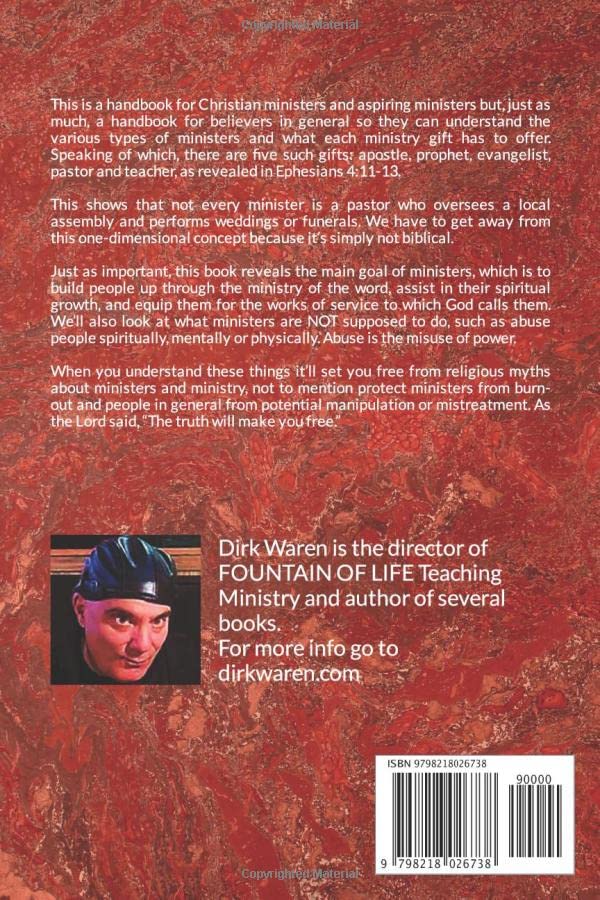
- You can purchase the print book here for only $7.38 (175 pages).
- Or get the Kindle eBook here for only 99¢
Both links allow you to LOOK INSIDE the book.
Related Topics:
Ministerial Abuse — The Diotrephes Spirit vs. the Davidic Spirit
Ministerial Pitfalls and Abuses
Condemnation & Authoritarianism
Legalism — Understanding its Many Forms
Nosiness and Manipulation (NOT Spiritual)
Official Prophets (Ministers) and Independent Prophets (Ministers)
Should Ministers Be Addressed with Titles?
Judging—When SHOULD You Judge and When SHOULDN’T You Judge?
Spiritual Growth — The Four Stages
Spiritual Growth is Like Climbing a Mountain
Can Christians Drink ALCOHOLIC BEVERAGES?
Drinking an alcoholic beverage is not a sin in and of itself. But it can be a sin – or, at least, unwise – for certain people or in certain environments, not to mention anything done without moderation becomes negative by default.
Obviously someone with an alcoholic past must stay away from alcoholic beverages altogether just as a man with a severe lust problem has to stay away from pictures or shows/movies that feature scantily clad females. It’s just common sense: If your flesh has a weakness for something, you wisely avoid anything that would stir it up and lead to a fall.
Yet Christ didn’t completely abstain from alcohol (Matthew 11:19) and Paul instructed Timothy to drink a little wine apparently for health reasons (1 Timothy 5:23). Moreover, the LORD permitted the Hebrews to drink fermented beverages at certain celebrations:
and spend the money for whatever you desire—oxen or sheep or wine or strong drink, whatever your appetite craves. And you shall eat there before the LORD your God and rejoice, you and your household.
Deuteronomy 14:26 (ESV)
This somewhat corresponds to the Messiah’s first miracle — turning water into wine at a wedding celebration, which obviously wasn’t grape juice (John 2:1-11).
Yet “Scripture interprets Scripture” and so these passages need balanced out by others, like these proverbs:
Wine is a mocker, strong drink is a brawler,
and whoever is led astray by them is not wise.
Proverbs 20:1
Do not join those who drink too much wine
or gorge themselves on meat.
Proverbs 23:20
30 Those who linger over wine,
who go to sample bowls of mixed wine.
31 Do not gaze at wine when it is red,
when it sparkles in the cup,
when it goes down smoothly!
32 In the end it bites like a snake
and poisons like a viper.
Proverbs 23:30-32
As you can see, the problem isn’t drinking an alcoholic beverage, but rather drinking “too much,” which is echoed in the New Testament:
Do not get drunk on wine, which leads to debauchery
Ephesians 5:18
So the issue isn’t the alcoholic beverage itself, but rather the individual who loses a proper sense of moderation – self-control – and, instead, becomes controlled by the alcohol, meaning drunk. Why is this wrong or unwise? Because drunkenness naturally “leads to debauchery,” which means decadence, aka immorality; in short, sin. For this reason, there are several warnings against drunkenness in the New Testament:
Let us behave decently, as in the daytime, not in carousing and drunkenness, not in sexual immorality and debauchery, not in dissension and jealousy.
Romans 13:13
But now I am writing you not to associate with anyone who claims to be a brother but is sexually immoral or greedy, an idolater or a verbal abuser, a drunkard or a swindler. With such a man do not even eat.
1 Corinthians 5:11
For those who sleep, sleep at night; and those who get drunk, get drunk at night.
1 Thessalonians 5:7
This explains why drunkenness is listed as a work of the flesh:
The acts of the flesh are obvious: sexual immorality, impurity, and debauchery; 20 idolatry and sorcery; hatred, discord, jealousy, and rage; rivalries, divisions, factions, 21 and envy; drunkenness, orgies, and the like. I warn you, as I did before, that those who practice such things will not inherit the kingdom of God.
Galatians 5:19-21
A similar sobering warning is given here:
Or do you not know that wrongdoers will not inherit the kingdom of God? Do not be deceived: Neither the sexually immoral nor idolaters nor adulterers nor men who have sex with men 10 nor thieves nor the greedy nor drunkards nor slanderers nor swindlers will inherit the kingdom of God. 11 And that is what some of you were. But you were washed, you were sanctified, you were justified in the name of the Lord Jesus Christ and by the Spirit of our God.
1 Corinthians 6:9-11
These passages clearly show that living the lifestyle of a drunkard without care of repentance will keep the individual from inheriting God’s kingdom, which includes those who say they’re Christians (keep in mind that Paul was addressing believers that attended church gatherings in these passages). Put simply, anyone who chooses to live like this without concern of penitence can kiss eternal life goodbye.
Most Christians have probably missed it and gotten drunk on at least one occasion, but they humbly confessed and made things right with the Lord (1 John 1:8-9). There’s a difference between this and those who regularly get drunk as a lifestyle. These types have no intention of giving up their overindulgence in alcohol. They’re what the Bible calls stiff-necked – stubborn about their immoral behavior. These two passages are referring to this kind of person, not to those who miss it, honestly ’fess up, and get back up.
Yet there’s nothing wrong with drinking an alcoholic beverage and stopping, as long as you don’t make a weak brother or sister fall by your actions, which is what Paul was talking about when he said:
Therefore let us stop passing judgment on one another. Instead, make up your mind not to put any stumbling block or obstacle in the way of a brother or sister. 14 I am convinced, being fully persuaded in the Lord Jesus, that nothing is unclean in itself. But if anyone regards something as unclean, then for that person it is unclean. 15 If your brother or sister is distressed because of what you eat, you are no longer acting in love. Do not by your eating destroy someone for whom Christ died. 16 Therefore do not let what you know is good be spoken of as evil. 17 For the kingdom of God is not a matter of eating and drinking, but of righteousness, peace and joy in the Holy Spirit, 18 because anyone who serves Christ in this way is pleasing to God and receives human approval.
19 Let us therefore make every effort to do what leads to peace and to mutual edification. 20 Do not destroy the work of God for the sake of food. All food is clean, but it is wrong for a person to eat anything that causes someone else to stumble. 21 It is better not to eat meat or drink wine or to do anything else that will cause your brother or sister to fall.
22 So whatever you believe about these things keep between yourself and God. Blessed is the one who does not condemn himself by what he approves. 23 But whoever has doubts is condemned if they eat, because their eating is not from faith; and everything that does not come from faith is sin.
Romans 14:13-23
The brother or sister who “falls” due to seeing another believer drink an alcoholic beverage refers to either (1) someone who believes drinking such a beverage is always a sin, even though it’s not, or (2) an ex-alcoholic who could fall back into drunkard-ness upon observing the example of a believer s/he respects.
Since drinking an alcoholic beverage is generally looked down upon in Christian circles, particularly in parts of the USA, I suggest keeping it between yourself & the Lord if you occasionally choose to do so, as instructed in verse 22. In other words, only drink in private – like at home or at a campsite – and only in moderation, not to mention only with likeminded (freed-up, strong) believers. Why risk making a believer with a weak conscience or a weakness for alcohol stumble due to your actions? It’s a matter of selfless love for others, which trumps personal freedom.
I encourage you to read the whole chapter of Romans 14.
To walk free of any sin, addiction or bad habit see this article.
Related Topics:
How to keep BALANCED in every area of Life
Spirituality — How to be Spirit-Controlled Rather than Flesh-Ruled
Libertinism — What’s Wrong with It and How to Walk FREE
Holidays—Which Ones Should Christians Observe or Not Observe?