
Understanding THE RIGHT and THE LEFT from a Biblical Perspective

Solomon was the wisest man on earth in his time (1 Kings 4:29-34) and this explains why God utilized his great knowledge and wisdom in three books of the God-breathed Scriptures. Notice what it says about Solomon when the Queen of Sheba came to visit him:
Now when the queen of Sheba heard about the fame of Solomon concerning the name of the LORD, she came to test him with difficult questions… 3 Solomon answered all her questions; nothing was hidden from the king which he did not explain to her.
1 Kings 10:1,3
The king’s wisdom was renowned and so the Queen came to test him with hard questions and verse 3 shows that “nothing was hidden from the king which he did not explain to her.” “Solomon answered all her questions” and there was literally “nothing” he did not explain to her. Do you think that one of the questions she asked concerned the glaring contrast of human nature revealed in Conservatives and Liberals; that is, Rightwing people and Leftwing folks? Of course she did; after all, this is one of the most common observations of people & societies, modern or ancient.
As such, Solomon made a couple of stark commentaries on Right and Left in the book of Ecclesiastes. Here’s the most notable insight:
The heart of the wise inclines to the right, but the heart of the fool to the left.
Ecclesiastes 10:2
One renowned minister suggested that this insight was based on the fact that, commonly, the right hand is defter than the left. But this verse is not a commentary on right-handedness or left handedness, which is something people are born with and have no control over. The text shows that, generally speaking, those on the Right naturally veer toward wisdom while those on the Left naturally veer toward folly. Thus Conservatives tend to support law & order whereas Liberals incline toward lawlessness & disorder. Please notice I said “tend toward.”
Hence Conservatives have morals & restraint and naturally desire order & tranquility while Liberals are creatures of impulse with a lust for immediate satisfaction. The Leftist mindset is that of an immature, rebellious child who wants it their way or no way at all and as fast as possible. This was true 3000 years ago when King Solomon lived and it’s true today. In other words, the contrasting inclinations of Right and Left are universal to humankind and thus have manifested in societies throughout human history, whether in countries, kingdoms, tribes, clans, families or cliques. Every one of these has Right and Left factions, mild or pronounced, overt or hidden.
Christ took the concept of Right and Left further in his prophecy of the Sheep and Goat Judgment in Matthew 25:31-46 where the “sheep” are separated from the “goats” when the Lord returns to Earth and judges those still alive after the 7-year Tribulation. The “sheep” he puts on his right while the “goats” he puts on the left. The former go to eternal life whereas the latter are cast into the lake of fire to suffer the second death. This shows that Christ is speaking of Right and Left strictly in terms of morality and not in any other way, like Jacob being a Momma’s boy Liberal and Esau being a hairy Rightwinger (more on this momentarily).
It should be stressed that those on the Right can succumb to the flesh and become corrupt, which is clearly observed in Solomon’s other commentary on Right and Left in Ecclesiastes:
Do not be overrighteous, neither be overwise—why destroy yourself? 17 Do not be overwicked and do not be a fool—why die before your time? 18 It is good to grasp the one and not let go of the other. Whoever fears God will avoid all extremes.
Ecclesiastes 7:16-18
To be “overrighteous” or “overwise” refers to legalism whereas being “overwicked” or a “fool” refers to libertinism. The former is far Right and the latter is far Left. You could say that Legalism and libertinism are two sides of the same bad coin. Both are equally corrupt conditions and should be avoided at all costs. As you can see, Solomon puts it thusly in verse 18: “it is good to grasp one and not let go of the other,” which indicates that the truth lies somewhere in between the two. The extremes — far Right and far Left — should be avoided. This can also be observed in the Parable of the Prodigal Son with the prodigal representing libertinism (far Left) and the older son representing legalism (far Right). Go here for insightful details.
The Pharisees & Teachers of the Law that conflicted with Christ during his earthly ministry were legalists and were basically what we would now call Rightwing fascists. In America Today – and Western civilization in general – the problem isn’t Rightwing fascism, but rather Leftwing fascism. You can observe this in many ways: Conservatives being afraid to openly support Christianity or a conservative politician due to the threat of persecution; afraid to say such-and-such is a sin because they might lose their job; taxpayers forced to fund baby-killing & the sales of body parts; wise voices being prohibited at universities and on social media; Liberal leaders in school, government, media & entertainment shoving sexual perversion down the throats of the common people as legitimate lifestyles; etc. In summer 2016 when President Obama gave his absurd executive order to legally permit mentally ill men to use the women’s restroom it was the last straw. Conservatives & Independents in America finally had it with Leftwing fascism — even some Liberals — which paved the way for Trump’s election.
For anyone who argues that Leftwing fascism is an oxymoron, it’s not. Leftwing fascists of course say they’re anti-fascist, but they’re ideology & actions involve dictatorial control and forcible suppression of opposition, which is the definition of fascism. The centralized autocratic government that Far Left fascists bow to may not be an actual nation, but a more ambiguous shadow government or global-oriented cabal or Deep State, which is a dictatorial power. When such forces overtake a nation, as witnessed in modern America (detailed above), Leftwing fascism abounds.
Interestingly, the Rightwing corruption of the religious leaders of Judea in the 1st century provoked John the Baptist & the Messiah to righteous name-calling; some good examples can be read in Matthew 3:7-10 & Matthew 23:13-33. The outrageous Leftwing wickedness in modern America provokes a similar response in disciples of Christ.
For instance, due to Liberal fascism and their constant lies & slander, I sometimes amusingly refer to Liberals as LIEberals. One glaring example of their fallacious ideology is their insistence that Bruce Jenner – now known as Caitlyn Jenner – is a woman, even though he still has male DNA. Anyone who disagrees with their absurd claims and simply shares the truth is persecuted and branded a “bigot,” “misogynist,” “homophobe,” “xenophobe,” “transphobe,” “Islamophobe” and similar clichéd terms.
I also occasionally refer to the Democrat Party as the Demonic-rats, obviously with a wink of amusement. Why? Because they’re clearly Satan’s favorite political party in America in light of the fact that they’re anti-Christ, anti-Christian, pro-thug, anti-cop, pro-lawless, pro-strife, pro-perversion, pro-deviance, pro-baby killing (including letting abortion survivors die on the table), pro-silencing Conservative voices and more. Remember, Christ said that you can easily identify false prophets “by their fruits” (Matthew 7:15-23).
For those who might argue that Christians have no place commenting on politics with much-needed truths or being involved in politics, please. If believers allow political parties like the Demonic-rats to take control of their communities & countries you can kiss goodbye many freedoms and say hello to “hate crimes” for merely preaching/teaching the Scriptures. Don’t be surprised when you can’t purchase a Bible at a local store because it contains “hate speech” (rolling my eyes). Don’t be surprised when your business is shut down for not baking a “gay” cake, refusing to make a gay-pride t-shirt or declining to photograph a homosexual wedding. Don’t be surprised when Liberal Governors and Mayors close down Church assemblies while allowing thugs to Burn/Loot/Murder and keeping abortion clinics & strip joints open.
I should add that, if you’re debating someone, focus on logical reasons & facts that support your argument and not ad hominem tactics. Let the other side be guilty of the opposite. Remember, people resort to ad hominem antics when they’re losing the debate. That said, there’s a time & place for righteous name-calling, albeit infrequent. Sometimes a ‘pattern interruption’ is precisely what is in order and (hopefully) effective in a situation (Proverbs 27:5).
Please no comments on President Trump because it’s irrelevant whether you like him or not. I don’t care what you think about him. I’m politically Independent in the truest sense, à la Joshua 5:13-15. I’m just citing modern examples of the biblical concept of Right and Left.
Don’t Be One-Dimensional About Right and Left
Except for moral issues, please don’t be one-dimensional with your understanding of Right and Left and hence unbalanced. Be careful not to look down on people who don’t fit into the box of what is cliched Right or Left. For instance, Jacob was renamed Israel and became the progenitor of God’s nation on Earth, but he was a Momma’s boy who favored hanging around the tents while his half-brother, Esau, was a hairy manly man who preferred the outdoors and hunting (Genesis 25:27, 27:11 & 27:22-23). In short, Jacob was stereotypically Liberal whereas Esau was stereotypically Rightwing. In the New Testament Christ reveals his loving gentleness at times (Matthew 11:29) — a supposedly Liberal trait — while at other times being a veritable holy terror (Mark 11:15-18). As Solomon said, “It is good to grasp the one and not let go of the other. Whoever fears God will avoid all extremes.”
Related Topics:
SPIRITUAL GROWTH Is Like Climbing a Mountain
The Left’s UNBALANCED VIEW of Christ & Christianity
Understanding the Religion of LIEberalism
(Pseudo) SCIENCE Is the “New God” and Dubious SCIENTISTS Are the “New Gods”
What Are THE BASICS of Christianity?
Is it Ever Okay to Call Someone a FOOL?

Christ said “anyone who says, ‘You fool!’ will be in danger of the fire of hell” (Matthew 5:22). Does this mean a believer can never, ever call someone a fool under any circumstances? Obviously not since the Holy Scriptures written through designated people by the Holy Spirit openly describe certain people as fools (2 Peter 1:21). Here are a few examples:
The fool says in his heart,
“There is no God.”
They are corrupt, their deeds are vile;
there is no one who does good.Psalm 14:1
The fear of the LORD is the beginning of knowledge,
but fools despise wisdom and discipline.
Proverbs 1:7
Whoever conceals hatred with lying lips and spreads slander is a fool.
Proverbs 10:18
As you can see, God’s Word describes a fool — an unwise person — as (1) someone who doesn’t believe in God, (2) is corrupt and vile, (3) despises wisdom & discipline, and (4) hates certain people and spreads slander about them, aka lies, false accusations and untrue stories. For further biblical descriptions of a fool, go here.
Furthermore, Christ Himself boldly called corrupt religious leaders “fools” in Matthew 23:17, not to mention several other names in that chapter. This shows that calling someone a “fool” may be appropriate on occasion.
How do we balance this out with what the Messiah said in Matthew 5:22? Let’s read the full passage:
21 “You have heard that it was said to the people long ago, ‘You shall not murder, and anyone who murders will be subject to judgment.’ 22 But I tell you that anyone who is angry with a brother or sister will be subject to judgment. Again, anyone who says to a brother or sister, ‘Raca,’ is answerable to the court. And anyone who says, ‘You fool!’ will be in danger of the fire of hell.”
Matthew 5:22
“Context is King” is a hermeneutical rule for good reason and the topic of this passage is murder. Christ traces the sin of murder to its source, the heart. In other words, murder begins with an attitude of carnal hostility. Speaking of which, hatred is unjust hostility and it is a work of the flesh, as detailed in Galatians 5:19-23. A good example of carnal hatred is those who lie about others – slander. The Bible says “A lying tongue hates those it hurts” (Proverbs 26:28) thus slanderers hate those they smear with lies.
I specified carnal hatred because not all hatred is of the flesh. For instance, the Bible says “To fear the LORD is to hate evil” (Proverbs 8:13). This explains why Christ boldly called the corrupt religious leaders of Israel “blind fools” in Matthew 23:17. He hated their corruption — their gross hypocrisies — and, as the Scripture says, “open rebuke is better than hidden love” (Proverbs 27:5). We know Jesus never sinned (1 Peter 2:22, Hebrews 4:15 & 2 Corinthians 5:21), so this hatred was spiritual hatred, not carnal hatred.
In light of all this, every believer has to search his/her heart before calling someone a fool or any other name. Make sure you’re led of the Spirit. Make sure what you say is true and not a lie, even if it’s figurative. For instance, John the baptist called the Pharisees and Sadducees “brood of vipers” in Matthew 3:7, meaning “offspring of snakes.” While this wasn’t literally true, it was figuratively correct since snakes & scorpions are biblical figures for the devil (Luke 10:19); as such, John was calling these false religious leaders children of satan, as Christ later did (John 8:44). While this may not have been nice, it was kind and good since both John and Jesus were implementing tough love. Sometimes the best thing you can do for a person who’s arrogant & corrupt — especially those in leadership positions — is openly rebuke them because only the truth can wake them up to their error and set them free.
So make sure your motive is tough love and not carnal hatred before calling someone a fool or any other name, otherwise you’ll be in danger of the fires of Gehenna, as the Messiah said.
Related Topics:
Is Name-Calling Ever Appropriate?
How to Confront & Correct (and How NOT to)
Jesus Christ — Milksop or Mighty Lord?
How to CONFRONT & CORRECT (and How NOT to)

Genuine believers are to be submitted to one another (Ephesians 5:21), which means we’re accountable to each other based on the morality of New Covenant Christianity and the corresponding God-breathed Scriptures (2 Timothy 3:16-17; 1 Corinthians 4:6). The biblical book of wisdom puts it like this: “As iron sharpens iron, so one person sharpens another” (Proverbs 27:17). This principle keeps believers sharp and the best they can be thus “open rebuke is better than hidden love” (Proverbs 27:5).
You can learn a lot about the character of a person by how they respond to a legitimate correction:
8 Do not rebuke mockers [proud fools] or they will hate you;
rebuke the wise and they will love you.
9 Instruct the wise and they will be wiser still;
teach the righteous and they will add to their learning.Proverbs 9:8-9
Of course, no one appreciates a disrespectful correction or an exasperating overreaction, not even wise, godly people. In fact, an arrogant, impulsive rebuke shows that the one doing the correcting has moral issues likely greater than the one he/she is trying to correct. Keep in mind that carnal pride is sin numero uno, a decidedly satanic trait (Ezekiel 28:17; 1 Timothy 3:6; 1 John 2:16).
Humility, by contrast, is thoroughly spiritual and conducive to grace, i.e. God’s favor (James 4:6 & 1 Peter 5:5).
What the Messiah Instructed about Rebuke
What did Christ say about confrontation & potential correction? (I say “potential correction” because the rebuke might not be valid). When a brother or sister in the Lord offends you, here’s what the Lord said to do:
“If your brother or sister sins against you, rebuke them; and if they repent, forgive them. 4 Even if they sin against you seven times in a day and seven times come back to you saying ‘I repent,’ you must forgive them.”
Luke 17:3-4
The Messiah was not talking about a serious crime here, like rape, assault, robbery or the murder of a loved one. If someone commits a crime like this you need to take it to the governing authorities, which are established by God to punish criminals, including the power to execute when appropriate: “they are God’s servants, agents of wrath to bring punishment on the wrongdoer” (Romans 13:1-6).
So Christ was talking about personal offenses, like snubbing, malicious gossip (aka backbiting), insults, lying, minor theft and so forth. It could also be a situation where you observe the individual do something immoral, like committing adultery, lying, slandering or being a drunkard. When fellow believers offend in this manner they should first be confronted & corrected based on the moral truths of the Word of God, then, forgiven if they repent. ‘Forgive’ literally means to “cancel the debt” or “dismiss the charge.” When the offender is stubbornly unrepentant we are not to dismiss the offense. Jesus specified this condition in more detail here:
“If your brother or sister sins, go and point out their fault, just between the two of you. If they listen to you, you have won them over. 16 But if they will not listen, take one or two others along, so that ‘every matter may be established by the testimony of two or three witnesses.’ 17 If they still refuse to listen, tell it to the church; and if they refuse to listen even to the church, treat them as you would a pagan or a tax collector.”
Matthew 18:15-17
When a fellow believer sins against us we’re not to gossip about it to others, but rather go to the offending person in private and share with them what they did to offend. As far as is possible, we should do this with a humble, compassionate spirit, which sometimes might be challenging because the offense in question is so offensive.
If the offender refuses to repent then we are to get one or two spiritual believers and confront the person again. I emphasize spiritual believers because if you enlist a carnal Christian into the scenario it will not help the situation to say the least (I’m talking about someone who says they’re a believer, but regularly produce bad fruit like arrogance, greed, gossip and lying). The inclusion of additional godly people will naturally help make sure the charge is authentic.
If the offender is still impenitent then we’re to tell it to the church in general so that the person is socially pressured to ’fess up and make a turnaround. If the offender continues to be stubborn and unrepentant then we’re to regard him/her as a pagan or tax-collector. A pagan is an unbeliever, which means you stop treating the person as if they were a brother or sister in the Lord because his/her actions have proven otherwise.
You can read details about confrontation & correction here, what we want to focus on in this article is…
Things to Do and NOT do when Confronting & Correcting
- Make sure you have a scriptural basis for your correction since it is the foundation “for instruction, for conviction, for correction, and for training in righteousness” (2 Timothy 3:16-17). If you cannot articulate from the rightly-divided Word of God what’s wrong with the behavior in question then your case is too weak for a confrontation.
- Don’t say “Yay, the Holy Spirit told me to tell you” because (A) it comes off as religious arrogance and (B) you don’t need to say this if your rebuke has a legitimate biblical foundation. Keep in mind that the Scriptures were written by the Holy Spirit thru divinely designated people (2 Peter 1:21) so any moral correction of the Holy Spirit should already be conveyed in the Bible, directly or indirectly.
- Speaking of which, don’t rebuke a person for a moral rule that’s not actually biblical. People who do this are infected by legalism, which is law-ism. It’s a religious obsession with rules, usually unscriptural rules, and the despotic enforcement of them. A couple of good examples would be playing pool or cards. There’s nothing intrinsically evil about these games; they’re neutral activities relevant to healthy R&R (Ecclesiastes 3:4), which of course doesn’t mean you have to like them or play them. If you don’t like them, don’t play them. The real reason legalists denounce these games is because pool is associated with bars & the corresponding drunkenness while card-playing is associated with gambling. In the 2000s I had a pool room in my house, but there was zero drunkenness linked to it. A person can enjoy pool and not be a drunkard. Similarly, people can play card games and not froth at the mouth with greed & corruption. By all means, rebuke drunkard-ness and greedy corruption as led of the Spirit, but not playing pool and card games. Allow the Spirit to minister to individuals about whether or not it’s wise for them to participate in a particular neutral activity.
- Don’t overreact to what you perceive as a moral offense because it might not be a sin at all. Rather, the problem could be over-sensitivity on your part because you’re weak in a certain area (we’re all weak in one area or another). At worst, the behavior in question might just be unwise. For instance, an ex-alcoholic believer sees a brother drinking an alcoholic beverage and assumes he’s a drunkard, thus rebuking him. Yet the confronted brother walks in moderation and isn’t tempted by drunkenness in the slightest. In a case like this, the brother isn’t sinning because drinking a sip of alcohol is not a sin; rather being a drunkard is what is sinful. However, depending on the location, you could exhort him that it’s not wise to drink an alcoholic beverage in public because it could make a brother or sister with a weak conscience stumble. It could also be a bad ‘witness.’ In such cases the believer should “keep it between himself (or herself) and God” (Romans 14:22); in other words, it should wisely be kept private. For biblical insights on the believer’s freedom in relation to dealing with Christians with weak consciences see Romans 14 and 1 Corinthians 8.
- Since your goal is to correct the person, not unnecessarily offend or antagonize him/her, phrase your correction in a respectable manner. This is especially so if the person is your elder, whether physically or spiritually, which corresponds to this passage: “Likewise you younger people, submit yourselves to your elders. Yes, all of you be submissive to one another, and be clothed with humility, for ‘God resists the proud, But gives grace to the humble’ ” (1 Peter 5:5). The fact that someone is more mature than you physically or spiritually does not mean you shouldn’t correct him/her, but it does mean you should apply appropriate respect, particularly if you want the correction to be received (assuming it’s even legitimate). There’s a right way to do something and a wrong way. Even if your intentions are righteous, there’s a wrong way to carry out a correction — like being rash, excessive or disrespectful — which will naturally reduce the chances of it being received. Remember: Your goal is to successfully correct the person. A good example in the Scriptures is when Paul openly corrected the elder apostle Peter (Galatians 2:6-14). The reprimand was received because Paul used wisdom in what he said, how he said it and what he didn’t say (because he didn’t need to say it).
- When you implement the confrontation be open to receiving correction yourself since “iron sharpens iron” (Proverbs 27:17). In fact, it may be you who needs correction more so than the person you’re rebuking. In such situations the Holy Spirit turns the confrontation around on the wannabe rebuker. This is one of the reasons why going directly to the offending person and discussing the issue is so wise and effective.
- Speaking of wannabe rebukers, please don’t be a “gung-ho rebuker.” Confrontation & correction is a positive thing if the reprimand is valid, not to mention the boldness required to do this is commendable. It’s an example of walking in tough love. However, being an annoying faultfinder who’s perpetually “offended” and quick to accuse is not a good thing. For one thing, it smacks of pettiness.Remember, those who make a battle out of everything won’t have the energy for building anything, at least not anything positive.Another problem with constant questionable accusations is that it’s a trait of the Enemy. I’m talking about Satan — the “adversary” or “enemy” — who is also called the devil, which is translated from the Greek diabolos (dee-AB-ol-os), meaning “slanderer.” The term comes from the verb diaballó (dee-ab-AL-loh), meaning “to slander, accuse, defame, complain.” On top of this, the Bible plainly describes Satan as “the accuser of our brothers and sisters, who accuses them before our God day and night” (Revelation 12:10). Moreover, Christ called the devil a “murderer from the beginning” and “the father of lies” (John 8:44). Do you know a (supposed) brother or sister in the Lord — including “ministers” — that continuously faultfind & accuse believers? They’re behaving like Satan, which isn’t a good thing. Either they’re a child of the devil and therefore a counterfeit believer (Matthew 7:15-23; John 8:42-47) or they’re grossly ignorant and misled of the Enemy (2 Timothy 2:24-26).
Make no mistake, honest correction is sometimes necessary; it’s a healthy thing because it keeps believers sharp. Just be sure to follow these seven wise guidelines.
But what if you know confronting a certain person will turn UGLY? In other words, this individual is difficult and tends to bring out the worst in you, so a reprimand on your part will probably result in a nasty mêlée. What does the Bible instruct you to do in such cases? See this article for answers.
This article was taken from chapter 3 of…

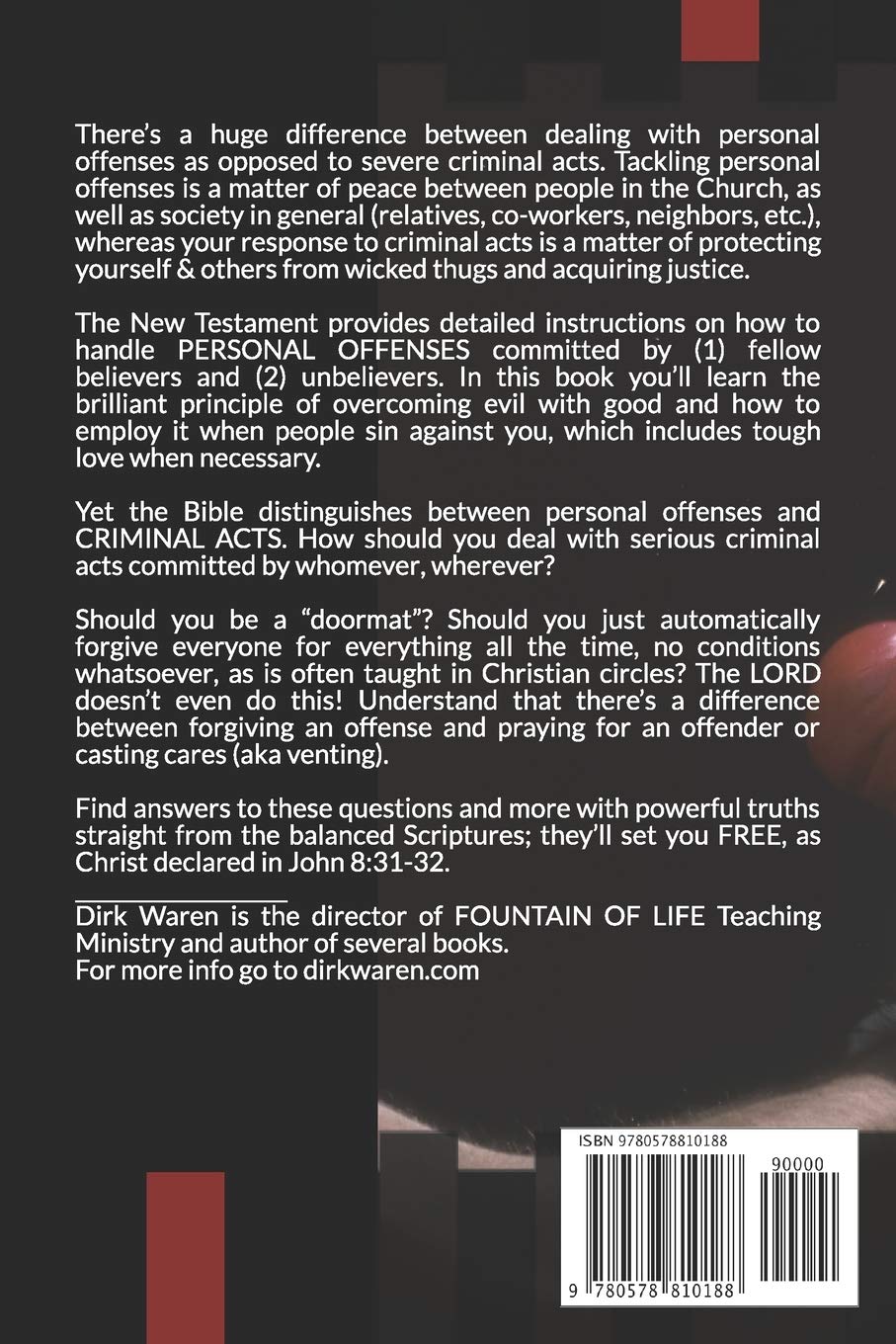
- You can purchase the print book here for only $5.76 (121 pages).
- Or get the Kindle eBook here for only 99¢
Both links allow you to LOOK INSIDE the book.
Related Topics:
Handling Personal Offenses vs. Handling Criminal Acts
Does Walking in AGAPE LOVE Mean You Should Be a DOORMAT to Abuse?
Condemnation & Authoritarianism
Is NAME-CALLING Ever Appropriate?
Forgiveness—Should You Forgive EVERYONE for EVERYTHING ALL of the Time?
Nosiness and Manipulation (NOT Spiritual)
What Are MANDRAKES, as Mentioned in the Bible?

“Mandrakes” are cited in the Bible five times and refer to the roots of mandrake plants, which sometimes resemble naked humans, particularly the lower areas. They were used as an aphrodisiac and to induce pregnancy, as observed in this passage:
1When Rachel saw that she was not bearing Jacob any children, she became jealous of her sister. So she said to Jacob, “Give me children, or I’ll die!”
2Jacob became angry with her and said, “Am I in the place of God, who has kept you from having children?”…
14During wheat harvest, Reuben went out into the fields and found some mandrake plants, which he brought to his mother Leah. Rachel said to Leah, “Please give me some of your son’s mandrakes.”
15But she said to her, “Wasn’t it enough that you took away my husband? Will you take my son’s mandrakes too?”
“Very well,” Rachel said, “he can sleep with you tonight in return for your son’s mandrakes.”
16So when Jacob came in from the fields that evening, Leah went out to meet him. “You must sleep with me,” she said. “I have hired you with my son’s mandrakes.” So he slept with her that night…
22Then God remembered Rachel; he listened to her and enabled her to conceive. 23She became pregnant and gave birth to a son and said, “God has taken away my disgrace.” 24She named him Joseph, and said, “May the Lord add to me another son.”
Genesis 30:1-2,14-16,22-24
Rachel was the favored wife of Jacob, whose name was changed to Israel (Genesis 32:22-32). She wasn’t able to bear children for her husband and so made a bargain with her older homely sister, Leah – also married to Jacob – to allow Leah to sleep with Jacob in exchange for the mandrake plants that Leah’s son had found. The passage doesn’t say that the Mandrake roots actually worked to induce pregnancy, just that “God remembered Rachel” and thus enabled her to conceive her son Joseph. Nevertheless, it’s clear that mandrake roots were thought to augment sex & procreation and were sought after for this purpose.
Mandrakes are also mentioned in Solomon’s overtly erotic Song of Songs (see 7:13).
As noted, Mandrake roots sometimes look like nude bodies, particularly the nether regions. So the fact that they were used as an aphrodisiac and to induce pregnancy would be a natural correlation. Think about it in terms of walnuts, which resemble human brains when cracked open; they’re coincidentally the top nut for brain health, as chronicled here. Similarly, tomatoes resemble the heart when opened up — the “chambers,” etc. — and they’re by happenstance strategic to cardiac health, as detailed here. Is this mere coincidence or did our Creator do this purposely?
The fact that (1) the LORD created mandrake roots, (2) they’re cited in Holy Scripture five times, (3) they resemble the lower regions of naked humans and (4) were used to augment sex & procreation shows that the Almighty is an imaginative Creator, not to mention has a sense of humor.
Do mandrake roots actually “work”? I have no idea, but Rachel obviously believed they did; and belief is faith, which opens the door to the miraculous.
This article is also available in book form in…


- The print book is available here for only $7.26 (171 pages)
- The Kindle eBook is available here for just 99¢!
Both links allow you to LOOK INSIDE the book.
Related Topics:
SPIRITUAL WARFARE — Do You Know What You’re Fighting For?
Faith — What Is It? Why Is It Important? How Does It Grow?
Does the Bible Support MONOGAMY or POLYGAMY?
Provision, MONEY and Prosperity

This article is a balanced biblical look at money & provision. The Bible distinguishes that poverty is a curse and prosperity is a blessing (Deuteronomy 28). Poverty is not having enough to make it while prosperity is the opposite. It’s God’s will to provide for you so that you can effectively fulfill your assignment & call, whatever they may be (Philippians 4:19). The individual has a part to play in this, of course. For instance, you can’t be lazy and prosper (Proverbs 13:14) and we are called to “grow in the grace of giving” (2 Corinthians 8:7, 2 Corinthians 9:6-8 & Luke 6:38); in other words, you can’t be ungenerous and expect financial blessing (Proverbs 11:24-25). God is your helper, not your do-everything-for-you-so-you-don’t-have-to-do-anything-at-all-er (Psalm 54:4).
As far as money goes, Christ emphasized that you cannot serve God and Mammon (Matthew 6:24) while Paul said that the love of money is the root of all kinds of evil (1 Timothy 6:10). Please notice that money itself isn’t evil, but rather the love of money. Nor is money the root of all evil, but rather the root of “all kinds of evil.” For instance, money isn’t the root of sexual immorality, but rather lust. Needless to say, we want to make sure that we’re loving God & serving the LORD and not money. This is a given. But this doesn’t negate the importance of finances/provision in your life. For instance, you can’t help provide for others if you aren’t first provided for yourself. In other words, you can’t bless others materially unless you are first blessed materially.
The Bible has a Lot to Say about Money
Some believers freak out when the topic of money is brought up in a Christian teaching because of hang-ups. Yet the Bible actually has a lot to say on the subject. One in five verses address the issue of wealth one way or another, whether finances, property, possessions, inheritance or otherwise. One third of Christ’s parables address the topic. It’s only right that Christians have a balanced understanding of what the Holy Scriptures say on wealth and provision otherwise we’ll develop an erroneous perspective stemming from the world or religion:
- The world basically teaches that money is god and worships wealth. Thus peoples’ worth is evaluated on how much money & possessions they have. It’s a worldly viewpoint (2 Corinthians 5:16-17).
- Religion – including counterfeit Christianity – teaches two lies: That poverty is godly wherein ministers of certain sects take a vow of poverty or the opposite extreme that Christianity is about being as filthy rich as possible and poor people should be regarded as if they have the plague.
Concerning taking a “vow of poverty,” Deuteronomy 28 makes it clear that poverty is a curse along with other curses, like mental illness, physical sickness & disease, defeat to enemies and premature death. So taking a vow of poverty is as absurd as taking a vow of sickness & disease or a vow of premature death.
As for the other religious lie, that Christianity is all about being as financially prosperous as possible and anyone who isn’t is (supposedly) cursed of God, Christ rebuked the believers at the Laodicean assembly thusly:
You say, ‘I am rich; I have acquired wealth and do not need a thing.’ But you do not realize that you are wretched, pitiful, poor, blind and naked.’
Revelation 3:17
Wow, what a reprimand! This shows that it’s possible for believers to be financially wealthy but thoroughly impoverished in regards to more important things in God’s eyes, which can be observed in the proverb: “better to be poor than a liar” (Proverbs 19:22). Think about what this verse is saying: According to God’s Word, it is better — superior — to be an honest poor person than a financially rich liar.
In regards to the worldly lie that money is god and wealth should be pursued above all else, Christ said that there was no human greater than John the Baptist up to that time (Matthew 11:11), but John dwelled in the lonely desert with clothes made of camel hair, living on locusts and wild honey (Matthew 3:4).
The reason this article is important is because believers overcome this world through faith (1 John 5:4) – which includes overcoming any CURSES the enemy throws at us, like disease, defeat and poverty – and faith comes through hearing what God’s Word says on any given topic (Romans 10:17). We are to fight the good fight of faith to overcome the curses of the enemy (1 Timothy 6:12) and this explains why Christ regularly said things like “According to your faith be it done to you” (Matthew 9:29). Needless to say, it’s important to increase our knowledge and build-up our faith in regard to God’s provision and money in general.
Please don’t stumble over the word “prosperity.” Prosperity is relative to your God-given mission and environment. Joseph, for instance, was a slave in Potiphar’s house and a prisoner in Egypt, but the Bible says he prospered in both environments despite the obvious limitations thereof (Genesis 39:2-6 & 39:20-23). Speaking of which…
Financial Blessing is determined by Season, Calling & Environmental Context
Financial provision is the blessing that tends to upset some Christians, as if they want to fight for their right to be impoverished. While there have been problems with dubious ministers who essentially make Christianity out to be a get-rich-quick scheme or have used the gospel as a means to get rich (1 Timothy 6:9), we shouldn’t throw out God’s conditional promises of financial provision with the proverbial bathwater. Disregarding the false teachings of greed-loving “ministers” (who are as rare as the dodo bird), the problem some believers have with the concept of financial provision begins with an erroneous image of what it means to be financially blessed of God in a fallen world. Moreover, their criticisms do not take into account issues like the season the believer’s in, divine purpose or environmental context. Let’s look at each of these:
An erroneous image of financial blessing in a fallen world
Someone wrote to rebuke me in response to one of our teaching videos where he mistook my references to “living the good life,” which came from the Amplified version of Ephesians 2:10. He evidently envisioned “living the good life” to mean living like Hugh Hefner, as if true prosperity is all about owning a huge mansion and sipping cocktails while lounging at an in-ground pool with myriad half-naked women prancing about, etc. (I’m not saying, by the way, that a believer can’t own a mansion or have an in-ground pool). For one thing, this is a one-dimensional and decidedly worldly image of “prosperity.”
Secondly, the video itself defined the “good life” as being hooked-up with God’s will and fulfilling the objectives the Spirit gives you, whatever they may be, which includes acquiring the resources to carry out these objectives. An objective or purpose like this could be any number of things, including moving to an undeveloped area and ministering (e.g. missionaries). God’s objectives — His courses — for each believer are exciting and good because they’re in line with your Creator’s will who knows you inside & out and therefore how you’re “wired.” Living in accordance with the LORD’s purposes is “the good life,” regardless of what that purpose is. There will be hardships and persecutions, of course, but God knows what you can handle and can’t handle and will provide the grace to get through as you wisely fight the good fight of faith. Watch the video for details.
The Season You’re In
You might be in God’s perfect will and yet the season you’re in will determine your prosperity to an extent. For instance, prosperity at 18 years-of-age is different than prosperity at 65. Consider, again, the example of Joseph, who was a type of Christ: He was unjustly sold into slavery by his jealous brothers when he was 17 and became a slave, and then a prisoner, before eventually living in the palaces of Egypt many years later as second-in-command of the nation (Genesis 41:41-43). This journey entailed about 13 years. When he was a slave in Potiphar’s house the LORD blessed Joseph and he “prospered” in that context, but he was still a slave (Genesis 39:2-6). Obviously, there are limitations to how much you can prosper as a slave. Likewise Joseph “prospered” while an inmate in prison, but he was still a prisoner (39:20-23). You see? The season you are in determines the extent of your prosperity.
Your Divine Purpose
Your God-given calling will also determine the scope of your prosperity. This is similar to the previous one: Joseph was called to be a slave for a season, and then a prisoner, before becoming second-in-command of Egypt. He prospered as a slave and a prisoner, but this divine direction certainly limited his prosperity during those times. Why would God possibly call Joseph to be a slave and prisoner for so many years? Because Joseph was being groomed to be second-in-command of one of the most powerful nations on Earth at the time. The way up is down. People are more apt to be quality leaders if they have personally experienced humiliating circumstances, unjust suffering and corrupt non-leadership.
Your Environmental Context
A brother-in-the-Lord I know came from the more modest sections of Youngstown, Ohio, and as he became increasingly successful his fiancé wanted him to move to a better area before marrying. Yet he insisted that he was called to stay in that community to reach the people there. The LORD heavily put them on his heart. Whether he knew it or not, this corresponded to Paul’s exhortation to the Corinthian believers: Generally speaking, they should remain in the situation they were in when they were called in order to reach the people thereof, as directed by the Holy Spirit (1 Corinthians 7:17-24). After all, who better to reach a group of people than those from that community and culture? This was a general instruction and not an ironclad law. Obviously if a person is led of the Spirit to move outside of such a context then that’s what he or she should do (Galatians 5:18 & Romans 8:14).
The brother who felt led to stay in a modest area of Youngstown would indeed prosper there, but it would be a different expression of prosperity than if he were called to, say, the wealthy side of Hollywood or the jungles of the Amazon. What if your environmental context is a communistic country where the ruling elite ensure that everyone stays at an equally modest level (except for them, of course)?
Obviously, there’s some overlap between the season you’re in, your divine calling and your geographical setting.
In any case, when you grasp these things, it helps set you free of envy and facilitates contentment in your God-given assignment.
What is “Prosperity” Anyway?
This all brings us to the definition of prosperity. What exactly is prosperity for the believer? It’s having enough resources for your needs and righteous desires in order to fulfill your God-given calling, which depends on the season you’re in, your specific assignment and the environment to which you’re called. Righteous desires are, of course, not the same as unrighteous desires, like greed, hedonism and pomposity.
With this understanding, someone could be living below the so-called “poverty threshold” of his or her area/nation and still be prosperous in the Lord. In other words, the secular “poverty threshold” is irrelevant and meaningless to the believer and his/her purpose or call. Simply put, the “poverty threshold” does not exist to the spiritually-regenerated believer in covenant with the Most High God. It does not define your prosperity in the Lord. Are you following? So throw it out.
People who lust after material things for the purpose of being greater than so-and-so (the proverbial Jones) and looking down on others are walking in eye-rolling carnality. Yet there’s nothing wrong with having a spirit-of-excellence and wanting what you have to reflect the glory of God. I Praise the LORD for my neighbors who maintain a great home & yard rather than let things get rundown.
Nor is merely being rich evil, as Abraham, Job, Solomon and David were (or became) quite wealthy.
When Paul instructed the young pastor Timothy on rich people in the congregation he didn’t tell Timothy to rebuke them for being wealthy, he simply exhorted Timothy to tell them not to be arrogant, but to put their hope in God rather than their riches and “to be rich in good deeds and to be generous and willing to share” (1 Timothy 6:17-18). Why did Timothy have to tell them not to be arrogant? Because the attainment of material wealth tends to feed the fleshly ego and tempts people to look down on those with less. This is a form of greed, which Christ blatantly condemned (Luke 12:15); so is putting on airs to impress others. Needless to say, if you’re wealthy don’t let it go to your head. Instead, develop the spirit of a giver; giving is the antidote to greed (Romans 12:8). Yet don’t become arrogant of your giving and look down on those you presume don’t give as much and condemn them as not truly saved or what have you.
Again, it’s not money that’s the root of all kinds of evil, but rather the love of money (1 Timothy 6:10). It’s fine to have money; it’s just not fine for money to have you. Speaking of which…
“Do Not Wear Yourself Out to Get Rich”
When I was in my early 20s I was working for a small company wherein the supervisor suddenly quit and I was offered his job. I was excited because the position offered an impressive salary. I took the job but suddenly found myself running around like a headless chicken and no longer had the time to spend with studying the Scriptures or prayer/meditation, things that were dear to my heart. After a few weeks I went to the remote corner of a dark stockroom and literally wept. I had inadvertently made money my god and was pursuing it at the expense of more important things.
This brings to mind this wise Scripture:
Do not wear yourself out to get rich; be wise enough to restrain yourself.
Proverbs 23:4 (BSB)
This corresponds to what Christ said about how the deceitfulness of wealth — including the obsessive pursuit of it — can “choke the word, making it unfruitful” (Mark 4:19). This is what happened to me on this occasion.
Needless to say, we have to be careful not to fall into the mindset of the world where everything revolves around how much you make and the respect/privileges thereof. The world says that if you make under a certain figure you’re in “poverty” and if you make over a certain figure you’re “prosperous,” but this is irrelevant to true prosperity. Again, the Scriptures say that Joseph was prosperous as a slave in Potiphar’s house and when he was in prison (Genesis 39:2-6) & 39:20-23). Chew on that.
What to do When You are Hit with a Financial Attack
Paul pointed out in Philippians 4:12-13 that he knew what it was like to be in need and also to have plenty; he knew what it was like to be hungry and to be well fed. He also testified to his brushes with financial attack in 2 Corinthians 6:10. So we know Paul went through challenging experiences where physical resources were seriously limited. Yet, in the Philippians passage he shared his secret of being content in any situation, whether living in plenty or in want: He said he could do all things through the Lord Jesus Christ who strengthened him. In other words, he stood in faith. He didn’t give-in to worry or despair in times of need and defeatedly cry “God has forsaken us—we’re not gonna make it!” Likewise, in the Corinthians passage he admitted to having nothing, but countered it with an expression of faith, “yet possessing everything.” Consequently, he always made it through times of lack with a peaceful contentment. He fully understood that blessings come via faith & patience in our covenant, and faith works in love (Hebrews 6:12 & Galatians 5:6). Jehovah Jireh — which literally means “the LORD Provides” — always eventually provided and Paul fulfilled his many God-given missionary assignments.
Late in his life, when Paul was in custody in Caesarea, Governor Felix frequently went to him hoping Paul would offer him a bribe (Acts 24:26). This indicates that even under house arrest Paul was financially blessed since wealthy politicians don’t try to milk people who are impoverished and have no money.
A good example from the life of Christ would be when, out of nowhere, tax collectors required Peter and Jesus to pay the annual Temple tax, which amounted to about $500 each (Matthew 17:24-27). Christ wasn’t taken off guard and, interestingly, didn’t even ask Judas to take the money from their ministry earnings. He had faith that God provides the power to get wealth (Deuteronomy 8:18) and knew precisely where to get the amount they needed by the Spirit. Hence, the LORD provided.
Christ, Job and Paul are our examples. When any of the five general curses of the Law show up in your life, including an attack on your resources, it means you are under satanic attack.
When this happens, the first thing you need to do is determine if the assault is a Self-Inflicted Trial (SIT), a Discipline-Intended Trial (DIT) or a Maturity-Intended Trial (MIT). Here’s an explanation of each:
- SITs are obvious; the result of one’s own folly, like suffering poverty because the individual is lazy and refuses to work (2 Thessalonians 3:10, Proverbs 10:4 & Proverbs 12:11). In such cases the person’s travails are not due to some satanic plot, but simply his/her foolish choices. The answer to SITs is learning wisdom.
- A DIT means the curse is hitting you due to disobedience, whether a sin of commission or a sin of omission. If this is the case, immediately ’fess up and God will dismiss the charge (1 John 1:8-9); then take up your weapons and fight the good fight of faith until the curse departs.
- An MIT means that the curse is striking you for righteousness’ sake and the LORD is allowing the enemy to assault you in order to test your character and, once your character is proven, turn the negative situation around to your good (Romans 8:28). That’s the genius of MITs: God takes something in which the enemy intends to destroy you with—or, at least, hinder you—and ultimately turns it around to your good, making you “strong, firm and steadfast” “after you have suffered for a little while” (1 Peter 5:8-10). Of course, this is providing you fulfill your role by fighting the good fight of faith and enduring. (Remember: the LORD is your “helper,” not your do-everything-for-you-so-you-don’t-have-to-do-anything-at-all-er). This is precisely what happened with Joseph and Job (Genesis 50:20 & Job 42:10).
The reason this data is essential is so that you know with certainty when you’re under satanic attack. After all, what good is the armor & arms of God if you can’t even recognize when you’re being assaulted?
This material is also essential so you don’t mistake a satanic attack for “God’s will.” For instance, a genuine Christian woman was diagnosed with life-threatening cancer and concluded that, whether she lived or died from the cancer, it was God’s will. No, it’s Satan’s will to take out fruit-bearing believers prematurely.
The obvious problem with this woman’s type of fatalistic reasoning is that, if you think something’s God’s will — including a financial attack — you won’t fight it. You’ll accept it and suffer the consequences. But if you recognize something as a satanic attack you’ll fight it tenaciously.
Needless to say, don’t accept any curse of the Law on the mistaken grounds that it’s “God’s will”! If a curse shows up in your life due to your own folly or rebellion, you’re evidently undergoing an SIT or DIT; simply repent and proceed to fight the good fight of faith. The curse will depart as you persevere in faith; the enemy will literally flee from you (James 4:7).
If, however, you’re walking blamelessly before the LORD, keeping with repentance, you’re obviously undergoing an MIT. Don’t embrace the curse as “God’s will.” Tenaciously fight the good fight of faith and don’t give up. The curse will eventually depart and the LORD will turn around the negative situation for your good.
For important details on spiritual warfare — fighting the good fight of faith — see this article.
For scriptural details on God’s provision and “prosperity,” check out this audio sermon, which was designed to increase the believer’s faith in receiving provision (as it is said, “Where God guides, God provides”) just keep in mind the points of this article for scriptural balance; the video conveniently cites all the key passages:
Related Topics:
The Gist on Giving and “Tithing”
GIVING and “TITHING” — What’s the Bible Say?
How to TAKE CAPTIVE Thoughts (Noémas—Mindsets, Ideologies)
ACCOUNTABILITY — the Good, the Bad and the Eye-Rolling

Accountability refers to the fact or condition of being accountable. All believers are ultimately accountable to God and will thus stand before Christ at the Judgment Seat to give an account of what we did in the body, whether good or bad (2 Corinthians 5:10-11). Even unbelievers are accountable to their Creator and will thus undergo the Great White Throne Judgment (Revelation 20:11-15).
In the worldwide Church — regardless of sectarian label — all genuine believers are to be submitted to one another (Ephesians 5:21), which means we’re accountable to each other — young and old, male and female, spiritually mature and immature, minister and congregant. Holding each other accountable is relevant to (1) how we’re living and (2) the accuracy of the doctrines (teachings) we spread (James 3:1). The effectiveness of this corrective principle is explained in the book of Proverbs, “As iron sharpens iron, so one person sharpens another” (Proverbs 27:17).
All Christians — whatever sectarian tag they choose to go by (or not go by) — are to honestly meet at the blueprint for Christianity, God’s Word (2 Timothy 3:16-17 & 1 Corinthians 4:6), regarding all matters of doctrine, practice and morality. We all must be humbly willing to concede to the authority of the God-breathed Scriptures and what they clearly & consistently teach from a New Covenant perspective based on sound hermeneutics. We can all legitimately claim ignorance now and then, but once scriptural revelation is provided we are obligated to make corrections accordingly.
This is true biblical accountability. It’s simple as ABC (and we’ll look at some examples in a moment).
We could end this article here but, as with most topics, there are complexities and…
Some Deeper Questions
What do most Christians automatically think of when they hear the term “accountability”? Likely 1. being part of a local assembly (& the corresponding sect) and 2. submitting to the pastoral staff thereof. This is wonderful, but some questions are naturally raised…
What if you legitimately hold a believer from a different camp accountable for teaching false doctrine and prove your case, but they refuse to change their belief because their sect supports the erroneous teaching in question? Obviously the leaders of this sect will be held accountable by God first and foremost (James 3:1 & Matthew 15:14), but those followers who ignorantly spread the error will also be held responsible to some degree.
What if submitting to a pastor means not fulfilling God’s will or God’s call? For instance, a subordinate pastor in the Midwest was led to leave the assembly where he was serving in order to start a ministry in another city far away. The head pastor didn’t like this and arrogantly told him, “If you leave you’ll come back crawling on your hands and knees.” He actually said this. Should the associate pastor (1) obey this pompous minister who was technically over him or (2) obey the leading of the Spirit? I think the answer is obvious. Thankfully, he did the latter and went on to great fruitbearing service in the Lord.
What if the minister sins or teaches false doctrine and you can prove it? Is the subordinate believer allowed to correct the one in authority, the one “over” him/her? Both questions are also relevant to when one minister is compelled to correct another minister. What if a subordinate minister works for the minister who needs correction? In other words, his/her paycheck depends on good relations with that minister? Wouldn’t this hinder positive accountability? Wouldn’t this potentially compel the subordinate minister to be a weak “yes man” or “yes woman”?
If it turns out an allegation is true, what do you do if the minister stubbornly refuses to acknowledge it and make corrections after a reasonable period of reflection? What if s/he starts to unjustly persecute you? What if the overseer of the minister in question (assuming there is one) takes a hands-off approach, like Eli did with his two wicked sons who were “in the ministry” (1 Samuel 2:12-17, 27-36)? Do you leave the assembly? Do you leave the sect?
Speaking of overseers: Who oversees the pastor and other fivefold ministers? Who oversees the overseer? Who oversees the one who oversees the overseer; in other words, the one at the top of the spiritual pecking order? (Every sect, ministry or assembly has someone at the top). If the answer is God then this shows that official human oversight ends — as far as one person being over another — when an individual reaches the top of the hierarchy in question. A good example in the Bible is the king of a nation (Ecclesiastes 8:3-4).
Of course this wouldn’t discount the accountability detailed above — all believers are accountable to each other based on the truths of the rightly-divided Word of God. Even kings in Israel — who were in a supreme position — were accountable to the Word of God spoken through a Man of God or what have you (e.g. 2 Samuel 12:1-14). Unfortunately, but to be expected, ministers stained by arrogance don’t like to be corrected by those they consider below them (and no doubt those above them as well, just more so with the former), no matter how humbly and respectfully the correction is offered.
What if you’re a fivefold minister — a genuine pastor, teacher, apostle, prophet or evangelist (Ephesians 4:11-13) — and you’re led of the Spirit to start your own ministry? I’m talking about believers who’ve spent years — and, more likely, decades — learning/training in churches & seminaries and the LORD is calling them into a new position in the spirit after much proven service. In such cases, they would be the head of their ministry, much like a business owner is the head of his/her business. If such a minister operates within an official sect — like the Assemblies of God or the Southern Baptists — they would still technically have someone over them, like a regional leader.
However, if the individual in question is an independent minister and not part of a sect, there would be no official human oversight; in other words, no human would be above them in their ministry. But, again, biblical accountability would be applicable — (1) accountability to God and (2) to fellow believers based on the Holy Scriptures, which would include accountability to the minister’s board/inner circle. Nor would being an independent minister discount mentors in his/her life; such mentors simply wouldn’t be “official” overseers appointed by leaders of a particular sect.
Some people reading this might be somewhat sectarian-minded and understandably have difficulty fathoming ministers functioning outside of an official group of Christianity, but people operating independently can be observed even while Christ was ministering on Earth, as witnessed here:
49 “Master,” said John, “we saw someone driving out demons in your name and we tried to stop him, because he is not one of us.”
50 “Do not stop him,” Jesus said, “for whoever is not against you is for you.”
Luke 9:49-50
While Christ’s immature disciples had a problem with this man ministering independently of their group, the Lord did not. For details on the contrast between official ministers and independent ministers see independent minister.
Examples of Believers Holding Fellow Believers Accountable
Let’s consider a couple of examples of biblical accountability applicable to real life: Say you notice a fellow Christian who’s married flirting with a comely woman at work or wherever. This brother may not even go to your assembly, but you can hold him accountable to God’s Word by warning him about adultery and the importance of not doing anything that appears evil to others (1 Thessalonians 5:22).
Or, say someone is sharing false doctrine in your community, even on Facebook or Twitter, you can hold him/her accountable to the sound doctrine of the rightly-divided word of God. This will lead to a Scripture-based dialogue on the topic where correction takes place, even if it turns out to be you who is corrected.
Read that again because it’s important to be open to the possibility that you might be wrong if the person you correct turns out to have fuller knowledge on the topic. I should add that — since few Christians agree on every jot and tittle — it’s important to major in majors and not in minors. When it comes to God’s Word “The main things are the plain things.” It’s just not profitable to quibble over disputable matters (Romans 14:1), not to mention the Bible repeatedly denounces the folly of a quarrelsome spirit (Proverbs 17:14, Proverbs 20:3, 2 Timothy 2:14 & Titus 3:9-11).
Both of these examples are decidedly biblical, as shown in Matthew 18:15-17, Luke 17:3, Galatians 6:1, James 5:19-20 and Proverbs 9:8-9. Please look up these passages and notice that we’re instructed to go to the person and confront him/her in a wise, loving manner, NOT go to others and gossip about the person and their supposed offense, smearing the individual and poisoning people’s minds in the process. Gossiping about fellow Christians who have (supposedly) offended you poisons believers’ minds and separates brothers & sisters in the Lord; in short, it causes division in the Church. This is a great sin in God’s eyes. The first passage from Matthew 18 shows that the matter should only be taken to others — godly believers who aren’t prone to gossip — if it turns out the offender is actually guilty of a sin and s/he is stubbornly impenitent. You can read more about such a scenario here.
Recent Examples of Accountability From My Own Life
Speaking of going to the offender directly and not gossiping, I was fellowshipping with a brother not long ago wherein he adamantly preached about accountability, although his understanding of the topic was shallow and evidently ineffective; let me explain:
During our conversation he condemned a mutual friend & believer, but he was murky about his accusation. The brother he criticized is a musician who regularly releases albums and plays out at various establishments, Christian and secular. Apparently the brother I was speaking with — who plays guitar at a local fellowship — felt this other brother should only play praise & worship music in the context of a local assembly; so he smeared him as a “rebel.” Yet I know this other brother well and he’s no rebel; he’s a humble believer who uses his musical talents to serve the Lord, reach people and make a living. A true rebel would be guilty of practicing an actual sin without repentance.
I searched my heart as to how to properly respond by the Spirit. The man I was conversing with was ten years older than me and he & his wife were hosting my wife & me at their house. In short, it was a delicate situation. Instead of overtly rebuking his open slander and causing a scene I decided to simply speak the opposite of what he said, which was the truth (speaking the truth is always the best antidote to slander). I shared how Carol & I recently saw the man perform at a local restaurant wherein the place was packed and he played several songs with overt Christian lyrics, including one about the return of Christ. We also purchased his newest album. It goes without saying that sharing the truth negated the man’s false accusations and put the kibosh on his gossip/slander.
You might have noticed that the accuser in this scenario was a musician and so was the believer he was falsely accusing. This reveals the obvious motive behind the man’s faultfinding and smear campaign — he was envious of the brother’s success in playing regular paid-gigs and releasing albums. Needless to say, beware of the “little foxes” of envy, jealousy, rivalry and hatred (Song of Solomon 2:15). I include hatred in the list because, when a person actively lies about another and tries to poison people’s minds against him/her, hatred is at play (Proverbs 26:28), which just so happens to be the opposite of God’s character since “God is love” (1 John 4:16).
How does this tie into our topic? Simple: The man was preaching on the importance of accountability and I ironically held him accountable to God’s Word, which blatantly condemns gossip/slander as thoroughly ungodly. This is biblical accountability. We have to get away from this superficial idea that Christian accountability is limited to a pastor correcting a congregant. It can be this, of course, but it’s so much more universal. What if the pastor needs corrected and no official minister/elder in the camp will do it? God will have to raise someone else up who’s willing.
Here’s another point: practically every time I see this man he slips-in some gossip/slander to which I correct in a low-key manner (I keep it subdued because I don’t want an ugly argument to break out for reasons I can’t go into, not to mention I have an aversion toward strife and hold peace dear). For instance, several years ago he adamantly said a minister we both know was gay on the grounds that he was seen in public with an obvious homosexual. I replied, “You mean his brother?” What he didn’t know was that the man’s brother was overtly gay, but lived out of state. Whenever he came to visit they’d go out to eat or to the movies or what have you, which would be a few times a year. It’s what siblings do when they haven’t seen each other for long periods of time. As with the previous example, simply speaking the truth put a quick, peaceful end to his slander.
Unfortunately, he hasn’t learned his lesson even though he plays guitar in a praise & worship band and considers himself a worship leader. No doubt part of the problem is that he’s not seriously in the Word and so the Spirit has little to work with to correct him (John 14:26 & Psalm 119:9). Meanwhile his wife curiously condones his gossip/slander, although she’s otherwise a godly woman. The reason I’m bringing this up is because his assembly obviously isn’t holding him accountable in this important area. Why not? Who knows? It’s likely the pastor has discerned this problem and is interceding in prayer or slipping truths into his sermons, not to mention setting a godly example.
Another thing to consider is that when congregants are generous givers it’s tempting for pastors to take a passive approach to correction for reasons of self-interest (I’m not saying this is right, just that it happens). In the meantime I’m praying that the Spirit would open this brother’s eyes — his wife too — and, if necessary, that the pastor & other spiritually mature believers would teach him or confront him on this issue when applicable. I’ve also decided that the next time I hear him badmouth someone I’m going to humbly advise him to talk to the person about it directly rather than me (and others).
Here’s an example of accountability regarding possible doctrinal error: A minister friend from another state wrote me and told me he disagreed with a point made in the footnotes of one of my books. I considered his erudite evidence and saw that he was correct and so immediately implemented changes in the corresponding articles. Unfortunately I couldn’t change what was printed in the book, but I corrected everything else.
On a more recent occasion, a minister from another continent wrote me to correct what he considered erroneous doctrine in one of our articles. I took the time to hear what he had to say, considered his respectable evidence, and we went back-and-forth for a few days. Finally, he modified his viewpoint based on the scriptural data, saying he agreed.
These are all good examples of accountability — brothers & sisters in the Lord prayerfully & carefully holding one another accountable to the blueprint for Christian doctrine, practice and morality, the Holy Scriptures.
On that note, I encourage believers worldwide from every sect to hold me & my wife and this teaching ministry accountable to God’s Word. If you think we’re in error on a particular topic or — God forbid — walking in sin, by all means, let’s hear it. Don’t be vague, but also don’t be a nosy ninny. If you’re in my local area — northeast Ohio/Western Pennsylvania — I’ll happily meet with you. This open invitation is based on Proverbs 9:8-9 and similar passages noted earlier. While Fountain of Life is an independent ministry we have a board and a circle of believers that we are in daily fellowship with, locally and more distant. We are accountable to one another but, like I said, we are also accountable to our dear brothers & sisters worldwide, whatever tag they choose to go by or not go by.
Accountability Gone Bad
Biblical accountability is a good thing, but Pharisaical religionists tend to morph it into a negative thing where they constantly concoct dubious accusations based on rash (arrogant) judgments and then poison people’s minds against the ones they’re supposedly holding accountable; that is, the ones they’re accusing. They did this with the sinless Messiah (Matthew 11:19), how much more will they do it with flawed people who genuinely follow the Christ?
The problem with constant questionable accusations is that it’s a trait of the Enemy. I’m talking about Satan — the “adversary” or “enemy” — who is also called the devil, which is translated from the Greek diabolos (dee-AB-ol-os), meaning “slanderer.” The term comes from the verb diaballó (dee-ab-AL-loh), meaning “to slander, accuse, defame, complain.” On top of this, the Bible plainly describes Satan as “the accuser of our brothers and sisters, who accuses them before our God day and night” (Revelation 12:10). Moreover, Christ called the devil a “murderer from the beginning” and “the father of lies” (John 8:44).
Do you know a (supposed) brother or sister in the Lord — including “ministers” — that continuously accuse believers (typically behind their backs)? They’re behaving like Satan, which isn’t a good thing. They’re wickedly using their tongue to murder others (Proverbs 25:18 & 12:18). Either they’re a child of the devil and therefore a counterfeit believer (Matthew 7:15-23 & John 8:42-47) or they’re grossly ignorant and misled of the Enemy (2 Timothy 2:24-26).
These are the bad fruits of the devil and the satanic nature, which is the flesh — accusing, slandering, defaming, complaining, lying and murdering. Needless to say, if you know people, groups or organizations that regularly operate in such tactics it tells you everything you need to know — they’re “of the devil” — regardless of what respectable position they might hold in the Church.
A good example in the Scriptures are the false apostles who infiltrated the Corinth church and smeared Paul in an attempt to turn the believers against the human founder of the assembly. Being a humble, godly man, Paul was uncomfortable defending himself against the false accusations, but — led of the Spirit — he had no other choice and so became a “fool” by “boasting” of his credentials and defending his ministry (2 Corinthians 11). Observe what Paul concluded about these slandering, accusatory “apostles”:
13 For such people are false apostles, deceitful workers, masquerading as apostles of Christ. 14 And no wonder, for Satan himself masquerades as an angel of light.
2 Corinthians 11:13-14
When you come across arrogant individuals who feign meekness and regularly accuse, discredit and slander meek, sincere believers it’s a big red flag. As with this case in Corinth, they’re false Christians masquerading in key positions in the church. Don’t buy their lies and don’t allow your mind to be poisoned against innocent brothers & sisters in the Lord. “By their fruit you will recognize them.”
Sectarian “Accountability” That Actually Hinders the Truth
Another kind of accountability gone bad is sectarian “accountability” that, in reality, can hamper the acquisition & spread of truth. Let me explain. Christianity consists of hundreds or thousands of sects/camps/groups/denominations, big and small. Each group has some kind of school of training and a means for ministry ordination & licensing. There’s nothing wrong with being part of such a camp as long as the group in question remains open to biblical correction and endeavors to fulfill the Great Commission, the problem only enters the picture when believers become sectarian-minded, which is factionism, a work of the flesh (Galatians 5:19-21).
Each of these camps have a “statement of faith,” a list of doctrines they consider essential in order to be a member. In other words, the people of every sect agree to agree that certain doctrines — teachings — are true to the Holy Scriptures and requisite to being a Christian. Some of the groups take a harder approach to their list of official doctrines than others, but they all insist that their ministers — their leaders — embrace their core doctrines, whatever these might be.
This is healthy as long as the doctrine in question is actually biblical, that is, true; however, it becomes unhealthy when it’s not. In the latter case, members of the sect agree to believe a doctrine that is false, a lie, and leaders hold their members accountable to the lie, especially those who are ministers or aspire to be ministers. So if you’re a member and discover from the Scriptures that an official doctrine of the sect is false, you’ll be expelled from the group or, at least, expelled from ministering the Word in it.
A good example is the false doctrine that human beings intrinsically possess immortality apart from Christ, otherwise known as the “immortal soul” (also dubbed the “eternal spirit”). Actually the Bible refutes this teaching point blank: 2 Timothy 1:10 plainly reveals that immortality and eternal life are only available through Christ. Immortality is something people are called to apprehend and not something we intrinsically possess apart from Christ, as shown in Romans 2:7. The Scriptures say “Whoever believes in the Son has eternal life, but whoever rejects the Son will not see life, for God’s wrath remains on them” (John 3:36). You can read details here.
How does this tie-in to accountability? Leaders of sects that embrace the immortal soul apart from Christ as an official doctrine hold their ministers accountable to supporting that doctrine. In short, ministers in such camps are forced to embrace error because they’ll be kicked out if they don’t. If they are full-time ministers this means that their “bread & butter” is dependent upon supporting a false doctrine. Thus they are pressured to advocate error. A believer from an Evangelical camp wrote me and said he was convinced that the immortal-soul-apart-from-Christ doctrine was erroneous and that the Bible plainly supported literal everlasting destruction for unrepentant people who suffer the “second death” (Revelation 20:11-15, Matthew 10:28, Hebrews 10:26-27 & Luke 19:27). When he informed the leaders of his assembly he was told that he could stay, but he wouldn’t be allowed to teach in any capacity.
Here’s a personal example regarding a different doctrine: In 2001 I was getting training and seeking credentials with a certain sect. Carol & I went out to lunch with the head elder when the topic of spiritual gifts came up and he said to me, “If you talk on speaking in tongues it’ll be your last sermon.” You see? If a sect adheres to false doctrine — in this case the doctrine of cessationism — the hierarchy will hold you accountable to supporting their official doctrines, even if they’re incorrect. Cessationism is the erroneous belief that speaking in tongues and gifts of the Spirit were done away with once the biblical canon was completed.
While you can certainly hold to cessationism and still be a Christian, it will limit your spiritual walk and service since it discourages believers from receiving the baptism of the Holy Spirit & the benefits thereof, which you can read about here. The Bible teaches us to “eagerly desire” spiritual gifts, as shown in 1 Corinthians 12:1, 31, 14:1, 39, which would include the gift of personal tongues, otherwise known as glossolalia (gloss-ah-LAY-lee-ah). Cessationism encourages believers to do the precise opposite of what the Scriptures plainly instruct — it encourages us to eagerly deny spiritual gifts when God’s Word encourages us to eagerly desire them!
This is accountability gone wrong. It hinders the apprehension & spread of Scriptural truth and perpetuates false doctrine. We’ll look into this more as we progress.
I should add that if you’re a minister and you get a gig to preach at an assembly of a sect separate from your own you should, generally speaking, respect their official doctrines and wisely serve within the parameters thereof. After all, your goal is to minister to the people — feed them, build them up, heal — not cause undue strife (Ephesians 4:11-13). However, if you are led of the Spirit to say something that offers doctrinal correction then, by all means, do so (they might never welcome you back though, lol).
Ministers Being “Examples” to the Flock
This section ties-in to the topic of accountability so be patient and you’ll see why I include it.
A genuine minister I respect preferred small-group assemblies and so criticized pastors of large fellowships on the grounds that it’s impossible to be an example to people you can’t spend quality time with because the assembly is so big. It’s true that fivefold ministers and elders are called to be examples to younger believers, spiritually speaking (1 Peter 5:3, 1 Corinthians 11:1 & 1 Timothy 4:12), but does this mean that spending considerable time with them is the only way to be a good example? If so, how much time does this require? How much privacy is a fivefold minister or elder allowed? Didn’t Paul say strong believers need to keep some things private to prevent those with weak consciences from stumbling? (Romans 14:22). How far do we take this?
I’ve functioned in both small group settings and mega-churches and I’ve seen God work in both. There’s nothing wrong with preferring one over the other, but it’s wrong to condemn the one you don’t favor because (1) a solid scriptural argument can be made for both and (2) the LORD is big enough to minister in either setting, and everything in between. Remember, God is not one-dimensional.
Consider Yeshua, who was a daily example to the 12 disciples & friends who traveled with him for three years, and also to the other 72 disciples to a lesser degree (Luke 10:1,17). Yet how much of an example was he to the thousands who came to see him minister? There’s no way he could regularly spend time with all these people and maintain a tight relationship with the Father and minister effectively; that is, fulfill his calling.
What Christ did was spend quality time with those within his inner circle — particularly Peter, James and John — and they would, in turn, set a similar example with those within their sphere of influence. It’s the domino effect of positive social impact. This is precisely how legitimate pastors of big assemblies set the example for their hundreds or thousands of members, not by having bosom buddy relationships with every congregant which, needless to say, is impossible.
Getting back to the minister’s criticisms, he chastised pastors of huge churches by accusing them of having some sinful practice on the side that they were supposedly hiding. He claimed that this was the real reason they weren’t interested in being examples to the flock. Wow, what an accusation and what a blanket statement. Surely no pastor of a small fellowship would ever do this! (sarcasm). If this were true, then consider the pastor of an assembly I used to go to that had less than 20 attendees: he fell from the ministry after being caught with his hand in the money jar, amongst other fleshly activities. Simply put, to accuse all pastors of huge churches of not setting a proper example and enjoying some wicked sin on the side is ridiculous.
Eye-Rolling Legalistic “Accountability”
This kind of reasoning stems from a legalistic understanding of accountability. It assumes that believers are all a bunch of weak fools just waiting to rush into sin and hypocrisy, even seasoned fivefold ministers. As such, we need to protect our brothers & sisters by snooping around in their houses and nosing into their personal affairs. In fact, this is the main reason we need “accountability partners.” After all, without the watchful eye of some prying elder we’re all doomed to going astray. What a sick mentality.
Sure, there will always be immature believers we need to keep an eye on in a protective sense, particularly those in the fundamental stage of spiritual growth, i.e. STAGE TWO, but we have to be careful that this doesn’t become a form of bondage or authoritarianism. It’s better to give people the freedom to make a mistake and learn from it than to eye them overbearingly like some mother hen. The former fosters independence while the latter cultivates a dependent, immature spirit. We don’t need domineering authoritarians or moronic “accountability partners,” we need gatherings of warriors and warrioresses!
As for those “believers” in our midst who can’t seem to do anything remotely spiritual without someone hovering over them and twisting their arm, isn’t it possible that they’re not believers at all? Perhaps they’re goats in sheep’s clothing, so to speak. Let ’em go! The Church is better off without counterfeits. If they’re truly genuine they’ll come back at some point of their own accord.
This will come as a shock to those with a legalistic understanding of accountability, but there are numerous areas of believers’ lives — including fivefold ministers — that are no one’s business. One obvious example is what a person does in the bathroom. Unless a sin is involved, what I do when I go out with my wife or what I enjoy for recreation is no one’s business but mine, my wife’s and the Lord’s. It’s the same thing with how people choose to make a living, assuming it’s not criminal. Or what vehicle they choose to drive or what style of clothes they wear, assuming they’re not immodest.
We’ll address faultfinding & nosiness further in a moment, let’s first look at…
Submitting to Ministers / Submitting to Each Other
The Bible instructs believers to submit to their spiritual leaders, like pastors & teachers, so that their service will be a joy and not a burden (Hebrews 13:17). Diligent servant-leaders should be honored, especially those who preach & teach (1 Thessalonians 5:12 & 1 Timothy 5:17), but there’s a healthy way to submit to them and an unhealthy way. Furthermore, this doesn’t mean submit in the absolute sense. If your spiritual leader told you to jump off a cliff, should you do it? If he/she encouraged you to engage in sexual immorality, would you do it? If s/he taught blatant false doctrine and demanded you accept it, should you? Obviously not, so there are wise limits to this kind of submission. You can read details here.
Christ is the “Chief Shepherd” in the worldwide Church whereas fivefold ministers are under-shepherds (1 Peter 5:1-5). This shows that ministers are accountable to the Lord (Luke 12:42-48).
I encourage submitting to one another in Christ, as instructed in the New Testament (Ephesians 5:21 & 1 Corinthians 16:15-16). Obviously the most fruitbearing believers would rank at the top of the list, which presumably includes your spiritual leader(s), although not necessarily.
I should specify that by “fruitbearing” I’m talking about bearing fruit of the spirit as opposed to works of the flesh (Galatians 5:19-23 ). The Lord pointed out that you can distinguish a true minister from a false minister by their fruit (Matthew 7:15-23). Do you see a “minister” constantly faultfinding, accusing and slandering other believers? It tells you everything you need to know. I emphasize this so that submitting to ministers, like pastors, isn’t a one-way street, which can lead to abuse.
In short, the minister is accountable to subordinate believers as well as those over him/her in the spiritual pecking order. This is why Paul stressed this by the Spirit — so that pastors & other fivefold ministers don’t become arrogant and unaccountable in their top positions at ministries. Remember, God opposes the proud (James 4:6 & 1 Peter 5:5). This brings up…
Who Oversees the Minister?
While we considered this earlier, let’s go a little deeper. Who oversees the pastor? Usually someone higher up in the pastor’s organization that doesn’t regularly attend the assembly in question, like a regional leader. It may also be pastors from other fellowships in the area who may or may not be part of the minister’s sect. How closely do these people oversee the pastor? How often do they communicate? Not all that closely or often, right?
Furthermore, who oversees those who oversee the pastor? I’m talking about ministers higher up in the chain of authority of the sect in question. My point is that at some juncture in spiritual growth close human oversight becomes minuscule, even irrelevant. Why? Because the believers have matured. They’ve established a relationship with God; they walk in the spirit and not in the flesh; and they’re quick to humbly ‘fess up when they do miss it (1 John 1:8-9 & Matthew 3:8). This is in line with what a pastor friend told me:
My job is to become unnecessary in the life of the believer.
This should be the goal of all ministers — disciple people to the point where they walk with God of their own accord, guided by the Spirit, and have no need of close pastoral oversight. If some ministerial work needs done — like praying for a relative in the hospital or sharing the Word with someone — the disciple doesn’t call the pastor but rather does it himself/herself. Unfortunately, some ministers foster a dependent spirit with their congregants because — consciously or subconsciously — they don’t want to lose them and, in some cases, they enjoy having people dependent on them. This is an unhealthy and unscriptural attitude to say the least.
As noted earlier, not all fivefold ministers are “official” in the sense that they belong to an official sect, some are independent. Independent ministers are just as necessary as “official” ministers, but both can be corrupted. See this article for details.
Independent ministries are usually non-sectarian and don’t function within a specific sect and thus they don’t operate within a delineated authority structure as official ministers do. But this doesn’t negate that independent ministers are accountable since (1) they are accountable to the LORD & the God-breathed Scriptures first and foremost and (2) to the body of Christ at large, which includes their inner circle of believers and mentors. Keep in mind that most effective correction takes place through (1) having a humble, teachable heart that craves greater knowledge and (2) the process of learning. Direct face-to-face correction is secondary. You can read more about this here.
Consider Paul, who left the structure of the Jerusalem church and went off to minister to the Gentiles, as led of the Spirit (Acts 18:6, 26:15-23, Galatians 2:7 & Romans 15:15-16). His three long missionary journeys and the years he was a prisoner, including house arrest where he wrote the four prison epistles, comprised almost two decades of his life. Paul didn’t function within an official authority structure during this time. In fact, he was the top Christian authority in these travels as he preached the message of reconciliation, started assemblies across the landscape and wrote epistles by the Spirit, but this didn’t mean he wasn’t accountable. Again, he was accountable to the LORD and fellow believers in general (all of whom were technically “under” him, by the way).
It’s also important to point out that Paul didn’t view any leader in the Jerusalem church as “God Jr.” (Galatians 2:6 & 2:9). The Mighty Christ is the only head of the worldwide Church, i.e. the spiritually-regenerated “called-out ones” across the globe (Ephesians 1:22 & Colossians 1:18). Was Paul belittling these leaders in these verses of Galatians? No, he was providing balanced perspective by the Spirit so no person or persons in the body of Christ come to be considered infallible and untouchable; rather “Christ is all and in all” (Colossians 3:11 & Romans 10:12).
Actually, Jesus Christ was an independent minister. Yes, he was a Judaic believer who regularly attended synagogue, but he didn’t identify with and operate strictly within the parameters of the various Hebrew factions of the 1st century: Pharisees, Sadducees, Herodians, Essenes, Zealots, etc. Being independent and devoted to God & the Scriptures first and foremost, Christ wasn’t biased based around sectarian allegiances; Christians today shouldn’t either.
John the Baptist was another independent minister. For those not in the know, the New Testament started with John (Luke 16:16). He hailed from the desert wilderness wherein his clothes were made of camel hair and he ate locusts & wild honey (Matthew 3:1-11). Contrary to the claims of some, John didn’t identify with the Essenes (e.g. those at Qumrân) since the differences between John’s message/activities, and those of this sect of Judaism, are as significant as any alleged similarities. Yet this doesn’t mean John didn’t fellowship with them on occasion wherein accountability worked both ways.
The obvious weakness of being an official minister is that you can become a pathetic “yes man” or “yes woman” who’s afraid to call out false doctrines/practices/corruptions within the sect or correct someone who’s over them in the authority chain for fear of losing favor and their position or even being defrocked altogether.
Martin Luther, for example, dared to speak out against a number of his denomination’s unbiblical doctrines & practices and so he lost his job and credentials, was branded a heretic and banished to live in hiding, his books were burned and Pope Adrian VI declared him to be the antichrist. Why did Luther do something so costly? Because he was accountable to the LORD and the Word of God first and foremost (James 3:1).
As he was believed to have said said, “Unless I am convinced by Scripture and plain reason – I do not accept the authority of popes and councils for they have contradicted each other – my conscience is captive to the Word of God… Here I stand, I cannot do otherwise.” Observe that he did not consider himself accountable to popes or councils, but rather to the authority of the LORD and the God-breathed Scriptures (2 Timothy 3:16-17).
Consider these contrasting examples of official leaders in Israel: After King David’s adultery with Bathsheba and his failed attempts to get valiant Uriah to sleep with Bathsheba to cover up his sin, David contacted Israel’s military commander, Joab, and instructed him to put Uriah in the front line where the fighting was fiercest and then have the other soldiers withdraw so Uriah would die in battle. This is murder in an indirect form, but murder nevertheless. Joab should have rejected this wicked order since Uriah was a noble, brave warrior, but he instead chose to be a pathetic “yes man” (2 Samuel 11:14-21). Shortly later, the prophet Nathan refused to be like this. He boldly confronted David’s corruption and spoke the truth, come what may (2 Samuel 12:1-14).
Joab failed to hold the King accountable whereas Nathan did. When you see corruption in the leadership of the body of Christ you can either weakly go along with it, like Joab, or hold the person accountable whatever the cost, like Nathan. If you choose the former you’ll have to answer for it at the Judgment Seat because the Lord will hold you accountable.
The obvious challenge for independent ministers is their lack of an official hierarchy and their potential for creative interpretations of the Scriptures (as if official sects don’t have their share of questionable positions, e.g. “once saved always saved” and the grossly erroneous amillennialism). However, humble submission to the LORD, the rightly-divided Word of God and the body of Christ at large alleviates this issue wherein needed corrections are regularly made.
Of course, being part of a reputable official sect and functioning under a designated chain of authority isn’t a guarantee of proper accountability and righteousness. The pastor I mentioned above who was ousted after he got caught with his hand in the proverbial cookie jar was from the Assemblies of God, which is the last thing from a loose sect. Several members of the congregation and inner circle were members of his extended family and yet he went a long time before being found out, confronted and disciplined (although it’s certainly commendable that this eventually happened). It goes without saying that, if someone wants to practice sin as a lifestyle, they’ll find a way to do it and hide it, whether they operate within an official sect/assembly and the power structure thereof or not.
Also, just because an official sect supports a doctrine, this doesn’t make the teaching true. Moreover, if it is a false doctrine it doesn’t make it okay for ministers in that sect to spread the erroneous teaching, even though it’s advocated by their sect. While their fellow ministers may applaud them, they will be held accountable for false doctrine when they stand before the Lord (James 3:1).
Legalists Are Unreasonably Judgmental FAULTFINDERS
Holding one another accountable is beneficial, but I think it’s necessary to include a warning about faultfinding.
Those who tend to excessively harp on accountability (always in the cliched, simplistic sense) also tend to be hell-bent on picking out people’s flaws and condemning them accordingly. They’re faultfinders, impure and simple, which is a severely fleshly characteristic according to the Scriptures (Jude 1:16 & Romans 15:7). Even worse, they’re often guilty of the very things they criticize in others. This isn’t righteous judging, like Paul’s judgment and public rebuke of Peter’s legalism in Galatians 2:11-14, but hypocritical judging. Notice what Jesus said about this type of judging:
Do not judge, or you too will be judged. 2 For in the same way you judge others, you will be judged, and with the measure you use, it will be measured to you. 3 Why do you look at the speck of sawdust in your brother’s eye and pay no attention to the plank in your own eye? 4 How can you say to your brother, ‘Let me take the speck out of your eye,’ when all the time there is a plank in your own eye? 5 You hypocrite, first take the plank out of your own eye, and then you will see clearly to remove the speck from your brother’s eye.”
Matthew 7:1-5
As you can see, Christ wasn’t denouncing righteous judging, like judging a fellow believer’s bad fruit and offering a corrective word, as when Paul reprimanded Peter, which — by the way — is an example of biblical accountability. Jesus was condemning hypocritical judging, which is criticizing others for things that the criticizer himself (or herself) practices.
It goes without saying that being a grumpy faultfinder is a big red flag. Those preoccupied with faultfinding are either immature believers stuck in STAGE TWO or they’re counterfeit believers actually lost in STAGE ONE. If you’re not familiar with the Four Stages of spiritual growth see this article.
Faultfinders Are at Odds With the True Ministerial Spirit — to Build Up and Give LIFE
The spirit of faultfinding & condemnation is in utter contrast to the true ministerial spirit, which Paul summed up nicely when he spoke of the authority ministers have for building believers up and not tearing them down (2 Corinthians 10:8 & 13:10). He also stressed this in Ephesians 4:11-13 where he detailed the purpose of all fivefold ministers: “to prepare God’s people for works of service, so that the body of Christ may be built up”. In other words, true believers and genuine ministers are to overflow with life, not death. Why? Because we’re children of God and the LORD is the Fountain of Life (Psalm 36:9). This explains Christ’s prime directive: to give people life and life to the full, not death (John 10:10).
You don’t have to be a spiritual Einstein to recognize a wicked spirit of condemnation. Years ago my sister, Jennifer, was looking for a church in Southern California and ended up visiting one for three Sundays in a row, but she decided not to stay. Why? Because after all three services she left feeling beat up and condemned rather than inspired and encouraged. She felt the life sucked out of her rather than put into her. Needless to say, only a glutton for punishment would stay in such an assembly. This isn’t to suggest that there’s no place for denouncing sins and encouraging repentance at services. Skilled ministers who are led of the Spirit will bring about a spirit of repentance through the ministry of the Word, but will also remove the burden of guilt, instill the Lord’s peace and motivate individuals onward. In other words, even though they denounce sin and spur repentance their ministry is encouraging and inspiring. This is the minister’s job.
A good example of such an inspiring spirit can be observed in Jesus after his resurrection. Christ appeared to two of the disciples who were understandably discouraged after his unjust crucifixion. The Messiah met up with them as they were walking along the road and they talked for a bit, but they were prevented from recognizing him. After the Lord departed, the two disciples reflected on the encounter:
“Were not our hearts burning within us while he talked with us on the road and opened the Scriptures to us?”
Luke 24:32
This is the effect Christ-like ministers should have on believers. You know you’re hanging with godly believers when you leave with your heart burning with inspiration and you see things in God’s Word you never saw before.
Luke 24 goes on to show us what Christ did on the day he ascended, which was weeks later: “he lifted up his hands and blessed them. While he was blessing them, he left them and was taken up into heaven” (verses 50-51). The point? Even as Jesus was leaving this Earth he was blessing people — it was the last thing he did before going to the Father! This is how Christ-like ministers should be — constantly blessing people and building them up, not frothing at the mouth with constant vague accusations, condemning and tearing down.
So accountability is a positive thing when it is scriptural — very much so — but be on your guard against legalistic forms of “accountability.”
Closing Thoughts
“Iron sharpens iron” (Proverbs 27:17) and “many advisers bring success” (Proverbs 15:22) with the greatest advisor being the Holy Spirit (John 14:26-28, 16:13 & 1 John 2:27). Believers are to submit to the LORD & each other and therefore are accountable to one another based on the truths of the Word of God (Ephesians 5:21).
But, to be balanced, here’s an important axiom to consider: All people are flawed and have a downside, even the best of us — even the greatest minister or hero you can name (Psalm 130:3-4, Ecclesiastes 7:20, Proverbs 20:9 & 1 John 1:8). A big time minister said he has hanged with the top international ministers you can cite and he said, without exception, they were all flawed and had a downside, one way or another. As such, it makes best sense to have as few people over you as possible in your endeavors, particularly as you mature. This is the Conservative perspective wherein government should be small and limited whereas the LIEberal perspective is that government should be huge with endless (useless) bureaucrats.
In any ministry or business there’s a head with a vision, along with the corresponding inner circle/board. If you can’t agree with the head’s vision then you should leave, otherwise there will be di-vision. I’m not talking about condoning sin or gross error. If you see either you obviously should confront the individual as led of the Spirit, keeping in mind that there’s always a profitable and unprofitable way to do this.
The New Testament encourages believers to humbly submit to the heads of the ministry they’re involved with (Hebrews 13:17) and honor diligent servant-leaders (1 Thessalonians 5:12-13) “so that their work will be a joy, not a burden.” If you can’t do this, or can no longer do this, then please leave and go somewhere that you can agree with the vision or — if led of the Spirit — start your own work, like Paul was led to conduct his own ministry to the Gentiles, covered earlier. In the latter event you’ll be the head of your ministry, but you’ll still be accountable to (1) the LORD & the God-breathed Scriptures and (2) the worldwide body of Christ based on biblical truth.
Ultimately, every believer will give account at the Judgment Seat:
10 For we must all appear before the judgment seat of Christ, so that each of us may receive what is due us for the things done while in the body, whether good or bad.
11 Since, then, we know what it is to fear the Lord, we try to persuade others. What we are is plain to God, and I hope it is also plain to your conscience.
2 Corinthians 5:10-11
This article is also a chapter in…

- You can purchase the print book here for only $7.38 (175 pages).
- Or get the Kindle eBook here for only 99¢
Both links allow you to LOOK INSIDE the book.
Related Topics:
How to CONFRONT & CORRECT (and How NOT to)
Forgiveness—Should You Forgive EVERYONE for EVERYTHING ALL of the Time?
Why You should Always FORGIVE When the Offender Is Repentant
Understanding the FEAR OF THE LORD

The “fear of the LORD” isn’t talked about much in Christian circles today, including sermons. Why? Likely because the Mighty LORD has been essentially reduced to a cuddly teddy bear in the sky or perhaps a genial genie. The idea that the Almighty Sovereign God — the Creator of all things in Heaven, Earth & the Universe — is to be feared, respected and awed seems to be unhip. But what does the Bible say about the fear of the LORD, both Old and New Testaments? After all, the Holy Scriptures are God’s blueprint for authentic doctrine (teaching) and practice (2 Timothy 3:16-17 & 1 Corinthians 4:6).
Let’s start with the fact that the fear of the LORD is foundational in a person’s life. Foundational to what? See for yourself:
The fear of the LORD is the beginning of knowledge, but fools despise wisdom and discipline.
Proverbs 1:7
The fear of the LORD is the beginning of wisdom; all who follow his precepts have good understanding. To him belongs eternal praise.
Psalm 111:10
The fear of the LORD is the beginning of wisdom, and knowledge of the Holy One is understanding.
Proverbs 9:10
These verses show the close connection of knowledge, understanding and wisdom. Knowledge, of course, is factual information, whether mundane or spiritual, while understanding has to do with comprehension. It’s possible to know something, including trivia, but not really understand it. Meanwhile wisdom is the application of what you know and understand. Many people know & understand certain important things, but they fail to live it or live in light of it, which means they lack wisdom.
Observe what these passages say is the beginning of all three – the fear of the LORD. If the fear of the LORD is the beginning of knowledge, understanding and wisdom then a person who seeks to attain these without the fear of the LORD is off track right from the start! Consequently, the conclusions they’ll come to in their journey of enlightenment will be off. We see this today with all these highly intelligent and “educated” people who are trying to reinvent morality: What is bad is now good and what is good is bad (Isaiah 5:20). Their journey has brought them to a place of twisted understanding because they failed to start with the fear of the LORD, which is acknowledging the Creator and respecting God.
Someone might argue that the “fear of the LORD” is an outmoded Old Testament principle, but Christ himself said we are to fear God:
“Do not be afraid of those who kill the body but cannot kill the soul. Rather, be afraid of the One who can destroy both soul and body in hell.”
Matthew 10:28
Want more proof? Revelation 19:5 depicts a scene in heaven that the apostle John saw in a vision. In this scene a voice comes from God’s throne saying: “Praise our God, all you his servants, you who fear him, both great and small!” Furthermore, after Ananias and Sapphira were slain by the LORD for their unrepentant lying “great fear seized the whole church and all who heard about these events” (Acts 5:5,11). Great fear of whom? God!
When Paul noted that all believers will have to stand before Jesus Christ and give an account of our lives at the Judgment Seat he followed it up with “since, then, we know what it is to fear the Lord” (2 Corinthians 5:10-11). Why do we fear the Lord? Because we’re going to stand before Christ and give an account of our lives for what we did in the body, whether good or bad. Of course, any deeds repented of beforehand will not be evaluated because God forgave you when you ‘fessed up and “purified you from all unrighteousness” (1 John 1:8-9). Those sins were cast into the sea of forgetfulness (Micah 7:19). Isn’t that awesome?
The type of fear Paul was talking about — led of the Holy Spirit — was obviously fear of being held accountable to something negative. In other words, fear of punishment (Proverbs 16:6, 3:7 & 8:13). This is the most elemental kind of fear, which compels people to stay on the straight and narrow. For instance, someone might not believe in God, but he won’t commit murder because he fears going to prison for decades or the death penalty. A married man might find a woman sexually alluring, but he refuses to commit adultery because he doesn’t want to ruin his family and life. Of course the Lord wants us to grow past fear of punishment on our spiritual journey and be motivated by love of God led of the Holy Spirit (1 John 4:16-18 & Romans 8:14). This naturally comes with spiritual growth.
So the fear of the LORD is the beginning of knowledge, understanding and wisdom, and it’s not just an Old Testament principle, but what exactly is the fear of the LORD? Since fear is another word for reverence and worship this suggests that knowledge and wisdom begin when we properly acknowledge God and offer our Creator the reverence and adoration due. The writer of Hebrews put it like this:
Therefore, since we are receiving a kingdom that cannot be shaken, let us be thankful, and so worship God acceptably with reverence and awe, for our “God is a consuming Fire.”
Hebrews 12:28-29
There’s also the respectful fear that a son has toward the just correction and discipline of his loving father. It’s a healthy respect for authority, in God’s case the ultimate authority.
A key trait of the fear of the LORD is, of course, humility, the attitude that we’re not all that and a bag of chips, which brings to mind a simple yet potent passage:
God opposes the proud but gives grace [favor] to the humble.
James 4:6; 1 Peter 5:5 & Proverbs 3:34
This is quoted three times in the bible, once in the Old Testament and twice in the New. Do ya think God’s trying to get something across to us? Of course! The passage says that God “opposes” the proud, which means the LORD resists them. Those who are arrogant resist God and the Lord, in turn, resists them. They resist, God resists. It’s a doomed cycle.
The good news, of course, is that the LORD gives grace to the humble, the meek, not the weak. This means his favor! God says:
“This is the one I esteem: he who is humble and contrite in spirit, and trembles at my word.”
Isaiah 66:2
God’s favor, blessing and enlightenment only flow to the humble who genuinely acknowledge their Creator, not the arrogant who are stubborn, hard-hearted and think they know it all. The latter includes religious leaders, like the Pharisees and teachers of the law, who put on airs that they knew and honored God when nothing could’ve been further from the truth. The Pharisees, for instance, claimed to be God’s children but the Messiah told them point blank that they were children of the devil (John 8:41-47)! Don’t think that such religious leaders only existed in Christ’s day. They’re all over today, just open your eyes; they even go by the tag ‘Christian’ and say “Lord, Lord” (Matthew 7:15-23).
What can we conclude from all this? If we want freedom we have to want truth, which means the way it really is. Why? Because truth is the very thing we need to set us free, as Jesus taught (John 8:31-32). Truth consists of knowledge, understanding and wisdom from God’s Word and the foundation of these is the fear of the LORD.
Needless to say, let’s be wise sons & daughters of God and cultivate a healthy reverence and awe of the Holy One. Always strive for humility, which is the opposite of stubbornness and arrogance. If you do this, God’s favor will surely flow to you. But please understand that persecutions will increase (2 Timothy 3:12). Higher levels, bigger devils.
Related Topics:
Does God Reserve All Judgment UNTIL the End of the Age
Jesus Christ — Milksop or Mighty Lord?
Judgment Seat of Christ (the Judgment of Believers)
Why the BREASTPLATE OF RIGHTEOUSNESS Is So Vital

Do you feel you’re too sinful to serve God? Do you struggle with a sense of unworthiness that hinders your communion with the Lord (that is, your prayer life)? Do you think you’re too unrighteous to fulfill God’s call on your life? The LORD has provided a piece of spiritual armor to set you FREE and empower you to serve effectively; it’s the breastplate of righteousness (Ephesians 6:14).
This vital piece of armor refers to accepting the gift of righteousness the LORD has provided you in Christ (Romans 5:17) and living out of your new nature — your spirit — because it was born righteous when you accepted the gospel and underwent spiritual regeneration (2 Corinthians 5:21; Titus 3:5). This is your “new self, which was created to be like God in true righteousness” (Ephesians 4:22-24). As you learn to walk according to this new nature with the help and guidance of the Holy Spirit you’ll naturally walk in practical righteousness. So putting on your breastplate of righteousness is one-and-the-same as walking in the spirit (Galatians 5:16).
Of course, as a human being with a flesh, you’ll inevitably sin; this includes the more common sins like envy, jealousy, rivalry, hatred, gossip, lying, greed or lust. Those who have their “breastplate” on will humbly ’fess up and receive God’s forgiveness when they miss it, which “purifies you from all unrighteousness” (1 John 1:8-9). Doing this is “keeping with repentance” (Matthew & Luke 3:8). The repentance/forgiveness dynamic is essential to spiritual growth because it ensures God’s grace continually flowing in your life and your ongoing progress. It keeps your spiritual arteries clear of the clog-up of unconfessed sin. *
* Incredibly, there’s this widespread false teaching amongst Evangelicals today which suggests that believers never have to repent of anything, ever. Gee, Christ must have been walking in gross error when he instructed the Ephesian Christians to repent in Revelation 2:5 (sarcasm).
A Roman soldier’s breastplate guarded his heart and other vital organs. Just so, the breastplate of righteousness guards your figurative heart — your mind — and prevents it from being corrupted by things that would eventually destroy you, including oppressive guilt and a destructive sense of unworthiness (Proverbs 4:23).
Endeavor to live out of your new nature, which was “created to be like God in true righteousness.” The Bible calls this “participating in the divine nature” (2 Peter 1:4). Cultivate a pliable, humble heart that’s quick & willing to ’fess up if you succumb to the corrupt desires of the old nature. God is faithful to (1) dismiss the sin and (2) “purify you from all unrighteousness.” Guard your heart as the wellspring of life by regularly rooting-out negative, destructive thoughts & desires (Proverbs 4:23).
For important details, this sermon explains what the breastplate of righteousness is, why you need it and how to put it on; it’s easy (all Scripture passages are cited in the video for your convenience):
Related Topics:
How to Walk FREE OF THE FLESH by being Spirit-Controlled
Spiritual Growth — The Four Stages
What Are THE BASICS of Christianity?
How to OVERCOME LUST

Sexual lust concerns out-of-control preoccupation in deed or thought with porn, fornication, adultery, sexual fantasy, as well as deviant practices, like homosexuality, pedophilia and bestiality.
If you’re not a believer in Christ, the first step to freedom from lust is turning to the LORD in repentance & faith (Acts 20:21 & Romans 10:9-10) wherein you’ll receive spiritual regeneration (John 3:3-6; Titus 3:5). This means you’ll acquire the spiritual software necessary to overcome any sin bondage, not to mention the help of the indwelling Spirit.
If you’re a believer and you’re struggling with sexual lust, you’re not alone; many other Christians do too. I did at one time as well. The awesome news is that there’s freedom in Christ for everyone in bondage to lust, whatever its form! The sin of lust is similar to any other life-dominating flesh bondage — like alcoholism, drug abuse, out-of-control gambling, greed, hatred, fits of rage, gossip/slander, and so on — in that the antidote revealed in the Holy Scriptures is the same: The Bible offers a simple 3-point strategy on how to walk free from any sin, including a severe lust problem, wherein you tackle the issue on three fronts (1) mental, (2), physical and (3) spiritual. This proven 3-point strategy is detailed in this article.
Here’s a video version of the plan:
Related Topics:
SPIRITUAL GROWTH Is Like Climbing a Mountain
The Seven Keys to SPIRITUAL GROWTH
Spiritual Growth — The Four Stages
Beauty, Objectification and Lust