
FAITH — What Is It? Why Is It Important? How Does It Grow?

There are six basic doctrines in Christianity and Faith in God is the second one, which indicates that it’s a foundational element of Christianity. Why? Here’s why:
And without faith it is impossible to please God, because anyone who comes to him must believe that he exists and that he rewards those who earnestly seek him.
Hebrews 11:6
Faith is so important because it’s impossible to please God without it. What exactly is faith?
What Is Faith?
Faith is belief, but not in the sense of believing in fairy tales or casual mental assent. It is belief based on:
- what is intrinsically obvious,
- accurate knowledge, whether scientific, spiritual or otherwise,
- genuine revelation by the Holy Spirit,
- or some combination of these three.
Let’s consider examples of the first three. Regarding #1, someone may say that they believe in the concept of God as Creator because it’s obvious that the earth, universe and all living creatures were intelligently designed. Or someone may believe homosexuality is intrinsically wrong because the design and function of the sexual organs is obvious (tab ‘A’ fits into slot ‘B’). In each case the person believes based on what is clearly palpable. Concerning #2, people may believe they have a brain even though they’ve never seen it because medical science has proven it through dissecting human remains, brain surgery, etc. So the person believes based on sound data. Regarding #3, some may turn to God because the Holy Spirit revealed reality to them and they believed it. Their belief is based on the enlightenment of the Holy Spirit.
The Bible calls faith the substance of things hoped for and being certain of what we do not see (Hebrews 11:1). The Amplified Bible amplifies the original Greek text:
Now faith is the assurance (the confirmation, the title deed) of the things [we] hope for, being the proof of things [we] do not see and the conviction of their reality [faith perceiving as real fact what is not revealed to the senses].
Hebrews 11:1 (Amplified)
Faith is the “title deed” of the things we hope for; that is, the things we righteously desire. In short, faith is the substance that brings the world of hope or desire into reality!
In the Gospels, for instance, people would come to Jesus hoping for healing and after receiving it the Lord would say something like “Your faith has healed you” (see, for example, Mark 5:25-34). Faith was the substance that brought them what they hoped for, healing. They were certain—convinced—that the power of Christ would provide the healing they needed even though they couldn’t yet see it physically.
Faith for Salvation & Eternal Life
I trust you’re seeing why faith is necessary to receive God’s gracious gift of reconciliation and eternal life. After all, how can someone receive a gift from someone s/he doesn’t even believes exists? For example, if you said you had a gift for me and I responded by saying I can’t receive it because I don’t believe you exist, would you still force the gift on me? Of course you wouldn’t. More likely, you’d be irked at my stupidity and arrogance. The same principle applies to those who reject the gospel. When you come across people who do this, be sure to pray that the LORD open their eyes to the truth, i.e. reality.
Did you ever wonder why faith is so important to receiving salvation? Because faith is nothing more or less than believing God. That’s precisely what Adam & Eve failed to do when they were tested in the Garden of Eden and that’s why they fell (see Genesis 2:15-3:24). In other words, the fall of humanity came about due to unbelief and therefore humanity’s restoration is dependent upon belief.
Everyone Has Faith, but Not Necessarily Faith in God
In a sense, every human soul has faith, which explains why we’re incurably religious as a species. Even those who claim to not believe in God develop belief systems and institutions that have all the earmarks of what is generally perceived as “religion.” *
* For instance, secular humanism — essentially one-in-the-same as Far Left “liberalism” (aka LIEberalism) — has its own cosmology, its own miracles (e.g. the idea that everything originally sprang from nothing, which conflicts with the scientific axiom of biogenesis — that life only proceeds from life), its own beliefs in the supernatural, its own “churches” (public schools & universities), its own “high priests” (godless professors & teachers), its own “saints” (corrupt politicians and thugs), its own rites, its own sacrifices (e.g. abortion & infanticide), its own godless worldview and its own explanation of the existence of the Universe and life itself (the big bang theory and the theory of evolution). While this may be generally true, it shouldn’t be misinterpreted to mean that all professors, public school teachers, scientists, judges, etc. are godless Left-wing LIEberals because that’s not the case.
Belief in God is simply a part of our make-up; it’s in our spiritual DNA. Heck, creation itself inspires belief in a Creator; more than that, creation screams out God’s existence (Psalm 19:1-4 & Romans 1:18-20). To suggest that everything in the universe came about through accident and that there’s no Intelligent Designer is like expecting a Boeing 747 to emerge out of a metal scrapyard after millions of years. It’s absurd.
Unfortunately, as Paul put it, unbelievers “are darkened in their understanding and separated from the life of God because of the ignorance that is in them due to the hardening of their hearts” (Ephesians 4:18). In other words, they have faith in God but they’ve willingly hardened their hearts to it, consciously or subconsciously. Why? For a number of reasons, such as not wanting to give up some pet sin, but often simply because that’s how their godless culture brainwashed them and they choose to run with the pack rather than go against the flow and face the negative repercussions thereof. And so they deny obvious reality.
Hardening their hearts to their intrinsic faith in God, they redirect their faith to something else, like a godless government party and the politicians thereof; or the idea that humans originated from apes even though there’s zero evidence of a “missing link”; and so on.
Repentance and Faith
It’s interesting that repentance and faith are the first two basic doctrines of Christianity (of the six) because these are the conditions to receiving God’s gift of eternal salvation:
I have declared to both Jews and Greeks that they must turn to God in repentance and have faith in our Lord Jesus.
Acts 20:21
We effectively “turn to God” via the gospel through repentance and faith.
‘Repentance’ inexplicably has a negative connotation in modern times because people misinterpret it to mean that God is trying to prevent them from having a “good time.” But sin can only bring a “good time” superficially because underneath the surface pleasure is misery and death for “the wages of sin is death.” This is an axiom.
Take, for instance, the “party” lifestyle. When I was a teen I did drugs and drank frequently. It became a lifestyle and it was difficult for me to imagine life without constant “partying.” After several years I wisely quit. This was before I became a believer. In essence, I repented because repentance is simply the resolve — the mental decision — to change for the positive, along with the corresponding action. Why did I quit? Because, although the “party” lifestyle delivered a quick fix to escape reality and have a “good time,” they couldn’t deliver the goods in the long term. Instead they brought hangovers, depression, broken relationships and bondage.
What spurred my change-for-the-positive, that is, my repentance? I saw the obvious truth, believed it, and changed accordingly. The same principle applies to receiving God’s grace of salvation through the gospel of Christ. We see the truth, believe it, and change accordingly. Repentance is the mental resolve to change for the positive in accordance with God’s will and the corresponding action.
Repentance and Faith Are Not Works
This shows that repentance and faith are not works, but rather the natural reaction to realizing the truth, which is simply the way it really is. It’s the wise response to seeing the truth.
Here’s an illustration: Say a man sincerely believes that 2 + 2 = 5. This is a false belief whether he believes it’s true or not. So I go to him with four stones and plainly illustrate that 2 stones plus the other 2 stones equals four stones, not five. He clearly observes the truth — the way it really is — and therefore believes and hence changes his mind. He now believes that 2 + 2 = 4, which is the truth, reality.
You see? Repentance and faith are not works, but simply the natural response to being exposed to the truth. Only a blind, indoctrinated fool would see the truth — the way it really is — and reject it in favor of his/her incorrect belief.
Everything in the New Covenant Is by Faith
Our covenant (contract, agreement) with God is a covenant of faith and so everything in our covenant is by faith. Do you want eternal salvation? It’s by faith. Healing? It’s by faith. Intimacy with God? Faith. Answers to prayer? Faith. Power to overcome? Faith. Grace to fulfill God’s will? Faith.
In light of this I find it perplexing when I come across Christians who are “anti-faith” because it’s a total oxymoron, sorta like naming a fellowship “Faith Baptist Church.” (That’s a joke). They defend their position on the grounds that there have been some extremists in the faith movement, but every movement in the body of Christ inspired by the Holy Spirit has its lunatic fringe. You don’t throw the baby out with the bathwater!
Faith and Perseverance (Patience)
One thing about faith needs to be stressed: Faith must be combined with perseverance — that is, patient endurance — or what you’re hoping for will not come to pass. This is why the Bible says:
We do not want you to become lazy, but to imitate those who through faith and patience inherit what has been promised.
Hebrews 6:12
This is just common sense. After all, faith isn’t really faith if you give up. It might be temporary, fleeting belief or mental assent, but it’s not the faith that can withstand the time of testing, which includes the wait before the manifestation (Luke 8:13). Even salvation can be lost if one doesn’t persevere in the faith, as shown in this passage
Once you were alienated from God and were enemies in your minds because of your evil behavior. 22 But now he has reconciled you by Christ’s physical body through death to present you holy in his sight, without blemish and free from accusation — 23 if you continue in your faith, established and firm, and do not move from the hope held out in the gospel.
Colossians 1:21-23
We have eternal security in Christ. The Lord said so and it’s 100% true (John 10:27-30). But eternal security is not the same as unconditional eternal security because reconciliation with God and eternal life are the result of faith in the message of Christ, the gospel. In other words, if it takes faith to be saved, a person who doesn’t persevere and thus gives up on faith is no longer saved. I’m not talking about someone experiencing doubts, but rather giving up on faith in Christ altogether. It’s the difference between stumbling and utterly falling away in outright rebellion (Hebrews 6:4-9). All believers struggle & stumble in their spiritual journey, especially when we’re immature; only faithless rebels fall away. You can read important details here.
Faith IN GOD
Someone might argue that the second basic doctrine of Christianity is technically “faith in God” (Hebrews 6:1-2) and therefore only refers to believing the LORD personally. Yes, it refers to believing the LORD personally, but faith in God also includes believing whatever the LORD has created that testifies to His existence or will.
For instance, all creation is a physical testimony to the existence of the Almighty and therefore inspires faith (belief) in the Creator. One of the reasons I was an agnostic and not a strict atheist before I accepted the message of Christ is because the earth & universe and all living things cried out that there was an Intelligent Designer (Psalm 19:1-4 & Romans 1:18-20). I simply wasn’t stupid enough to be an atheist, keeping in mind that true atheists stubbornly say they know there is no Creator with almost zero doubt. This, by the way, shows that they have faith, just not faith in God.
Consider also the testimony of God’s amazing Word: The Lord is truth and His Word is truth and therefore His Word testifies to His existence (John 14:6 & 17:17).
Faith in God, Not Faith in Faith
The doctrine of faith in God shows that our faith is the result of knowing the LORD — which means the result of relationship — as well as knowing God’s word & promises. So it’s faith in God, not faith in faith.
In other words, the power in biblical faith stems from its object — God. Genuine faith must have an object and that object is the character of the Almighty Creator. It’s not something in our flesh that makes faith work, but rather the character of God combined with the faith that spring from our reborn spirit and the indwelling Holy Spirit (Titus 3:5 & 1 Corinthians 6:19). Faith (belief) is simply the natural response to God, his Word and his creation. This prevents faith from becoming a human work and gives all the glory of our faith exploits to the LORD.
A couple of quick examples from the Bible: Abraham’s trust in the faithfulness of God to fulfill the promise of Abraham becoming a “father of many nations” when he was well past age, not to mention Sarah being barren up to that point (Hebrews 11:11), and Paul’s Christ-confidence as opposed to self-confidence (Philippians 4:13). The object of faith in both cases was the LORD and this explains Christ’s instructions “Have faith in God” (Mark 11:22) and “believe in God; believe also in me” (John 14:1). Are you following?
This is an encouragement to go deeper in your relationship with the Lord and to grow in the knowledge of God’s Word and the promises thereof (2 Peter 3:18), as well as the promises the Holy Spirit gives to you personally. See this video for more insights.
How Does Faith Grow?
The starting point for every believer is faith because our covenant with God is a covenant of faith. ‘Covenant’ means “an agreement or pact having complete terms determined by the initiating party, which are also affirmed by the one entering the agreement.” A good English word for covenant is contract. All Christians have a contract with Father God through Christ by the Holy Spirit. This is the New Covenant or New Testament. Everything we receive in our agreement with the LORD is by faith because “without faith it is impossible to please God, because anyone who comes to him must believe that he exists and that he rewards those who earnestly seek him” (Hebrews 11:6).
The Bible says that every believer has a “measure of faith” otherwise they wouldn’t be a believer (Romans 12:3). It’s a done deal — “God has distributed” the measure of faith to everyone who’s a believer. It’s a gift from God (Ephesians 2:8-9) and every believer starts with the same measure.
However, it’s clear from the Scriptures that faith can grow. For instance, Jesus noted the “little faith” of his disciples on occasion (Luke 12:28 & Matthew 14:28–31), which shows that they could’ve had more faith. In 2 Thessalonians 1:3 Paul observed that the faith of the Thessalonian believers was “growing more and more” and in 2 Corinthians 10:15 he clearly expected the Corinthians’ faith to “continue to grow.” Your faith can likewise increase, but it’s dependent on YOU adding the seven qualities relayed in 2 Peter 1:5-7 — goodness, knowledge, self-control, perseverance, godliness, mutual (Christian) affection and love. They’re all important, but adding knowledge — the Word of God — is chief for developing faith on any given issue, like faith for healing or faith for answered prayer (Romans 10:17).
You’ll note that there are seven virtues. This is fitting since the number 7 is identified with something being “finished” or “complete” in the Bible. Thus, if you are diligent to add these seven qualities to your walk you will be complete as a man or woman of God. Praise the Lord! You can read more here.
Related Topics:
Should You Get the Surgery or BELIEVE FOR HEALING?
If Healing Comes by Faith, Why Use Anointing Oil, Handkerchiefs, etc.?
GRACE — What Is God’s Grace? How Do You Receive It? How Do You Grow In It?
What Is the SPIRIT OF THE WORLD?

What is the “spirit of this world” noted in the Bible? Let’s read the verse:
What we have received is not the spirit of the world, but the Spirit who is from God, so that we may understand what God has freely given us.
1 Corinthians 2:12
A relevant passage that comes to mind is the opening verses of Ephesians 2:
As for you, you were dead in your transgressions and sins, 2 in which you used to live when you followed the ways of this world and of the ruler of the kingdom of the air, the spirit who is now at work in those who are disobedient. 3 All of us also lived among them at one time, gratifying the cravings of our flesh and following its desires and thoughts. Like the rest, we were by nature deserving of wrath.
Ephesians 2:1-3
The same Greek word for “world” in 1 Corinthians 2:12 is also used in Ephesians 2:2. “The ruler of the air, the spirit who in now at work in those who are disobedient” would be satan and, by extension, his filthy spirits. Those who walk according to the spirit of this world regularly manifest the works of the flesh, which is the sinful nature or satanic nature (Galatians 5:19-21).
For instance, the word ‘devil’ means “slanderer” and satan is described in Scripture as “the accuser (slanderer) of the brethren” and “the father of lies” (Revelation 12:10; John 8:44). As such, those who live according to the spirit of this world function in this manner – slandering people and lying. The more they live like this, the more they are living according to the spirit of this world. A good example is the highly dubious accusers of Supreme Court appointee Brett Kavanaugh that the Democrats manifested from thin air at the 11th hour in late 2018.
True believers didn’t receive that spirit, but rather the spirit of God, the Holy Spirit, not to mention our human spirit was reborn via the Holy Spirit (John 3:3,6; Titus 3:5). Genuine believers thus produce the fruit of the spirit rather than the works of the flesh (Galatians 5:22-23). When we miss it, we’re humble and quick to repent (1 John 1:8-9) whereas those who are false — those who function according to the spirit of this world — are stubborn and unrepentant; and will hate anyone who dares correct his/her fleshly works (Proverbs 9:7-9). Christ said we can recognize the true from the false by their fruits (Matthew 7:15-23).
Related Topics:
Satan (the Devil) — Liar, Slanderer, Thief, Murderer
Spirituality — How to be Spirit-Controlled Rather than Flesh-Ruled
Why Gossip & Slander are so EVIL
Evil Spirits (Demons) — What Are They? What’s Their Purpose?
Demonic Spirits — How to Deflect Them
LEGALISM — Understanding Its Many Forms

I ran into someone on the internet the other day and he denounced Christianity on the grounds that it had “hypocritical teachings” and its followers were “enslaved to rules.” He also referred to God as an “invisible sky daddy.”
These are fairly typical criticisms of Christianity but it’s ironic that not one of them is legitimate. All three criticisms refer to legalism, which is counterfeit Christianity. It’s easy for people to mistake the counterfeit for the genuine because the counterfeit looks like the genuine. Just as a counterfeit $50 bill looks like the real thing so someone thoroughly infected by legalism looks like a genuine Christian. You can only tell the difference upon close inspection, as long as you know for what to look.
Let’s consider this man’s three criticisms in light of what the Bible actually teaches:
As far as “hypocritical teachings” go, ‘hypocrisy’ literally means to put on an act. I explained to the man that the Bible outright denounces hypocrisy (1 Peter 2:1) and blatantly states that God’s wisdom is “WITHOUT HYPOCRISY” (James 3:17 NKJV). This guy might have run into some professing believers who were hypocrites, but this doesn’t mean that Christianity itself is hypocritical or that it advocates hypocrisy. How foolish to discount all Christianity simply because of a bad experience with some people who propose to be Christians. It’s throwing the baby out with the bathwater.
Concerning his criticism that believers are “enslaved to rules,” I told him I didn’t know what version of Christianity he was exposed to but it certainly wasn’t REAL Christianity because authentic Christianity outright denies enslavement to religious rules, as seen here:
It is for freedom that Christ has set us free. Stand firm, then, and do not let yourselves be burdened again by a yoke of Slavery.
Galatians 5:1
The “yoke of slavery” Paul was referring to was the YOKE OF RELIGIOUS LAW, which—in this case—included the Old Testament Torah and its hundreds of laws, like circumcision, as well as traditional fasts and observing various holy-days.* While Paul adamantly declared elsewhere that the Law was “holy, righteous and good” (Romans 7:12) it was actually a yoke of slavery if the Law was pursued as a means of reconciliation with God and the all-and-end-all of faith. What then was the purpose of the Law? To prove the need of a Savior. In fact, the Law pointed to the Savior (John 5:39). New Testament believers are set free from the yoke of slavery to the Law through spiritual regeneration, which is made available through the Good News of Christ.
* Circumcision was an issue as confirmed by Galatians 2:3 and 5:2-3 whereas the others are addressed in 4:10.
To all intents and purposes, there are only two laws in Christianity with three applications: Love God and love people as you love yourself. When believers fulfill these two simple laws, they automatically fulfill all the moral law (Matthew 22:36-40). All believers have to do is learn to put off the “old self” and put on the “new self,” meaning live out of their new spiritual nature and not the flesh. This enables them to be “like God” and walk in “true righteousness” (Ephesians 4:22-24). Do you find this incredulous? Keep reading.
I then explained to the man that what he referred to as “enslavement to rules” was actually legal-ism, because legalism focuses on religious rules rather than what Christianity is really about. Christianity is not a set of rules, like every religion on Earth, but rather a dynamic relationship with the Creator of the universe through spiritual rebirth. True believers aren’t “enslaved to rules” like prune-faced religionists because we simply live according to our new nature, which is who we ARE. Remember, the gospel literally means “good news.” Why? Because Jesus Christ came to give us ABUNDANT LIFE (John 10:10), not enslave us to some system of rules. Like the world needs another impotent religion with its dos and don’ts!
As for the man’s final criticism, that God was an “invisible sky daddy,” this is also a misconception that can be attributed to legalism. I explained that the LORD isn’t only in Heaven; he’s everywhere because he’s omnipresent. More than that, he’s within me, just as he’s in all believers (Luke 17:21). Legalists, on the other hand, can’t handle this concept because their entire focus is on the outward forms of Christianity, not its heart. As such, God is “out there” somewhere far away, like some big cop in the sky and we might be able to reach Him but only if we conform to the lifeless drudgery of the religious grind, whatever that might be.
It’s so sad that this is how many unbelievers picture Christianity because it’s simply not true. It’s even sadder when professing Christians have this perception. It’s a picture of legalism, not real Christianity; an image that’s often seen in the popular media. Practically anytime a Christian-type character is featured in a mainstream movie or TV show it’s either a sourpuss religionist, like the “Church Lady,” or an uninspiring milksop. How often do you see someone as dynamic, bold and inspiring as Jesus Christ, Paul, Peter or John? Rarely.
Is it any wonder that a man I was talking to recently argued that Christianity weakens people and instills fear. He likened God and the devil to forest monsters in fairy tales that Christian leaders use to control and limit people through fear. Such a view may reflect some legalistic groups who propose to be Christian, but it’s not supported by the Bible in the least. If Christianity weakens people why did Christ give the Holy Spirit to empower us (Acts 1:8)? Why did Paul say we haven’t been given a spirit of fear, but a spirit of power (2 Timothy 1:7)? Why did Jesus say he came to give us “life to the full” (John 10:10)? If Christianity uses the devil to instill fear why did Jesus give authority to believers “to trample on snakes and scorpions”, which are types of the devil and demons, and “to overcome all the power of the enemy” (Luke 10:19)? He even added, “nothing will harm you.” If Christianity teaches that believers are to have a negative fear of God why does the Bible say “God is love…There is no fear in love. But perfect love drives out fear” (1 John 4:16,18)? The only fear believers are encouraged to have is a healthy, reverent fear of God because it’s the “beginning of wisdom” and protects us from foolish paths (Psalm 111:10).
It’s stunning how deceived people are about Christianity, all because they confuse it with the counterfeit—legalism.
What Is Legalism?
Legalism has always been a major threat to genuine Christianity. What exactly is legalism? It’s the belief and practice that eternal salvation can be attained through obedience to religious law or good works. That’s the common definition. Most Christians think legalism is limited to this meaning, but they’re wrong. Its broader definition has to do with its root word legal, which of course refers to law or rules. Legal-ism could just as well be called law-ism or rule-ism. It’s an obsession with moral or religious laws and therefore legalists primarily judge others based on strict adherence to the rules they deem important, many of them being unbiblical. Furthermore, legal-ism emphasizes the letter of the law rather than its spirit.
You could say that legalism is the mentality that godliness is an outward job. As such, legalists focus on the outer at the expense of the inner. A person’s outward façade is more important than the inward reality. For instance, as long as an individual goes to every church service throughout the week, and all that goes with that—wearing the “right” dress clothes, carrying the Bible, saying “Amen” at the appropriate moment, putting something in the offering, seeking the favor of the pastor, etc.—it’s okay to be a malicious, lying, envious, arrogant, abusive, sexually immoral, gossiping, slanderous, drunken, chattering fool the rest of the time (not that any one person would likely be all these things). Simply put, legalism is religious hypocrisy. It’s putting on an act. It’s fake Christianity.
Let me stress here that there’s nothing wrong with going to genuine church gatherings and everything that might go along with it just noted; the problem is the attitude of legalism, the mindset that faith is a mere garnishment when nothing could be further from the truth. Such an attitude is not only unbiblical, it’s corrupting, and it’ll slowly corrupt anyone who succumbs to it.
As we shall see, legalism takes on many forms, but each form grows from the same root: religion without relationship and rules above the Savior.
Contrasting Legalism and Real Christianity
Legalism regularly goes unnoticed because most Christians only perceive it according to the first definition above—focusing on something other than the grace offered in the gospel to attain salvation or have a right-relationship with God. They fail to grasp its broader definition, which is rooted in the word legal-ism. To better understand this wider definition, let’s compare legalism with legitimate Christianity; the contrast is glaring:
Legalism is externally imposed human religion, which attempts to change a person—or measure their worth—from the outward in. It’s a spirit that’s obsessed with putting on airs of godliness without the heart of godliness. ‘Godliness,’ by the way, literally means to be like God, which is encouraged in the New Testament; see, for example, Ephesians 5:1 and 1 Peter 4:11.
Biblical Christianity, by contrast, is internally birthed reality, which transforms a person and measures their worth from the inside out.
Put more simply, legalism is man’s way and true Christianity is God’s way. Legalism is religion and religion is the human attempt to connect with God through works, whereas Christianity is God connecting with humanity and giving us the gift of righteousness through spiritual rebirth in Christ. The religious person attempts to produce good works in order to please God whereas the believer has a relationship with God through spiritual regeneration, which naturally produces fruit and works.
I’ve heard it put this way: Religion says “do” while Jesus says “done;” religion says “slave” while Jesus says “son” (or “daughter”).
The distinction between these two is as great as the difference between death and life! You see, legalism is essentially a spirit of dead religiosity. The best it can do is create robotic sheeple or sourpuss totalitarians, whereas true Christianity sets free and produces unique people filled with the life of the Lord!
Let that sink in, it’s important: Legitimate Christianity sets people free and produces unique, empowered individuals whereas the best legalism can do is morph people into religious automatons or joyless authoritarians.
Furthermore, Christianity is beautiful in its simplicity: Love God and love people as you love yourself; learn to put off the flesh and walk in the spirit and you’ll produce the fruit of the spirit. That’s Christianity in a nutshell. Legalism, by contrast, is a tangled web of religiosity, a muddy quagmire that bogs you down and slowly takes your life.
This sterile religious spirit is no respecter of persons or church/ministry lines; it’s a threat to every Christian, small or great, regardless of sectarian boundaries. Every believer and every ministry will be threatened by legalism at varying points in their spiritual journey so it’s important to be able to recognize its many faces or defining characteristics. That’s the purpose of this article, to unmask legalism, and set the captives free.
Legalism at the Time of Christ and Early Church
The Pharisees were the conservative religious leaders at the time of Christ, but they were notorious legalists. In fact, they’re the quintessential example of legalism in the Bible, along with the Teachers of the Law. As such, Pharisaical behavior is synonymous with legalism. Saying someone is Pharisaical is the same as saying he or she is a rigid legalist.
Unsurprisingly, Jesus conflicted with the Pharisees on numerous occasions, even to the point of calling them names like “sons of hell,” “blind fools,” “hypocrites” (fakes) and “snakes”! We’ll observe these examples and more as we progress.
Paul the apostle also encountered legalists and knew how to recognize them because he used to be one. Notice how he refers to legalists in this passage:
Beware of the dogs, beware of the evil workers, beware of those who mutilate the flesh! 3For it is we who are the circumcision, who worship in the Spirit of God and boast in Christ Jesus and have no confidence in the flesh
Philippians 3:2-3 (NRSV)
Paul was warning the Philippian believers of legalists who taught that non-Jews had to be physically circumcised in order to be truly saved; they were obsessed with it. Notice that Paul doesn’t mince words here. He blatantly calls these legalists “dogs” and “evil workers”!
Calling someone a “dog” was even more offensive in biblical times than it is today. The term referred to people of low moral character.*
* For instance, “dogs” is used in the Bible in reference to homosexual prostitutes (Deuteronomy 23:18), wicked betrayers (Psalm 59:5-6), corrupt leaders (Isaiah 56:10), heathen (Matthew 15:26-27) and, in this passage, staunch legalists.
And how would you like to be called an “evil worker”? That’s pretty harsh, don’t you agree? This is recorded in God’s Word to show that legalism is utter wickedness in the LORD’s eyes. It cannot be tolerated; it must be confronted, exposed and corrected; and genuine believers should be warned for their protection.
About a decade earlier Paul had to deal with similar legalists who were trying to corrupt the churches in Galatia, that is, modern central Turkey. Paul called the Galatian believers “bewitched” for tolerating these legalists and allowing them to corrupt the Galatian churches (Galatians 3:1). Notice what he says about the legalists:
If anybody is preaching to you a gospel other than what you accepted, let him be eternally condemned!
Galatians 1:9
This “different gospel” (Galatians 1:6) was propagated by the Judaizers, a group of Jews who insisted that believers must observe Jewish laws & traditions in addition to the grace of the gospel to attain salvation, like the practice of circumcision. But physical circumcision is unnecessary in the New Covenant because believers are circumcised inwardly through spiritual regeneration (Romans 2:29 & Titus 3:5). Notice in the above passage what Paul adamantly said concerning anyone who preached this different gospel: “let him be eternally condemned!” You know what this means in plain English? “Let him go to hell!”
Yes, as unbelievable as it may seem, Paul, the greatest figure of Christianity after Jesus Christ, was emphatic that those who unrepentantly preached a different gospel—a “gospel” that soiled the body of Christ with legalism—should go to hell!
As you can see, legalism is a grievous sin in God’s eyes and cannot be tolerated, whether in myself, yourself or others. It must be recognized, corrected and purged ASAP.
As noted earlier, legalism is no respecter of persons, denominations or ministries; it can infect anyone anywhere—small or great—regardless of sectarian boundaries.
Levels of Infection
Of course, there are levels of infection and not everyone tainted by legalism is a modern-day Pharisee frothing at the mouth with iniquitous religiosity. In other words: While legalism is counterfeit Christianity—and therefore bogus—it’s possible for a genuine believer who is ignorant of legalism to be partially infected by this spiritual disease. Such a person may indeed be an authentic believer, but his/her legalistic qualities are decidedly counterfeit. Are you with me?
Naturally, those infected by legalism will typically degenerate, some to the point where God will literally pull the plug on them, that is, if they’re even believers in the first place. For instance, the Pharisees claimed that God was their father but Jesus squarely told them that the devil was their true spiritual father (John 8:41-44). They were dyed-in-the-wool legalists, you see, but they were blind to it because legalism by its very nature creates a spirit of religious arrogance. In fact, the very thing they claimed (being God’s children) was actually the opposite. They were totally deceived.
To be expected, this degenerative tendency of legalism works in a generational sense as well. In other words, the spiritual children of legalists will often be corrupted to an even greater degree than their spiritual parents, which explains Jesus’ declaration to the legalists of the 1st century:
“Woe to you, teachers of the law and Pharisees, you hypocrites! You travel over land and sea to win a single convert, and when he becomes one, you make him twice as much a son of hell as you are.”
Matthew 23:15
The spiritual children of these legalists were twice as bad as they were!
The Hideous “Beast” and Its Four Limbs
In my experience I’ve observed five basic strains of legalism—general legalism and four offshoots or pillars. Picture legalism as a hideous beast with four limbs, like so:
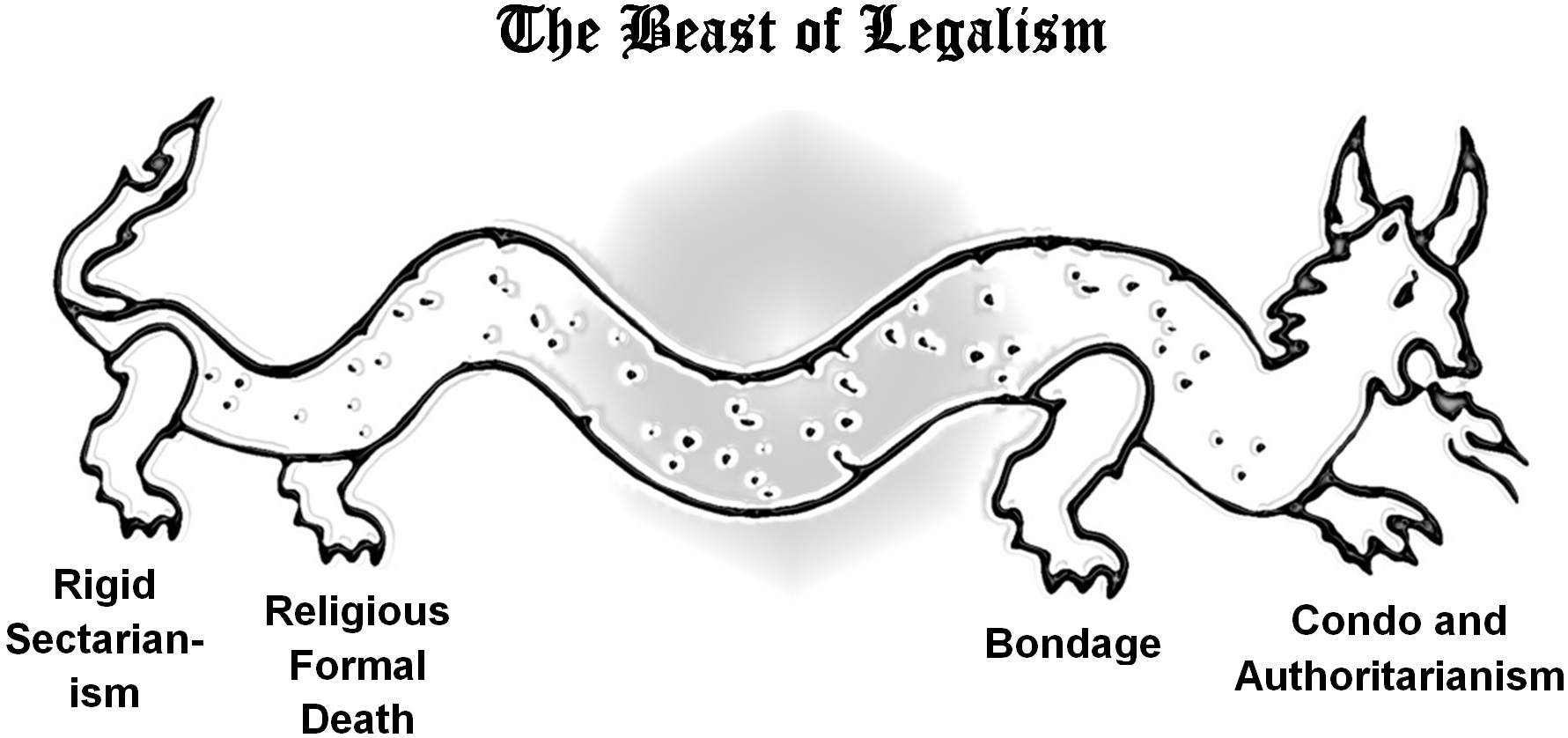
Ugly, ain’t he? He’s supposed to be. Legalism is a hideous beast!
Since legalism is a colossal beast, separating it into these five categories—general legalism and four limbs—makes it easier to understand and digest. It also helps in strategizing to purge it since you’ll be able to identify the specific form of legalism with which you’re dealing. This is important because you cannot confront and defeat an enemy unless you first recognize the enemy.
As you go through these various character traits of legalism the first thing you’ll want to do is examine yourself to see if you are missing it in any of these areas, which I regularly do myself. This is in accordance with Paul’s instruction to the Corinthian believers:
Examine yourselves to see whether you are in the faith; test yourselves. Do you not realize that Christ Jesus is in you—unless, of course, you fail the test?
2 Corinthians 13:5
Regular self-examination is necessary in order to insure that you are freed-up from any flesh issues, in this case legalism or dead religiosity. This is imperative because you can only help others to the degree that you yourself are freed-up, which Jesus illustrated in Matthew 7:3-5. After all, how can you set others free if you’re not free yourself? It’s just common sense.
The second thing you should do is see if you can identify legalistic qualities in other believers, particularly those who claim to be leaders since they have the most influence, especially those who teach and preach. Before anyone says that this is somehow unChrist-like, remember Jesus himself said that counterfeits can be identified by their fruits (Matthew 7:15-23), which means it’s necessary to examine the fruit of fellow believers, in particular those who claim to speak for God.
When you identify legalistic qualities in other believers be sure to do your part to help set them free. How so? This is covered in detail in Chapter 9 of Legalism Unmasked, but here’s a brief plan of action:
Start with prayer. Intercede for them that God may open their eyes and deliver them. Pray in the spirit for them, which is a powerful spiritual weapon (Ephesians 6:18). You should also find a way to correct from the Scriptures in an indirect sense; as well as set an example of the abundant freedom, life, joy and power true Christianity offers, which you do through your words, attitude and lifestyle. Confront and correct as you have opportunity and are led of the Spirit, as gently as possible (Proverbs 27:5 & 25:15).
If, after a reasonable amount of time, you see no positive change then you may have to take a sterner approach, like Jesus did with the Pharisees and Teachers of the Law. If you fail to see repentance, leave them, for they have proven themselves to be counterfeits and this is exactly what Jesus said to do (Matthew 15:12-14). But keep them in prayer and be open to reconciliation since there’s always the possibility that they might come to their senses and repent. If they do, be sure to warmly receive them. Christianity isn’t some powerless religion or philosophy; it’s all about a real relationship with God and the real positive change that springs from it.
Let’s now unmask legalism by focusing on legalism in general—an overall description of this spiritual disease and its numerous telltale characteristics…
General Legalism
General legalism is one-and-the-same as Pharisaical-ism. It’s the emphasis on external forms of religiosity. In other words, legalists are hell-bent on outward appearances or putting on airs. And I mean “hell-bent” literally.
Notice what Jesus said to this effect:
“Woe to you, teachers of the law and Pharisees, you hypocrites! You are like whitewashed tombs, which look beautiful on the outside but on the inside are full of dead men’s bones and everything unclean. 28 In the same way, on the outside you appear to people as righteous but on the inside you are full of hypocrisy and wickedness.”
Matthew 23:27-28
This is legalism in a nutshell—putting on appearances so that everything looks righteous and godly while being full of wickedness within. This is “hypocrisy,” which is putting on an act. It’s fake Christianity, impure and simple.
Jesus stressed that it’s the condition of the heart that’s important:
“What comes out of a man is what makes him ‘unclean.’ 21 For from within, out of men’s hearts, come evil thoughts, sexual immorality, theft, murder, adultery, 22 greed, malice, deceit, lewdness, envy, slander, arrogance and folly. 23 All these evils come from inside and make a man ‘unclean.’ ”
Mark 7:20-23
As you can see, humanity’s sin problem is not an outward matter; it’s inward. All outward manifestations of sin are rooted in the condition of the heart, which is why Jesus said: “Make a tree good and its fruit will be good, or make a tree bad and its fruit will be bad, for a tree is recognized by its fruit… For out of the overflow of the heart the mouth speaks” (Matthew 12:33-34). This also explains why human religion always ultimately fails, regardless of its noble intentions. Why? Because human religion cannot give spiritual rebirth and, consequently, cannot reconcile people to their Creator. Christianity can and does—real Christianity, not the impotent counterfeit.
True positive change starts within through spiritual regeneration. This is why Jesus stressed that we must be “born again” (John 3:3,6). Genuine change then proceeds by the believer learning to live out of his or her new nature (Ephesians 4:22-24). Only then can we truly be “imitators of God,” as instructed in Ephesians 5:1. This means to be like-God or godly. These truths are of the utmost importance in order to walk in newness of life and victory; in fact, they’re the antidote to legalism.
When I was in my early teens I used to visit a friend’s house and even stayed overnight a few times. I was a totally lost kid yet I was still able to discern that something was horribly wrong in that household. Everything looked good on the surface. It was a nice modern brick domicile with a fine yard, but there was no love there, no warmth in the relationships, not to mention the parents were serious alcoholics. There was a palpable emptiness there. In short, it was a house, but not a home.
Just the same, legalism is mere window dressing. It can produce a religious person, but it cannot produce a godly believer. It can produce someone who goes through the motions of being a godly person, but it cannot produce someone who is godly because he or she has a heart of love, life, joy, peace, righteousness and power!
Legalists Create Their Own Religion
In a sense, legalists who propose to be Christians create their own religion, a syncretic belief system—part Christianity and part flesh. It’s an unholy union of two opposing principles or lifestyles
An excellent example of syncretic religion can be found in 1 Kings 12:28-33. After Solomon’s death, his son Rehoboam took over the kingdom of Israel, but he was harsh and the ten northern tribes rebelled, choosing Jeroboam as their king. Jeroboam wasted no time in forging two golden calf idols to be the new “gods” of the Northern Kingdom; one was set up in a southern city and the other in the north. He then appointed “priests” who weren’t even Levites and instituted a counterfeit religious festival as well. What Jeroboam did was create a new syncretic religion for the separated northern tribes. It was influenced by Judaism and had some of its trappings, but it left out the most important part—God!
In essence, this is what legalists do with Christianity. They may have the trappings of Christianity, but they don’t have the heart. They substitute rules and regulations for God and consequently de-emphasize or forsake the most important part of Christianity—a relationship with the Living LORD. They may know the Bible but they don’t know the author of the Bible. Like Jeroboam’s non-Levite “priests,” legalists ordinate un-anointed men and women as ministers who are mere “yes men” in the cogwheels of the religious grind. They put on the appearances of love while having a heart of hatred and slander. They propose to be genuine while being full of hypocrisy. They claim integrity while living in sin. A good example would be all these “priests” in the Roman Church who molest boys on the side. Unbelievably, the hierarchy has protected them to a large degree. It’s absurd. They’ve created their own religion—proposing to know and represent the LORD while secretly engaging in one of the vilest sins under the sun.
I should add that I’m not talking about believers who miss it and genuinely repent (1 John 1:8-9), but rather a mass problem with no sign of change. It’s an ongoing thing because they’re unrepentant. And, no, this is not a blanket denouncement of all Catholics, so please don’t take it that way. The tag people go by isn’t important; what’s going on inside is.
The point is that legalists essentially create their own religion. It might look a lot like Christianity, but it’s not; it lacks the most important part—God Himself. And because it lacks the LORD it also lacks the life and power that only the Creator can give; the life and power necessary for genuine change. Legalistic Christian religion is fake Christianity.
The Difficulty of Discerning Legalists
Because legalists put on the appearance of godliness it can be hard to distinguish them from authentic believers, that is, if you don’t know what to look for and you’re easily swayed by appearances.
Jesus acknowledged this difficulty when he shared the Parable of the Weeds from Matthew 13:24-30. This story tells of a man who sowed wheat in his field, but his enemy came at night and sowed weeds, possibly darnel, a weed that’s hard to distinguish from wheat until the head matures. Both the wheat and the weeds grew together in the field until the workers discovered the weeds. They informed the owner and he deduced that it was the work of an enemy. The workers asked the owner if he wanted them to pull up the weeds but he told them not to because they might accidently root up some of the wheat. He decided to wait until the harvest to separate the two wherein the weeds would be burned and the wheat brought into the barn. Jesus explained this story:
“The one who sowed the good seed is the Son of Man. 38 The field is the world, and the good seed stands for the sons of the kingdom. The weeds are the sons of the evil one, 39 and the enemy who sows them is the devil. The harvest is the end of the age, and the harvesters are angels.”
40 “As the weeds are pulled up and burned in the fire, so it will be at the end of the age. 41 The Son of Man will send out his angels, and they will weed out of his kingdom everything that causes sin and all who do evil. 42 They will throw them into the fiery furnace, where there will be weeping and gnashing of teeth. 43 Then the righteous will shine like the sun in the kingdom of their Father. He who has ears, let him hear.”
Matthew 13:37-43
The “weeds” are children of the devil and they dwell amidst the “wheat,” which are the children of the kingdom of God, meaning the Church or body of Christ. Remember, Jesus plainly called the Pharisees children of the devil and they’re the ultimate example of legalism in the Bible (John 8:42-47). At the end of this age Jesus will send out his angels to weed out of his kingdom all those who do evil and promote sin and they will be condemned.
This story shows that the devil’s children will dwell amongst God’s children in the Church, at least to some extent. In other words, the counterfeit will function amidst the authentic. Jesus was specifically talking about dyed-in-the-wool legalists here; people who are stubborn and unrepentant about their legalism. He wasn’t talking about legalists like Nicodemus who are open to the truth and willing to repent.* Christ was also talking about those in the Church who practice and promote lawlessness or licentiousness. This is the opposite side of the coin to legalism, called libertinism, which is addressed here. Whether legalists or libertines, Jesus was referring to those who are unrepentant about their carnality, not to those who realize their sins and humbly confess (1 John 1:8-9), which we all must do on occasion.
* For evidence of Nicodemus’ conversion see John 3:1-10, 7:45-52 and 19:38-42.
The reason I bring up this story is to show that the Bible acknowledges the difficulty of distinguishing the genuine from the false in the Church and any mass attempt to do so would cause collateral damage to believers. The reason it’s hard to distinguish legalists is because they put on the appearances of godliness while the truth of the heart is quite different.
Several Telltale Signs of Legalism
The Parable of the Weeds shows that most legalists won’t be exposed until the day they stand before the Lord to be judged, but this doesn’t mean the Church—God’s authentic children—should stand idly by and allow legalists to run amok in our fellowships. The best way to keep this spiritual disease to a minimum is to make sure those in leadership positions aren’t infected since they have the most influence. How do we do this? The Bible repeatedly shows how to unmask legalists and how to deal with the infection. That’s what this article is all about.
Because legalism is merely a surface garnishment it always gives itself away and the New Testament provides numerous telltale signs of this syndrome.
So let’s explore 16 traits of general legalism as revealed in the Scriptures:
Legalists Focus on Appearances Above All Else
Observe, again, how Jesus bluntly described legalists:
“Woe to you, teachers of the law and Pharisees, you hypocrites! You are like whitewashed tombs, which look beautiful on the outside but on the inside are full of dead men’s bones and everything unclean. 28 In the same way, on the outside you appear to people as righteousbut on the inside you are full of hypocrisy and wickedness.”
Matthew 23:27-28
Just as whitewashed tombs look clean and beautiful on the outside so legalists look good on the outside. Verse 28 shows that legalists only appear to people as righteous, but the inside doesn’t reflect their appearance. In fact, they’re “full of hypocrisy and wickedness.” The root word for ‘hypocrisy’ is hypocrite, which literally means “actor.” Legalists are professing Christians who essentially put on an act; they’re not genuine. Does this mean that anyone infected by legalism can’t at the same time be a legitimate Christian? As already noted, there are levels of infection and, therefore, it’s possible for someone to be a genuine believer and be infected by legalism to some degree. In other words, they may be a legitimate Christian but they’ve fallen into the practice of putting on an act in one way or another. Such people are in danger of becoming more deeply infected. This is different than someone who’s a dyed-in-the-wool legalist, like the Teachers of the Law and Pharisees whom Jesus was addressing in this passage. These were legalists through and through—people who appear godly on the outside but are full of hypocrisy and wickedness within.
How can you know the difference? Simple: A genuine believer is someone who is born of God and is therefore a child of God (John 1:12-13). As such, he or she will have a natural drive to be godly, that is, to be like God (Ephesians 5:1). Consequently, any genuine believer will be thoroughly repentant upon the realization that he or she is walking in counterfeit Christianity. If you encounter individuals infected by legalism and implement the appropriate techniques relayed earlier and they remain stubbornly unrepentant—after applying much patience and mercy, I should add—you can be sure they’re dyed-in-the-wool legalists and not true believers. This doesn’t mean there’s no hope for them. There’s hope for everyone, but change ultimately depends on the will of the individual. Keep implementing the warfare principles and maybe one day they’ll come to their senses.
Years ago I came across a minister who showed signs of legalism. We were both involved with a ministry where he was the assistant pastor and I was a regular teacher. He was much older than me so I didn’t feel it appropriate to correct him in a face-to-face manner, unless of course I was moved by the Spirit to do so. So I prayed for him, set an example of freedom & abundant life, and simply taught the truths of the Scriptures from the pulpit. Lo and behold one day he was giving a sermon and he admitted his struggle from the pulpit, clearly indicating his repentance and victory. I was so impressed! This was proof that he wasn’t a dyed-in-the-wool legalist but rather a true believer who was infected by legalism. How so? He was willing to humbly repent when corrected through the Word and the Holy Spirit.
Getting back to how legalism focusses on appearances, think about it like this: Only one-ninth of an iceberg can be seen above water. The other eight-ninths are unseen. Legalists are people who put all their focus on the one-ninth that can be seen while the other eight-ninths are tainted by hypocrisy and carnality.
I’m not saying that the one-ninth that can be seen means nothing; just that the other eight-ninths are far more important and should be our priority otherwise we’ll just be putting on an act, the very definition of hypocrisy. If we concentrate our efforts on the eight-ninths that are unseen it will positively affect the one-ninth that can be seen. This is why Peter encouraged women to not obsess over outward adornments, but rather to focus on the true beauty that proceeds from within (1 Peter 3:3-4). No amount of make-up, expensive jewelry or apparel can compete with the shining beauty of a godly heart. Remember, ‘godly’ means “to be like God.” God is the “fountain of life” who gushes forth life and fullness of joy (Psalm 36:9 & 16:11). Nothing can compare with the radiant glory of a truly godly heart, nothing.
Here’s a fairly well-known passage that reveals the tendency of legalists to focus on appearances while the heart is corrupt:
But mark this: There will be terrible times in the last days. 2 People will be lovers of themselves, lovers of money, boastful, proud, abusive, disobedient to their parents, ungrateful, unholy, 3 without love, unforgiving, slanderous, without self-control, brutal, not lovers of the good, 4 treacherous, rash, conceited, lovers of pleasure rather than lovers of God— 5having a form of godliness but denying its power. Have nothing to do with them.
2 Timothy 3:1-5
What a list, huh? Obviously Paul wasn’t saying that any one person would likely be all these things, but rather that in these “last days”* there will be people who have “a form of godliness” but deny the life-changing power of the gospel because they have any number of these fleshly traits active in their lives. By “active” I mean they consistently produce these carnal works with no care of repentance, which indicates a proud, stubborn spirit. Consequently, their supposed godliness is limited to outward forms—the mere appearances of righteousness and religious devotion.
* The “last days” have been in effect since the arrival of the Messiah and extend to his return. See Acts 2:17, Hebrews 1:2, 1 Peter 1:20 and James 5:3.
Paul was describing hardcore legalists in this passage. In verse 8 he said that these types literally “oppose the truth” or “resist the truth” (NKJV). This is important: Legalists always resist the truth. Why? Because it’s the truth that sets people (John 8:31-32) and so legalists naturally resist truth because they oppose freedom. They’re all about religious bondage, not true freedom. If you see someone who claims to be a Christian who’s always opposing or resisting the life-giving truths of God’s Word you can be sure he or she is a legalist (or libertine).
Also notice what Paul said at the end of the above passage: “Have nothing to do with them” or, as the New King James Version puts it, “from such people turn away!” When you come across legalists like this—especially legalists in leadership positions—flee for your spiritual health! This is the precise instruction Jesus gave his disciples concerning the legalists of the 1st century: “Leave them; they are blind guides. If a blind man leads a blind man, both will fall into a pit” (Matthew 15:14).
Lastly, what’s most important to God is the inside condition of a person, not the outside:
Neither circumcision nor uncircumcision means anything; what counts is a new creation.
Galatians 6:15
The legalists that infiltrated the Galatian churches taught that circumcision was necessary for salvation and spirituality, but Paul denied this religious rule outright. What counts with God is a new creation. This refers to the new birth—the regeneration of one’s spirit through Christ. Becoming a new creation and living by your spirit with the help of the indwelling Holy Spirit is what’s important, not some outward procedure done to the male reproductive organ! If the latter were true, where would that leave female believers?
Legalists Are Obsessed With “Putting on Airs”
Since legalists focus on outward appearances they’re obsessed with putting on airs. We see this tendency in Jesus’ statement:
“Everything they do is done for men to see: They make their phylacteries wide and the tassels on their garments long;”
Matthew 23:5
The real motivation for everything legalists do is to impress others with how supposedly godly they are. As such, they’re always “putting on airs” of religiosity.
Jesus said the legalists of 1st century Israel “make their phylacteries wide and the tassels on their garments long”. Phylacteries were little leather boxes that contained Scriptures attached to their arms and foreheads. * They made sure to make them big enough for people to see, apparently hoping for a reaction like, “Oh, Rabbi Joseph is so godly, he walks around with Scriptures on his arm and forehead!”
* The parchments in the phylacteries contained these four passages: Exodus 13:1-10, 11-16, Deuteronomy 6:4-9 and 11:13-21.
Tassels were sown to the corners of garments to remind the Israelites to obey God’s commandments, as detailed in Numbers 15:38-40 (and also Deuteronomy 22:12). The Pharisees and Teachers of the Law made their tassels longer than normal in order to be noticed. What was their motivation? It had nothing to do with genuine dedication to God, but rather to impress people!
Elsewhere Jesus stressed that the legalists of his day liked to walk around in “flowing robes” and “for a show” made lengthy prayers (Mark 12:38-40 & Luke 20:46-47).
Christians are guilty of this today when we drape our verbiage with unnecessary Christianese. The obvious purpose of this is to be a witness by sending out signals. This is great if our intention is to genuinely reach people and it comes forth naturally, like with Jesus and the woman at the well (John 4:1-42), but discerning people can spot a fake from about twenty paces. I’m talking about when Christian verbiage is mixed into statements in a forced and unnatural manner, which is the case when Christianese is sent out to signal our supposed godliness.
We need to continually ask ourselves if the motivation for what we’re wearing, saying or doing is to serve God and love people more effectively or if we’re merely putting on airs. This is important because putting airs is the very definition of hypocrisy. Is the main reason we “dress up” for church services to impress others? If so, it’s wrong. Why do we carry our Bible or place it on the desk at work or coffee table at home? If it’s merely to give the impression to others that we’re seriously devoted to God’s Word then it’s wrong. How so? Because it’s a lie.
There’s a huge problem with putting on airs in the Church today. What do you immediately think of when someone mentions “going to church”? Most people, including unbelievers, think of nice suits, ties, pretty dresses, people carrying their Bibles, droning prayers and sleep-inducing sermons. Why? Because the Church has been putting on airs for decades and centuries. What we should immediately think of—if the church in question is spiritually healthy—is loving fellowship, joy, celebration, experiencing the Living God, inspiring teachings from the Scriptures, people getting miraculously healed or supernaturally set free, not to mention the lost seeing the Light and reconciling with their Creator!
Since when did church become all about parading around in fancy dress clothes? Hey, I’m all for dressing up now and then but something is seriously wrong if suits, ties and pretty dresses are the first things people think of when they think of church!
Years ago I was attending an assembly that had a spirit of freedom and lively praise & worship. Sometimes I’d dress up and sometimes I wouldn’t, it was about 50/50, but I’d almost always wear dress clothes when teaching. I started to notice that an older worship leader would give me dirty looks whenever I dressed down, particularly Sunday mornings. I naturally caught word of her grumblings, but she wouldn’t complain to my face, likely because she knew she had no leg to stand on. James 2:1-4 plainly shows that church gatherings aren’t about “dressing up.” Rather, they’re about experiencing the LORD through genuine fellowship, praise & worship, the life-changing power of the Word of God, inspiring ministry and the miraculous moving of the Holy Spirit, not putting on airs to impress others!
Airs of Poverty and Airs of Wealth
We need to address one last thing about putting on airs and it has to do with money and possessions. I’ve noticed that some Christians believe it’s godly to be poor while others think that financial prosperity and expensive possessions indicate the blessing of God and spiritual maturity. As such, the former will sometimes put on airs of poverty to prove their godliness while the latter will show off their wealth and possessions to prove their spirituality. Both attitudes represent the two extremes on the subject and they’re both equally wrong. Ecclesiastes 7:18 says “The man who fears God will avoid all extremes.”
Concerning the idea that wealth and possessions prove a believer’s spiritual maturity, I recently ran into a couple of believers who embraced this mentality and find it hard to fathom. Hey, I’m all for God prospering the believer (Proverbs 10:22), but wealth and possessions are not the ultimate sign of God’s blessing. If they were, then Hugh Hefner was a sterling example of godliness! Christ said we can determine the true from the false by their fruit, referring to the fruit of the spirit or lack thereof (Matthew 7:15-23). He also said:
“Watch out! Be on your guard against all kinds of greed; a man’s life does not consist in the abundance of his possessions.”
Luke 12:15
Wow, that just blows the whole theory that wealth and possessions signify spirituality, doesn’t it? Please be careful not to fall into this mentality; it’s not only a manifestation of greed, it’s just plain arrogant. People who develop this mindset naturally start to look down on believers who lack money and expensive possessions. This is why Paul instructed a young minister like so:
Command those who are rich in this present world not to be arrogant nor to put their hope in wealth, which is so uncertain, but to put their hope in God, who richly provides us with everything for our enjoyment. 18Command them to do good, to be rich in good deeds, and to be generous and willing to share.
1 Timothy 6:17-18
This was how Timothy was to urge wealthy believers in his congregation. Notice that Paul didn’t say there was anything wrong with believers being wealthy, but he did warn against arrogance because it’s easy for wealth to create an attitude of superiority. His instructions were that wealthy Christians are to be rich in good deeds and generous with their wealth. Nowhere does he say that riches are a sign of spiritual maturity or that wealthy believers should display their money and possessions to impress other believers; that is, put on airs of wealth. The very idea is absurd.
Unbelievably, I ran into a believer not long ago who said he judged men by their shoes. This was how he sized-up other men and I find it almost incredulous. What a shallow measure of worth! I realize that people in general ordinarily judge others by external things, like clothes, possessions, education and occupation, but this isn’t the way it’s supposed to be with believers:
So from now on we regard no one from a worldly point of view. Though we once regarded Christ in this way, we do so no longer. 17 Therefore, if anyone is in Christ, he is a new creation; the old has gone, the new has come!
2 Corinthians 5:16-17
What did Paul mean by “a worldly point of view”? He meant judging people by outward appearances alone. Paul used to view Christ in this manner back when he was a highfalutin Pharisee. As an arrogant legalist, Paul looked down on the Messiah despite his incredible ministry, likely because Jesus chose to operate outside of the religious establishment and enlisted common, uneducated individuals for his ministry, like fishermen.
God, by contrast, determines a person’s worth by what’s in the heart:
But the LORD said to Samuel, “Do not consider his appearance or his height, for I have rejected him. The LORD does not look at the things man looks at. Man looks at the outward appearance, but the LORD looks at the heart.”
1 Samuel 16:7
People tend to base their judgment of others on appearances, while the LORD evaluates based on what’s in the heart. Isn’t that what’s really important? What good is it for a man to pursue a woman who looks and dresses like a Hollywood starlet, but has a roaming eye and disloyal heart? She may look stunning, but a marriage to her would be doomed to misery and divorce. How much better to find a more down-to-earth woman who has a heart of love and loyalty? Proverbs 27:19 says, “As water reflects a face, so a man’s heart reflects the man.”
Several years ago I was a supervisor at a company and would occasionally interview applicants. I hired a young man who looked like a tall Tom Cruise and dressed immaculately. Unfortunately, he proved to be a poor employee. He was lazy, troublesome and snuck smoke breaks every hour. After nine months I had no recourse but to fire him and interviewed two new applicants for the position. One looked great and carried himself with confidence, but he smoked and was overqualified. The other applicant looked and dressed poorly, but something about his demeanor was attractive. I sensed humility. Since I didn’t want to deal with another smoker and was looking for someone who would stay a long period of time, I chose the second man. He stayed with me until I decided to change occupations, which was almost five years later, and he turned out to be one of my favorite workers. Although not without shortcomings, he was a solid worker, dependable and utterly loyal. In fact, he’s one of the most loyal people I’ve ever met. (Loyalty is so underrated). I developed the highest respect for him and maintain contact with him to this day. Why? He may look and dress shoddily, but he has a heart of gold. When all is said and done, that’s what really counts.
I should add that I’m just making a point here and not encouraging people to dress shabbily, especially if you go to a job interview. Every situation and environment calls for wisdom to act and dress appropriately. You don’t wear a bathing suit to a funeral. When Pharaoh sent for Joseph from the dungeon, Joseph shaved and dressed appropriately before going to see the king (Genesis 41:14). Such things are a matter of protocol and common sense.
Legalists Put On a Show
Putting on a show is along the same lines as putting on airs. The legalists in 1st century Israel claimed that God was their father, but Jesus plainly told them that the devil was, in fact, their father (John 8:39-47). They were putting on a show and fooled the Israelites.
Similarly, just because people say they’re a pastor, prophet or apostle doesn’t mean it’s true. Jesus commended the Ephesians for testing some people who claimed to be apostles but proved false (Revelation 2:2). There are people in every Christian sect today who claim to be this or that, but they’re not. They’re essentially putting on a show.
For instance, one woman I knew for a handful of years insisted on being addressed as “Apostle Harris” at all times, even though she wasn’t an apostle in the remotest sense. She had to be one of the most arrogant, joyless persons I’ve ever met, yet she claimed to be a high-ranking Christian leader when nothing could be further from the truth. She once rebuked me because I didn’t pray over a cupcake, if you can believe it (!).
Years ago I sat across the desk from a pastor of a small church once a week for four months. I had to do this for an internship class. He was a gentle and likable man but every time I was around him I kept sensing that he wasn’t really a pastor, that he was just playing the part. Don’t take that the wrong way because I’m not one to jump to conclusions; I’m just sharing what I sensed every time I was around him. If his fruit proved my impression wrong then I would have immediately dismissed it, but his fruit verified what I sensed. Maybe when he started in ministry 25 years earlier he was really a pastor, I don’t know, but when I spent time with him he was clearly just going through the motions. He was putting on the airs of being the pastor while everything else proved him to be false. I felt sad for him, but when I left his assembly I had to tell him the truth. I respectfully encouraged him to step down for a season in order to draw close to God, the Fountain of Life, because he clearly needed to let go of the grind of “the ministry” for a season and get his inspiration back.
Although he was putting on a show, he wasn’t malevolent in the least. His abuse of the Church was passive in nature, not aggressive. He was hurting believers simply by setting a lifeless example and not being inspiring, but he didn’t intentionally seek to hurt others. Regardless, it’s still an example of putting on a show, and those who put on a show aren’t really what they propose to be. As such, it’s impossible for them to fulfill the mandate of the position they claim.
Needless to say, be wary of those in the Church who give the impression of putting on a show. Putting on an act is the very definition of hypocrisy and the Bible blatantly teaches that believers must rid themselves of hypocrisy (1 Peter 2:1).
The above examples show that just because people say they’re a pastor, prophet or apostle, it doesn’t mean it’s so. This includes people who are in ministerial positions at churches and insist on a title. Think about it like this: If I said I was a car, hanged out in a garage and insisted on being called a car, would that make me a car? Of course not. The same can be applied to the Church. Don’t assume that just because people say they’re fivefold ministers* (or whatever the case may be) that they are, even if they hang their credentials on the wall and their names are in lights on the church billboard accompanied by titles like “Rev.” or “Pastor”. Remember Jesus’ words: “By their fruit you will recognize them.”
* “Fivefold ministers” refer to believers functioning in the office of apostle, prophet, evangelist, pastor or teacher, as detailed in Ephesians 4:11-13.
“Putting on a show” is not limited to people pretending to be fivefold ministers, any Christian can succumb to this hypocritical spirit. Take praise & worship, for example. Some churches encourage celebratory praise and reverent worship, and that’s awesome, but this can devolve into putting on an act where the individual just goes through the motions at church services while it’s not a reality in his/her everyday life. The temptation to do this isn’t just an issue for regular churchgoers; it can happen to Christian leaders as well. Even worship leaders and their musicians can succumb.
I have to be careful how I word this because I don’t want to be taken the wrong way, so please read with discernment. Of course it’s better to enter into praise & worship once or twice a week in the assembly of the saints than not at all, that’s a given. But celebration and adoration of God should become more of an everyday thing as the believer grows. Praise & worship should flow out of us as naturally as water from a spring (Hebrews 13:15). This is the way it should be for growing believers and more seasoned ones alike. But something’s seriously wrong if praising and worshipping God becomes mere outward antics at church services. When this happens, the believer is essentially just putting on an act because he or she is around other believers, but it’s not a reality in his/her personal life. Beware of falling into this mode because it’s a form of legalism that Jesus denounced when he quoted Isaiah:
“These people honor me with their lips, but their hearts are far from me.”
Mark 7:6
It’s possible to praise & worship God with our mouths and yet not really mean it with our hearts. Please be careful to never slip into this legalistic mode!
Believe it or not, churches sometimes unknowingly facilitate this problem. They put so much stress on coming to every church service and being involved in the church that believers end up running around like headless chickens doing this or that for the ministry, which leaves very little time for the most important thing, their relationship with God. This is especially so when you factor in other life essentials like work, kids, education, shopping, cooking, physical fitness, rest and recreation. * In other words, believers are so pressured to run around doing this or that so their pastors will deem them faithful and godly that they don’t have time and energy for the very things that create true godliness—personal time spent with the LORD and his Word.
* Yes, some measure of recreation is essential: “There’s a time to weep and a time to laugh, a time to mourn and a time to dance” (Ecclesiastes 3:4).
Like I said, this could just as easily happen to pastors and worship leaders or musicians. Such people become so involved in the work of the ministry that they forsake the core of all Christian service, the Lord himself. The story of Mary and Martha applies here:
As Jesus and the disciples were on their way, he came to a village where a woman named Martha opened her home to him. 39 She had a sister called Mary, who sat at the Lord’s feet listening to what he said. 40 But Martha was distracted by all the preparations that had to be made. She came to him and asked, “Lord, don’t you care that my sister has left me to do the work by myself? Tell her to help me!”
41 “Martha, Martha,” the Lord answered, “you are worried and upset about many things, 42 but only one thing is needed, Mary has chosen what is better and it will not be taken away from her.”
Luke 10:38-42
Martha was so focused on the busy-ness of working for the Lord that she unintentionally forsook what was most important, spending time with him and “listening to what he said,” an obvious reference to spending quality time with God’s Word. In fact, Martha was so involved with the work of her service—i.e. her ministry—that she got mad at someone else who was free of such concerns and spending quality time with the Lord. So mad, in fact, that she started demanding things from the very One she was supposed to be serving! She TOLD the Lord, “Tell her to help me!” This is what legalism does to people; it corrupts them to the point that they end up having the very opposite attitude they should have.
Serving God is a wonderful thing, but don’t be foolish like Martha and get your priorities out of whack. Think about it, the Living Lord was AT HER HOUSE—the amazing miracle-worker—and all she does is run around in a whirlwind of activity? Mary chose what was more important on this occasion. There’s a time for work, of course, but there’s also a time for your relationship with your Creator. The latter’s more important because our service for the Lord must spring from our love for the Lord. Otherwise it’s just religious works or, worse, putting on a show.
Legalists Focus On the Minor Rather Than the Major
Notice these two denouncements of legalism by Jesus:
“Woe to you Pharisees, because you give God a tenth of your mint, rue and all other kinds of garden herbs, but you neglect justice and the love of God. You should have practiced the latter without leaving the former undone.”
Luke 11:42
“You blind guides! You strain out a gnat but swallow a camel.”
Matthew 23:24
The first passage shows that the Pharisees were steadfast in giving their herbal tithes at the expense of godly traits like justice and love.
The second passage is figurative. Both the gnat and the camel were non-kosher to the Israelites, meaning they weren’t allowed to consume these foods in accordance with Mosaic Law. Jesus’ point was that these legalists concentrated so much on minor issues at the expense of more important ones that it was like straining out a gnat and then consuming a camel. In other words, it was absurd. If anything is strained out it should be the camel!
You’ll observe this in people or churches infected by legalism, just open your eyes. For instance, if someone slips a cuss word it’s frowned upon as the ultimate evil, but a blind eye is turned to those who run around the church lying, gossiping, slandering and provoking needless strife! I’m not saying cussing is good, but—depending on the words—it’s a relatively minor issue in comparison to the others, which are way more destructive. Let’s say a believer slips the “f” word or the “s” word, who does it really hurt? I’ve heard these words and worse standing in line at Dairy Queen. Gossip and slander, on the other hand, have the power to ruin lives, reputations and relationships. Many cuss words are about as shocking and harmful as saying “darn,” but gossip and slander truly hurt people by causing division and strife. Which is the minor issue and which is the major?
Unfortunately, legalistic Christians focus on the minor issue at the expense of the major and we consequently have churches full of liars, gossips, slanderers and strife-makers, but—Praise God—they don’t cuss! (That’s sarcasm, in case you’re not sure).
Legalists Focus On Rules Above Relationship
The gospel is referred to as the “message of reconciliation” in Scripture (2 Corinthians 5:17-21). Why? Because it is through the good news of the gospel that people are reconciled with their Creator. ‘Reconciliation’ means “to turn from enmity to friendship” and this is the core of the Christian message: We can have an actual relationship with God through spiritual regeneration via the imperishable seed of the enduring Word of God, Jesus Christ (1 Peter 1:23). I should add that ‘seed’ in the Greek is “sperm”—we’ve been born-again of the imperishable sperm of Christ, the Living Word of God (see 1 John 3:9).
Since legalism is the definition of hypocrisy—putting on an act—legalists can’t stress relationship; consequently, they divert to religious rules, including the many they make up. Why do they dream up new rules or laws? Because they’re obsessed with them, that’s legal-ism.
Notice what Jesus said about the legalists of the 1st century:
“ ‘These people honor me with their lips, but their hearts are far from me. 7 They worship me in vain; their teachings are but rules taught by men.’ 8You have let go of the command of God and are holding on to the traditions of men…”
13 “Thus you nullify the word of God by your tradition that you have handed down.”
Mark 7:6-8,13
What we see here is a tendency of legalists to conjure-up rules that go beyond Scripture. The Bible is full of moral commands, which can be condensed into the two greatest commands, loving God and loving people as you love yourself (Matthew 22:34-40). But this isn’t good enough for legalists; they have to add more rules. Paul commented on this fleshly practice when he wrote to the Colossians:
Since you died with Christ to the basic principles of this world, why, as though you still belonged to it, do you submit to its rules: 21 “Do not handle! Do not taste! Do not touch!”? 22 These are destined to perish with use, because they are based on human commands and teachings. 23 Such regulations indeed have an appearance of wisdom with their self-imposed worship, their false humility and their harsh treatment of the body, but they lack any value in restraining sensual indulgence.
Colossians 2:20-23
Notice Paul is denouncing human commands and teachings, not biblical ones. Such rules only have an appearance of wisdom and have no real power to restrain carnality (verse 23). Only spiritual rebirth, putting off the old self and putting on the new self with the help of the Holy Spirit provides the power to walk in true righteousness and holiness (Ephesians 4:22-24) .
Also observe in verse 21 how Paul literally mocks the goofy rules that legalists dream up: “Do not handle! Do not Taste! Do not touch!” He’s making fun of their stupid rules!
Legalists do the same thing today as they did in the 1st century. Here are ten modern examples with my observations about each in parentheses:
- “Don’t drink caffeinated beverages” (Why not if it’s done in moderation? In fact, a recent 15-year study revealed that people who regularly consume caffeinated beverages in moderation actually live longer).
- “Don’t drink alcoholic beverages” (But wasn’t Jesus’ first miracle to turn water into wine at a wedding party? Didn’t Christ and the disciples drink wine at the Lord’s Supper? What about Deuteronomy 14:26 and numerous other passages? Not that I’m advocating being a drunkard, of course, which is carnal according to Galatians 5:19-21, but there’s a difference between being a drunkard and drinking a sip of alcohol. At the same time, those who partake of this freedom shouldn’t look down on those who choose not to and vice versa; read Romans 14 for details).
- “Don’t eat meat or pork” (Why not? Didn’t Jesus and Paul declare all foods clean in the New Testament, as shown in Mark 7:18-19 and 1 Timothy 4:2-5? Didn’t Paul stress that every neutral thing is permissible if we’re not mastered by it, according to 1 Corinthians 6:12 and 10:23? I’m not saying there’s anything wrong with a vegetarian lifestyle; in fact, I’m not a big meat-eater, but to make vegetarianism a rule that all believers must follow is a different story and wholly wrong).
- “King James only!” (Not that there’s anything wrong with the KJV Bible, of course—except that it’s written in an archaic style of English that modern readers can barely understand—but this rule is so absurd it requires no further comment. However, if you’d like to explore the issue, go here).
- “You’re only welcome at our church services if adorned in dress clothes” otherwise known as “Suit and tie only!” (This is more of an unwritten rule where you’ll get dirty looks if you dare to come to church in anything other than the so-called appropriate apparel. There’s nothing wrong with wearing dress clothes to church gatherings, but to make it a rule and look down upon those who don’t is grossly wrong. See James 2:2-4).
- “You can celebrate this and that holiday but not this or that holiday” (Although some religious holidays have somewhat dubious origins, observing them or not is a matter that comes down to a person’s heart. For example, Christmas may be about materialism to one person and it may be about a celebration of Christ and the gift of giving to another; Easter may be about colored eggs and spring vacation to one person and about the resurrection of Christ and spiritual regeneration to another. This is why Paul encouraged Christians to resist making judgments about fellow believers and the days they choose to celebrate as holidays. See Romans 14:5-8 & Colossians 2:16).
- “You must not view an R-rated movie” (Unless, of course, it’s The Passion of the Christ, which proves that not all R-rated films are moral filth, even if they have scenes depicting various fleshly behaviors and extreme violence. Want proof? Are there any stories in the Bible that are heavily R-rated? Obviously: David’s lust for the bathing Bathsheba and his subsequent adultery and murder of Uriah; David chopping off Goliath’s head and parading it around; Lot’s daughters’ incestuous actions with their drunken father; the mass slaughter of infants; whole cities put to the sword, including women and children; the global bloodshed in Revelation; the naked demoniac; the witch of Endor; Judah having sex with his daughter-in-law who was posing as a prostitute; God threatening to kill Moses until his wife circumcises their son and throws the bloody foreskin at Moses’ feet; wicked Jezebel being thrown alive from an upper window, splattering on the pavement, her corpse trampled by a chariot and torn to pieces by dogs; all the pregnant women of a city ripped open; lions mauling to death Gentile settlers in Israel; ten thousand captured soldiers thrown off a cliff to their deaths; etcetera. What about the Song of Songs? It’s a beautifully poetic book about romantic love and sexual union with a deeper subtext, but what’s it rated? Read it and be honest. God’s Word obviously doesn’t whitewash human nature but honestly bares it with all its potential glory or shame. The Bible isn’t the “Good Book” because it Disney-fies the human experience, but because it’s brutally honest about it and provides the God-given answers. Of course, someone could argue that these hardcore Bible stories include moral themes or lessons, but so does the R-rated 3:10 to Yuma remake, which is a story of redemption with a Christ-figure. Needless to say, not all films are moral trash and believers should have the freedom to seek out the worthy ones while adhering to the principle “Above all else, guard your heart for it is the wellspring of life” from Proverbs 4:23).
- “You can’t play competitive games, like football, including board games, like chess” (You might think I’m kidding, but I actually read this absurd rule on a Christian website. It’s hard to believe, but this ministry was actually making the argument that truly holy Christians shouldn’t engage in any type of competitive games whatsoever because it’s inherently carnal. Incredible) (This is a different issue than those who watch — or play — sports, like football, to the point that it’s akin to idolatry. Anything can become an idol if it becomes our primary focus at the expense of God and health).
- “Marital couples can only have sex in the missionary position; all other sexual expressions are forbidden” (As unbelievable as this one sounds, multiple believers who left a rigid sect testified that this was actually one of the groups’ numerous, eye-rolling rules. I’m guessing these prudish rule-makers never read the Song of Songs).
- “You must witness door-to-door or you’re not a true believer” (I came across a couple of believers about a year ago who regularly went door-to-door sharing the gospel. One of them was an elder and it became clear that he looked down on Christians who failed to go door-to-door as they did. I asked, “Did Jesus go door-to-door?” They quickly answered, “Of course,” but failed to cite any Scripture (because they couldn’t). I then asked, “How come there’s not one instruction in the epistles for believers to ‘witness’ door-to-door?” They had no answer, except to inquire, “How else will people hear the good news?” I then listed a number of ways off the top of my head: “Natural contact, revivals, internet, tracts, books, radio, TV, inviting people to church, etc.” I’m not at all saying that believers shouldn’t go door-to-door, as Jesus sent his disciples to do this on a couple occasions, but there’s no rule in the New Testament that believers must go door-to-door. Why? Because not all cultures or generations are conducive to the door-to-door approach, as 1st century Israel was, and believers need to adjust their evangelistic methods accordingly. What God’s Word does say is that believers should “Always be prepared to give an answer to everyone who asks” us to give the reason for the hope that we have “But do this with gentleness and respect” (1 Peter 3:15); and that we should “shine out like stars in the universe” as we “hold out the word of life” (Philippians 2:15-16). You see? There’s no ironclad law that believers must go door-to-door, but rather general instructions to hold out the word of life in a respectful fashion as led of the Holy Spirit. Speaking of which, if the Holy Spirit guides you to go door-to-door in certain neighborhoods, by all means do so).
Eye-rolling rules like these bring to mind Jesus’ potent observation about legalists: “They worship me in vain; their teachings are but rules taught by men” (Mark 7:7).
Legalists Are Works-Oriented Rather Than Relationship-Oriented
Just as legalists are rule-oriented rather than relationship-oriented, so they’re also works-oriented. We see this in Jesus’ confrontation with legalists in this passage:
“Watch out for false prophets. They come to you in sheep’s clothing, but inwardly they are ferocious wolves. 16 By their fruit you will recognize them. Do people pick up grapes from thornbushes, or figs from thistles? 17 Likewise every good tree bears good fruit but a bad tree bears bad fruit. 18 A good tree cannot bear bad fruit, and a bad tree cannot bear good fruit. 19 Every tree that does not bear good fruit is cut down and thrown into the fire. 20 Thus, by their fruit you will recognize them.”
21 “Not everyone who says to me, ‘Lord, Lord,’ will enter the kingdom of heaven, but only he who does the will of my Father who is in heaven. 22Many will say to me on that day, ‘Lord, Lord, did we not prophesy in your name, and in your name drive out demons and perform many miracles?’ 23Then I will tell them plainly, ‘I never knew you. Away from me, you evildoers!’ ”
Matthew 7:15-23
Jesus was speaking of the future occasion when those who falsely speak for God stand before him to be judged.* Notice what these people say to Jesus upon meeting him in verse 22. Unbelievably, they immediately start boasting of their great works! They brag about their prophesying, exorcisms and miracles! Interestingly, Jesus doesn’t contest that they did these works, so they’re likely telling the truth. He merely responds, “I never knew you. Away from me you evildoers!”
* ‘False prophets’ in the Greek is one compound word pseudoprohetes (soo-doh-prah-FAY-tus); pseudo of course means false and prophetes refers to inspired speakers or those who propose to speak for God. Hence, pseudoprophetes or “false prophets” refers to people who falsely speak for the LORD.
This shows two things: Firstly, legalists trust in their religious works to obtain God’s favor and salvation, which explains why these false prophets immediately boast of their great works when appearing before the Lord.
Secondly, Christianity’s all about reconciling with God and literally knowing him. This is why the gospel is called the “message of reconciliation” (2 Corinthians 5:18-20). Christianity is a relationship with the awesome Creator of the universe and our works are merely an overflow of this relationship. But legalists reject this simple truth because having an actual relationship with the LORD is something that’s largely done in private and legalists are all about putting on airs of religiosity to impress others. Consequently, they divert to rule-ism and works-oriented religion. This is why these false ministers immediately start boasting of their works when they come face-to-face with the Lord. As is typical with legalists, they thought their great works would secure them God’s favor and eternal salvation, but they were wrong.
Christ’s response to these legalists, “I never knew you,” is a key insight about legalists—they don’t have a relationship with the Lord and therefore don’t really know him despite claims to the contrary. Take the Pharisees, for example. They claimed that God was their father, which implies close kinship, but Jesus frankly told them they were children of the devil (John 8:41-44)! Another good example is the priests of Judah just before their forced exile. The LORD spoke of them like so:
“The priests did not ask,
‘Where is the LORD?’
Those who deal with the law did not know me;
the leaders rebelled against me.’ ”
Jeremiah 2:8
He goes on to point out that they had no awe of God (verse 19). People who really know the LORD develop an overwhelming awe. Legalists lack such awe because they don’t know him, even though they put on airs of veneration to impress others.
I should stress that works have their place. After all, James made it clear that “faith by itself, if it is not accompanied by action, is dead” (James 2:14-24). But, again, works are a result of having a relationship with God and not a means to the relationship. This is why Paul said it is by God’s favor we are saved, through faith, and not by works so that no one can boast (Ephesians 2:8-9). Unfortunately, legalists choose to concentrate on their works so that they can boast. It’s all about ego and arrogance. We see this in the passage from Matthew above.
Scholar E.W. Bullinger points out the differences between godliness and religion in his lexicon (335). The Greek word for godliness in the Bible relates to a real and vital relationship with the Almighty whereas the Greek word for religion refers to the outward acts of religious works and ceremonies. The latter can be performed by the flesh without knowing God at all, which is why legalists make it their focus, but the former—having a relationship with God—requires the human spirit. Jesus said, “God is spirit, and his worshippers must worship in spirit and truth” (John 4:24) ‘Spirit’ here refers to the human spirit. The point being that true worship is not merely a matter of outward conformity to religious rules, ceremonies, works and places. Authentic worship springs from a regenerated spirit that’s connected with the LORD and involves communion between the individual and the indwelling Holy Spirit, who guides/helps us. This is relationship. ‘Godliness’ means to be like God and stems from this relationship since we become like those we spend time with the most. In other words, a relationship with God produces godliness. ‘Religion’ by contrast doesn’t refer to godliness, but to outward forms of devotion.
Let me give an example of works being a natural outflow of having a relationship with God. I always strive for a relationship with the Lord and therefore talk to him throughout the day, give thanks, etc. As a result of this relationship he has given me a general commission as well as specific tasks. For instance, teaching God’s Word is my general assignment whereas writing this article is a specific task. When you focus on the LORD and genuinely seek his will he’ll tell you precisely what to do in each season of your life. Whatever general assignment or specific work he gives you, you’ll have a joyful enthusiasm about it. For example, it takes a lot of time and work to write books like the one this article is taken from, but it’s a joy for me. I literally love doing it and I struggle with a sense of meaninglessness whenever I stray from my calling. Teaching God’s Word is a joy because it’s a natural outflow of my relationship with him. Just the same, you’ll have an elated drive for whatever the LORD calls you to do. In some cases it may be something very difficult, like the last twelve hours of Jesus’ life on Earth, but your Father will give you the grace, peace and power you’ll need to accomplish it, just as he did for Yeshua. On a much less traumatic scale, I’ve taught sermons at churches where the experience wasn’t very fun, but God faithfully gave me the grace, peace and power to accomplish it.
Legalists Love to Boast of Their Work
In the above passage—Matthew 7:15-23—Jesus tells of legalists who appear before him at the judgment and they immediately start boasting of their works! Imagine standing before the very Creator of the universe, what would be your first reaction? I don’t know about you, but I’d immediately fall on my face in reverence and humility! Then I’d proceed to thank him and praise him. But this isn’t what legalists would do. Notice again the reaction of legalists when they stand before the Lord:
“Many will say to me on that day, ‘Lord, Lord, did we not prophesy in your name, and in your name drive out demons and perform many miracles?’ 23 Then I will tell them plainly, ‘I never knew you. Away from me, you evildoers!’ ”
Matthew 7:22-23
How could anyone come before the Living Lord and start boasting away? Legalists can because they’re arrogant. People who are arrogant have a superiority complex; that’s what arrogance is. They think they’re all that and a bag of chips—even when standing before the Almighty! I know it’s crazy, but that’s what carnal pride does to people. It corrupts.
Let’s observe another scriptural example of this legalistic tendency:
To some who were confident of their own righteousness and looked down on everybody else, Jesus told this parable: 10 “Two men went up to the temple to pray, one a Pharisee and the other a tax collector. 11 The Pharisee stood up and prayed about himself: ‘God, I thank you that I am not like other men—robbers, evildoers, adulterers—or even like this tax collector. 12 I fast twice a week and give a tenth of all I get.’
13 “But the tax collector stood at a distance. He would not even look up to heaven, but beat his breast and said, ‘God, have mercy on me a sinner.’
14 “I tell you that this man, rather than the other went home justified before God. For everyone who exalts himself will be humbled, and he who humbles himself will be exalted.”
Luke 18:9-14
Notice what this Pharisee does when he goes to the Temple—he prays about himself. Can you believe it? His “prayer” consists of boasting of how supposedly righteous he is, then putting down another man who also came to the Temple to pray and, lastly, boasting of his religious works. The tax collector, by contrast, doesn’t even look up to Heaven; he looks down, confesses himself a sinner, and asks for God’s mercy.
Is it any wonder that Jesus said the tax collector would go home justified in God’s eyes and not the Pharisee? Keep in mind that tax collectors were viewed with disdain while Pharisees were respected religious leaders of Israel. Jesus’ story shows that appearances aren’t always what they seem.
Do you know people in the Church who have a tendency to boast of their great religious works? It may even be a respected pastor, prophet, teacher or evangelist. Beware. It’s a blatant indication of legalism.
Legalists Have an Unbiblical Understanding of Worldliness
Believers should conduct themselves with standards of holiness, especially since pure religion in God’s sight includes keeping oneself from being polluted by the world (James 1:27), but legalists have a confused and unbiblical definition of worldliness. Their idea of worldliness is not following the priority rules of their sect to the letter. But how does the Bible itself define worldliness? Take note:
Do not love the world or the things in the world. If anyone loves the world, the love of the Father is not in him. 16 For all that is in the world—the lust of the flesh, the lust of the eyes, and the pride of life—is not of the Father but is of the world.
1 John 2:15-16 (NKJV)
As you can see, this passage reveals that worldliness is three things: The lust of the flesh, the lust of the eyes and the pride of life. The lust of the flesh refers to all sexual-oriented sins, as well as gluttony, sloth, etc.; the lust of the eyes refers to things like envy, malice, greed and theft; and the pride of life refers to everything that stems from arrogance, like hatred, abuse, authoritarianism, slander, strife and fictitious stories (otherwise known as “Barbara Streisand” or “BS”). Keep in mind that “the lust of the flesh” refers to sexual-oriented sins and not to sex itself. God created sex and there’s nothing wrong with sexual expression between a husband and wife who are one-flesh in God’s eyes. It’s sexual immorality that’s wrong, not sex itself. God created sex.
Understanding what true worldliness is can be very liberating. You realize that someone could be a full-time pastor and also be thoroughly guilty of worldliness, just like the Pharisees whom Jesus said looked good on the outside but were “full of greed and wickedness” within (Luke 11:39).
A Note on “Disputable Matters”
As pointed out above, having standards of holiness is good but, be careful, because anything good can be corrupted.
Consider what the Bible calls “disputable matters,” like any of the ten extra-biblical rules addressed earlier. The Bible instructs those who walk free of the debatable rule to not look down on those who follow it and vice versa (Romans 14:1-4). Paul taught that “Each one should be fully convinced in his own mind” (Romans 14:5) and concluded that whatever believers determine about such things should be kept between themselves and God, generally speaking (Romans 14:22). Why? Because the issue itself tends to stir up unnecessary controversy which naturally leads to strife. So seek the LORD on the matter through prayer & study and draw your own conclusions; only discuss the subject with other believers if they seem open to discussing it. Other than that, keep it between yourself and the LORD.
Usually people embrace rules in “disputable matters” because they have a problem in the area in question. Again, there’s nothing wrong with this; the problem enters the picture when they impose their personal rule on everyone else, which isn’t necessary because not everyone has a problem in the same area. Let me give a couple examples.
Not long ago I was part of a men’s group that would read Christian books on male-oriented issues and regularly meet for discussion and fellowship. In one of the books the author went to extreme lengths to protect himself from his lust problem. For instance, before reading a newspaper or magazine he’d cut out any ads or pictures that featured a fetching female, especially scantily-clad ones like underwear or bathing suit ads. In addition, if he were out in public he’d never look at a comely female for more than a passing glance (approximately 0.187 seconds) and would refuse to view TV shows or movies that showed women in alluring apparel. Etcetera. These were rules that this man came up with in order to walk free of lust and serve the Lord with a clear conscience. There’s nothing wrong with these rules if a man has a severe lust problem. Such a man observes the rules for the sake of personal holiness, which is pure religion in God’s eyes (James 1:27). These rules are akin to the alcoholic who must stay away from any environment that includes alcoholic beverages in order to walk in victory. But not all men have such a lust problem, nor do all people struggle with alcohol like the severe alcoholic.
To be expected, this subject provoked a lively discussion at the men’s group. A couple of the men admitted they needed to go to such extremes to walk free of lust, while most others felt the rules were so radical that it was the next thing to requiring women to wear robes and veils in public, like in some Islamic countries.
This was the perfect occasion for us to practice Paul’s instructions in Romans 14: The men who felt it necessary to adhere to these rigid rules should not look down on those who didn’t and vice versa. As Paul instructed, “Who are you to judge someone else’s servant? To his own master he stands or falls. And he will stand, for the Lord is able to make him stand… Each one should be fully convinced in his own mind” (Romans 14:4-5).
Such rules are fine if you require them to keep a clean conscience before God, but be careful that religious pride doesn’t seep-in and you start judging and condemning other genuine believers who don’t require these rules. Otherwise you’ll be infected by legalism, which is a path of spiritual darkness and death.
Carol & I went to one church where the pastor had a history of alcohol-related problems before he came to the Lord and, consequently, was hell-bent against anything having to do with alcohol. Not only was drinking a sip of alcohol a sin, it was also a sin to dine at an establishment that served alcohol, like Red Lobster. In fact, it was wrong to shop at a store that sold alcohol, like Walmart! Do you see the problem here? Because he had a weakness toward alcohol he developed an extreme view on the subject and tried to impose his personal rules of holiness on everyone else, including the vast majority who had no need of such rules.
IMPORTANT: Being Anti-Legalism Is Not the Same as Being Pro-Lawless!
Before moving on, let me stress that I’m in no way advocating lawlessness. The words ‘lawless’ and ‘sinful’ are essentially one-and-the-same because sin is the disregard of divine law. In fact, John plainly pointed out that “sin is lawlessness” in 1 John 3:4. But what is the divine law of the new covenant that believers have with the Almighty? Faith, hope and love; and the greatest of these is love—love for God and love for people (1 Corinthians 13:13 & Mark 12:28-31). How does faith work? Faith works by love (Galatians 5:6). Let me explain.
Jesus plainly stated that if we fulfill these two laws of love we’ll automatically fulfill all the moral laws contained in the Old Testament (Matthew 7:12 & 22:40). How so? Through the motivation of love—God’s love that’s inside of us through spiritual regeneration, putting off the flesh and putting on the new self. This is living out of our spirit with the help of the Holy Spirit:
You were taught with regard to your former way of life, to put off your old self, which is being corrupted by its deceitful desires; 23 to be made new in the attitude of your minds; 24 and to put on the new self, created to be like God in true righteousness and holiness.
Ephesians 4:22-24
This is the new covenant of the spirit, which is the sound “middle ground” between legalism and lawlessness. The “old man” refers to the flesh or sinful nature. It’s corrupted by “deceitful desires” and therefore must be “put off.” This means that we have to learn to recognize the wrong desires of the flesh and not embrace them. Rather we put them off by counting ourselves dead to the flesh’s deceitful desires and alive to God and his nature. (Romans 6:11). What’s God’s nature? The fruits of the Spirit are his nature and are opposed to the works of the flesh (Galatians 5:19-23). When we put off the old man and put on the new man in this manner we’ll be spirit-controlled rather than flesh-controlled. We’ll live out of our “new self” and will therefore produce fruits of righteousness and holiness “like God.” This is the biblical way to be godly. It’s putting the flesh on the level of a slave and dominating it by walking in the spirit.
It’s actually a very simple thing, but it must be learned and become habitual, which is a process and matter of growth. We’ll miss it now and then, but that’s what 1 John 1:8-9 is for. You don’t drown by falling in the water; you drown by staying there and eventually sinking.
Legalists, unfortunately, reject this new way of the spirit. It’s too easy and they don’t get the sole credit they crave. They prefer instead to subject themselves to hard labor in order to achieve their own fleshly salvation and godliness, but this type of godliness is false and is actually self-righteousness.
Lawlessness, or libertinism, is addressed in more detail in here and walking in the spirit here.
Isn’t Christianity a Bunch of Rules, Like Legalism?
We’ve seen how legalism is a mentality of rule-ism where people are obsessed with outward compliance to the dos & don’ts of their belief system above all else. Someone might understandably argue that Christianity has its own endless list of rules and regulations. In other words, how does genuine Christianity differ from legalism? What makes Christianity superior?
As noted in the previous section, there are only two laws in Christianity with three applications: love God and love people as you love yourself:
Jesus replied, “ ‘Love the Lord your God with all your heart and with all your soul and with all your mind.’ 38 This is the first and greatest commandment. 39 And the second is like it: ‘Love your neighbor as yourself.’ 40 All the Law and the Prophets hang on these two commandments.”
Matthew 22:37-40
Let no debt remain outstanding, except the continuing debt to love one another, for he who loves his fellowman has fulfilled the law. 9 The commandments, “Do not commit adultery,” “Do not murder,” “Do not steal,” “Do not covet,” and whatever other commandment there may be are summed up in this one rule: “Love your neighbor as yourself.” 10 Love does no harm to its neighbor. Therefore it is the fulfillment of the law.
Romans 13:8-10
Love does no harm to God, it does no harm to others and it does no harm to self, so it’s the fulfillment of the Law. Walking in love doesn’t just refer to gentle love; sometimes tough love is necessary, like when Jesus sternly rebuked the Pharisees and boldly cleared the temple. *
* See the article Gentle Love and Tough Love for details.
So love is the sole rule of Christianity, that’s it.
How is the believer able to successfully walk according to this rule? It starts with spiritual rebirth:
He saved us, not because of righteous things we had done, but because of his mercy. He saved us through the washing of rebirth and renewal by the Holy Spirit,
Titus 3:5
As Jesus said, “I tell you the truth, no one can see the kingdom of God unless he is born again… Flesh gives birth to flesh, but Spirit gives birth to spirit” (John 3:3,6). When believers are spiritually regenerated God gives them new “God-ware”:
“This is the covenant I will make with the house of
Israel
after that time,” declares the LORD.
“I will put my law in their minds
and write it on their hearts.
I will be their God
and they will be my people.”
Jeremiah 31:33
The passage speaks of the time of the new covenant, which is the Church Age, meaning NOW. In the new covenant all believers are of the house of Israel in a spiritual sense:
A man is not a Jew if he is only one outwardly, nor is circumcision merely outward and physical. 29 No, a man is a Jew if he is one inwardly; and circumcision is circumcision of the heart, by the Spirit, not by the written code.
Romans 2:28-29
The passage is talking about spiritual rebirth. This is how the LORD puts his moral law in the minds and hearts of his people. This is the first essential step for people to fulfill God’s law. The second step is noted in the previous section: Learn to distinguish the desires of the flesh—your old nature—from the desires of the spirit—your new nature. Put off the old and put on the new. When you do this you will naturally produce the fruit of the spirit, which are the very character traits of God. Consequently, you’ll be spirit-controlled rather than flesh-ruled, you’ll be an “imitator of God,” you’ll be godly or like-God (Ephesians 5:1).
Since love is the primary fruit of the spirit and love is the fulfillment of the law, believers fulfill this single law of Christianity when they walk in the spirit. It’s actually very simple, but religion unnecessarily complicates everything.
So Christianity is vastly superior to legalism because believers fulfill the Law by living according to the law of love that is within them and not by futilely disciplining their flesh to conform to an endless list of external rules.
Someone might respond, “If believers have the law of love written in their hearts why do they need the Bible and all its instructions?” Several reasons, starting with the fact that the Bible shares a lot of information that isn’t moral law. For instance, it includes historical, prophetic and psychological truths, as well as passages of encouragement and comfort. It shows believers who they are, spiritually speaking, and therefore how God sees them (Colossians 1:22 is a good example). There are also instructions that are not of a moral nature, such as information on church order, church government, spiritual gifts, prayer, spiritual warfare, faith and healing. As far as the actual moral law is concerned, it’s important to have it documented for reasons explained here. Furthermore, the Bible instructs us to “not go beyond what is written” (1 Corinthians 4:6). In other words, the Scriptures set the boundary lines for believers and the Church in general. For instance, when someone strays into false doctrine God’s Word can be used as a corrective.
But, as far as the moral law goes, it’s written in the believer’s spirit. All the believer has to do is learn how to live by their spirit led of the Holy Spirit and he or she will fulfill all the moral law through the love of God that’s been poured out into our hearts by the Holy Spirit (Romans 5:5).
This article was edited from the first two chapters of…


- You can pick up a low-priced copy here (290 pages).
- Or you can obtain the Kindle eBook version here for only $2.99.
Both links allow you to LOOK INSIDE the book.
Please see the related articles Law (Torah) — New Testament Believers are NOT Under the Law and Law (Torah) and the Believer, which clearly prove from the Scriptures that Believers are not under the Mosaic Law (1 Corinthians 9:19-21, Galatians 5:18, Romans 6:14 & Romans 7:6). They explain the difference between fulfilling the moral Law by the spirit and being under the Law. The latter article also explores the issue of Old Testament ceremonial & dietary laws and how they relate to the believer,
Related Topics:
Libertinism — What’s Wrong with It and How to Walk FREE
Sabbath — What is it? Should Believers Observe It?
Spirituality — How to be Spirit-Controlled Rather than Flesh-Ruled
Holidays—Which Ones Should Christians Observe or Not Observe?
Does Christianity Weaken People or EMPOWER?

I was talking to a man a couple years ago who argued that Christianity weakens people and instills fear. He likened God and the devil to forest monsters in fairy tales that Christian leaders use to control and limit people through fear. While such a view may reflect some religious groups who propose to be Christian, it’s not supported by the Bible in the least.
If Christianity weakens people, why did Christ give the Holy Spirit to empower us (Acts 1:8)? Why did Paul say we haven’t been given a spirit of fear, but a spirit of POWER (2 Timothy 1:7)? Why did the Lord say he came to give us “LIFE to the full” (John 10:10)? If Christianity uses the devil to instill fear, why did the Messiah give authority to believers “to trample on snakes and scorpions”, which are types of the devil and demons, and “to overcome all the power of the enemy” (Luke 10:19)? He even added, “nothing will harm you.”
If Christianity teaches that believers are to have a negative fear of God, why does the Bible say “God is love…There is no fear in love. But perfect love drives out fear” (1 John 4:16,18)? The only fear believers are encouraged to have is a healthy, reverent fear of God because it’s the “beginning of wisdom” and protects us from foolish paths (Psalm 111:10).
Speaking of which, Christianity empowers people to overcome the lower nature — the flesh or sinful nature — through spiritual regeneration and learning to live out of one’s new nature, which you can read about here.
It’s stunning how deceived people are about Christianity, all because they confuse it with the counterfeit — religious, Pharisaical non-Christianity.
This article was edited from chapter 1 of…

- The print book is available here for a special low price (291 pages).
- Or get the eBook here for just $2.99!
Both links allow you to LOOK INSIDE the book.
Related Topics:
What Are THE BASICS of Christianity?
Jesus Christ — Milksop or Mighty Lord?
LEGALISM — Understanding its Many Forms
Can Someone Who Commits SUICIDE Still Have Eternal Life?

The question we want to address is this:
Can a person go to heaven or have eternal life if they commit suicide?
It depends on if the person is in Christ or not; that is, if he or she is saved. Those who are in covenant with the LORD via the gospel have been born of the spiritual “seed” – sperma – of Christ (1 John 3:9; 1 Peter 1:23) and thus already have eternal life in their spirit (John 3:36; 1 John 5:13). They thus go to be with the Lord when they die (Philippians 1:23-24; 2 Corinthians 5:8; Revelation 7:9-17) and are guaranteed an awesome bodily resurrection (1 Corinthians 15:42-44) and eternal life in the new Heavens and new Earth (2 Peter 3:13).
However, all believers will have to give an account of their lives at the Judgment Seat of Christ for what they did while in the body, whether good or bad:
For we [believers] must all appear before the judgment seat of Christ, that each one may receive what is due him for the things done while in the body, whether good or bad. 11 Since, then, we know what it is to fear the Lord, we try to persuade men.
2 Corinthians 5:10-11
Sins that have been confessed and repented of on Earth will have already been forgiven – dismissed – by the Lord because such offenses are under the blood (1 John 1:8-9), but believers will be accountable to un-confessed sins of commission and sins of omission (James 4:17). If a believer commits suicide it would be his or her last act on this Earth and so they’d be accountable to this sin at the Judgment Seat. While they’ll be penalized in some manner they wouldn’t lose their eternal life. Consider what Paul taught by the Holy Spirit:
No, in all these things we are more than conquerors through him who loved us. 38For I am convinced that neither death nor life, neither angels nor demons, neither the present nor the future, nor any powers, 39neither height nor depth, nor anything else in all creation, will be able to separate us from the love of God that is in Christ Jesus our Lord.
Romans 8:37-39
Let’s keep in mind that anyone who takes his or her own life was not acting out of a sound mind, but was obviously suffering mental illness to some degree, listening to the lies of the enemy (see this article to get my drift). Let’s also keep in mind that the LORD is absolutely righteous, compassionate and just (Psalm 97:2, 98:9 & 103:8). In short, he’s the perfect person to judge people and a zillion times superior to even the best human judge on Earth.
Something else to keep in mind is that God judges people based on the light they have and their level of spiritual maturity (John 9:41; John 15:22-24; James 4:17). Thus a knowledgeable, mature believer would face a stricter evaluation at Christ’s Judgment Seat than someone more ignorant and immature (James 3:1).
Did Samson Commit Suicide While Fulfilling His Commission?
It’s interesting to note that Samson arguably committed suicide after he was captured & imprisoned by the Philistines and his eyes were gouged out. The Philistines had a great celebration involving thousands of people at their temple and had blind Samson brought out for entertainment. Notice what Samson does with his last breath:
Then Samson prayed to the Lord, “Sovereign Lord, remember me. Please, God, strengthen me just once more, and let me with one blow get revenge on the Philistines for my two eyes.” 29Then Samson reached toward the two central pillars on which the temple stood. Bracing himself against them, his right hand on the one and his left hand on the other, 30Samson said, “Let me die with the Philistines!” Then he pushed with all his might, and down came the temple on the rulers and all the people in it. Thus he killed many more when he died than while he lived.
Judges 16:28-30
While Samson was fulfilling his God-given commission to deliver the Israelites from the Philistines with this dying act (Judges 13:5), it was still a suicidal act, although it could also be viewed as an act of war — a suicidal act of war. Nevertheless, Samson is noted in the Hall of Faith chapter (Hebrews 11:32-34) and it is assumed that he will be blessed with the resurrection unto eternal life (Daniel 12:2-3) although, like Christians, he will be judged “for the things done while in the body, whether good or bad” (Matthew 19:28-29).
The LORD will evaluate Samson’s suicidal last act based on his intent: Did he use his great strength to make the temple collapse in order to fulfill his divine commission (to deliver the Hebrews from Philistine oppression) or did he do it because he was depressed due to his blindness and wanted to die? Or Both? Whatever the case, it will be addressed when Samson stands before his Maker.
‘What About Unbelievers?’
Unbelievers are not in Christ and therefore are not in covenant with God.
This includes former believers who have “fallen away” (Hebrews 6:4-9; Luke 8:13). People who fall away from Christ are not believers who struggle with a serious sin problem — repeatedly falling into a certain sin and repenting, craving freedom from it (1 John 1:8-9); nor does it refer to believers who stumble into sin, like we’ve all done, and sometimes do. Anyone who says they “never sin” is self-deceived, I don’t care how mature they are (Proverbs 20:9; Ecclesiastes 7:20; 1 John 1:8-9). Those who practice sin as a lifestyle, however, are neither struggling with sin nor stumbling; they’ve given their hearts over to the flesh and no longer have any concern about repenting. They’ve become calloused towards God’s will and the things of the Spirit and are in danger of falling away from Christ altogether. It’s the difference between struggling or stumbling and outright rebellion. See this article for balanced scriptural details.
Unbelievers will be resurrected at the end of the age and judged. Anyone whose name is not found written in the book of life will be discarded in the lake of fire, which is “the second death” :
Then I saw a great white throne and him who was seated on it. The earth and the heavens fled from his presence, and there was no place for them. 12And I saw the dead, great and small, standing before the throne, and books were opened. Another book was opened, which is the book of life. The dead were judged according to what they had done as recorded in the books. 13The sea gave up the dead that were in it, and death and Hades gave up the dead that were in them, and each person was judged according to what they had done. 14Then death and Hades were thrown into the lake of fire. The lake of fire is the second death. 15Anyone whose name was not found written in the book of life was thrown into the lake of fire.
Revelation 20:11-15
Suicide would be just one of all manner of sins for which these people will be judged. While theologians speculate as to whether all these people will suffer the “second death” or most of them or some of them (with Evangelicals usually leaning toward the former), we can all agree that the best option is to partake of the LORD’s antidote for sin and its consequences:
For the wages of sin is death, but the gift of God is eternal life in Christ Jesus our Lord.
Romans 6:23
For God so loved the world that he gave his one and only Son, that whoever believes in him shall not perish but have eternal life.
John 3:16
Only a fool would opt for sin & death above faith-in-Christ & eternal life.
Related Topics:
Eternal Life (“Heaven”): Questions & Answers
IMMORTALITY — Only Available Through the Gospel
DEATH — Does It Mean “Separation” as Religionists Claim? (No)

There are doctrinal “sacred cows” in Christendom that aren’t actually biblical. One of these is the curious theory that death doesn’t really mean death, but rather “separation.”
Consider Paul’s unmistakable statement in this passage:
For the wages of sin is death (thanatos), but the gift of God is eternal life in Christ Jesus our Lord.
Romans 6:23
“Death” here is translated from the Greek word thanatos (THAYN-ah-tohs), which simply means “death” (Strong 35)—the absence of life or opposite of life. Greek scholar E.W. Bullinger says that thanatos refers to “The natural end of life” (207). Although this is simple to understand and commonly understood, those who teach that human damnation consists of eternal (never-ending) torment “explain” that death in this passage doesn’t really mean death, but rather “separation from God.” When you press them for details as to exactly what they mean by “separation from God,” it turns out that they really mean never-ending conscious life in fiery torment. Do you see the obvious problem with this theory? Under the guise of “interpretation” they would have us believe that death actually means the exact opposite of what it really is! In other words, since “the wages of sin” to them is not death at all, but rather immortal life in conscious torment, their definition of death means something entirely opposite to literal death! If this isn’t a blatant example of subtracting from God’s Word and adding to it, I don’t know what is.
This religious theory must be rejected for a number of obvious reasons:
1. If we take “eternal life” literally, we must also take “death” literally
God clearly declares in Romans 6:23 above, as well as numerous other passages, that the wages of sin is death and eternal life is a gift to those in right-standing with him. So death is promised as a punishment for ungodly sinners and life is promised as a gift for the righteous. In such a context as this, every law of language and common sense agrees that if we take the promise of life literally we must also take the punishment of death literally. If one is literal then both are literal. If there is to be no real death for unrepentant sinners there will be no real life for repentant saints.
Adherents of eternal torment can insist that death only means “separation” all they want, but the simple fact is that the opposite of life is death. What word could better describe the end of life than ‘death’? The only way a person can accept the view of eternal torture is to believe that death doesn’t mean death, that die doesn’t mean die, that destroy doesn’t mean destroy, that perish doesn’t mean perish, that destruction doesn’t mean destruction and that consume doesn’t mean consume.
2. Physical death is death of the body
While most Christians believe the soul (mind & spirit) survives the body, we cannot ignore the biblical fact that “the body without the spirit is dead” (James 2:26). The body is not itself separated; it is dead. It no longer has life in it because death is the opposite of life. Death means death, it’s not complicated. Thanatos, the Greek word translated as death in Romans 6:23 above, is used most often simply in reference to this death, the first death. For example:
“I found that the accusation had to do with questions about their law, but there was no charge against him [Paul] that deserved death (thanatos) or imprisonment.”
Acts 23:29
The Roman commander speaking in this verse is merely attesting that Paul committed no crime worthy of execution or imprisonment. Thanatos here simply refers to physical execution—the cessation of physical life. When a person is executed his/her conscious life expires, at least as far as physical life is concerned. Believe it or not, adherents of eternal torture suggest that “death” refers to separation even in this context. Their theory is that death would refer to separation of the inner being (mind & spirit) from the outer being (body) (Dake 619). According to this theory the Roman commander really meant to say, “There was no charge against Paul that deserved separation of the inner being from the outer being or imprisonment.” Did the Roman commander really mean to say this when he used the word thanatos? Of course not, the idea is ludicrous. The usage of thanatos here refers to literal physical death, the expiration of conscious life in the body. This is how James 2:26 above defines physical death: the body without the spirit is dead. That is, void of conscious life. Whether or not a person’s consciousness exists on a spiritual plane after physical death is a separate issue.
3. The same biblical words used in reference to the second death are also used in reference to the death of animals
In his popular lexicon (a dictionary of biblical words), W.E. Vine admits that thanatos—death—is indeed “the opposite of life,” but then completely contradicts this statement by saying that “it never denotes non-existence” (Vine 149). With all due respect, Mr. Vine would do well to forsake his sectarian bias and honestly dig a little deeper in his studies as the Scriptures blatantly disagree with this statement. Case in point: The equivalent Hebrew word for death, maveth (MAW-veth) (see 1 Corinthians 15:54-55, which combines quotes from Isaiah 25:8 and Hosea 13:14 supplanting the Hebrew maveth with the Greek thanatos). Maveth is used in reference to the death of animals in the Old Testament:
Man’s fate is like that of the animals; the same fate awaits them both: as one dies (maveth) so dies (maveth) the other.
Ecclesiastes 3:19
As dead (maveth) flies give perfume a bad smell, so a little folly outweighs wisdom and honor.
Ecclesiastes 10:1
Would anyone ludicrously argue that the equivalent Hebrew word for death in these verses refers to “separation” or never-ending torment? Of course not. Animals and flies that experience death (thanatos/maveth) literally die—their life ceases. They of course leave behind a dead, decaying shell, but their conscious life expires. That’s what death is. It’s plain and simple. This disproves Vine’s unscholarly theory as animals definitely cease to exist when they die, that is, their conscious life expires. If “death” (thanatos/maveth) literally means death when used in reference to animals, why would its definition mysteriously change to something completely different—actually opposite—when applied to human beings? It doesn’t, but adherents of eternal torment are forced to interpret the Bible in this bizarre manner because of their unbiblical theology. (Their reasoning is: “If people have an immortal soul and can therefore never actually die, then death can’t really mean death when used in reference to people”).
4. Numerous other biblical words besides thanatos describe the second death in strict terms of death and destruction
Thanatos (John 8:51, Romans 6:23 & James 5:20) is supported by many other Hebrew and Greek words which are variously translated as
- “die” — John 11:26 & Romans 8:13,
- “destruction” — Matthew 7:13 & 2 Peter 3:7,
- “destroy” — Matthew 10:28 & James 4:12,
- “perish” — John 3:16 & 2 Peter 3:9,
- “consume” — Hebrews 10:26-27
These are all in reference to the ultimate wages of sin — literal everlasting destruction when cast into the lake of fire (2 Thessalonians 1:9 & Revelation 20:11-15). As covered in the early sections of this article, these words are backed-up by numerous crystal clear examples of literal destruction, like weeds thrown into fire (Matthew 13:40), a king’s enemies being executed in front of him (Luke 19:27) and the very word for “hell” itself, Gehenna — a symbolic reference to the lake of fire, which is the second death. Add to this the fact that the Bible says point blank that eternal life and immortality are only available through the gospel (2 Timothy 1:10 & Romans 2:7). In light of all these factors, even if thanatos had a secondary definition of “separation” — which it doesn’t — it still wouldn’t refer to separation in regards to the second death of human beings.
5. If the fate of ungodly sinners is to be some sort of life or “existence” in undying “separation” from God in misery and torment, God would have certainly expressed this repeatedly in the Bible.
The LORD could have easily chosen words to describe damnation in explicit terms of “separation,” “existence in torment” or “perpetual life in misery,” but He did not do this. Forgive me for being redundant, but God consistently chose words that have for their usual, basic meaning “die,” “death,” “destruction,” “destroy,” “perish,” “consume” and “burn up.” This is established in Chapter One of HELL KNOW, which you can read here. God couldn’t possibly use a better choice of words to describe literal death. He then made sure to back-up these unmistakable words with multiple easy-to-understand examples of literal death and incineration, as noted above and in detail in Chapter Two.
Consider also that if thanatos really meant “separation” then why should English Bible translators even bother translating thanatos as “death” at all (which they unanimously do)? Why not rather universally translate it as “separation”? Wouldn’t this simplify matters and spare us all a lot of confusion? The obvious reason they don’t do this is because thanatos literally means death, the opposite of life, and therefore non-existence or, we could say, the state of non-being. Death is not a different form of life; it is the opposite of life. Thus the first death, which is physical death, refers at least to non-existence in the physical realm; and the second death—which entails the everlasting destruction of soul and body—refers to absolute non-existence with no hope of resurrection.
6. “Death” and “separation” are two completely different words in Hebrew and Greek, just as they are in English; these words have different meanings
The Hebrew badal (baw-DAL) and the Greek chorizo (koh-RID-zoh) are two Old and New Testament words for “separation” (see, for example, Isaiah 59:2 and Romans 8:35,39). If the wages of sin is not really death, but rather separation, then God would have used these Hebrew and Greek words to describe the ultimate wages of sin. For example, Romans 6:23 would read, “For the wages of sin is separation (chorizo)” and Ezekiel 18:4 would read, “The soul who sins will separate (badal).” But does the Bible teach this anywhere? No, “the wages of sin is death” and “the soul who sins will die” (NASB).
It is true that one of the results of sin is separation from God (Isaiah 59:2). This is spiritual death, which simply means that one’s spirit is dead to God. Those who are spiritually dead cannot have a relationship with the LORD because God is spirit, and those who worship and know him can only do so in spirit and in truth (see John 4:24). That’s why Christ taught that we need to have a spiritual rebirth in order to know God (John 3:3-6; see also Titus 3:5). Jesus experienced separation from the Father when he bore our sins on the cross. He even cried out, “My God, my God, why have you forsaken me?” (Matthew 27:46). He also experienced severe suffering when he was crucified. While it was horrible for Christ to experience this separation and suffering, it ended in death. The penalty Jesus paid for our sins was separation from God, temporary suffering, followed by death. This was an example of the second death to all humanity. Those who are already separated from God (i.e. spiritually dead) and reject His offer of reconciliation can likewise expect suffering that ends in death on Judgment Day (Revelation 20:11-15).
The bottom line is that the second death is consistently described in terms of literal death and utter destruction in the Bible, not “separation.” See this article for details.
7. To suggest that death means something entirely opposite of its actual definition is nothing more than a blatant case of subtracting from God’s Word and adding to it
Adherents of eternal torment subtract the word “death” (thanatos) from the numerous passages which describe the wages of sin strictly in terms of literal death, and supplant it with “eternal life in separation from God” — a definition that is, once again, completely opposite to the actual definition of death. This practice is all done under the noble mask of “interpretation,” but notice how the Bible strictly condemns this practice:
Do not add to what I command you and do not subtract from it, but keep the commands of the LORD your God that I give you.
Deuteronomy 4:2
Every word of God is flawless;…
(6) Do not add to his words,
or he will rebuke you and prove you a liar.
Proverbs 30:5-6
I warn everyone who hears the words of the prophecy of this book: If anyone adds anything, God will add to him the plagues described in this book. (19) And if anyone takes words away from this book of prophecy, God will take away from him his share in the tree of life and in the holy city, which are described in this book.
Revelation 22:18-19
As you can see, it’s a grave offense in God’s eyes to subtract from his Word and add to it something else. As pointed out in Proverb 30 above, the God-breathed Scriptures are flawless. There’s simply no reason to make any changes. But adherents of eternal torment are guilty of this transgression in regards to the Bible’s repeated declaration that the wages of sin is death.
The scriptural arguments above are proof enough that ‘death’ simply means death in the Bible and not “separation,” but here’s additional proof…
8. A comparison of New Testament words for “death,” “perish,” “destruction,” etc. to other well-known Greek writings of the same general period offers additional support
For example, Plato argued that the human soul is immortal and can never die or cease to exist. What Greek words did Plato use to express this denial? He used the exact Greek words that Paul and others in the New Testament used to describe the everlasting destruction of unbelievers. Here are several examples to show what I mean: Plato taught that the human soul would not die (apothnesko), Paul taught that it could die (e.g. Romans 8:13); Plato taught that the human soul would never experience death (thanatos), Paul and James taught that it could experience death (e.g. James 5:20); Plato taught that the human soul would not suffer destruction (apoleia and olethros), Paul, Peter and Christ taught that it could suffer destruction (e.g. 2 Thessalonians 1:9, 2 Peter 3:7 and Matthew 7:13-14).
Plato used these various Greek words to describe absolute extinction of being, not separation of being. Since Paul and others used these very same words to describe the eternal fate of those who reject God’s message of reconciliation in Christ, we must conclude that they too were referring to absolute extinction of being (Constable 42).
Furthermore, there were people in the 1st Century who adhered to universal extinction, that is, they believed that when people died they simply ceased to exist, with no hope of resurrection for either the righteous or unrighteous. The Epicureans were Greeks who advocated this view and the Sadducees were Jews who supported it. What words did these sects use to express their belief in absolute extinction of conscious life? Why, the very same Greek words used in the New Testament to describe the everlasting destruction of the ungodly (Constable 48).
So, death simply meant death in uninspired writings—the cessation of life—just as it does in the biblical Scriptures.
In light of these eight reasons, we have no recourse but to take God at his Word and conclude that the second death will be a literal death—utter, awful, complete and final. The religious theory that death means “separation” must be categorically rejected.
‘ What About Spiritual Death? ’
This next objection goes hand in hand with the argument that death means “separation.” Under the guise of “interpretation” many sincere Christians add the word “spiritual” to the numerous plain passages that promise death to unrepentant sinners. For instance, they argue that Romans 6:23 should read: “For the wages of sin is spiritual death, but the gift of God is eternal life in Christ our Lord.” They then translate ‘spiritual death’ as “eternal separation from God because of sin” (Dake 619). The obvious problem with doing this is that none of the multitude of biblical texts that promise death and destruction as the ultimate wage of sin contain the word “spiritual.”
God wrote the Scriptures through men by the Holy Spirit (2 Peter 1:20-21 & 2 Timothy 3:16). The Bible is truly “God’s Word.” If the LORD really meant to say “spiritual death” in all these passages we’ve looked at throughout this study then He would’ve said so. I don’t think the Almighty needs our help in writing a book, do you?
Actually, adding the word “spiritual” to the numerous passages that promise death to unrepentant sinners is another case of adding to God’s word and subtracting what it really says—a practice that’s condemned in the Scriptures, as already noted.
Speaking of which, spiritual death is a legitimate doctrine. To understand spiritual death it’s necessary to understand that it’s the spiritual side of human nature that actually “connects” with God. Thus spiritual death simply means that the spirit of a person is dead to God, that is, the capacity of his/her spirit to unite or commune with God is dead. “Original sin” is the reason this capacity does not exist. In order for a person’s spirit to unite with God he or she has to be spiritually regenerated. This explains why Jesus taught that our spirit must be “born again” for us to “see the kingdom of God” (John 3:3-6).*
* The doctrine of “original sin” suggests that humanity’s fallen nature—our inclination to commit sin—was naturally passed on to all of us by our primeval parents, Adam and Eve.
So spiritual death is a present state of the non-Christian. This is why Paul described the Ephesians as “dead in transgressions” before their spiritual rebirth (Ephesians 2:5). The second death, by contrast, is a future event entailing the complete destruction of soul and body in hell. So spiritual death ultimately results in the second death, which is an absolute death described in the Bible as “everlasting destruction” (2 Thessalonians 1:9) and the destruction “of soul and body” (Matthew 10:28) wherein “raging fire will consume the enemies of God” (Hebrews 10:26-27,31) when the unrepentant wicked are discarded in the lake of fire “which is the second death” (Revelation 20:11-15).
All the relevant passages we’ve examined in this study apply to the second death, a future event. None of them refer to spiritual death, which is a present state in the non-believer’s life.
For a more detailed examination of human nature and spiritual death see Human Nature: Spirit, Mind & Body.
This article was edited from chapter 6 of…

- Print copies are available here for a low price (350 pages, about $12).
- Or pick up the Kindle eBook for only 2.99!
- The more affordable Condensed Version is available here for only $6.72 (155 pages); or get the eBook for only 99¢!
Related Topics:
Hell (Human Damnation) — Questions and Answers
IMMORTALITY — Only Available Through the Gospel
What Are THE BASICS of Christianity?
What Does CREATED IN THE IMAGE OF GOD Mean?
The Bible says that human beings are “created in the likeness of God” or “created in God’s image.” What exactly does it mean to be created in the LORD’s likeness or image? While people are the only physical beings created in God’s image, is it possible that angels — decidedly spiritual beings — were also created in the Creator’s likeness? What does the Bible say on this intriguing topic?
Let’s start by looking at the very first reference to people being created in God’s image and likeness:
Then God said, “Let us make mankind in our image, in our likeness, so that they may rule over the fish in the sea and the birds in the sky, over the livestock and all the wild animals, and over all the creatures that move along the ground.”
27 So God created mankind in his own image,
in the image of God he created them;
male and female he created them.
Genesis 1:26-27
As you can see, the LORD — Father, Son & Holy Spirit — decided to make humankind in their image and likeness and then did so. The Hebrew word for ‘likeness’ is demuth (dem-OOTH), which means likeness or similitude—that is, something that resembles another; it’s something that is a, match or counterpart to another. As such, human beings resemble the Almighty; you could say that we’re God’s counterpart in the physical realm.
The Hebrew for ‘image’ is tselem (SEH-lem), which simply means image, representation, copy or duplicate. A scriptural example can be observed when the LORD instructed Moses to drive out the rejected inhabitants of the Promised Land and “destroy all their carved images (tselem) and their cast idols” (Numbers 33:52). The false Canaanite god Baal, for instance, was perceived as a man with the head and horns of a bull; and so the Canaanites’ carved images depicted this — the carving (idol) was a physical image of the mental concept.
So humankind — male and female — is the physical image of God. This shows that, while “God is spirit,” as Christ said (John 4:24), He’s not some amorphous cloud entity in the spiritual realm. The LORD has a shape, similar to people, with a head, torso, arms and legs. It has been argued that God has no physical body, which is obvious, but the Creator certainly has a spiritual form or “body.” For instance, the Bible says repeatedly that the LORD sits enthroned in Heaven (Psalm 47:8, 103:19 & Isaiah 40:22). Does this refer to a shapeless cloud being sitting on a throne in Heaven? No, the Creator has a central presence and spiritual form, similar to the body of human beings, who were created in God’s image and likeness.
Consider Ezekiel’s awesome description of the LORD in a vision of an incredible craft wherein God sits on a throne that rests on a sparkling ice-like platform propelled by four cherubim with the aid of four giant wheels within intersecting wheels:
Above the expanse over their heads was what looked like a throne of lapis lazuli, and high above on the throne was a figure like that of a man. 27 I saw that from what appeared to be his waist up he looked like glowing metal, as if full of fire, and that from there down he looked like fire; and brilliant light surrounded him. 28 Like the appearance of a rainbow in the clouds on a rainy day, so was the radiance around him.
This was the appearance of the likeness of the glory of the LORD. When I saw it, I fell facedown, and I heard the voice of one speaking.
Ezekiel 1:26-28
I realize this is a vision, but it’s describing God’s form — “the appearance of the likeness of the glory of the LORD” — which is chronicled as “a figure like that of a man.” This is how the God-breathed Scriptures describe the Creator’s appearance and it is the Scriptures that we are to use to formulate accurate doctrine, that is, teachings; they’re the basis for correcting error and erroneous ideas (2 Timothy 3:16-17). Sure, the references to “glowing metal” from the waist up and “fire” from there down are figurative, but Ezekiel is simply using items he’s familiar with to describe the indescribable — God.
Genesis 1:26 (cited above) provides further insight on what it means to be created in God’s image and likeness: It means to possess authority of some sort, like humankind holds over the Earth and its creatures. This explains why people have zoos for animals and not vice versa.
Being created in God’s likeness further means to possess volition, which is the power to consciously choose. It also means to understand and distinguish good and evil. Thus we have a conscience — an inward moral compass — and only those who foolishly harden their hearts are bereft of this sense. Animals, by contrast, are instinctual and do not comprehend such concepts.
Being created in the LORD’s image also means having the ability to create in a sophisticated sense, like the Creator. Hence, human beings create cities, highways, languages, literature, art, music, movies, computer systems and so on. Animals, of course, lack such aptitude.
Were Angels Also Created in God’s Image?
People are the only physical beings created in God’s image, but what about angels? Are they spiritual beings also created in God’s likeness? The Bible doesn’t expressly say it in these terms, but it could be argued that the Scriptures point to this conclusion. Consider the evidence:
- Angels are referred to as “the sons of God,” which is ben Elohim in the Hebrew. This can be observed in Job 38:7. The phrase is also used in Job 1:6 & 2:1 and Genesis 6:1-4, the latter of which refers specifically to fallen angels. Needless to say, sons are created in the likeness of their father; they’re “chips off the old block.”
- When angels manifested physically they always appeared as people and not some other life form. While fallen angels have been known to possess animals on occasion (Genesis 3:1 & Matthew 8:31-32), not to mention people, when angels actually manifested physically without possessing someone or something they always appeared as human beings (Genesis 18:1-3,10,16-17,22-23).
- When the “sons of God”—fallen angels—manifested in the physical realm to copulate with women and produce offspring they obviously had to be men in form. To produce offspring you have to be the same basic species. For instance, a dog and a wolf can produce viable, fertile offspring, but two different species can’t, like a giraffe and a lion or a human being and any animal. Since the coupling of these “sons of God” with women produced offspring they had to be a compatible species (Genesis 6:1-4).
- The devil & his angels understood morality and possessed volition to make a choice for evil. In other words, they weren’t instinctual like animals; they comprehended good and evil and made a conscious decision for the latter.
- Christ said redeemed people would become “like the angels” at the First Resurrection (Luke 20:34-36). He didn’t say we would become angels, just that we’d become “like the angels” in two senses: A. We will never marry and B. we will no longer be able to die; in short, we’ll attain intrinsic immortality at the bodily resurrection (2 Timothy 1:10). Nevertheless, the fact that Jesus linked humans to angels reveals a degree of commonality, the main difference being that angels are decidedly spiritual in nature whereas people are created specifically to function in the physical realm. Yet neither of these is absolute since angels have been known to physically manifest and redeemed humans are shown functioning in the spiritual realm separate from their physical bodies (Revelation 6:9-11 & 7:9-15).
- Descriptions of angels in Scripture show them having the basic appearance and anatomy of people—head, human-like faces, torso, arms & legs—with the exception of some described as having wings. True, Ezekiel described cherubs in two visions in terms of being covered with eyes and having four faces, including that of a man, but this is likely symbolic language, as detailed here; the same goes for John’s descriptions of the living creatures in Revelation.
- Jesus is The Son of God and The Angel of the LORD whereas angels are referred to as sons of God and angels. Christ is Deity, of course—the Creator of all things, as detailed here — while angels are created beings created by the Creator, yet this terminology reveals some kind of affinity in likeness.
All this points to angels being created in the image of God, like human beings. However, the Bible never technically describes angels as being created in God’s image and likeness, which it repeatedly does with humans (aside from Genesis 1:26-27, there’s also Genesis 5:1, 9:6, 1 Corinthians 11:7 and, arguably, Ephesians 4:24 & Colossians 3:10).
In any case, angels lack the privilege and position granted to people; that is, to be co-heirs with Christ, seated with Him at the right hand of the Father, as shown in these potent verses:
Now if we are children, then we are heirs—heirs of God and co-heirs with Christ, if indeed we share in his sufferings in order that we may also share in his glory.
Romans 8:17
To which of the angels did God ever say, “Sit at my right hand until I make your enemies a footstool for your feet”?
Hebrews 1:13
And God raised us up with Christ and seated us with him in the heavenly realms in Christ Jesus,
Ephesians 2:6
Reflect on these things; it’s good stuff!
So were angels created in God’s image like human beings? I think the evidence speaks for itself and this association helps us to understand…
The Reason for the Great War of the Three Realms
As detailed in this article, before Satan’s fall & casting from Heaven along with a third of the angels, he was originally Lucifer — aka “Morning Star” or “Shining One” — the most attractive, talented and honored angel the LORD had created (Isaiah 14:12). Lucifer was a guardian cherub handpicked by God for the privilege of guarding — i.e. covering — God’s throne in Heaven, similar to the cherubim who were assigned to guard the Garden of Eden after Adam & Eve were banished (Genesis 3:24).
Ezekiel 28:12-19 shows that Lucifer had an intrinsic musical anointing and dwelt in the presence of the Almighty. When God created the Earth & Universe the angels “sang together” and “shouted for joy”. Satan’s rebellion occurred sometime after this because there had to be an Earth and the corresponding Underworld for him to fall to and inhabit (Luke 10:18). As explained in this article, the “underworld” is simply the spiritual dimension that undergirds the Earth & Universe. Not being physical beings, the devil and his fallen angels operate from this spiritual realm to negatively influence the physical world.
Job 38:4-7 shows that “all the angels shouted for joy” when the Earth was created. The word ‘all’ is kol (kohl) in the Hebrew, meaning “the whole.” As noted earlier in this article, the Hebrew for ‘angels’ in this verse literally means “the sons of God,” the same phrase used to describe angels elsewhere in Scripture, including the devil & his filthy angels (e.g. Genesis 6:2,4 & Job 1:6, 2:1). My point is that all the angels rejoiced when God created the Heavens and the Earth (Genesis 1:1), which would include Lucifer and his subordinates before their rebellion and ouster from Heaven.
Yet in Genesis 3:1-15 we observe Satan, after his fall, possessing a serpent-with-legs in order to tempt the first woman. This shows that Lucifer and his cohorts rebelled and were cast from Heaven sometime after the creation of the Earth & Universe, but before the devil’s duping of Eve, which means sometime between Genesis 1:31 and Genesis 3:1.* We don’t know the exact expanse of time between the two, but it could’ve been years. In any case, this shows that Satan’s rebellion occurred shortly after the creation of human beings.
* This is the young Earth perspective, which I believe is the most biblically faithful position on the age of the Earth/Universe. Gap theorists, who embrace the old Earth model, place the fall of Lucifer & his fallen spirits sometime between Genesis 1:1 and 1:2. For details, see this article.
We know that Lucifer’s insurgency was due to pride:
13 You said in your heart,
“I will ascend to the heavens;
I will raise my throne
above the stars of God;
I will sit enthroned on the mount of assembly,
on the utmost heights of Mount Zaphon.
14I will ascend above the tops of the clouds;
I will make myself like the Most High.”
Isaiah 14:13-14
These five “I will” statements reveal Satan’s arrogance — he wanted to be God rather than be God’s servant. This was the first sin ever committed, the first sin to enter God’s creation. And notice that sin is traced to what’s going on in one’s heart, which is corroborated by Christ in the New Testament (Mark 7:20-23). No wonder Jesus emphasized this in the Sermon on the Mount (Matthew 5:21-22, 27-28).
Lucifer was not satisfied with his extraordinary blessings and privileges. Instead, he wanted to be God and so, after his defeat, he naturally tempted Adam & Eve with the same basic sin that led to his downfall (Genesis 3:1-5). But there’s more to this story, way more…
Lucifer was possibly having problems with the concept of serving before God created Adam & Eve, but once humans were created and he caught wind of the fact that angels were commissioned to serve people (Hebrews 1:14) his pride couldn’t handle it, particularly when he found out human beings were created in the likeness of God, like the angels. And, worse, that they were expressly created to be co-heirs with Christ, seated with Him at the right hand of the Father, a privilege and position not granted to angels, as detailed earlier (Romans 8:17, Hebrews 1:13 & Ephesians 2:6). Lucifer’s envy went into overdrive and thus he orchestrated his doomed revolt.
Lucifer thus became Satan, the “Adversary” or “Enemy.” Knowing God’s character, the LORD gave Satan & his foul cronies time to repent, but they were incorrigible. Since angelic spirits possess intrinsic immortality (Luke 20:34-36), God couldn’t annihilate Satan & his fallen angels and so sentenced them to eternal separation from God’s kingdom and so created the lake of fire as their eternal habitation (Matthew 25:41 & 46).
This is when the devil – which means “slanderer” – accused the LORD of being unloving and unjust. Consequently, God allowed a universal demonstration to all the angels – faithful and fallen – to prove both his great love and perfect justice by allowing the Enemy to tempt human beings, which would result in humanity’s fall. This would pave the way for God to implement his wonderful plan of redemption through the suffering & sacrifice of Christ, which offered forgiveness, reconciliation & eternal life for any human being who humbly repented and received God’s graciousness (Acts 20:21), which was something the devil & his cronies were unwilling to do.
Hence God’s sentence on the fallen angels was temporarily suspended until this universal demonstration was completed. This “demonstration” to spiritual powers can be observed in this passage:
8Although I am less than the least of all the Lord’s people, this grace was given me: to preach to the Gentiles the boundless riches of Christ, 9and to make plain to everyone the administration of this mystery, which for ages past was kept hidden in God, who created all things. 10His intent was that now, through the church, the manifold wisdom of God should be made known to the rulers and authorities in the heavenly realms, 11according to his eternal purpose that he accomplished in Christ Jesus our Lord. 12In him and through faith in him we may approach God with freedom and confidence.
Ephesians 3:8-12
“The rulers and authorities in the heavenly realms” refers to angelic authorities, which includes “the rulers… the authorities… the powers of this dark world and… the spiritual forces of evil in the heavenly realms” (Ephesians 6:12).
In the meantime the devil & his underlings are doing everything they can to thwart God’s demonstration. For anyone who might object to the idea of a dispute between God and the devil and the corresponding exhibition on Earth, the Bible details just such a scenario on a smaller scale in the book of Job (Job 1:8-12 & 2:3-7).
Satan’s top priority, of course, is to keep as many people from eternal salvation as possible (2 Corinthians 4:3-4). Apparently he thinks that if he can keep enough people from redemption the Creator will be forced to bend his justice, which would set a precedent and thus grant Satan & his demons an acquittal.
I know this is heavy stuff, but it gives the big picture of what’s happening behind the scenes and explains our fallen Universe and the ongoing war between good and evil. All the pieces of the puzzle fit. Mull over the data and decide for yourself. Thankfully, this is a temporary war and God’s kingdom wins in the end. Thus all the humbly repentant are looking forward to the new heavens and new earth, the home of righteousness (2 Peter 3:13).
Praise the LORD!
Related Topics:
IMMORTALITY — Only Available Through the Gospel
Satan (the Devil) — Liar, Slanderer, Thief, Murderer
The Fall of Man (Humanity) and Slavery to Satan
REDEMPTION — God’s Plan of Liberation for Humanity & Creation
Why is this World so Messed Up?
What is Oneness theology—aka “Jesus Only”—and is it Biblical?
New Testament Believers are NOT UNDER THE LAW (Torah)

The Judaizers who infiltrated the Galatian assemblies wanted to put the believers back under the Old Testament Law, along with other religious traditions. A good modern example of this would be the legalists of the Hebrew Roots movement, who have infiltrated many churches and seminaries. Yet notice how clear the New Testament is about believers not being under the Mosaic Law, the Torah:
But if you are led by the Spirit, you are not under the law.
Galatians 5:18
For sin shall not be your master, because you are not under law, but under grace.
Romans 6:14
…we have been released from the law so that we serve in the new way of the Spirit, and not in the old way of the written code.
Romans 7:6
In the New Testament era we’ve been released from the Law—the Torah—to “serve in the new way of the Spirit, and not in the old way of the written code.” We’re “not under Law, but under grace,” meaning we’re under God’s graciousness—favor—through the work of Christ wherein we obtain spiritual regeneration and are reconciled with the LORD & indwelt by the Counselor, the Holy Spirit.
What does being “under the law” mean? It means putting the Law in front of you and trying to force your flesh to comply. This never works. In fact, it will actually increase the sin problem. Why do you think Paul said, “The law was added so that the trespass might increase” (Romans 5:20)? This was the reason the Law was given to humanity—to increase the sin problem and drive us to the Savior in whom we can have spiritual regeneration. The Law “is holy, righteous and good”—no doubt—but God uses it to illustrate humanity’s miserable sinful condition and drive us to Christ (Romans 7:12).
Since believers are justified in God’s sight by faith we are no longer under the supervision of the Law:
So the law was our guardian until Christ came that we might be justified by faith. 25 Now that this faith has come, we are no longer under a guardian.
Galatians 3:24-25
‘Guardian’ is translated as “tutor” in some translations and as “schoolmaster” in the King James Version. The original Greek word refers to a household servant or slave whose job was to tutor and oversee male children until they came of age whereupon they took on the responsibilities and freedoms of adulthood. Are you getting this? Believers are no longer under the supervision of religious law. Since we are spiritually regenerated and have the Holy Spirit we are liberated to function in the responsibilities and freedoms of spiritual adulthood.
While New Testament believers are not under the Mosaic Law, we are under the law of Christ:
Though I am free and belong to no one, I have made myself a slave to everyone, to win as many as possible. 20 To the Jews I became like a Jew, to win the Jews. To those under the law I became like one under the law (though I myself am not under the law), so as to win those under the law. 21 To those not having the law I became like one not having the law (though I am not free from God’s law but am under Christ’s law), so as to win those not having the law.
1 Corinthians 9:19-21
As you can see, the apostle Paul was “under Christ’s law,” not under the Mosaic Law. He only became “like one under the law” on certain occasions in order to “win those under the law,” meaning he did so to win Jews over to the superior New Covenant. We’ll look at what makes the New Covenant ‘superior’ momentarily.
So believers are not under the Old Testament Law, but rather “under Christ’s law.” Here’s another passage that verifies this:
Carry each other’s burdens, and in this way you will fulfill the law of Christ.
Galatians 6:2
But what is the law of Christ? Neither of these verses defines it. Yet this isn’t a problem because Scripture interprets Scripture and the rest of the New Testament shows us what the law of Christ is. Notice how Jesus answers an Expert in the Law who sought to test him:
“Teacher, which is the greatest commandment in the Law?”
37 Jesus replied: “‘Love the Lord your God with all your heart and with all your soul and with all your mind.’ 38 This is the first and greatest commandment. 39 And the second is like it: ‘Love your neighbor as yourself.’ 40 All the Law and the Prophets hang on these two commandments.”
Matthew 22:36-40
“The law and the prophets” is a reference to the Old Testament Scriptures; and, specifically, to the moral law since the dietary and ceremonial laws of the Old Testament were foreshadows of Christ and were fulfilled in Him:
Therefore do not let anyone judge you by what you eat or drink, or with regard to a religious festival, a New Moon celebration or a Sabbath day. 17 These are a shadow of the things that were to come; the reality, however, is found in Christ.
Colossians 2:16-17
The passage is addressing the dietary and ceremonial laws of the Old Testament: “what you eat or drink” refers to dietary laws and the others refer to ceremonial laws. We are not to allow legalists to judge us negatively by these things. In fact, all of them—dietary laws, the Jewish festivals, the New Moon celebration and the Sabbath day—were mere shadows of what was to come, meaning Jesus Christ, the Anointed One. “A shadow” means a foreshadow, which is something that testifies to the reality to come. The real thing, however, is not the shadow. “The reality is found in Christ” and if you’re a believer YOU are “in Christ.” Are you following?
Everything in the Law and Prophets from Genesis to Malachi were types and shadows of the true reality, which is Christ and the spiritual rebirth that comes through his seed and the corresponding indwelling/empowerment of the Holy Spirit.* More than 600 laws were given to the Hebrews in the Old Testament and Jesus fulfilled every one of them; he completed or stopped each one of them, including the Sabbath. This is why Scripture blatantly says “Christ is the culmination [end] of the law so that there may be righteousness for everyone who believes” (Romans 9:4).
* ‘Seed’ is “sperm” in the Greek; compare 1 John 3:9 and 1 Peter 1:23.
So the dietary and ceremonial laws were fulfilled in Christ and thus we are “released from” them (Romans 7:6). Of course, we are released from the moral law as well since the Messiah also fulfilled the moral law. As such, we’re not under the moral law. Now, some dubious believers might think that this gives them a license to sin, but Paul dealt with this same question in the 1st century and notice his response:
What then? Shall we sin because we are not under the law but under grace? By no means!
Romans 6:15
So, while believers are not under the moral law, we uphold it:
Do we, then, nullify the law by this faith? Not at all! Rather, we uphold the law.
Romans 3:31
How exactly do we uphold the moral law; that is, establish it and fulfill it? Observe…
so that the righteous standard of the Law might be fulfilled in us, who do not live according to the flesh but according to the spirit.
Romans 8:4 (BSB)
The “righteous standard of the Law” refers to the moral law, which is fulfilled in believers “who do not live according to the flesh, but according to the spirit.” This means learning to live out of your new spiritual nature as led of the Holy Spirit:
So I say, walk by the spirit,* and you will not gratify the desires of the flesh.
Galatians 5:16
* Since there is no capitalization in the original Greek text, translators have to determine if the word for “spirit,” pneuma, refers to the human spirit (un-capitalized) or the Holy Spirit (capitalized). Either/or works in this case since the believer’s spirit (un-capitalized) is indwelt and led by the Spirit (capitalized).
You see? Walking in the spirit is the key to fulfilling the moral law for the New Testament believer. This is one-in-the-same as “participating in the divine nature” (2 Peter 1:4). It means being spirit-controlled rather than flesh-ruled and is the automatic result of loving God, which is the primary part of the law of Christ and includes “coming near to God” (James 4:8). If you are “near to God” that obviously means that you have a close relationship. So relationship with the LORD is key.
Let’s get back to the Messiah’s statement in Matthew 22:
Jesus replied: “‘Love the Lord your God with all your heart and with all your soul and with all your mind.’ 38 This is the first and greatest commandment. 39 And the second is like it: ‘Love your neighbor as yourself.’ 40 All the Law and the Prophets hang on these two commandments.”
Matthew 22:37-40
All the Old Testament moral laws can be condensed into two basic rules with three applications: LOVE GOD and LOVE PEOPLE as you LOVE YOURSELF. When you do this you automatically fulfill all the moral law of the Old Testament, which is verified by several passages:
“In everything, then, do to others as you would have them do to you. For this is the essence of the Law and the prophets.”
Matthew 7:12
Let no debt remain outstanding, except the continuing debt to love one another, for whoever loves others has fulfilled the law. 9 The commandments, “You shall not commit adultery,” “You shall not murder,” “You shall not steal,” “You shall not covet,” and whatever other command there may be, are summed up in this one command: “Love your neighbor as yourself.” 10 Love does no harm to a neighbor. Therefore love is the fulfillment of the law.
Romans 13:8-10
The entire Law is fulfilled in a single decree: “Love your neighbor as yourself.”
Galatians 5:14
The law of Christ or law of love is also referred to as “the royal law” in Scripture:
If you really keep the royal law found in Scripture, “Love your neighbor as yourself,” you are doing right.
James 2:8
By the way, loving others means walking in tough love when necessary just as much as it means walking in gentle love. There are several clear examples in Scripture of both Jesus and the apostles walking in tough love when appropriate (e.g. Matthew 23:13-35, Mark 11:15-18, Acts 8:17-24 & 13:8-12).
As noted earlier, the New Covenant that believers have with God is superior to the Old Covenant that the Israelites had:
They serve at a sanctuary that is a copy and shadow of what is in heaven. This is why Moses was warned when he was about to build the tabernacle: “See to it that you make everything according to the pattern shown you on the mountain.” 6 But in fact the ministry Jesus has received is as superior to theirs as the covenant of which he is mediator is superior to the old one, since the new covenant is established on better promises…
13 By calling this covenant “new,” he has made the first one obsolete; and what is obsolete and outdated will soon disappear.
Hebrews 8:5-6,13
The New Covenant is “superior” because we’ve been released from the Law—the Torah—as shown in Romans 7:6. We serve in the new way of the Spirit wherein we receive spiritual regeneration (Ephesians 4:22-24) and not in the Old Covenant way of the written code, i.e. the Law. This is great because “the letter [the Law] kills, but the Spirit gives life” (2 Corinthians 3:6).
Humble repentance and faith are the conditions for entering into the New Covenant (Acts 20:21 & Hebrews 6:1) and the terms are “faith working through love,” which means faith is activated by love (Galatians 5:6 Amplified). When we walk out of love (1 Corinthians 13:4-7) we walk out of faith and thus negate it, which isn’t good because faith is the foundation of our covenant. Why is “faith working through love” so important? Because love is the fulfillment of the moral law. It’s the law of Christ, the law of love.
Needless to say, if you come across a church, a group or any Christian in general who advocates putting believers under the Old Testament Law—including observing the Saturday Sabbath—flee for your spiritual welfare. These types adhere to a “different gospel” (Galatians 1:6). Some obvious modern examples include: The Hebrew Roots movement, adherents of Armstrongism (e.g. the United Church of God and the Philadelphia Church of God) and the Seventh-Day Adventists.
For important details on this topic see the article THE LAW and the Believer.
This article was edited from…

- You can purchase copies here for just $6.99 (150 pages).
- Or get the Kindle eBook for a mere 99 cents!
Both links allow you to LOOK INSIDE the book.
Related Topics:
Holidays—Which Ones Should Christians Observe or Not Observe?
Sabbath — What is it? Should Believers Observe It?
Legalism — Understanding its Many Forms
MIRACLE or DIVINE PROVIDENCE — What’s the Difference?

Believers throw around the word ‘miracle’ a lot when what they really mean is divine providence. There’s a difference: With divine providence God is clearly involved with the event because what happens is just too coincidental (or whatever) and therefore it could be categorized as supernatural provision of some sort. The difference between this and a miracle is that a skeptic could argue that – while remarkably coincidental – such things sometimes happen and therefore it wasn’t necessarily supernatural in nature.
A good example of divine providence would be praying for needed cash and suddenly apprehending it one way or another. For instance, Carol & I were in need of funds a couple of years ago when we pulled into a park on Lake Erie, about an hour drive from our home. There were no vehicles near us but Carol found some large bills as soon as she got out of her door. While we believe this was God’s supernatural provision, it wasn’t technically a miracle because a skeptic could explain it away on the grounds that people are sometimes careless with their cash and we merely stumbled upon some that was accidently dropped. It was mere chance that we pulled into that particular spot in the large parking lot at that particular time.
Here’s another example of divine providence: Say an aged relative has to have surgery but the doctor says chances of survival are very slim. You & others bathe the situation in prayer and the procedure is amazingly successful. While wonderful, a cynic would argue that she was saved simply through the expertise of the medical professionals, time/rest and natural healing.
A miracle, by contrast, is decidedly supernatural and cannot be explained away by a skeptic. The burning bush wherein the Angel of the LORD spoke to Moses from within the flames (Exodus 3:1-2) and the resurrection of Lazarus after four days (John 11:38-44) are good examples. Even “smaller” miracles like Christ’s healing of Peter’s relative are clearly miracles:
Simon’s mother-in-law was in bed with a fever, and they immediately told Jesus about her. 31 So he went to her, took her hand and helped her up. The fever left her and she began to wait on them.
Mark 1:30-31
While not as spectacular as the parting of the Red Sea (Exodus 14:13-41), this is a miracle because it cannot be explained away by a skeptic on natural grounds: One moment this woman was bed-ridden with a fever, but when Jesus ministered to her she was immediately healed and proceeded to wait on visitors.
To sum this up: Divine providence is God working through natural means to provide one way or another whereas a miracle is God working outside of natural means. The former can be “explained away” by skeptics while the latter cannot.
Related Topics: