
RICH MAN & LAZARUS: Fantastical Parable or Literal Account?
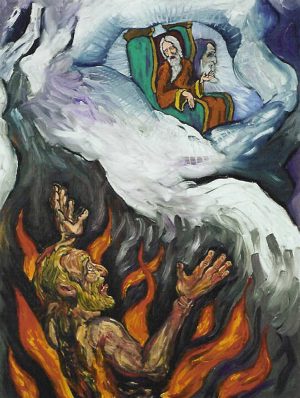
What happens to the soul & spirit of unsaved people when they die? By “unsaved” I’m referring to anyone who has not experienced spiritual regeneration through the gospel (see John 3:3,6 and Titus 3:5), which includes Old Testament saints—holy people who were in covenant with God throughout the Old Testament. The Bible shows that the souls of these people go to (or went to) Sheol at the point of physical decease. Sheol corresponds to Hades in the New Testament. These souls will be resurrected from Sheol/Hades one day (Revelation 20:11-15), which is why Sheol/Hades is described as the “intermediate state” since it refers to the condition of souls between physical death and later resurrection.
So what’s the condition of souls in Sheol/Hades? Jesus’ story of the rich man and Lazarus, if taken literally, suggests a conscious state where people either hang out in bliss with father Abraham or suffer constant fiery torment begging for less than a drop of water for relief. Another view is that Sheol is the graveyard of dead souls, a vast pit in the underworld where dead souls are laid to rest “awaiting” their resurrection to be judged. Initially I adhered to the first view solely due to Christ’s story of The Rich Man and Lazarus, which was the only passage I ever seriously considered on the topic. This is the case with the majority of believers as well. I have since come to accept the second position after much thorough and honest biblical research—prayerfully analyzing literally hundreds of passages on the subject.
In this teaching we’re going to analyze Jesus’ popular tale and determine if it should be taken literally or figuratively. Here’s the story:
“There was a rich man who was dressed in purple and fine linen and lived in luxury every day. 20 At his gate was laid a beggar named Lazarus, covered with sores 21 and longing to eat what fell from the rich man’s table. Even the dogs came and licked his sores.
22 “The time came when the beggar died and the angels carried him to Abraham’s side. The rich man also died and was buried. 23 In Hades, where he was in torment, he looked up and saw Abraham far away, with Lazarus by his side. 24 So he called to him, ‘Father Abraham, have pity on me and send Lazarus to dip the tip of his finger in water and cool my tongue, because I am in agony in this fire.’
25 “But Abraham replied, ‘Son, remember that in your lifetime you received your good things, while Lazarus received bad things, but now he is comforted here and you are in agony. 26 And besides all this, between us and you a great chasm has been set in place, so that those who want to go from here to you cannot, nor can anyone cross over from there to us.’
27 “He answered, ‘Then I beg you, father, send Lazarus to my family, 28 for I have five brothers. Let him warn them, so that they will not also come to this place of torment.’
29 “Abraham replied, ‘They have Moses and the Prophets; let them listen to them.’
30 “ ‘No, father Abraham,’ he said, ‘but if someone from the dead goes to them, they will repent.’
31 “He said to him, ‘If they do not listen to Moses and the Prophets, they will not be convinced even if someone rises from the dead.’ ”
Luke 16:19-31
The first thing that needs to be stressed about this story is that, whether a person takes it literally or figuratively, it does not refer to the eternal fate of damned people; that is, the “second death.” In the story, the rich man and beggar are said to be in Hades, which refers to the intermediate state of un-regenerated souls between physical death and resurrection to stand before God and be judged. The Greek Hades corresponds to the Hebrew Sheol, as a comparison of Psalm 16:10 and Acts 2:27 verifies. Once everyone is resurrected from Hades (Sheol) and judged, Hades will itself be thrown into the lake of fire.
See for yourself:
The sea gave up the dead that were in it, and death and Hades gave up the dead that were in them, and each person was judged according to what he had done. Then death and Hades were thrown into the lake of fire. The lake of fire is the second death. Anyone whose name was not found written in the book of life was thrown into the lake of fire.
Revelation 20:13-15
So regardless of how a reader views Christ’s imaginative story, it’s not applicable to the eternal fate of unredeemed people. It amazes me how often this tale is brought up when discussing the topic of human damnation with others. Anyone who cites this story to support eternal conscious torture hasn’t studied the subject of damnation to any great length.
With that understanding, let’s now consider Jesus’ story—it’s meaning and importance.
Someone wrote me and said:
There’s got to be something more to this tale as I’ve found that every time there’s a seeming contradiction in Scripture, a deeper truth is waiting to be discovered. The story of the rich man and Lazarus bothers me. If this was a common story of the time, why did it make it into Scripture? Jesus did so much stuff that didn’t get written down and since God knew this tale would get confused in future generations, why was it included for us to scratch our heads over? There’s something there.
I agree, so we’ll focus on mining insights from Christ’s story, but—at the same time—we shouldn’t overstate its importance. Unlike the Parable of the Sower, which appears in 3 of the 4 gospel accounts, the Parable of the Rich Man and Lazarus only appears once. I’m not saying it’s not important, but it’s no more important than, say, the Parable of the Shrewd Manager that also appears only once in Scripture, also in Luke 16, and is of comparative length. How often do we hear anything about that parable? Almost never, right? But everyone seems to know about the tale of the rich man and Lazarus and ask questions about it ad nauseam (don’t take me wrong as the tale naturally provokes important questions; I’m just making a point).
Now, someone might object that I just referred to Jesus’ story as a “parable”—a figurative tale—but be patient because I’m going to prove beyond any shadow of doubt that the story of the rich man and Lazarus is just that—a symbolic tale that makes many potent points.
Christ Gave the Parable to Rebuke the Pharisees
Greek scholar E.W. Bullinger maintained that Jesus was using the Pharisees own teachings and own words to convict them. This makes sense for two reasons: 1. The story, if taken literally, blatantly contradicts what the rest of Scripture teaches about Sheol, including the LORD’s own descriptions, as detailed in Chapter Six of SHEOL KNOW: The Longest and Most Detailed Passage on Sheol (which you can read in this article, just scroll down to the section).
And 2. the Pharisees embraced the unbiblical Hellenistic concept of the immortal soul apart from Christ and, consequently, eternal roasting of damned souls (immortality is only available to people thru the gospel, which you can read about here). As such, Jesus’ parabolic tale mimicked their beliefs with the twofold purpose of rebuking them and conveying one of the most important themes of the Bible, both of which we’ll extract from the story as we progress.
It’s notable to point out that there’s an Old Testament precedent to this kind of correction of leaders in Israel: After King David committed adultery with Bathsheba and indirectly murdered her noble husband, the prophet Nathan used a parable of a rich man and poor man to rebuke the monarch (2 Samuel 12:1-12). The tale never happened; it was made up for the purpose of rebuking the Hebrew official. Christ does the same with the Pharisees.
You can read Bullinger’s take on the story on the internet (just Google “E.W. Bullinger rich man and Lazarus” and it will come up). I should warn you though that he has an archaic and convoluted style of writing that’ll likely turn-off most modern readers. Let me also add that I don’t embrace everything Bullinger advocates, but who agrees with anyone about everything? As they say, “Eat the meat and spit out the bones.”
The Living Word of God Would NOT Contradict the Written Word of God
Christ Himself is the living “Word of God,” so he’s not going to contradict the written Word of God. This is another key that the story is not to be taken literally. After all, anyone—regardless of sectarian mindset—who simply does an honest, systematic study on Sheol in the Bible will admit that a literal reading of Jesus’ tale contradicts what the entire rest of the Bible teaches about Sheol. As my book SHEOL KNOW (and this abridged article) exhaustively detail, many of the most important men of God in the Old Testament, and even the LORD Himself, describe Sheol as the world of the DEAD where souls ‘sleep’ in death until their resurrection & judgment.
And by ‘sleep’ I don’t mean literal snoozing, but rather the condition of death itself—i.e. non-existence as far as conscious life goes (please read the scriptural data detailed in SHEOL KNOW or this article before automatically assuming that this is erroneous). No one is roasting in conscious torture crying out for tiny bit of water; and neither are (or were) Old Testament saints chummin’ around with father Abraham in paradise. Christ said the TRUTH will set us free, which is God’s Word (John 8:31-32 & 17:17). By contrast, that which is false cannot set us free, because it’s not true.
With this understanding, God didn’t place the Parable of the Rich Man and Lazarus in the Bible to “confuse anyone in future generations” because he knew (and knows) that anyone who is diligent and simply studies the subject from Genesis to Revelation will be set free by the truth. Only those who are unwilling to search for the truth or are too proud to admit they might be wrong and insist on following uninformed leaders will be misled by it (see Matthew 15:14). Most of these are sincere God-fearing brothers and sisters in the Lord who’ve simply been misled about Jesus’ tale and only casually view it as a literal teaching; in other words, they’re simply ignorant on the subject. However, some of their leaders are rigid, unthinking sectarians poisoned by legalism, like the Pharisees. To them Christ’s story is a stumbling block.
Believe it or not, the LORD and godly characters in the Bible have been known to set out “stumbling blocks” to intentionally discombobulate proud fools, whether legalists or libertines; see, for example, Ezekiel 3:20, Romans 11:9 and Psalm 69:22. I’m not saying there’s no hope for these people. I’m very patient and merciful; in fact, this ministry is all about setting the captives free, including those who are figuratively blind. I want to stress that I’m not suggesting that everyone who regards the story of the rich man and Lazarus as a literal description of life after death is a modern-day Pharisee, not at all. Again, most are simply ignorant on the subject. I wrote SHEOL KNOW (and this abridged article) for just such people.
“Scripture Interprets Scripture” is a Hermeneutical Law
I said above that the tale of the rich man and beggar “if taken literally, doesn’t gel with what the rest of Scripture teaches on the nature of Sheol, including the LORDs own descriptions;” I also said “Jesus Himself is the living ‘Word of God,’ so he’s not going to contradict the written Word of God.” Both statements are rooted in the hermeneutical rule that Scripture interprets Scripture, which is a common sense guideline for proper biblical interpretation. Without this rule, people could take any passage in the Bible and declare that it means whatever they say it means, which Peter condemned when he said, “no prophecy of Scripture is a matter of one’s own interpretation” (2 Peter 1:20).
In other words, the way you interpret a passage is 1. According to its immediate context where the surrounding texts usually indicate the meaning of the passage; and 2. According to the context of the whole of Scripture whereupon you ask: What does the rest of the Bible say about this particular subject? The clearer or more detailed passages obviously take precedence over the more ambiguous and sketchy ones.
Here’s an excellent example of Jesus utilizing this rule when the devil attempted to mislead him by quoting a passage:
Then the devil took him to the holy city and had him stand on the highest point of the temple. (6) “If you are the Son of God,” he said, “throw yourself down. For it is written:
‘He will command his angels concerning you, and they will lift you up in their hands, so that you will not strike your foot against a stone.’ ”
(7) Jesus answered him, “It is also written: ‘Do not put the Lord your God to the test.’ ”
Matthew 4:5-7
As you can see, the devil—who knows the Bible verbatim—was trying to use a biblical passage to spur Christ to do something wrong, but Jesus didn’t fall for it because he followed the principle of interpreting Scripture with Scripture. So He responds, “It is also written…” In other words, the verse the devil quoted must be viewed in light of what other passages say. When a person fails to do this they inevitably get off track and fall into error. The problem with error is that it’s not true; even partial error is not wholly true; and it’s only the truth that can set people free, as the Lord taught (John 8:31-32).
With this understanding, the Messiah’s tale of the rich man and beggar is not open to private interpretation because doing so is condemned in the Bible. The parable must be interpreted in light of what the whole of Scripture teaches on the subject of Sheol, as well as the other topics that the tale addresses. This is the approach we’ll take.
A Literal Interpretation Doesn’t Mesh With either Old Testament or New Testament Theology
If taken literally the Parable of the Rich Man and Lazarus does not support either Old Testament or New Testament theology, which is another indication that the tale’s not to be taken literally.
For instance, notice that nothing is said of the rich man being immoral or evil, nothing. In fact, it’s implied that he gave handouts to the beggar. Also, according to Old Testament theology, the Mosaic covenant Israel had with YHWH (the LORD), being consistently financially blessed indicated God’s blessing—generally speaking—whereas poverty indicated being cursed (see Deuteronomy 28).
Let’s honestly consider what this story says if we embrace it as a literal accounting of life after death in Sheol. In other words, what does this tale literally say? Please disregard any sectarian bias and what you think it says, just focus on what it actually says:
- If one is prosperous, gives to the poor,* respects authority and is concerned about his loved ones, he will go to Sheol at the point of death and suffer constant roasting torment desperately hoping for less than a drop of water for relief, but it won’t be given.
- If one is poverty-stricken, diseased, has no faith to be healed, is not physically blessed of God and has a life of bad things, he will go to the paradise compartment of Sheol to hang out with father Abraham and be perpetually consoled and comforted.
* For those who argue that the rich man didn’t give anything to Lazarus, why else would the beggar be laid at his gate (verse 20) if he wasn’t receiving anything from him? It would be pointless.
Let’s face it: This literal data from the story totally butchers Old and New Testament theology concerning eternal salvation. The fact that it’s diametrically opposed to Old Testament theology has already been stated while the latter is obvious: Nowhere in the story does it indicate that Lazarus expressed repentance and faith for salvation (Acts 20:21). Nowhere does Lazarus indicate or imply that “Jesus is Lord” (Romans 10:9-10). If we take the facts of the story as literal history we must conclude that being a diseased bum equals paradisal bliss at Abraham’s side. Is this the case? Does the rest of Scripture back up such a conclusion, such a warped theology? If so, we’re damned and so are 99.9% of the people we know!
The Parabolic ‘Lazarus’ vs. the Real-Life Lazarus
Let me offer one quick example of how a literal interpretation of Christ’s Parable of the Rich Man & Lazarus contradicts what God’s Word teaches on the nature of Sheol/Hades:
Contrary to the fictitious “Lazarus” of Jesus’ parable, there’s an account of the real, historical Lazarus and his death, as detailed here:
11 After he [Jesus] had said this, he went on to tell them, “Our friend Lazarus has fallen asleep; but I am going there to wake him up.”
12 His disciples replied, “Lord, if he sleeps, he will get better.” 13 Jesus had been speaking of his death, but his disciples thought he meant natural sleep.
14 So then he told them plainly, “Lazarus is dead, 15 and for your sake I am glad I was not there, so that you may believe. But let us go to him.”
John 11:11-15
The account goes on to show that the Messiah eventually resurrects Lazarus after his body had been in the tomb for four days (verses 43-44).
Please notice in the passage that Christ plainly informed the disciples that Lazarus was dead and not chumming around with father Abraham in some paradise in the nether realm. Also observe that Lazarus’ sisters — Mary & Martha — were horribly mourning his death, as well as many others (verse 33). Why were they mourning so severely if going to Sheol for Jews meant immediate blissful fellowship with father Abraham? Furthermore, why would Christ resurrect Lazarus and bring him back to this lost, corrupt world? Wouldn’t it be better for Lazarus to chum around with Abraham in wonderful bliss than come back to this dark, miserable world?
As you can see, a literal interpretation of Jesus’ Parable of the Rich Man & Lazarus makes nonsense of the Scriptures. And this is just one example.
The Story of the Rich Man and Lazarus is a Parable—a Symbolic Tale
These factors are further evidence that the story was never meant to be taken as a literal account of the nature of Sheol. It’s symbolic, meaning it’s a parable—a figurative story. This is in line with the generality that Jesus “did not say anything to them without using a parable” (Matthew 13:34) and that Christ’s story of the rich man and Lazarus comes in a long line of parables: The whole first half of Luke 16 is a parable that starts with the same exact words as Jesus’ tale of the rich man and Lazarus; and Luke 15 consists of three other parables. It simply makes no sense that the Messiah would suddenly switch to giving a supposedly historical account that contradicts what the Word of God has plainly established about Sheol up to this point.
Add to this the fact that the story clearly contains fantastical elements. For instance, the rich man is in literal agony in the fire and so he asks Abraham to have Lazarus dip the tip of his finger in water so he can cool his tongue—not even his hand or finger, the tip of his finger! Like that’s going to help his roasting condition one iota. It’s as if Jesus was getting a megaphone and declaring, “This is a fantastical tale that is not meant to be taken literally!” How much more evidence do people need that this is not a literal accounting of life after death?
I’ve heard it argued that a parable always reflects reality and cannot be fantastical. But a parable is simply a short allegorical tale that teaches a moral lesson or lessons. That’s it. Nowhere does the Bible say that a parable has to reflect reality and cannot be fantastical. For instance, righteous Jotham shared a parable in Judges 9:8-15 about trees talking to each other. Should we take that as reality? Of course not; the argument holds no water.
With the understanding that this is a fantastical symbolic story, Christ knew that rigid sectarians who fail to rightly divide the Scriptures would wrongly interpret it as a literal account in centuries to come, just as a religionist misinterpreted Jesus’ statement about being born-again to refer to literal physical rebirth (John 3:3-4). Please understand that the Lord didn’t tell parables to reveal truth to the masses, but rather to hide it for those with spiritual discernment (Matthew 13:10-15 & 1 Corinthians 2:14). As such, the Parable of the Rich Man and Lazarus is a stumbling block to those who fail to correctly handle the Scriptures (2 Timothy 2:15)—i.e. those who are spiritually blind to some degree, usually due to staunch sectarianism—including religious people with a Pharisaical spirit.
The Surface Meaning of the Parable
The surface meaning of The Parable of the Rich Man and Lazarus is obvious: Jesus had just finished rebuking the Pharisees’ greed:
“No one can serve two masters. Either you will hate the one and love the other, or you will be devoted to the one and despise the other. You cannot serve both God and money.”
The Pharisees, who loved money, heard all this and were sneering at Jesus. He said to them, “You are the ones who justify yourselves in the eyes of others, but God knows your hearts. What people value highly is detestable in God’s sight.
Luke 16:13-15
As you can see, the Pharisees worshipped Mammon (money) and therefore scoffed at Christ’s correction. The Lord’s wise response was to reprimand them further via a classic tale of reversal of fortune. This was possibly Jesus’ unique take on a common story of the time, perhaps a favorite of the Pharisees. In any case, the tale mimics the Pharisees’ Hellenistic belief in the immortal soul apart from Christ with the dual purpose of rebuking them and conveying one of the most important themes of Scripture.
The rich man in the parable obviously represented the Pharisees (and Hebraic leaders in general) whereas Lazarus symbolized the Gentiles. We’ll look at this further in the next section, but allow me to point out the obvious: We live in a world of lies where the devil is the “god of this world” (2 Corinthians 4:4) and not everything is as it might appear. In this case the Pharisees claimed to be Abraham’s offspring (John 8:38-44) and prided themselves on being rich in God’s truth—not to mention they were physically rich due to their greedy manipulations—but Christ’s parable reveals them be greatly impoverished in reality and that it is the Gentile beggar who’s actually Abraham’s “bosom” buddy, not the Pharisees.
Needless to say, if the Pharisees sneered with contempt before Jesus gave the parable they were absolutely livid now!
The Lord’s punchline in verse 31 is that, if the Pharisees did not listen to Moses and the Prophets, they will not be convinced even if someone rises from the dead. Christ was potently proclaiming two things by this statement:
- Although the Pharisees claimed to strictly follow the Torah—God’s Law—they really didn’t. The reference to “Moses” is a reference to the Law; and “the Prophets” refers to all the prophets who rebuked Judah & Israel’s wickedness in times past and were rejected. In other words, Jesus was saying that the Pharisees and other religious leaders of Israel were not who they claimed to be—devout men of God who strictly followed the Law. No, they were hypocrites, which literally means actors. In fact, the Messiah blatantly told them this to their faces on other occasions, as shown in Luke 11:37-54 and Matthew 23:13-35. In short, the Pharisees were fakes.
- Since the Pharisees and other Judaic leaders weren’t really listening to Moses and the Prophets—even though they put on airs that they did—they wouldn’t likely believe even if someone rose from the dead, which is not only a reference to Christ’s later resurrection, but also to Martha & Mary’s brother, Lazarus, whom Jesus raised from the dead, as seen in John 11:1-44. This is one of the reasons the Lord utilized the name ‘Lazarus’ for his parable. You see, many people believed in Jesus because of Lazarus’ resurrection, but not the proud, stubborn religious leaders of Israel; in fact, they proceeded to plot to kill Lazarus—as well as Christ—because so many people believed on account of Lazarus’ awesome resurrection (John 12:9-11)! Unbelievable, isn’t it? This shows why the Lord shared the parable in an effort to rebuke these disingenuous religious authorities. As far as them not having faith even after Jesus later rose from the dead, this is precisely how history panned out: When the Messiah was resurrected, the Pharisees and other stuffy Judaic rulers refused to believe it and tried to stamp out those who did believe in Christ and his resurrection. The few Pharisees who humbly repented were the exception, like Nicodemus and Saul (Paul).
Now, notice the key words in Christ’s punchline in verse 31: The Pharisees and other hypocritical Judaic rulers wouldn’t believe even when the Lord rose from the dead. You see, Jesus died and his soul went to Sheol (Hades) when he was crucified. In other words, Jesus himself described the condition he was soon going to experience in explicit terms of being dead. If Christ’s story of the rich man and Lazarus was a literal account of life after death and not a fantastical tale Jesus would have said something like, “If they do not listen to Moses and the Prophets, they will not be convinced even if someone rises from blissful communion with father Abraham in the paradise compartment of Hades.” Sounds absurd, doesn’t it? Yet this would be what the Lord really meant if his story of the rich man and Lazarus is taken literally rather than symbolically. Of course, Christ said nothing of the kind. He indirectly declared that he was going to rise from the dead, which perfectly coincides with the Bible’s clear descriptions of Sheol/Hades as “the world of the dead,” as scholar James Strong defined it, or “the company of the dead,” as Proverbs 21:16 defines it, or “the realm of the dead,” as the New International Version translates it on a number of occasions (e.g. Isaiah 14:9,15, Ezekiel 31:15,17 and 32:21,27; the verses from Ezekiel, incidentally, are the LORD Himself speaking).
Of course, there are some ministers who teach that Christ didn’t go to be with Abraham in Sheol; instead they maintain that he was tormented in fire for three days & three nights, like the rich man in the story. If this were so, Jesus’ punchline would’ve been something akin to this: “If they do not listen to Moses and the Prophets, they will not be convinced even if someone rises from three days of fiery torment in Hades.” Whether a person holds to this interpretation or the other one it doesn’t matter because the Lord said nothing of the kind. He plainly said that he was going to rise from the dead, not rise from comforts in paradise with Abraham or rise from horrible roasting agony. Neither belief washes with the Scriptures because they’re false doctrines based on an erroneous interpretation of a tale Christ told that is clearly parabolic and fantastical in nature, not literal.
Getting back to the reason Jesus used the name ‘Lazarus’ in his parable, we observed one notable reason above and we’ll see another below, but the Messiah didn’t give a name for the rich man in his story. Why? Because the rich man is not a real person but rather is symbolic of group of people, which we’ll look at momentarily. This shatters the argument that Christ’s story is a historical account on the grounds that he uses the proper name of ‘Lazarus,’ which Jesus didn’t do in any of his other parables. Bear in mind, however, that the rich man is the sole character in proving the conscious roasting of the damned in Sheol and yet he’s not given a name!
Chew on that.
Interpreting the Symbolism—the Bigger Picture
With the understanding that Christ’s tale of the rich man and Lazarus is a parable, how are we to interpret it? Believe it or not, the symbolism of the tale is obvious for anyone who’s adequately familiar with the Scriptures and isn’t blinded by religious sectarian mumbo jumbo:
The rich man represents the Pharisees or Judaic rulers—and the Hebrews in general—who had the truth and who were therefore spiritually rich. His purple linen represents the priesthood (Exodus 39:1) and the abundant food on his table represents the blessings of truth and the oracles of God that were entrusted to the Israelites (Romans 3:1-2). The beggar at the gates refers to the gentiles who didn’t have a covenant with YHWH and were therefore spiritually poor (Ephesians 2:11-12). Lazarus in the story wanted even crumbs that fell from the table of the rich man, which corresponds to the Syro-Phoenician woman who begged Jesus to heal her daughter of the evil spirit in Mark 7:24-30. To further support this, dogs lick Lazarus’ sores in the story and Hebrews contemptuously called gentiles “dogs.”
Another indication is Lazarus’ name, which means “One in whom God helps or saves.” In the New Testament, who is God’s salvation focused on? Paul said, “because of [Israel’s] transgression, salvation has come to the Gentiles” (Romans 11:11). He goes on to point out: “But if their transgression means riches for the world, and their loss means riches for the Gentiles, how much greater riches will their fullness bring?” (verse 12).
In the Bible, the Word of God is likened to spiritual food and compared to bread (Matthew 4:4 & Deuteronomy 8:3). In verses 20-21 we see Lazarus being laid at the rich man’s gate and hoping for crumbs from his table. This was the way it was for Gentiles during the Old Testament period: The Israelites were blessed with the Word of God—spiritual bread—while Gentiles rarely heard God’s word and essentially settled for “crumbs” from the Israelite’s table, which perfectly coincides with the Gentile woman’s response to Jesus in Matthew 15:27 after he told her that it wouldn’t be right to take the children’s bread—the Israelite’s bread—and toss it to “dogs,” i.e. the Gentiles. Her response was brilliant and showed great faith & persistence: “Yes, Lord, yet even the dogs eat the crumbs that fall from their masters’ table” (NRSV).
In short, the rich man and poor man refer to spiritual riches and spiritual poverty. If you have a covenant with God you’re spiritually rich; if not, you’re poor, no matter how much material wealth you might possess. The rich man refers to the Hebrews who had a covenant with God, which is verified by the statement concerning his brothers having “Moses and the Prophets” (verse 29) while Lazarus is figurative of the Gentiles who through faith in Christ become “Abraham’s offspring” (Galatians 3:29), spiritually born of Abraham’s “bosom.” Lazarus being carried into Abraham’s bosom symbolizes the “grafting in” of believing Gentiles to a place once possessed by Israel (Romans 11:11-24).*
* The King James Version and the New American Standard Bible, which are both literal word-for-word translations, say that Lazarus was “in” Abraham’s “bosom” in verse 23.
Death for the rich man represents the end of their covenant with God (Hebrews 8:13 & Romans 11:15, 21) while death for Lazarus represents a believer’s death to the old nature when they’re spiritually regenerated through Christ (Galatians 2:20 & Titus 3:5) and the beginning of their new covenant with the Almighty. Think of it this way: The rich man was blessed and Lazarus was impoverished at the beginning of the parable, but these conditions are reversed when they die. Their deaths represent the end of the old covenant and the beginning of the new: Now the Gentiles have spiritual riches through the gospel while the Hebrews languish in unbelief. This was prophesied by Amos:
“The days are coming,” declares the Sovereign Lord, “when I will send a famine through the land—not a famine of food or a thirst for water, but a famine of hearing the words of the Lord.
People will stagger from sea to sea and wander from north to east, searching for the word of the Lord, but they will not find it.”
Amos 8:11-12
The rich man’s torment likely refers to the humbling torment of seeing God’s favor—God’s grace—shift to all the world who genuinely believe (Matthew 21:43), and possibly to the Jews’ extraordinary persecution and trouble throughout the last 2000 years.
Finally, if there was any question as to whom the Lord was referring to by the rich man, the parable reveals that he had five brothers. The significance of this is that Christ shared this parable in Jerusalem, which was part of the southern kingdom of Israel, Judah. Genesis 35:23 shows that Judah—the person—had five brothers just as the rich man in the story. So the Lord was condemning the southern kingdom of Israel whose capital, Jerusalem, he described as “the city that kills the prophets and stones those sent to her” (Luke 13:34), the same city where Jesus—The Prophet (Deuteronomy 18:15)—was soon to be put to death. Through the parable the Lord rebukes the Judaic leaders for not genuinely following the law and the prophets (Luke 16:31) because they, in fact, pointed to Christ (John 5:39). Remember Jesus’ indictment of the counterfeit religious leaders:
“Woe to you, teachers of the law and Pharisees, you hypocrites! You build tombs for the prophets and decorate the graves of the righteous. (30) And you say, ‘If we had lived in the days of our ancestors, we would not have taken part with them in shedding the blood of the prophets.’ (31) So you testify against yourselves that you are the descendants of those who murdered the prophets. (32) Go ahead, then, and complete what your ancestors started!
(33) “You snakes! You brood of vipers! How will you escape being condemned to hell (Gehenna)?
Matthew 23:29-33
As you can see, Christ’s parable potently symbolizes the main theme of the New Testament. It’s a prophecy of the rejection of unrepentant Israel and the coming Church Age where reconciliation with God and eternal life are made available to the whole world. Amazing, isn’t it? It’s true!
The woman who wrote me about the rich man and Lazarus asked why this story was included in God’s Word; she insisted that there was “something there.” There certainly is—the most important theme of Holy Scripture!
This article was edited from chapter 8 of…

- The print book is available here for just over $10 (257 pages)
- The eBook is available here for just 99¢
- The more affordable Condensed Version is available here for only about $6 (153 pages); or get the eBook for just 99¢.
Related Topics:
Sheol / Hades: The “Intermediate State” of the Unsaved Dead
Hell (Lake of Fire): Eternal Torment or Everlasting Destruction?
The Believer’s “Intermediate State” (between Physical Death and Bodily resurrection)
Suicide – Can Someone who Commits Suicide still have Eternal Life?
Eternal Life (“Heaven”): Questions & Answers
Eternal Life (“Heaven”) — What will it be Like?
Judgment Seat of Christ (the Judgment of Believers)
What Are THE FOUR STAGES of Spiritual Growth?

The Bible reveals that there are four stages of spiritual growth. Understanding them is fascinating and will help you SEE where you’re at spiritually and where you need to go.
STAGE ONE is actually a stage of spiritual darkness where the individual is separate from God and in need of spiritual regeneration. The next three stages apply to the development of the believer who is spiritually reborn in Christ. The Bible refers to these three stages in terms of childhood, youth and maturity, as shown in 1 John 2:9-14. We’ll examine this passage momentarily.
Too many Christians get stuck in STAGE TWO, which is the institutional stage of growth where believers learn the fundamentals and are dependent upon pastors for their spiritual health. There’s nothing wrong with STAGE TWO unless you get stuck there. This article will help you to keep growing and not run aground in STAGE TWO.
As you shall see, not only are the Four Stages of spiritual growth scriptural, understanding them is quite enlightening. Grasping them will help you see where you are at spiritually and where you need to go. It will also help you locate where others are at so you can understand their position and relate to them accordingly.

STAGE ONE: Separation from God / Chaos
This is the classic “sinner” stage where the individual is separate from God and therefore in spiritual darkness. At this stage people are in bondage to the flesh — the sinful nature — to one degree or another. Being that people in this stage are separate from God and in spiritual darkness, you could also describe it as moral chaos.
By the way, I’m not saying that people in this stage don’t have a spirit, as every human being has a spirit, but that their spirit is dead to God and therefore in need of regeneration. See the article Human Nature: Spirit, Mind & Body for more details.
STAGE TWO cannot occur until the individual is enlightened to his or her needy spiritual condition and turns to God via the good news of the gospel, which is called “the message of reconciliation” in Scripture (2 Corinthians 5:18-20). This salvation comes through repentance and faith (Acts 20:21).

STAGE TWO: Institutional / Fundamental
After reconciliation with God, the new believer will join a church/ministry/sect. The group’s oversight and instruction naturally provide the necessary structure for him or her and (hopefully) the Bible as well. As such, the chaos of STAGE ONE transforms into order as the organization provides protection & accountability for the convert and opportunities to learn, participate, serve, grow and eventually lead in some capacity.
STAGE TWO can be described as “fundamental” because those at this level become attached to the rules and doctrines that their organization provides, which the elders decree to be fundamental to their faith. Not surprisingly, STAGE TWO believers become discombobulated when these fundamentals are threatened, regardless of whether these “fundamentals” are true, false or somewhere in between. As such, those in this stage are “fundamentalists.
STAGE TWO is essentially Christian boot camp. It’s a stage of spiritual immaturity where the believer is learning and growing. It’s immature in the sense that the believer is typically dependent upon the group to maintain their spiritual status. Just as in military boot camp recruits need their drill instructors and the military institution or they’ll revert back to their civilian ways, Christian converts are very dependent on their churches and elders without which they’d fall back into STAGE ONE.
Ideally, the new believer will be in STAGE TWO while simultaneously growing in STAGE THREE and STAGE FOUR, as shown here:

While believers in STAGE TWO should be simultaneously growing in the next two stages, it unfortunately doesn’t always happen. Sometimes they get stuck in STAGE TWO, usually because the church or sect they hook up with is infected by legalism, which is sterile (counterfeit) Christianity and characterized by rigid sectarianism. When this occurs, the organization fosters a spirit of dependency in the believer rather than independence, bondage rather than freedom and weakness rather than strength. It’s actually spiritual abuse and it harms or limits the believer’s growth. Abuse, by the way, is the misuse of power.

STAGE THREE: Individual / Seeker
Healthy believers will grow as individuals and develop an identity separate from the group. They’ll start to question doctrines that don’t really gel with the Scriptures or make sense. They’ll seek truth — reality — beyond the limitations of their sect and elders, that is, if they sense they’re in error in one area or another. This is good because error can’t set people free, even if it’s disguised as “truth” by one’s church or pastor. Only the truth sets free, as Jesus taught (John 8:31-32). Also, as believers develop in STAGE THREE they will cultivate a discernment to spiritual abuse and will not tolerate it, which explains why weak “pastors” try to keep individuals in STAGE TWO. I put “pastors” in quotes here because real pastors passionately desire for believers to grow spiritually.
Now, just because believers in STAGE THREE discover error or abuse in their group it doesn’t mean they’ll automatically leave. They’ll likely stay and do their part to help correct any problems, but this depends on many factors, like: How deeply involved are they in the group? What about their families and close friends? How severe is the error or abuse? What do they discern the Holy Spirit leading them to do? How long have they been trying to help without any appreciable change?
In STAGE THREE believers will find themselves questioning beliefs — possibly even their faith and God Himself. Because of this, it’s a risky and unstable stage in the believer’s journey. I’ve known people in STAGE TWO who were believers for many years, but as they seem to transfer to STAGE THREE they totally fall away from God and faith. Usually the signs are there that this is the way they’re heading. They failed to “guard their heart as the wellspring of life” (Proverbs 4:23) and let things enter in that took their hearts away from their pure devotion to the LORD. Guarding your heart is a matter of wisdom and believers make a big mistake when they allow negative things in that take them away from their “first love.”
Thankfully, STAGE THREE doesn’t end this way for those who genuinely seek God and persist rather than using STAGE THREE as an excuse to backtrack to STAGE ONE, as depicted here:

This is an extreme form of what the Bible calls backsliding.
STAGE THREE can be difficult due to its inherent growth pangs just like the teenage years and early 20s can be in the natural, but it’s a necessary stage of growth in the believer’s spiritual journey. It develops their sense of individuality apart from the group and motivates them to seek out the truth for more certainty and accuracy, not to mention clarifies their objectives. Without STAGE THREE believers will be stuck in STAGE TWO and they cannot move on to STAGE FOUR.

STAGE FOUR: Knowing God
STAGE FOUR is the stage where believers develop a living relationship with God rather than just knowing about God. This is the goal of Christianity and explains why the gospel of Christ is called the “message of reconciliation” (2 Corinthians 5:18-20). STAGE FOUR is enlightenment, independence and strength. Let’s look at all three of these:
STAGE FOUR is enlightenment because the believer is in direct communion with God. This communion becomes a 24/7 thing where believers are in constant connection with their Creator. This is what Paul was referring to when he mentioned “praying without ceasing” (1 Thessalonians 5:17). Enlightenment in this manner includes the constant awareness of God’s presence via the Holy Spirit and also the awesomeness, beauty and mystery of actually knowing the LORD. Those stuck in STAGE TWO, by contrast, only have an inkling of this and basically view God as a big cop in the sky. This is an outward perspective of God and it’s frankly an Old Testament mentality. The New Testament, by contrast, emphasizes the believers spiritual regeneration and the indwelling empowerment of the Holy Spirit — God is within us! See Titus 3:5, 1 Corinthians 3:16 and Ephesians 1:19.
STAGE FOUR is independence from bondage to the error and corruption that often comes with the institution of STAGE TWO. Please read that again and chew on it. This isn’t to say that the church/sect/pastors that believers are hooked up with in STAGE TWO are always bad or that they’re all bad — not at all — they’re usually good and definitely necessary, but error and abuse come with the territory of people and groups, even Christian churches and sects. Are you following?
Furthermore, STAGE FOUR is independence from the uncertainty of STAGE THREE. How so? In STAGE FOUR believers know God personally. They’ve “tasted and seen that the LORD is good” (Psalm 34:8). As such, it’s impossible for someone to convince them that God doesn’t exist because they personally walk with the LORD. This isn’t to say, of course, that believers in STAGE FOUR are exempt from falling from faith, only that it’s much harder for them to fall than those in STAGE TWO or THREE. Why? Because they’re actually walking with God 24/7.
This combination of enlightenment and independence makes for strong believers. They’re spiritually mature. These are people who know God and increasingly know their calling. They don’t just sacrifice 10% of their finances as a tithe, their whole lives are “living sacrifices” when they wake up in the morning (Romans 12:1). Because they discern and fulfill God’s will on both minor and major levels they become a threat to the enemy’s kingdom, which naturally draws attack. This includes opposition from people at lower stages of spiritual growth, including quasi-believers and legalists, like the Pharisees.
Furthermore, those in STAGE FOUR become increasingly independent of the need of others in order to stay tight with God and fulfill their calling. What I’m saying is that believers in STAGE TWO and THREE will fall back into STAGE ONE without the service, support and encouragement of fellow believers, particularly in the context of church services, but those firmly walking in STAGE FOUR don’t need others to walk free of the pitfalls of the flesh and legalism. They don’t need others to motivate them to spiritual disciplines, like prayer, study, worship, fasting, etc. Don’t get me wrong here, Paul was encouraged and blessed by other believers, and so should every Christian, but Paul performed spiritual disciplines and fulfilled his calling without people over him compelling him to do so. It goes without saying that every believer should aspire to this level of spirituality. The ones who don’t are not spiritually mature.
By the way, I’m not saying that believers in STAGE FOUR shouldn’t attend church services. Going to healthy church gatherings is always good, regardless of where you’re at spiritually. But those in STAGE FOUR will often lead their own ministries within other ministries or start their own, whether within an existing camp or otherwise.
In light of all this, STAGE FOUR is a stage of strength. Of course, there is a downside: “Higher levels bigger devils.” But those in STAGE FOUR can handle the increased attacks and their intensity because, again, they’re tight with the LORD. A good scriptural example is Paul who endured great persecutions while he traveled the eastern Mediterranean area, starting and overseeing numerous churches. Check out Paul’s list of persecutions in 2 Corinthians 11:23-28; it’s incredible. Someone in STAGE TWO or STAGE THREE could never endure such hardships without falling away, but those in the higher levels of STAGE FOUR can, just as Paul did.

Getting Stuck in STAGE TWO
As already noted, believers in STAGE TWO should simultaneously be growing in STAGE THREE and FOUR. In other words, as believers grow in the realm of Christian community (STAGE TWO), they should also be growing as an individual (STAGE THREE) and in their relationship with God (STAGE FOUR). Healthy believers always have a finger, hand or foot in the next stage (or the next level of the stage they’re in). The Bible refers to this maturation from one level to the next in terms of going “from strength to strength” or “glory to glory” (Psalm 84:5,7: & 2 Corinthians 3:18).
But what of those who get stuck in STAGE TWO? These are people who fail to develop spiritually as individuals and in relationship with their Creator. Instead, the institution they are involved in — their church and its camp — replaces both. This isn’t good because, in essence, the institution itself takes the place of God. They become “sheeple” — mindless automatons dedicated to perpetuating the machine of the institution, their “god.” This explains why those stuck in STAGE TWO become rigid sectarians who eye outsiders suspiciously and get irate when someone merely questions the legitimacy of the rules and doctrines of their group. Why is this so? Because the institution has taken the place of the LORD. You see this with cults like the Jehovah’s False Witnesses. It’s really a form of idolatry.
Non-Christian Substitutions
There are obvious secular substitutions to STAGE TWO. Prison is a good example. Individuals in the lower levels of STAGE ONE inevitably break the law because of their darkened spiritual condition, which inevitably lands them in prison. Their new environment provides the parameters and order they need to escape the chaos of STAGE ONE, but as soon as they’re released back into the public they revert back to STAGE ONE because they can’t handle the freedom. They’re dependent on the institution to keep them from iniquity, at least outwardly.
Religious and non-religious institutions are also substitutes, like Sciencefictionology, Mormonism, TM, rehabs, psyche wards, 12-step programs, martial arts programs and a gazillion others. They’re not all bad, of course, and they do help the individual escape the darkness and chaos of STAGE ONE, but all such disciplines pale in comparison to the effectiveness of genuine Christianity (as opposed to sterile, religious “Christianity”) because true Christianity solves humanity’s root problem — the condition of spiritual death and separation from God.
The family can also be a substitute (and in the believer’s life it can play an accessory role). For instance, individuals who grow up in strong families that have a lot of love, order and discipline essentially grow up without experiencing the darkness and chaos of STAGE ONE. They were, in essence, born into STAGE TWO. This is normally a good thing and those with healthy families like this should be praising God that they largely skipped STAGE ONE. This only becomes a problem if the individual becomes arrogant (spoiled) by his or her good fortune, which is a sure slide into STAGE ONE, keeping in mind that arrogance — a superiority complex — is sin numero uno in God’s eyes. This brings up an important point…

STAGE FOUR Believers are HUMBLE
Since STAGE FOUR believers are at the highest stage of spiritual growth (although not necessarily the highest level, as there are levels within each stage), it’s easy to assume that they’d be arrogant, but this isn’t the case at all. People who genuinely know God are extremely humble because “God resists the proud, but gives his favor to the humble” (James 4:6 & 1 Peter 5:5). As such, only the humble can get close to God.
If you know domineering Christians who love to bloviate and abuse, they’re not in STAGE FOUR. They’re in STAGE TWO or THREE with their heads in STAGE ONE. See this article for more information.
John’s References to the Four Stages
An excellent biblical reference to the Four Stages of spiritual growth can be observed in this passage:
Anyone who claims to be in the light but hates a brother or sister is still in the darkness. (10) Anyone who loves their brother and sister lives in the light, and there is nothing in them to make them stumble. (11) But anyone who hates a brother or sister is in the darkness and walks around in the darkness. They do not know where they are going, because the darkness has blinded them.
(12) I am writing to you, dear children, because your sins have been forgiven on account of his name.
(13) I am writing to you, fathers, because you know him who is from the beginning.
I am writing to you, young men, because you have overcome the evil one.
(14) I write to you, dear children, because you know the Father.
I write to you, fathers, because you know him who is from the beginning.
I write to you, young men, because you are strong,
and the word of God lives in you, and you have overcome the evil one.
1 John 2:9-14
John wasn’t being literal with his references to “children,” “young men” and “fathers,” but rather figurative. We know this for several reasons: 1. Literal children wouldn’t even read his epistle and wouldn’t understand it if someone read it to them; 2. not all mature believers reading his epistle (then or now) would be literal fathers—Paul’s a good example—but all spiritually mature believers are spiritual fathers and mothers; 3. elsewhere when Paul literally referred to segments of the congregation by the Spirit he did so in a more universal manner, as shown in Colossians 3:18-24 (i.e. wives, husbands, children, fathers and slaves); and 4. John’s references to “children,” “young men” and “fathers” simply fits the four stage model, particularly since he referred to STAGE ONE three times in the previous three verses.
John’s references to the Four Stages in 1 John 2:9-14 can be summed up as follows:
- “In the darkness” refers to the spiritual darkness of STAGE ONE where an unbeliever is separate from the light of God because his or her spirit is dead to Him.
- “Children” is a reference to the boot camp fundamentalism of STAGE TWO where the believer establishes a foundation. Unfortunately, too many Christians get stuck in this stage and never grow beyond it. They live and die as spiritual children.
- “Young men” refers to the growing individualism and sense of freedom and adulthood of STAGE THREE.
- “Fathers” is a reference to the maturity and independence of STAGE FOUR where believers naturally propagate.
Since there’s neither male nor female in Christ (Galatians 3:28) we can broaden the terms for STAGE TWO, THREE and FOUR as such: children, young people and parents or, better yet, childhood, youth and maturity. Let’s fit these into our Four Stages diagram:

There are awesome pastors out there, Praise the Lord, but some are weak — or even counterfeits — in that they encourage the pastoral dependency of STAGE TWO (“children”) and are threatened by those believers trying to move into the next two stages. Instead of thinking in terms of apprehending new disciples — converts — they think in terms of “holding on” to their current fold by intentionally keeping them in the dependent stage of STAGE TWO. They don’t want to “lose” them, not realizing that losing them is the best thing for them because these believers would grow up spiritually, becoming “young men” (STAGE THREE) and “fathers” (STAGE FOUR). As a pastor I know puts it: “My job is to become unnecessary in the life of the believer.”
My Book on the Four Stages
- You can pick up copies here (258 pages, $9.95).
- Or get the Kindle eBook for only $2.99!
This book will help you see where you are at spiritually and where you need to go. Just as important, it provides the spiritual tools you’ll need to get there!
I first learned of the Four Stages of spiritual development theorized by M. Scott Peck (1936-2005) detailed in two of his books from the late 80s and early 90s. Peck was essentially a non-sectarian Christian and formulated his theory inspired by another’s work. As a psychiatrist, he developed his version of the Four Stages from a psychological viewpoint mixed with Christianity rather than purely a biblical one.
The Four Stages as relayed above (and in my book), by contrast, are firmly rooted in biblical truth and Christian experience. For instance Peck never cites the biblical reference to the Four Stages from 1 John 2:9-14. As such, the version of the Four Stages illustrated here (and in my book) is quite different than Peck’s. While I give him credit for popularizing the theory and I acknowledge his insights on the topic, he didn’t actually formulate it; the Holy Spirit did via the God-breathed Scriptures.
Furthermore, as a minister of God I naturally feel he deviated too much from scriptural truth, particularly by suggesting that a spiritually dead person—an unbeliever—could reach STAGE TWO, THREE and FOUR. They can, but only in a substitutionary sense. As noted above, their inherent spiritual condition—being dead to God and unable to have a real relationship—pins them down to STAGE ONE.
I want to stress that I’m not a follower of Peck and don’t know every jot and tittle of what he believed or taught and don’t care to, but I found his writings on the Four Stages fascinating when I read them in 2000. I discerned that he was on to something—something scriptural and very real—but it was clear that his secular studies tainted his understanding of the topic. The last time I remember reading any of his writings was circa 2001. So this article was written without referencing his works and similarities are based purely on memory. In short, this is my own take on the Four Stages of spiritual growth in light of what the Bible teaches.
Related Topics:
Spiritual Growth — Darkness, Childhood, Youth & Maturity
Can You Fix Your SPIRITUAL FOUNDATION If It’s Faulty?
HUMAN NATURE — Spirit, Mind and Body
NOTE: This is a detail-oriented study and therefore only recommended for advanced Bible students (just a heads up).
Understanding human nature is important because it can help us comprehend ourselves and other people. It helps us to fathom or discern behaviors, motives and bondages. Knowledge is power (Proverbs 24:5) and truth sets free (John 8:31-32). ‘Truth’ is “reality” – the way it really is – and therefore properly understanding the reality of human nature will naturally help us walk in victory over the dark side of our psyche and mental illnesses. We can then, in turn, help others with the same knowledge and freedom we’ve acquired.
There has been much debate in the church on the subject of human nature. Some teach that people are essentially a dichotomy (two-part) consisting of the inner person—soul/spirit—and the outer person—body. Others maintain that we are a trichotomy (three-part) consisting of two separate inner facets—spirit and soul (mind)—and an outer facet—body. Others insist that human beings are essentially one psychosomatic unit by nature and therefore terms that the Bible uses, such as “soul,” “spirit,” “mind,” “body” and “heart,” are ways of looking at the individual from different angles and so on.
One popular description of human nature that I hear often is “man is a spirit that possesses a soul and lives in a body.” Although this description isn’t entirely biblically accurate, it is a workable description as long as we understand that “soul” in this context refers to the mind.
Most of the confusion over the subject of human nature can be traced to two problems: 1. Lack of depth in biblical studies, and 2. a narrow view of the Hebrew and Greek words for “soul,” “spirit,” etc. The purpose of this article is to see what the Bible has always clearly taught on the subject and avoid these two interpretational ruts. In doing this, the scriptural truth should be plain to see.
Human Beings Are “Living Souls”
Naturally the best place to start a study on human nature is “the creation text.” This is the passage in the first book of the Bible that describes precisely how God created human beings:
And the LORD God formed man of the dust of the ground, and breathed into his nostrils the breath of life; and man became a living soul (nephesh).
Genesis 2:7 (KJV)
The LORD God formed the man from the dust of the ground and breathed into his nostrils the breath of life and the man became a living being (nephesh).
Genesis 2:7 (NIV)
We see here that God created the human body out of “the dust of the earth”* breathed into it “the breath of life” and so man became “a living soul” (KJV) or “living being” (NIV).
* It’s a scientific fact that the human body is made up of the same essential chemical elements that are in the soil. Interestingly, humanity did not discover this until recent times, but the Creator revealed it here thousands of years ago.
The Hebrew word for “soul” or “being” is nephesh (neh-FESH). We know that nephesh is equivalent to the Greek psuche (soo-KHAY) because when this creation text is partially quoted in 1 Corinthians 15:45 nephesh is translated by the Greek word psuche. The Greek psuche is incidentally where we get the English words psychology, psychiatry and psyche.
As you can see, this foundational passage plainly states that human beings are living souls. Biblically, “Soul” (nephesh/psuche) in its broadest sense refers to the entire human person. We are living souls. We see this clearly in such passages as these:
All the souls (nephesh) that came with Jacob into Egypt, which came out of his loins, besides Jacob’s sons’ wives, all the souls (nephesh) were threescore and six.
Genesis 46:26a (KJV)
“Souls” in this verse simply refers to the people who accompanied Jacob to Egypt. The New International Version translates nephesh in this passage as “those” and “persons” respectively:
And that day Joshua took Makkedah, and smote it with the edge of the sword, and the king thereof he utterly destroyed, them, and all the souls (nephesh) that were therein; he let none remain:
Joshua 10:28 (KJV)
“Souls” here likewise refers to the people that Joshua and his troops slew. The NIV translates nephesh in this passage as “everyone.”
In both these examples, and numerous other passages, it is clear that “soul” does not refer to the immaterial facet of human beings, which is how “soul” is popularly understood, but rather to the whole person. It’s understandable why the average Bible reader would fail to see this because in most translations nephesh is not translated as “souls” in such passages, but rather as “those,” “persons,” “everyone,” “people,” etc.
Here are a couple examples from the New International Version where nephesh is translated as “people”:
… and the people (nephesh) they had acquired in Haran,
Genesis 12:5b
There were 4,600 people (nephesh) in all.
Jeremiah 52:30b
And here’s an example from the New Testament where psuche, the Greek equivalent to nephesh, is translated as “people”:
In it [Noah’s ark] only a few people (psuche), eight in all, were saved…
1 Peter 3:20b
Once again we see that “soul” (nephesh/psuche) in its broadest sense clearly refers to the whole person, the whole human being—spirit, mind and body. When nephesh/psuche is used in this broad sense “being” is perhaps the best translation. This is why the NIV translators decided to translate nephesh as “being” in the creation text, Genesis 2:7—the first man was a “living being.”
The Human Being (Soul): Spirit, Mind & Body
According to Scripture, human beings (souls) have three facets—spirit, mind and body. This will become clearer as our study progresses. All three of these facets are interconnected though not necessarily inseparable. God designed these facets to function as one unit. The Hebrew and Greek words for “soul”—nephesh and psuche—can refer to any one of these three facets depending upon the context of the passage.
For evidence of this, let’s start with passages where nephesh—“soul”—refers specifically to the body:
” ‘He [the high priest] must not enter a place where there is a dead body (nephesh).’ “
Leviticus 21:11a
“Whoever touches the dead body (nephesh) of anyone will be unclean for seven days.”
Numbers 19:11
The Hebrew word nephesh in these passages refers to the body, but not to mind or spirit. This is obvious because a dead body possesses neither mind nor spirit. There are many other such examples in the Bible.
Nephesh/psuche—“soul”—can also refer specifically to the human mind. The mind itself possesses three powerful qualities: volition (will), emotion (feeling) and reason (thinking). The mind is the decision-making center of our being. Here are a couple examples of nephesh/psuche used in reference to the mind:
“And you, my son Solomon, acknowledge the God of your father, and serve Him with wholehearted devotion and with a willing mind (nephesh), for the LORD searches every heart and understands every motive behind the thoughts.
1 Chronicles 28:9a,b
But the Jews who refused to believe stirred up the Gentiles and poisoned their minds (psuche) against the brothers.
Acts 14:2
The first text speaks of Solomon’s “willing mind.” We know that nephesh here refers to the mind because the mind is the center of volition and will. It is the mind that makes willful decisions.
The second passage speaks of the Jews who poisoned the minds of the gentiles. We know that psuche in this verse refers to the mind because the Jews obviously corrupted the reasoning faculties of the Gentiles so they would make a willful decision to reject the gospel.
Nephesh/psuche—“soul”—can also refer specifically to the human spirit:
And Mary said: “My soul (psuche) glorifies the Lord (47) and my spirit (pneuma) rejoices in God my savior.”
Luke 1:46-47
This is an example of synthetic parallelism, a type of Hebraic poetry where the second part of the passage explains or adds something to the first. In this case, Mary says that her “soul”—psuche—glorifies the Lord (verse 46). Exactly what part of her being glorifies the Lord? Verse 47 specifies that it is her spirit that rejoices in Him. Thus “soul”—psuche—a broad term for the whole human being, refers here specifically to the spirit. Likewise nephesh is translated as “spirit” five times in the Old Testament in the New International Version.
“Soul” Used in Reference to the Entire Immaterial Being—Mind & Spirit
The Hebrew and Greek words nephesh and psuche at times refer to both mind and spirit—the entire immaterial being as separate from the body:
And he [Elijah] stretched himself upon the [dead] child three times, and cried unto the LORD, and said, O LORD my God, I pray thee, let this child’s soul (nephesh) come into him again.
1 Kings 17:21 (KJV)
Elijah is praying to God here that the boy’s immaterial being (“soul”)—his mind and spirit—return to his dead body. Our whole immaterial being—mind and spirit—is our life force, our very life. It is the mind and spirit that gives life to a fleshly body that would otherwise be dead. This is why the New International Version translates Elijah’s prayer as “O my God, let this boy’s life (nephesh) return to him.”
Here are a few other examples of nephesh/psuche used in reference to the entire immaterial being as separate from the physical body:
Be merciful to me, O LORD, for I am in distress; my eyes grow weak with sorrow, my soul (nephesh) and body with grief.
Psalm 31:9
The glory of his forest and his fruitful land the LORD will destroy, both soul
(nephesh) and body, and it will be as when an invalid wastes away.
Isaiah 10:18 (NRSV)
“Rather, be afraid of the One who can destroy both soul (psuche) and body in hell.”
Matthew 10:28
All three of these passages describe human nature as decidedly two separate parts—“soul and body”—non-physical and physical—immaterial and material. “Soul” in such cases clearly refers to the whole immaterial being, both mind and spirit.
Perhaps the best proof that nephesh/psuche can refer to the entire immaterial being is found in the book of Revelation where disembodied saints are described as “souls” (psuche) in John’s vision:
When he opened the fifth seal, I saw under the altar the souls (psuche) of those who had been slain because of the word of God and the testimony they had maintained. (10) They called out in a loud voice, “How long, Sovereign Lord, holy and true, until you judge the inhabitants of the earth and avenge our blood?
Revelation 6:9-10
I saw thrones on which were seated those who had been given authority to judge. And I saw the souls (psuche) of those who had been beheaded because of their testimony for Jesus and because of the word of God.
Revelation 20:4a,b
Whether these passages are literal or symbolic isn’t important to our study (I believe they’re literal for reasons detailed here). What is important is that psuche (“souls”) is the biblical word used to describe disembodied people. It therefore refers to their entire immaterial being, both mind and spirit.
The fact that “soul”—nephesh/psuche—can refer to the mind in certain passages (and to the spirit on rare occasions), and to both mind & spirit in others, explains the seeming interchangeability of these terms in Scripture.
The Narrow View of “Soul” Must Be Rejected
In light of this data, to properly understand what the Bible teaches about human nature, the narrow view of the term “soul” (nephesh/psuche) must be rejected. I say this because many ministers and theologians give the impression that “soul” only refers to the mind or that it only refers to the immaterial part of human beings. We’ve just seen clear biblical proof that both of these views are narrow and erroneous. To recap our study, “soul” (nephesh/psuche) in its broadest sense refers to the entire human being. Depending on its context it can also refer specifically to each one of the three facets of human nature—body, mind or spirit. It can also refer to the entire immaterial being—mind and spirit. Thus the views that nephesh/psuche only refer to the mind or only refer to mind & spirit are only true in certain contexts.
Consider, for instance, Paul’s statement here:
May God Himself, the God of peace, sanctify you through and through. May your whole spirit, soul (psuche) and body be kept blameless at the coming of our Lord Jesus Christ.
1 Thessalonians 5:23
Even though psuche—“soul”—in its broadest sense refers to the entire human person, in this context it obviously refers to the mind. We know this because spirit, mind and body are the three interconnecting facets of human nature. Thus psuche must refer to the mind in this verse. This is in line with the hermeneutical rule: “Context is king.”
Or consider this passage:
For the word of God is living and active, sharper than any double-edged sword, it penetrates even to dividing soul (psuche) and spirit, joints and marrow; it judges the thoughts and attitudes of the heart.
It’s obvious here that “soul” refers to the mind because spirit and mind can be “divided” but spirit and the whole person cannot be divided since the whole person naturally includes the spirit. A person that lacks a spirit is no longer a whole person, are you following?
The Struggle of the Mind between Flesh and Spirit
In 1 Thessalonians 5:23 (cited above) Paul, by the inspiration of the Holy Spirit, describes human nature as having three basic facets—spirit, mind and body. Let’s observe further support for this in Paul’s inspired letter to the Romans:
For I know that nothing good dwells within me, that is, in my flesh. I can will what is right, but I cannot do it. (19) For I do not do the good I want, but the evil I do not want is what I do. (20) Now If I do what I do not want, it is no longer I that do it, but sin that dwells within me.
(21) So I find it to be a law that when I want to do what is good, evil lies close at hand. (22) For I delight in the law of God in my inmost self [i.e. spirit], (23) but I see in my members another law at war with the law of my mind, making me captive to the law of sin that dwells in my members.
Romans 7:18-23 (NRSV)
Paul speaks of three facets of human nature in this passage. In verse 18 he mentions his “flesh” (or “sinful nature” in the NIV) and states that “nothing good dwells within” it.
In verse 22 he mentions his “inmost self” and says that this part of his being delights in God’s law. Paul is speaking of his spirit here; this will be more obvious in a moment.
In verse 23 he mentions his “mind” and the “war” that it is fighting. The precise nature of this “war” is made clearer just a few verses later (Keep in mind that Paul’s original letter to the Romans had no chapter and verse divisions. These divisions were added centuries later for convenience in scriptural study and citation):
For those who live according to the flesh set their minds on the things of the flesh, but those who live according to the spirit* set their minds on the things of the spirit. (6) To set the mind on the flesh is death, but to set the mind on the spirit is life and peace.
Romans 8:5-6 (NRSV)
* Since there is no capitalization in the biblical Greek, translators must determine if “spirit” should be capitalized, in reference to the Holy Spirit, or not capitalized, in reference to the human spirit. Many translations capitalize “spirit” in these passages and some do not (for example The New English Bible). I believe these passages (and other such passages) are plainly referring to the human spirit and therefore “spirit” should not be capitalized. This will be made clearer as our study progresses. In a way it makes no significant difference since our born-again human spirit is indwelt and led by the Holy Spirit (Ephesians 3:16; ).
These divinely inspired words reveal two truths: 1. That there are three basic facets to human nature—flesh, mind and spirit; and 2. that the mind is caught in a struggle between the other two opposing facets—flesh and spirit. This is the “war” Paul is talking about in verse 23 above.
What exactly is the mind? The mind is our center of being. The Greek for “mind” is nous (noos) meaning “The intellect, i.e. the mind (divine or human; in thought, feeling or will)” (Strong 50). This definition reveals the aforementioned three qualities of the human mind: volition (will), intellect (reason) and emotion (feeling):

Since the mind is the center of volition and will, it is the mind that decides whether to live according to the flesh or according to the spirit, as the above passage shows.
What exactly are flesh and spirit? The flesh and spirit, once again, are the opposing facets of our being. In Romans 7:18 above Paul describes the flesh as the part of his being where “nothing good dwells.” In verse 22 he describes his spirit as the side of him that delights in God’s laws. We could therefore define flesh and spirit as follows: The “flesh” is that part of us that veers toward what is negative, destructive and carnal. The “spirit” is that part of us that inclines toward what is positive, productive and godly.
These contrasting facets of our being are repeatedly mentioned in Scripture:
“Watch and pray, lest you enter into temptation. The spirit indeed is willing, but the flesh is weak.
Matthew 26:41 (NKJV)
I say then: Walk in the spirit, and you shall not fulfill the lust of the flesh. (17) For the flesh lusts against the spirit, and spirit against the flesh; and these are contrary to one another, so that you do not do the things that you wish.
Galatians 5:16-17 (NKJV)
As you can see, the desires of the spirit and the lusts of the flesh are in conflict. Since both spirit and flesh have desires we could say that they have a voice, and each person determines which “voice” s/he will accept and follow. What do I mean by this? As noted above, our mind is the center of our being and the mind has the power of volition, meaning will. To put it simply, the mind decides. In your mind YOU decide to live by spirit or flesh, which will in turn determine whether you’re spirit-controlled or flesh-ruled. It’s completely up to YOU.
With this understanding, the desires of your spirit and your flesh are not you, they are your potential you. They only become you as you DECIDE in your mind to walk according to one or the other. The way you walk according to one or the other is by embracing and feeding the thoughts or desires of one or the other. For instance, you may be in a non-criminal conflict situation and your flesh flashes a crazy thought of killing the antagonist, but does this murderous desire of the flesh make you a murderer? No. You only become a murderer if you give in to the fleshly desire and act on it. It’s the same thing with desires of your spirit. For instance, you might be moved to give a large sum of money to a poor family, but does this spiritual desire make you a generous giver? No. You only become a generous giver by embracing the spiritual desire to grow in the grace of giving (2 Corinthians 8:7) and then acting on it.
Paul called the born-again human spirit the “new self, created to be like God in true righteousness and holiness” (Ephesians 4:24). Your spirit is like God and is truly righteous and holy, but does this automatically mean every believer is godly and truly righteous and holy, as far as practice goes. Of course not. Believers will only be like God and walk in true righteousness and holiness to the degree that they identify with and live out of their spirit. Who you are in your spirit is your potential you; it’s the way God sees you and how he wants you to be, but you’ll only walk in it as you DECIDE to live out of your spirit and not your flesh, that is, putting on the new self and putting off the old self.
It’s interesting to note that the formulator of psychoanalysis, Sigmund Freud, was able to discover these three basic facets of human nature through his studies. The mind is comparable to Freud’s “ego;” likewise the flesh coincides with his “id;” and the spirit corresponds to the “superego.” Although I’m obviously not an advocate of Freud, pointing this out may help readers who are familiar with psychological theories to better understand the biblical model of human nature—spirit, mind and body. I just find it fascinating that, with little or no biblical knowledge, Freud was able to discover these three basic facets of human nature through sheer scientific analysis, which shows that human nature is obvious to anyone who cares to honestly examine it from either an unbiased scientific or biblical approach. I am reminded of M. Scott Peck, the psychiatrist and bestselling author, who converted to Christianity not long after publishing his first book, The Road Less Traveled, at the age of 43. One of the main factors contributing to this decision, Peck said, was the Bible’s brutally honest and accurate depiction of human nature, as illustrated here:
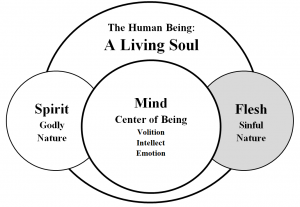
With the understanding that the human being is a living soul consisting of spirit, mind and body, let’s take a closer look at the two opposing facets of human nature—flesh and spirit
Body (Soma) and Flesh (Sarx)
The Biblical Greek for “body” is soma (e.g. 1 Corinthians 6:19). This word can also refer metaphorically to the sinful nature:
For we know that the old self was crucified with him so that the body (soma) of sin might be done away with, that we should no longer be slaves to sin.
Romans 6:6
The Greek word for “flesh” is sarx. Although sarx is most frequently used in the Bible in reference to the literal flesh of a person (e.g. John 3:6), it is often figuratively used in reference to the sinful nature. In such cases the New International Version understandably translates sarx as “sinful nature”:
I know that nothing good lives in me, that is, in my sinful nature (sarx). For I have the desire to do good, but I cannot carry it out.
Romans 7:18
The acts of the sinful nature (sarx) are obvious: sexual immorality, impurity and debauchery; (20) idolatry and witchcraft; hatred, discord, jealousy, fits of rage, selfish ambition, dissensions, factions (21) and envy; drunkenness, orgies, and the like. I warn you, as I did before, that those who live like this will not inherit the kingdom of God.
Galatians 5:19-21
Both of these examples show sarx—“flesh”—being used as a metaphor for our carnal, sinful nature. In the first text Paul says that “nothing good lives in” his sarx. He’s obviously not talking about his body here. Likewise the second passage reveals the various sinful manifestations of the sarx.
Because sarx—“flesh”—plainly refers to the sinful nature in such cases, I use “flesh” and “sinful nature” interchangeably throughout this study.
Soma (body) and sarx (flesh) seem to be very closely related in Scripture:
And in him (Christ) you were also circumcised with a circumcision made without hands, in the removal of the body (soma) of the flesh (sarx) by the circumcision of Christ.
Colossians 2:11 (NASB)
Soma (body) and sarx (flesh) are so closely related in this passage that the NIV translators decided to translate them both simply as “sinful nature:”
In him you were also circumcised in the putting off of the sinful nature (soma/sarx), not with a circumcision done by the hands of men but with the circumcision done by Christ.
Colossians 2:11
The conclusion we draw from this biblical information is this: Although body and flesh are not technically one and the same, it’s obvious that the flesh—the sinful nature—is most closely related to the body rather than mind and spirit. In fact, the Bible tends to use body and flesh interchangeably. Because of this, I will do the same in this study.
The Human Spirit
Even though the flesh is most closely related to the body in Scripture, we know that it is somehow interwoven with the mind as well. We know this for certain because, if the sin nature were merely a condition of the body, then physical death would be the ultimate and absolute solution to humanity’s sin problem. Needless to say, this would render Christ’s death for humanity’s sins pointless.
So the flesh is somehow interwoven with the mind, but it also renders the spirit dead to God. Jesus thus taught that the first step in solving our sin problem is to have a spiritual rebirth. The human spirit must be regenerated. Once the spirit is born-again and becomes a “new creation” the mind needs to be “renewed” and trained so that it submits its will, intellect and emotions to the spirit and not to the flesh. This is the second step. The third and final step to solving the sin problem is to receive a new imperishable glorified body.
Before we get into all that, let’s define specifically what the human spirit is and what it desires to do.
The Koine Greek word for “spirit” is pneuma (NYOO-mah), which corresponds to the Hebrew ruwach (ROO-ahk). We’ve already seen in Scripture that the human spirit is that part of our being that “delights in God’s law.” It is that part of our nature that inclines toward what is positive, productive and godly. We could also add that the human spirit is that facet of our being that is aware of a spiritual dimension to reality and thus naturally attempts to “connect” with that dimension. Only this spiritual side of our being can know of God and desire to connect with Him because, as Jesus pointed out, “God is spirit” (John 4:24). Since the flesh is our “sinful nature,” we could properly define our spirit as our “godly nature.”
Both the non-believer and the spiritually born-again believer have a human spirit. The difference is that the non-believer is spiritually dead to God whereas the born-again believer is spiritually alive to God. Because born-again Christians are spiritually alive to the LORD they can have a relationship with Him, but because non-believers are spiritually dead to the Creator it is impossible for them to have a relationship with Him.
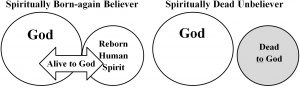
Non-Christians indeed have a spirit and therefore can be aware of God (or a spiritual dimension) and desire to “connect” with God (or the spiritual dimension) but they cannot connect with Him and have a relationship unless they are spiritually born-again. This universal attempt by humanity to connect with God (or a spiritual dimension) explains the existence of the world’s numerous religions. Because we have a spiritual side to our being, human beings are—as a race—incurably religious.
The difference between religion and biblical Christianity is that religion is humanity’s attempt to connect with God, whereas Christianity is God connecting with humanity. Religion is humanity’s way, but biblical Christianity is God’s way. Although it is certainly commendable that religious people are aware of a spiritual dimension to reality, and are attempting to connect with it—as they understand it—their attempt to connect with the Creator ultimately fails because they are spiritually dead to Him. It is therefore, once again, impossible for them to have a relationship with Him. This is why when Jesus’ disciples asked him who could be saved, he said: “With man this is impossible, but not with God; all things are possible with God.” (Mark 10:27). You see, salvation through the flesh—through religion—is impossible. But with God it’s not only possible, it’s available to all. That’s Christianity—real Christianity, not the counterfeit legalism.
The Human Spirit must be “Born Again” to Connect with God
Biblical Christianity teaches that, in order to successfully connect with God and have a relationship with Him we need to be spiritually regenerated. As Jesus plainly taught:
“I tell you the truth, no one can see the kingdom of God unless he is born again.”
(5) “I tell you the truth, no one can enter the kingdom of God unless he is born of water and the Spirit. (6) Flesh gives birth to flesh, but Spirit gives birth to spirit.”
John 3:3,5-6
Jesus makes it clear in verse 3 that, in order to have a relationship with God, we must be “born again.” In verse 6 he clarifies specifically what kind of rebirth we need—spiritual rebirth. When a person is spiritually born again the Holy Spirit gives birth to a new human spirit—the spiritual facet of his or her being is born anew! This is the “new creation” that Paul writes about:
Therefore, if anyone is in Christ, he is a new creation; the old has gone, the new has come.
2 Corinthians 5:17
“New Creation” in the Greek literally means “a new species of being which never existed before.” The born again spirit is “God’s workmanship” (Ephesians 2:10) “created to be like God in true righteousness and holiness” (Ephesians 4:24). The intrinsic character of the new born-again spirit is righteous and holy, just as God is righteous and holy. When the apostle Paul spoke of the “treasure in jars of clay” that he and other born-again believers have, he was referring to the new born-again spirit, which is housed in the body or “jar of clay” (2 Corinthians 4:7).
I’m always amazed when I come across believers who either play down spiritual rebirth or deny it altogether when it’s actually a fundamental Christian doctrine (see Titus 3:3 and 1 Peter 1:23).
The Mind Needs Renewed – Trained to Live by the Born-Again Spirit
Once a person’s spirit is born anew something has to be done with the mind and body, the two remaining facets of the human soul:
Therefore, I urge you, brothers, in view of God’s mercy, to offer your bodies as living sacrifices, holy and pleasing to God – this is your spiritual act of worship. (2) Do not conform any longer to the pattern of this world, but be transformed by the renewing of your mind. Then you will be able to test and approve what God’s will is – his good, pleasing and perfect will.
Romans 12:1-2
You were taught with regard to your former way of life, to put off your old self [flesh], which is being corrupted by its deceitful desires; (23) to be made new in the attitude of your minds; (24) and to put on the new self [born-again spirit] created to be like God in true righteousness and holiness.
Ephesians 4:22-24
After a person is spiritually born again, his or her body needs to be offered to God as a “living sacrifice.” This means that we make a conscious decision to no longer offer the parts of our body to sin as instruments of unrighteousness but to God’s service as instruments of righteousness (Romans 6:13,19). This simply means we turn away from—repent of—behaviors that God informs us are unproductive or negative and start putting into practice positive and productive behaviors approved of Him. Repentance should never be viewed as a negative thing as it essentially means “to change for the better.”
As far as the mind is concerned, it needs to be “renewed.” As we are faithful and diligent to “be made new in the attitude of our minds” we will start to be “transformed.” “Transformed” is the Greek word metamorphoo (met-ah-mor-FOH) which means “to change into another form.” This is obviously where we get the English word metamorphosis. Just as an ugly worm-like caterpillar is transformed in its cocoon and emerges as a beautiful butterfly, so a wondrous metamorphosis will take place in our lives as we renew our minds.
The second passage above shows how to successfully do this: We put off the “old self”—the flesh—by stop setting our minds on this carnal side of our being. Instead we put on the “new self”—the born-again spirit “created to be like God in true righteousness and holiness”—by training our minds to live according to our born-again spirit:
Those who live according to the sinful nature have their minds set on what that nature desires; but those who live in accordance with the spirit have their minds set on what the spirit desires. (6) …the mind controlled by the spirit is life and peace.
Romans 8:5-6
There’s so much life, energy and peace when we train our minds to live according to our new born-again spirits as led of the Holy Spirit! Speaking of which, Ephesians 3:16 and Romans 8:16 show that the Holy Spirit indwells the believer’s regenerated spirit. The only reason the Holy Spirit can do this is because our reborn spirit was “created to be like God in true righteousness and holiness,” as shown in Ephesians 4:24. Chew on that.
When we successfully learn to be spirit-controlled the born-again spirit acts as a sort of “sixth sense,” tuning us in to God and enabling us to perceive reality from the “divine viewpoint.” People who are spiritually dead are limited to their five senses and consequently only perceive reality from the “human viewpoint” (sadly, this is also true of many legitimately born-again Christians who fail to train their minds to live according to their new born-again spirits). Intimate knowledge of God can only be attained through this sixth sense. With this understanding, it becomes increasingly clear why Jesus stressed that we must be spiritually born again to “see the kingdom of God.”
It should be every Christian’s goal and desire to be spirit-controlled; unfortunately, many never adequately learn to do this. They instead settle for being body-ruled Christians, thus cutting themselves off from the divine viewpoint and limiting themselves to the human perspective. A more common name for this is “carnal Christian.” Of course there are degrees to this limiting condition and not every carnal Christian is frothing at the mouth with extreme iniquity, but they are body-ruled and therefore impeded from the divine viewpoint. Carnal Christians can become so hardened in heart by their sin that they naturally become hostile toward God and Christianity. As it is written:
The sinful mind is hostile to God. It does not submit to God’s law, nor can it do so. (8) Those controlled by the sinful nature cannot please God.
Romans 8:7-8
Some body-ruled Christians become so hardened in heart by their sin that they end up denying Christ (!!). This is the ultimate result of unrepentant and deceptive sin—it destroys your relationship with God. This is spiritual death—being dead to God—and explains why the Bible says: “The mind governed by the flesh is death” (Romans 8:6).
It should be pointed out that it takes time and effort to properly train the mind to habitually live according to the new born-again spirit with the help of the Holy Spirit. Most Christians will naturally need support from more mature brothers and sisters to learn to do this. In fact, the very reason God appoints and anoints spiritually mature believers to ministerial positions—like pastor, teacher or prophet—is so that believers might be encouraged and equipped to successfully discern and fulfill God’s will for their lives (see Ephesians 4:11-15).
The Positive Nature of the Flesh when Submitted to the Spirit
Allow me to add one important detail on this matter: When the mind is properly controlled by the spirit (which is, in turn, led by the indwelling Holy Spirit) the appetites and inclinations of the body actually become a positive force in a person’s life. This is naturally because the body is properly submitted to the spirit-led mind.
To illustrate, consider the sexual appetites of the body. If, in our mind, we choose to be flesh-ruled, the sexual appetite can be very destructive. For instance, unbridled sexual lust can lead us into fornication, adultery and perversion resulting in broken relationships, broken families, illegitimate children, horrible diseases, prison and even death. Yet when we choose to allow our mind to be spirit-led, our natural sexuality becomes a very positive and productive force in our lives. There’s nothing inherently wrong, for example, with the God-given male sex drive. The sex drive submitted to the spirit will compel a man to find a suitable wife, physically love her and produce children.
Another good example would be anger. Anger stems from our carnal nature. We all realize that uncontrolled anger can be quite destructive, even provoking people to murder. Yet, when we choose to allow our minds to be spirit-led rather than body-ruled, anger can be utilized for righteous and productive purposes, rather than childish temper tantrums. A mother’s anger over drunk driving is a fitting example; her anger, properly submitted to the spirit, will compel her to seek social justice. Or consider the biblical example of Jesus when he, in righteous anger, got out a whip (!) and drove everyone out of the temple—overturning tables, scattering coins and yelling (see John 2:13-17 and Mark 11:15-18). Needless to say, the common assumption that a good Christian must be a spineless doormat for other people is a lie. There’s something called tough love and it’s thoroughly biblical.
The Heart: The Core of the Mind
Many scriptural passages speak of the human “heart” (e.g. Mark 7:6,21). What exactly is the heart? And how does it fit into the biblical model of spirit, mind and body?
The Greek word for “heart” is kardia (kar-DEE-ah), which is where we get the English ‘cardiac.’ Like the English word “heart,” kardia literally refers to the blood-pumping organ but figuratively to the core thoughts or feelings of a person’s being or mind (Strong 39). E.W. Bullinger describes the heart as “the seat and center of man’s personal life in which the distinctive character of the human manifests itself” (362). The heart could therefore be best described as the core of the mind, the center of our being. It is part of the mind, but specifically refers to the deepest, most central part, i.e. the core.
What’s in your heart is determined by whether your mind has decided to live by the flesh or by the spirit. Jesus said, “The good man brings good things out of the good stored up in his heart, and the evil man brings evil things out of the evil stored up in his heart. For out of the overflow of the heart the mouth speaks” (Luke 6:45). If we, in our mind, decide to dwell on carnal thoughts, then carnal, negative, destructive things will naturally store up in our heart. If, on the other hand, we choose to dwell on spiritual thoughts, then good, positive, productive things will store up in our heart. The paraphrase of Proverbs 4:23 puts it like this: “Be careful what you think for your thoughts run your life” (NCV). Take heed—truer words have never been spoken!
Here’s a visual on how the heart fits into the biblical model of human nature:
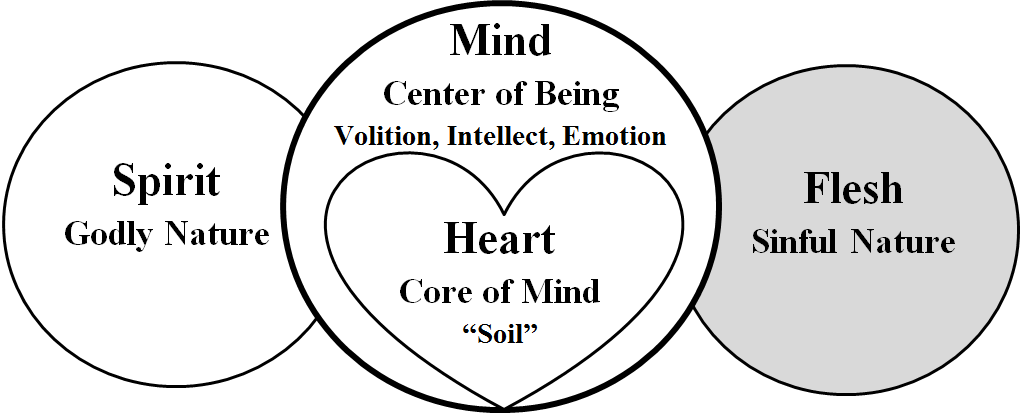
Notice that the heart is the core of your mind and is figuratively called “soil.” Why? Because the Bible likens the heart to soil (Luke 8:15). Soil in the natural is a neutral substance that grows whatever seed is planted in it. This is the way it is with the soil of your heart, except that it grows non-physical “seeds,” whether spiritual or unspiritual.
By “seeds” I mean thoughts, impulses, desires, images or impressions. Dwelling on these “seeds” waters them, so to speak, and thus enables them to nurture. In short, your meditation feeds them; and that is how they grow. Whatever grows in your heart is what eventually fills your heart and produces the desires thereof. These desires of your heart then determine your actions, good or bad.
Has someone ever offended you and you dwelt on it so much that you made more of it than what it was? When the issue was finally resolved, you realized that you made a mountain out of a mole hill. How did this happen? Simple: You fed the offense with your thought life and thus it grew. As you kept thinking about it, the bigger the problem got. This principle goes into motion with any impulse you choose to focus on and give life to, whether of the spirit or of the flesh.
The bottom line is that we decide what’s stored up in our hearts depending on whether we’re governed by the flesh or spirit.
I think it’s important to point out that carnal and crazy thoughts will at times flash through your mind; yet this doesn’t mean these thoughts are stemming from your heart. Having carnal and crazy thoughts flash through the mind is natural to the human experience; in other words, if you’re human, it will happen. Sometimes you may even be bombarded with such thoughts. These thoughts may originate from the flesh, unclean spirits, ungodly people, the environment you’re exposed to, or otherwise, but just because such thoughts flash through your mind it does not mean they’re in your heart. These thoughts are not you, and are not originating from your heart; but they can become you if you allow them to get lodged in your heart by dwelling on them and giving them life. Such thoughts should just be ignored or, if that doesn’t work, taken “captive” and made “obedient to Christ,” the Word of God (see 2 Corinthians 10:3-5). Otherwise they will become a weed with the potential of growing into a big, ugly tree of destructive bad fruit (e.g. bitterness, immorality, frustration, sloth, depression, arrogance, abuse, gossip/slander, rage, etc.).
The Resurrection Body: Imperishable, Glorified, Powerful & Spiritual
Even the most mature spirit-led Christian will fail to reach perfection as long as he or she dwells within a perishable flesh and blood body. Absolute escape from the sin nature will not be complete until the resurrection where God’s people will receive a new imperishable, glorified, powerful and spiritual body:
(35) But someone will ask, “How are the dead raised? With what kind of body will they come?”
(42b) The body that is sown is perishable, it is raised imperishable; (43) it is sown in dishonor, it is raised in glory; it is sown in weakness, it is raised in power; (44) it is sown a natural body, it is raised a spiritual body.
1 Corinthians 15:35, 42b-44
This passage describes the new bodies that born-again Christians will receive at the resurrection of the righteous, which takes place in stages, as detailed in here. It should be emphasized that this passage contextually only refers to spiritually born-again believers, not spiritually dead pagans. The latter will of course be resurrected later in order to be judged and “If anyone’s name is not found written in the book of life, he [will be] thrown into the lake of fire” (Revelation 20:11-15).
One of the best benefits of this new body will be that it will not have a flesh; that is, a sin nature. That’s why it’s called a spiritual body. Granting us such new bodies is God’s final measure in our obtaining freedom from sin. The power of sin and death will be “swallowed up in victory” (1 Corinthians 15:54-57)!
The above passage describes these new bodies as imperishable, glorified, powerful and spiritual in nature. We obviously know what “imperishable” means—our new bodies will never die (i.e. we will possess unconditional immortality); but what exactly do the other descriptive words mean? We of course don’t have all the answers since we presently “see through a glass darkly,” but to take a peek at how wondrous it will be in our new bodies, all we have to do is observe what the Bible says about Jesus after his resurrection. After all, we’re going to receive the same type of resurrection body he did. In light of this, we’ll evidently be able to walk through locked doors (John 20:26), instantly appear out of nowhere (Luke 24:36-37) and disappear (24:31). With this understanding we’ll no doubt be able to take instant “quantum leaps” to anywhere on the new earth or new universe—including planets and galaxies millions of light-years away. I personally find this extremely invigorating and excitedly look forward to it (unlike the traditional boring concept of living on a cloud playing a harp forever).
Spiritual Death Leads to Absolute Death (i.e. the Second Death)
The strongest proof that the born-again believer is spiritually alive to the LORD—and, by extension, the non-believer is spiritually dead to God—can be found in 1 Corinthians 6:17 and this passage:
You, however, are controlled not by the sinful nature but by the spirit, if the Spirit of God lives in you. And if anyone does not have the Spirit of Christ, he does not belong to Christ. (10) But if Christ is in you, your body is dead because of sin, yet your spirit is alive because of righteousness.
Romans 8:9-10
The key statement for our subject is verse 10: “If Christ is in you… your spirit is alive”. The obvious implication is that, if the human spirit of a spiritually born-again believer is alive, the human spirit of a non-believer must be dead.
As noted in Chapter Six of HELL KNOW, spiritual death is a present state in the non-Christian’s life. They are spiritually dead to God and this explains why Paul described the Ephesian & Colossian believers as being “dead in their sins” before they accepted the Lord (see Ephesians 2:1 and Colossians 2:13). These believers were spiritually dead before their born-again experience. This is in contrast to all the many scriptural texts examined in HELL KNOW which clearly state that the second death—the literal destruction of soul and body in hell—is an experience that will take place in the future. In other words, the second death is not a present state but a future experience that will eventually occur, but only if the individual fails to reconcile with God and receive His gracious gift of eternal life.
We see this contrast between spiritual death and the second death in Romans 8:10 and 8:13. Romans 8:10 (above) clearly implies, once again, that the spirit of a non-believer is presently dead. Notice what Paul says about the second death a mere three verses later:
For if you live according to the sinful nature you will die; but if by the Spirit you put to death the misdeeds of the body, you will live.
Romans 8:13
Do you see the clear contrast between spiritual death and the second death here? Paul says that people who choose to live according to the flesh will eventually have to reap the wages of their actions and die. This is the second death—absolute destruction of soul and body in hell. This, again, is a future event, not a present state.
The bottom line is that spiritual death ultimately results in absolute death. That’s why God sent His Son so that “whoever believes in him shall not perish but have eternal life” (John 3:16).
Can Non-Christians Live by their Un-regenerated Human Spirit?
The material we’ve been covering so far brings up an interesting question: Can a person who is spiritually dead to God train his or her mind to live according to his/her (unregenerated) human spirit? Absolutely, and this explains the many non-Christian people we run into regularly who display noble characteristics even though their spirit is dead to God.
We have to remember that Adam didn’t eat of the tree of the knowledge of evil; he ate of the tree of the knowledge of good and evil (see Genesis 2:17 and 3:11-12). The entire human race, as Adam’s descendants, therefore possesses the capacity for both good and evil. However, even though we have the capacity for good, Adam passed on to us a sin nature (flesh)—the carnal proclivity to rebel against good, i.e. God’s righteous laws (Romans 7:12). As already determined, this sinful nature is largely a condition of the body, but negatively affects the rest of our being as well. As such, the unbeliever’s spirit is rendered dead to God—incapable of connecting with the Creator, unless it is born-again of the Holy Spirit via the seed (sperm) of Christ (1 John 3:9).
Because Adam ate of the tree of the knowledge of both good and evil, most people who are not spiritually regenerated are a mishmash of spiritual and carnal qualities; that is, they possess both good and bad traits.* Only a relatively small number of unbelievers could be designated as wholly wicked; and even they no doubt have some good qualities. (Although I sometimes wonder how “good” people would be if there were no human laws to keep them in check;** in other words, if they could “get away” with raping, murdering or stealing, would they do it? Only God knows their hearts).
* Spiritually born-again believers are also a mishmash of both good and bad traits; I’m not suggesting otherwise, but our topic here is individuals who are not spiritually reborn.
** If people don’t fear God’s law, the only law they have left to fear is human law; but if there’s no human law to constrain their lower impulses they would naturally have nothing to fear. This would be the ultimate test of character.
In any event, we regularly come across non-Christian individuals who are quite developed in character. Even though they’re spiritually dead to God, they appear to be humble, intelligent, loving, positive, moral, compassionate, etc. Such people have somehow trained their minds to live according to their spirit which, even though it’s dead to God and thus in dire need of regeneration, is still the facet of their being that inclines toward what is positive, productive and godly, as opposed to the flesh which veers toward negativity, destruction and perversion.
There’s always some training or discipline that enables people to do this. It could simply be the result of how they were raised, in which case they were trained by their parents or guardians to be loving and moral. It could also be the result of their exposure and submission to various “disciplines;” for example, religion, meditation, martial arts and generally positive philosophies, such as Sciencefictionology. Such disciplines could be considered good in that they inspire people to be the best that they can be, yet they ultimately fail to solve the sin problem and reconcile people to their Creator. For this reason they have the potential for harm as these disciplines can delude people into thinking they can attain righteousness by their own efforts or works without spiritual regeneration. This notion is rooted in human pride and arrogance, sins the LORD “hates” (Proverbs 8:13).
The message of the Bible is that humankind is cursed with a sin nature and a spirit that is dead to God. Thus no amount of human effort to attain righteousness can adequately remove our sinfulness and reconcile us to the Almighty. Although it is certainly commendable that a person makes a conscious decision to live by his/her spirit, in a sense it’s all flesh to God because the sin nature has tainted the human spirit and rendered it dead. It is utterly incapable of doing what it was originally designed to do—commune with God. Theologians refer to this as “total depravity;” not that human beings are as bad as we could possibly be, but that we are unable to contribute to our salvation in any way because we are spiritually dead in our fallen condition. The obvious exception is humble repentance & faith in response to the gospel (Acts 20:21).
It should be added that there is a danger in attempting to live out of the un-regenerated spirit. Anyone who does so will naturally become increasingly in tune with the spiritual realm. The problem with this is that there are both good and evil spirits. If a person’s spirit is dead to God it naturally stands to reason that the spiritual realm they’re more prone to get in tune with would not be of God. Unless intercessory prayer is made on their behalf—releasing the Holy Spirit to draw them to God—they are vulnerable to the deception and misleading of impure spirits. This is how false religions and philosophies develop. Their message is always the same: There’s another way to God besides the gospel of reconciliation through Christ. Perhaps the ultimate satanic deception is that humankind can somehow attain righteousness apart from God’s gift of righteousness in Christ. As already pointed out, this notion—that we can be good without God, that we don’t need our Creator—is rooted in human arrogance. Thus the human attempt to be righteous apart from God is a fleshly stench to the all-knowing LORD who knows the secrets and motivations of the heart.
The popular message of the day is that there are many paths to God, none superior to any other, so what I’m teaching here will be rejected by those who embrace the spirit of this age. The bottom line is that God loves the whole world and has provided a way to spiritual regeneration, reconciliation and eternal life. Let’s be wise and go with God’s way (biblical, Spirit-led Christianity), and reject man’s way (religion). Amen?
So, to answer the question, can spiritually un-regenerated persons learn to live out of their human spirit and consequently produce good works and develop in character? Certainly. This is commendable, but whatever discipline they follow ultimately fails to heal their sinful condition and reconcile them to the LORD. This is “total depravity.”
“Spirit” and “the Breath of Life”
Take a deep breath (no pun intended) because this is where the topic gets a little confusing due to the limitations of human language, which I’ll explain later. Stick with me and it will all make perfect sense.
In our study we’ve determined that the human spirit is the facet of human nature that is opposed to the flesh; it is the part of our being that compels us toward what is positive & godly and inspires our desire to connect with our Creator. It should be pointed out that in certain contexts ‘spirit’ refers to “the breath of life.” The breath of life could also be referred to as the spirit of life because “breath” is translated from the same Hebrew and Greek words for “spirit”—ruwach and pneuma respectively.
The “breath of life” describes the human spirit on the most basic level as separate from mind and body: The human spirit is essentially a breath of life from God. As such, the breath of life is not our being; it is the life force from God that gives consciousness to our being. In other words, the very reason we have consciousness is because of the breath of life, but the breath of life is not our consciousness.
We could draw a parallel to the human body. The body is the facet of human nature that enables our being to dwell in the physical realm. It is indeed a part of our being, but it is not our consciousness, rather it enables our consciousness to dwell in the physical realm. Separate from spirit and mind, the body is just a carcass, a slab of nonliving flesh. This is what the body is on the most basic level separate from spirit and mind. Likewise, separate from mind and body, the human spirit is simply a breath of life from God.
We’ve discovered from the Scriptures that the mind is the center of our being. Our mind has the power of will and therefore makes decisions. The mind is also the emotional and intellectual seat of our being; we therefore feel and reason with our mind.
The breath of life gives consciousness to the mind, the center of our being. The breath of life, or spirit of life, could thus be described as the animating spiritual life force from God. You see, our being consists of material and immaterial facets, physical and non-physical. Our immaterial being is our mind (disembodied soul). We could describe the mind as spiritual in nature and substance. Our spiritual being (mind) requires a spiritual breath of life to live just as our physical being requires a physical breath of life to live. In fact, “breath of life” often refers simultaneously to both spiritual and physical breath in the Scriptures. This will be made clear as we continue.
The Scriptures reveal that animals have a breath of life just as human beings do. We could therefore say that animals have a spirit, yet only in the sense that they have a breath of life. They certainly don’t have a spirit in the sense that they possess a godly nature. The human being, as God’s highest order of living creature on earth was created in God’s image. Our spiritual makeup therefore prompts a desire to connect and commune with God and drives us toward goodness and productivity. The human spirit is endowed with this “godly nature.” This is a fact whether the spirit is born-again or not. All the passages we’ve looked at so far on the human spirit refer to this godly nature (e.g. Matthew 26:41). The passages we will now address refer to the breath of life.
Two words are used for ‘breath’ in the phrase “breath of life”: The Hebrew word ruwach, which corresponds to the Greek pneuma, and the Hebrew word neshamah (nesh-aw-MAW). Neshamah, like ruwach/pneuma, can refer to “breath,” “wind” or “spirit.” *
* Although neshamah rarely refers to the human spirit’s godly nature, it does so in Proverbs 20:27.
So ruwach/pneuma and neshamah are basically interchangeable words. Let’s turn to Genesis 7 to observe biblical support for this:
Pairs of all creatures that have the breath (ruwach) of life in them came to Noah and entered the ark.
Genesis 7:15
Everything on dry land that had the breath (neshamah) of life in its nostrils died. (23) Every living thing on the face of the earth was wiped out; men and animals… Only Noah was left, and those with him in the ark.
Genesis 7:22-23
The first text refers to the animals that accompanied Noah to his ark. They had “the breath of life.” The second text refers to every living thing on earth that had “the breath of life”—human and animal—that died as a result of the flood. This is plain evidence that ruwach and neshamah are used interchangeably in the Bible.
These two passages clearly show that animals as well as humans have the breath of life. This proves that the breath of life cannot be a reference to the human spirit’s “godly nature” because the animal spirit possesses no such nature. This is what distinguishes animalkind from humankind: The human spirit, which is created in the image of God, possesses a godly nature whereas the animal spirit is merely a breath of life, an animating life force from the Creator. Because the human spirit is endowed with a godly nature, people possess an inherent inclination toward goodness, productivity and godliness; which is contrasted by the carnal nature, the inclination toward destruction, negativity and evil.
Animals of course have neither a spirit (godly nature) nor flesh (sinful nature). Animals are instinctual creatures that live and act by instinct. Their actions are therefore neither good nor evil, unlike human beings. Chapter Four of Hell Know offers scriptural proof that the same Hebrew and Greek words for “soul” (nephesh/psuche) are used in reference to animals in the Bible. Biblical translators usually render nephesh/psuche as “creature(s)” or “thing” in such cases (see for example Genesis 1:20,24 and Revelation 8:9 & 16:3). In these contexts “soul” (nephesh/psuche) must be defined in its broadest sense as “a living being.” Like humans, animals are living beings or living souls, but unlike humans they lack both a spiritual dimension and carnal dimension. In other words, animals are living souls but they do not have a spirit or flesh—a godly nature or sinful nature. Because they lack the higher spiritual dimension inherent to people, animals are unaware of the existence of God and lack the ability or desire to commune with Him.
In light of this, whenever the Hebrew word for “spirit”—ruwach—is used in reference to animals in the Scriptures we know it always refers to the breath of life, the animating life-force of the Almighty that enables them to live. This is the extent and limit of their spiritual dimension. Let’s observe support for this:
“I [God] am going to bring floodwaters on the earth to destroy all life under the heavens, every creature (nephesh) that has the breath (ruwach) of life in it. Everything on earth will perish.”
Genesis 6:17
This verse describes both animals and humans as nephesh (“creatures”), which is the Hebrew word for “soul;” and then goes on to state that these creatures (souls) have the “breath of life.” “Breath” here is the Hebrew word for ‘spirit,’ ruwach. Since ruwach is used in reference to both animals and humans we know it refers to the breath of life, the animating life force from the Almighty that sustains all living creatures, and not to what we understand as the human spirit’s godly nature, the human inclination toward goodness and godliness. Animals, once again, do not have a spirit as such. Keep in mind that “breath” in this passage simultaneously refers to physical breath, which we’ll look at in a moment.
All this is made clear in this passage from Psalm 104, which contextually refers to animals of all kinds (see verses 17-25) and, in fact, includes human beings as well (verse 23):
Thou [God] dost take away their spirit (ruwach), they expire. And return to their dust.
(30) Thou dost send forth thy spirit (ruwach), they are created;
Psalm 104:29b-30a (NASB)
This text plainly shows that all animals are created by a ruwach from God (verse 30) and expire when God takes this ruwach away. *
* Many translations translate ruwach in verse 30 as “Spirit” (capitalized) giving the impression that the verse refers to God’s Spirit; but let’s remember that there is no capitalization in the original Hebrew. With this understanding, it is clear that ruwach in verse 30 refers to the same ruwach referred to in verse 29, that is, the breath of life—the spiritual animating life force of the Almighty. See the NRSV rendition of this text and the accompanying footnote for support.
Animals do not have a spirit in the sense of a godly nature as humans do, but both animals and humans have a spirit in the sense of a breath of life that animates and sustains them; and that’s what ruwach in this passage is referring to. This is why most other translations do not translate ruwach as “spirit” in verse 29, but as “breath” (see for example the NIV, KJV and NRSV).
Let’s observe another passage:
Man’s fate is like that of the animals; the same fate awaits them both: As one dies so dies the other. All have the same breath (ruwach); man has no advantage over the animal. Everything is meaningless.
Ecclesiastes 3:19
This is an enlightening verse. It says that both humans and animals have “the same ruwach.” While there is the possibility that ruwach in this verse is referring to mere physical breath, we will see momentarily why this conclusion must be ruled out. Ruwach here, again, refers to the breath of life—the animating spiritual life force from God—and not to what we understand as the human spirit’s godly nature. This is obvious for two reasons: 1. The text plainly states that both humans and animals have the same ruwach. Since animals don’t have a spirit (ruwach) in the sense that humans have a spirit (ruwach), ruwach in this passage must refer to the breath (ruwach) of life because we know from other passages that both humans and animals are sustained by a “breath of life.” 2. Notice that the text says that both humans and animals have “the same ruwach.” All creatures have the same animating life force from the Almighty—the same spiritual breath (ruwach) of life. This ruwach of life is a depersonalized life force. In other words, it is the spiritual life force that gives life to the person, but is not itself the person; it gives consciousness to the being but is not the consciousness of the being. It’s comparable to electricity that lights up a lamp: The electricity enables the lamp to have light, but the electricity is not the lamp’s light. Furthermore, when the lamp is unplugged and loses its source of electricity, its light expires. The same is true in regards to God’s breath (ruwach) of life; as the aforementioned Psalm states, “Thou [God] dost take away their spirit (ruwach), they expire” (104:29 NASB).
Two verses later, in Ecclesiastes 3:21, the writer of the book speculates on where the spirit of a person and the spirit of an animal go after death: “Who knows if the spirit (ruwach) of man rises upward and if the spirit (ruwach) of the animal goes down into the earth?” It’s once again obvious that ruwach here refers to the breath of life and this is why the NASB translates ruwach as “breath” in this passage (even though most others translate it as “spirit”). This verse gives evidence that the writer was not referring to mere physical oxygen—in both this passage and verse 19 above—since it would be ludicrous to argue whether oxygen “rises upward” or “goes down into the earth.” What then is the writer trying to express by this question? He’s simply pointing out that, from a purely natural viewpoint (“under the sun”—the perspective of Ecclesiastes), human beings appear to be little different than the animals and both ultimately perish from this plane of existence. In reality, however, the human soul, unlike the animal soul, is created in the image of its Creator and thus possesses a higher spiritual dimension enabling us to be aware of our Creator and desire to commune with Him.
“The Breath of Life” – The Animating Spiritual Life Force from God
Continuing our study on the breath of life, let’s turn to “the creation text” once again to observe how the breath of life figures into God’s creation of human beings:
The LORD formed the man from the dust of the ground and breathed into his nostrils the breath (neshamah) of life, and the man became a living being (nephesh).
Genesis 2:7
We see here that God formed the body of man out of the essential chemical elements of the earth and breathed into his nostrils the breath of life and thus he became “a living soul.” Earlier in this appendix we saw that nephesh, the Hebrew word for “being” or “soul,” can refer more specifically to the body. You see, a body without the breath of life is a dead soul (nephesh), but, as seen above, a body with the breath of life is a living soul (nephesh). As such, it’s obvious that it’s the breath of life—God’s spiritual life force—that animates the mind or soul and enables us to actually live (the body, once again, is merely the facet of human nature that enables us to function in the physical realm). Elihu makes this clear:
“If it were His intention and He withdrew His spirit (ruwach) and breath (neshamah),
(15) all mankind would perish together and man would return to the dust.” *
Job 34:14-15
* Elihu’s words are reliable, as he is a type of Christ. The biblical support for this is as follows: 1. Elihu claimed to be “perfect in knowledge” (Job 36:4) whereas only the LORD is “perfect in knowledge” (37:16); the Lord, as well as Job and his three friends, would have certainly rebuked Elihu for this seemingly arrogant statement if, in fact, it were not true; 2. Elihu’s questioning rebuke to Job in 37:14-23 coincides perfectly with the LORD’s questioning rebuke to Job in chapters 38-41; 3. God rebuked Job because he “spoke words without knowledge” (38:1-2), as did Elihu (35:16); 4. Job would not or could not respond to Elihu’s rebuke (as he was sure to do with each of his three friends); 5. God rebuked Job (38:1-3; 40:1-2 & chapters 38-41) and his three friends—Eliphaz, Zophar and Bildad (42:7-9)—for their error, but He never rebukes or even mentions Elihu. Apparently Elihu was right and just in God’s eyes; 6. Like Christ, Elihu acted as the mediator between God and man: Elihu spoke after Job and his three friends and before God (mediating between the two); 7. Elihu righteously showed no partiality and refused to flatter (32:21).
We see here further proof that ruwach and neshamah are used interchangeably; although in this specific passage ruwach would refer to God’s spiritual breath—his animating life force—and neshamah would refer to physical breath. God’s spiritual breath of life animates the mind (disembodied soul) which in turn animates the body; and the body is physically sustained by physical breath. The ruwach breath of life could be viewed as the spiritual counterpart to the physical neshamah breath of life. Just as our physical body needs air to live and function, so our disembodied soul—our mind—needs spiritual breath to live and function. Just as physical breath is not a person; neither is spiritual breath a person.
Greek and Hebrew scholar, W.E. Vine, helps us to understand this relationship between the breath of life, the disembodied soul (mind) and the body: “The spirit may be recognized as the life principle bestowed on man by God, the soul as the resulting life constituted in the individual, the body being the material organism animated by soul and spirit” (Vine 589[68]). Keep in mind that when Vine refers to “spirit” he’s referring to the breath of life and when he refers to “soul” he’s referring to the mind.
Secondly, we see further proof that if God withdrew His breath of life all humanity would perish and our bodies would decay back to dust.
This is evident in this Psalm passage:
Do not put your trust in princes, in mortal men, who cannot save.
(4) When their spirit (ruwach) departs, they return to the ground; on that very day their plans come to nothing.
Psalm 146:3-4
Ruwach (“spirit”) here refers to the breath of life. When the breath of life departs, the human body merely decays into the ground.
At Death the Breath of Life Goes Back to God
So what happens to the breath of life when a person (or animal) dies? It merely goes back to God from whence it came. As it is written:
Remember Him [God]—before the silver cord is severed, or the golden bowl is broken; before the pitcher is shattered at the spring, or the wheel broken at the well, and the dust returns to the ground it came from, and the spirit (ruwach) returns to God who gave it.
Ecclesiastes 12:6-7
Verse 6 uses various metaphors to encourage us to think of our Creator before death inevitably overtakes us. Verse 7 then simply explains what happens to the human body and the breath of life when we die. The breath of life, once again, is the spiritual life force from God that animates the human being and makes it a living soul. The breath of life gives life to the mind/spirit in the human body. When an unredeemed person dies this depersonalized life force merely returns to the Creator who gave it. This is further proof that the breath of life is not just physical oxygen. When people die their physical breath simply returns to the atmosphere; there’s no need for it to return to God. Yet when we understand that the breath of life is a spiritual breath—an animating life force from God—it then makes sense that it returns to its source, the Giver of Life from which all life flows (Psalm 36:9).
The fact that the breath of life returns to God is evident in Elihu’s previously quoted statement: “If it were His intention and He withdrew His spirit and breath all mankind would perish together and man would return to the dust” (Job 34:14-15). The statement “If God withdrew His spirit and breath” implies that the breath of life will simply return to God who gave it.
Keep in mind, of course, that the writer of Ecclesiastes wrote this well before Jesus Christ died for our sins and was raised for our justification and, in the process, “destroyed death and brought life and immortality to light through the gospel” (2 Timothy 1:10). Consequently, believers who are born-again of the imperishable seed (Greek: sperm) of Christ (1 Peter 1:23; see 1:3 & 2:3 as well) don’t have to fear death since Jesus destroyed him who holds the power of death – the devil (Hebrews 2:14-15). When we physically perish we are ushered into the presence of the Lord, Praise God! Philippians 1:21-24, 2 Corinthians 5:8, Revelation 6:9-11 and 7:9-17 verify this beyond any shadow of doubt (go here for more details). Bear in mind, however, that this is only the “intermediate state” of believers between physical death and bodily resurrection, and is therefore a temporary condition. See the article Eternal Life — What will it be Like? for more details.
The Limitations of Human Language
Getting back to “the breath of life,” some readers may feel that I’ve gone into this issue a little too deeply, but it’s important for us to understand that the Hebrew and Greek words for “spirit” (ruwach and pneuma) can refer to either the human spirit or the breath of life in biblical passages pertaining to human nature. The passage and context will determine which of these ruwach and pneuma refer to. If we assume that ruwach and pneuma always refer to the human spirit, the part of human nature that is opposed to the flesh, then the Scriptures can become very confusing. For instance, we would have to conclude that animals have a spirit just like humans have a spirit. Yet, we must understand that when God inspired people to write the Scriptures by his Holy Spirit (2 Peter 1:20-21) he was limited to flawed human language. No human language is an exact science. Language is indeed a wondrous human creation, but it often makes little sense. We saw proof of this earlier in this appendix when we saw that the Hebrew word for “soul,” nephesh, can refer to a dead body, a living whole person (spirit, mind and body), or the immaterial facet of human nature (mind or mind & spirit). To further confuse the issue nephesh most often refers to “life” in the Bible. Needless to say, the definition of nephesh depends on the passage and its context. So it is with the Hebrew and Greek words for “spirit.”
The Greek Pneuma in Reference to the Breath of Life
Let us now turn our attention to the New Testament and observe occasions where the Greek pneuma obviously refers to the breath of life and not to the human spirit.
The following verse from Revelation is talking about God’s anointed two witnesses who were killed by “the beast” and laid dead in the street for three and a half days:
But after three and a half days a breath (pneuma) of life from God entered them, and they stood on their feet, and terror struck those who saw them.
Revelation 11:11
Pneuma, the Greek word translated as “breath” here, obviously refers to the breath of life—God’s animating life force—and not to the human spirit as described earlier in this appendix. The breath of life animates the mind and spirit, the disembodied soul, which in turn animates the body. The way this verse describes how God resurrects these two people coincides with how he gave life to Adam (Genesis 2:7) and how he miraculously brought to life a bunch of dry bones and flesh in Ezekiel 37:1-14 (a vision that the LORD gave Ezekiel).
Pneuma likely refers to the breath of life in this popular passage as well:
As the body without the spirit (pneuma) is dead, so faith without works is dead.
James 2:26
In light of the above-cited texts, it makes sense to regard pneuma here as a reference to the breath of life—the animating life force from God. If it is not a reference to the breath of life then we would have to conclude that pneuma in this case refers to the entire immaterial facet of human nature, mind and spirit (this is W. E. Vine’s interpretation [593]). It makes little difference however, as it is God’s breath of life that animates this immaterial facet of human nature which, in turn, animates the body.
Conclusion: The Biblical Definition of Human Nature
In light of all the scriptural data we have examined, human nature could best be defined as such: The human being is a living soul consisting of spirit, mind and body animated by a breath of life from God.
Here’s a diagram to illustrate this (click image to enlarge):
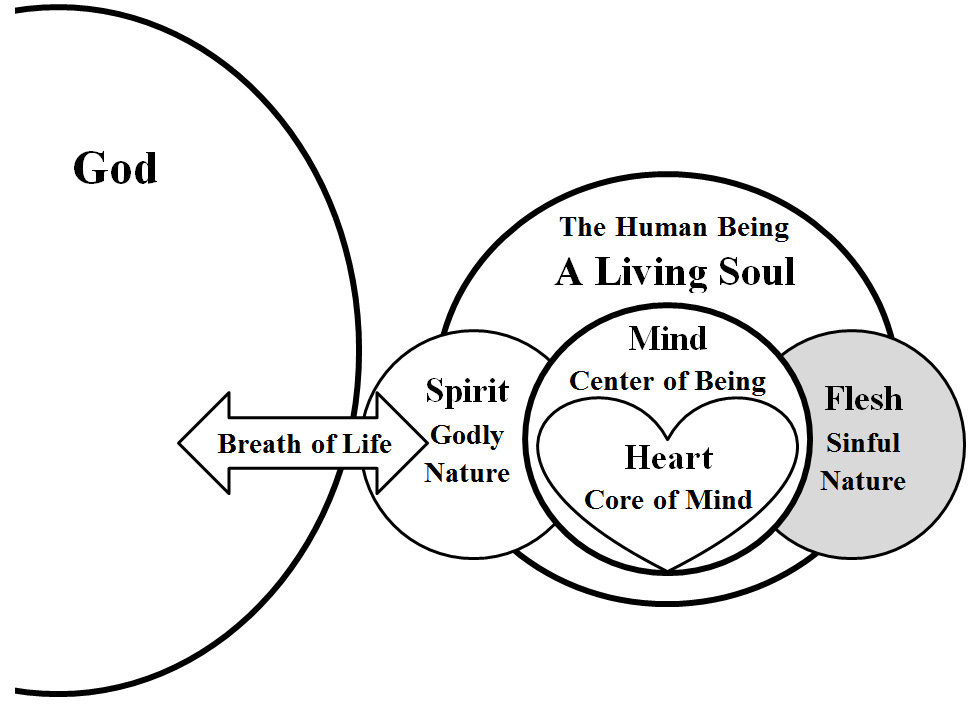
This article is available in book form with loads of additional material…

- The print book is available here for only $6.49 (92 pages)
- The Kindle eBook is available here for just 99¢!
Both links allow you to “look inside” the book.
Related Topics:
Is Christ’s Body after Resurrection Physical or Spiritual (or Both)?
A Fresh Look at HOLINESS

Holiness is such a misunderstood subject in the church. For instance, I ran into a believer the other day who argued that wearing dress clothes to church gatherings is a matter of holiness. This is absolutely not true. It may be a matter of common sense if you want to function within a formal group and be accepted, but it has nothing whatsoever to do with holiness.
Holiness refers to absolute purity or wholeness and is an obvious trait of the Holy Spirit, who is God. It’s also a trait of the human spirit in light of the fact that, when people believe the gospel, they are spiritually reborn by the Holy Spirit. Jesus put it in the clearest terms when he said, “The Spirit gives birth to spirit” (John 3:6). This is why Ephesians 4:24 instructs us to put on the new man since it was “created to be like God in true righteousness and holiness.” My point? Holiness is a trait of your spirit, which is why the Bible says:
21Once you were alienated from God and were enemies in your minds because of g your evil behavior. 22But now he has reconciled you by Christ’s physical body through death to present you holy in his sight, without blemish and free from accusation— 23if you continue in your faith, established and firm, and do not move from the hope held out in the gospel. This is the gospel that you heard and that has been proclaimed to every creature under heaven, and of which I, Paul, have become a servant.
Colossians 1:21-23
How is it that believers are holy in God’s sight, without a blemish and free from accusation? Because that’s who we already are in our spirit and God sees us according to our spirit and not our flesh. The LORD only sees our sin when we miss it, but he forgives us and cleanses us as soon as we repent:
8If we claim to be without sin, we deceive ourselves and the truth is not in us. 9If we confess our sins, he is faithful and just and will forgive us our sins and purify us from all unrighteousness.
1 John 1:8-9
God forgives us as soon as we humbly confess and purifies us from all unrighteousness. If God purifies us from all unrighteousness what’s that make us? Completely righteous in his sight. This is why it’s so important to keep your spiritual arteries free of the clogging of unconfessed sin. When we stubbornly refuse to confess our sins, the LORD can’t help but see that sin because we’re not forgiven and cleansed of it. The offense will stand between us and God and prevent his grace from flowing in our lives to some degree. This is why the psalmist said, “If I had cherished sin in my heart, the Lord would not have listened” (Psalm 66:18). It’s nothing deep.
Think about it like this: say your spouse or close friend sins against you but stubbornly refuses to repent (I’m not talking about something petty). How will this affect your relationship? Warm feelings will cease and it’ll separate you to some degree. Only honest communication will restore the fellowship or, more specifically, penitence and forgiveness. When the offender humbly confesses, it releases you to forgive and intimacy is restored. The repentance/forgiveness dynamic is awesome and keeps relationships alive. It keeps marriages, friendships and every other type of relationship functioning. Without the operation of these powerful principles — apologizing and forgiving — very few, if any, relationships would last.
Getting back to holiness, some define holiness as avoiding sin and keeping oneself undefiled by the world. While there’s certainly some truth to this definition as far as human beings go, it doesn’t wash as a full definition. After all, God is repeatedly described as holy in the Scriptures and, in fact, is worshiped for it (Isaiah 6:3; Revelation 4:8), but God was holy eons before sin ever existed and needed avoided.
Holiness could be defined as “absolute purity” because it’s regularly cited in the Bible as the opposite of what is impure and indecent. See, for example, 1 Thessalonians 4:7, 2 Corinthians 7:1, Hebrews 7:26 and Deuteronomy 23:14.
“Wholeness” is another good definition. Wholeness is single-mindedness or integrity. It’s the opposite of double-mindedness and inner conflict. God is holy — whole — because he has no inner conflict; he doesn’t straddle the fence between good and evil.
Wholeness is the whole of God’s character and therefore refers to all the fruits of the Spirit since the fruits of the Spirit are the very traits of God. Charles Spurgeon put it like this: “Holiness is the harmony of all godly virtues.” With this understanding, consider this passage:
14As obedient children, do not conform to the evil desires you had when you lived in ignorance. 15But just as he who called you is holy, so be holy in all you do; 16for it is written: “Be holy, because I am holy.” a
1 Peter 1:14-16
As you can see, holiness is described as being the opposite of conforming to the evil desires of the flesh. What is the opposite of conforming to the evil desires of the flesh? Conforming to the good desires of the spirit, which are the fruits of the spirit (Galatians 5:22-23). All the fruits of the Spirit combined refer to God’s wholeness — the wholeness of his character — which is holiness. My point? Since holiness refers to all the fruits of the Spirit (Galatians 5:22-23), the more believers put off the flesh and walk in the spirit the more holy they’ll be! When you participate in the divine nature you’ll produce the myriad fruits of the spirit. This is holiness, which is godliness or being like-God. It’s spirituality, which is the spirit-controlled life as opposed to the flesh-ruled life. It’s wholeness of being and purpose rather than double-mindedness. It’s completeness.
In short, walking in the spirit is the key to holiness.
Holiness is the answer to the extremes of legalism and libertinism. You could also call it godliness. The reason I describe it as spirituality is because it’s the most fitting word to describe people who live out of their higher nature and produce the fruits of that nature, the fruit of the spirit.
Common Errors of “Holiness” Teachings
Holiness has unfortunately gotten a bad name over the years due to the infection of legalism in the Church and understandably so.
Legalists have enforced their pet rules under the guise of holiness when, actually, the rule in question often has nothing to do with holiness. For instance, playing card games isn’t in and of itself sinful, although it can lead to sin due to the law of association (1 Corinthians 15:33) and other factors. In other words, playing card games isn’t wrong, it’s the atmosphere you play the card games in that might corrupt you. It would be for this reason that the Holy Spirit might move a believer to stop playing cards rather than because card games themselves are wrong. Please notice that I said it’s the Holy Spirit who’s supposed to move a person to stop doing something and not the enforcement of a rule by legalists. This means that the person has to have a relationship with God to some degree because otherwise he or she won’t be able to discern the Holy Spirit’s guidance. Focusing on relationship rather than rules is always the best protection against legalism.
The list of absurd “holiness” rules goes on and on — men can’t have long hair, women can’t have short hair, mandatory skirt length, sleeve length, such and such style of music is evil, viewing movies is worldly, etc.
Let’s consider that last one. Legalists will typically denounce all R-rated films, as well as many PG and PG-13 ones, all in the name of holiness. They’ll argue that there are too many sexually explicit (or implied) scenes, violence and cussing, etc. Yet, consider the 1992 version of Last of the Mohicans. It’s R-rated, but it’s one of the most beautiful and moving films you’ll likely ever watch. Yet staunch legalists will automatically denounce it because, after all, it’s R-rated. It must therefore be evil or corrupting. While their motivations for doing this may be sincere, the issue isn’t as black and white as they say. It never occurs to them, for instance, that the Bible is full of hard R-rated stories that are chock-full of incredible violence, sordidness and horror (for a list of examples, go here). When confronted with this fact they’re either stunned to silence or will argue that the Bible stories contain important themes or examples. If this is so, can’t filmmakers do the same thing? Take Star Trek: Nemesis, for example. On the surface it’s a serious space adventure, but the subtext explores the conflict of flesh and spirit and the story provides a sacrificial Christ-figure, an android no less!
So the message of the film in question must be considered. If the message is corrupt then I agree, avoid it like the plague. However, if the message is good and corresponds to the truths of human nature and universal morality, as chronicled in the Bible, it may be worth checking out. Again, there are numerous R-rated stories in the Bible and they’re worth one’s time because they drive home an important lesson while, at the same time, entertain to some degree (and by “entertain” I simply mean capture your attention). King David’s lust over the bathing Bathsheba and his subsequent adultery and murder of her husband is an excellent example. Anyone who’s been a believer for a number of years has read this story many times and visualized it in their minds each time. Many of us have even viewed film versions, like King David with Richard Gere. Is this sinful? No, it’s the Word of God!
Furthermore, did you ever notice that God doesn’t spell-out the messages in a lot of these stories? There’s often an amount of ambiguity that requires reflection and further pursuit for answers. Those who have “ears to hear” will put in the effort while others won’t. Take the story of Judah and his daughter-in-law Tamar from Genesis 38: Judah unjustly blamed the death of his two sons on Tamar and essentially condemned her to childless widowhood. Tamar understood her father-in-law’s fleshly weaknesses and used it to her advantage in a story so sordid it’d be right at home next to any hard R-rated melodrama. Interestingly, God doesn’t spell out the lessons in the story. Judah’s hypocrisy is revealed but, at the same time, he should be commended for his honest repentance when confronted with the truth. Tamar’s tactics to escape being a childless widow reveal shrewdness — it guaranteed her security for the future — but does this justify her insidious actions? Not as far as I’m concerned, yet the Bible doesn’t spell-out the answers.
Or take Samson from Judges 13-16. Samson is honored in the New Testament’s “Hall of Faith” chapter for his great faith (Hebrews 11), but if you read his story it’s clear that he’s sometimes not an example of godliness or wisdom. Again, God refuses to spell everything out for the reader. These stories are fascinating, but they make you scratch your head. They provoke you to mine them for gems of insight.
The best stories do this and so do the best films. One Flew Over a Cockoo’s Nest is a good example. It’s a subtle but ingenious denouncement of legalism and praise of the spirit of freedom.*
*The protagonist of the movie is McMurphy (Nicholson), despite his obvious flaws. Although he’s impulsive and has a weakness for the female gender (like Samson and King David), which got him into prison in the first place, he definitely has a spirit of freedom & life and inspires great love in the men of his ward. If there’s any doubt, note how Chief (Will Sampson) dearly hugs him at the end. McMurphy’s problem is that he needs to learn wisdom; then he can walk in his freedom without causing unnecessary harm to himself and others.
Yet some Christians may find the pull-no-punches realities of a mental ward too unpleasant to watch, and that’s perfectly okay. It’s not a pleasant film, but please don’t take the legalistic attitude that it’s an immoral film. Even though immorality is depicted, nothing could be further from the truth.
I said above that a movie may be worth checking out if the message is good. This shouldn’t be interpreted to mean that a story has to have a happy ending in order to be worthwhile. The stories of Judas Iscariot and King Saul and the prophecy of the white throne judgment in Revelation don’t have happy endings, but they each drive home a powerful truth — the wages of sin is death.
Also, I’m not saying that a film always has to have a deep moral to be watchable. What if you’re in the mood for something light or amusing in the name of rest & recreation? Sloth is of the flesh, of course, but R&R is necessary and healthy, as long as it doesn’t become an idol. Doesn’t the Bible say “There’s a time to mourn and a time to dance” (Ecclesiastes 3:4)? What about Deuteronomy 14:26, which is the Mosaic Law. Balance is the key.
These are just matters of common sense, but legalists will take the simplest of things and complicate them to no end.
Distinguishing Holiness and Worldliness
Religionists go awry with their “holiness” teachings because they lose sight of what the Bible itself calls worldly. Worldliness is any sin that springs from three things: the lust of the eyes, the lust of the flesh and the pride of life, as observed by 1 John 2:15-17. With this understanding, a lot of activities or behaviors are only worldly depending upon the intent of the person’s heart. For example, two females might wear the exact same scanty apparel, but one does it merely because it’s the style she grew up with and the other does it to incite lust. I’m not saying that the former girl shouldn’t learn to dress more modestly, which is a matter of wisdom, but she’s not guilty of worldliness if her intentions are pure and she simply doesn’t know any better. The intent of the heart makes all the difference. Even something considered good can be worldly if the intent of the heart is fleshly. Giving a sermon is good, but what if the pastor uses the occasion to brag on himself and tear down others? Ministering at a revival is good, but what if the evangelist’s main interest is fleecing the flock and making a lot of moolah from the gig? Both the pastor and the evangelist are guilty of worldliness even though they’re doing something good.
Another thing that should be stressed is that holiness is different for each believer depending on what their weaknesses are. For instance, one man can watch a TV show like Survivor where there are several women in scanty apparel while another can’t because he has a lust weakness and can’t risk stirring it up. One woman can enjoy a glass of wine but another can’t because she’s an alcoholic. One guy can listen to a certain style of music on occasion but another can’t because he has no sense of moderation with that genre. One woman can enjoy the shopping channel but another can’t because she’s a shopaholic. One man can go boating or play golf, but another can’t because he idolizes the activity. Believers who decide not to do these activities do so because they know their weaknesses and are guarding their heart as the wellspring of life (Proverbs 4:23).
Holiness is also different for believers depending on where they’re at spiritually and what the Holy Spirit has instructed them. For instance, one brother may have been instructed by the Lord to give up watching football on Sunday afternoon to use the time to draw closer to Him, but another brother hasn’t been given any such instruction.
One of my sisters is a very godly woman but she enjoys a glass of wine now and then. She told me last year that the Lord told her not to drink wine for three weeks and she complied. The Lord may have instructed her to do this just to stay freed-up and focus on spiritual things. After all, anything can become an addiction, which is a habit you can’t live without. This is why it’s good to periodically fast from certain things, particularly if you discern bondage setting in, however slight. Nip it in the bud and fast from it. Carol & I have taken long fasts from TV for this very reason. You can do this with any activity – computer games, fishing, golf, watching sports, going to certain establishments, etc. Be sensitive to the leading of the Spirit and periodically fast from anything you have an affinity for so that it doesn’t become a bondage. Why? Because when something becomes a bondage you’re no longer walking in freedom. It’s a case of being double-minded rather than single-minded or whole, which is holiness. As such, it’s being imbalanced because you’ve lost self-control in this one area. The spiritual man or woman, by contrast, is “temperate in all things” (1 Corinthians 9:25 KJV), which means they maintain self-control in every area of their lives.
Holiness is also a matter of spiritual growth. What may be acceptable for one may not be acceptable for someone who’s more mature. A brother recently encouraged me to view a certain movie about vigilantism that he claimed had a spiritual subtext. I tried to view it but couldn’t even finish it because it was so repugnant. I’m willing to watch a film that shows brutal reality if it drives home an important theme, like many stories in the Bible, but I didn’t discern any depth to this particular film and everything was just cartoonish overkill – the style, the cussing, the violence. It just struck me as goofy, shallow and vile; a complete waste of my time. Yet this brother strongly recommended it; go figure.
Everything shared in this section will rock the boat of legalists because they only think in terms of black and white. If something’s wrong for brother Joe it must also be wrong for everyone else. If something’s okay for sister Suzy it must also be okay for everyone else. This is true when it comes to black and white matters. For instance, adultery, murder, envy, slander and homosexuality are always wrong. But it’s a different story when it comes to issues like the ones covered in this section. These things are right or wrong for the believer based on factors like the intent of the heart, the believer’s weaknesses & strengths, their level of spiritual maturity, the counsel of the Holy Spirit and keeping free of potential bondages.
This article was edited from chapter 11 of…


- You can purchase the book here for just over $10 (292 pages).
- Or get the Kindle eBook for only $2.99!
Related Topics:
Legalism — Understanding its Many Forms
Can a Certain Style of ART be Evil?
Nosiness and Manipulation (NOT Spiritual)
Hair Length for Men – How Short or How Long?
“Holy water” and “Saying Grace”
Sectarianism — What is It? What’s Wrong with It?
Can Christians Drink Alcoholic Beverages?
How to keep BALANCED in every area of Life
Is the Saying “CLEANLINESS Is Next to Godliness” Biblical?
How to Walk FREE OF THE FLESH by Being Spirit-Controlled

The article is important to me because I was once in bondage to the flesh in my youth and struggled greatly to escape it. With God’s help and His Word, not to mention the teachings/example of spiritual mentors, I slowly learned how to walk free of the flesh and desperately want to share how I did it with anyone who needs it so they too can be set free.
In short, the answer to being in bondage to the flesh is spirituality. That might sound anticlimactic to you — even lame — but let me explain. While ‘spirituality’ is a term that’s thrown around a lot — sometimes by people who aren’t really spiritual — it actually refers to the spirit-controlled life. This merely means being spirit-driven rather than flesh-ruled; it means being controlled by your higher self as opposed to the lower self. To do this you simply have to learn to put off the old self and put on the new:
You were taught with regard to your former way of life, to put off your old self, which is being corrupted by its deceitful desires; (23) to be made new in the attitude of your minds; (24) and to put on the new self, created to be like God in true righteousness and holiness.
Ephesians 4:22-24
This passage contains the antidote to both legalism and libertinism. It’s therefore imperative that we get it. The “old self” is the flesh or sin nature and we are instructed to put it off. Why? Because the old self is corrupted by “deceitful desires.” Your flesh has desires, which means it has a voice, but these desires are deceitful. They promise happiness but they don’t deliver. They can only ultimately bring death and all that goes with it. We are told to “put off” these fleshly desires. In the Greek this means to strip it off. We have to strip off the old way of thinking in favor of a new way. Verse 23 tells us how to do this: we must be made new in the attitude of our minds. What’s the new attitude we should have? We are to count ourselves dead to the old self and alive to God in Christ Jesus (Romans 6:11). Counting ourselves alive to God includes accepting everything God says we are in Christ, that is, who we are in our new self, the spirit. We’ll address this in the next section.
This results in what verse 24 calls putting “on the new self,” which means living out of our spirits as led of the Holy Spirit. When we do this we’ll be spirit-controlled and naturally produce the fruit thereof.
The New Testament describes this in different ways: When we are spirit-controlled we “live by the spirit” (Galatians 5:16), we “clothe ourselves with the Lord Jesus Christ” (Romans 13:14), we “participate in the divine nature” (2 Peter 1:4), we “put on the new self” (Colossians 3:10). How can putting on the new self be described as clothing ourselves with Christ or participating in the divine nature? Because the “new self” refers to our regenerated spirit which was “created to be like God in true righteousness and holiness” (verse 24).
If there’s a true righteousness and holiness there’s also a false righteousness and holiness, which is legalism. True righteousness and holiness can only be attained by, first, being born-again spiritually and, second, living out of your spirit rather than the flesh. The latter is a learning process, of course, and takes time, but the more you do it the easier it is and the more fruit you’ll produce. The fruits of the spirit are the fruits of God’s nature. Hence, those who live by their spirit, which is guided by the Holy Spirit, will be “like God” because the spirit naturally produces the fruits of his nature:
The acts of the sinful nature are obvious: sexual immorality, impurity and debauchery; (20) idolatry and witchcraft; hatred, discord, jealousy, fits of rage, selfish ambition, dissensions, factions (21) and envy; drunkenness, orgies, and the like. I warn you, as I did before, that those who live like this will not inherit the kingdom of God. (22) But the fruit of the spirit is love, joy, peace, patience, kindness, goodness, faithfulness, (23) gentleness and self-control. Against such things there is no law.
Galatians 5:19-23
This list of the fruit of the spirit isn’t exhaustive any more than the list of the works of the flesh is exhaustive. God has many other character traits, like righteousness (Philippians 1:11), truth (Ephesians 5:9), power (2 Timothy 1:7), righteous anger (Mark 3:1-6) and boldness (Mark 11:15-18).
The awesome news is that believers can walk free of the works of the flesh and the two ways they manifest in the church – legalism and libertinism – simply by putting off the flesh in favor of participating in the divine nature. If this weren’t possible Paul would never have instructed us to “be imitators of God” in Ephesians 5:1.
Speaking of Ephesians 5:1, Christians are usually blown away by this verse. They ask, “How can I possibly imitate God?” It’s simple: Put off the flesh and learn to live out of your spirit and you’ll automatically participate in the divine nature and produce the very fruit of God’s character!
So how exactly do we walk in the spirit like this? There are three things that we have to do, all corresponding to the three parts of human nature – mind, body and spirit. These are the three keys to walking in the spirit. Let’s look at each key, starting with the mind.
1. Count Yourself Dead to Sin and Alive to God
The first thing believers need to do in order to walk in the spirit has to do with the mind. Paul said that we are to be transformed by the renewing of our mind in Romans 12:2. The Greek word translated as “transformed” is where we get the English ‘metamorphosis,’ which means to be transformed as the result of a process. A great example of this would be a lowly and not-particularly-good-looking caterpillar being transformed in its cocoon and emerging as a beautiful butterfly. Think about it, caterpillars crawl on the ground and are kind of ugly, whereas butterflies are beautiful and can fly. Believers can have just as stunning of a transformation, but it involves renewing the mind – we must let go of caterpillar-thinking (flesh-ruled thinking) in favor of butterfly-thinking (spirit-controlled thinking).
Here’s a cornerstone passage on renewing the mind and being spirit-controlled:
The death he died, he died to sin once for all; but the life he lives, he lives to God.
(11) In the same way, count yourselves dead to sin but alive to God in Christ Jesus. (12) Therefore do not let sin reign in your mortal body so that you obey its evil desires.
Romans 6:10-12
Verse 12 reveals the goal of this instruction – not letting sin reign in your body so that you obey its evil desires. In short, the goal is to not be flesh-ruled. Verse 11 shows us how to attain this goal: First, we must count ourselves dead to sin and, second, we must count ourselves alive to God in Christ Jesus.
Concerning the first part, counting ourselves dead to sin involves a new way of thinking. We must start counting ourselves as dead to the sins that normally tempt us if we want to experience freedom. For instance, if you have a weakness for lying, gossip, drunkenness or lust, you have to start making it your mindset that you are dead to these things. I used to have a problem with fits of rage so I had to start making it my mindset that I was dead to fits of rage in order to eventually walk in freedom. Making something your mindset includes making it your confession because words have the power of life and death (Proverbs 18:21). So I made this my regular confession: “I Dirk Waren am dead to fits of rage.”
The second part of verse 11 is just as important. We have to count ourselves as “alive to God in Christ Jesus.” Being alive to God in Christ Jesus is the opposite of being dead to God in the bondage of the flesh. So if you make it your mindset that you’re dead to sin, be sure to also make it your mindset that you’re alive to the opposite. For example, I made it my belief and confession that I’m dead to fits of rage, but I added that I’m alive to peace and self-control. Or say if a brother has a problem with lying or exaggerating, he would make it his mindset that he’s dead to lying but alive to the truth. Or say if a sister has a problem with gossip and slander (which go hand-and-hand) she would make it her confession that she’s dead to gossip and slander and alive to praying for others and blessing them.
Whatever your sin weakness is, count yourself dead to it and counteract it with the truth of who you already are in your regenerated spirit. You see, this whole instruction is geared to getting the believer spirit-focused instead of flesh-focused, spirit-controlled instead of flesh-ruled. For instance, the brother who has a problem with lying has a problem with lying because his flesh has a problem with lying. The only way for him to escape this condition is to stop being flesh-ruled because he’ll continue to have a problem with lying as long as he’s flesh-ruled. To walk free he’ll have to learn to be spirit-controlled by changing his thinking so that it agrees with who he is in his spirit rather than who he is in his flesh. Remember, our regenerated spirit was “created to be like God in true righteousness and holiness” (Ephesians 4:24). If you’re a believer your spirit is already righteous and holy; it doesn’t have a sin problem like your lower nature. It’s whole and complete, which is what holiness is. The key to freedom is to line up your thinking with who you are in your spirit rather than who you are in your flesh.
This isn’t merely a “mind over matter” principle, as some might think. If you’re a believer, you can genuinely count yourself dead to sin because you are dead to sin in your spirit. Even if you don’t feel like you’re dead to sin, you are dead to sin. It’s who you already are in your spirit because your spirit is righteous and holy like God!
By the way, renewing your mind in this manner is tied to repentance since ‘repent’ literally means to change your mind for the better. Both the Greek words for ‘repentance’ and ‘repent’ are derived from the Greek word for mind, which is nous (pronounced noos). To repent means to change your thinking, your mindset, your attitude. Any other type of “repentance” is incomplete and ineffective.
Who Are You “In Him”?
Notice that we are to count ourselves alive on to God in Christ Jesus (verse 11). Whenever you see phrases like “in Christ Jesus” or “in him” in the New Testament it’s covenant phraseology. In other words, the passage is stating a fact about the believer who’s in covenant with the Lord. Here’s an example:
God made him who had no sin to be sin for us, so that in him we might become the righteousness of God.
2 Corinthians 5:21
Jesus didn’t sin, of course, but the Father made him to be sin for us on the cross so that all those who enter into covenant with him would become the righteousness of God. As noted in chapter 3, the word ‘become’ in the Greek means to come into being, that is, to be born. Hence, we “become” the righteousness of God through spiritual rebirth. If you’re a believer this means that you are already righteous in your spirit and the more spirit-controlled you become the more righteous you will be.
The key to walking in practical righteousness is to be spirit-focused rather than flesh-focused because, in your spirit, you already are righteous. With this understanding, as you count yourself dead to sin make sure that you’re also counting yourself alive to righteousness. It’s the truth because it’s who you already are in your spirit. Remember, Jesus said it’s the truth that will set you free (John 8:31-32).
There are numerous ways the New Testament describes you in covenant with the LORD. Here are ten:
- You’re holy (Colossians 1:21-22).
- You’re a child of God (John 1:12-13).
- You’re a new creation (2 Corinthians 5:17).
- You’re the righteousness of God (2 Corinthians 5:21).
- You’re dead to sin (Romans 6:11,14,18).
- You’re more than a conqueror (Romans 8:37).
- You’re a temple of the Holy Spirit (1 Corinthians 6:19-20)
- You’re rich (2 Corinthians 8:9).
- You’re healed (1 Peter 2:24).
- You’re a royal priest or priestess of the Most High God (1 Peter 2:9)!
These are all “positional truths.” A positional truth is any truth from the Scriptures that reveals your position in covenant with God and therefore how God sees you because of this position. For instance, Colossians 1:22 declares that we are “holy in His sight, without blemish and free from accusation.” This is how God sees you because this is who you are in Christ. Just be wise to repent when you miss it so that God can faithfully purify you from all unrighteousness (1 John 1:8-9). This is “keeping with repentance” (Matthew & Luke 3:8). Don’t allow the build-up of unconfessed sin to block the power and favor of God in your life. A side benefit of this is that it keeps your heart soft and malleable rather than hard and incorrigible.
For the New Testament believer, meaning YOU, these ten descriptions reveal who you are in your spirit, the “new self” (Ephesians 4:22-24).
How do you practice such positional truths? You practice them simply by believing them and not disagreeing with them. Remember, “The tongue has the power of life and death” so utilize this power accordingly. Never speak words that contradict who God says you are. Never! This is tantamount to calling God a liar. Be sure to chew on these amazing positional truths and others as well. Make them your meditation and your confession. Take David, for example. He was diligent to “meditate” on God’s Word, as shown in Psalm 119:15-16. The Hebrew word for ‘meditate’ is siach (SEE-akh), which means “to ponder and converse with oneself and, hence, out loud” (Strong’s Exhaustive Concordance). As you do this with these positional truths, you’ll grow in understanding and power. The more these truths become a part of you, the more you’ll be set free of the flesh and the more you’ll soar in the spirit free of the limitations of the fleshly plane.
Jesus said in John 8:31-32 that we must “continue” in his word if we are to “know the truth” and be set “free.” Unlike your spiritual rebirth which happened instantaneously, your metamorphosis from caterpillar-thinking to butterfly-thinking is a process; it may not happen overnight, but it will happen, so don’t give up. If you miss it, be quick to repent and God will forgive you, and then keep moving forward. You don’t drown by falling in the water; you drown by staying in the water!
Here’s a detailed video presentation of this topic, if you’re interested:
If all you do is change your thinking to focus on who you already are in your spirit – dead to sin, righteous, holy – you’ll be blessed, but there are two other keys to participating in the divine nature and they have to do with your body and your spirit.
2. Offering Your Body as a Living Sacrifice
Let’s go back to Romans 6:11-12 and see what it goes on to say:
In the same way, count yourselves dead to sin but alive to God in Christ Jesus. (12) Therefore do not let sin reign in your mortal body so that you obey its evil desires. (13) Do not offer the parts of your body to sin, as instruments of wickedness, but rather offer yourselves to God, as those who have been brought from death to life; and offer the parts of your body to him as instruments of righteousness. (14) For sin shall not be your master, because you are not under law, but under grace.
Romans 6:11-14
Since we are dead to sin and alive to God in our spirits, Paul says that we shouldn’t offer the parts of our bodies to sin as instruments of wickedness, but rather to God as instruments of righteousness. We can do this because we’ve been brought from a condition of spiritual death to spiritual life, as verse 13 points out.
All unbelievers are spiritually dead. This doesn’t mean that they don’t have a spirit and the capacity for good, but rather that their spirit is dead to God, which means that the ability to commune with the LORD doesn’t exist. They’re cut off from a relationship with their Creator because their spirit can’t connect or commune with him. Yet it’s precisely because they have a spirit that they desperately want to connect with him, even though it’s impossible. This, of course, gives birth to religion, which is the human attempt to connect with God. Authentic Christianity, by contrast, is God connecting with us through spiritual rebirth in Christ by the Holy Spirit.
In this passage Paul reasons that, since we’ve been brought from a condition of spiritual death to spiritual life, we are to offer the parts of our bodies to God’s service as instruments of righteousness. This refers to two things: (1.) Put into practice the truths you discover in God’s Word, whether from your own studies or through receiving from others. In other words, line up your body with what God’s Word teaches. This doesn’t just include practical truths like “Husbands love your wives, just as Christ loved the church and gave himself up for her”, but positional truths as well. How so? Because it takes your brain and your tongue to practice positional truth and both are parts of your body. If your brain and tongue aren’t lining up with what God’s Word says about you then you’re not offering these parts of your body to Him as instruments of righteousness. (2.) Put into practice whatever instruction God gives you, which includes serving in any role he calls you to or moving toward any objective he gives you. Seek the Lord in prayer concerning your purpose, both short-range and long-range. What are you inspired to do for God? What area of service really stirs you? Colossians 3:15 says to “let the peace of Christ rule in your hearts.” What do you have a peace about doing? In other words, what do you have a good feeling about? Identify your strengths and then major in them. Grasp the unique task God has called you to do in each season of your life. Whatever it is, start doing it and ask for God’s strength and direction. A journey of a thousand miles starts with the first step.
When you begin utilizing the parts of your body as instruments of righteousness in God’s service the law of displacement comes into play. Light displaces darkness, righteousness displaces wickedness, spirit replaces flesh. Sin shall not be your master for you are not under law (legalism) but under grace (spirituality)!
A Living Sacrifice in Worship
There’s even more to offering yourself to God:
Therefore, I urge you, brothers, in view of God’s mercy, to offer your bodies as living sacrifices, holy and pleasing to God – this is your spiritual act of worship. (2) Do not conform any longer to the pattern of this world, but be transformed by the renewing of your mind. Then you will be able to test and approve what God’s will is – his good, pleasing and perfect will.
Romans 12:1-2
This passage plainly details the first two steps to spirituality; that is, being spirit-controlled. Verse 2 instructs us to be transformed by the renewing of our minds, which we’ve already addressed. Verse 1 tells us to offer our bodies to God as “living sacrifices” and adds “this is your spiritual act of worship.” ‘Worship’ means to “reverently honor or adore.” We can worship in two ways: Through our actions and through our communion. Actions have to do with practice. When we sincerely practice the truths of God’s Word we are also honoring the LORD, which is worship. It’s the same thing when we start lining up our lives with his assignment, big or small, we’re worshipping him. Either way, our actions give glory to God. Communion, however, has to do with communication. Prayer is communion with God and we specifically honor him through the type of prayer known as praise & worship.
What exactly is praise & worship? The two go hand and hand. Praise is celebration and includes thanksgiving, raving and boasting; whereas worship is adoration. Praise naturally attracts God’s presence and is in accordance with the law of respect: What you respect moves toward you while what you don’t respect moves away from you. Worship, on the other hand, is adoration or awe, and is the response to being in his presence. See Psalm 95:1-7 and Psalm 100 for verification.
You’ll see this principle at work in relationships all the time. Take, for instance, romantic relationships. Say if a woman is interested in a man and she praises his work, how will this make him feel? He’ll feel important and respected. He’ll feel like the “king of the world” and will naturally be more inclined to the woman, even if she’s someone he might not have noticed otherwise. It’s the same principle with God. When you start praising him and boasting of him he’ll naturally be more inclined toward you. It’s a simple principle.
We can further differentiate praise & worship as such: Praise celebrates God whereas worship humbly reveres him; praise lifts Godup while worship bows when he is lifted; praise dances before God whereas worship pulls off his shoes; praise extols God for what he’s done while worship adores him for who he is; praise says “Praise the Lord” whereas worship demonstrates that he is Lord; praise is thanksgiving for being a co-heir in Christ while worship lays the crown at His feet.
Many believers are more comfortable with worshipping God through what they do rather than through communion, but I encourage you to excel in both. I run across a lot of wives who complain that their husbands rarely tell them that they love them, if ever. They hardly even compliment them. When confronted, the husband typically argues that he loves his wife by doing things for her, including working hard to bring home the bread. This is wonderful, of course, but the wife still wants to hear him communicate it to her. Do you think it’s any different with God?
Some men tend to veer away from praise & worship because they think it’s somehow girly. But, let me tell you something, David is one of the most passionate praise & worship warriors recorded in the Bible and he was wholly masculine. As a teenager he had the great faith and boldness to challenge the hulking Goliath with a slingshot when the entire army of Israel was shrinking back in terror (1 Samuel 17:24)! He went on to become one of the greatest kings of Israel, but God wouldn’t allow him to build the temple because he was a warrior king and had too much blood on his hands! See 1 Chronicles 28:3. Does this sound like a girly man? Or consider Moses’ aide, Joshua. After Moses spoke with God in the tent of meeting, Joshua would stay and linger in God’s presence (Exodus 33:11). Guess who God later chose to lead the Israelites in the conquest of Canaan? Joshua. There’s clearly a link between those who choose to be mighty praise & worship warriors for God and those who are mighty warriors in his service. Those who are “ever praising” the LORD and who dwell in his presence “go from strength to strength” (Psalm 84:4-7). They are “transformed into his likeness with ever-increasing glory, which comes from the Lord, who is the Spirit” (2 Corinthians 3:18). In light of all this, anyone who claims that praise & worship is worthless or sissified is grossly ignorant.
Needless to say, every believer is called to deeper praise & worship. It will literally revolutionize your life, as it has mine and continues to do so.
If all we did was practice these first two keys to being spirit-controlled we’d be greatly blessed and experience freedom to a higher degree than ever. But there’s one more step and it has to do with our spirit. It’s what the Bible calls praying in the spirit.
3. Praying in the Spirit and Charging Yourself Up
Let’s look at a couple of key passages about praying in the spirit:
But you, dear friends, build yourselves up in your most holy faith and pray in the Holy Spirit.
Jude 20
This verse shows that believers in general should “build themselves up” in faith by praying in the Holy Spirit. It gives the impression of charging up our faith like a battery. In the Greek “build yourselves up” means “to build upon.” You see, every believer has a measure of faith at the time of salvation (Romans 12:3), but this measure can be built upon as the believer grows. In other words, believers should increase in faith as they mature. How do we do this? One way is through God’s Word (Romans 10:17), another is by spending time in God’s presence through praise & worship; after all, God is full of faith and therefore those who hang around him will develop the same faith he has. It’s the law of association. Jude 20 shows that praying in the Spirit is also essential for increasing in faith.
Here’s another passage on praying in the spirit:
And pray in the Spirit on all occasions with all kinds of prayers and requests.
Ephesians 6:18
This verse appears right after Paul details the six pieces of the “armor of God,” which shows that praying in the spirit is actually the seventh piece of the armor even though he doesn’t analogize it like he does with the other six pieces (for instance, faith is a “shield” and the Word of God is a “sword” and so on). I liken praying in the spirit to artillery or a missile since you can pray in the spirit for people and situations a long distance away, even on the other side of the planet.
So we’re clearly instructed in the Scriptures to charge our faith up by praying in the spirit and also to pray in the spirit on all occasions with all kinds of prayers and requests. The question now is, what is “praying in the Spirit”? After all, we can’t very well pray in the spirit if we don’t even know what it is. Thankfully, the Bible tells us exactly what it is:
For if I pray in a tongue, my spirit prays, but my mind is unfruitful. (15) So what shall I do? I will pray with my spirit, but I will also pray with my mind; I will sing with my spirit, but I will also sing with my mind.
1 Corinthians 14:14-15
By saying “if I pray in a tongue, my spirit prays” Paul was defining praying in the spirit. If he prayed in a tongue his spirit was praying, led of the Holy Spirit, and therefore he was praying in the spirit
or praying in the Spirit (capitalized*). Praying in the spirit is synonymous with speaking in tongues, which is also known as glossolalia. What is speaking in tongues? It’s when a believer prays from his spirit rather than his mind and therefore speaks in a language unknown to him. We see this in verse 15 where Paul notes two types of prayer – praying with his spirit and praying with his mind, singing with his spirit and singing with his mind.
* Since there is no capitalization in the original Greek text translators have to determine if the word for spirit, pneuma, refers to the human spirit (un-capitalized) or the Holy Spirit (capitalized). Either/or works in this case since the human spirit prays as led of the Holy Spirit due to the fact that the believer’s human spirit (un-capitalized) is birthed and indwelt by the Spirit (capitalized).
Praying with your mind is obvious, it’s praying with a language you understand, which is typically the language you most often speak. For me it would be English. When I pray in English I’m praying with my mind because it’s a language I know and understand. Praying with one’s mind is wonderful and this is usually what people think of when they think of prayer, but when we pray in this manner we are limited to our own understanding. Whatever it is we’re praying for – whether a person, people, place or situation – we’re limited to our own understanding. This is where praying in the spirit comes into play. Praying in the spirit – speaking in tongues – bypasses the limitations of our understanding as led of the Holy Spirit. For instance, say if I’m praying for a believer who’s struggling with a certain sin and has backslid to some degree. If I pray with my mind – my understanding – I am limited to what I know about the situation, but if I pray in the spirit for him I can address things beyond my understanding as led of the Holy Spirit. Or say if you’re going to lose your job due to budget cuts or whatever in six months, but you don’t know about it. You can’t pray about this with your mind because you don’t even know it’s going to happen. But the Holy Spirit knows everything because he’s God and he indwells your spirit; he guides you. So when you pray in the spirit the Holy Spirit will likely guide your spirit to pray for your encouragement and a new job opportunity when you lose your current one in six months. You may not know about it, but the Holy Spirit does. As such, you were able to address something in prayer that your mind didn’t even know about through praying in the spirit. You bypassed the limitations of your understanding.
This is why Paul encouraged us to “pray in the Spirit on all occasions” in Ephesians 6:18 and it’s why he stressed that he would pray and sing with both his mind and his spirit. Both are important.
The gift of personal tongues is for all believers, which is why these passages on praying in the spirit refer to all believers and not just to some who have a special gift. Note how none of these passages say anything like “Now, if you have the gift of tongues, pray in the spirit on all occasions” or “If you can speak in tongues build yourself up in faith by praying in the Holy Spirit.” Back when these passages were written it was assumed that all believers had the gift of personal tongues. Virtually every believer had it because leaders in the church didn’t shy away from emphasizing the importance of the baptism of the Holy Spirit, as they do today, unfortunately.
I describe praying in the spirit as “personal tongues” to distinguish it from the gift of tongues utilized in a church environment, which is followed by an interpretation in the common language. Not everyone has this gift, which Paul made clear in 1 Corinthians 12:30. The kind of speaking in tongues I’m talking about is different and refers to the believer praying to God with his or her spirit as led of the Holy Spirit. This is for all believers. Public tongues, on the other hand, isn’t actually praying in the spirit because the believer who is functioning in this gift isn’t praying to God, but is rather giving a message from God to the group of believers for their exhortation and encouragement, which isn’t prayer at all. One refers to the believer praying to God with his/her spirit and the other refers to God speaking to the congregation. They’re quite different. All believers can have the gift of personal tongues, but not all believers have the gift of public tongues. It’s important to distinguish the two.
If every believer can have the gift of personal tongues, how do we get it? We receive it through the baptism of the Holy Spirit, which you can read about here.
Recapping the Three Keys to Walking in the Spirit
So the three keys to being spirit-controlled rather than flesh-ruled are as follows:
- Renew your mind. Make it your mindset that you’re dead to sin but alive to God in Christ Jesus. This includes making it your confession. Say: “I [state your name] am dead to sin and alive to God in Christ Jesus.” Renewing your mind effectively includes lining up your thoughts and words with who God’s Word says you already are in Christ. For instance, the Bible says that you’re dead to sin, holy, righteous and more than a conqueror in covenant with the Lord. These all describe who you are in your spirit as opposed to the flesh. You may not feel like you are these things, but you already are in your spirit. By accepting these positional truths by faith you’re being spirit-focused rather than flesh-focused. Do it.
- Offer the parts of your body to God as instruments of righteousness. This includes both serving the Lord – doing what God wants you to do (both general instructions from the Scriptures and specific instructions from the Spirit) – and praise & worship. Each of these puts into motion the law of displacement. By moving forward in the spirit you aren’t slipping backwards in the flesh. By spending time in the light of God’s presence through regular praise & worship darkness has no recourse but to flee. How do you get the darkness out of a room? You simple turn on the lights!
- Pray (and sing) in the spirit regularly. This will keep you charged up and built-up in faith. It’ll produce the power you need to walk in the full life Jesus came to give us; it’ll empower you to love people you don’t have warm feelings toward, including your enemies who hate you without cause. It’ll enable you to walk in tough love when necessary, including righteous radicalness, like when Paul radically rebuked an arrogant sorcerer and temporarily cursed him with blindness to humble him, as led of the Holy Spirit (Acts 13:8-12). It’ll provide the self-discipline necessary to overcome personal weaknesses, including lack of confidence, depression and various sin problems, like alcoholism, drugs, lying, gossip and slander.
Practicing these three principles is simply a matter of wisdom and love. The first and greatest command is to love God with all your heart and the second is to love people as you love yourself (Matthew 22:34-39). In a sense there are three commands since we are commanded to love others as we love ourselves, which means you have to love yourself first. I mean that in a healthy sense, of course, and not a narcissistic one. If you genuinely love yourself you’ll put these principles into practice on a regular basis. After all, if you fail to implement them you won’t have a victorious Christian life and you won’t be intimate with God. You’ll be encumbered and limited by personal weaknesses or areas of the flesh. This will not bless you, it won’t bless those linked to you, and it won’t bless God.
Practicing these three principles is the key to walking in the spirit or participating in the divine nature. It’s the key to producing the fruit of the spirit and, therefore, being spiritual rather than carnal. Simply put, it’s the key to being spirit-controlled rather than flesh-ruled. The former gives life while the latter brings death.
24/7 “God-Consciousness”
This is the key to having a vital, active relationship with God, which is the antidote to all forms of legalism. By “active relationship” I don’t mean thinking about God once or twice a day, but rather 24/7 God-consciousness where you’re in constant connection and communion. This makes sense of Paul’s instruction to “pray without ceasing” in 1 Thessalonians 5:17 (KJV). How can anyone possibly “pray without ceasing”? By participating in the divine nature and walking in 24/7 God-consciousness. A close relationship with your heavenly Father requires the same time and attention that any close relationship requires. Like those relationships, it’s not a chore, but a joy and an honor. It develops over time. David said, “Taste and see that the LORD is good” (Psalm 34:8). Once you’ve genuinely tasted of a relationship with God nothing else in life compares. It’s the ultimate high!
It’s your choice. You’ve been granted the awesome power of DECISION, which is volition. Whether you know it or not, you operated in this power to receive eternal salvation (Romans 10:9-10). Use this God-given gift to your advantage in your Christian walk. You’re not a loser, you’re a winner. Go forth and walk in the freedom and victory that God has bought for you at great cost! Rise up O man of God, rise up O woman of God, and soar on the heights in the spirit far above the limitations of the mental realm and the flesh! Amen.
“Put Off the Old Man”
One last exhortation before closing: It’s imperative that you put off the “old man” – the flesh – for this to work. This is the very first thing we are instructed to do in Ephesians 4:22-24. We see the same instruction in this passage:
Do not lie to one another, since you have put off the old man with his deeds, (10) and have put on the new man who is renewed in knowledge according to the image of Him who created him,
Colossians 3:9-10 (NKJV)
Before you can put on the new man – that is, effectively walk in the spirit – you have to be willing to put off the old man and “his” fleshly deeds. This means repenting of any area of the flesh once it is revealed to you as sin. You see, God deals with his children according to the light we have. Once we have revelation of something we are responsible for living according to it. See John 9:39-41 and 15:22 for verification. And, no, this isn’t an excuse to stay in ignorance.
Let me give a widespread example. In Westernized cultures today fornication is viewed as a normal lifestyle, but it’s a sin according to God’s Word. When the average male turns to the Lord he’ll often come into the kingdom with the attitude that there’s nothing wrong with fornication since it’s such a prominent activity. Besides, “everyone does it,” he might reason. As he grows spiritually, however, he comes to realize that it’s wrong and God has something better for him. Up until this point God would automatically overlook transgressions in this area because he was corrupted by worldly culture and just didn’t know any better. Once he knows the truth, however, he’s obligated to walk according to it.
This is simply a matter of loving God, the first and greatest command (1 John 2:15-17). It’s also a matter of wisdom or common sense. Yet I’m surprised at how many people refuse to give up fornication after becoming believers and discovering it’s a sin. Then they wonder why they don’t feel close to the LORD and they’re not blessed. I’ll tell you why – they’re not putting off the old man! They’re being stubborn and stupid.
Think about it like this: Say you’re a parent and have a baby who soiled her diaper. You take the old diaper off, clean her up, and then put on the new diaper. Wouldn’t it be absurd to put the new diaper over the old diaper? Yet this is what many Christians do in effect when they refuse to put off the old man before putting on the new. They try to put the new man over the old man and it doesn’t work. No wonder they’re frustrated!
So please be sure to put off the deceitful desires of the flesh by keeping in repentance (Matthew & Luke 3:8).
Repentance and Faith
To repent, by the way, simply means to change one’s mind for the positive. This doesn’t mean a meaningless mental exercise, but rather a change of mind with the corresponding actions, like the revolve to fulfill God’s will (Acts 26:20) and turn from that which is opposed to God’s will, i.e. sin (Acts 8:22 & 2 Corinthians 12:21). Repentance and faith are two sides of the same coin (see Acts 20:21) and so for repentance to be effective it must be combined with faith, otherwise repentance is just a dead exercise. Is it any wonder that repentance and faith are the first two of the six basic doctrines of Christianity? See Hebrews 6:1-2. It is of the utmost importance to your spiritual health to grasp this.
See our video on this topic…
This article was edited from chapter 11 of…

- You can pick up a low-priced copy here (290 pages).
- Or you can obtain the Kindle eBook version here for only $2.99.
Both links allow you to “Look inside” the book.
Related Topics:
The Six Basic Doctrines of Christianity
The Seven Keys to SPIRITUAL GROWTH
Spiritual Growth — The Four Stages
Spiritual Growth is Like Climbing a Mountain
LIBERTINISM — What’s Wrong With It and How to Walk FREE

Do you know what libertinism is? (Pronounced LIB-er-tee-niz-uhm.). Within the context of Christendom, Legalism and libertinism are two sides of the same coin, which is counterfeit Christianity. This can be observed in the Lord’s statement to his disciples:
“Be careful,” Jesus warned them. “Watch out for the yeast of the Pharisees and that of Herod.”
The Pharisees represented legalism whereas Herod represented libertinism. They’re opposite extremes. We need to watch out for the “yeast” of these two mindsets and the corresponding lifestyles because yeast works its way through an entire batch of dough. Similarly, legalism or libertinism can corrupt a person’s entire life if embraced.
How do you distinguish the two sides of the “coin” of legalism and libertinism? Whereas legalists put on airs of religiosity while hiding their sins, libertines claim to be Christians while openly walking in the flesh and encouraging others to do so also (by their example and what they teach). Both are corrupt and neither solves the sin problem.
Libertinism should not be confused with libertarianism. A libertarian* is a person who advocates liberty in thought or conduct, whereas a libertine is a person who is morally or sexually unrestrained and therefore given to immoral or improper conduct. Libertarianism doesn’t have the negative connotation of libertinism. This doesn’t mean, of course, that libertarians are all moral.
* Please don’t confuse libertarian here with Libertarian, a member of the Libertarian Party, the third largest political party in the USA.
Christianity and Freedom
In a sense, authentic Christianity is the truest form of libertarianism because Christianity’s all about liberty (please notice that I said “in a sense”). The Bible says that freedom is actually a quality of God’s very being:
Now the Lord is the Spirit, and where the Spirit of the Lord is, there is freedom.
2 Corinthians 3:17
The Scriptures also emphatically declare:
It is for freedom that Christ has set us free.
Galatians 5:1
And Jesus said:
“So if the Son sets you free, you will be free indeed.”
John 8:36
You see, Christianity is all about freedom – freedom to know God, freedom from the flesh, and freedom from the yoke of religious law. Yet notice that the freedom Christianity offers is freedom from the flesh, not freedom to engage the flesh. This is why Paul stressed, “You, my brothers, were called to be free. But do not use your freedom to indulge the sinful nature”; and Peter emphasized, “Live as free men, but do not use your freedom as a cover-up for evil” (Galatians 5:13 & 1 Peter 2:16). In other words, believers shouldn’t pervert the freedom Christianity offers into a license to sin.
I’ve come across confessing Christians who say things like, “I’m totally free” or “I’m a freethinker” when what they really mean is, “I’m totally free and can indulge my sinful nature all I want.” This is libertinism. It’s a perversion of the doctrine of eternal security* and twists God’s grace into an excuse to sin.
* The doctrine of eternal security refers to the fact that believers are eternally secure in Christ as they continue in faith (John 10:27-30). This isn’t to suggest, however, that a believer is saved if they no longer have faith. After all, if it takes faith to be saved, how can an individual be saved if he or she no longer has faith? The very word “believer” means that the individual believes. See the article Once Saved Always Saved?
Notice what Jude said about people who adopt this mentality:
For certain men whose condemnation was written about long ago have secretly slipped in among you. They are godless men, who change the grace of our God into a license for immorality and deny Jesus Christ our only Sovereign and Lord.
Jude 4
Jude was addressing believers and told them that libertines had slipped into their midst. What these libertines advocated, in essence, was this: “We’re saved and have God’s grace and can therefore sin all we want without care of repentance. The Lord won’t reject us.” Although these people didn’t literally deny Jesus Christ, they denied him by using God’s grace as a license for immorality. What deception!
If you’re a believer and you’re struggling with a certain sin, the answer to your problem is to learn to walk in the spirit and be spirit-controlled rather than flesh-ruled. Paul said in Galatians 5:16 that if we live by the Spirit we will not gratify the desires of the sinful nature because, again, “Where the Spirit of the Lord is, there is freedom.” This is why you need to learn how to put off the “old man” – the flesh – and put on the “new man” (Ephesians 4:22-24). This means living out of your spirit as led of the Holy Spirit. The result is that you’ll be spirit-controlled rather than flesh-ruled. The more you learn to do this the more freedom you’ll experience and the more fruit of the spirit you’ll produce (Galatians 5:19-23).
Libertinism perverts these wonderful truths and makes freedom out to be an excuse to live in sin. It actually subjects people to the bondage of the flesh, which means it’s not freedom at all, but rather bondage to the limitations and negative consequences of the flesh. Christianity, by contrast, sets people free from captivity to the sinful nature to soar in the spirit!
So, while it could be said that Christianity is the purest form of libertarianism, it’s totally against libertinism.
Libertinism, Lawlessness and Licentiousness
Libertinism is one-and-the-same as lawlessness and licentiousness (or ‘license’ for short); the terms are interchangeable.
As the word implies, ‘lawlessness’ is the disregard of divine law. It’s the attitude that says, “I don’t care what God says; I’m going to live however I want to and do whatever I want.” On the surface this sounds like freedom, but it’s really just bondage to the lower nature because the thing the person wants to do is of the flesh. It’s like a husband or wife saying, “I don’t care if God’s Word says adultery is wrong and I don’t care that I vowed to be faithful, I want to have an affair and I’m going to do it!” This is lawlessness – the disregard of divine law. Years ago I was at a friend’s house and his wife was on a weight-loss regimen. Although she was a confessing Christian, she declared, “When I lose 15-20 pounds I’m going to have an affair.” She said this in front of her husband and I wasn’t sure if she was kidding. It was definitely an uncomfortable moment. In the months to come she did exactly what she said!
Or take the popular topic of “gay marriage.” Practicing homosexuals who want to redefine marriage to include people of the same sex are essentially waving their fists at their Creator in defiance. They don’t care that their sex organs don’t line up. I don’t mean to be crude, but the truth about sexuality is obvious. Just look at the sex organs: Tab ‘A’ fits into Slot ‘B.’ It’s really no more complicated than this. Those who rebel against this axiom are rebelling against their Creator and nature itself. They’re embracing a lie. It’s lawlessness. They may not be lawless in every area, very few people are, but they’re lawless in regards to sexuality.
In light of this self-evident truth, the whole concept of “gay churches” is an oxymoron. Those who want to practice homosexuality (in willful thought or deed) and also be a Christian are practicing lawlessness. Please notice I’m referring to those who practice homosexuality. It’s perfectly okay for a person who repents of homosexuality to be a Christian and function as a minister just as it’s okay for people who repent of other sins to be Christians and minister. Notice what the Bible says:
Do you not know that the wicked will not inherit the kingdom of God? Do not be deceived: Neither the sexually immoral nor idolaters nor adulterers nor male prostitutes nor homosexual offenders (10) nor thieves nor the greedy nor drunkards nor slanderers nor swindlers will inherit the kingdom of God. (11) And that is what some of you were. But you were washed, you were sanctified, you were justified in the name of the Lord Jesus Christ and by the Spirit of our God.
1 Corinthians 6:9-11
As you can see, Paul lists an assortment of fleshly activities and then tells the Corinthian believers: “And that is what some of you were.” It’s past tense because the believers were no longer practicing these sins as a lifestyle. I’m not saying that some of them didn’t stumble or fall now and then but they were willing to confess and repent when they did, which means God would forgive them and cleanse them (1 John 1:8-9). This is “keeping with repentance” (Matthew & Luke 3:8).
Notice that homosexuality is put on par with sins like adultery, thievery, greediness, drunkard-ness, slandering and swindling. This indicates two things: (1.) homosexuality is a sin, and (2.) believers are expected to repent of it just like any other fleshly behavior.
Discard Legalism & License in Favor of True Godliness
Many Christians understandably flee to libertinism because they had bad experiences with churches tainted by legalism. Flawed “holiness” teaching is often part of these bad experiences. They instinctively want to vomit out the legalism, but they make the mistake of running to libertinism for succor. But, again, just as legalism puts people in bondage to religious law and the resulting hypocrisy, so libertinism puts people in bondage to the flesh. Since legalism and lawlessness are two sides of the same coin, switching from one side to the other is not the answer because it’s still the same bad coin! Both are equally bad. The coin must be tossed out altogether in favor of a new coin, a priceless coin, which is genuine Christianity.
What is “genuine Christianity”? It’s reconciliation with God through spiritual rebirth, putting off the flesh, and learning to live out of one’s spirit as led of the Holy Spirit, which requires a new way of thinking. This is what Christianity is in a nutshell. It includes cultivating and maintaining a relationship with the Living LORD. Developing a relationship with God is important because the best way to become “like” someone is to spend time with him or her. If you want to be “like God” the first step is to spend time with the LORD. After that, being godly comes naturally. It’ll come from within and not from without because it’s who you are in your spirit and you’ve decided to be spirit-ruled rather than flesh-ruled.
I’m not saying that it won’t take some discipline and perseverance on your part, but you’ll be working with the Lord as a team and not without him. True holiness is not following a list of rules by trying to force your flesh to comply, it’s discarding the way of the flesh altogether in favor of living out of your reborn spirit by the Holy Spirit.
An Example of Libertinism
Years ago I was part of a home-styled Bible study where the teacher taught on the corruption of legalism and how his experiences with it made him reject the concept of holiness all together. Although he only taught about once every three weeks, it soon became clear that he was advocating lawlessness.
The group was mostly males in their early twenties or thereabouts. One day the subject of alcohol came up and this teacher told these impressionable guys that he regularly drank “and not just the light stuff.” In other words, he regularly drank hard liquor. Now, I’m not one to believe that merely drinking a sip of alcohol is a sin,* but is this a good message to send to young Christian males? One of them later said he saw the teacher at some function a year or so earlier where he was passed out due to excessive drinking. Is this appropriate conduct for a pastor or any supposedly mature believer? Is it a good example? Of course not. The youth lost respect for him and understandably so.
* See, for example, Deuteronomy 14:26 and 1 Timothy 5:23. Such passages must be balanced out by other clear passages, like “Do not get drunk on wine, which leads to debauchery, but be filled with the Spirit” (Ephesians 5:18), as well as other texts that teach that we shouldn’t do anything that would make a fellow believer stumble in an area that’s weak for him/her (Romans 14:21 & 1 Corinthians 10:31-32). Still, it’s clear that merely drinking an alcoholic beverage isn’t by itself evil. See this article for details.
This pastor escaped the bondage of legalism only to fall into the error of licentiousness. His negative experiences with legalism caused him to reject the concept of holiness altogether. He threw out the proverbial baby with the bathwater. It goes without saying that this is not the answer to legalism!
Years later he unsurprisingly joined a lawless sect.
A Biblical Example of Libertinism
Are there examples of so-called believers walking in lawlessness in the New Testament? Absolutely. Consider the church of Thyatira and what Jesus said to the believers of this fellowship:
“Nevertheless, I have this against you: You tolerate that woman Jezebel, who calls herself a prophetess. By her teaching she misleads my servants into sexual immorality and the eating of food sacrificed to idols. (21) I have given her time to repent of her immorality, but she is unwilling. (22) So I will cast her on a bed of suffering, and will make those who commit adultery with her suffer intensely, unless they repent of her ways. (23) I will strike her children dead. Then all the churches will know that I am he who searches hearts and minds, and I will repay each of you according to your deeds.”
Revelation 2:20-23
Christ was clearly ticked off and rightly so. This woman, “Jezebel” (which is a symbolic name and not her real name), was functioning in the role of a prophet in the Thyatiran church and she misled some of the believers, whom Jesus referred to as his “servants.” The Lord mercifully gave her time to repent, meaning he corrected her in various ways, but she remained stubborn and unrepentant. As a result, Chrict was going to strike her and her followers with sickness unless they repented of her ways (verse 22). Verse 23 mentions “her children,” which is a reference to her followers who were mimicking her example. Jesus even said that he was going to strike them dead if they didn’t repent. What a far cry from “gentle Jesus meek and mild”!
The Thyatiran fellowship was a real church in Asia Minor in the late 1st century. The situation in this assembly provides a picture of what happens to people in leadership positions when they succumb to libertinism. They’ll spread their lawlessness by encouraging others to walk in their unclean practices, just like “Jezebel.” They’ll call it freedom when it’s really just bondage to the flesh.
What can Christians today get from this? Don’t be misled by libertines, even if they’re in a leadership position in the church and go by titles like “Pastor,” “Prophet” or “Apostle.” As this passage shows, the Lord will show mercy to those who fall into libertinism and give them time to repent, but if they stubbornly refuse they will face severe discipline just as “Jezebel” and her followers did in Thyatira. When God’s mercy is repeatedly spurned his judgment inevitably falls.
Five Facts about Libertines
Paul was referring to libertines when he made this statement:
For, as I have often told you before and now say again even with tears, many live as enemies of the cross of Christ. (19) Their destiny is destruction, their god is their stomach, and their glory is in their shame. Their mind is on earthly things.
Philippians 3:18-19
There are four facts about lawlessness that we can pull from this passage:
1. Libertines worship fleshly indulgence with no concern to repent
We see this in Paul’s statement, “their god is their stomach,” which means libertines make an idol of the appetites of their flesh. This is different than a believer who struggles with sin or those who stumble into one area of the flesh or another. The struggler hates the sin but is in bondage to some degree; he or she doesn’t want to commit the transgression but falls and repents again and again. Because such people humbly ‘fess up, God forgives them over and over. This is struggling with the flesh. Yet even mature Christians who are freed-up from life-dominating sins, like sexual immorality or substance abuse, are perfectly capable of missing it in less noticeable areas, like arrogance, gossip, envy, legalism and rivalry. This isn’t struggling but rather stumbling. The fact that even mature believers can miss it now and then explains why John the Baptist instructed his hearers to “produce fruit in keeping with repentance” (Matthew & Luke 3:8). If we want to be close to God and effective in his service we have to be diligent to keep our spiritual arteries clear of the build-up of unconfessed sin. Why? Because it’ll block the flow of God’s grace. Needless to say, be quick to repent whenever you feel even a tinge of conviction. This keeps your heart soft and unhardened.
The people Paul was talking about in this passage were neither struggling with the flesh nor stumbling. They made the appetites of their flesh an idol that they worshipped; in other words, they gave their hearts over to the flesh with no concern of penitence. It’s the difference between struggling or stumbling and outright rebellion, the latter being tantamount to what the Bible calls falling away (Hebrews 6:4-9). This isn’t merely falling down, but falling away. Someone who stumbles can fall down if they’re not careful, but those who fall away have abandoned the road and have even set a whole new course! Such people are in danger of being cut off from salvation altogether if they choose to persist in their stubborn folly.*
*NOTE: See the aforementioned article Once Saved Always Saved?
Paul instructed that we shouldn’t even eat with someone who calls himself/herself a brother or sister in the Lord if they’re practicing sin with no concern to repent (1 Corinthians 5:9-11). And it doesn’t matter what the sin is. Paul listed six examples on this occasion – sexual immorality, greediness, idolatry, slander, drunkard-ness and swindling. If someone claims to be a Christian and is walking in these sins or others without concern to repent we are not to associate with them. This doesn’t mean we can’t greet them or minister to them as the Lord leads, but as far as close relations go – like just hanging out – we need to cease associations until they repent. This shows what a serious offense libertinism is.
A passage we looked at earlier, 1 Corinthians 6:9-11, clearly shows that those who practice sin as a lifestyle with no concern to repent will not inherit the kingdom of God!
I want to stress, however, that this is not referring to those who struggle with sin or stumble into sin and repent. All believers miss it, even mature believers, but God expects us to humbly confess and he’ll forgive us – dismiss the charge – and cleanse us of all unrighteousness (1 John 1:8-9). Praise God!
2. Libertines are proud of what they should be ashamed of
We see this in Paul’s statement, “their glory is in their shame.” Libertines will exalt a fleshly desire or behavior and make it an object of admiration or idolization, like alcoholism, drugs, pedophilia or homosexuality. They’ll start organizations, movements or pride marches for the sin of their choice.
3. Libertines are focused on the here and now and not eternity
We observe this in Paul’s statement, “Their mind is on earthly things.” Indulgence of their fleshly desire is of such eminent importance that they are blinded to the eternal repercussions of their licentiousness.
4. The destiny of unrepentant libertines is destruction
Paul made this clear when he said, “Their destiny is destruction.” He was talking about the “everlasting destruction” of the “second death” (2 Thessalonians 1:9 & Revelation 20:11-15). Jesus described it like so:
“Do not be afraid of those who kill the body but cannot kill the soul. Rather, be afraid of the One who can destroy both soul and body in hell.”
Matthew 10:28
Why is everlasting destruction the penalty for unrepentant sin? Because “the wages of sin is death, but the gift of God is eternal life in Christ Jesus our Lord” (Romans 6:23).
Does this mean that any believer who dies with unrepentant sin will suffer everlasting destruction? No, but since they didn’t repent of the sin in question God couldn’t forgive it and therefore they’ll have to answer for it at the judgment seat of Christ:
For we must all appear before the judgment seat of Christ, that each one may receive what is due him for the things done while in the body, whether good or bad.
Since, then, we know what it is to fear the Lord, we try to persuade men.
2 Corinthians 5:10-11
The “judgment seat of Christ” is the judgment believers will face. We will all stand before the Lord and give an account of our lives and receive what is due us, whether good or bad. This indicates rewards and penalties. The “bad” cannot refer to penalties for sins that were repented of since the believer already confessed them and God forgave him or her. So it must refer to sins of which the believer failed to repent in which God must justly hold the individual accountable.
How much unrepentant sin would it take for a believer to lose their salvation? Jesus’ Parable of the Vineyard in Luke 13:5-9 reveals God’s great patience and mercy in dealing with fruitless servants. It also shows that when his patient mercy ends his judgment begins.
The message we get from all of this should be loud and clear: DON’T BE A LIBERTINE! Always keep in repentance by honestly confessing sin when you miss it and God will forgive you. This keeps your heart soft and your spiritual arteries free of the clogging of unconfessed sin.
Libertines Have Allowed the Flesh to Master Them
Notice what Peter taught about libertines:
For they mouth empty, boastful words and, by appealing to the lustful desires of sinful human nature, they entice people who are just escaping from those who live in error. (19) They promise them freedom, while they themselves are slaves to depravity – for a man is a slave to whatever has mastered him. (20) If they have escaped the corruption of the world by knowing our Lord and Savior Jesus Christ and are again entangled in it and overcome, they are worse off at the end than they were at the beginning. (21) It would have been better for them not to have known the way of righteousness, than to have known it and then to turn their backs on the sacred command that was passed on to them. (22) Of them the proverbs are true: “A dog returns to its vomit,” and, “A sow that is washed goes back to her wallowing in the mud.”
2 Peter 2:18-22
Libertines focus on the desires of the flesh above all else and thus they entice immature believers with their licentiousness. They promise freedom when they themselves are slaves to the flesh, which is absurd. You can’t give freedom if you don’t have it. The only thing libertines can give is what they have – bondage to the flesh.
The latter part of verse 19 is important: “for a man is a slave to whatever has mastered him.”
I stopped over an old friend’s place recently; I hadn’t seen him in years. The whole time I was with him he chain-smoked cigarettes and drank beer after beer, admitting that he was an alcoholic. He also said he regularly smoked pot. I knew he struggled in these areas in the past, but I wasn’t sure of his current condition, although I suspected it wasn’t good. As a friend and a minister I wanted to help him if he was willing. I gave him a Christian book and we talked for a while, but any discussion about the Lord or the Bible was cursory at best. After about 40 minutes I was getting seriously smoked-out by his chain-smoking. When I dismissed myself he asked me to drive him to the store a mere two blocks away. I took him under the impression that I was doing a good deed and he came out with a 12-pack of beer! Do you see the problem here? I stopped by his apartment to share God’s love and freedom with him and he used me to take him on a beer run. My purpose is to deliver people from addictions and bondages, not enable them, but he was so consumed with this addiction that he couldn’t see this. All he cared about was getting his alcohol-fix. What bondage, what blindness, what folly!
This man was a confessing believer, but he was addicted to things that he should have dealt with 25 years earlier. This is where his fleshly bondages have taken him at close to 50 years of age – no job, no vehicle, no church and total dependency on the government for his basic needs. He only had one or two family members who was willing to associate with him. This is where his addictions have brought him. I say this with sadness, not Pharisaical arrogance, but he has no one to blame but himself. He had access to God, his Word, strong brothers & sisters in the Lord and excellent churches, but he forsook them all because he allowed the deceitful desires of his flesh to master him.
God told Cain, “sin is crouching at your door; it desires to have you, but you must master it” (Genesis 4:7). The root of sin is the flesh – the sinful nature – the hideous beast within us all. God said we must master it, not allow it to master us, as was the case with this old friend. The Bible refers to the desires of the sinful nature as deceitful (Ephesians 4:22). Why? Because the flesh promises satisfaction and happiness, but it doesn’t deliver. It can’t. It won’t. All it can give is bondage and the resulting emptiness. It’s deceitful.
I haven’t given up on this man. I’m still praying for him and ministering to him as the Lord directs. I’m hoping and believing that he’ll come to his senses and come out of this self-made pit of libertinism, like the prodigal son did. In fact, I’ve recently seen positive signs that he’ll do just that. Praise God!
Needless to say, don’t allow yourself to become mastered by the deceitful desires of your flesh. Your lower nature wants to have you but you must master it through Christ by counting it dead and participating in the divine nature, that is, walk in the spirit as led of the Holy Spirit.
I encourage believers to pray for the grace to walk free of sinful bondages as David did:
Keep your servant also from willful sins; may they not rule over me.
Psalm 19:13
Direct my footsteps according to your word; let no sin rule over me.
Psalm 119:133
Why did David pray like this? Because he knew that if he allowed a “willful sin” to master him and rule over him it would severely limit his life, even ruin it, as was the case with this friend of mine.
You’ll see people who allow a sin or bad habit to rule over them all the time. For instance, gossips who spread slander and wonder why no one with an ounce of character wants to spend time with them; pathological liars who can’t figure out why no one believes a word they say; the overweight glutton who can’t enjoy a walk in the park because he or she is too heavy and out of shape; the millions who define their very lives by their sexual lusts; etc.
It goes without saying, refuse to let the flesh rule over you. It is for freedom that Christ has set you free! For details on how to walk free of the flesh and its deceitful desires see this article.
“Everything is Permissible for Me”
As already established, libertines have the mindset that they’re totally free in Christ and can therefore indulge the sinful nature anytime they feel like it. There were libertines in the church at Corinth who embraced this attitude so Paul brought up the topic twice in his first letter to this assembly. Here’s the first time:
“Everything is permissible for me” – but not everything is beneficial. “Everything is permissible for me” – but I will not be mastered by anything.
1 Corinthians 6:12
Paul was quoting a popular phrase of some believers at the Corinth church: “Everything is permissible for me.” This is the attitude of libertines in a nutshell. “I can do anything I want” is what they believe. Paul wasn’t against freedom, of course, since he preached liberty to these very same believers when he said “the Lord is the Spirit and where the Spirit of the Lord is there is freedom” (2 Corinthians 3:17). Yet Paul adds some wise framework for freedom here. While people have the power of volition and can essentially do whatever they want if they decide to do it, Paul points out that “not everything is beneficial.” This is an obvious fact, of course, but he had to stress it because not everyone in Corinth realized it. Since following the deceitful desires of the sin nature is never beneficial, anything sinful is off-limits to the believer. Why? Because it’s not beneficial; it’s destructive. Say, for example, if a married man meets a pretty woman at work and entertains the idea of committing adultery with her, would this be beneficial to his life or destructive? Even if he’s not a believer, it’s a destructive course of action because it would hurt his wife and could harm his marriage, possibly even destroy it, not to mention the domino effect of hurting his children and losing the respect of the community. No sane person respects unfaithfulness, not even unbelievers.
Paul quotes the popular phase again in the second half of the verse and then adds “but I will not be mastered by anything.” Here Paul isn’t just talking about the corrupt desires of the flesh but rather anything neutral that has the capacity to master him and put him in bondage. Today, we see people mastered by many destructive addictions, like alcohol, drugs and various forms of sexual immorality. But millions are just as mastered by things that aren’t considered bad, like food, computer games, watching or playing sports, TV, forms of recreation and even church activities. Of course none of these things are bad in and of themselves, but they can become bad if a person is mastered by them, in which case they become idols. We don’t see many people in modern Western Civilization worshiping literal idols, but people can become so addicted to certain things that it becomes a form of idolatry because idolatry is the worship – the adoration – of something other than God. Christians are free, but we have to be careful to guard our hearts as the wellspring of life so that nothing takes us away from our devotion to the Lord (Proverbs 4:23).
Paul brought up the popular phrase again shortly later in his letter:
“Everything is permissible” – but not everything is beneficial. “Everything is permissible” – but not everything is constructive. (24) Nobody should seek his own good, but the good of others.
1 Corinthians 10:23-24
Paul again points out the obvious: Everything is permissible because we have been blessed with freewill and therefore have the power of decision. We have the power to choose to act or not act on any impulse, whether good or bad; but Paul stresses, once again, that not everything is beneficial. This is a repeat denouncement of the deceitful desires of the flesh, which are never beneficial. Christians are free in the Lord but the appetites of the sinful nature are off-limits because they are destructive. If there’s any doubt Paul cleared it up with his statement to the Roman believers: “What then? Shall we sin because we are not under law but under grace? By no means!” (Romans 6:15).
He repeats the phrase again, “everything is permissible” and this time adds “but not everything is constructive.” This obviously refers to neutral things. The believer is free to do the neutral activity, but we have to ask ourselves if it’s constructive. He then adds that “Nobody should seek his own good, but the good of others.” For instance, if you’ve chosen to be a part of a certain church and are regularly late to the gatherings, is this constructive to the body of believers? Are you arriving late for your own good – to sleep in or whatever – or for the good of the fellowship? These are commons sense questions that we need to ask ourselves when it comes to the freedom we have in Christ.
Teachers and preachers can share these principles until they’re blue in the face but some believers will never “get it” because they lack wisdom, which is the ability to distinguish difference. Anyone who wants wisdom must seek it as if it were a treasure; and God will give it to him or her (James 1:5).
The bottom line is this: Believers have freedom in Christ but it’s not freedom to embrace the flesh, but rather freedom from the bondages of the flesh. We have true freedom in Christ, but we must be careful to not allow anything to master us, and we must use wisdom – common sense – in what we choose to do since not everything is constructive, for ourselves or others.
Sin Kills
Paul said that “the letter kills” (2 Corinthians 3:6), which is a reference to the deadly effects of legalism, but in this article we observe that sin kills just as well. We shouldn’t be surprised since the Bible plainly declares that “the wages of sin is death” (Romans 6:23). Legalism and sinful license are two sides of the same bad coin. They both produce death. If anything, libertinism is worse. After all, what’s the bigger problem in society today, legalism or fleshly license?
Neither legalism nor lawlessness is the answer. The bad coin must be thrown out altogether in favor of something that works; something that sets us totally free.
The answer is… spirituality, which is the fruit of godliness, i.e. like-God-ness. This means learning to walk in the spirit and being spirit-controlled rather than flesh-ruled, as detailed in Ephesians 4:22-24.
For more information, see the articles Spiritual Growth is Like Climbing a Mountain and Spirituality—How to be Spirit-Controlled Rather than Flesh-Ruled or this video:
This article was edited from chapter 10 of…
- The book is available here for a special low price (292 pages).
- Or get the Kindle eBook for only $2.99!
Both links allow you to LOOK INSIDE the book.
SECOND COMING of Christ — Rapture and Return to Earth

The Two Phases of Jesus’ Second Coming
Most believers don’t realize that there are two phases to the Lord’s Second Coming: 1. Jesus’ return for his Church, known as the Rapture, and 2. Jesus’ return to the earth to establish his millennial kingdom. The former is detailed in 1 Thessalonians 4:13-18 and the latter in Revelation 19:11-16. A comparison of these passages and other pertinent Scriptures reveal two separate phases of Jesus’ Second Coming that can be distinguished like so:
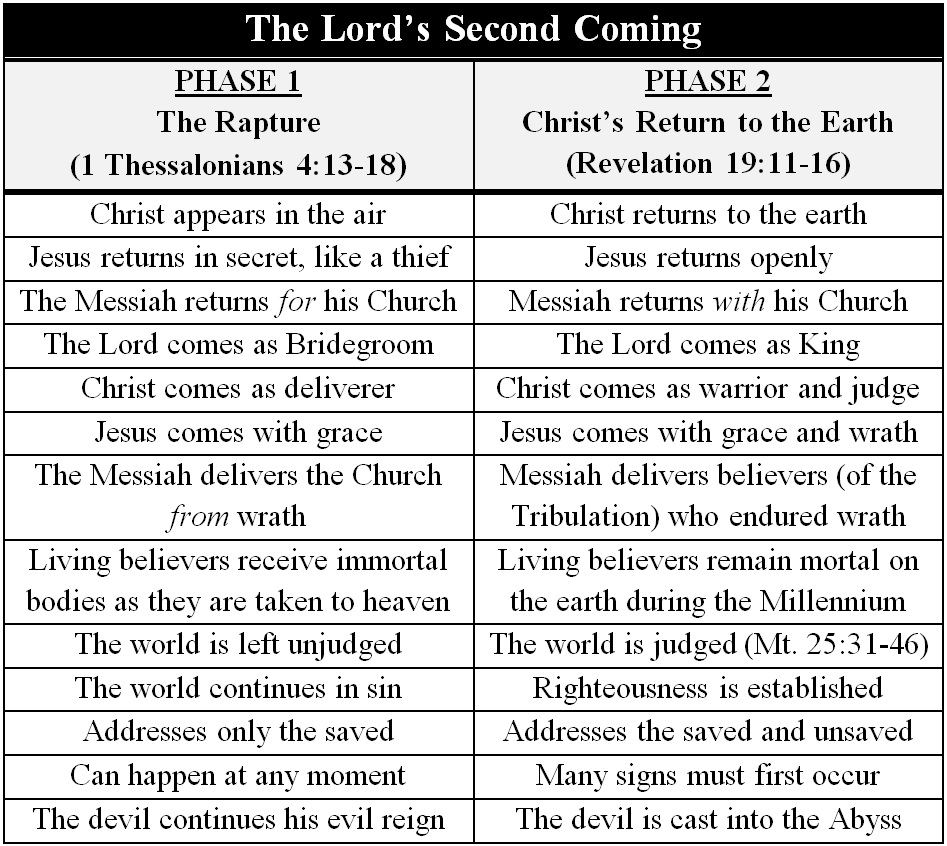
(Click image for enlargement and clarity)
The Rapture is Imminent while Definitive Signs Precede Christ’s Return to Earth
One of the differences on the list is that the Lord’s return for his Church—the Rapture—can happen at any time once the general season of the end is apparent, meaning it’s imminent, whereas many distinct signs precede Christ’s return to the earth. These signs include, amongst others: the global cataclysm of the Tribulation period itself (Revelation 6-19), the revealing of the antichrist (2 Thessalonians 2:1-8), the two witnesses (Revelation 11:1-12) and the institution of the mark of the beast (Revelation 13:16-17). In short, once the Tribulation begins—and it will be obvious when it does—you can be sure that Jesus will return to the earth seven years later.
However, this isn’t the case with the Lord’s return for his Church because, again, it’s imminent and could happen at any time with zero warning once the general season of his return is at hand, which means now (Matthew 24:3-14). Notice what Jesus said:
(36) “But about that day or hour no one knows, not even the angels in heaven, nor the Son, but only the Father. (37) As it was in the days of Noah, so it will be at the coming of the Son of Man.
(42) “Therefore keep watch, because you do not know on what day your Lord will come. (43) But understand this: If the owner of the house had known at what time of night the thief was coming, he would have kept watch and would not have let his house be broken into. (44) So you also must be ready, because the Son of Man will come at an hour when you do not expect him.
Matthew 24:36-37, 42-44
As you can see, we are instructed to “keep watch” and “be ready” because Jesus “will come at an hour when we do not expect him.” Interestingly, the Son doesn’t even know the day or hour, only the Father knows (verse 36). We must be “dressed ready for service” and “keep our lamps burning” (Luke 12:35) precisely because the Lord’s return for his Church is imminent. I should add that, while we don’t know the day or hour, we can know the general season via Jesus’ descriptions and, again, that season is now.
Is “The Rapture” Biblical?
While some claim that the word “Rapture” isn’t biblical, it is. It refers to a phrase used in this passage:
After that, we who are still alive and are left will be caught up together with them in the clouds to meet the Lord in the air. And so we will be with the Lord forever.
1 Thessalonians 4:17
‘Caught up’ in the Greek is harpazó (har-PAD-zoh), which means to “snatch up” or “obtain by robbery.” It’s translated in Latin as “rapio” in the Vulgate, which is where we get the English “Rapture.” With this understanding, when the Bridegroom, Jesus, comes for his bride, the Church, he’s going to obtain us by robbing us off the earth!
First Thessalonians 4:13-18 is the most prominent support text for the Rapture, but there’s quite a bit more support:
“Do not let your hearts be troubled. You believe in God; believe also in me. (2) My Father’s house has many rooms; if that were not so, would I have told you that I am going there to prepare a place for you? (3) And if I go and prepare a place for you, I will come back and take you to be with me that you also may be where I am.”
John 14:1-3
Listen, I tell you a mystery: We will not all sleep, but we will all be changed—(52) in a flash, in the twinkling of an eye, at the last trumpet. For the trumpet will sound, the dead will be raised imperishable, and we will be changed.
1 Corinthians 15:51-52
and to wait for his Son from heaven, whom he raised from the dead—Jesus, who rescues us from the coming wrath.
1 Thessalonians 1:10
What is the “coming wrath” and how does Jesus “rescue” us from it? The coming wrath refers to the Tribulation and the Lord rescues the Church from it via the Rapture.
Notice what Jesus promises the faithful church of Philadelphia:
“Since you have kept my command to endure patiently, I will also keep you from the hour of trial that is going to come on the whole world to test the inhabitants of the earth.”
Revelation 3:10
“The hour of trial that is going to come on the whole world” is referring to the Tribulation period detailed in Revelation 6-19. Jesus doesn’t say he would just protect believers during the Tribulation, but that he’d “keep them from the hour of trial” altogether. Keep in mind that, while the church at Philadelphia was one of seven first century churches that Jesus addresses in Revelation 2-3; these seven churches were picked by the Lord because they typify the seven kinds of churches that exist throughout the Church Age. As such, Jesus’ words were to all faithful Christians throughout the ensuing centuries of the Church Age. In fact, since the Rapture and the Tribulation didn’t come at the general time of this message to the church of Philadelphia circa 90-100 AD, the passage must more specifically refer to a future generation of faithful believers.
“Come Up Here”
Further support for the Rapture can be observed in what happens to John in the book of Revelation. Jesus gave John the threefold contents of Revelation at the end of chapter 1: “Write, therefore, what you have seen, what is now and what will take place later” (Revelation 1:19). This is the Contents Page of the book of Revelation: “What you have seen” refers to chapter 1 because that’s what John had seen up to that point in the vision while “what is now” refers to chapters 2-3 and “what will take place later” refers to chapters 4-22.
Chapters 2-3 of Revelation cover “what is now,” meaning the Church Age, as noted above. These chapters cover the seven types of churches that exist throughout the Church Age. Chapters 4-22 address “what will take place later” and chapters 4-19 specifically the period of the Tribulation, which involves the seal, trumpet and bowl judgments of God’s wrath that will befall the earth and its inhabitants.
Here’s my point: John was an apostle of the church and right at the beginning of Revelation 4—the beginning of his coverage of the Tribulation—Jesus says to him, “Come up here,” referring to heaven (verse 1). You see? John is representative of the church and just before the Tribulation he is taken up into heaven. Why? Because the church itself will be delivered from the Tribulation via Jesus’ return for his church, which is the Rapture.
Another thing to consider is that the church is referred to no less than nineteen times in the first three chapters of Revelation and not once on earth in chapters 4-19. Why? Because the existing church—all genuine believers—were “snatched up” to heaven before the Tribulation started. Revelation 19 details Christ’s return to the earth at the end of the Tribulation. Guess who’s riding with him? The church (verse 14).
This doesn’t mean, however, that there won’t be believers during the Tribulation because there will be multitudes; and, yes, they are the church because ‘church’ simply refers to the ekklesia (ek-klay-SEE-ah), the “called-out ones” who are called out of the darkness of this world into the kingdom of light. However, the existing church at the time of the Rapture before the Tribulation will have been snatched away. In other words, believers during the Tribulation embraced the gospel after the Rapture. We’ll address this in the next section.
A Biblical Pattern
The snatching up of the church before the Tribulation corresponds to the biblical pattern of the righteous being saved from destruction when God’s judgment falls on unrepentant masses. Jesus noted this pattern when he taught on the Rapture:
For the Son of Man in his day will be like the lightning, which flashes and lights up the sky from one end to the other. (25) But first he must suffer many things and be rejected by this generation.
(26) “Just as it was in the days of Noah, so also will it be in the days of the Son of Man. (27) People were eating, drinking, marrying and being given in marriage up to the day Noah entered the ark. Then the flood came and destroyed them all.
(28) “It was the same in the days of Lot. People were eating and drinking, buying and selling, planting and building. (29) But the day Lot left Sodom, fire and sulfur rained down from heaven and destroyed them all.
(30) “It will be just like this on the day the Son of Man is revealed. (31) On that day no one who is on the housetop, with possessions inside, should go down to get them. Likewise, no one in the field should go back for anything. (32) Remember Lot’s wife! (33) Whoever tries to keep their life will lose it, and whoever loses their life will preserve it. (34) I tell you, on that night two people will be in one bed; one will be taken and the other left. (35) Two women will be grinding grain together; one will be taken and the other left.”
Luke 17:24-35
Jesus is talking about “the day the Son of Man is revealed” (verse 30) that “will be like the lightning, which flashes and lights up the sky from one end to the other” (verse 24). In other words, it’ll take place in the blink of an eye. The last two verses show beyond any shadow of doubt that Jesus was talking about his snatching up of the church: “Two people will be in bed; one will be taken and the other left. Two women will be grinding grain together; one will be taken and the other left” (verses 34-35). This, incidentally, presents a problem for those who argue that the Rapture takes place at the same time as Jesus’ return to the earth at the end of the Tribulation because the impression of these verses is that of ordinary every-day life and not of people who just went through a worldwide cataclysm horrifically described in Revelation 6-19.
Observe in verses 26-29 how Jesus likens the time of the Rapture to the “days of Noah” and the “days of Lot”. “Just as it was” in the days of these two “so it will be” when Christ returns for his church. What’s the significance of this? In the days of Noah and Lot there were warnings of the LORD’s coming judgment on masses of people if they stubbornly refused to repent. In Noah’s situation the judgment concerned the entire world whereas in Lot’s situation it concerned the cities of Sodom and Gomorrah. In both cases the righteous were removed before God’s judgment fell. “So it will be” with the future Tribulation—those in right-standing with God will be taken out of the way before His wrath falls on rebellious humanity. Those who become believers during the Tribulation are those who wisely respond to the pouring out of God’s wrath by repenting.
In verse 30 Jesus says “It will be just like this on the day the Son of Man is revealed.” Just like what? Just like the days of Noah and Lot where people were carrying on business as usual—eating, drinking, marrying, buying, selling, planting and building (verses 27-28). This is what people will be doing when Jesus comes for his church, not enduring a global upheaval, which disproves the post-Tribulation position.
Speaking of the post-Tribulation view, how do people who hold this position explain Luke 17:24-35? They argue that Jesus only speaks of his coming once in this passage, not twice, and when he comes he will 1. snatch up the righteous and then 2. pour out his wrath on the unrighteous, citing verses 26-32. The problem with this, of course, is that it’s an explicit description of the pre-Tribulation position (or, at least, “pre-wrath”). The only thing they’re omitting is Jesus’ return to the earth after God’s wrath is poured out on rebellious humanity to set up his millennial kingdom (Matthew 25:31). As already explained, this is detailed in the book of Revelation: In Revelation 4:1 Jesus says to John—representing the church—to “come up here” to heaven. Chapters 4-19 cover the Tribulation where God’s wrath is poured out and Jesus returns to the earth at the end (Revelation 19).
Here’s a timeline diagram to help visualize these events:
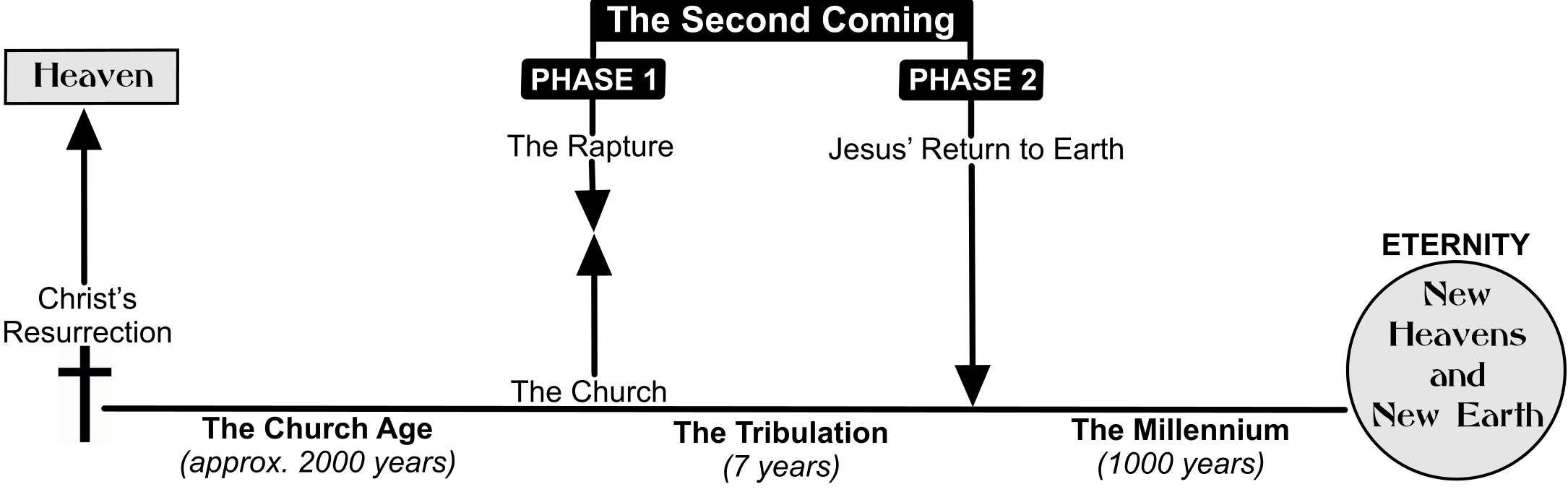
(Click image for enlargement and clarity)
Both the Rapture and Jesus’ Return to Earth are the Parousia
Some people suggest that the Rapture isn’t part of Jesus’ Second Coming and that only his return to the earth should be designated as the Second coming, but Jesus himself spoke of his snatching up of the church as “the coming of the Son of Man” (Matthew 24:27,37,39) and within this context are clear references to the Tribulation (verses 21-22 & 29). The Greek for “coming” in these passages is parousia (par-oo-SEE-ah), traditionally translated as “advent” in Christian circles as in “the Second Advent of Christ.” This is the same word used to describe the Lord’s coming at the end of the Tribulation in 2 Thessalonians 2:8. Jesus elsewhere referred to this latter coming as “When the Son of Man comes in his glory” (Matthew 16:27 & 25:31). Since the Rapture of the church is clearly separate from the Lord’s coming to the earth—with the Tribulation separating them—and both the Rapture and Jesus’ return to the earth are described in terms of “coming” then we must conclude that they both represent his Second Coming, albeit two phases.
Someone might argue: “But these two phases are separated by several years, how can they both refer to the same Second Coming? Because it’s one coming taking place in two stages. Besides, seven years isn’t that long of a time to the eternal God. Let me put it in perspective: The Bible says that a thousand years is like a day to the Lord (Psalm 90:4 & 2 Peter 3:8), which means that seven years would be like 10½ minutes! So from Jesus’ perspective the Second Coming—both stages—takes place in 10½ minutes. It’s hard to get out of the airport without baggage in that amount of time!
If you or anyone else prefers to designate Christ’s return to earth specifically as his Second Coming, that’s fine with me. I’m not going to argue with you. But this doesn’t change the biblical fact that parousia is used to describe BOTH (1.) Christ’s rapture of the Church and (2.) his return to earth shortly later. Furthermore, consider this: To believers the rapture IS Christ’s Second Coming whereas to the unsaved his return to earth is His Second Coming. So both refer to His Second Coming depending upon the spiritual condition of the individual; they’re just two different phases.
Lastly, notice what this passage says:
so Christ was sacrificed once to take away the sins of many; and he will appear a second time, not to bear sin, but to bring salvation to those who are waiting for him.
Hebrews 9:28
As you can see, the verse states that Christ will appear “a second time” — clearly referring to his Second Coming — and then goes on to say that when he appears this “second time” he will “bring salvation to those who are waiting for him,” which is an obvious reference to the Rapture.
“For it will not be, unless the Departure comes First”
Both phases of the Lord’s Second Coming are covered in this passage:
Now, brothers, concerning the coming of our Lord Jesus Christ, and our gathering together to him, we ask you (2) not to be quickly shaken in your mind, nor yet be troubled, either by spirit, or by word, or by letter as from us, saying that the day of Christ had come. (3) Let no one deceive you in any way. For it will not be, unless the departure comes first, and the man of sin is revealed, the son of destruction, (4) who opposes and exalts himself against all that is called God or that is worshiped; so that he sits as God in the temple of God, setting himself up as God. (5) Don’t you remember that, when I was still with you, I told you these things? (6) Now you know what is restraining him, to the end that he may be revealed in his own season. (7) For the mystery of lawlessness already works. Only there is one who restrains now, until he is taken out of the way. (8) Then the lawless one will be revealed, whom the Lord will kill with the breath of his mouth, and destroy by the manifestation of his coming;
2 Thessalonians 2:1-8 (WEB)
Verse 1 shows that this text concerns the Second Coming, including the church being “gathered together to him,” which is the Rapture. Verse 8 details the second phase of Jesus’ coming, which is when he returns to the earth and destroys the “lawless one”—the antichrist—simply with a word or two from his lips. (So much for Christ being a milksop weakling as he’s often maligned in modern Western culture!) The Greek word for “coming” in both verses is the aforementioned parousia. You see? The Second Coming consists of 1. Jesus’ return for his church and 2. His return to the earth to vanquish his enemies and establish his millennial kingdom.
Verse 3 reveals the sequence of events, emphasizing that the “day of Christ” will not come to pass until “the departure comes first, and the man of sin is revealed.” The “departure” is an obvious reference to the snatching up of the church while the revealing of the “man of sin” refers to the unveiling of the antichrist, a wicked, possessed man who will obtain worldwide power during the Tribulation (Revelation 13:7).
The Greek word for “departure” is apostasia (ap-os-tas-EE-ah) and is only used one other time in the Bible where it refers to departing from the law of Moses (Acts 21:21). Interestingly, the word was translated as “departure” or “departing” in 2 Thessalonians 2:3 in the first seven English translations of the Bible, which changed when the King James translators decided to translate it as “falling away.” Most modern English versions have followed the lead of the KJV by translating it as “apostasy” or “rebellion,” but the World English Version (above) translates it as “departure.” I believe this is the proper translation for a couple of reasons:
- The verb form of the word is used 14 times in the New Testament where it predominantly means “departed.” Luke 2:37 is a good example where it refers to an elderly prophetess who “never left the temple but worshiped night and day, fasting and praying;” Acts 12:10 is another example where it refers to an angel leaving Peter after helping him escape from prison.
- It doesn’t make sense in the context of 2 Thessalonians 2:3 to translate apostasia as “rebellion” or “apostasy”/“falling away.” Concerning the former, the world has always been in rebellion against genuine Christianity (please notice I said “genuine”). Concerning the latter, there’s already mass apostasy in Christendom with whole denominations embracing gross libertinism and rejecting the most obvious biblical axioms. In fact, this has been increasing for decades.
- Translating apostasia as “departure” fits both the immediate context of 2 Thessalonians 2:1-8 and the greater context of the Lord’s Second Coming in the Bible, the latter of which we’ve already covered. Concerning the former, verse 1 speaks of the Second Coming in terms of the church being gathered to Jesus, which involves believers departing from this earth. And verses 6-8 speak of the “restrainer” of lawlessness, which must be removed before the antichrist can rise to power. Who is this “restrainer” of lawlessness? The most obvious answer is the Holy Spirit and, by extension, the church, which is the temple of the Holy Spirit (1 Corinthians 3:16). When they depart the earth the antichrist will no longer be restrained in the vacuum and will make his move. Whereas the church will remain in heaven during the Tribulation the Holy Spirit will return as masses of wise people will almost immediately turn to God after the incredible testimony of the Rapture. The Holy Spirit obviously returns because it’s the Spirit who regenerates people through the gospel (Titus 3:5). As noted earlier, untold millions will be saved during the Tribulation (Revelation 7:9,14) through the testimony of 1. the Rapture, 2. the 144,000 Jewish evangelists, 3. the two witnesses, 4. the mass divine judgments, and 5. an angel commissioned to preach the eternal gospel to the inhabitants of the earth (Revelation 14:6-7).
As you can see, 2 Thessalonians 2:1-8 strongly supports the two phases of the Second Coming and the pre-Tribulation Rapture.
Closing Thoughts
Let me close by stressing that I personally don’t care if the Rapture takes place before the Tribulation, mid-Tribulation or “pre-wrath.” I don’t even care if it takes place at the same general time as Jesus’ return to the earth at the end of the Tribulation. Don’t get me wrong, like any sane believer I have zero desire to go through the Tribulation, but as a responsible minister of the Word of God all I care about is accurately conveying what the Bible teaches and my studies have led me to conclude what’s contained in this article. Bear in mind that I’m a devoted non-sectarian and therefore don’t draw doctrinal conclusions based on the pressure of a certain group. I draw conclusions from the God-breathed Scriptures and, as you see, they overwhelmingly point in the direction of a pre-Tribulation Rapture.
I encourage you to unbiasedly look at the different perspectives in your studies and draw your own conclusions with the help of the Holy Spirit. I recommend David Reagan’s many excellent articles, which can be found at lamblion.com, as well as the great works of Hal Lindsey and Todd Strandberg. Check out the latter’s popular website raptureready.com.
Lastly, all genuine believers who know how to read agree that the Lord will “snatch up” his church when he returns based on the clear passages we’ve looked at in this article, so the Rapture is a biblical fact. It’s the timing of the Rapture that believers disagree on and this is a secondary issue; it’s not something to argue about or break fellowship over. Whether pre, mid, post or pre-wrath, the Rapture will occur.
This article was edited from chapter 11 of…

- The print book is available here for just over $10 (257 pages)
- The eBook is available here for just 99¢
- The more affordable Condensed Version is available here for only about $6 (153 pages); or get the eBook for just 99¢.
Millennial Reign of Christ (THE MILLENNIUM) — Why?

The Bible teaches that there will a thousand-year reign of Christ on this earth before the eternal age of the new heavens and new earth is established. What is the scriptural evidence for the Millennium and what differentiates it from the coming eternal age? Most importantly, what’s the purpose of the Millennium?
The Scriptural Evidence for the Millennium
While there are several biblical references to the Millennium, such as Zechariah 14:1-9 and Isaiah 11, Revelation 20 is the most detailed passage in the New Testament:
And I saw an angel coming down out of heaven, having the key to the Abyss and holding in his hand a great chain. 2 He seized the dragon, that ancient serpent, who is the devil, or Satan, and bound him for a thousand years. 3 He threw him into the Abyss, and locked and sealed it over him, to keep him from deceiving the nations anymore until the thousand years were ended. After that, he must be set free for a short time.
4 I saw thrones on which were seated those who had been given authority to judge. And I saw the souls of those who had been beheaded because of their testimony about Jesus and because of the word of God. They had not worshiped the beast or its image and had not received its mark on their foreheads or their hands. They came to life and reigned with Christ a thousand years. 5 (The rest of the dead did not come to life until the thousand years were ended.) This is the first resurrection. 6 Blessed and holy are those who share in the first resurrection. The second death has no power over them, but they will be priests of God and of Christ and will reign with him for a thousand years.
7 When the thousand years are over, Satan will be released from his prison 8 and will go out to deceive the nations in the four corners of the earth—Gog and Magog—and to gather them for battle. In number they are like the sand on the seashore. 9 They marched across the breadth of the earth and surrounded the camp of God’s people, the city he loves. But fire came down from heaven and devoured them. 10 And the devil, who deceived them, was thrown into the lake of burning sulfur, where the beast and the false prophet had been thrown. They will be tormented day and night for ever and ever.
Revelation 20:1-10
The sequence of events is as follows: 1. After the Tribulation the devil will be seized and locked in the Abyss for a thousand years. As such, he will not be able to deceive the nations, which suggests that all demonic entities will be powerless over people during the Millennium. 2. The third stage of the first resurrection takes place wherein martyred believers will be bodily resurrected and reign with Christ for a thousand years. Other passages show that mortal believers will not receive their glorified bodies, but will enter the Millennium as mortals (Isaiah 65:20-25). We’ll consider why momentarily. 3. Glorified believers will be priests of God and will reign with Christ during the Millennium. Such believers will not be able to propagate because, as Jesus taught, “they will neither marry nor be given in marriage… for they are like the angels” (Luke 20:34-36). 4. At the end of the Millennium Satan is released and immediately deceives the nation, inciting a mad mass attack on the righteous government of Christ in Jerusalem. 5. The rebellion is easily defeated and the devil is cast into the lake of fire forever.
Those who deny a literal thousand-year reign of Christ on this Earth (aka people who embrace amillennialism) argue that Revelation is full of symbols and therefore the millennial reign is symbolic of one thing or another. While it’s true that Revelation contains a lot of symbolism, the symbols are usually revealed. For instance, the first chapter of Revelation speaks of seven stars and seven golden lampstands, which Christ later explains are seven designated angels and seven churches of Asia Minor (verse 20).
Another example of symbolism from Revelation 1 can be observed in verse 16 where a sharp, double-edged sword is said to be coming out of Jesus’ mouth. Since this is obviously a symbolic statement, what does the symbolism refer to? Ephesians 6:17 & Hebrews 4:12 show that it’s a reference to the Word of God, which fits what happens in Revelation 19:21. Scripture interprets Scripture.
Secondly, not everything in Revelation is symbolic. After all, Is Jesus Christ symbolic? Is God symbolic? Heaven? The Earth? John?
So how do we know the “thousand-years” isn’t symbolic? Several reasons: 1. There’s nothing about the phrase “the thousand years” that would indicate it’s figurative as is the case with the sharp sword coming out of Jesus’ mouth. In other words, you don’t interpret something allegorically when there’s no indication in the passage or elsewhere that it’s non-literal. 2. Nowhere does the book of Revelation say that the “thousand years” refer to something altogether different, like it does with the seven stars and seven churches in 1:20. 3. Since there’s no interpretation of what the “thousand years” refer to then it must refer to — you guessed it — a thousand years! 4. Lastly, notice that I underlined “thousand years” six times in verses 2-7 above. Keep in mind that, while this is John’s vision, it’s actually the “revelation of Jesus Christ” to John via the vision he’s given (Revelation 1:1). The point? The Lord stresses six times in six verses that there will be a literal thousand year reign of Christ on this Earth. What more do we need to know that Christ is referring to a literal thousand years? It goes without saying that anyone who uses theological mumbo jumbo to say that there won’t be a literal Millennium is getting precariously close to “taking words away” from this divine prophecy (Revelation 22:18-19).
What Differentiates the Millennium from the Coming Eternal Age?
With the understanding that a literal Millennium is scriptural, what distinguishes it from the eternal age of the new heavens and new earth? Several things, including:
- While believers with glorified bodies will reign with Christ during the Millennium, there will be nations of mortal people who will breed throughout the thousand years. These people are the “sheep” and their ensuing offspring that Jesus allows to enter the Millennium after the Judgment of Living Nations detailed in Matthew 25:31-46 (Also called the Sheep and Goat Judgment or the Pre-Millennial Judgment of Christ.). The “sheep” are promised eternal life and are allowed to enter the Millennium — as mortals — because they assisted believers during the Tribulation, which would include the 144,000 Jewish evangelists and their innumerable converts. These mortals will breed throughout the thousand years all over the world and, despite the completely righteous government of Christ, many of these will be susceptible to the devil’s deception when he’s released from the Abyss at the end of the Millennium to “deceive the nations in the four corners of the earth” (Revelation 20:7-8). Thankfully, this won’t be the case with the eternal age-to-come because there won’t be any mortals with ungodly natures.
- While life during the Millennium will be a veritable utopia compared to our current age because of 1. the righteous government of Christ and 2. the absence of the devil and his filthy spirits to deceive people, there will still be sin because mortals will still have sinful natures, which explains why many of them will be open prey to Satan’s deceptions when he’s released from the Abyss at the end of the thousand years. There will also be aging, pain and death. Not to mention the Earth & Universe will yet be burdened by the bondage to decay, which is entropy.
Lastly, the function of glorified believers during the Millennium will be focused on assisting the King of kings as priests of God, reigning in love over the nations of the Earth (Revelation 20:6). While this is wonderful, it’s a limited purpose compared to the literally universal scope of eternal life detailed in the article Eternal Life—What will it be Like?
There are other differences, of course, but these are the most obvious.
What’s the Purpose of the Millennium?
Some answer this by saying that the Millennium is the fulfillment of Scripture prophecy in that promises to Israel, the Church and Jesus Christ will be fulfilled. While this is true it doesn’t satisfactorily answer the root question: What is God’s actual purpose for the Millennium? I’ve heard it said that the Millennium is a transitional phase between this present evil age (Galatians 1:4) and the eternal righteous age-to-come (Luke 18:29-30). While this is also true (not to mention obvious) it still doesn’t answer the root question.
Hal Lindsey offers a fascinating explanation: The Millennium is the LORD’s irrefutable proof to humanity that the religion of secular humanism is a lie. As you may or may not know, secular humanism is atheistic in nature and therefore anti-God. To those who embrace this godless religion there’s no sin problem because there’s no God with whom to sin against. To them, the problem of evil isn’t humanity’s sin nature and alienation from our Creator, but rather a negative environment. As such, they believe evil, crime, poverty, war and other ailments will largely be eradicated when the right government is in place and every person is provided an education, a decent job, a nice living environment, protection from crime, and so on. While these things are good they don’t actually remedy the sin problem or reconcile people to their Creator. After all, a white collar man living in a wealthy suburb is still perfectly able to commit fraud due to a greedy heart, not to mention be a drunkard, drug addict, wife-beater, slanderer, hypocrite, adulterer, murderer, blowhard, oppressor, porn addict or practicing homosexual.
In the Millennium the LORD is going to provide nations of mortals the perfect government and environment — a veritable worldwide utopia. Since Jesus will be the King over all the Earth and his assistants will be glorified believers who don’t have a sin nature there will be zero corruption in the government (imagine that!). Yet as the population increases over the course of the Millennium many of the offspring of the original “sheep” will just go through the motions of being faithful to Christ while their hearts aren’t in it. This is legalism — putting on the airs of godliness without the heart of godliness. Because legalism is an “outward job” it’s decidedly inauthentic. As such, when the devil is unleased at the end of the thousand years these covert rebels will naturally embrace the lies of the kingdom of darkness and unite for war in an insane attempt to take over the completely righteous government of Christ!
Of course the rebellion is quickly quelled (Revelation 20:9) and, after the Great White Throne Judgment, the eternal age of the new heavens and new earth will manifest (Revelation 21-22).
So the Millennium is the Most High’s eternal showcase in disproving the religion of secular humanism. Chew on that!
Related Topics:
Amillennialism — What Is It? What’s Wrong With It?
Second Coming of Christ — Rapture and Return to Earth
RESURRECTIONS: Firstfruits, Harvest & Gleanings
Sheep and Goat Judgment — What’s It All About?
Eternal Life (“Heaven”): Questions & Answers
Questions & Answers on HUMAN DAMNATION, aka HELL
Is the Bible Full of CONTRADICTIONS? Does It Promote Slavery, Tyranny and Discrimination?

Someone wrote me recently with this claim:
The bible is so full of inconsistencies, contradictions, and untruths, as well as promoting slavery, tyranny, discrimination, that no truly moral person would ever follow its precepts, let alone accept its predictions.
I’d like to devote an article to answering this statement because this kind of gross misrepresentation of the Bible has now become fairly common in Western countries that used to highly respect the Judeo-Christian Scriptures just a couple of generations ago. Now we see the express opposite—utter loathing of the Bible to the point of actually slandering it—as with the case above.
While it’s true that some of the people who say these things are intentionally misrepresenting the Bible, others believe it simply because it’s what they’ve been taught; in other words, they were indoctrinated to believe it. As such, they’re not intentionally misrepresenting the Scriptures because they really believe the Bible is inconsistent and promotes the negative things cited above. So let’s look into the Scriptures and see what they actually say on these topics.
Is the Bible Full of Inconsistencies and Contradictions?
Answer: Only to someone investigating it superficially. There are obvious hermeneutical rules, such as “Scripture interprets Scripture,” meaning that a passage is interpreted in light of its immediate context and also the greater context of the entire Bible. One verse might superficially address a topic while another offers more detail. Needless to say, the more overt and detailed passages expand our understanding of the sketchy and ambiguous ones.
There’s also what theologians call “truths in tension,” which refer to two biblical truths that seemingly contradict and, yet, are both true. Some of these truths are paradoxical, but they’re not contradictory and actually balance each other out. One example of a biblical paradox is the nature of God — Father, Son, Holy Spirit. The Bible says that God is “one” (1 Corinthians 8:4 & Deuteronomy 6:4), but consists of Father, Son and Holy Spirit (Matthew 28:19). How can we explain this paradox? Think about it in terms of the clover, which is one small plant, but consists of three petals; or the human being, which is one being, but consists of spirit, mind and body. Other examples that are often cited by people as paradoxes aren’t really “truths in tension” because the conflicting passages are talking about two separate things. Here are several interesting examples:
Seeming Paradox: We are to honor our fathers and mothers (Ephesians 6:1-3), but Jesus said we must hate our fathers and mothers in order to be legitimate disciples (Luke 14:26).
Explanation: Jesus was using hyperbole, which is exaggeration for effect. As such, he was saying that our love for the LORD should be so great that our love for others, including parents, would seem like hate by comparison. Christ put it like this in another passage: “Anyone who loves their father or mother more than me is not worthy of me; anyone who loves their son or daughter more than me is not worthy of me” (Matthew 10:37). Keep in mind that the foremost command of God is to “Love the Lord your God with all your heart and with all your soul and with all your mind” and loving people is the second greatest command (Matthew 22:37-40). By following these two simple commands we fulfill all the moral law. Marinate on that!
Seeming Paradox: Jesus instructed, “If anyone slaps you on the right cheek, turn to them the other cheek also” (Matthew 5:39), but he himself entered the temple courts and threw over tables, scattered coins yelling while brandishing a whip and driving people out (John 2:13-17 & Mark 11:15-18).
Explanation: Christ specified the right cheek, indicating that he was referring to a backhanded slap, which was an insult in that culture. As such, Jesus was encouraging us to ignore a couple of insults for the sake of peace, which is plainly taught in the Old Testament (Proverbs 12:16 & 20:3). Such a response is wise because it helps defuse potential and unnecessary strife. However, Jesus was not teaching that we should be milksop doormats. In fact, he instructed us to confront fellow believers when they offend us (Matthew 18:15-17). As far as Jesus boldly “cleansing” the temple of ungodly riffraff, these people—the money-changers and hypocritical religionists—were corrupting the house of God, the temple, and so Christ confronted the evil and purged it, just like we should boldly confront and purge anything that’s corrupting our “temple of God” according to the New Covenant (1 Corinthians 3:16). Chew on that.
Seeming Paradox: Jesus came to give us abundant life (John 10:10), but also said that we must lose our life to save it (Matthew 16:24-26).
Explanation: The “abundant life” that Jesus came to give us is referring to eternal life, which literally means “the life-of-the-age-to-come.” Receiving eternal life is a two-part process that starts with spiritual regeneration (Titus 3:5) and culminates with our bodily resurrection (1 Corinthians 15:35-58). The life-of-the-age-to-come is within us—in our spirits—and we can tap into this awesome life every day via walking in the spirit and producing the fruit thereof (Galatians 5:16-24); and manifesting it to a lost, dark, dying world. When Jesus said we must lose our life he was talking about throwing off the “old self,” the flesh, which is “corrupted by its deceitful desires” (Ephesians 4:22-24). The flesh — the sinful nature — is definitely something you want to lose because its desires are deceitful. Such carnal impulses promise happiness and satisfaction, but can only deliver on the surface; underneath is misery, shame and death.
Paradox: The Bible is “God-breathed” (2 Timothy 3:16), but was written by human authors.
Explanation: Peter put it like this: “prophecy never had its origin in the human will, but prophets, though human, spoke from God as they were carried along by the Holy Spirit” (2 Peter 1:21).
Paradox: How can the LORD be sovereign, meaning “reigns supreme,” and yet people have free will?
Explanation: While God reigns supreme, he allows humans to have free will in order that they have the option to reject obvious truth, including the Creator’s existence, goodness and love. After all, how can you have an intimate “relationship” with someone if it’s forced?
Seeming Paradox: How are we “saved by grace through faith… not by works” (Ephesians 2:8-9) when another passage plainly says that faith without works can’t save us (James 2:14-26)?
Explanation: Genuine faith always results in both fruit and works (Colossians 1:10). The very next verse of that popular passage (Ephesians 2:8-9) says that we are “God’s handiwork, created in Christ Jesus to do good works” (2:10). In other words, it is through faith that we are “recreated in Christ Jesus” (Amplified) and this naturally results in good works. The phrase “Don’t put the cart before the horse” applies here: Faith and salvation come first; fruit and works follow.
Seeming Paradox: If we’re “saved by grace through faith… not by works” (Ephesians 2:8-9), why did Paul elsewhere stress [to believers] that an impenitent carnal lifestyle negates salvation in Christ (1 Corinthians 6:9-11; Galatians 5:21; Titus 1:16)?
Explanation: Christ said you can discern between those who genuinely represent God and those who are false “by their fruit” (Matthew 7:15-23). As such, genuine believers will feel convicted by sin and “keep with repentance” (Matthew 3:8; Luke 3:8; 1 John 1:8-9) whereas false believers will not.
Seeming Paradox: Is the kingdom of God present or future?
Explanation: It’s both. The “kingdom of God” simply refers to the rule of the LORD, which starts within the believer through spiritual rebirth and then proceeds without as the individual matures. Some of the Pharisees, who were fake religionists, asked Jesus when the kingdom of God would come and he answered: “The coming of the kingdom of God is not something that can be observed, nor will people say, ‘Here it is,’ or ‘There it is,’ because the kingdom of God is in your midst” (Luke 17:20-21). Jesus was/is the King of kings and the kingdom of God was already amidst the Pharisees via Jesus’ teachings and miracles, as well as the works of his disciples. Bear in mind, however, that Jesus didn’t say the King was amongst them, he specified the Kingdom of God. In other words, the kingdom of God was just as much available to the Pharisees as it was for blatant sinners, like prostitutes, but the Pharisees and other hypocritical religionists will not enter it. Why? Because entering God’s kingdom requires repentance and faith (Acts 20:21) and pharisaical people are too arrogant and disingenuous for either. Other passages show the future tense of the kingdom of God, such as 1 Corinthians 6:9,10, Galatians 5:21 & Ephesians 5:5. The paradox is resolved when one understands the two-phase process of salvation, as detailed above: Salvation starts with spiritual regeneration and culminates with the bodily resurrection. These two events correspond to the present and future kingdom of God. As such, the LORD is “jump starting” the future kingdom of God—which includes both the Millennium and the eternal age of the new heavens and new earth (Revelation 20-22)—through people spiritually born of his kingdom. These believers are “Christ’s ambassadors” (2 Corinthians 5:20)—ambassadors of the kingdom of God – in this dark, dying world.
For further details see the article Berean Spirit — What is It? How Do You Cultivate It?
Is the Bible Full of “Untruths”?
Jesus is the living Word of God (John 1:1) and the Bible is the written Word of God (2 Timothy 3:16). Christ said he was “the truth” and also referred to the Word of God as “truth” (John 14:6 & 17:17). ‘Truth’ means “reality”; that is, the way it really is. We live in a severely messed-up world full of lies, half-truths and totally contradicting philosophies or belief systems. Jesus Christ and the Bible claim to be the truth—the way it really is. As such, it reveals spiritual, moral, historical and future reality.
I realize that’s an astounding claim, but the proof is in the pudding, so to speak. For instance, consider all the biblical prophecies that have been amazingly fulfilled, which you can research in this article: Fulfilled Prophecy: Evidence for the Reliability of the Bible. Or consider the millions of lives that have been miraculously transformed by embracing the awesome news of the gospel and putting into practice the principles of Christ’s Word, like my life.
As noted above, one of the truths the Bible reveals is moral truth. We live in a world that is critically confused about morality to the point that what was evil a mere couple generations ago is now considered good and vice versa (Isaiah 5:20). The definition of morality may change at a whim in this world, but thankfully we have the rock-solid Word of God that boldly shows us the moral truth—moral reality.
The answer to society’s moral dilemma is not to put ourselves under God’s moral law because that won’t work. It didn’t work for the Israelites in the Old Testament and it won’t work for us today in the New Testament era. In fact, putting oneself under the law will actually increase the sin problem (Romans 5:20). The answer to walking free of the law of sin and death is to activate a greater law; and that’s the law of the spirit of life in Christ (Romans 8:1-2). For details see these articles: How to be Spirit-Controlled Rather than Flesh-Ruled and Law (Torah) and the Believer.
Does the Bible Promote Slavery?
No, Paul boldly included slave trading in a list of sins:
We know that the law is good if one uses it properly. (9) We also know that law is made not for the righteous but for lawbreakers and rebels, the ungodly and sinful, the unholy and irreligious; for those who kill their fathers of mothers, for murderers, (10) for adulterers and perverts, for slave traders and liars and perjurers – and for whatever else is contrary to the sound doctrine (11) that conforms to the glorious gospel of the blessed God,
1 Timothy 1:8-11
He also said this:
There is neither Jew nor Greek, there is neither slave nor free man, there is neither male nor female; for you are all one in Christ Jesus.
Galatians 3:28
As you can see, there’s neither slave nor free person “in Christ Jesus.”
This explains why Paul encouraged his friend and fellow Christian, Philemon, to set free his runaway slave, Onesimus, when Paul sent Onesimus back to Philemon. It’s not overtly stated, but obviously insinuated, e.g. “knowing that you will do even more than I ask” (Philemon 1:14-21).
The institution of slavery in the Roman world of the first century was a widespread, ironclad fact of life, and the New Testament’s instructions to slaves and owners must be viewed in this historical light.
Nevertheless, Paul’s instructions to slaves and masters in Ephesians 6:5-9 were utterly revolutionary at the time. The focus wasn’t to challenge the morality of the system but rather to transform people within the system from within; that is, in their sprits and hearts. Freedom always starts within and then proceeds without; and I don’t mean just freedom from conventional slavery. Trying to change people from the outside in, by contrast, doesn’t work because it’s merely a garnishment. This is why the Old Covenant that the Israelites had with God didn’t work—it was merely a set of rules to obey without inward regeneration. The New Covenant, by contrast, provides the necessary spiritual rebirth (Titus 3:5).
While the priority of New Testament ministers was to transform people from within rather than tackle slavery head-on, Paul plainly instructed slaves:
Were you a slave when you were called (to the Lord)? Don’t let it trouble you — although if you can gain your freedom, do so”
1 Corinthians 7:21
As you can see, the bible actually doesn’t support slavery in the least.
Add to this the fact that the greatest abolitionists of the 18th and 19th centuries were devout Christians, like William Wilberforce and William Lloyd Garrison.
As for the voluntary servants permitted amongst Hebrews according to the Torah, this wasn’t slavery as we understand it today. Individuals could sell their services for up to six years to repay debts or what have you; on the seventh year they were released, unless they loved their “masters” and wanted to stay (Exodus 21:2-6). As such, Hebrew “slaves” were actually hired hands and only became lifelong servants based on the desire of the servant (and the master).
What about real slaves from other countries who fled to Israel? Notice what the LORD commanded:
If a slave has taken refuge with you, do not hand them over to their master. 16 Let them live among you wherever they like and in whatever town they choose. Do not oppress them.
Deuteronomy 23:15-16
Wow, that just blows the LIE-beral lie that the Bible supports human bondage, huh?
Furthermore, the Old Testament is clear about apprehending people and selling them as if they were property:
“Whoever steals a man and sells him, and anyone found in possession of him, shall be put to death.”
Exodus 21:16
Stealing people and selling them as chattel was a crime with the penalty of death according to the Mosaic law.
In light of all this, how anyone can misconstrue that the Bible advocates slavery is beyond me. In fact, Christianity’s all about freedom from slavery and far more than just the conventional kind, as this verse shows:
It is for freedom that Christ has set us free. Stand firm, then, and do not let yourselves be burdened again by a yoke of slavery
Galatians 5:1
The only context that God permitted the captivity of people was the Hebrews during the Old Covenant in regards to conquered enemies (Deuteronomy 20:10-11), which would be akin to serfdom as opposed to what we understand as chattel slavery. For details, see this article.
Does the Bible Promote Tyranny?
There’s a difference between righteous Lordship (or kingship) and oppressive tyranny. For instance, Jesus Christ is called the “King of kings and Lord of lords” (Revelation 19:16) and will function in this capacity during the Millennium (Revelation 20:4-6) and eternally in the “new heavens and new earth,” which is the eternal age-to-come (2 Peter 3:13).
Would you like to hear about Jesus’ (supposed) abusive, domineering governmental proclivities? Listen to what he says:
“Come to me, all you who are weary and burdened, and I will give you rest. Take my yoke upon you and learn from me, for I am gentle and humble in heart, and you will find rest for your souls. For my yoke is easy and my burden is light.”
Matthew 11:28-30
Now observe Peter’s clear instructions to “elders,” which refers to mature believers called to serve as “shepherds,” that is, pastors:
To the elders among you: (2) Be shepherds of God’s flock that is under your care, serving as overseers – not because you must, but because you are willing, as God wants you to be; not greedy for money, but eager to serve; (3) not lording it over those entrusted to you, but being examples to the flock
1 Peter 5:1-3
Verse 3 says point blank that pastors are not to lord it over the people entrusted to their care. The word “lording” here means to control, subjugate or rule in the sense of being the final authority. Pastors are not to be tyrannical like this! Although pastors are certainly the authority of the fellowships they oversee, Christ is the final authority of the church. Pastors simply have no business “lording it over” believers as if they were the supreme and final authority in their lives.
Being “tyrannical” is authoritarianism, which is demagoguery where a leader tries to dominate others through intimidation and manipulation. A tyrannical Christian leader is an oxymoron since ‘minister’ literally means “servant” and reveals how Christian ministers are to minister – with a servant’s heart. This isn’t to say, of course, that ministers have to be perpetually sugary sweet as there’s a time and place for Spirit-led rebuke, like when Paul openly corrected Peter for his legalism (Galatians 2:11-14) or when he radically confronted a sorcerer who was brazenly hindering the spread of the gospel (Acts 13:8-12) or when Jesus boldly cleared the temple of fools (Mark 11:15-18).
Concerning the Israelite monarchy in the Old Testament, God originally wanted the Israelites to be a theocracy, not a monarchy, but they cried out for a king and so the LORD allowed it (1 Samuel 8). The problem with monarchies in a morally fallen world is that, sooner or later, you’ll wind up with a corrupt king or queen who will mislead the people, which is precisely what happened with both Ephraim (Northern Israel) and Judah (Southern Israel).
You can read more about what the Bible says on authoritarianism here.
Does the Bible Promote Discrimination?
Let me quote from the Bible:
There will be trouble and distress for every human being who does evil: first for the Jew, then for the Gentile; but glory, honor and peace for everyone who does good: first for the Jew, then for the Gentile. For God does not show favoritism.
Romans 2:9-11
There is neither Jew nor Greek, there is neither slave nor free man, there is neither male nor female; for you are all one in Christ Jesus.
Galatians 3:28
As you can see, there’s no favoritism with God and under the New Covenant all are one in Christ, whether Jew or Gentile, slave or free, male or female.

Does the Bible Discriminate Against “Gay” People?
I’m only including this question because, reading between the lines of the guy’s words (cited at the top in red), it seemed like he was insinuating that the Bible discriminates against homosexuals.
The Bible plainly teaches that “God so loved the world that he gave his one and only Son, that whoever believes in him shall not perish but have eternal life” (John 3:16). This includes homosexuals. Like all people, the LORD loves them and has provided a way for them to escape the wages of sin—death—and obtain eternal life.
Is homosexuality wrong in God’s eyes? Yes, but so is fornication, adultery, drunkard-ness, pomposity, hatred, strife, gossip, slander and numerous other sins. The wages of all sin is death and God wants us to escape it through the gospel. You see, there’s no discrimination—the LORD wants all people across the board to be set free from slavery to fleshly bondages. Again, Christianity’s all about freedom: “It is for freedom that Christ has set you free” (Galatians 5:1).
Modern culture has embraced two lies: 1. If you disapprove of someone’s lifestyle it automatically means that you fear or hate them; and 2. to truly love someone you must agree with everything they believe and do. Needless to say, this is absurd. I don’t approve of drunkards* and fornicators, but that doesn’t mean I fear or hate them. I actively walk in love toward arrogant people, liars, adulterers and slanderers, but that doesn’t mean I agree with their destructive behaviors. By the way, when I say that I “walk in love” I don’t just mean the gentle variety because sometimes “tough love” is in order. See the article Gentle Love and Tough Love for details.
* By “drunkard” the Bible isn’t referring to someone who drinks a sip of alcohol (see Deuteronomy 14:26), but rather to the alcoholic lifestyle, including binge drinking. Ephesians 5:18 instructs believers to “not get drunk on wine, which leads to debauchery” but “Instead, be filled with the Spirit.” This means that we should be seeking to get “drunk” on the LORD and the things of God, not alcohol. Psalm 34:8 says “taste and see that the LORD is good.” When you truly “taste” of the Almighty nothing else satisfies!
When it comes to any sin we have to distinguish between our flesh’s proclivity to sin and the actual practice of it. For instance, someone might have a fleshly penchant for alcohol, but they’ve learned to overcome the temptation through Christ and the support of others and therefore don’t indulge it. A married man might experience the carnal desire to commit adultery with a flirtatious sexpot at work, but he refuses to indulge the desire, which includes guarding his thought life (Proverbs 4:23 & Matthew 5:27-29).
So, yes, homosexuality is a sin (1 Corinthians 6:9 & Leviticus 18:22), but having a flesh proclivity for it isn’t, as long as you don’t indulge it. All Christians have carnal proclivities because of the sinful nature and these proclivities are usually based on the sins we’ve tasted of in the past, although in some cases it’s a generational thing. For instance, I’ve never been tempted by cocaine because I’ve never “tasted” of it, but there are sins I’ve tasted of and therefore have a penchant for. When I’m tempted I merely resist the temptation and it passes. This is overcoming the flesh (1 Corinthians 10:13). Temptation, by the way, is simply the enemy’s attempt to get the believer out of the realm of the spirit and into the realm of the flesh. The enemy wants you flesh-ruled rather than spirit-controlled because when you’re flesh-ruled it’s impossible to truly be effective in God’s service. For key scriptural principles on walking free of any fleshly addiction or bondage see this video How to Walk FREE of the Flesh.
Someone might ask: Why were homosexuals put to death in the Israelite community under Old Testament law, as seen in Leviticus 20:13? The same reason adultery, incest, rape and bestiality were capital crimes for the Israelites, God’s consecrated people: These particular sins threatened the very fabric of society—the family—and therefore immediate death was the penalty under Old Testament law in order to deter them.
You might say that this is rather stern and the Bible actually agrees with you:
Not that we are adequate in ourselves to consider anything as coming from ourselves, but our adequacy is from God, (6) who also made us adequate as servants of a new covenant, not of the letter but of the Spirit; for the letter kills, but the Spirit gives life.
2 Corinthians 3:5-6
The “letter” refers to being under the Old Testament law, which—as you can see—KILLS. The good news, however, is that “the Spirit gives LIFE.” Praise God!
While some sins were considered severe enough for the person to be put to death under Old Testament law we have to understand that death is actually the penalty of all sin. The grave sins listed above resulted in premature physical death for the Israelites during the Old Covenant, but all sins result in eternal death if not repented of through the gospel of Christ. As it is written:
For the wages of sin is death, but the gift of God is eternal life in Christ Jesus our Lord.
Romans 6:23
Then, after desire has conceived, it gives birth to sin; and sin, when it is full-grown, gives birth to death.
James 1:15
Whoever sows to please their flesh, from the flesh will reap destruction; whoever sows to please the Spirit, from the Spirit will reap eternal life.
Galatians 6:8
The bad news is that death is the wages of sin, but the good news is that eternal life is God’s free gift to those who turn to him through the gospel in repentance and faith (Acts 20:21), which starts with spiritual regeneration (John 3:3,6). From there deliverance from any sin problem is a process as the believer is transformed by the renewing of his or her mind, learning to live out of his/her “new self” with the guidance of the Holy Spirit (Ephesians 4:22-24). The more a believer becomes spirit-controlled rather than flesh-ruled the more he or she will bear the fruit of the spirit, one of which is self-control or self-discipline (Galatians 5:22-23 & 2 Timothy 1:7). This naturally gives the believer the “edge to win” over any severe sin problem or addiction. In other words, the closer you get to the LORD the more self-control you’ll walk in and therefore the more freedom you’ll experience. This explains why David praised God like so:
I run in the path of your commandments, for you have set my heart free.
Psalm 119:32 (WEB)
Keep in mind that David was a type of the New Covenant believer.
How’s all this apply to the topic of homosexuality? The truth is that homosexuality is a severe sexual addiction, a life-dominating sin problem, which is why the kingdom of darkness does everything in its power to get a person to fall into that dark pit. For the Hebrews under Old Testament law there was no hope for those who fell into this pit. The “letter KILLS” and so the ‘best’ the Israelites could do was to put to death those infected by homosexuality, which stopped its spread in their communities (2 Corinthians 3:5-6). But that passage doesn’t end with “The letter kills,” it goes on to say “but the Spirit gives LIFE.” In other words, while deliverance for the homosexual was unavailable under the inferior Old Covenant, total deliverance is available in the New Covenant. This is one of the many reasons why the New Covenant is a superior covenant (Hebrews 8:6,13).
So Christianity doesn’t discriminate against homosexuals at all. Like any other sin it offers deliverance, freedom and LIFE (John 10:10). Praise God!
Related Topics:
Women — Were they Considered Just Property in Bible Times?
Homosexuality is a Sin, BUT there’s Freedom through Christ
Does the Bible Support SLAVERY?
Hermeneutics — Proper Bible Interpretation
Christianity — Does it Weaken People or Empower?
Who Wrote the New Testament Books? Who Authorized them as Scripture Canon?
Ministerial Pitfalls and Abuses