
EXORCISM and the Believer’s Authority

I’d like to take a different approach with this article by examining a film based on a true story. We’ll flesh out its biblical themes and use it as a bridge to our dealings with cases of demonic oppression or possession.
The Exorcism of Anneliese Michel
The movie The Exorcism of Emily Rose was loosely based on the real story of a 23 year-old German girl, Anneliese Michel, who died while a priest was trying to exorcize her of demons in the late 70s. He was then put on trial for neglectful homicide.
In the movie, Erin Bruner (Laura Linney) is the agnostic lawyer who defends the priest (Tom Wilkinson), while the prosecutor (Campbell Scott) is a non-Catholic believer. I’m sure you see the conundrums of the situation: How can an agnostic defend a minister who performs a supernatural operation that ends in the death of a young woman? How can a genuine believer prosecute another believer who was simply fulfilling his calling and performing a service for a congregant?
The prosecution argues that the woman was physically & mentally ill with symptoms of epilepsy, psychosis and schizophrenia; and that the attempted exorcism was just a bunch of witch doctor hooey. The defense, on the other hand, argues that such physical/mental manifestations were the result of diabolical spiritual possession. In other words, the girl’s possession produced the symptoms of epilepsy, psychosis and schizophrenia. It’s the proverbial chicken or the egg question.
Observations
In the Bible, didn’t Jesus deliver people from demons who induced insanity, deafness, muteness and infirmity? See Mark 5:1-20, 9:17-29 and Luke 13:10-16. It’s clear from the Scriptural evidence that being possessed (or oppressed) by an evil spirit can induce mental or physical ailments. Such demons are “spirits of infirmities,” which we’ll address momentarily.
Another point of the defense in the movie is that a powerful drug that Emily was prescribed prevented the exorcism from being successful because it physiologically trapped her in a mode that was resistant to exorcism and the corresponding freedom.
All of this provokes many questions: How many people in our mental institutions are being drugged up and essentially imprisoned for the rest of their lives when what they really need is exorcized of dark spiritual entities that have possessed them to one degree or another? Don’t get me wrong here, I’m not against these kinds of asylums and realize that we, as a society, are just doing what we have to for such ailing people; that is, what we can.
Yet, what if someone of Jesus Christ’ stature were around, someone who had the authority, faith and courage to rebuke demons and send them fleeing with their tails between their legs, so to speak? The first chapter of the gospel of Mark shows the Messiah exorcizing demons from numerous people and this is merely one chapter of the New Testament! (See verses 25-26, 34 and 39).
A Real-Life Experience With Demonic Possession
I know of one person who was seriously mentally ill all her life but the best professionals medical science had to offer couldn’t deliver her. The best they could do was sedate her, try this or that (including shock treatments) and help her cope. Some of this is good to an extent, but they could not set her free. She lived and died with this severe illness. I’m convinced that these symptoms were the result of some type of demonic possession/oppression. Others who were close to the situation have drawn the same conclusion. The signs pointed to a partial possession, which we’ll look at shortly. If only I knew then what I know now and was the person I am now, I would have exorcized her of this spiritual subjugation without a second thought, as long as she was willing (which is necessary since God will never heal or deliver people against their will).
Am I suggesting that we should let loose a bunch of religious kooks into our mental institutions to supposedly exorcize the severely ill of their (very possible) literal demons? No, but if some people show evidence of the power and boldness Jesus Christ walked in, shouldn’t we? Didn’t Jesus come to “set the captives free,” “heal the sick and brokenhearted” and “release the prisoners from the darkness”? (See Luke 4:16-21 and Isaiah 42:5-9).
The fact that so few believers are walking in this authority, power, faith and boldness is a shame to the modern Church in general. It’s also testimony to the powerless nature of so many counterfeit sects and “believers” who “have a form of godliness but deny its power” (2 Timothy 3:1-5). Not that all the believers within these camps are counterfeits, not at all. But their leaders are ignorant, disingenuous or spiritually blind. And didn’t Jesus say, “If a blind man follows a blind man they will both fall into a pit”? (Matthew 15:14).
One of the purposes of this book is to reveal the reality of dark spiritual entities, how their attacks manifest, and how to effectively combat them by faith.
Further Commentary on the Film
The Exorcism of Emily Rose works beyond the courtroom drama where the theological questions are hammered and tested; it works as a simple horror film, based on a true story. The movie successfully shows the reality of dark spiritual malevolence. It drives home the reality of unseen menace and literally scares the hell out of the viewer, but only unbelievers and immature Christians. Strong believers, by contrast, laugh at evil spirits and simply command ’em to shut up, like Christ did (more on this momentarily). You must understand that believers have authority over evil spirits and thus we have no reason to fear them (Luke 10:18-20). I don’t.
And yet, thankfully, the film is somehow affirming of life, love, hope and faith.
I only have one theological criticism introduced late in the story, the idea that Emily only had one of two options: To physically perish and go home to be with the Lord or stay in the body and suffer further as a supposed testimony to the world of the reality of the spirit realm and the dark powers thereof. This implies that God allowed Emily’s possession for the purpose of showing the world the unseen truth. The obvious problem with this is that Jesus was Immanuel, aka “God with us,” and He never hesitated to exorcize demons from the afflicted. In other words, it’s always God’s will to deliver the demon-possessed, as long as the person wants free. Such deliverances are not only a testimony to the realm of the spirit, but of the victory of light over darkness.
Although I wouldn’t call the film a masterpiece it’s effective in many ways. It provokes important questions: How many of our mentally ill—perpetually drugged-up and confined—are suffering from demonic possession? The drugs and confinement can only sedate them and help them cope (which helps those nearest them, of course); they cannot set them free. Only exorcism can do that, which is deliverance.
The Believer’s Authority
Where is the church of Jesus Christ, the “called-out” ones who are called out of the darkness of this world? Why is the church so inert and seemingly powerless when it comes to dealing with victims of demonic possession or oppression? I know there are a few “radicals” or “extremists” who function in this capacity, but what of the general body of Christ? I’m not talking about young, immature or erratic Christians, but rather seasoned believers who know the Lord & His Word and function in the body as deacons, elders, praise & worship warriors, teachers, pastors and prophets.
Let’s not forget the incredible authority Jesus gave believers:
“I saw Satan fall like lightning from heaven. 19 I have given you authority to trample on snakes and scorpions and to overcome all the power of the enemy; nothing will harm you. 20 However do not rejoice that the spirits submit to you, but rejoice that your names are written in heaven.”
Luke 10:18-20
“Snakes and scorpions” are figurative of the devil and demonic spirits. Jesus gave his disciples authority to trample them under their feet, that is, overcome their power. Hence, filthy spirits had to submit to them and the disciples were understandably elated (see verse 17). They delivered people from demonic oppression and possession; they healed the sick and brokenhearted; they set the captives free because they had the authority and power to do so. Authority is the right to rule whereas power is the ability to rule.
If Jesus’ disciples—who weren’t even spiritually regenerated at the time—had authority to overcome the powers of darkness, how much more so Christians who have been spiritually born of the imperishable seed of Christ?
Get a hold of this fact: If you’re a believer YOU have authority over the kingdom of darkness! All the spiritual forces of evil are under your feet! They don’t have the authority to overcome you; you have the authority to overcome them!
As stressed in this article, words have the power of life and death (Proverbs 18:21), so make this powerful positive confession:
I [state your name] have the authority to trample on snakes and scorpions and to overcome all the power of the devil and his wicked angels. Nothing will harm me. I have the victory in Jesus Christ — Hallelujah!!
Make Biblical statements like this your regular confession. Speak them with fervor! Never speak disempowering words of doubt, defeat, fear or grumbling. Cast such things off on the LORD in prayer, which is venting (Psalm 55:22 & 1 Peter 5:7). When you spend quality time praising, adoring and communing with the Most High the very light of his presence will squelch emotional waste like doubt, fear and worry. Do this regularly. God is the Fountain of Life and in his light we see light (Psalm 36:9); darkness naturally vanishes!
Jesus Christ Is the Genuine “Lion” While Satan Is a Counterfeit
The devil may prowl around like a roaring lion trying to frighten people immobile with his intimidating roar, but for the believer who walks in faith he’s a toothless, clawless, sinew-less lion. More than that, the Bible describes Jesus Christ as the genuine Lion of Judah. In other words, Jesus is the real deal, while the devil is just a counterfeit—a fake—who prowls around like a roaring lion. Oh, sure, he can attack since he’s “the god of this world” and we’re invading his turf, but the Bible says that all we have to do is “submit to God and resist the devil” “standing firm in the faith” and the enemy will literally “flee” from us (James 4:7 & 1 Peter 5:8-10).
This is what the apostle Paul called fighting “the good fight of faith” (1 Timothy 6:12). When we stand in faith with our spiritual armor on and swing our spiritual swords the forces of evil have no recourse but to “flee.” One minister I heard said the imagery in the original language paints the picture of a dog running away with his tail between his legs—“Yipe, yipe, yipe yipe!!” Picture that the next time you take a stand in faith against the enemy—including exorcisms—and have yourself a knee-slapping victorious laugh.
Walking in the Amazing Authority of Jesus Christ
As The Exorcism of Emily Rose illustrates, we live in a generation that idolizes reason and science above all. These are the only criteria for determining reality to the unspiritual man, and understandably so. Thus anyone who looks to the Holy Scriptures for truth and has the audacity to act accordingly is viewed with disdain and ridicule. Which explains why the church is so powerless and timid when it comes to dealing with demonic possession or oppression: We fear the scorn of the world.
This reminds me of a Pentecostal pastor who told me about a prophet he had at his church for a series of services. The prophet ministered to the people and apparently dealt with a couple cases of demonic oppression or possession. The pastor said he was uncomfortable with the man’s ministry because it was sometimes awkward and even shocking. But, let me tell you, dealing with filthy spirits can get ugly! Yelling, vomiting, screaming, wiggling on the floor, etc. come with the territory. We’ll look at examples from the Scriptures in a moment. The pastor said that the experience made him “gun shy” of demonic deliverance and everything that goes with it. Unfortunately, he threw the baby out with the proverbial bathwater because his church had the most sterile atmosphere of any I’ve experienced, and it was “Pentecostal”!
I realize we have to “become all things to all people that by all possible means we might save some” (1 Corinthians 9:22). Hence, we have to “locate” where people are and act accordingly, otherwise we’ll scare ’em off with things they simply can’t handle, at least not presently. We need to do this to reach people, but let’s not do it to the extent that we become as spiritually powerless as the world. We are the “light of the world” (Matthew 5:14), meaning that the Church is the light that inspires those lost in the darkness of this world. Those in the darkness “who have ears to hear and eyes to see” will naturally be drawn to the light and ultimately delivered; and the closer they get to The Light the freer they’ll be (John 8:12,31-32). This is the way it’s supposed to be.
But something’s wrong when the church allows the darkness of the world to squelch our light to the point that we’re impotent and ineffective, all because we fear the world’s contempt and ridicule! Needless to say, this is an example of allowing the world to mold us into its form; something the Bible instructs us not to do (Romans 12:2).
One of the things that drew people to the Mighty Christ was the genuine authority he walked in, which shouldn’t be confused with pompous authoritarianism. This made his ministry—his service—effective, including demonic deliverance. Observe:
They went to Capernaum, and when the Sabbath came, Jesus went into the synagogue and began to teach. 22 The people were amazed at his teaching because he taught them as one who had authority, not as the teachers of the law. 23 Just then a man in their synagogue who was possessed by an evil spirit cried out, 24 “What do you want with us, Jesus of Nazareth? Have you come to destroy us? I know who you are – the Holy One of God!”
25 “Be quiet!” said Jesus sternly. “Come out of him!” 26 The evil spirit shook the man violently and came out of him with a shriek.
27 The people were all so amazed that they asked each other, “What is this? A new teaching – and with authority! He even gives orders to evil spirits and they obey him.” 28 News about him spread quickly over the whole region of Galilee.
Mark 1:21-28
Verse 22 shows that the people were amazed at the aura of authority Jesus displayed merely with his public teaching. This was something the religious leaders of that day didn’t have, like the Pharisees and the Sadducees. The people were even more amazed when he proceeded to command evil spirits to shut up and come out of people, as shown in verse 27. Unsurprisingly, news then spread about him throughout the region (verse 28).
Speaking of commanding demons to shut up, Christ typically did this when encountering possessed people (Mark 1:24-25 & Luke 4:35,41). Why? Because evil spirits are liars who have ages of experience duping even the brightest of people. In light of this, never talk with demons; just tell ’em to shut up and exorcize the individual, presuming the person is willing.
A pastor I know testified of his first encounter with a demon-possessed man. The wicked spirit started a conversation with him that went on for a couple of hours (!) whereupon the pastor’s head was spinning, so to speak. Then a seasoned fellow-minister, who just happened to be visiting from out of state, entered the room and immediately discerned what has happening. He didn’t talk with the foul spirit at all, but simply said “loose” and that was the end of it.
Rise Up and Walk in Your Authority!
Unlike 1st century Israel where Christ ministered, I realize most reading this live in irreligious cultures of the post-Christian Western world (or, at least, Western-influenced). As such, we have to be careful how we minister and make sure we’re led of the Holy Spirit. Regardless, you can be sure that if we boldly rise up and walk in our authority and people start getting miraculously healed and freed from life-dominating sin and demonic oppression or possession nothing will keep the news from spreading. It will light a spiritual fire in this dark, dying world and those who long for healing and freedom will literally come running for deliverance! Make no mistake, Jesus plainly said that “anyone who has faith” will do the works he did. In fact, he said such people would do even greater works (John 14:12)! Please note that he said “anyone who has faith;” this means “anyone” who simply believes!
Do you sometimes struggle with faith? All believers are believers precisely because they have “a measure of faith” (Romans 12:3). The wonderful thing is that this is merely the starting point of the faith walk because faith can grow. Faith grows three ways:
- Getting closer to God, who is the Fountain of Life and therefore He gushes life, light, power and belief into whoever gets close to Him (Psalm 36:9).
- Through regular feeding on God’s Word, as shown in Romans 10:17 and Matthew 4:4. Whatever element of the Word you feed on is where your faith will grow. For instance, if you want strong faith in regards to the believer’s authority, spiritual warfare and exorcism then I encourage you to master the material in this article, as well as Chapter 19 and 20 of my book ANGELS.
- By praying in the Holy Spirit, as shown in Jude 20 (see also Ephesians 6:18, 1 Corinthians 14:14-15 and 2 Timothy 1:6-7).*
* For details, see the seventh piece of the armor & arms of God in this article.
A pastor I know, Rick, testified to something he experienced when he was in Bible college: He attended a big service where the Charismatic leader was ministering and Rick happened to be standing in the front row. The minister was not far from him when fear suddenly seized Rick and he felt paralyzed. The minister looked at him, but seemed to be focusing on something unseen over Rick’s shoulder. He simply pointed to this thing and waved his hand, as if to say “Go,” and the fear immediately left the brother.
This minister was obviously walking in the gift of discerning of spirits (1 Corinthians 12:1-11), which is the ability to perceive what’s happening in the spiritual realm. (Contrary to what some think, discerning of spirits is not the gift of carnal judgment and gossip & slander). An Old Testament example of this spiritual gift can be observed when Elisha’s assistant was suddenly able to see into the spirit realm (2 Kings 6:15-17).*
* Since Paul, by the Spirit, didn’t elaborate on the gift of the discerning of spirits there must be a biblical precedent to define it. While the gifts of the Spirit are a New Testament phenomenon, Old Testament prophets obviously functioned in these gifts, as the Spirit willed.
Don’t you want to walk in the gifting and authority that this minister functioned in when he delivered this brother seized by a spirit of fear? Of course you do; I do too. The material in this book is a good starting point.
Dealing With “Spirits of Infirmities”
At the beginning of this article it was pointed out that Christ delivered people from demons which induced infirmities of one sort or another, including mental illness. Here are two biblical examples:
- Deafness and muteness: Mark 9:17-29.
- Crippling: Luke 13:10-16.
Let’s look at both cases, starting with the first:
A man in the crowd answered, “Teacher, I brought you my son, who is possessed by a spirit that has robbed him of speech. 18 Whenever it seizes him, it throws him to the ground. He foams at the mouth, gnashes his teeth and becomes rigid. I asked your disciples to drive out the spirit, but they could not.”
19 “You unbelieving generation,” Jesus replied, “how long shall I stay with you? How long shall I put up with you? Bring the boy to me.”
20 So they brought him. When the spirit saw Jesus, it immediately threw the boy into a convulsion. He fell to the ground and rolled around, foaming at the mouth.
21 Jesus asked the boy’s father, “How long has he been like this?”
“From childhood,” he answered. 22 “It has often thrown him into fire or water to kill him. But if you can do anything, take pity on us and help us.”
23 “‘If you can’?” said Jesus. “Everything is possible for one who believes.”
24 Immediately the boy’s father exclaimed, “I do believe; help me overcome my unbelief!”
25 When Jesus saw that a crowd was running to the scene, he rebuked the impure spirit. “You deaf and mute spirit,” he said, “I command you, come out of him and never enter him again.”
26 The spirit shrieked, convulsed him violently and came out. The boy looked so much like a corpse that many said, “He’s dead.” 27 But Jesus took him by the hand and lifted him to his feet, and he stood up.
28 After Jesus had gone indoors, his disciples asked him privately, “Why couldn’t we drive it out?”
29 He replied, “This kind can come out only by prayer.”
Mark 9:17-29
This passage reveals several insights:
- As you can see, this evil spirit induced muteness and deafness (verses 17 & 25).
- While the muteness and deafness were presumably constant conditions, the demon only seized the child on occasions, not 100% of the time (verse 18). Luke’s account verifies that the spirit would leave him on occasion (Luke 9:39), which indicates a partial possession. (This was the situation with the person in my life, shared earlier). In this particular case of partial possession there was only one demon involved whereas in the example of total possession with the man from the Gerasenes there were hundreds, perhaps thousands, of demons involved (Mark 5:1-20).
- Speaking of partial possession, it’s clear that the infamous serial killer Ted Bundy was demonically influenced to commit his atrocious crimes; and the evidence points to partial possession: When he was his normal self he was affable and charismatic, which explains the inexplicable loyalty of several naïve people close to him, not to mention his mounting fan club (!). Many remained loyal during his eleven years of imprisonment before his execution. Even the judge who sentenced him noted how likable and gifted he was. Yet his myriad wicked murders and subsequent abuse of the corpses indicated a wholly sinister side. An investigator who visited Bundy’s cell in Florida witnessed firsthand his satanic mood swings: During an ordinary conversation the murderer abruptly metamorphosed before his very eyes wherein Bundy’s body & countenance weirdly altered and the investigator perceived an odor. He described the situation as extremely intense during this dispositional change, which lasted about 20 minutes.
- Getting back to Mark 9:17-29, when the demon took control of the boy it threw him to the ground where he foamed at the mouth, gnashed his teeth and became rigid. Needless to say, it helps to recognize these characteristics of demon-possession (verse 20).
- The demon drove the boy to self-harm by often trying to kill him, throwing him into fire or water (verse 22). This demon-influenced tendency is covered in Chapter 9 of ANGELS.
- Christ rebuked the demon, calling it a “deaf and mute spirit,” which simply means it was a demon that had the ability to bring about deafness and muteness (verse 25).
- Jesus commanded the wicked spirit to come out of the boy, adding “and never enter him again” (verse 25). It’s an important addition.
- The spirit shrieked and convulsed the lad violently during the exorcism (verse 26). These are further characteristics we need to recognize when exorcizing demons.
- Explaining why the disciples couldn’t cast out this particular wicked spirit, Jesus said “This kind can come out only by prayer” (verse 29).* Since prayer is communion with God this indicates that a close relationship with the LORD and the corresponding increased spiritual sensitivity & anointing are required to operate in the authority necessary to deliver people from demons of this magnitude. Obviously some evil spirits are more powerful and obstinate and hence are more resistant to exorcism.
* While some translations say “prayer and fasting” (e.g. the KJV), the earliest (and therefore most reliable) manuscripts omit “fasting.” It was likely added by an overzealous scribe at some point.
Now let’s look at the other passage and cull insights from it as well:
On a Sabbath Jesus was teaching in one of the synagogues, 11 and a woman was there who had been crippled by a spirit for eighteen years. She was bent over and could not straighten up at all. 12 When Jesus saw her, he called her forward and said to her, “Woman, you are set free from your infirmity.” 13 Then he put his hands on her, and immediately she straightened up and praised God.
14 Indignant because Jesus had healed on the Sabbath, the synagogue leader said to the people, “There are six days for work. So come and be healed on those days, not on the Sabbath.”
15 The Lord answered him, “You hypocrites! Doesn’t each of you on the Sabbath untie your ox or donkey from the stall and lead it out to give it water? 16 Then should not this woman, a daughter of Abraham, whom Satan has kept bound for eighteen long years, be set free on the Sabbath day from what bound her?”
Luke 13:10-16
- The woman’s crippled condition was caused by a demon (verse 11). This shows that evil spirits have spiritual powers that can negatively affect those in the physical world. Medical science has, of course, discovered various other causes of ailments, whether physical or mental, but this does not discount the effect the spiritual has on the physical. Furthermore, could it not be possible—even likely—that these spirits induced these “causes,” as pointed out earlier?
- Unlike with the spirit that induced muteness and deafness, Christ did not rebuke the demon or command it to leave (at least Luke didn’t cite this in his account). Jesus simply said, “Woman, you are set free from your infirmity,” followed by laying his hands on her, and she was both delivered from the spirit and healed (verses 12-13). This shows a correlation between the two—being delivered from demonic oppression and receiving healing. Comparing the two accounts also shows that 1. exorcizing demons and healing people are not one dimensional in nature as there are various methods we can employ, which grant the same result, and 2. we should rely on the Holy Spirit’s distinctive leading in each case.
- On a side note, this passage shows that legalists like the Pharisees—i.e. lifeless religionists—are prone to opposing genuine ministerial works, such as exorcism and healing. Big surprise, huh?
Of course, not every infirmity is directly caused by evil spirits, so you have to have spiritual discernment in order to effectively minister in these situations. And the only way you can do this, again, is to have genuine spiritual sensitivity, which comes by drawing closer to the LORD, as well as eagerly desiring gifts of the Spirit rather than eagerly denying them (1 Corinthians 12:1,31 & 14:1,39). If you’re not sure if a malady was induced by a demon, you can simply rebuke the ailment itself, as Jesus did here:
Now Simon’s mother-in-law was suffering from a high fever, and they asked Jesus to help her. 39 So he bent over her and rebuked the fever, and it left her. She got up at once and began to wait on them.
Luke 4:38-39
As a believer and co-heir in Christ you have the authority to do the works the Messiah did (John 14:12).
Closing Blessing
Rise up O man of God, rise up O woman of God, and walk in the authority that is yours in Jesus Christ. May you walk in faith and do the works Jesus did! May you heal the sick and set the captives free through the power of God that’s in you and upon you. Let it be so.
For additional insights, see the linking article Demons Vs. Jesus Christ — No Contest.
As well as Demonic Spirits — How to Deflect Them
This article is also featured in chapter 16 of…

- Copies are available here for a special low price here (345 pages).
- Or pick up the eBook for just $2.99!
Both links allow you to LOOK INSIDE the book.
Related Topics:
ANGELS — What Are They? What’s Their Purpose?
Evil Spirits (Demons) — What Are They? What’s Their Purpose?
Satan (the Devil) — Liar, Slanderer, Thief, Murderer
How to Enlist the Help of Angels
Why do Unclean Spirits seek out Dry Places?
Why is this World so Messed Up?
REDEMPTION — God’s Plan of Liberation for Humanity & Creation
Dunamis (Dynamite) POWER — Is Within YOU!

I’m going to make a slightly radical statement, but please don’t take it the wrong way; I’m just being honest: Modern-day Westernized Christianity is often so sterile, dull and impotent it’s a wonder that anyone turns to the LORD at all. Christianity’s about more than just apprehending “fire insurance” and living forever in the awesome “new heavens and new earth“; it’s about walking in the life-of-the-age-to-come now and the dynamite power thereof. We need to get the power back into Christianity. What am I talking about? I’m talking about the power of godliness — the power of like-God-ness.
Let’s start with an amazing statement Jesus made while under arrest when answering the high priest’s inquiry as to whether or not he was the Anointed One of God, the promised Messiah:
Jesus said to him, “It is as you said. Nevertheless, I say to you, hereafter you will see the Son of Man sitting at the right hand of the Power and coming on the clouds of heaven.”
Matthew 26:64 (NKJV)
Notice that Jesus refers to Father God as “The Power.” The New International Version translates this as “the Mighty One.” The Greek word for “Power” is dunamis (DOO-nah-miss), which is where we get the English dynamite. Thayer’s Greek Lexicon defines it as “inherent power… residing in a thing by virtue of its nature”.
Get ahold of this: God — YHWH — the Great I AM — isn’t some dull, sterile fuddy duddy in the sky. God is dynamite power! It’s God’s very nature! In the Bible the LORD is called “the Fountain of life” or “the spring of living water” (Psalm 36:9, Jeremiah 2:13 and 17:13). God is dynamite power and exudes life itself because God is the fountain of life, the source from which all life springs! The Almighty is explosively exciting and full of life!
With this undestanding, here’s an amazing truth about real Christianity: God reproduces his nature in believers through the seed of Christ and regeneration by the Holy Spirit! It’s for this very reason that Paul had no qualms instructing believers — us — to imitate God as his dearly loved children in Ephesians 5:1. How can we possibly imitate the Almighty Creator of the universe? We can imitate him becasue we’ve been recreated in Christ Jesus and spiritually born as his very children. For proof, check out John 1:12-13 and Titus 3:5. Now, someone might argue that all people are God’s children, even atheists and unbelievers. No, all people are creations of God, but only those who turn to the LORD in repentance and faith through the gospel are born-again spiritually as God’s very children (Acts 20:21).
Here’s the point: God is “the Power“ — dynamite power — and he reproduces this nature in the lives of his children through spiritual rebirth. This means that dynamite power is within every believer, meaning YOU. In other words, dynamite power is at your disposal every day. You just have to tap into it.
A Form of Godliness Without the Power
Let’s look into this topic further by examining a passage that is often misinterpreted:
…having a form of godliness but denying its power. Have nothing to do with them.
2 Timothy 3:5
This passage is describing legalists. A legalist is someone who is only concerned with putting on the appearances of godliness and not true godliness. It’s fake Christianity, which is why Jesus repeatedly called the religious leaders of first-century Israel “hypocrites,” literally meaning ‘actors.’ They were phony representatives of God, pure and simple.
Since ‘godliness’ means “to be like God” it’s one-and-the-same as producing the fruit of the Spirit because the fruit of the Spirit are the fruits of God’s character. Those who are truly godly are godly because they’re living out of their spirits with the help of the Holy Spirit and therefore produce fruit of the spirit. One of these fruits is power — dynamite power.
Galatians 5:22-23 lists nine fruits of the spirit — love, joy, peace, patience, kindness, goodness, faith, humility and self-control. This list is awesome and it gives a well-rounded sampling, but the fruits of the spirit are no more limited to these nine fruits than the works of the flesh are limited to the fifteen works cited in the previous three verses. Practical righteousness and truth are also fruits of the spirit, as shown in Ephesians 5:9 and Philippians 1:11. So is power. Jesus told his disciples that they’d receive power from on high when the Holy Spirit came upon them (Luke 24:49 & Acts 1:8). If they were to receive power when the Spirit came upon them it’s obviously because power is a trait of the Spirit, a fruit of God’s character. Yet power is also a fruit of the born-again spirit, as seen in this passage:
For God did not give us a spirit of timidity, but a spirit of power, love and self-discipline.
2 Timothy 1:7
As you can see, ‘spirit’ here is not capitalized; that’s because it’s not talking about the Holy Spirit, but rather the human spirit. And power is a characteristic — a “fruit” — of the regenerated human spirit. Again, the word ‘power’ comes from the Greek dunamis and this is where we get the English dynamite. Does “dynamite power” sound dull and lifeless? How about joy? Peter described this spiritual fruit as “inexpressible and glorious joy” (1 Peter 1:8). Does that sound boring and deathly? No, it sounds full of life and vibrancy! Those who are spiritual naturally produce the fruits of the spirit, while those who are not spiritual, don’t. Obviously the more fruit a person produces the more spiritual he or she is. This is why Jesus said we can recognize those who speak falsely for God “by their fruit” (Matthew 7:15-23). If someone who ministers the Word doesn’t show consistent evidence of the fruit of the spirit it’s a big red flag. If they have an arrogant, abusive spirit and are unrepentant when they miss it, this tells you everything you need to know. They’re false. Leave them! This is precisely what Jesus said to do (Matthew 15:14).
Getting back to 2 Timothy 3:5, notice what the passage says about legalists: They only have a form of godliness, but deny it’s power. How so? Because their godliness is mere outward adornment; it has no depth. It’s outward structure without inward substance. In other words, it’s not real!
The Power of Godliness
I’ve heard some teach on this passage and they wrongly interpret it to mean that legalists deny the miraculous power of the Holy Spirit and charismatic gifts. But this is not what the text says. Read the passage closely; it says that legalists deny the power of godliness. The only godliness legalists have is superficial appearances because they deny godliness’ power. What is the power of godliness that legalists deny? It’s the power of spiritual regeneration and living out of one’s “new man” rather than out of the “old man,” which means being spirit-controlled rather than flesh-ruled:
You were taught, with regard to your former way of life, to put off your old self, which is being corrupted by its deceitful desires; (23) to be made new in the attitude of your minds; (24) and to put on the new self, [which is] created to be like God in true righteousness and holiness.
Ephesians 4:22-24
Those who live by their born-again spirit and not of the flesh will naturally produce the fruits of God’s character, meaning they’ll be “like God in true righteousness and holiness.” This doesn’t mean they’ll be perfect, of course, because they still have a body of flesh as long as they’re in this world, which is where 1 John 1:8-9 comes into play. It’s also why John the Baptist stressed that we need to “keep with repentance,” meaning humbly fessing up as we miss it (Matthew & Luke 3:8). Yet those who mature spiritually will become more and more freed-up from the flesh and be “like God,” that is, godly. This is the awesome power of Christianity — being like God, not just putting on a “righteous” act, like the Pharisees and teachers of the law.
Paul alluded to this power when he spoke of the treasure we have in our earthen vessels:
For God who said, “Let light shine out of darkness,” made his light shine in our hearts to give us the light of the knowledge of the glory of God in the face of Christ.
(7) But we have this treasure in jars of clay to know that this all-surpassing power is from God and not from us.2 Corinthians 4:6-7
The “jar of clay” refers to your body or earthen vessel. The “treasure” in your body is your reborn spirit, created to be like God in true righteousness and holiness. It’s the “new creation”:
Therefore, if anyone is in Christ, he is a new creation; the old has gone, the new has come!
2 Corinthians 5:17
Obviously your body isn’t a new creation. Did your body change when you turned to the Lord in repentance and faith? No, this “new creation” refers to your reborn spirit. It’s “Christ in you, the hope of glory”:
God has chosen to make known among the Gentiles the glorious riches of this mystery, which is Christ in you, the hope of glory.
Colossians 1:27
How can your spirit possibly be “Christ in you, the hope of glory”? Through spiritual rebirth. Notice how Peter described it:
For you have been born-again, not of perishable seed, but of imperishable, through the living and enduring Word of God.
1 Peter 1:23
You’ve been born-again of the imperishable seed of the living, enduring Word of God, meaning Jesus Christ. ‘Seed’ in the Greek literally means “sperm. You’ve been regenerated through the imperishable sperm of Christ. As Jesus declared: “Flesh gives birth to flesh, but Spirit gives birth to spirit” (John 3:3,6).
Why is all this important? I’m simply pointing out the incredible power that is within every believer, a treasure that is full of “glorious riches.” All you have to do is learn to recognize the flesh and not feed it, put it off, which includes keeping your spiritual arteries clear of the build-up of unconfessed sin (you don’t drown by falling in the water; you drown by staying in the water). Be transformed in your mind — in your thinking — through these Scriptures and many more (Romans 12:1-2). And simply learn how to put on the new man and be spirit-controlled as led of the Holy Spirit. If you do this, you’ll experience the dynamite power and full-life Jesus promised in John 10:10. You’ll be “like God in true righteousness and holines.” You*ll be godly, Hallelujah!
Are you excited? Are you feeling encouraged and built-up within? Is there a fire of motivation burning within you? I hope so. If not, you need to check your pulse.

This is the dynamite power that’s available to every believer; all you have to do is learn how to tap into it. If you do, you’ll “reign in life,” as the Bible promises (Romans 5:17); you’ll soar on a spiritual level far above the carnal and intellectual planes and the limitations thereof. Even amidst severe trials and persecutions — like Paul — you’ll reign in the situation inwardly with the peace, favor and power of God to overcome!
Legalists — counterfeit Christians — deny all this. They deny the power of this new life, the power of spiritual regeneration, the power of godliness. All they can do is put on a form of godliness, a useless outer garnishment. And that’s why they’re so dull, sterile and impotent. As Jesus said, “By their fruit you will recognize them” (Matthew 7:16,20).
Needless to say, reject the sterile, impotent, phony “Christianity” that’s so prevalent and learn to tap into the dynamite power of God within and “participate in the divine nature” (2 Peter 1:4). Amen!
For details see this video:
Related Topics:
Spirituality — How to be Spirit-Controlled Rather than Flesh-Ruled
Is Christianity a “Relationship with God”?
Spiritual Growth is Like Climbing a Mountain
Spiritual Growth — The Four Stages
The Seven Keys to SPIRITUAL GROWTH
Questions & Answers on ETERNAL LIFE (“Heaven”)

What Is Heaven?
Heaven is the spiritual abode of God where angels dwell and other celestial creatures (Psalm 115:3 & Psalm 103:19). This is the primary definition of heaven and it’s what English-speaking people automatically think of when they hear the term.
A secondary definition is the sky or starry panorama, usually rendered “the heavens”; this includes the physical universe and everything in it. For example, Psalm 19:1 states: “The heavens declare the glory of God; the skies proclaim the work of His hands.” This is an example of Hebrew poetry known as synonymous parallelism where the second part of the verse simply repeats the first part in different words. In this case, “the heavens” in the first part is confirmed as “the skies” in the second. The context of the passage will determine the proper definition, which is the hermeneutical rule “context is king.”
Do Redeemed People Go to Heaven Forever?
If by ‘heaven’ you mean the spiritual abode of God then the answer is no.
However, it is true that the souls of spiritually regenerated people—believers—go to heaven when they die to await their bodily resurrection, as shown in such clear passages as Philippians 1:23, 2 Corinthians 5:8, Revelation 6:9-11 & 7:9-15. This refers to the intermediate state of believers between physical death and bodily resurrection, which you can read about here.
If the Redeemed Don’t Go to Heaven Forever, Where Do They Go?
The Bible says believers are to be “looking forward to a new heaven and a new earth, where righteousness dwells” (2 Peter 3:13). This is where we will spend eternity. The apostle John elaborated on this in his vision:
Then I saw “a new heaven and a new earth,” for the first heaven and the first earth had passed away, and there was no longer any sea. (2) I saw the Holy City, the new Jerusalem, coming down out of heaven from God, prepared as a bride beautifully dressed for her husband. (3) And I heard a loud voice from the throne saying, “Look! God’s dwelling place is now among the people, and he will dwell with them. They will be his people, and God himself will be with them and be their God. (4) ‘He will wipe every tear from their eyes. There will be no more death’ or mourning or crying or pain, for the old order of things has passed away.”
(5) He who was seated on the throne said, “I am making everything new!”
Revelation 21:1-5

What Exactly Are the “New Heaven and New Earth”?
“New heaven” does not refer to the spiritual abode where God’s throne is located—that is, heaven—because heaven is already perfect and therefore doesn’t need restored. After all, how can you restore perfection? “New heaven” refers to a divinely renovated physical universe. Likewise, “new earth” refers to a renovated earth. This passage elaborates on this restoration:
The heavens will disappear with a roar; the elements will be destroyed by fire, and the earth and everything done in it will be laid bare.
(11) Since everything will be destroyed in this way, what kind of people ought you to be? You ought to live holy and godly lives (12) as you look forward to the day of God and speed its coming. That day will bring about the destruction of the heavens by fire, and the elements will melt in the heat. (13) But in keeping with his promise we are looking forward to a new heaven and a new earth, where righteousness dwells.
2 Peter 3:10-13
This refers to the final stage of what the Bible calls the “final restoration of all things” (Acts 3:21). The Greek word for ‘restoration’ in this verse is apokatastasis (ap-ok-at-AS-tas-is), and only appears on this occasion in the Bible. The root word is apokathistémi (ap-ok-ath-IS-tay-mee), which means “to set up again” and “restore to its original position or condition.” That’s what the “restoration of all things” is about—restoring the defiled earth and universe to their original condition before the fall, which is the way God originally intended it to be.
As you can see above, the Almighty will use fire to renovate the earth and the “elements,” which literally refers to heavenly bodies, like planets and stars. The earth and universe will finally be free of the “bondage to decay,” with is the law of entropy. All negative things, like sin, death, pain and curses will be forever removed.
What Is the “New Jerusalem” and Where Is It?
This is the “holy city,” noted in Revelation 21:2 (quoted above). This magnificent city is currently in heaven, but it won’t stay there. After the Millennium and Satan’s final rebellion, the LORD will wholly renovate the earth and universe and then the new Jerusalem will “come down out of heaven, from God” to rest upon the new earth. This is the home city of all genuine believers, i.e. the “bride of Christ,” which explains why the city itself is called the “bride” of Christ in Revelation 21:2 because the redeemed will be in it.
I want to stress that the new Jerusalem will not stay in heaven where it currently is. The Bible states very clearly three times that this city will “come down out of heaven, from” God to rest upon the new earth (Revelation 3:12 and 21:2 & 10).
What About the “Pearly Gates”?
We’ve all heard references to “the pearly gates of heaven,” but in the Bible the “pearly gates” actually refer to the gates of the twelve main entrances of the new Jerusalem, not to heaven itself. The walls of the city are said to be made of jasper and 200 feet thick while each of the huge twelve gates are made of a single pearl (Revelation 21:17-18,21). Where did such huge pearls come from? I don’t know. All I can say is that there must be a planet somewhere out there in the universe with some really big oysters.
What Does the Bible Say About the New Jerusalem?
The new Jerusalem will be unimaginably huge and glorious: The city will be 1400 miles long and wide (Revelation 21:16). That’s approximately the distance from New York to Wichita, Kansas. Can you imagine a city that big? It would take a trip of about 6000 miles just to travel around the city! What’s more, the magnificent golden buildings will extend up into space 1400 miles—those will be some serious skyscrapers! How would you like to live on the top floor?
Revelation 21 describes this city in some detail. We’ve already addressed the humongous walls and the twelve pearly gates, but there’s more: The main streets of the city will be of pure gold; in fact, the whole city itself will apparently be made of pure gold—so pure it’s transparent!
Henry Morris in his book The Revelation Record did the math and pointed out that, if say 20 billion people lived there and their homes & property took up merely 25% of the space in the city, each individual would have a cubical block of about 75 acres of space on each face! The rest of he colossal city would involve streets, parks, public buildings and the like.
What Will Be the Most Significant Aspect of Life in the New Heavens and New Earth?
The fact that believers will intimately know God Almighty face to face (Revelation 21:3-4 & 1 Corinthians 13:12). Jesus said knowing God is the most significant aspect of eternal life (John 17:2-3).
While this is awesome, we can know Him in a more limited sense in this current evil age simply by learning to tap into the eternal life that’s in our spirits. If this doesn’t make sense to you, consider these two facts: (1.) The actual definition of “eternal life.” In the Greek is aionios zoe (aay-OH-nee-us ZOH-aay), which literally means “age-lasting life” (aion is where we get the English ‘eon,’ meaning “age”). Since the age-to-come is an eternal age scholars usually render aionios as “eternal,” hence, “eternal life.” Aionios zoe could also be translated as “the life of the ag-to-come.” This is the “abundant” or “full” life that Jesus said he came to give people in John 10:10. And (2.) the fact that receiving eternal life—the “life of the age-to-come”—is a two-phase process:
- Believers receive eternal life in their spirits at the point of spiritual regeneration, which is why John the Baptist said: “Whoever believes in the Son has eternal life [present tense], but whoever rejects the Son will not see life, for God’s wrath remains on him” (John 3:36. See also 1 John 5:11-12). The fact that believers presently have the abundant life-of-the-age-to-come in their regenerated spirits reveals why it’s so important that we learn to put off the “old self”—the flesh—and put on the “new self”—the spirit (Ephesians 4:22-24), meaning walking in the spirit, not in the flesh. When we do this, we tap into that full life of God and are able to manifest it in this dark, dying, lost world.
- Attaining eternal life is completed at the resurrection of the righteous, which is when we’ll receive new imperishable, glorified, powerful and spiritual bodies. The fact that the believer’s eternal life is completed at the resurrection is confirmed by Jesus when he plainly stated that believers will receive eternal life “in the age to come” (Mark 10:29-30). This is verified by other passages like Titus 1:2, 3:7 and Jude 21.
Every believer can grow in knowing God simply by tapping into that eternal life that’s in our spirits, but we have to put off the flesh to do this; it’s also necessary to “throw off” every weight or distraction that hinders (Hebrews 12:1). The Bible says, “Come near to God and he will come near to you” (James 4:8). This is how we “grow in God’s grace (i.e. favor)” (2 Peter 3:18). Think about it: We can have as much of God as we want!

What Will These “Glorified Bodies” Be Like?
We can get an idea by simply observing what the Bible says about Jesus after his resurrection. After all, we’re going to receive the same type of glorified body he did; that is, if you’re a believer. In light of this, we’ll evidently be able to walk through solid objects (John 20:26), instantly appear out of nowhere and disappear (Luke 24:31,36-37); in other words, we’ll be able to teleport at will. With this understanding, we’ll no doubt be able to take “quantum leaps” to anywhere on the new earth, moon, Mars or universe—distances and space will no longer limit us.
For those who argue that Christ is deity and therefore our glorified bodies may not have the same capacity as his, the Bible blatantly says that we are “co-heirs with Christ,” which means ‘joint heirs’ or ‘joint participants’ (Romans 8:17). Besides, why would the LORD reveal to us the incredible abilities of the glorified body through Jesus’ actions after his resurrection if He didn’t intend for us to have the same incredible capacity when we’re bodily resurrected?
What’s Another Significant Aspect of Life in the New Heavens and New Earth?
Revelation 21:3-4 plainly states that in the eternal age there will be no more pain, crying, aging or death—all such maladies will have been eliminated! This makes perfect sense. After all, what good is paradise if one has to suffer pain, aging and death? The passage even says that God Himself will personally console us regarding the many pains, heartaches and injustices we’ve experienced in our lives in “the present evil age” (Galatians 1:4).
Why Does the Bible Speak of Nations and Kings on the New Earth?
Simply because there will be nations and kings on the new earth (Revelation 21:24). The Greek word for “nations” is ethnos (ETH-nos), meaning “a race, a people or a nation that shares a common and distinctive culture.” In short, peoples on the new earth won’t be look-alike drones under the supervision of the Most High. Variety is the spice of life, Praise God! Plus there will be kings over these nations; that is, national authorities. And if there are national authorities there will be subordinate authorities, like governors of territories and mayors of cities and so on. Of course, there will also be authority structures in the vast new Jerusalem.
Jesus showed who will be placed in authority positions in two parables—Matthew 25:14-30 & Luke 19:15-19. The Lord invests in every believer and expects a return on his investment when he returns. The two men in the first story who doubled what was invested in them are praised by the master and told, “You have been faithful with a few things; I will put you in charge of many things.” In the second parable, the first person the King invested in is put in charge of ten cities and the second five cities. This is figurative of the judgment seat of Christ, which is the judgment believers undergo (2 Corinthians 5:10-11 & Romans 14:10).
Both stories are figurative of the literal truth that believers will be rewarded according to what they do or don’t do with the talents the Lord has invested in them. Those who are “faithful with a few things” will be “put you in charge of many things.” The phrase “put in charge” indicates a position of authority; and the second parable specifies being put in charge of cities.
When and where will faithful believers be put in charge of “many things,” including “cities”? On the new earth for sure, but other planets in the new universe as well.
With this understanding, your faithfulness now with the few small things the Lord has put you in charge of has eternal ramifications! What has God put you in charge of? Several things: Your body, your family, your job, your Christian service, your money, your talents and the people linked to you.

What Do You Mean by Believers Being in Charge of Things on Other Planets in the New Universe?
While it’s true that “the meek will inherit the earth,” meaning the new earth (Matthew 5:5 & Psalm 37:29), we are also blatantly promised the “new heaven” as part of our eternal inheritance, meaning the entire new universe (2 Peter 3:13). In other words, the new Jerusalem and new earth will only be our home base; we’ll be able to explore and inhabit the unfathomable reaches of the universe!
Don’t think for a second that God, our Almighty Creator, formed the incomprehensibly vast universe—the billions of galaxies and incalculable stars & planets for nothing. Be assured that the whole universe will be under humanity’s subjection to explore, inhabit, rule, enjoy and who knows what else? As it is written:
For You (God) have put everything in subjection under his (humanity’s) feet. Now in putting everything in subjection to man, He left nothing outside [of man’s] control. But at present we do not yet see all things subjected to him [man].
Hebrews 2:8 (The Amplified Bible)
“Everything” in the physical universe will be put in subjection to redeemed humanity; “everything” will be put in our control. It’s interesting to note that ‘everything’ can also be translated as “the universe,” which is how the Weymouth New Testament translates it. In other words, nothing in the entire universe will be outside of our control. As stated above, we will be able to explore, inhabit and rule the unfathomable reaches of the physical universe!
Remember, God originally blessed humankind to “be fruitful and multiply,” to “subdue” and “have dominion” over all the earth:
And God BLESSED them, and said unto them, “Be fruitful, and multiply, and replenish the earth, and subdue it: and have dominion over the fish of the sea, and over the fowl of the air, and over every living thing that moveth upon the earth.”
Genesis 1:28 (KJV)
This blessing/directive is inherent in the psycho-spiritual DNA of humankind. There’s no escaping it; it’s our Divine mission; it’s part of who we are. Unfortunately, the sin nature inevitably twists this blessing and it becomes a curse, resulting in abuse, slavery, wars, environmental raping, etc. Yet, this doesn’t take away from the fact that the intrinsic blessing is wholly good and was intended to empower humanity to fulfill its Divine mandate—to be fruitful, multiply, replenish, subdue and take dominion. In other words, the LORD didn’t create humankind to be servants of the earth, but to be lords over it, which is befitting since Father God is “Lord of heaven and earth,” as Jesus Christ Himself acknowledged (Matthew 11:25). Keep in mind that humanity is created in God’s image and believers are called to be “imitators of God” (Ephesians 5:1).
Before I go any further, I want to stress that the LORD doesn’t want us to “subdue” and take “dominion” in a negative sense. I have to emphasize this since most people equate “dominion” with carnal control because the devil naturally tries to pervert whatever God creates, commands or blesses. God’s mandate was to subdue and hold dominion IN LOVE, because “God is love” (1 John 4:7-8,16). This helps make sense of this proverb:
Love and faithfulness keep a king safe; through love his throne is made secure.
Proverbs 20:28
A “king” refers to an authority figure. In our day and age it would apply to anyone who has authority in any given environment: a father or mother, a teacher or professor, an employer or supervisor, a president or governor, a pastor or apostle, a police officer or security guard, etc. This proverb reveals the godly way of keeping one’s position of authority—one’s “throne”—safe and secure: Through love and faithfulness. So, when the Bible talks about “subduing” and taking “dominion” it’s talking about doing so in love and faithfulness, not being an abusive tyrant. Are you with me?
Now, here’s something interesting: The Garden of Eden was only about the size of California according to the specifications shown in Genesis. It was already a paradise, which is the way God created it, but the rest of the earth wasn’t. The rest of the planet had potential, but it was untamed and uncultivated, which is why the LORD empowered humankind to subdue it and take dominion. In other words, God blessed humanity to make the rest of the planet the same paradise as that of the Garden of Eden, which is why Genesis 1:28 above twice stresses replenishing and subduing “the earth” and not the Garden of Eden since it was already replenished and subdued.
The paradise of the Garden of Eden was God’s blueprint for humankind to expand on until the entire planet was a paradise. Once ‘Project Earth’ was complete they could go on to subdue and replenish every planet in the solar system, the galaxy, and ultimately the furthest reaches of the universe! Why do you think all those innumerable barren planets are there for? They’re there for us to reach and subdue, in love and faithfulness. This is supported by Hebrews 2:8 above: God has placed “everything” in the natural universe in subjection to humanity—“nothing” is outside of redeemed humanity’s control! Chew on that.
Doesn’t this remind you of various science-fiction shows, films and books—humanity uniting together and going out to the furthest reaches of space to peaceably explore and inhabit? These sci-fi visionaries instinctively grasp God’s blessing/directive because it’s part of our spiritual DNA. The significant difference is that there will be no pain, hostility, war, disease, aging or death, not to mention the presence of the Almighty. All humanity will truly be united together in love, mutual respect and acceptance under the perfectly just govern-ship of the Creator of All.
This article is available in print form as chapter 16 of…

- The print book is available here for only $11.99 (299 pages)
- The Kindle eBook is available here for just 99¢!
Both links allow you to “look inside” the book.
Here’s a live audio sermon on the topic with all Scripture passages cited in the video for your convenience:
Related Topics:
Is Christ’s Body after Resurrection Physical or Spiritual (or Both)?
Eternal Life (“Heaven”) — What will it be Like?
Avoiding Ministerial PITFALLS and ABUSES

A topic like this requires explanation so as not to be misunderstood. Quality ministers are of eminent importance in the lives of believers. I could name several outstanding ministers who were strategic to my spiritual upbringing, which isn’t to say I necessarily agree with any of them on every jot & tittle. I don’t, but that doesn’t negate their monumental contribution to my spiritual health.
Furthermore, 1 Thessalonians 5:12-13 says that believers are to “respect those who work hard among you, who are over you in the Lord…[and to] Hold them in the highest regard in love because of their work.” We are to respect those who are over us in the Lord, which refers to fivefold ministers, like pastors and teachers (Ephesians 4:11-13). The reason it says to respect those who “work hard among you” is because it’s impossible to respect lazy ministers.
For instance, I can’t respect ministers who are obviously lazy when it comes to the teaching and preaching of God’s Word. Think about it, roughly 50% of every church service is devoted to the ministry of the Word, which is necessary for the feeding, inspiration and growth of believers. As such, you would think that ministers would be prepared before they teach or preach and that they’d serve with all their hearts (Colossians 3:23), but sometimes—too often—I observe ministers just winging it, and you can always tell. This is laziness and it’s impossible to respect ministers who give lazy sermons, whether at a home-styled fellowship, a mega-church or anywhere in between. Speaking of winging sermons, this itself is a form of abuse, albeit the passive kind. How so? Because those who teach/preach the Word are obligated to feed believers so that they might mature, not fill the air with hollow sermonizing (1 Peter 5:1-4).
Notice that 1 Thessalonians 5:12-13 says believers are to respect ministers who work hard and are “over you in the Lord.” These people are over you in the Lord. They’re over you at the fellowship you’re a part of, but they’re not over you in matters of style and taste, like clothing, hair styles, food, romantic interests or types of music, movies and recreation. They’re over you spiritually, not over you in areas of personal taste. Also, the passage says to hold hard-working ministers in the highest regard “because of their work.” Respect them for their work—their calling and anointing from God—and not in regards to items of personal taste. If you think a minister has bad taste in women, too bad, it’s his choice. If you don’t like her choice of vehicle, it’s none of your business. If you don’t like the way he prefers to dress at church, at home or when he’s out and about, too bad, mind your own business. Amen.
The Four Pitfalls of Ministers
The four pitfalls of ministers are:
- Sexual misconduct.
- Greed.
- Arrogance.
- Legalism, which is sterile Pharisaical religiosity (pick up a copy of my book Legalism Unmasked for more details; here’s the eBook version).
It’s no surprise that the first three correspond to what the Bible says are the three categories of sin: the lust of the flesh, the lust of the eyes and the pride of life (1 John 2:16). Two well-known ministerial scandals in the late 80s correspond to the first two: Jimmy Swaggart and Jim Baker. All believers, of course, have to be wary of these common pitfalls, how much more so those who aspire to be leaders?
Examples of Ministerial Abuse in the New Testament
Paul founded the Corinthian church on his second missionary journey. He stayed in Corinth for at least a year and a half feeding the believers the Word of God before venturing off to other areas (Acts 18:11). Two or three years later Paul heard some disturbing news about the church so he wrote them a few letters of instruction, encouragement and correction. The epistles known as 1 Corinthians and 2 Corinthians are the two surviving letters. Notice Paul’s comments in this passage:
You gladly put up with fools since you are so wise! (20) In fact, you even put up with anyone who enslaves you or exploits you or takes advantage of you or pushes himself forward or slaps you in the face. (21) To my shame I admit that we were too weak for that!
2 Corinthians 11:19-21
During Paul’s absence some arrogant authoritarians rose up and were abusing the believers. He blatantly calls these corrupt leaders “fools.” Paul then details five ways in which the authoritarians were abusing the believers:
- “Enslaves you”: This refers to a general atmosphere of bondage, including excessive rules that quench the spirit of freedom in Christ.
- “Exploits you”: ‘Exploit’ means “to use selfishly for one’s own ends.” This likely refers to excessive demands for financial support in light of the fact that the same Greek word is used in Luke 20:47 to describe Jesus’ denouncement of legalists’ “devouring widows’ houses”.
- “Takes advantage of you”: This refers to all manner of manipulation, including intimidation and social pressure.
- “Pushes himself forward”: This refers to lording it over people with an authoritarian spirit, something which fivefold ministers aren’t supposed to do.
- “Slaps you in the face”: Apparently the legalists resorted to physical abuse to humiliate the believers, but this could also be a figurative reference to humiliating abuse in general. Either way, both are wrong. Abuse is the misuse of power.
Paul then points out in verse 21 that he never resorted to these types of fleshly tactics when he established the church. Why didn’t he? Because Paul was a godly minister and not one poisoned by arrogance and legalism.
All five of these practices are typical of authoritarians and are condemned in Scripture. Please be aware of each and don’t tolerate it if any should surface in your fellowship.
Pastors Are NOT Supposed to “Lord it Over” People
Concerning “lording it over” believers, notice what the Bible says:
To the elders among you, I appeal as a fellow elder, a witness of Christ’s sufferings and one who also will share in the glory to be revealed: (2) Be shepherds [pastors] of God’s flock that is under your care, serving as overseers – not because you must, but because you are willing, as God wants you to be; not greedy for money, but eager to serve; (3) not lording it over those entrusted to you, but being examples to the flock. (4) And when the Chief Shepherd appears, you will receive the crown of glory that will never fade away.
1 Peter 5:1-4
As you can see in verses 2-3, the New Testament condemns the practice of pastors “lording it over” others outright. “Lording it over” means to try to control or subjugate people in the sense of being the ultimate authority. The passage says that pastors are to serve as “overseers” and not lord it over those entrusted to their care. In light of this, whatever else ‘oversee’ means, we can be sure that it doesn’t mean to lord it over people.
It’s important to understand how spiritual leaders are to oversee others so we don’t allow them to oversee us in the wrong way. Ministers are to oversee in two ways: in a protective sense and in a directive sense. They are protective in the sense of guarding people from false teachers and their false doctrines, not to mention wolves in general, whether legalists or libertines. They’re directive in the sense of directing the affairs of the assembly and giving people their God-given vision for the ministry. This includes giving believers the encouragement and opportunity to excel in their gifting and calling within the framework of that vision. Needless to say, overseeing in these senses has nothing to do with lording it over people.
There was a big church in my area where the pastor had an overtly authoritarian spirit. I know because I heard many of his sermons on radio and cassette. This pastor had an overwhelming air and it was easy to see why people would follow him, but I didn’t sense any love or joy in his words. I later developed a friendship with someone who attended this church for a season. Some of his relatives and friends were members, but they were so wowed by the pastor’s natural leadership qualities that they failed to see his potentially harmful spirit. My friend, on the other hand, wasn’t so wowed. He said he visited the church many times before deciding not to stay. He told his relatives and friends, “He’s a charismatic speaker and all, but I just don’t see any love or joy there.” It wasn’t much later that the church had two mass exoduses over a period of about a year. By this point the church had a bad reputation in the community and it never really recovered. The pastor died prematurely a dozen years later.
Before the breakdown and decline of this church there were red flags of authoritarianism everywhere: congregants had to get the pastor’s approval for large purchases, like a refrigerator; if someone left the church his or her relatives and friends were instructed to cut all ties; people were encouraged to quit their well-paying jobs and start their own businesses; men with longer hair were pressured to cut it and maintain shorter hair length; the entrance gates were closed and the doors locked during services; believers were discouraged from going to the restroom during the ridiculously long Sunday services; individuals were literally screamed at in front of the congregation if the pastor thought they were going astray; etc. If you ever saw the excellent 1980 film Guyana Tragedy: The Story of Jim Jones, this church was bordering on being that authoritarian.
Since the Bible plainly teaches that pastors are not to “lord it over” believers, they have no business telling congregants where to work, how to wear their hair, what kind of car to buy, what kind of clothes to wear, what style of music to listen to, what kind of movies to watch, etc. They’re not the final authority in believers’ lives, God is. The believer should simply be fed the Word of God and encouraged to develop a relationship with the Lord. This includes teaching them important principles of wisdom like how to guard their hearts as the wellspring of life so that negative, evil things don’t get planted in their heart (Proverbs 4:23). As they grow they’ll naturally make their own decisions about these types of things. By the way, I’m not saying that pastors shouldn’t encourage modest apparel.
Authoritarian Tactics: Bluster, Intimidation and Insults
Arrogant authoritarians typically resort to bluster, intimidation and unnecessary insults in confrontations, even casual ones where you’re simply discussing biblical topics. A couple of ministers I met, for instance, had the tendency to “prove” their points through bluster or intimidation rather than what the Bible clearly and consistently teaches. When you come across these types you have to resist the temptation to stoop to their level. Ignore their covert (and sometimes overt) insults & intimidation and simply focus on the relevant biblical data. When they see that you won’t submit to their manipulations they’ll either 1. get more insulting and abusive or 2. end the discussion one way or another (if it’s an email exchange, for example, they’ll simply refuse to write back under the assumed guise that they’re “too busy”). In cases of the former, continue to resist the temptation to respond in kind and focus on what the Word of God teaches in a balanced fashion, interpreting Scripture with Scripture. Only revert to tough love tactics if led of the Holy Spirit to do so, which Jesus did on occasion (e.g. Matthew 23:13-33).
Whatever the case, you must not tolerate or condone this kind of pompous abuse—tactics of bluster and intimidation—even if the minister has an impressive ministry and decades of experience. If the individual is truly a great man or woman of God then s/he has no business behaving in this manner. If it’s someone over you in the LORD you’re still obligated to correct. Of course, you should correct in a respectful manner, particularly if the person is older than you, unless the situation calls for a more blunt approach.
I’ve known big-time ministers who seem to have let it go to their head and are therefore rigid with the box into which they’ve put God (and themselves). If you happen to share a legitimate scriptural point that deviates from a dubious doctrine they’ve taught as gospel truth for decades they’ll get irate and rashly insult you. Mature believers don’t get mad when someone merely disagrees with them; they humbly and honestly turn to God’s Word and allow it to settle the matter in a thorough and balanced manner. In short, mature believers allow the Word of truth (John 17:17 & 2 Timothy 2:15) to reveal what’s true and what’s not true or what’s partially true. This’ll correct the other person. If he or she still disagrees then that’s his/her problem.
I’ve noticed, unfortunately, that too many believers—including fivefold ministers—don’t go by the authority of God’s Word, but rather by the authority of religious tradition and the forefathers or foremothers of their camp, whatever that might be. For instance, if you say something thoroughly biblical that disagrees with a religious slogan of their sect or what the founder teaches (or taught) they’ll immediately put up a wall and the case will be closed. Why? Because they respect the word of a human authority above the Word of God. People like this, no matter how great their position, are still locked into the childhood stage of Christianity (1 John 2:12-14) even though they may have a foot or hand in the next two stages. It’s frankly a puerile mindset.
Thankfully, I’ve known world-traveling ministers with impressive ministries who are incredibly humble. For instance, I’ve met some great ministers face-to-face to discuss scriptural topics and their humility was palpable. I’ve met with other ministers whose ministries are 1/50th the size of these, but who were noticeably arrogant about their supposedly great position and accomplishments, the latter of which weren’t very impressive. It’s impossible for these types to relate to fellow believers as equals and they therefore tend to speak down to them or intimidate, even if it’s subtle. I find it amusing whenever I see it, but not in a good way. They tend to posture and bloviate like they’re great men or women of God when it’s simply not the case. How do I know? Because, again, God actively opposes the proud but gives his favor to the humble. See for yourself:
“God opposes the proud but shows favor to the humble.”
James 4:6 & 1 Peter 5:5
The passage is in quotes because James and Peter are paraphrasing Proverbs 3:34. Consequently, the verse appears no less than three times in God’s Word—once in the Old Testament and twice in the New Testament. Do ya think the LORD’s trying to tell us something? He’s driving home that He resists the arrogant—opposes them—but extends favor and honor to the humble. If God resists and opposes the proud—including those who say they’re Christians and even function in the ministry—then he’s obviously not close to them, right? And if God’s not close to the person they’re obviously not spiritually mature because believers who are spiritually mature know and walk humbly before God.
Notice what this psalm says about the humble and the arrogant and how the LORD regards both:
Though the LORD is highly exalted, yet he pays attention to those who are lowly regarded (i.e. the humble), but he is aware of the arrogant (only) from afar.
Psalm 138:6 (ISV)
Arrogant ministers — no matter how long they’ve been in the ministry and how great their accomplishments — are not close to God, regardless of their claims otherwise. It is impossible for the LORD to be close to an arrogant person! God only knows such people from a distance.
Needless to say, mentors who resort to bluster, intimidation or insults in discussions disqualify themselves as mentors; they’re not worthy of your respect. FLEE from unworthy “mentors” who utilize carnal measures, like bluster, intimidation & invalid insults, or who show signs of envy & rivalry without repentance. If you don’t, you can be sure you’ll regret it one day.
This article is an edited rendition of chapter 13 of…

- You can purchase the print book here for only $7.38 (175 pages).
- Or get the Kindle eBook here for only 99¢
Related Topics:
The Fivefold Ministry Gifts — Apostle, Prophet, Evangelist, Pastor and Teacher
Ministerial Abuse — The Diotrephes Spirit vs. the Davidic Spirit
Should Ministers Be Addressed with Titles?
Condemnation & Authoritarianism
Legalism — Understanding its Many Forms
Religion and Christianity — What’s the Difference?
Godliness and Religion—What’s the Difference?
Should Ministers Be Addressed With TITLES?
What does the Bible say about addressing ministers with titles, like “Pastor John,” “Apostle Harris” or “Reverend Jones”? Some ministers are so insistent about titles that they become noticeably upset or offended when someone doesn’t address them accordingly. You can be sure that a disciple in this type of minister’s group won’t be promoted if he/she fails to voice the preferred title; they will in effect be shunned and sometimes even badmouthed for their perceived “transgression.”
While this topic is a minor issue, it’s not insignificant and Christ himself elaborated on it. Notice what He taught in reference to Christian leadership.
“they [Pharisees and teachers of the law] love to be greeted with respect in the marketplaces and to be called ‘Rabbi’ by others.
8 “But you are not to be called ‘Rabbi,’ for you have one Teacher, and you are all brothers. 9 And do not call anyone on earth ‘father,’ for you have one Father, and he is in heaven. 10 Nor are you to be called teacher, for you have one Teacher, the Messiah. 11 The greatest among you will be your servant.
Matthew 23:7-11
The legalistic religious leaders of Israel relished being referred to with an honorary title like “Rabbi,” which means ‘teacher’ (John 1:38). Jesus said this isn’t the way it’s supposed to be in the Church because we “are all brothers,” which indicates the equalitarian nature of leadership in the body of Christ. No matter who the pastor or teacher is, we “are all brothers (and sisters)” in Christ Jesus.
Do you see ministers obsessed with honorary titles, like “Pastor,” “Reverend,” “Apostle,” “Doctor,” “Master Prophet” and so on? (Please notice I said obsessed). It’s not a good sign in light of what the Lord taught. This was the way religious leaders were during Christ’s earthly ministry and you’ll unfortunately see the same thing today. Of course, hard-working servant-leaders are to be respected (1 Thessalonians 5:12) and Ephesians 4:11 shows that there are legitimate leadership gifts in the body of Christ—apostles, prophets, evangelists, pastors and teachers—but these are gifts, anointings or positions, not titles.
If you disagree, try to find one occurrence in the New Testament where a leader is addressed as Pastor So-and-So, Apostle So-and-So, Teacher So-and-So, Prophet So-and-So or Reverend So-and-So. You won’t find it because it’s an unbiblical practice. Paul was simply called “Paul” and other significant leaders were also referred to by name, like Peter, John, James, Apollos, Timothy and Barnabas (e.g. 2 Peter 3:15 & Galatians 2:6-9). The Holy Spirit inspired these passages through men of God (2 Peter 1:20-21) and thus the Holy Scriptures are described as “God-breathed” and, naturally, the blueprint for authentic Christian doctrine & practice, meaning genuine Christianity (1 Corinthians 4:6; 2 Timothy 3:16-17). In other words, this is the example God’s Word sets for believers throughout the Church Age. If these great men of God could be referred to simply by their first names how much more so men and women of God today, small or great?
As far as the title ‘Reverend’ goes, this word means “awesome” and is used once in the Bible and only in reference to God in the King James Version (Psalm 111:9). Gee, no wonder some people want to be addressed as Reverend.
Let me stress that I’m not saying every leader in the body of Christ who utilizes a title is a wicked counterfeit frothing at the mouth with arrogance. I’m just saying that titles for servant-leaders were not used in the 1st century as recorded in the New Testament Scriptures and therefore those people who are obsessed with titles have a problem because there’s no biblical basis for the practice, except that the Pharisees and Teachers of the Law relished honorary titles. What godly man or woman wants to be associated with such religious cons?
Christ said that the greatest amongst us—meaning leaders—should have servant’s hearts and not be pompous authoritarians who revel in the power and honor of their position (Matthew 23:11). Paul taught the same thing (2 Corinthians 4:5; 1 Corinthians 4:1). Let me hastily add, however, that having a humble servant’s heart and an equalitarian attitude does not mean being a wimpy, powerless milksop. Anyone close to the Almighty will be anything but because God is the awesome Fountain of Life who gushes life and power into the hearts of anyone who gets close to their Maker (Psalm 36:9), which is why we see dynamic men and women of God throughout the Old and New Testaments doing all kinds of bold and amazing things with the LORD’s blessing and empowerment.
Furthermore, godly men and women aren’t nicey-wicey doormats (speaking as someone who highly values niceness). Sometimes walking in love calls for tough love and sometimes the kindest thing you can do for a person is to boldly tell him/her the awful truth. Christ did this when he powerfully cleansed the Temple of greedy charlatans and carnal riff-raff whereupon he instilled fear in the religious leaders and amazement in the onlookers (Mark 11:15-18); Paul did it when he radically rebuked Elymas the sorcerer for trying to keep the proconsul of Cyprus from the faith (Acts 13:8-12); and Peter did it with another sorcerer in Samaria (Acts 8:9-24).
Closing Word
Insisting on a title in the body of Christ — not a job position, a title — smacks of insecurity. The problem with this is that strong men and women of God are not insecure. They’re genuinely close to the LORD and therefore are perfectly secure with who they are, whom they serve, and what their God-given call and current mission are.
Beyond pride and insecurity, the reason some fivefold ministers — mostly pastors — insist on a title is to subconsciously drill into their congregants (and others) that they’re the authority of the assembly in question. While this seems legitimate and harmless on the surface there’s an obvious drawback: It unconsciously promotes the sheeple mentality wherein believers are perpetually dependent upon their pastors. In short, it promotes spiritual immaturity in the long run (see this article for details).
If you are a fivefold minister, here’s a test to see if you have a problem with the “title syndrome”: If you’re even a little disappointed or, worse, offended when someone fails to address you with a title like “Pastor John” or “Reverend Smith” you have a problem and need to change for the positive, i.e. REPENT.
Remember what the Lord said: If you continue in his Word “the truth will make you free” (John 8:31-32). Doing something or embracing something just because it’s a religious tradition — or it’ll help you function in a certain group — isn’t truth and won’t set you free.
The reason I bring this topic up is because the “title syndrome” can get pretty eye-rolling in the body of Christ and it smacks of the flesh since it’s obviously centered around ego. For instance, I was at a church dinner where the pastor corrected his own mother for not addressing him with the title of Pastor. Seriously?
It goes without saying that anyone who goes into ministry because they desire subordinates to constantly refer to them as “Pastor,” “Reverend,” etc. is going into ministry for the wrong reasons.
That being said, if a fivefold minister wants to insist on a title for those under them in their ministry, that’s their call. What’s it to me? However, they should not expect believers who know what the Scriptures plainly teach on this topic to do so.
For more on ministers and ministry…
- You can purchase the print book here for only $7.38 (175 pages).
- Or get the Kindle eBook here for only 99¢
Both links allow you to LOOK INSIDE the book.
Related Topics:
Ministerial Abuse — The Diotrephes Spirit vs. the Davidic Spirit
Ministerial Pitfalls and Abuses
Legalism — Understanding its Many Forms
The Fivefold Ministry Gifts — Apostle, Prophet, Evangelist, Pastor and Teacher
Key of Knowledge — What is It?
MENTOR & PROTÉGÉ Dynamics

Notice what the Lord taught on the topic of Christian leadership:
“they [Pharisees and teachers of the law] love to be greeted with respect in the marketplaces and to be called ‘Rabbi’ by others.
8 “But you are not to be called ‘Rabbi,’ for you have one Teacher, and you are all brothers. 9 And do not call anyone on earth ‘father,’ for you have one Father, and he is in heaven. 10 Nor are you to be called instructors, for you have one Instructor, the Messiah. 11The greatest among you will be your servant. 12 For those who exalt themselves will be humbled, and those who humble themselves will be exalted.”
Matthew 23:7-12
Sitting down, Jesus called the Twelve and said, “Anyone who wants to be first must be the very last, and the servant of all.”
Mark 9:35
Christ emphasized that believers “are all brothers (and sisters)” and that the person who wants to be first must become last. Although such instructions don’t mean Christian leaders should be spineless doormats it certainly conveys a humble and equalitarian attitude amongst the brethren and sistren that should increase as we advance in the faith (and, yes, “sistren” is an actual word).
Paul and Timothy are a good example of a mentor/mentee relationship in the New Testament. In such relationships should the protégé concede to the perspective of the mentor even if the mentor is wrong? What is the basis for spiritual truth in the body of Christ? God’s Word (1 Corinthians 4:6; 2 Timothy 3:16-17). If the mentee clearly discerns that the mentor is in error should the mentee speak up, particularly if the mentor is trying to “prove” his/her point by mere bluster rather than thorough scriptural evidence? Of course the protégé should speak up, keeping in view that there’s a right way and a wrong way to disagree with someone who’s over you in the Lord or, at least, older than you. Out of respect for the mentor you’ll want to leave room for him or her to keep their dignity because, after all, they are the mentor.
However, what if the mentor refuses to receive the correction simply because he or she is the mentor? If this happens it’s an indication of the infection of arrogance—a superiority complex—which isn’t a good sign. In such occasions you have no choice but to make a stand with the truth and let the chips fall where they may. If the mentor severs ties with you then shame on him or her.
Sometimes the lines between mentor and mentee are blurred for various reasons. Say, for instance, you read a book, article or blog by a certain minister and proceed to learn many things from him or her, which means that the minister automatically becomes your mentor since you are learning from him/her (keeping in mind that protégé means “pupil”). Does this make the minister the ultimate authority on every spiritual topic? Does it mean that you can’t legitimately disagree with him or her if it’s clear he/she is wrong in one area or another? Of course not. Jesus Christ is the “Chief Shepherd” and fivefold ministers are simply under shepherds (1 Peter 5:1-4).
Bear in mind that spiritually mature mentors won’t be threatened by the questions of a mentee. And disagreements won’t aggravate them as long as they can be scripturally proven. In fact, true mentors want their pupils to exceed them and therefore they welcome questions and contentions as the mentee grows. Mentors who get irate when mentees merely question them or disagree based on the Scriptures show that they’re not spiritually mature, meaning they’re not STAGE FOUR (if you’re not familiar with the Four Stages of Spiritual Growth see this article).
For anyone who would argue that a protégé couldn’t possibly reach a point where he/she knows more than the mentor in one area or another, this is frankly silly and unrealistic. After all, David proclaimed he had greater insights and understanding than his teachers and elders (Psalm 119:99-100). Why do you think God recorded this in the Holy Scriptures, our blueprint for Christianity and spirituality? (2 Timothy 16-17; 1 Corinthians 4:6). Because this will happen whenever a person has the same heart of David, meaning “a man (or woman) after God’s own heart.”
Needless to say, mentors who resort to bluster, intimidation or insults in scriptural discussions disqualify themselves as mentors and show that they’re not worthy of your respect (unless they humbly repent, of course). They’re spiritually immature and infected by arrogance. Leave them, as the Lord instructed (Matthew 15:14).
Lastly, there’s only one flawless teacher during the Church Age and that’s the Holy Spirit (John 16:7-13; 1 John 2:27). Men and women of God—no matter how knowledgeable, gifted and spiritually mature—are human beings and therefore imperfect. They’re not infallible or perfect in knowledge and therefore don’t know it all. Those who transfer knowledge can also transfer error.
Furthermore, human mentors have weaknesses and will inevitably let you down. For all of these reasons you’ll naturally move away from dependency on human mentors as you advance in the Lord. You’ll instead lean more and more on the Holy Spirit; and the Holy Spirit is God (go here for proof). Believers who are dependent upon human mentors are not spiritually mature. They’re in STAGE TWO or, at best, STAGE THREE.
Please notice I said “dependent upon human mentors,” which is different than receiving from them. Those in STAGE FOUR are humble and wise enough to always seek out and receive from other people in their area of expertise and wisdom—in fact, they’re enthusiastic about it because they’re learners who are constantly learning. So receiving from people’s area of strength is always good, but this is different than being perpetually dependent on them, which isn’t good.
For more on the importance of cultivating the attitude of a learner — i.e. a disciple — go here.
This article was edited from chapter 3 of…
- You can purchase a low-priced copy here (260 pages, $9.95).
- Or get the Kindle eBook for just $2.99!
Related Topics:
Hermeneutics — Proper Bible Interpretation
The Fivefold Ministry Gifts — Apostle, Prophet, Evangelist, Pastor and Teacher
Ministerial Pitfalls and Abuses
Ministerial Abuse — The Diotrephes Spirit vs. the Davidic Spirit
Should Ministers Be Addressed with Titles?
Should You “Obey” Your Pastor?
Condemnation & Authoritarianism
Legalism — Understanding its Many Forms
Religion and Christianity — What’s the Difference?
Godliness and Religion—What’s the Difference?
What Are the SIX BASIC DOCTRINES of Christianity?
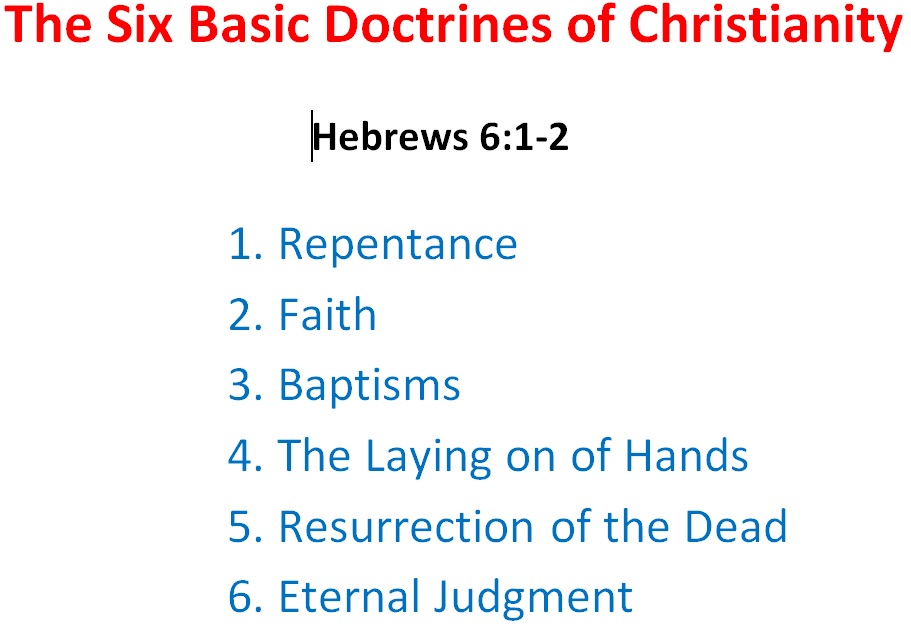
Establishing a sound spiritual foundation is important because it sets the groundwork for the believer’s entire walk with the Lord. Just as a good foundation is a prerequisite for a sound building, so a proper spiritual foundation is vital for an effective, liberating and victorious Christian life. People who fail to lay a proper foundation are doomed to spiritual immaturity because they have nothing by which to judge what is right or wrong, scriptural or unscriptural, appropriate or inappropriate, wise or foolish. Simply put, a heathy biblical understructure eliminates feeble spirituality.
Believers who fail to establish a good foundation can shipwreck their faith altogether, as Paul put it in 1 Timothy 1:19, and find themselves back in the world—in spiritual darkness and separate from God. That’s why this teaching exists. It’ll help believers lay a quality understructure so that their faith isn’t shipwrecked at some point down the road.
The Six Basic Doctrines
Many Christians don’t know this, but the Bible details six doctrines that will ensure a sound spiritual foundation:
Therefore let us move beyond the elementary teachings about Christ and be taken forward to maturity, not laying again THE FOUNDATION of repentance from acts that lead to death, and of faith in God, (2) instruction about baptisms, the laying on of hands, the resurrection of the dead, and eternal judgment.
Hebrews 6:1-2
The writer of Hebrews was lamenting that the believers he was addressing needed to be taught these basic doctrines all over again when they should’ve been teachers by this point (see Hebrews 5:11-12). Notice that knowing these six elementary doctrines is spoken of in terms of “laying” a “foundation.” In other words, these teachings are the elementary understructure for every Christian. They are as follows:
- Repentance from acts that lead to death.
- Faith in God.
- Instructions about baptisms.
- The laying on of hands.
- The resurrection of the dead.
- Eternal judgment.
The Greek word for “elementary” doesn’t mean simple, but rather “The initial (starting) point.” In other words, these six doctrines come first and are therefore the chief teachings of Christianity. They’re “basic” only in the sense that they’re foundational and therefore have priority over other doctrines. As such, this article could also be titled The Six Chief Doctrines of Christianity.
The more fully you understand these preeminent doctrines the more difficult it will be for people to lead you astray with false doctrine. For instance, some Christians falsely teach that it’s not necessary for believers to keep in repentance, but the very first elementary doctrine contradicts this. Some say that spiritual rebirth isn’t biblical, but the third doctrine disproves this. Some say that everyone will ultimately be saved regardless of the evil they chose to practice without repentance, but the sixth doctrine refutes this. Simply put, the six basic doctrines will protect you from doctrinal error.
Years ago I did a six-part series on these foundational doctrines, one sermon per each teaching. A knowledgeable minister could easily do a series of teachings on every one of them. Unbelievably, in most Christian camps the six basic doctrines are almost utterly ignored. And then ministers wonder why many in their congregations act like spiritual babies. It’s because the pastors and teachers aren’t properly feeding them! This means, of course, that they’re not doing their jobs (Ephesians 4:11-14 & 1 Peter 5:1-4).
Since an entire book could be written on the six basic doctrines, I’m not going to go into exhaustive detail on them. However, it is necessary to go into some detail to be effective. The purpose of this teaching is to simply provide foundational structure for younger believers, as well as help more mature believers inspect and fix their foundation as necessary. Speaking of which…
No believer is in bondage to their foundation that was laid in their early years as a Christian. If you come across more accurate biblical data you should adjust your foundation accordingly. I’ve come across believers who won’t change their view on this or that subject because it goes against “how they were taught,” no matter how much scriptural evidence is offered to the contrary. This is immaturity where the believer puts the word of some pastor or sect above the Word of God. Please don’t be like this. At the same time you shouldn’t make changes to your foundation at a whim. Don’t make any adjustments or repairs until doing a thorough biblical investigation, like the Bereans did when Paul preached the message of Christ to them (Acts 17:10-12). The truth will set you free (John 8:31-32).
Let’s now look at each of the six basic doctrines:
1. Repentance from Acts that Lead to Death
The word ‘repent’ simply means to change one’s mind for the positive. This doesn’t mean a meaningless mental exercise, but a change of mind with the corresponding actions, like the revolve to fulfill God’s will (Acts 26:20) and turn from that which is opposed to God’s will, i.e. sin (Acts 8:22 & 2 Corinthians 12:21). Repentance and faith are two sides of the same coin (see Acts 20:21) and so for repentance to be effective it must be combined with faith, which is the second basic doctrine, otherwise repentance is just a dead exercise. It is of the utmost importance to your spiritual health to grasp this.
According to Hebrews 6:1 (above), what are we to repent of? “Acts that lead to death.” The word ‘act’ is the same Greek word translated as “act” in this passage:
The acts of the flesh are obvious: sexual immorality, impurity and debauchery; (20) idolatry and witchcraft; hatred, discord, jealousy, fits of rage, selfish ambition, dissensions, factions (21) and envy; drunkenness, orgies, and the like. I warn you, as I did before, that those who live like this will not inherit the kingdom of God.
Galatians 5:19-21
These verses show that “acts of the flesh” aren’t limited to just sexual immorality, drunkard-ness, stealing and murder. Things like discord (strife), jealousy, factions (meaning the divisive spirit that results from rigid sectarianism), hatred and envy are also works of the flesh. Unfortunately, these works are regularly evident in many congregations. Paul warns believers that “those who live like this will not inherit the kingdom of God,” meaning those who practice these sins with no care to repent. This explains why the Bible encourages us to keep ‘fessed-up when we miss it:
If we claim to be without sin, we deceive ourselves and the truth is not in us. (9) If we confess our sins, he is faithful and just and will forgive us our sins and purify us from all unrighteousness.
1 John 1:8-9
When we miss it we need to be quick to repent. This takes humility, of course, but humility is good because God’s favor flows to the humble, not the proud. In fact, the LORD resists or opposes the proud, which is why He doesn’t offer forgiveness to the unrepentant (James 4:6 & 1 Peter 5:5). This explains Jesus’ declaration: “But unless you repent you will all perish” (Luke 13:3,5). Arrogant people have an extremely hard time admitting they’re wrong, which is why they won’t repent. By contrast, humble folk will readily confess when missing it and it’s humility that unlocks God’s favor.
John the Baptist referred to regularly repenting as “keeping with repentance”:
“Produce fruit in keeping with repentance.”
Matthew & Luke 3:8
It’s impossible to bear fruit unto God while knowingly walking in unrepentant sin. So the principle of keeping with repentance assures the continuing stream of the LORD’s forgiveness and favor in our lives as we repent. Needless to say, don’t allow unconfessed sin to block-up your spiritual arteries from the flow of God’s grace.
Humbly ‘fessing-up should become a regular activity in the life of the believer. It’s particularly helpful for believers who are in bondage to a certain sin. They want free, but they keep falling back into the sin in question and confessing. This keeping-with-repentance principle ensures the flow of the LORD’s forgiveness and favor into their lives. As they seek God and continue in His Word they will eventually walk in freedom (see this article for details). I was once one of these people, but no longer struggle with any certain sin, which is different than saying I never miss it. A couple days ago I missed it and felt so convicted; I immediately repented and received God’s grace. Praise God!
The question is often raised: How long can a believer knowingly continue in sin without repentance before God cuts him or her off from salvation? Surely God overflows with mercy, patience and compassion and, as such, there’s a generous “grace period.” How long is this grace period? Jesus’ Parable of the Barren Fig Tree addresses the question. In this story, from Luke 13:5-9, the owner of the vineyard represents God, the fruitless fig tree represents an individual in covenant with God who’s not bearing fruit, the caretaker of the vineyard represents Jesus, the mediator between the owner and the fig tree. In the story the owner wants to cut the tree down because it hasn’t produced fruit in three years, but the caretaker intercedes and convinces the owner to give the tree one more year wherein the caretaker will do everything he can to get it to be fruitful. If the tree still hasn’t produced fruit by the end of the fourth year the owner and caretaker agree to cut it down and remove it from the vineyard. What we see here is patience, mercy and grace. The owner of the vineyard and the caretaker, who represent the heavenly Father and Jesus, are willing to give the tree a total of four years to be fruitful before ultimately cutting it down, and that would only be because they must.
The story is figurative so we can’t take it strictly literal, i.e. that God will pluck someone out of the kingdom if they’re fruitless for exactly four years. What we can get from it, however, is that God’s patience, mercy and grace are awesome and He will do everything He can to get us to be fruitful. He’s invested in us greatly and understandably wants us to be productive. Another thing we can get from the parable is that when the Lord’s mercy ends His judgment begins and he’ll cut off when/if necessary. Why be foolish and incur such judgment?
So, while there’s no doubt to God’s great mercy and grace in such cases, why risk walking on thin ice by playing around with sin? Particularly in view of such sobering passages as Galatians 5:19-21, Hebrews 10:26-27 and 2 Peter 2:20-21. Some are deceived into thinking they can flirt with the flesh—the deceptive beast within us all—but before they know it they become captive to it. This is the deceitfulness of sin noted in Hebrews 3:12-14. Sin has the power to harden a person’s heart to the point where s/he doesn’t want anything to do with God or the things of God. How so? Practice a carnal behavior long enough without care of repentance and there comes a point where character is firmly set and nigh incorrigible. Pathological liars are testimony to this.
Someone might argue that Jesus died on the cross for our past, present and future sins and therefore it’s not technically necessary to keep in repentance to be forgiven of future sins. While it’s true that Jesus died for our future sins along with our past and present ones, you can’t very well repent of something you haven’t even done yet, which is why 1 John 1:8-9 is in the Bible. For important details on this topic see the article Once Saved Always Saved?
Why is the first basic doctrine referred to in terms of repenting from fleshly works “that lead to death”? Because death is the wages of sin (Romans 6:23). Sin leads to death!
While it’s clear that the first basic doctrine refers to repenting of works of the flesh, the terminology in the Greek is open enough to interpret it as “repentance from dead works,” which is how the KJV and ESV put it. As such, the first basic doctrine includes repenting from dead religious works performed to obtain reconciliation with God and eternal salvation. This, by the way, is the definition of human-made religion, which Jesus said doesn’t work. Notice what the Lord said to the disciples when they asked who could be saved:
“With people it is impossible, but not with God; for all things are possible with God.”
Mark 10:27
Eternal salvation and everything that goes with it—reconciliation with the LORD, forgiveness of sins and the acquisition of eternal life—are only available through God and not human religion, including religious “Christianity,” which isn’t actual Christianity. These awesome blessings are available exclusively from God through the gospel, which explains why ‘gospel’ literally means “good news.”
The first doctrine of Christianity is to repent of—and keep in repentance of—acts of the sinful nature and dead religious works. This is why the gospel is referred to as “repentance unto life” in the Bible (Acts 11:18). Enough said.
2. Faith in God
Faith in God is the second basic doctrine because, as the Bible says:
And without faith it is impossible to please God, because anyone who comes to him must believe that he exists and that he rewards those who earnestly seek him.
Hebrews 11:6
Faith is vital because without it it’s impossible to please God. What exactly is faith?
Faith is belief, but not in the sense of believing in fairy tales or casual mental assent. It’s belief based on 1. what is intrinsically obvious, 2. accurate knowledge, whether scientific, spiritual or otherwise, 3. genuine revelation by the Holy Spirit, or 4. some combination of these three.
Let’s consider examples of the first three. Regarding #1, someone may say they believe in the concept of God as Creator because it’s obvious that the earth, universe and all living creatures were intelligently designed. Or someone may believe homosexuality is intrinsically wrong because the design and function of the sexual organs is obvious (tab ‘A’ fits into slot ‘B’). In each case the person believes based on what is clearly palpable. Concerning #2, people may believe they have a brain even though they’ve never seen it because medical science has proven it through dissecting human remains, brain surgery, etc. So the person believes based on sound data. Regarding #3, some may turn to God because the Holy Spirit revealed reality to them and they believed it. Their belief is based on the enlightenment of the Holy Spirit.
The Bible calls faith the substance of things hoped for and being certain of what we do not see (Hebrews 11:1). The Amplified Bible amplifies the original Greek text:
Now faith is the assurance (the confirmation, the title deed) of the things [we] hope for, being the proof of things [we] do not see and the conviction of their reality [faith perceiving as real fact what is not revealed to the senses].
Hebrews 11:1 (Amplified)
Faith is the “title deed” of the things we hope for; that is, the things we righteously desire. In short, faith is the substance that brings the world of hope or desire into reality! In the Gospels, for instance, people would come to Jesus hoping for healing and after receiving it the Lord would say something like “Your faith has healed you” (see, for example, Mark 5:25-34). Faith was the substance that brought them what they hoped for, healing. They were certain—convinced—that Jesus would heal them even though they couldn’t yet see it physically.
I trust you’re seeing why faith is necessary to receive God’s gracious gift of reconciliation and eternal life. After all, how can someone receive a gift from someone he/she doesn’t even believes exists? For example, if you said you had a gift for me and I responded by saying I can’t receive it because I don’t believe you exist, would you still force the gift on me? Of course not. More likely, you’d be irked at my stupidity and arrogance. The same principle applies to those who reject the gospel. When you come across people who do this, be sure to pray that the LORD open their eyes to the truth, i.e. reality.
Did you ever wonder why faith is so important to receiving salvation? Because faith is nothing more or less than believing God. That’s precisely what Adam & Eve failed to do when they were tested in the Garden of Eden and that’s why they fell (see Genesis 2:15-3:24). In other words, the fall of humanity came about due to unbelief and therefore humanity’s restoration is dependent upon belief.
In a sense, every human soul has faith, which explains why we’re incurably religious as a species (even those who claim to not believe in God develop belief systems and institutions that have all the earmarks of what is generally perceived as “religion”*). Belief in God is simply a part of our make-up; it’s in our spiritual DNA. Heck, creation itself inspires belief in God; more than that, creation screams out God’s existence (Psalm 19:1-4 & Romans 1:18-20). To suggest that everything in the universe came about through accident and that there’s no Intelligent Designer is like expecting a Boeing 747 to emerge out of a metal scrapyard after millions of years. It’s absurd. Unfortunately, as Paul put it, unbelievers “are darkened in their understanding and separated from the life of God because of the ignorance that is in them due to the hardening of their hearts” (Ephesians 4:18). In other words, they have faith but they’ve willingly hardened their hearts to it, consciously or subconsciously. Why? For a number of reasons, such as not wanting to give up some pet sin, but often simply because that’s how their godless culture brainwashed them and they choose to run with the pack. And so they deny obvious reality.
* For instance, secular humanism—essentially one-in-the-same as far left “liberalism”—has its own cosmology, its own miracles, its own beliefs in the supernatural, its own “churches” (public schools), its own “high priests” (godless professors and teachers), its own “saints” (thugs), its own worldview and its own explanation of the existence of the universe. While this is generally true, it shouldn’t be interpreted to mean that all professors, public school teachers, scientists, judges, etc. are LIEberal secular humanists because this isn’t true in the least.
Repentance and Faith
It’s interesting that repentance and faith are the first two basic doctrines of Christianity because these are the conditions to receiving God’s gift of eternal salvation:
I have declared to both Jews and Greeks that they must turn to God in repentance and have faith in our Lord Jesus.
Acts 20:21
We effectively “turn to God” via the gospel through repentance and faith.
‘Repentance’ inexplicably has a negative connotation in modern times because people misinterpret it to mean that God is trying to prevent them from having a “good time.” But sin can only bring a “good time” superficially because underneath the surface pleasure is misery and death for “the wages of sin is death.” This is an axiom.
Take, for instance, the “party” lifestyle. When I was a teen I smoked pot, did drugs and drank frequently. It became a lifestyle and it was difficult for me to imagine life without constant “partying.” After several years I wisely quit. This was before I even became a believer. In essence, I repented because repentance is simply the resolve to change for the positive and the corresponding action. Why did I quit? Because, although doing these things delivered a quick fix to escape reality and have a “good time,” they couldn’t deliver the goods in the long term. Instead they brought hangovers, depression, broken relationships and bondage.
What spurred my change-for-the-positive, i.e. repentance? I saw the obvious truth, believed it, and changed accordingly. The same principle applies to receiving God’s grace of salvation through the gospel of Christ. We see the truth, believe it, and change accordingly. Repentance is the resolve to change for the positive in accordance with God’s will.
Repentance and Faith are Not Works
This shows that repentance and faith are not works, but rather the natural reaction to realizing the truth, which is simply the way it really is. It’s the wise response to seeing the truth.
Here’s an illustration: Say a man sincerely believes that 2 + 2 = 5. This is a false belief whether he believes it’s true or not. So I go to him with four stones and plainly illustrate that 2 stones plus the other 2 stones equals four stones, not five. He clearly observes the truth — the way it really is — and therefore believes and hence changes his mind. He now believes that 2 + 2 = 4, which is the truth.
You see? Repentance and faith are not works, but simply the natural response to being exposed to the truth. Only a blind, indoctrinated fool would see the truth — the way it really is — and reject it in favor of his/her incorrect belief.
The New Covenant is a Covenant of FAITH
Our covenant is a covenant of faith and so everything in our covenant is by faith. Do you want eternal salvation? It’s by faith. Healing? It’s by faith. Intimacy with God? Faith. Answers to prayer? Faith. Power to overcome? Faith.
In light of this I find it perplexing when I come across Christians who are “anti-faith” because it’s a total oxymoron. They defend their position on the grounds that there have been some extremists in the faith movement, but every movement in the body of Christ inspired by the Holy Spirit has its lunatic fringe. You don’t throw the baby out with the bathwater!
Faith and Perseverance
One thing about faith needs to be stressed: Faith must be combined with perseverance—i.e. patient endurance—or what you’re hoping for will not come to pass. This is why the Bible says:
We do not want you to become lazy, but to imitate those who through faith and patience inherit what has been promised.
Hebrews 6:12
After all, faith isn’t really faith if you give up. It might be temporary, fleeting faith, but it’s not the faith that can withstand the time of testing, which includes the wait before the manifestation (Luke 8:13). Even salvation can be lost if one doesn’t persevere in the faith, as shown in this passage
Once you were alienated from God and were enemies in your minds because of your evil behavior. (22) But now he has reconciled you by Christ’s physical body through death to present you holy in his sight, without blemish and free from accusation—(23) if you continue in your faith, established and firm, and do not move from the hope held out in the gospel.
Colossians 1:21-23
One last thing about the second basic doctrine: Someone might argue that it’s technically “faith in God” and therefore only refers to believing the LORD personally. Yes, it refers to believing God personally, but it also includes whatever God has created that testifies to His existence or will. For instance, all creation is a physical testimony to the existence of the Almighty and therefore inspires faith. One of the reasons I was an agnostic and not a strict atheist before I accepted the message of Christ is because the earth & universe and all living things screamed out that there was an Intelligent Designer. I simply wasn’t stupid enough to be an atheist. Consider also the testimony of God’s amazing Word: The Lord is truth and His Word is truth and therefore His Word testifies to His existence (John 14:6 & 17:17).
3. Instructions about Baptisms
The third basic doctrine is biblical teachings about baptisms. The Greek word for ‘baptize’ is baptizó (bap-TID-zoh), which means “overwhelmed, covered or submerged.” It was used in reference to being “baptized” by debts in ancient times. The noun form is in the plural in Hebrews 6:2 because there are three baptisms in Christianity. Most Christians only know about water baptism, which ironically is the least important (which is different than saying it’s unimportant). Every believer should experience all three baptisms, but the first one must be experienced to be a Christian. The three baptisms are:
- Baptism into Christ
- Water baptism.
- The baptism of the Holy Spirit. Let’s address all three:
Baptism into Christ
This refers to being spiritually born-again through Christ. Notice what the Scriptures say about this baptism:
26So in Christ Jesus you are all children of God through faith, 27for all of you who were baptized into Christ have clothed yourselves with Christ.
Galatians 3:26-27
Or don’t you know that all of us who were baptized into Christ Jesus were baptized into his death?
This baptism is not water baptism, but rather refers to being spiritually born-again through Jesus Christ.
He saved us, not because of righteous things we had done, but because of his mercy. He saved us through the washing of rebirth and renewal by the Holy Spirit
The reason the baptism into Christ is a foundational doctrine is because it’s impossible to be a Christian apart from this new spiritual birth. If someone says they’re a believer, but aren’t spiritually regenerated then they’re a Christian in name only and aren’t genuinely saved.
If you come across any minister or group that says people don’t have to be spiritually reborn to be a Christian, as the Lord stressed in John 3:3,6, they should be rejected as false teachers. As Jesus said about the false teachers of his day: “Leave them; they are blind guides. If the blind lead the blind, both will fall into a pit” (Matthew 15:14).
Water Baptism
Baptism in water is simply a public testimony of the believer’s baptism into Christ. Acts 10:47-48 is a good example. Here are five things about water baptism you should know:
- It is an outward expression of a personal decision already made.
- It symbolizes death to the sin nature.
- Being lifted out of the water symbolizes resurrection to a new life (Romans 6:1-4).
- In addition, the water obviously represents the “washing of rebirth and renewal by the Holy Spirit” (Titus 3:5).
- Believers are to be baptized “in the name of the Father and of the Son and of the Holy Spirit” (Matthew 28:19).
I’m sure you see why water baptism isn’t as important as the baptism into Christ since water baptism is merely the symbolic testimony of what has already taken place spiritually through the baptism into Christ. What’s more important, the inward baptism or the outward baptism that represents it?
Baptism of the Holy Spirit
Being baptized into Christ is essentially one-in-the-same as being “born of the Spirit” (John 3:3,6), but being born of the Spirit is distinct from the baptism of the Spirit, although they can occasionally happen at the same time. When you’re born of the Spirit, the Spirit is in you (Romans 8:9 & 1 Corinthians 6:19), whereas when you’re baptized in the Spirit, the Spirit is all over you because you’re covered or overwhelmed by the Spirit. It’s the difference between drinking a glass of water and jumping into a pure mountain lake. Think about it.
Speaking in tongues is the initial physical evidence of the baptism of the Holy Spirit. While speaking in tongues is not the Holy Spirit and the Holy Spirit is not speaking in tongues, they go hand in hand. Here are five scriptural examples of people receiving this baptism:
- The believers in Jerusalem, as shown in Acts 2:1-4. All of them spoke in tongues.
- The Samaritans, as shown in Acts 8:12-19. The Samaritans were part Jew and part Gentile. Verse 18 shows that Simon the sorcerer “saw” that the Spirit was given to the Samaritans when the apostles laid their hands on them. In other words, he saw evidence that they received the Holy Spirit. What did he see? We must interpret Scripture with Scripture, which is a hermeneutical rule. Since the rest of the New Testament shows that speaking in tongues is the initial evidence of the baptism of the Holy Spirit, this must’ve been what Simon saw—people speaking in languages they didn’t know.
- Saul in Damascus, as shown in Acts 9:17-18. Although speaking in tongues is not mentioned in this passage, the baptism of the Holy Spirit is, and we observe scriptural evidence elsewhere that Saul (Paul) spoke in tongues on a regular basis, which is praying in the spirit (1 Corinthians 14:18-19).
- Cornelius’ household in Caesarea, as shown in Acts 10:44-48. This refers to the first Gentile believers. Verses 45-46 state that “The circumcised believers who had come with Peter were astonished that the gift of the Holy Spirit had been poured out even on the Gentiles. For they heard them speaking in tongues and praising God.” Since believers who are not baptized in the spirit can and do praise God, the evidence of the baptism is obviously speaking in tongues.
- The Ephesians, as shown in Acts 19:5-7. This passage shows that all twelve spoke in tongues as a result of receiving the baptism, not just a select few.
As already noted every Christian can and should receive this baptism and pray in the spirit to supplement prayer in his or her everyday language. This can be observed in 1 Corinthians 14:14-15, 18-19 and Ephesians 6:18. I have to emphasize this because there’s this idea rampant in the body of Christ that speaking in tongues was done away with once the biblical canon was completed. Don’t believe it; it’s a colossal lie that has allowed the enemy to keep multitudes of sincere believers from the full empowerment and help of the Holy Spirit.
Praying in the spirit is important because it edifies us by building us up in faith and empowers us to witness, to love people and to walk free from sin, which we’ll look at momentarily.
Before we do, there are a few things about the baptism of the Spirit and speaking in tongues that should be stressed and clarified:
- Just because a Christian is baptized in the Spirit and can speak in tongues it does not mean that he or she is walking in the spirit; that is, bearing fruit of the spirit, like love, joy, peace, kindness, faith, humility and self-control (Galatians 5:22-23). Putting it another way, to be spirit-controlled is synonymous with bearing fruit of the spirit but just because a believer is baptized in the Spirit and can speak in tongues doesn’t mean that he or she is participating in the divine nature, i.e. walking in the spirit and producing the fruit thereof (2 Peter 1:4).
- If a Christian can walk in the spirit to a good degree without the baptism of the Holy Spirit, how much more so if they are baptized in the Holy Spirit! In other words, just because you’re doing well spiritually without speaking in tongues, don’t let it rob you of this wonderful gift that God has provided for all believers!
- The baptism of the Holy Spirit is usually transferred through physical contact via the ministry of the laying on of hands, but not always. Although the gift can be received in this manner through someone who already has it, as shown in some of the above examples, a believer can also receive it simply through faith (Luke 11:9-13). In fact, everything in our covenant is by faith.
- If any believer has hands laid on them for this baptism and they don’t speak in tongues it doesn’t necessarily mean they didn’t receive the baptism. They may have received it, but they simply have yet to speak in tongues. We have to understand that speaking in tongues—praying in the spirit—is something that the believer does by his or her volition and is not something the Holy Spirit makes people do. Remember what Paul said: “So what shall I do? I will pray with my spirit, but I will also pray with my mind” (1 Corinthians 14:15). Just as praying in a language you understand is an act of your own will, so is praying in the spirit. With this understanding, if I chose to I could theoretically not pray in the spirit the rest of my life even though I’m baptized in the Spirit.
- On that note, there are too many Christians who are baptized in the Spirit and yet rarely if ever pray in the spirit and therefore lack the empowerment the Holy Spirit wants to give them. Speaking of which…
The Empowerment and Help of the Holy Spirit
The reason I’m going into so much detail about the baptism of the Holy Spirit and praying in the spirit is because they are God-given sources of great empowerment for the believer to walk in newness of life and victory. Unfortunately, many believers settle for less than God’s best and they go through life struggling with things they don’t need to struggle with because the LORD has provided them the power and help they need—if only they knew of these truths and implemented them! This is the very reason God detailed these truths in His Word and it’s why I’m stressing them here.
With this understanding, notice the power that Paul said was available for his protégé Timothy:
For this reason I remind you to fan into flame the gift of God, which is in you through the laying on of hands. (7) For God did not give us a spirit of timidity, but a spirit of power, of love and of self-discipline.
2 Timothy 1:6-7
What gift was Paul talking about? He doesn’t say, but there are clues: The gift was given through the laying on of hands and it is linked to the spirit or Spirit.* Since Scripture interprets Scripture we must conclude that Paul was referring to the baptism of the Spirit because 1. this gift involves the Spirit and 2. there’s repeated evidence that this gift is typically transferred through the laying on of hands, as detailed in the previous section. As such, the baptism of the Spirit is the obvious answer.
* Keeping in mind that there was no capitalization in the original Greek and so translators have to determine whether the Greek word for ‘spirit’—pneuma (NYOO-ma)—refers to the human spirit (un-capitalized) or the Holy Spirit (capitalized).
By instructing Timothy to “fan into flame” this gift he was simply encouraging him to pray in the spirit more often, which is actually the seventh piece of the armor of God (Ephesians 6:18). What does he mean by fan it into flame? Speaking from experience, when I first received the baptism of the Holy Spirit in 1986—two and a half years after my salvation—I would keep saying the same phrase over and over in the spirit. It was just a handful of words and I had no idea what I was saying. Regardless, I put into practice this passage: I fanned the gift into flame by praying in the spirit whenever I had the opportunity, like driving to classes or to work or when I went off by myself to pray, as Jesus did (Luke 5:16). In time my spiritual prayer language grew dramatically. How so? Because I fanned it into flame as Paul instructed. This is the key to walking in the blessings cited in verse 7: power, love and self-discipline.
- Power. The Greek word for ‘power’ is dunamis (DOO-nah-miss) and it’s where we get the English word dynamite. When you pray in the spirit you’re building yourself up in dynamite power! The more you pray in the spirit the more you’ll be empowered—anointed—to fulfill whatever mission the LORD gives you. As you grow you’ll kiss timidity goodbye!
- Love. As you pray in the spirit you’ll build yourself up in agape (ah-GAH-pay) love, which is simply practical love, as detailed in this article. Hence, you’ll be able to practically love people whom you don’t even like, including enemies. Put another way, you’ll be empowered to love people for whom you don’t have loving feelings. By doing this you’ll fulfill the biblical instruction to love your enemies (Luke 6:35), which—I always stress—includes tough love when appropriate.
- Self-Discipline. As you pray in the spirit you’ll also be built up in self-discipline, which means self-control. You’ll find yourself being able to do things you never had the discipline to do previously. You’ll be empowered to quit negative behaviors or addictions that you’ve struggled with for years. I’m living proof. In short, it’ll give you the edge to win spiritually. I’m sure you see why the baptism of the Holy Spirit is a foundational doctrine. Christians who write off this incredible gift due to the false doctrine that charismatic gifts passed away with the last of the original apostles are robbing themselves. And believers who have the gift but don’t “fan it into flame” are wasting it and robbing themselves of great power and anointing that would enable them to walk in newness of life.
For more details on the baptism of the Holy Spirit go here.
An Example from Scripture of All Three Baptisms in One Passage
All three of the baptisms are featured in a single occasion in the book of Acts:
1While Apollos was at Corinth, Paul took the road through the interior and arrived at Ephesus. There he found some disciples 2and asked them, “Did you receive the Holy Spirit when you believed?”
They answered, “No, we have not even heard that there is a Holy Spirit.”
3So Paul asked, “Then what baptism did you receive?”
“John’s baptism,” they replied.
4Paul said, “John’s baptism was a baptism of repentance. He told the people to believe in the one coming after him, that is, in Jesus.” 5On hearing this, they were [water] baptized in the name of the Lord Jesus. 6When Paul placed his hands on them, the Holy Spirit came on them, and they spoke in tongues and prophesied. 7There were about twelve men in all.
Acts 19:1-7
‘Disciple’ in the Greek just means learner, pupil or student. These particular disciples in Ephesus were students of John the Baptist since they received his baptism, which was a baptism of repentance.
You see, John’s ministry prepared people for Christ’s salvation by zeroing in on their sin and convincing them they were sinners, which inspired them to undergo John’s baptism of repentance (Luke 3). Humbled by their overwhelming spiritual needs, they repented and became receptive to forgiveness & reconciliation made possible thru Christ’s sacrifice and resurrection (Luke 7:29-30).
Verses 4-6 show these disciples of John experiencing the three Christian baptisms as follows:
- They believed and thus were spiritually regenerated à la Titus 3:5 (the moment someone genuinely believes is the moment they experience inward rebirth wherein Spirit gives rebirth to spirit as Christ said in John 3:3,6).
- They were consequently water baptized as a public testimony of their belief & corresponding spiritual rebirth.
- Lastly, Paul laid hands on them and they were baptized in the Spirit.
4. The Laying on of Hands
The doctrine of the laying on of hands refers to the transference of four things through physical contact: 1. blessing, 2. anointing and consecration for service, i.e. ministry, 3. the baptism of the Holy Spirit, and 4. healing and deliverance.
Let’s briefly look at all four.
Blessing (or General Prayer)
Jesus placed his hands on children and blessed them (Mark 10:13,16 & Matthew 19:13,15). To ‘bless’ someone means “to speak positive words that have a productive impact.” The official priestly prayer supports this definition (Numbers 6:22-27) and you can find these types of prayer/blessings all over the Bible, e.g. Romans 15:13 and Colossians 1:9-12.
Blessing or prayer in this manner is so important because words “have the power of life and death” (Proverbs 18:21). Whether people know it or not, our words bring life or death, blessing or cursing. Proverbs 12:18 reinforces this: “Reckless words pierce like a sword, but the tongue of the wise brings healing.”
Needless to say, the idea that “words can never hurt me” is a lie.
Kids and youth are especially vulnerable to “reckless words” or verbal abuse, particularly from authority figures in their lives (Colossians 3:21). Adults who continually berate, belittle and call children names are speaking a prophecy of death and destruction over them (!).
Blessing, by contrast, is a prophecy of life, which is why Jesus laid his hands on children and blessed them.
Words are powerful by themselves and adding the dimension of touch magnifies their impact.
Anointing/Separation for Ministry
Hands are to be lain on those called of God to special service. Biblical examples include the Levites (Numbers 8:10-11), Joshua, (Numbers 27:18-23), Stephen & six others (Acts 6:1-6) and Saul & Barnabas (Acts 13:2-3).
Obviously the people who qualify for such a rite of passage should already be full of faith, God’s Word and the Spirit, as was the case with Joshua and Steven in the aforementioned examples. The laying on of hands simply provides a stronger anointing to fulfill their God-given assignment.
Paul instructed his young protégé, Timothy, to not be “hasty in the laying on of hands” (1 Timothy 5:22) because ministers must be tested for character and faithfulness and there’s no test like the test of time. Those who hastily confirm untested ministers share responsibility for the damage they eventually do to people.
The Holy Spirit Baptism
Hands are to be laid on believers to receive the baptism of the Holy Spirit, which is evidenced by speaking in tongues (Acts 19:1-7).
While this powerful gift is typically received this way—i.e. through someone who has it—a believer can also receive it simply through faith in God’s Word (Luke 11:9-13). In other words, believers don’t absolutely need a human conduit for the gift to be transferred. We’ll look at this more in the next section.
For details on the Holy Spirit baptism and glossolalia see the earlier sections Baptism of the Holy Spirit and The Empowerment and Help of the Holy Spirit.
Healing and Spiritual Deliverance
Jesus said that believers “will place their hands on sick people, and they will get well” (Mark 16:17-18).
The book of Acts says “God anointed Jesus of Nazareth with the Holy Spirit and power, and… he went around doing good and healing all who were under the power of the devil, because God was with him” (Acts 10:38). We see evidence of this throughout the Gospels. A couple of good examples of the Holy Ghost power available to believers for ministry to those in need include Luke 5:17 and 6:19. Here are some other examples plus important additional info:
- Jesus laid hands on sick people and healed them or exorcized demons from them (Luke 4:40-41).
- A woman who was subject to bleeding for twelve years heard about Jesus’ anointing to heal and therefore had faith to receive healing from him (Mark 5:25-34). When the woman touched his cloak Jesus sensed “power had gone out from him” (verse 30).
- Jesus had an anointing to heal, but his ministry was very limited in his hometown because of the people’s lack of faith due to a “spirit of familiarity”—meaning they were so familiar with Jesus during his first three decades that they couldn’t acknowledge his divine anointing and receive from it (Mark 6:1-6). This example reveals that receiving a healing is a matter of faith in regards to the person praying (i.e. the human conduit of God’s power), as well as the recipient of the healing, which shows that receiving a healing via a human conduit involves a combination of faith. Needless to say, there’s power in agreement (Matthew 18:20 & Leviticus 26:8).
- People with the greatest faith do not require hands to be laid on them for healing or deliverance. This type of faith accepts the LORD at His Word, like the centurion from Matthew 8:5-10,13. In other words, they don’t require a human conduit to receive healing or deliverance from God. As noted earlier, the Baptism of the Holy Spirit can be received this way (Luke 11:13).
Important Points on Transmitting the Anointing
Here are several things to keep in mind when you lay hands on people to bless, pray, heal or deliver:
- Only make physical contact when you are ready to release your faith, as can be observed with Paul in Acts 28:8.
- While praying over someone you will sense your faith reaching its peak; that’s when you should make contact.
- Children may freak out a bit when you lay hands on them because the anointing—God’s power—is new to them, but don’t let it derail you. Be at peace and keep ministering in faith, as led of the Holy Spirit.
- God’s anointing is like electricity flowing through you and your hand is the conductor for this power like an electricity cable.
- When you experience the anointing you’ll naturally get excited, which is great; just be careful not to absorb it through excessive shouting, laughing and leaping; rather channel it to those who need it. In short, don’t waste the anointing—get your hands on someone!
- Since your words and hands are the primary vehicles in which the Spirit transmits the anointing to others don’t waste words or motions. Watch your words and actions and be careful not to do anything that will drain or lose the anointing, including grieving the Holy Spirit (Ephesians 4:30).
- Put your words and motions in a direct line and use them to bring healing or deliverance to those in need. It’s akin to using a rifle: You aim it at the appropriate target in order to hit it. Wasting words and motions will cause you to miss the target.
- If you want God’s power to operate strongly in your life, as was the case with The Christ (Acts 10:38), you must discipline yourself to spend time with the LORD. In other words, saturate yourself with God through praise, worship, the Word and prayer. You can’t run around gabbing and doing frivolous things—watching TV, playing golf or computer games, etc.—right before a ministry engagement and expect the anointing to be strong when you minister.
- The anointing flows out of your inmost being like rivers of living water out of the very core of your soul/spirit (John 7:37-39). As such, you must protect the anointing so that it’ll be there when you need it.
- You can’t give something if you don’t have it and therefore you can’t expect the anointing to flow out of you if you haven’t prepared yourself beforehand to operate in God’s power. You must never allow people or things to rob you of your worship/Word/prayer time, particularly before you’re scheduled to minister. Turn off your phone.
Most Christians unfortunately don’t know much about the laying on of hands. This section reveals its importance.
5. The Resurrection of the Dead
The fifth basic doctrine is the resurrection of the dead, which means that everyone will be bodily resurrected, both the righteous and the unrighteous, as Jesus and Paul plainly declared:
“for a time is coming when all who are in their graves will hear his voice (29) and come out—those who have done what is good will rise to live, and those who have done what is evil will rise to be condemned.”
John 5:28-29
having hope toward God, which they themselves also wait for, that there is about to be a rising again of the dead, both of righteous and unrighteous;
Acts 24:15 (YLT)
As you can see, there will be resurrections of both the righteous and unrighteous. This doesn’t mean, however, that there will only be two resurrections in number, just that there are two types of resurrections: 1. The resurrection of the righteous and 2. the resurrection of the unrighteous. The former is called “the first resurrection” in Scripture (Revelation 20:5-6), which makes the latter the second resurrection.
The second resurrection takes place at the time of the Great White Throne Judgment, detailed here:
Then I saw a great white throne and him who was seated on it. The earth and the heavens fled from his presence, and there was no place for them. (12) And I saw the dead, great and small, standing before the throne, and books were opened. Another book was opened, which is the book of life. The dead were judged according to what they had done as recorded in the books. (13) The sea gave up the dead that were in it, and death and Hades gave up the dead that were in them, and each person was judged according to what they had done. (14) Then death and Hades were thrown into the lake of fire. The lake of fire is the second death. (15) Anyone whose name was not found written in the book of life was thrown into the lake of fire.
Revelation 20:11-15
This massive resurrection and judgment concerns every dead soul contained in Hades (Sheol) after the thousand-year reign of Christ on this earth, which means it involves every unredeemed person throughout history. It does not include Old Testament holy people because they had a covenant with the LORD and will be resurrected after the 7-year Tribulation and before the Millennium (Matthew 19:28-30 & Daniel 12:1-2).
We’ll examine the judgment of these people in the forthcoming section on the sixth basic doctrine: eternal judgment.
The Resurrection of the Righteous
The first resurrection is the resurrection of the righteous, meaning those in right-standing with God. Again, when Jesus and Paul spoke of two basic resurrections they were talking about types of resurrections and not numbers. While there’s only one resurrection of the unrighteous, the resurrection of the righteous takes place in stages, which correspond to the analogy of a harvest.
In biblical times the harvest took place in three basic stages: 1. the firstfruits, 2. the main harvest, and 3. the gleanings. The harvest began with the firstfruits, which concerned the first fruits and grains to ripen in the season and were offered to the LORD as a sacrifice of thanksgiving (Exodus 23:16,19). Later came the general harvest (Exodus 23:16) and, lastly, the gleanings, which were leftovers for the poor and needy (Leviticus 19:9-10).
Let’s examine the three stages:
1. The Firstfruits. Paul described Jesus as the firstfruits here:
But Christ has indeed been raised from the dead, the firstfruits of those who have fallen asleep. (21) For since death came through a man, the resurrection of the dead comes also through a man. (22) For as in Adam all die, so in Christ all will be made alive. (23) But each in turn: Christ, the firstfruits; then, when he comes, those who belong to him.
1 Corinthians 15:21-23
Just as the firstfruits of the harvest were a sacrifice to the LORD so Jesus Christ was sacrificed for our sins and raised to life for our justification (Romans 4:25); hence, He’s the firstfruits of the resurrection of the righteous.
2. The General Harvest. Verse 23 shows that the main harvest takes place when Jesus returns for the church—his “bride”—which is the Rapture, detailed in 1 Thessalonians 4:13-18. This harvest includes physically-alive believers translated to heaven.
3. The Gleanings refer to the righteous who were not included in the main harvest and are, as such, “leftovers.” This resurrection takes place at the time of Jesus’ return at the end of the Tribulation. Jesus’ return to earth to establish His millennial reign is separate from the Rapture, which is when the general harvest occurs. Remember, when Jesus comes for his church he doesn’t return to earth, but rather meets believers in the sky (1 Thessalonians 4:17). We’ll address this in a forthcoming section. The gleanings include the resurrection of Old Testament saints—at least a bodily resurrection, but more likely a soulish/bodily resurrection—as well as the bodily resurrection of believers who died during the Tribulation.
The “gleanings” will also include believers who physically die during the Millennium. Some argue that such a resurrection won’t be necessary because, as Isaiah 65:19-25 shows, lifespans will return to the lengthy durations of people before the flood, like Adam and Methuselah. However, this passage doesn’t actually say righteous people won’t die during the Millennium; notice what it says:
Never again will there be in it [Jerusalem] an infant who lives but a few days, or an old man who does not live out his years; the one who dies at a hundred will be thought a mere child; the one who fails to reach a hundred will be considered accursed.
Isaiah 65:20
The passage simply shows that lifespans will be greatly increased, as before the flood; it doesn’t say righteous people won’t die. In fact, it’s implied that blessed people will die by the reference to “an old man who does not live out his years.” Moreover, verse 22 says that God’s people will live as long as trees during the Millennium. Depending on the species, trees can live less than a hundred years or up to a few thousand, but they ultimately die.
Something else to consider: While it’s true that many people lived to be over 900 years old before the flood, it’s still not a thousand years, which is how long the Millennium will last. Also, some people died well short of 900-plus years; for instance, Lamech died at 777.
Someone might argue: How can both the resurrection of the righteous at the beginning of the Millennium and another resurrection at the end be considered “gleanings” since they’re separated by a thousand years? Answer: Because the very word “gleanings” implies more than one gleaning; after all, the poor gleaned the harvested fields more than once in biblical times. Also, Psalm 90:4 and 2 Peter 3:8 show that a thousand years is like a day to the LORD, so the two gleanings occur only one day apart from the Divine perspective.
Why is it called the “First Resurrection”?
The resurrection of the righteous is called the “first resurrection” in this passage:
I saw thrones on which were seated those who had been given authority to judge. And I saw the souls of those who had been beheaded because of their testimony about Jesus and because of the word of God. They had not worshiped the beast or its image and had not received its mark on their foreheads or their hands. They came to life and reigned with Christ a thousand years. (5) (The rest of the dead did not come to life until the thousand years were ended.) This is the first resurrection. (6) Blessed and holy are those who share in the first resurrection. The second death has no power over them, but they will be priests of God and of Christ and will reign with him for a thousand years.
Revelation 20:4-6
The passage refers specifically to the bodily resurrection of Christian martyrs from the Tribulation, which John calls the “first resurrection.” By calling it the first resurrection is he saying that there were no resurrections before this? No, because Jesus Christ was resurrected at the beginning of the Church Age and believers will be resurrected bodily at the time of the Rapture while living believers will be translated; not to mention the resurrections of Enoch, Elijah and Moses as types, covered in Chapter Nine of Sheol Know. Speaking of those three, their resurrections can be considered “taste-testing of the fruit” according to the harvest analogy.
Here’s a diagram that helps visualize the first and second resurrections and the three stages of the first (click to enlarge):
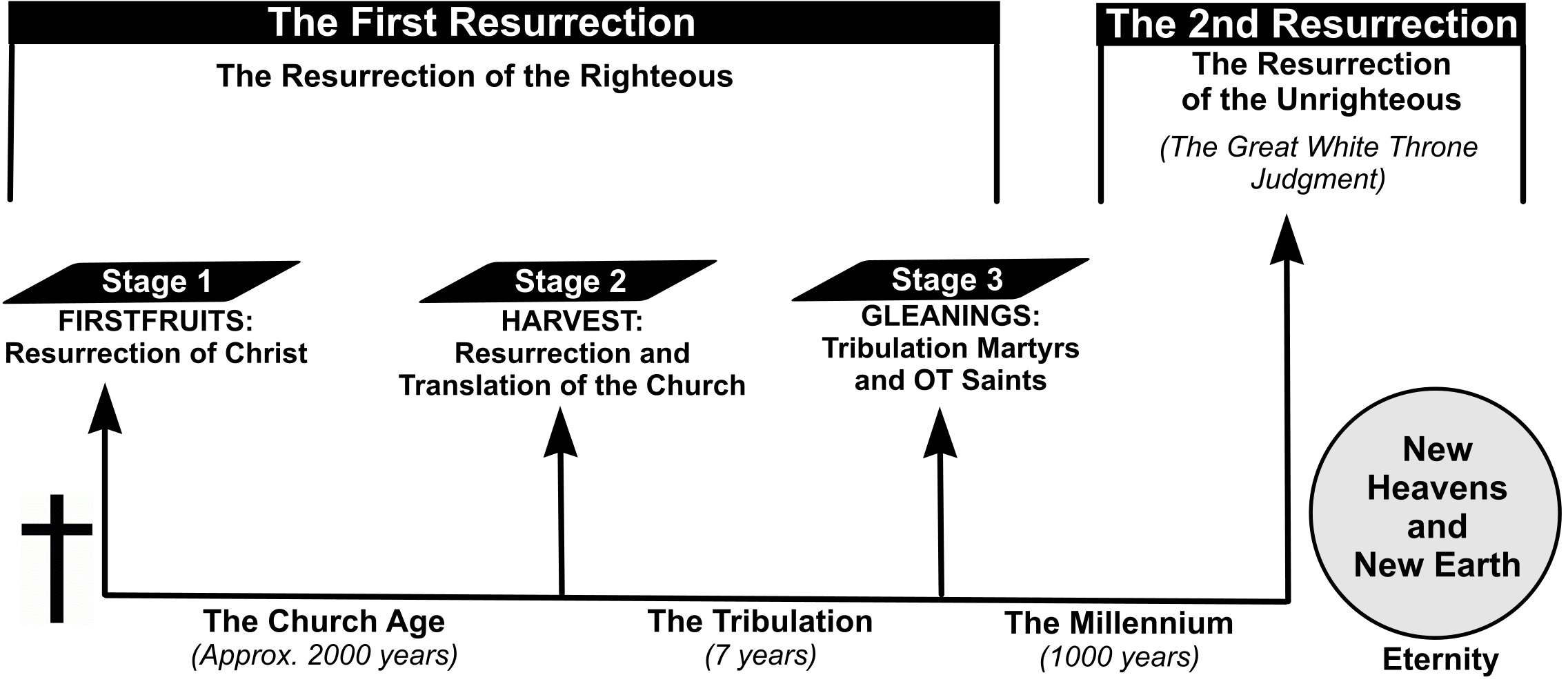
By calling the resurrection of the righteous the “first resurrection” John may mean more than just first in order. The Greek word for “first” is prótos (PRO-toss), which also means principle, chief, honorable or most important. How is the resurrection of the righteous the more honorable resurrection? Because it entails the resurrection of people in right-standing with the LORD through covenant and spiritual rebirth (Titus 3:5 & Ephesians 4:22-24). Since this resurrection involves people who are in right-standing with their Creator, i.e. God’s children, it’s the more honorable resurrection and therefore the more important one to the LORD, just as the resurrection of your child would be more important to you than some stranger you never knew.
Someone might argue that all people are God’s children, even atheists. No, all people are creations of God, but only those born-again of the seed (sperm) of Jesus Christ by the Holy Spirit are children of God (1 John 3:9 & 1 Peter 1:23). Because of the death and resurrection of the Messiah, Old Testament saints who were in covenant with God automatically become spiritually-regenerated at the time of their resurrection.
‘Isn’t this Too Complicated?’
Some might argue that the resurrection of the righteous, as just mapped out, is too complicated. This is perhaps one of the main reasons why the so-called “father of orthodoxy,” Augustine of Hippo, simplified human eschatology by inventing (or, at least, popularizing) the false doctrine of amillennialism. Believe it or not, this erroneous teaching suggests that we’re currently already in both the Millennium and Tribulation; and when believers or unbelievers die their immortal souls either go to heaven forever or suffer never-ending torment in hell. Incredibly, Augustine argued that biblical references to the new Jerusalem, new earth, new heavens and the believer’s new glorified body are all symbolic language for heaven! Talk about adding to and taking away from the Holy Scriptures, a practice repeatedly denounced in the Bible (see Revelation 22:18-19, Proverbs 30:6 and Deuteronomy 4:2).*
* See HELL KNOW for more information on Augustine and his false doctrines that corrupted the church, specifically Chapter Seven’s The Augustinian Corruption of Christendom and Chapter Nine’s The Good and Bad of Orthodoxy and Traditionalism (scroll down).
Getting back to our question: Is the resurrection of the dead too complicated? Think about it like this: When referencing a complex subject to someone who knows little about the topic it’s best to state the facts in the simplest of terms, which is how Jesus and Paul talked about the resurrection of the dead in John 5:28-29 and Acts 24:15 (both cited earlier). Daniel did the same thing in Daniel 12:1-2. All three of these passages detail that there will be a resurrection of both the righteous and the unrighteous, which is true, but they don’t go any further than this. As such, we have to look to the rest of Scripture for more details and that’s what we’re doing here. This is in line with the hermeneutical rule “Scripture interprets Scripture” wherein the more clear and detailed passages offer necessary data that helps interpret the more ambiguous and sketchy ones.
Furthermore, the argument that “this is just too complicated” implies that truth—reality—must always be simple when this simply isn’t the case. Take brain surgery, for example. Is it simple or does it take years of schooling to master? How about computer technology, astronomy, world history, languages or law? How simple is the sewage system of any major city? How about the electrical grid of New York City? I could go on and on.
Yes, the resurrection of the dead is more complicated than what Augustine taught, but it’s certainly not too complicated for the average person to grasp. The above diagram illustrates that it’s actually not that complicated and it’s much less complicated than any of the topics just listed.
As already established, the resurrection of the dead is one of the six basic doctrines (Hebrews 6:1-2). The writer of Hebrews was lamenting that the people he was addressing needed to be taught these basic doctrines all over again when they should’ve been teachers by this point (Hebrews 5:11-12). Now, think about it: If the topic of the resurrection of the dead was as simple as Augustine taught—that is, people just go to heaven or hell when they die to spend eternity in either bliss or torment—why would these people need to be taught the subject again? If the subject were that simplistic it’d take just a few minutes to teach and not a whole sermon or series of sermons. Moreover, if it were that simple how could the believers not grasp it the first time around?
Yes, the resurrection of the dead is a complicated subject, so what? That’s why it needs taught properly and thoroughly.
Jesus’ Rapture of His Church and His Return to Earth
I pointed out something earlier that should be elaborated on: Most believers don’t realize that there are two phases to the Lord’s Second Coming: 1. Jesus’ return for his Church, known as the Rapture, and 2. Jesus’ return to the earth to establish his millennial kingdom. The former is detailed in 1 Thessalonians 4:13-18 and the latter in Revelation 19:11-16. A comparison of these passages and other pertinent Scriptures reveal two separate phases of Jesus’ Second Coming that can be distinguished like so (click to enlarge):
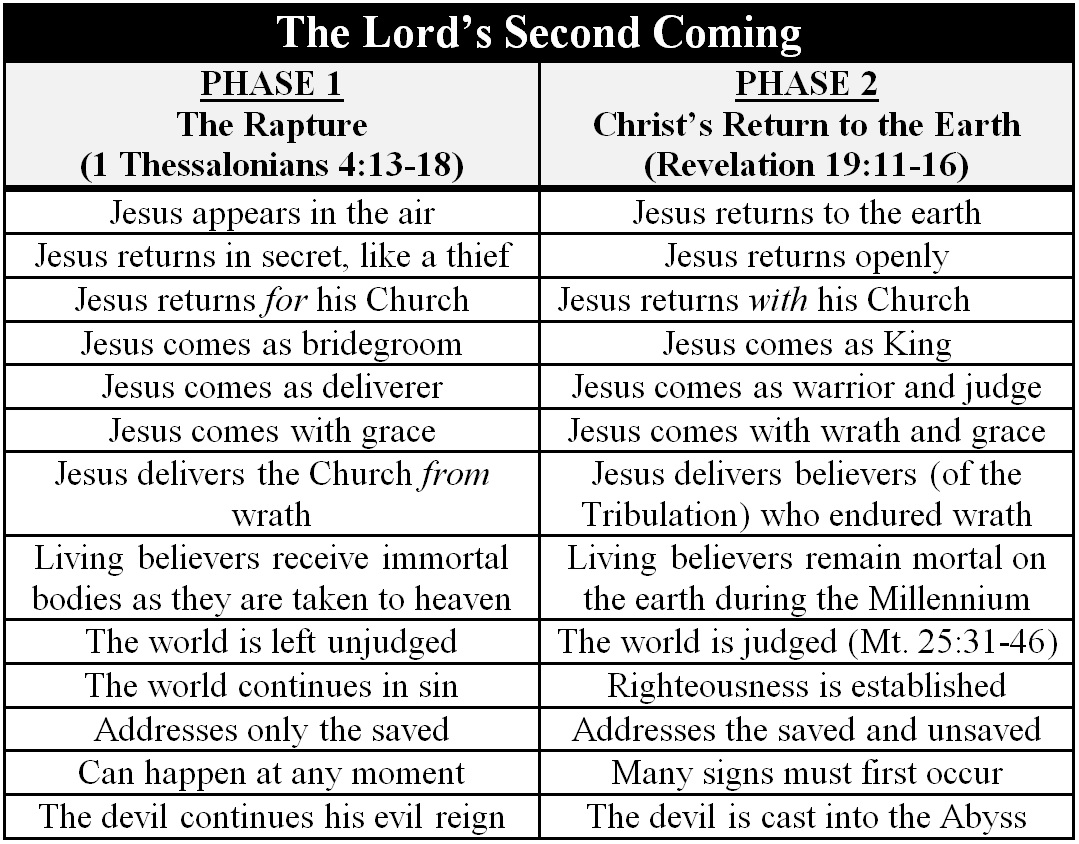
One of the differences on the list is that the Lord’s return for his Church—the Rapture—can happen at any time once the general season of the end is apparent, meaning it’s imminent, whereas many distinct signs precede Christ’s return to the earth. These signs include, amongst others: the global cataclysm of the Tribulation period itself (Revelation 6-19), the revealing of the antichrist (2 Thessalonians 2:1-8), the two witnesses (Revelation 11:1-12) and the institution of the mark of the beast (Revelation 13:16-17). Generally speaking, once the Tribulation begins—and it will be obvious when it does—you can be sure that Jesus will return to the earth seven years later (which is different than saying you’ll be able to pinpoint the precise moment or day).
However, this isn’t the case with the Lord’s return for his Church because, again, it’s imminent and could happen at any time with zero warning once the general season of his return is at hand, which means now (Matthew 24:3-14). Notice what Jesus said:
(36) “But about that day or hour no one knows, not even the angels in heaven, nor the Son, but only the Father. (37) As it was in the days of Noah, so it will be at the coming of the Son of Man…
(42) “Therefore keep watch, because you do not know on what day your Lord will come. (43) But understand this: If the owner of the house had known at what time of night the thief was coming, he would have kept watch and would not have let his house be broken into. (44) So you also must be ready, because the Son of Man will come at an hour when you do not expect him.
Matthew 24:36-37, 42-44
As you can see, we are instructed to “keep watch” and “be ready” because Jesus “will come at an hour when we do not expect him.” Interestingly, the Son doesn’t even know the day or hour, only the Father knows (verse 36). We must be “dressed ready for service” and “keep our lamps burning” (Luke 12:35) precisely because the Lord’s return for his Church is imminent. I should add that, while we don’t know the day or hour, we can know the general season via Jesus’ descriptions and, again, that season is now.
While some claim that the word “Rapture” isn’t biblical, it is. It refers to a phrase used in this passage:
After that, we who are still alive and are left will be caught up together with them in the clouds to meet the Lord in the air. And so we will be with the Lord forever.
1 Thessalonians 4:17
‘Caught up’ in the Greek is harpazó (har-PAD-zoh), which means to “snatch up” or “obtain by robbery.” It’s translated in Latin as “rapio” in the Vulgate, which is where we get the English “Rapture.” With this understanding, when the Bridegroom, Jesus, comes for his bride, the Church, he’s going to obtain us by robbing us off the earth!
The aforementioned 1 Thessalonians 4:13-18 is the most prominent support text for the Rapture:
Brothers and sisters, we do not want you to be uninformed about those who sleep in death, so that you do not grieve like the rest of mankind, who have no hope. (14) For we believe that Jesus died and rose again, and so we believe that God will bring with Jesus those who have fallen asleep in him. (15) According to the Lord’s word, we tell you that we who are still alive, who are left until the coming of the Lord, will certainly not precede those who have fallen asleep. (16) For the Lord himself will come down from heaven, with a loud command, with the voice of the archangel and with the trumpet call of God, and the dead in Christ will rise first. (17) After that, we who are still alive and are left will be caught up together with them in the clouds to meet the Lord in the air. And so we will be with the Lord forever. (18) Therefore encourage each other with these words.
1 Thessalonians 4:13-18
Here’s more support:
“Do not let your hearts be troubled. You believe in God; believe also in me. (2) My Father’s house has many rooms; if that were not so, would I have told you that I am going there to prepare a place for you? (3) And if I go and prepare a place for you, I will come back and take you to be with me that you also may be where I am.”
John 14:1-3
Listen, I tell you a mystery: We will not all sleep, but we will all be changed—(52) in a flash, in the twinkling of an eye, at the last trumpet. For the trumpet will sound, the dead will be raised imperishable, and we will be changed.
1 Corinthians 15:51-52
and to wait for his Son from heaven, whom he raised from the dead—Jesus, who rescues us from the coming wrath.
1 Thessalonians 1:10
What is the “coming wrath” and how does Jesus “rescue” us from it? The coming wrath refers to the Tribulation and the Lord rescues the Church from it via the Rapture.
Notice what Jesus promises the faithful church of Philadelphia:
“Since you have kept my command to endure patiently, I will also keep you from the hour of trial that is going to come on the whole world to test the inhabitants of the earth.”
Revelation 3:10
“The hour of trial that is going to come on the whole world” is referring to the Tribulation period detailed in Revelation 6-19. Jesus doesn’t say he would just protect believers during the Tribulation, but that he’d “keep them from the hour of trial” altogether. Keep in mind that, while the church at Philadelphia was one of seven first century churches that Jesus addresses in Revelation 2-3, these seven churches were picked by the Lord because they typify the seven kinds of churches that exist throughout the Church Age. As such, Jesus’ words were to all faithful Christians throughout the ensuing centuries of the Church Age. In fact, since the Rapture and the Tribulation didn’t come at the general time of this message to the church of Philadelphia circa 90-100 AD, the passage must more specifically refer to a future generation of faithful believers.
Further support for the Rapture can be observed in what happens to John in the book of Revelation. Jesus gave John the threefold contents of Revelation at the end of chapter 1: “Write, therefore, what you have seen, what is now and what will take place later” (Revelation 1:19). This is the Contents Page of the book of Revelation: “What you have seen” refers to chapter 1 because that’s what John had seen up to that point in the vision while “what is now” refers to chapters 2-3 and “what will take place later” refers to chapters 4-22.
Chapters 2-3 of Revelation cover “what is now,” meaning the Church Age, as noted above. These chapters cover the seven types of churches that exist throughout the Church Age. Chapters 4-22 address “what will take place later” and chapters 4-19 specifically the period of the Tribulation, which involves the seal, trumpet and bowl judgments of God’s wrath that will befall the earth and its inhabitants.
Here’s my point: John was an apostle of the church and right at the beginning of Revelation 4—the beginning of his coverage of the Tribulation—Jesus says to him, “Come up here,” referring to heaven (verse 1). You see? John is representative of the church and just before the Tribulation he is taken up into heaven. Why? Because the church itself will be delivered from the Tribulation via Jesus’ return for his church, which is the Rapture.
Another thing to consider is that the church is referred to no less than nineteen times in the first three chapters of Revelation and not once on earth in chapters 4-19. Why? Because the existing church—all genuine believers—will be “snatched up” to heaven before the Tribulation starts. Revelation 19 details Christ’s return to the earth at the end of the Tribulation. Guess who’s riding with him? The church (verse 14; also verified by 1 Thessalonians 4:14).
This doesn’t mean, however, that there won’t be believers during the Tribulation because there will be multitudes; and, yes, they are the church because ‘church’ simply refers to the ekklesia (ek-klay-SEE-ah), the “called-out ones” who are called out of the darkness of this world into the kingdom of light. However, the existing church at the time of the Rapture before the Tribulation will have been snatched away. In other words, believers during the Tribulation embraced the gospel after the Rapture. We’ll address this in the next section.
The snatching up of the church before the Tribulation corresponds to the biblical pattern of the righteous being saved from destruction when God’s judgment falls on unrepentant masses. Jesus noted this pattern when he taught on the Rapture:
For the Son of Man in his day will be like the lightning, which flashes and lights up the sky from one end to the other. (25) But first he must suffer many things and be rejected by this generation.
(26) “Just as it was in the days of Noah, so also will it be in the days of the Son of Man. (27) People were eating, drinking, marrying and being given in marriage up to the day Noah entered the ark. Then the flood came and destroyed them all.
(28) “It was the same in the days of Lot. People were eating and drinking, buying and selling, planting and building. (29) But the day Lot left Sodom, fire and sulfur rained down from heaven and destroyed them all.
(30) “It will be just like this on the day the Son of Man is revealed. (31) On that day no one who is on the housetop, with possessions inside, should go down to get them. Likewise, no one in the field should go back for anything. (32) Remember Lot’s wife! (33) Whoever tries to keep their life will lose it, and whoever loses their life will preserve it. (34) I tell you, on that night two people will be in one bed; one will be taken and the other left. (35) Two women will be grinding grain together; one will be taken and the other left.”
Luke 17:24-35
Jesus is talking about “the day the Son of Man is revealed” (verse 30) that “will be like the lightning, which flashes and lights up the sky from one end to the other” (verse 24). In other words, it’ll take place in the blink of an eye. The last two verses show beyond any shadow of doubt that Jesus was talking about His snatching up of the church: “Two people will be in bed; one will be taken and the other left. Two women will be grinding grain together; one will be taken and the other left” (verses 34-35). This, incidentally, presents a problem for those who argue that the Rapture takes place at the same time as Jesus’ return to the earth at the end of the Tribulation because the impression of these verses is that of ordinary every-day life and not of people who just went through a worldwide cataclysm horrifically described in Revelation 6-19.
Observe in verses 26-29 how Jesus likens the time of the Rapture to the “days of Noah” and the “days of Lot.” “Just as it was” in the days of these two “so it will be” when Christ returns for his church. What’s the significance of this? In the days of Noah and Lot there were warnings of the LORD’s coming judgment on masses of people if they stubbornly refused to repent. In Noah’s situation the judgment concerned the entire world whereas in Lot’s situation it concerned the cities of Sodom and Gomorrah. In both cases the righteous were removed before God’s judgment fell. “So it will be” with the future Tribulation—those in right-standing with God will be taken out of the way before His wrath falls on rebellious humanity. Those who become believers during the Tribulation are those who wisely respond to the pouring out of God’s wrath by repenting.
In verse 30 Jesus says “It will be just like this on the day the Son of Man is revealed.” Just like what? Just like the days of Noah and Lot where people were carrying on business as usual—eating, drinking, marrying, buying, selling, planting and building (verses 27-28). This is what people will be doing when Jesus comes for his church, not enduring a global upheaval, which disproves the post-Tribulation position.
Speaking of the post-Tribulation view, how do people who hold this position explain Luke 17:24-35? They argue that Jesus only speaks of his coming once in this passage, not twice, and when he comes he will 1. snatch up the righteous and then 2. pour out his wrath on the unrighteous, citing verses 26-32. The problem with this, of course, is that it’s an explicit description of the pre-Tribulation position (or, at least, “pre-wrath”). The only thing they’re omitting is Jesus’ return to the earth after God’s wrath is poured out on rebellious humanity to set up his millennial kingdom (Matthew 25:31). As already explained, this is detailed in the book of Revelation: In Revelation 4:1 Jesus says to John—representing the church—to “come up here” to heaven. Chapters 4-19 cover the Tribulation where God’s wrath is poured out and Jesus returns to the earth at the end (Revelation 19).
Here’s a timeline diagram to help visualize these events (click to enlarge):
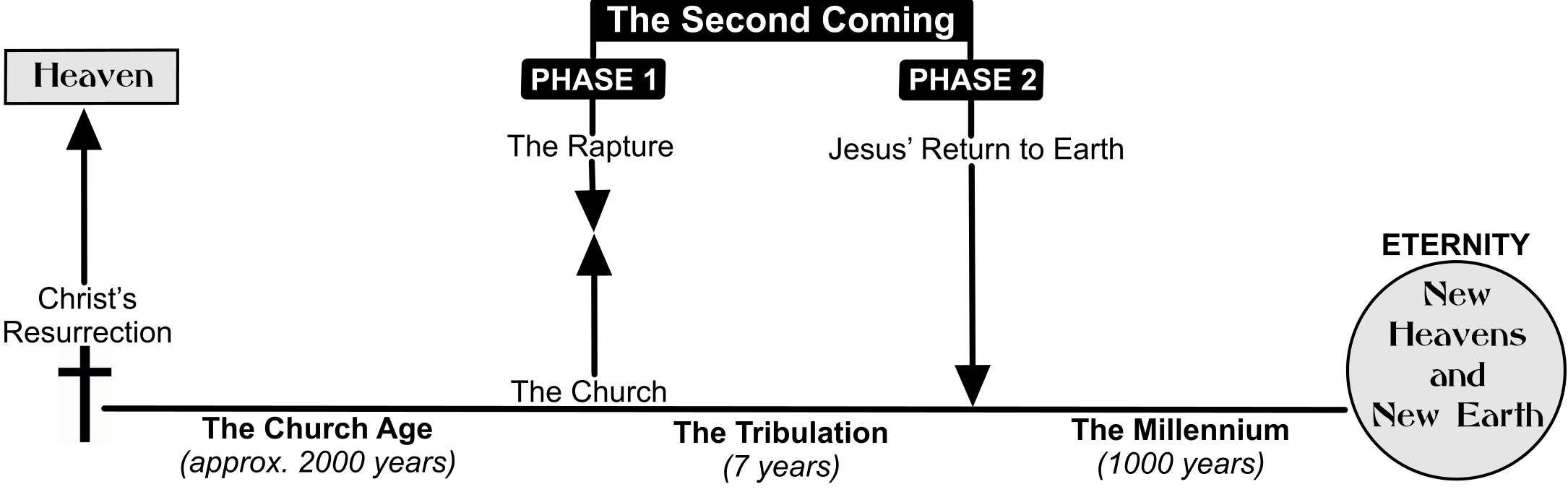
Some people suggest that the Rapture isn’t part of Jesus’ Second Coming and that only His return to the earth should be designated as the Second coming, but Jesus himself spoke of his snatching up of the church as “the coming of the Son of Man” (Matthew 24:27,37,39) and within this context are clear references to the Tribulation (verses 21-22 & 29). The Greek for “coming” in these passages is parousia (par-oo-SEE-ah), traditionally translated as “advent” in Christian circles as in “the Second Advent of Christ.” This is the same word used to describe the Lord’s coming at the end of the Tribulation in 2 Thessalonians 2:8. Jesus elsewhere referred to this latter coming as “When the Son of Man comes in his glory” (Matthew 16:27 & 25:31). Since the Rapture of the church is clearly separate from the Lord’s coming to the earth—with the Tribulation separating them—and both the Rapture and Jesus’ return to the earth are described in terms of “coming” then we must conclude that they both represent his Second Coming, albeit two phases.
Someone might argue: “But these two phases are separated by several years, how can they both refer to the same Second Coming? Because it’s one coming taking place in two stages. Besides, seven years isn’t that long of a time to the eternal God. Let me put it in perspective: The Bible says that a thousand years is like a day to the Lord (Psalm 90:4 & 2 Peter 3:8), which means that seven years would be like 10½ minutes! So from Jesus’ perspective the Second Coming—both stages—takes place in 10½ minutes. It’s hard to get out of the airport without baggage in that amount of time!
If you or anyone else prefers to designate Christ’s return to earth specifically as his Second Coming, that’s fine with me. I’m not going to argue with you. But this doesn’t change the biblical fact that parousia is used to describe BOTH (1.) Christ’s rapture of the Church and (2.) his return to earth shortly later. Furthermore, consider this: To believers the rapture IS Christ’s Second Coming whereas to the unsaved his return to earth is His Second Coming. So both refer to His Second Coming depending upon the spiritual condition of the individual; they’re just two different phases.
Lastly, notice what this passage says:
so Christ was sacrificed once to take away the sins of many; and he will appear a second time, not to bear sin, but to bring salvation to those who are waiting for him.
Hebrews 9:28
As you can see, the verse states that Christ will appear “a second time” — clearly referring to his Second Coming — and then goes on to say that when he appears this “second time” he will “bring salvation to those who are waiting for him,” which is an obvious reference to the Rapture.
“For it will Not be, Unless the Departure Comes First”
Both phases of the Lord’s Second Coming are covered in this passage:
Now, brothers, concerning the coming of our Lord Jesus Christ, and our gathering together to him, we ask you (2) not to be quickly shaken in your mind, nor yet be troubled, either by spirit, or by word, or by letter as from us, saying that the day of Christ had come. (3) Let no one deceive you in any way. For it will not be, unless the departure comes first, and the man of sin is revealed, the son of destruction, (4) who opposes and exalts himself against all that is called God or that is worshiped; so that he sits as God in the temple of God, setting himself up as God. (5) Don’t you remember that, when I was still with you, I told you these things? (6) Now you know what is restraining him, to the end that he may be revealed in his own season. (7) For the mystery of lawlessness already works. Only there is one who restrains now, until he is taken out of the way. (8) Then the lawless one will be revealed, whom the Lord will kill with the breath of his mouth, and destroy by the manifestation of his coming;
2 Thessalonians 2:1-8 (WEB)
Verse 1 shows that this text concerns the Second Coming, including the church being “gathered together to him,” which is the Rapture. Verse 8 details the second phase of Jesus’ coming, which is when he returns to the earth and destroys the “lawless one”—the antichrist—with a mere word or two from his lips. (So much for Christ being a milksop weakling as he’s often maligned in modern Western culture!) The Greek word for “coming” in both verses is the aforementioned parousia. You see? The Second Coming consists of 1. Jesus’ return for his church and 2. His return to the earth to vanquish his enemies and establish his millennial kingdom.
Verse 3 reveals the sequence of events, emphasizing that the “day of Christ” will not come to pass until “the departure comes first, and the man of sin is revealed.” The “departure” is an obvious reference to the snatching up of the church while the revealing of the “man of sin” refers to the unveiling of the antichrist, a wicked, possessed man who will obtain worldwide power during the Tribulation (Revelation 13:7).
The Greek word for “departure” is apostasia (ap-os-tas-EE-ah) and is only used one other time in the Bible where it refers to departing from the law of Moses (Acts 21:21). Interestingly, the word was translated as “departure” or “departing” in 2 Thessalonians 2:3 in the first seven English translations of the Bible, which changed when the King James translators decided to translate it as “falling away.” Most modern English versions have followed suit by translating it as “apostasy” or “rebellion,” but the World English Bible (above) translates it as “departure.” I believe this is the proper translation for a few reasons:
- The verb form of the word is used 14 times in the New Testament where it predominantly means “departed.” Luke 2:37 is a good example where it refers to an elderly prophetess who “never left the temple but worshiped night and day, fasting and praying;” Acts 12:10 is another example where it refers to an angel leaving Peter after helping him escape from prison.
- It doesn’t make sense in the context of 2 Thessalonians 2:3 to translate apostasia as “rebellion” or “apostasy”/“falling away.” Concerning the former, the world has always been in rebellion against genuine Christianity (please notice I said “genuine”). Concerning the latter, there’s already mass apostasy in Christendom with whole denominations embracing gross libertinism and rejecting the most obvious biblical axioms. In fact, this has been increasing for decades.
- Translating apostasia as “departure” fits both the immediate context of 2 Thessalonians 2:1-8 and the greater context of the Lord’s Second Coming in the Bible, the latter of which we’ve already covered. Concerning the former, verse 1 speaks of the Second Coming in terms of the church being gathered to Jesus, which involves believers departing from this earth. And verses 6-8 speak of the “restrainer” of lawlessness, which must be removed before the antichrist can rise to power. Who is this “restrainer” of lawlessness? The most obvious answer is the Holy Spirit and, by extension, the church, which is the temple of the Holy Spirit (1 Corinthians 3:16). When they depart the earth the antichrist will no longer be restrained and, in the vacuum, he will make his move. Whereas the church will remain in heaven during the Tribulation the Holy Spirit will return as masses of wise people will almost immediately turn to God after the incredible testimony of the Rapture. The Holy Spirit obviously returns because it’s the Spirit who regenerates people through the gospel (Titus 3:5). As noted earlier, untold millions will be saved during the Tribulation (Revelation 7:9,14) through the testimony of 1. the Rapture, 2. the 144,000 Jewish evangelists, 3. the two witnesses, 4. the mass divine judgments, and 5. an angel commissioned to preach the eternal gospel to the inhabitants of the earth (Revelation 14:6-7).
As you can see, 2 Thessalonians 2:1-8 strongly supports the two phases of the Second Coming and the pre-Tribulation Rapture.
Let me close by stressing that I personally don’t care if the Rapture takes place before the Tribulation, mid-Tribulation or “pre-wrath.” I don’t even care if it takes place at the same general time as Jesus’ return to the earth at the end of the Tribulation. Don’t get me wrong, like any sane believer I have zero desire to go through the Tribulation, but as a responsible minister of the Word of God all I care about is accurately conveying what the Bible teaches and my studies have led me to conclude what is contained in these last two sections. Bear in mind that I’m a devoted non-sectarian and therefore don’t draw doctrinal conclusions based on the pressure of a certain group. I draw conclusions from the God-breathed Scriptures and, as you see, they overwhelmingly point in the direction of a pre-Tribulation Rapture.
I encourage you to unbiasedly look at the different perspectives in your studies and draw your own conclusions with the help of the Holy Spirit. I recommend the works of David Reagan, Hal Lindsey and Todd Strandberg.
Lastly, all genuine believers who know how to read agree that the Lord will “snatch up” his church when he returns based on the clear passages we’ve looked at in this section, so the Rapture is a biblical fact. It’s the timing of the Rapture that believers disagree on and this is a secondary issue; it’s not something to argue about or break fellowship over. Whether pre, mid, post or pre-wrath, the Rapture will occur.
6. Eternal Judgment
The sixth basic doctrine of Christianity is that all persons will stand before God and the judgment will have eternal ramifications. The word “eternal” in the Greek is the adjective aionios (aay-OH-nee-us), which is derived from aion (aay-OHN). Aion is where we get the English ‘eon,’ meaning “an age.” As such, aionios means “like an age” or “age-lasting.” Since aionios in the phrase “eternal judgment” refers to the coming age of the new heavens and new earth, which is an everlasting age, God’s judgment on people at the end of this current age relates to the coming eternal age. Are you with me?
Notice how this verse describes God:
There is only one Lawgiver and Judge, the one who is able to save and destroy.
James 4:12
This is a New Testament passage and it describes the LORD in terms of being a Judge, a Judge who’s going to do one of two things with people depending on what they choose to do or not do on earth: He’s either going to save or destroy. Whether salvation or destruction, the judgment is eternal, meaning it applies to the never-ending age to come, which is the age of the new heavens and new earth (2 Peter 3:7,13).
There are four judgments and they apply to the unrighteous (i.e. the lost), the righteous in Christ, and Old Testament saints. I share them in this order because that’s the order we’re going to look at them.
The Great White Throne Judgment: Eternal Judgment of the Lost
The eternal judgment of the unredeemed is solemnly detailed in this passage:
(13) The sea gave up the dead that were in it, and death and Hades gave up the dead that were in them, and each person was judged according to what they had done. (14) Then death and Hades were thrown into the lake of fire. The lake of fire is the second death. (15) Anyone whose name was not found written in the book of life was thrown into the lake of fire.
Revelation 20:13-15
God’s judgment for anyone whose name is not found written in the book of life is being cast into the lake of fire, which is described as the “second death.” This is the judgment of the unrepentant wicked spoken of in Hebrews in terms of “raging fire that will consume the enemies of God” (Hebrews 10:26-27).
Paul described the second death as “everlasting destruction” (2 Thessalonians 1:9) while Jesus was even more explicit:
“Do not be afraid of those who kill the body but cannot kill the soul. Rather, be afraid of the One [God] who can destroy both soul and body in hell (Gehenna).”
Matthew 10:28
God’s going to literally destroy the unrepentant wicked in the lake of fire, not preserve them for eternal roasting torture. Jesus elsewhere described human damnation in terms of “eternal punishment” (Matthew 25:46) but there’s a difference between eternal punishment and eternal punishing. The Greek word for “punishment” is kolasis (KOL-as-is), which refers to a “penal infliction” and is therefore a judicial sentence. Jesus does not say in Matthew 25 what the penal infliction will be, only that it will take place in the lake of fire (“the eternal fire”) and that this infliction will last forever (that is, take place in the age to come, which lasts forever). Since Jesus doesn’t specify what exactly the penal sentence is, we must therefore turn to the rest of Scripture for answers. “Scripture interprets Scripture” is an interpretational rule. And we see above that Jesus plainly said God would “destroy both soul and body” in the lake of fire.
For additional evidence, consider these four points that reinforce each other:
1. Jesus and the apostles plainly taught what would happen to ungodly people when they suffer “the second death.” They taught that:
- the ungodly would die (John 11:26 & Romans 8:13),
- that they would experience death (John 8:51, Romans 6:23 & James 5:20),
- that destruction would occur (Matthew 7:13 & 2 Peter 3:7),
- that both their souls and bodies would be destroyed (Matthew 10:28 & James 4:12),
- and that they would perish (John 3:16 & 2 Peter 3:9).
As you can see, the Bible continually speaks of the eternal fate of the unrepentant wicked in explicit terms of destruction: “die,” “death,” “destruction,” “destroy” and “perish.” I refer to this as the “language of destruction.” The Holy Spirit wrote the Scriptures via men of God (2 Peter 1:20-21) and the terminology the Holy Spirit chose to use was the language of destruction, not the language of eternal conscious torture.
2. In a desperate effort to repudiate the above, advocates of eternal torture try to claim that the Greek word translated as “destroy” and “perish” in passages like Matthew 10:28 and John 3:16—apollumi (ah-POHL-loo-mee)—means “destruction, not of being, but of well-being.” However this is easily disproven because Jesus used this very word (as conveyed by Luke) to describe the incineration of the people of Sodom (Luke 17:29). Bear in mind that both the Old and New Testaments detail that Sodom & Gomorrah were burned to ashes and, even more, that this total incineration is an example of what will happen to the ungodly on the day of judgment (2 Peter 2:6). What word did Christ use to describe this incineration in Luke 17:29? Why, appolumi, the very same word translated as “destroy” in Matthew 10:28 and “perish” in John 3:16. Enough said.
3. Backing up the above two points are the unmistakable examples of literal destruction used in reference to the second death, like weeds thrown into fire and burned (Matthew 13:40). Tell me, what happens to weeds cast into fire? Do they burn forever and ever without ever quite burning up or do they burn for a little while, but ultimately burn up? (“Burn up” is incidentally the way John the Baptist described human damnation in Matthew 3:12 and Luke 3:17). Then there’s Jesus’ example of the enemies of the king (figurative of Christ) being brought before him and executed in front of him, not preserved and perpetually tormented in his presence (Luke 19:27). Another great example is that of “hell” itself. The only Greek word translated as “hell” in English Bibles that’s applicable to the second death is Gehenna, which literally means Valley of Hinnom or Hinnom Valley. This ravine was a trash dump and incinerator located outside the southwest walls of Jerusalem at the time of Christ. You can see it on close-up maps of Jerusalem in the backs of most Bibles. Jesus used Gehenna as a figure for the lake of fire and human damnation that his listeners readily understood. Trash and carcasses of animals and despised criminals weren’t thrown into Gehenna to be preserved, but rather to be discarded and eradicated. It’s the same with the unrighteous on Judgment Day when they’re cast into the lake of fire.
4. The above points are further reinforced by the fact that eternal life and immortality are only available to people through the gospel of Christ, as clearly shown in 2 Timothy 1:10 and Romans 2:7. Jesus plainly said that human beings are mortal apart from redemption and that angelic spirits possess intrinsic immortality, even wicked spirits (Luke 20:34-36), which explains why the lake of fire—the “eternal fire”—was “prepared for the devil and his angels” as their eternal habitation (Matthew 25:41). However, human beings are mortal apart from redemption in Christ. The very reason the LORD was sure to banish Adam & Eve from the Garden of Eden was so that they wouldn’t “eat of the tree of life and live forever” (Genesis 3:22-24) and thus suffer the same fate as the devil and his angels. Only the redeemed will be allowed to “eat of the tree of life” and live forever (Revelation 2:7).
For important details on human damnation (hell) see this article; for details on the nature of Sheol/Hades, the intermediate state of the unsaved dead, see this article.
The Great White Throne Judgment brings up an obvious question: Will every person who partakes of this judgment automatically be cast into the lake of fire? After all, what about those who never heard the gospel? What about those who heard the gospel but didn’t understand it for one legitimate reason or another? What about those who rejected it because it was either a flawed, religionized version of the gospel or it came with serious baggage, like imperialism? Every legitimate minister of God’s Word must consider these obvious questions and try to answer them based on what the Bible says and simple common sense. I would be seriously skeptical of anyone who doesn’t do this, particularly those who write off such questions in preference to the official position of whatever group they adhere to, which is an example of rigid sectarianism. Religious faction-ism like this actually hinders the truth and, in fact, is a form of legalism, i.e. counterfeit Christianity. Remember, Jesus said it’s the truth that will set us free (John 8:31-32), so anything that hinders the acquisition of truth is not good. In any case, these questions are explored in HELL KNOW.
The Sheep and Goat Judgment
This judgment concerns non-Christians still alive on earth after God’s judgment falls on humanity during the Tribulation, detailed in Revelation 6-19. When the mighty conqueror Jesus Christ returns to earth to set up His millennial kingdom He will judge the living nations, as shown in Matthew 25:31-46. They will be judged according to how they treated Tribulation saints—people who embrace the gospel during the Tribulation due to the testimony of 1. the Rapture of the church (1 Thessalonians 4:13-18), 2. the 144,000 Jewish evangelists, 3. the two witnesses, 4. the mass divine judgments, and 5. an angel commissioned to preach the eternal gospel to the inhabitants of the earth (Revelation 14:6-7). These believers will be greatly persecuted during the antichrist’s worldwide reign of terror. The living nations will be judged according to how they treated these Tribulation saints. Those who had regard for believers—the body of Christ—and acted accordingly will be designated as “sheep,” regenerated spiritually with the promise of eternal life and allowed to enter the Millennium as spiritually reborn mortals; whereas those who disregard and persecute believers will be cast into the lake of fire, God’s trash dump, to suffer the second death.
You can read details about this judgment here.
The Judgment Seat of Christ
The Judgment Seat of Christ is detailed in this passage:
For we must all appear before the judgment seat of Christ, so that each of us may receive what is due us for the things done while in the body, whether good or bad.
(11) Since, then, we know what it is to fear the Lord, we try to persuade others.
2 Corinthians 5:10-11
You, then, why do you judge your brother or sister? Or why do you treat them with contempt? For we [believers] will all stand before God’s judgment seat… 12 So then, each of us will give an account of ourselves to God.
Romans 14:10, 12
Paul is addressing believers in both passages and he says that we must all appear before the Judgment Seat of Christ. This is the judgment that believers will experience and is also called the Bema (BAY-mah) Judgment, named after the Greek word for “judgment seat.” Spiritually-regenerated Christians will not be evaluated at the Great White Throne Judgment, as that judgment only concerns spiritually-dead people (Revelation 20:11-15).
The purpose of the Judgment Seat of Christ is obviously not to determine who will be granted eternal life, as all spiritually regenerated believers rightfully possess such. The exceptions would be those proven to be hypocrites, that is, fakes (e.g. Matthew 7:15-23), which we’ll honestly look at as we progress. The purpose of this judgment is to acknowledge and reward Christians for the good things they did while in the body and to rebuke and penalize them for the bad, which will include an appraisal of our works. The “bad” will not concern sins already confessed because God forgives all such transgressions—dismisses them—and purifies us from the corresponding unrighteousness (1 John 1:8-9).
The “bad” would include both unconfessed sins of commission and sins of omission. A sin of commission is something we do, like gossip and slander. A sin of omission involves something we don’t do that we should have done. For instance, if God prompts a lady to give someone in need $100 and she doesn’t do it; or if the LORD calls a lawyer into full-time ministry and he ignores the call. These are sins of omission.
There’s something in the above passage that we need to consider: After stating that Christians will receive what is due them for the good or bad things they did, the apostle Paul then says in verse 11: “Since then, we know what it is to fear the Lord.” The King James Version translates this as “Knowing therefore the terror of the Lord.” This statement makes no sense if people just receive rewards at the Judgment Seat of Christ, as I’ve heard some ministers erroneously teach. Knowing that Christians will be held accountable for the bad things they do in this life can inspire some healthy “terror.” For those of us who are Christians, it’s spiritually healthy to regularly remind ourselves that we will one day stand before the throne of God Himself and give an accounting of our lives. Needless to say, the fear of the Lord inspires holy (pure) living. It inspires humbly “keeping with repentance” when we miss it (Matthew & Luke 3:8).
A minister argued that the Greek word for “bad” in 2 Corinthians 5:10 doesn’t refer to moral evil and so, he claimed, believers won’t be held accountable for unconfessed sins, including sins of omission. He argued that the word only means “worthless,” such as a piece of fruit that’s rotten. Actually the Greek word for “bad” can refer to moral evil, as well as something worthless. The word is phaulos (FOW-los). Observe how Christ plainly uses this word in reference to moral evil:
“For everyone who does evil (phaulos) hates the Light, and does not come to the Light for fear that his deeds will be exposed.”
John 3:20 (NAS)
“Do not marvel at this; for an hour is coming, in which all who are in the tombs will hear His voice, and will come forth; those who did the good deeds to a resurrection of life, those who committed the evil deeds (phaulos) to a resurrection of judgment.”
John 5:29 (NAS)
Interestingly, phaulos appears only six times in the Greek Scriptures and it’s translated as either “bad” or “evil” and not once as “worthless.” Chew on that.
The good news is that God “is faithful and just and will forgive us our sins and purify us from all unrighteousness” whenever we humbly ’fess up (1 John 1:9), which means that we will not be culpable for these transgressions at the Judgment Seat. This is a spur to “keep in repentance” (Matthew & Luke 3:8).
The Greek word for ‘judgment’ in reference to the sixth basic doctrine, “eternal judgment” (Hebrews 6:2), is krima (KREE-mah), which means “judgment, verdict or lawsuit.” The Greek for ‘judgment seat’ in the phrase “judgment seat of Christ” is a different word, the aforementioned bema (BAY-mah), which refers to a platform or throne from which justice is administered. Because of this, some might suggest that the sixth basic doctrine—eternal judgment—doesn’t apply to believers, but it does. For instance, it says in James 3:1 that “Not many of you should become teachers, my fellow believers, because you know that we who teach will be judged more strictly.” James was addressing believers and says that those who teach will be judged more strictly. More literal translations say that those who teach will “receive a stricter judgment” (e.g. NASB and NKJV). The word “judgment” (or “judged” in the NIV) is the aforementioned krima used in the phrase “eternal judgment” in Hebrews 6:2. Where do you suppose those who teach God’s Word will experience this stricter judgment? Not the Great White Throne Judgment, since that judgment applies strictly to spiritually unregenerated unbelievers. No, these teachers will be judged at the Judgment Seat of Christ, which is where believers are judged.
I’ve had ministers write me because they object to the notion of believers being judged on the grounds that Christ returns “to bring salvation to those who are waiting for him” and (supposedly) not to judge them (Hebrews 9:28). Yes, Jesus is returning to bring salvation to believers, but this does not negate the reality and necessity of the Bema Judgment, as detailed above.
I know believers who rip off people in business without a second thought or readily engage in gossip & slander, usually due to hidden (but obvious) envy, rivalry and malice. What doctrine of demons have they embraced to cause them to walk in such blatant unrighteousness without repentance? Answer: The false doctrine that believers can sin all they want with no care of repentance and never be held accountable because “Jesus is returning to bring salvation only to believers and no judgment whatsoever.” It’s a wicked and thoroughly unbiblical doctrine! The Judgment Seat of Christ is part of the six basic doctrines and is therefore a foundational teaching of true Christianity. It inspires God-fearing holiness and a spirit of humble repentance in believers and protects them from false doctrine, like the idea that believers won’t have to stand before Christ at His Judgment Seat.
For more details on the Judgment Seat of Christ see this article.
The Judgment of Old Testament Saints
The sixth basic doctrine of eternal judgment applies to one final group and that’s the Old Testament saints. They will be judged at the time of their resurrection when the Lord returns to the earth to establish His millennial reign, which takes place at the end of the Tribulation, as shown in the following two passages:
“At that time Michael, the great prince who protects your people, will arise. There will be a time of distress such as has not happened from the beginning of nations until then. But at that time your people—everyone whose name is found written in the book—will be delivered. (2) Multitudes who sleep in the dust of the earth will awake: some to everlasting life, others to shame and everlasting contempt.”
Daniel 12:1-2
Daniel prophesies that the resurrection of the Israelites will not take place until after a “time of distress” so great that such a thing never occurred before in the history of humanity. This refers to the Tribulation detailed in the book of Revelation (chapters 6-19). Daniel speaks in general terms of the righteous who will be delivered or resurrected at this time. He refers to them as “your people”—i.e. God’s people—and “everyone whose name is found written in the book,” which would of course include more than just Old Testament holy people; it would include Christian martyrs during the Tribulation, as well as living believers.
Jesus gets more specific about the resurrection and judgment of Old Testament saints in this passage:
Jesus said to them, “Truly I tell you, at the renewal of all things, when the Son of Man sits on his glorious throne, you who have followed me will also sit on twelve thrones, judging the twelve tribes of Israel. (29) And everyone who has left houses or brothers or sisters or father or mother or wife or children or fields for my sake will receive a hundred times as much and will inherit eternal life. (30) But many who are first will be last, and many who are last will be first.”
Matthew 19:28-30
Some might inquire why Old Testament saints are not resurrected at the time of Jesus’ return for his church—that is, the Rapture—which is when believers are either bodily resurrected or translated (1 Thessalonians 4:13-18), but this idea is negated by the obvious fact that the Rapture concerns the Lord’s return for His church—His bride—and not his return for holy people of the Old Testament period.
I encourage you to master the six basic doctrines of Christianity as detailed in these last two chapters. Those who do so set a solid foundation for their spiritual walk, which protects them from false doctrine and feeble quasi-spirituality.
This article was edited from chapters 9–10 of…
An expanded version of this article with loads of additional material is available in book form…


- The print book is available here for only $6.78 (155 pages).
- Or get the Kindle eBook here for just 99¢!
Both links allow you to LOOK INSIDE the book.
The Seven Keys to SPIRITUAL GROWTH

According to the Bible there are seven keys that guarantee spiritual growth whatever stage or level you’re currently at. Here’s our main text:
Grace and peace be yours in abundance through the knowledge (epignosis) of God and of Jesus our Lord.
(3) His divine power has given us everything we need for life and godliness through our knowledge (epignosis) of Him who called us by his own glory and goodness. (4) Through these he has given us his very great and precious promises, so that through them you may participate in the divine nature and escape the corruption in the world caused by evil desires.
(5) For this very reason, make every effort to add to your faith goodness; and to goodness, knowledge (gnosis); (6) and to knowledge, self-control; and to self-control, perseverance; and to perseverance, godliness; (7) and to godliness, mutual affection; and to mutual affection, love. (8) For if you possess these qualities in increasing measure, they will keep you from being ineffective and unproductive in your knowledge (epignosis) of our Lord Jesus Christ. (9) But whoever does not have them is nearsighted and blind, forgetting that they have been cleansed from their past sins.
(10) Therefore, my brothers and sisters, make every effort to confirm your calling and election. For if you do these things, you will never stumble, (11) and you will receive a rich welcome into the eternal kingdom of our Lord and Savior Jesus Christ.
2 Peter 1:2-11
This long passage contains a wealth of information absolutely vital to the effectiveness and productivity of every believer, as specified in verse 8. Let’s address a few preliminary items and then examine the seven keys to spiritual growth.
Experiential Knowledge (Epignosis) of God
The word “knowledge” is used five times in the passage, but two different Greek words are used. In verse 5 it says that we are to add “knowledge” to our faith. This is the Greek word gnosis (NOH-sis), which simply refers to the textual Word of God and the knowledge or sound doctrines thereof. This same Greek word is translated as “knowledge” in verse 6 as well. However, the other three times “knowledge” is cited it’s a different Greek word— epignosis (ep-EE-NOH-sis)—which is simply gnosis with the prefix epi. This isn’t just textual knowledge or doctrinal knowledge; it’s experiential knowledge. One lexicon defines it as “contact knowledge” or “experiential knowing” and hence “knowledge gained through first-hand relationship” (HELPS Word-Studies Lexicon).
With this understanding let’s look at verses 2-3 again:
Grace and peace be yours in abundance through the knowledge (epignosis) of God and of Jesus our Lord.
(3) His divine power has given us everything we need for life and godliness through our knowledge (epignosis) of Him who called us by his own glory and goodness.
2 Peter 1:2-3
In both verses “knowledge”—epignosis—refers to the knowledge of God and therefore to the experiential knowledge of God. In other words, knowing the LORD because you’ve experienced Him through applying the Word or textual knowledge, which is gnosis.
The passage reveals three things we can have through knowing God rather than just knowing about Him:
- We can have “grace and peace… in abundance” (verse 2).
- We can have “everything we need for life and godliness” (verse 3).
- We can “participate in the divine nature and escape the corruption in the world caused by evil desires” (verse 4).
Verse 5 says that it’s “for this very reason” we need to “make every effort” to add seven things to our faith, which are listed in verses 5-7: goodness, knowledge (gnosis), self-control, perseverance, godliness, mutual (Christian) affection and love. The prefix “make every effort” shows that we need to be diligent about seeking and applying these seven virtues. They’re not going to be automatically added to our faith and so we need to make it a top priority.
The context shows that we’re to add them one-to-another, which helps in determining their precise meaning here. Their meaning is obvious, of course, but the context sheds light on their specific meaning in this text, as you shall see.
How to Be Productive for God and Never Fall
Verses 8-9 reveal that if we possess these seven qualities “in increasing measure” it guarantees that we’ll be effective and productive (i.e. fruitful) in our walk. Those who don’t have them are said to be “nearsighted and blind, forgetting that they have been cleansed from their past sins.” This is talking about spiritual nearsightedness and spiritual blindness, not physical. Believers who fail to develop in these seven qualities will not be able to see afar off spiritually. In other words, they’re unable to view life through the eternal lens of the Divine perspective and will thus be hampered by the limited scope of the temporal viewpoint. Moreover, they’ll be spiritually blind. They won’t be able to see the most common-sense blatant spiritual truths. In short, they’ll be dull and constrained by the disadvantages thereof.
Another benefit of possessing these seven qualities “in increasing measure” is that it guarantees a “rich welcome” into the eternal kingdom when you come face to face with the LORD. A rich welcome is when people are excited to see you; they passionately run up to you and shake your hand, hug you or kiss you. Don’t you want a welcome like this? Of course you do. Have you ever had a tepid welcome? It’s no fun and it tempts you to make an about face and flee. How would you like Father God to say to the Son when you come face to face: “Oh, here comes John” with little or no enthusiasm? Thankfully, no Christian has to have such a welcome from God, but you’ll have to cultivate these seven virtues to assure a rich welcome. The Word says so.
Adding the Seven Virtues to Your Faith
The seven virtues that we are to add to our faith should be viewed as keys to spiritual effectiveness and productivity (2 Peter 1:8). They could also be viewed as steps to spiritual maturity because some of them depend on the previous one to be effective. For instance, the reason you add goodness before knowledge is because only a “good and noble heart” can produce fruit when the Word is planted in it (Luke 8:15). I’ll elaborate in the next couple sections.
The starting point for every believer is faith because our covenant with God is a covenant of faith. ‘Covenant’ means “an agreement or pact having complete terms determined by the initiating party, which are also affirmed by the one entering the agreement.” A good English word for covenant is contract. All Christians have a contract with Father God through Christ by the Holy Spirit. This is the New Covenant or New Testament. Everything we receive in our agreement with the LORD is by faith because “without faith it is impossible to please God, because anyone who comes to him must believe that he exists and that he rewards those who earnestly seek him” (Hebrews 11:6).
The Bible says that every believer has a “measure of faith” otherwise they wouldn’t be a believer (Romans 12:3). It’s a done deal—“God has distributed” the measure of faith to everyone who’s a believer. It’s a gift from God (Ephesians 2:8-9) and every believer starts with the same measure.
However, it’s clear from the Scriptures that faith can grow. For instance, Jesus noted the “little faith” of his disciples on occasion (Luke 12:28 & Matthew 14:28–31), which shows that they could’ve had more faith. In 2 Thessalonians 1:3 Paul observed that the faith of the Thessalonian believers was growing. Your faith can likewise increase, but it’s dependent on YOU adding the seven qualities relayed in 2 Peter 1:5-7—goodness, knowledge, self-control, perseverance, godliness, mutual (Christian) affection and love.
You’ll note that there are seven virtues. This is fitting since the number 7 is identified with something being “finished” or “complete” in the Bible. Thus, if you are diligent to add these seven qualities to your walk you will be complete as a man or woman of God. Praise the Lord!
Let’s now look at each one.
1. Adding Goodness (Virtue)
I’m probably going to spend a little more time on this first key than the other six. You’ll see why.
First, let’s review the applicable verse from our main text:
make every effort to add to your faith goodness; and to goodness, knowledge;
2 Peter 1:5
“Goodness” is translated from the Greek word arête (ar-ET-ay), which means “moral excellence,” “uprightness” or “good quality” and is translated as “virtue” in the King James Version. The same Greek word is used to describe the LORD in verse 3 of the text and, as such, God is of superior moral excellence and uprightness.
Note that goodness must be added before knowledge. As pointed out earlier, “knowledge” here is gnosis in the Greek and therefore refers to textual knowledge. Why add moral excellence before knowledge? Simply because it prepares the soil of your heart for the seed of the Word of God. You see, the quality of the soil of your heart determines the productiveness of God’s Word in your life. If your heart is of bad quality the Word will produce little or no results; if it is of mediocre quality, it will only produce okay results. However, if it is of good, moral quality it will produce good results!
For proof of this, let’s look at…
The Parable of the Sower
Luke 8:4-8 relays the story of a farmer scattering seed that lands on four types of soil: 1. The hardened soil of a path where the seeds were trampled by people, and then birds came and ate them; 2. the rocky ground where the plants started to grow, but withered because there wasn’t enough water; 3. the thorny soil where the plants started to sprout, but were choked by the thorns; and 4. the good soil, which yielded a huge crop. We don’t have to wonder what this parable means because Jesus explained it:
This is the meaning of the parable: The seed is the word of God. (12) Those along the path are the ones who hear, and then the devil comes and takes away the word from their hearts, so that they may not believe and be saved. (13) Those on the rocky ground are the ones who receive the word with joy when they hear it, but they have no root. They believe for a while, but in the time of testing they fall away. (14) The seed that fell among thorns stands for those who hear, but as they go on their way they are choked by life’s worries, riches and pleasures, and they do not mature. (15) But the seed on good soil stands for those with a noble and good heart, who hear the word, retain it, and by persevering produce a crop.
Luke 8:11-15
The “seed” that’s scattered on the four soils is the Word of God. Notice that Jesus didn’t specify what element of God’s Word the seed represents, like the gospel message. That’s because the seed refers to the Word of God in general. It refers to any truth contained in God’s Word that can bless you or save you.
The four types of soil represent the quality of four types of hearts. Observe the results of each type of soil:
- The Hardened Soil: The seeds could not take root at all in the hardened soil of the path and birds came and ate them. Some people’s hearts are so hard for one reason or another that the Word of God can’t even take root. So Satan is able to immediately steal the Word.
- The Rocky Soil: The seeds could not take root in the rocky soil because there wasn’t enough moisture; that is, water. God’s Word is likened to water in the Bible (Ephesians 5:26) because it feeds our faith on any given truth. When there’s not enough water faith withers and dies.
- The Thorny Soil: The seeds that fell in the thorny soil started to sprout but were choked by the thorns, which represent life’s worries, riches (the love of money) and various pleasures. The rocky soil and the thorny soil show that there are four things that will prevent the Word of God from bearing fruit in our lives: (1.) Lack of the watering of the Word, which feeds faith, (2.) the anxieties of life, (3.) preoccupation with money/wealth and (4.) various pleasures—good or bad—that preoccupy one’s time.
- The Good Soil: The Word of God can only produce fruit from “the good and noble heart” (verse 15).
I trust you see why it’s necessary to add goodness before the knowledge of God’s Word.
How Do You Add Goodness?
Adding goodness is a simple matter once you understand the nature of your mind & heart and the fact that each person is the “guardian” of his/her soul. To explain, let’s turn to a powerful passage that conveys a vital principle that, believe it or not, determines the very course of your life:
Above all else, guard your heart, for it is the wellspring of life.
Proverbs 4:23
When a passage prefaces what it says with “above all else” it means that what it’s about to say is of the utmost importance. So this verse is saying that guarding your heart needs to be a top priority in your life.
Your heart is the core of your mind and things get rooted in your heart based on your thought life and the ideas, desires or fears you choose to meditate on, that is, feed. This explains why the New Century Version of the Bible —a paraphrase—translates the verse like so:
Be careful what you think, because your thoughts run your life.
Proverbs 4:23 (NCV)
Be careful what you choose to think about—impulses, images, inclinations, worries, desires, fears, etc.—because what you decide to dwell on in your mind will run your very life!
Notice again how the NIV puts it: Guard your heart for it is the wellspring of life. The word “wellspring” in the Hebrew is totsa’ah (rhymes with matzah ball), which means “source” or “geographical boundaries.” In other words, whatever you allow to occupy your heart—your thought life—becomes the source of your very life and determines your geographical boundaries; that is, how far you go or how far you don’t go. Put differently, what you allow to get rooted in your heart determines what you will be!
This corresponds to what Jesus said: “A good man brings good things out of the good stored up in his heart, and an evil man brings evil things out of the evil stored up in his heart” (Luke 6:45). People produce according to what’s in their heart. This is why the Bible likens the human heart to soil, as shown in the aforementioned Parable of the Sower (Luke 8:4-15). Just as soil is neutral and grows whatever is planted in it—whether quality produce or weeds & thornbushes—so the heart is neutral and grows whatever you allow to get rooted in it, whether good or bad, productive or destruction, beautiful or hideous, pure or profane.
You must understand that you have two conflicting natures: a godly nature, which is your spirit, and a sinful nature, which is your flesh. This explains something Jesus said: “Watch and pray so that you will not fall into temptation. The spirit is willing, but the flesh is weak” (Matthew 26:41). Because your spirit is your godly nature it wants to do what is right, but because your flesh is your sinful nature it wants to do what is wrong. Your higher nature wants to do what is positive, productive and righteous whereas your lower nature wants to do what is negative, destructive and unrighteous. These two natures are in conflict with each other and are constantly sending images and impulses to your mind (Galatians 5:17). Whichever ones you accept and feed will get lodged in your heart. This explains Paul’s instructions to meditate on positive things in Philippians 4:8 because whatever you meditate on inhabits your thought life and will get lodged in your heart. The more you feed it the more it’ll grow. You’ll thus produce accordingly.
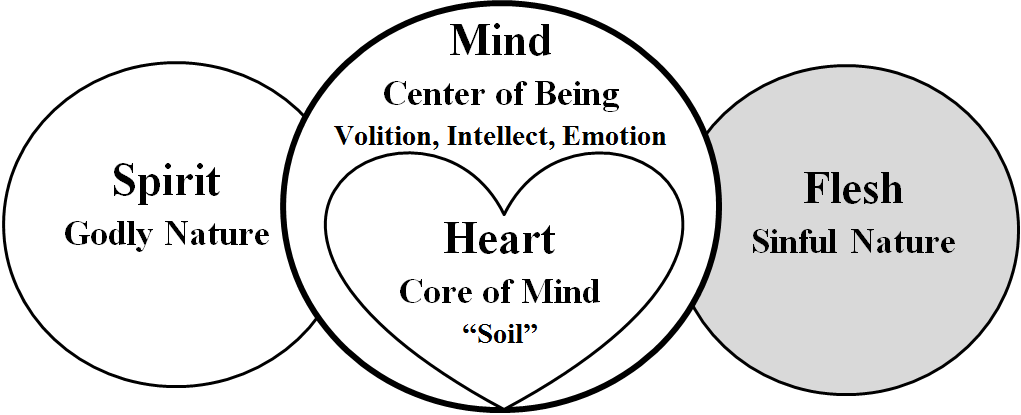
(click image to enlarge)
God works with you through your spirit—your godly nature—by the Holy Spirit whereas demonic spirits work with you through your flesh—the sinful nature. These two natures are in conflict and the one you heed will determine if you’re spirit-controlled or flesh-ruled. If you’re spirit-controlled you’ll produce the fruit of the spirit whereas if you’re flesh-ruled you’ll produce works of the flesh (Galatians 5:17-23). It’s your choice because, whether you know it or not, you possess the power of volition; that is, the power of decision.
Let me give an example of something negative getting lodged in a person’s heart: A pedophile in prison wrote Ann Landers years ago. He confessed that he was a pedophile and that his time in prison had not set him free—the walls could not change him. There was this “monster” in his heart, he said, and when he would be released in 7 months he was going to continue to do the very monstrous things that got him sent to prison in the first place. Why? Because he was in bondage to this evil desire that was lodged in his heart. In other words, this wicked desire that he allowed to get rooted in his heart by occupying his thought life was literally determining the course of his life! The good news is that there’s hope for people like this if they’re willing to humbly turn to the LORD in repentance & faith and put into practice the wisdom of God’s Word (e.g. Isaiah 55:6-9).
So you “add” goodness by:
- Actively meditating on good things—images, impulses, desires—which automatically push out the bad. This is the law of displacement: Two things cannot occupy the same space at the same time. You can’t walk in faith and fear simultaneously; you’re walking in one or the other. By choosing to focus on faith you weed out fear. Needless to say, weed out the negative things from your heart!
- Guard your heart from negative things. In other words, be proactive as the guardian of your soul. Don’t allow bad things to occupy your thought life because the corresponding desire will manifest as you dwell on them. And the more you meditate on them the more the desire grows. For instance, if you dwell on negative, hopeless thoughts it’ll give birth to depression, meaninglessness, frustration and, if it’s bad enough, suicide. Another example: If there’s a married person at work who starts flirting with you and you’re tempted to think about her or him in unwholesome ways, don’t allow such thoughts to get rooted in your thought life. If you do they’ll give birth to desire and desire ultimately gives birth to action (James 1:14-15).
Since things get planted in your heart through 1. what you see, 2. what you hear and 3. the company you keep or the atmosphere you permit, it’s important to discipline what you allow your eyes to see, your ears to hear and the people with whom you spend time.
You can look at adding goodness as removing the “dross” from your life so the LORD can forge a worthy vessel for His purposes. This coincides with Proverbs 25:4: “Remove the dross from the silver and out comes material for the silversmith.” Dross is waste material that a metallurgist removes in order to forge the quality instrument of his choice. It’s the same thing with God and you. Here’s a harmonizing New Testament passage:
In a large house there are articles not only of gold and silver, but also of wood and clay; some are for noble purposes and some for ignoble. (21) Those who cleanse themselves from the latter will be instruments for noble purposes, made holy, useful to the Master and prepared to do any good work.
2 Timothy 2:20-21
So be sure to weed out the dross in your life and, above all else: Be careful what you think because your thoughts run your life! By doing this you’re “adding” goodness to your faith.
2. Adding Knowledge to Goodness
Verse 5 of our text says that we are to add knowledge to goodness. As already noted “knowledge” in the Greek is gnosis (NOH-sis), which means textual knowledge or sound doctrine.
In order to add knowledge you must make the decision to feed on God’s Word and cultivate passion, as David did:
I have chosen the way of truth;
I have set my heart on your laws.
Psalm 119:30
David decided to live according God’s truth and so he set his heart on God’s law, which is a reference to the revealed Word of God at the time.
My soul is consumed with longing
for your laws at all times.
Psalm 119:20
Note David’s palpable passion! No wonder he’s referred to in both the Old and New Testaments as “a man after God’s own heart.” I encourage you to develop the same passion for God’s Word.
The best way to tackle this topic is to simply throw out numerous points to keep in mind in your pursuit of knowledge:
- YOU have an anointing to receive from the Word yourself, by the Holy Spirit (1 John 2:27). Feed on it yourself!
- Always remember the four basic laws of hermeneutics, but they bear repeating:
- Context is king: Meaning the surrounding text reveals the obvious meaning of each passage
- Scripture interprets Scripture: Meaning every passage must be interpreted in light of the context of the entire Bible and that the Bible itself is its best interpreter. In other words, one’s interpretation of a passage must gel with what the rest of Scripture teaches; the more overt and detailed passages obviously expand our understanding of the more sketchy and ambiguous ones.
- Take the Bible literally unless it’s clear that figurative language is being used: In which case you look for the literal truth that the symbolism intends to convey.
- If the plain sense makes sense—and is in harmony with the rest of Scripture—don’t look for any other sense lest you end up with nonsense: This includes the “plain sense” of the whole of Scripture on any given topic. In other words, if an individual or group comes up with an interpretation that is opposed to the plain-sense meaning that all the passages in the Bible obviously point to on that subject then it must be rejected. You may have noticed that this fourth rule is essentially the other three combined.
- Develop a reading plan as you’re more apt to stick with something if you have a plan (Proverbs 16:1 & 9).
- A good plan that works for me is to split the Bible up into sections and read 1 or 2 chapters from each section. The sections are: Gospels & Acts, Epistles, Psalms, Proverbs, the Law (or Torah) and the Prophetic books.
- Change translations from time to time. Everyone has a favorite translation, but periodically reading other translations keeps things fresh as it provides the opportunity to read the same text in a different light.
- A thousand mile journey begins with one step.
- “Feed” from the Scriptures via hearing, reading, memorizing, studying and meditating (Matthew 4:4):

- Notice that the thumb refers to meditation, which shows that you hear the Word and meditate; read the Word and Meditate; study the Word and meditate; and memorize the Word and meditate.
- Growth in the Scriptures is like taking a helicopter ride—you see more and more the further you go up.
- Consider topical studies from time to time. What subject interests you?
- Endeavor to master that subject.
- What’s the Bible itself say on the subject? Religious tradition isn’t always right. Sometimes it’s downright false.
- Research what others have to say via books, websites, audio teachings, videos, etc.
- The proof of desire is pursuit (Proverbs 2:1-6). If you want knowledge, understanding and wisdom you have to earnestly pursue it!
- If your Bible reading time seems dry and you’re not getting much out of it, get into the habit of sincerely praying for understanding before you read. After all, Jesus said “Ask and it will be given to you; seek and you will find; knock and the door will be opened to you” (Matthew 7:7). This explains why Paul prayed for believers in this manner: “we have not stopped praying for you and asking God to fill you with the knowledge of his will through all spiritual wisdom and understanding” (Colossians 1:9). This also explains this powerful passage from the biblical book of wisdom:
if you call out for insight and cry aloud for understanding, (4) and if you look for it as for silver and search for it as for hidden treasure, (5) then you will understand the fear of the LORD and find the knowledge of God. (6) For the LORD gives wisdom, and from his mouth come knowledge and understanding.
Proverbs 2:3-6
- The passage encourages us to passionately seek insight and understanding by crying out for it and calling aloud. God blesses such diligent pursuit because “He rewards those who earnestly seek him” (Hebrews 11:6). It’s an axiom.
- After praying for knowledge, understanding and wisdom. Expect to learn and be blessed.
- Make sure a revelation is true and ‘works’ before proclaiming it. Don’t jump the gun; be patient. As an example, I first discovered the truths conveyed in Sheol Know back in 1996 and waited twelve years before going public with the information!
- The Bible says the mind needs to be renewed (Romans 12:1-2) and is therefore perfectly capable of coming up with all kinds of erroneous “insights.” Also consider the fact that the Bible acknowledges the teachings of demons (1 Timothy 4:1), which suggests that whoever teaches or embraces these teachings received insight or “revelation” from demonic spirits, who are lying spirits. Revelation that’s accurate, by contrast, comes from the Holy Spirit, who guides us “into all truth” (John 16:13). The Holy Spirit is called the “Spirit of truth” (John 16:13); consequently, whatever revelation you get from the Spirit of truth will gel with the “word of truth” (2 Timothy 2:15), meaning it will conform to sound hermeneutics; that is, the aforementioned four principle rules of bible interpretation.
- Apprehend quality mentors near and far. A mentor is simply someone who positively influences you through knowledge, example or motivation.
- Realize that you can only go so far by yourself (Acts 8:30-31). Don’t be an unteachable, stubborn fool.
- “Feed” from those who minister the Word locally (via church services, etc.) and long-distance (via websites, books, videos, radio, etc.). The primary purpose of the fivefold ministry gifts—apostle, prophet, evangelist, pastor and teacher—is prayer and the ministry (i.e. serving) of the Word (Ephesians 4:11-13, Acts 6:1-4 & 1 Timothy 5:17).
- The ministry of the Word prompts spiritual growth and enables you to reach your maximum potential in Christ.
- One of the main reasons believers fail to reach their maximum potential is because they cut themselves off from the ministry of the Word (Proverbs 19:27).
- Learn from mentors but don’t worship mentors; that is, don’t make the mistake of viewing them as infallible in doctrine and practice because you will be let down.
- Flee from unworthy “mentors” who are arrogant and abusive, utilizing methods like bluster, intimidation and unnecessary insults.
- Realize that those who transfer knowledge can also transfer error. So “eat the meat and spit out the bones.”
- Don’t limit yourself to the limitations of a mentor. Just because they’ve limited themselves doesn’t mean you have to do the same.
- If you are diligent you’ll likely pass up your mentors, as David did (Psalm 119:99-100).
- Develop the all-your-heart ethic; don’t settle for okay or good—strive to be exceptional! (Ecclesiastes 9:10 & Colossians 3:23).
- Persevere through spiritual growth pangs.
- Be aware of hindrances to growth and shun them like the plague, such as:
- Pride—an “I know it all” attitude or superiority complex.
- Erroneous religious tradition—false beliefs that have passed on for centuries are difficult to escape. Escape!
- Rigid sectarianism (Luke 9:49-50 & 1 Corinthians 1:12-13). You can read more about staunch faction-ism here.
- Closed-mindedness. Endeavor to cultivate the “Berean spirit,” like the Bereans who were excited about Paul’s teaching, which deviated from the Berean’s set doctrine and the limitations thereof (Acts 17:11).
3. Adding Self-Control to Knowledge
Verse 6 of our text (2 Peter 1) says we’re to add self-control to knowledge. ‘Self-control’ in the Greek is egkrateia (eng-KRAT-ee-ah), which means self-mastery, self-restraint or dominion within. It’s self-control proceeding out of oneself, but not necessarily by oneself. Since we’re to add self-control to knowledge it contextually means we’re to control ourselves according to the knowledge we received. In other words, we’re to put into practice God’s Word after we receive it. That’s all it means.
The reason adding this quality is vital is obvious: What good is knowing God’s Word if you don’t actually practice it? Doing so is foolish and Jesus addressed it in this passage:
“Therefore everyone who hears these words of mine and puts them into practice is like a wise man who built his house on the rock. (25) The rain came down, the streams rose, and the winds blew and beat against that house; yet it did not fall, because it had its foundation on the rock. (26) But everyone who hears these words of mine and does not put them into practice is like a foolish man who built his house on sand. (27) The rain came down, the streams rose, and the winds blew and beat against that house, and it fell with a great crash.”
Matthew 7:24-27
The Lord is talking about two kinds of people who hear the Word of God. One is wise because he puts it into practice whereas the other is foolish because he doesn’t put it into practice. In both cases Jesus says the “rain came down, the streams rose, and the winds blew.” This refers to attacks from the kingdom of darkness “for the Word’s sake” (KJV). If you don’t know what I’m talking about, earlier this chapter we saw in the Parable of the Sower that those who receive God’s Word will undergo a “time of testing” (Luke 8:13). Mark’s account puts it like this: “trouble or persecution come because of the word” (Mark 4:17). Whenever someone receives the Word the enemy will come and try to steal it via some kind of attack. The wise person who puts into practice God’s Word will withstand the attack whereas the foolish person who fails to put it into practice will not. The latter person is apt to conclude that “God’s Word doesn’t work” when it has nothing to do with the truthfulness of the Word of God or the faithfulness of the Lord.
So “build your house on the rock” by simply putting into practice God’s Word. If it says “husbands love your wives” then love your wife if you’re a husband (Ephesians 5:25). If it says “slander no one” then be sure to slander no one, which includes gossip since gossip typically devolves into slander (Titus 3:2). Whatever the Word of God instructs you to do—as long as it’s relevant to the New Testament believer*—put it into practice. In short, DO IT. If your life is messed up due to the flesh or adhering to false beliefs, practicing “the word of truth” is the remedy (2 Timothy 2:15); it’ll turn your ship around, so to speak, just give it time.
* In other words, don’t practice anything that’s strictly applicable to someone else of a different era and covenant, like the Israelites under Old Testament law who offered animal sacrifices to cover their sins; Jesus took care of all that in the new covenant so believers don’t have to concern themselves with it.
Practicing Positional Truth
As important as it is to practice practical truth it’s just as important to practice positional truth. A “positional truth” is any truth from Scripture that reveals how God sees you in covenant with Him, which is your position. For the New Testament believer, meaning YOU, this is who you are in your spirit, the “new self” (Ephesians 4:22-24). Who are you in your spirit?
- You are holy (Colossians 1:21-22).
- You are a child of God (John 1:12-13).
- You are a new creation (2 Corinthians 5:17).
- You are the righteousness of God (2 Corinthians 5:21).
- You are dead to sin (Romans 6:11,14,18).
- You are more than a conqueror (Romans 8:37).
- You are a temple of the Holy Spirit (1 Corinthians 6:19-20).
- You are rich (2 Corinthians 8:9).
- You are healed (1 Peter 2:24).
- You are a royal priest or priestess of the Most High God (1 Peter 2:9)!
How do you practice positional truths? You practice them simply by believing them and not disagreeing with them. Remember, “The tongue has the power of life and death” so utilize this power accordingly (Proverbs 18:21). Never speak words that contradict who God says you are. Never! This is tantamount to calling God a liar. Be sure to chew on these amazing positional truths and others as well. Make them your meditation and your confession. Take David, for example. He was diligent to “meditate” on God’s Word, as shown in Psalm 119:15-16. The Hebrew word for ‘meditate’ is siyach (SEE-ahk), which means “to ponder and converse with oneself and, hence, out loud” (Strong 115). As you do this, you’ll grow in understanding and power. The more these truths become a part of you the more you’ll be set free of the flesh and the more you’ll soar in the spirit FREE of the limitations of the mental plane. (For important details on this topic see the video How God Sees YOU).
Again, Jesus said we must “continue” in his word if we are to “know the truth” and be set “free.” Growing in knowledge, understanding and wisdom on a continuing basis is the key to this.
The Power of the Tongue
Speaking of the power of words, Proverbs 4:24 says to “keep corrupt talk far from your lips.” The root Hebrew word for ‘corrupt’ is luz (looz), which means “to turn aside or depart from what is right or good.” To practice this Scripture you must realize the power of your tongue:
The tongue has the power of life and death, and those who love it will eat its fruit.
Proverbs 18:21
The “fruit” of the tongue is good, but only “those who love it will eat its fruit.” This means only those who realize and value the tongue’s power.
You must get a hold of the fact that your tongue is a powerful gift from God, which has the potential to bless or destroy. Only those who realize the value of the tongue will experience the fruit it has to offer.
Exactly how powerful is the tongue? The Bible likens it to the small rudder of a large ship that steers the vessel wherever the pilot wants it to go (James 3:2-6). Think about it: The very course of your life is linked to what you do with your tongue. How so?
Your words are creative forces or destructive forces. Let’s look at examples of both.
Words have THE POWER OF LIFE:
- The earth & universe were created at God’s command (Hebrews 11:3). You were created in God’s likeness and therefore your words have creative power as well.
- God promised Abram countless offspring (Genesis 15:5), but Abram was still childless 24 years later at the age of 91.
- God changed his name to Abraham, which means “father of a multitude” (17:3-5).
- Abraham and everyone else were in essence forced by God to speak of Abraham as “father of a multitude.” And so the promise came to pass (Romans 4:18).
- The priestly blessing blessed people: “The LORD bless you and keep you; the LORD make his face shine on you and be gracious to you; the LORD turn his face toward you and give you peace” (Numbers 6:22-27).
- To ‘bless’ means “to speak positive words that have a productive impact.”
- Jesus blessed the children (Mark 10:13,16).
- Your words, combined with belief, can remove obstacles (Mark 11:22-23).
Words have THE POWER OF DEATH:
- To ‘curse’ means “to speak negative words that have a destructive impact.” The Bible likens the tongue to a sword that can harm people (Proverbs 12:18 & Psalm 64:3).
- An influential person tells a little girl she’s “fat,” which she takes to heart and becomes anorexic.
- Parents curse their very own children; the kids take the evil words to heart and the words essentially become a deadly prophecy in their lives.
- Thankfully, underserved curses have no power over you, unless you allow it (Proverbs 26:2): “an undeserved curse does not come to rest.”
- Counteract curses by speaking blesses over yourself. For instance, you can take 1 Peter 2:9 and say: “I am a part of a chosen people, a royal priesthood, a holy nation, God’s special possession, that I may declare the praises of Him who called me out of darkness into his wonderful light.” Speak it with fervor!
- People speak curses over themselves: e.g. “I’m so clumsy,” “I always get sick during flu season,” “I can’t do it”—“I can’t,” “I can’t,” “I can’t,” “I can’t.” Because they speak it and start believing it the words come to pass.
- Never speak ill of yourself, your worth, your work or your goals. If you do, you’re cursing your own life, which could become a self-fulfilling prophecy.
- If you say anything enough you’ll eventually believe it; and as a person thinks or believes in their heart, so they are (Proverbs 23:7 KJV, Proverbs 27:19 & Matthew 12:34-35).
- Your words advertise who you are and where you are going, like signposts.
- Reject the victim vocabulary—“I was abused” or “I don’t have an education.”
- We are to bless others (Romans 12:14), but sometimes cursing is in order, like when Jesus cursed the fig tree (Mark 11:12-14, 20-21) or when Paul cursed Elymas (el-OO-mass) (Acts 13:8-12).
Here’s one last powerful passage on the subject to chew on:
From the fruit of their lips people are filled with good things, as surely as the works of their hands reward them.
Proverbs 12:14
Needless to say, “add self-control” to knowledge by lining up your actions and tongue (words) with the Word. Amen.
4. Adding Perseverance to Self-Control
Verse 6 of our text (2 Peter 1) says that we are to add perseverance to self-control. ‘Perseverance’ in the Greek is hupomoné (hoop-om-on-AY), which means endurance, stead-fastness or to wait patiently. So after preparing the soil of your heart to insure that it’s good soil and then adding the Word and putting it into practice, it’s then necessary to add perseverance for the Word to produce fruit in your life.
Let me give an example: several years ago I had an irritating skin rash on the back of my hand for over two years. I showed it to my doctor during a check-up and he referred me to a dermatologist. I had no desire to waste time or money on a skin doctor so I continued to put up with the rash until I got righteously angry over it one night. The Spirit strongly impressed me to curse the rash from the roots repeatedly and speak healing over the back of my hand until it was gone and that’s exactly what I did. I cursed the rash, commanded it to die and leave my body; and then blessed my hand, loosing healing and health. Guess what happened? The rash completely disappeared, but it took a while—nine weeks, in fact— and I had to be stubbornly tenacious, especially when it would reoccur after starting to die out. This is perseverance or following through. Faith and the Word of God are not enough in such cases; you must add perseverance, which is patience. The Bible emphasizes that it’s through faith and patience that we inherit what is promised, not just faith:
We do not want you to become lazy, but to imitate those who through faith and patience inherit what has been promised.
Hebrews 6:12
I said above that it took nine weeks for the healing to manifest. What if I gave up on week 8? The healing wouldn’t have manifested. This shows that you have to persevere when you practice the Word in order for it to produce lasting fruit.
Now consider adding perseverance to something else entirely, like your pursuit of truth and all that goes with it; i.e. acquiring knowledge, understanding and wisdom. Notice what Jesus said:
“If you continue in my word, you are truly my disciples; and you will know the truth, and the truth will make you free”
John 8:31-32 (NRSV)
The Christ said that only those who continue in His Word—persevere in it—will know the truth, not those who give up after a season of seeking and studying. He also didn’t say that those who conveniently and lazily embrace the official doctrines of this or that sect will know the truth. No, only those who continue in God’s Word will know the truth; and the more you continue—honestly seek and study—the more knowledge, understanding and insight you’ll have. Persevere in God’s Word and don’t give up!
The Last Three Keys
Applying the first four keys to your faith—goodness, knowledge, self-control and perseverance—will result in fruit in your life. In other words, these four keys guarantee the fruitfulness of God’s Word. They each concern the planting, cultivation and fruit-bearing of the Word.
The last three keys, by contrast, involve walking in love in our relationships, starting with the LORD (“godliness”), then fellow believers (“mutual affection”) and, lastly, people in the world (“love”). The reason this is important is revealed in this passage:
For in Christ Jesus neither circumcision nor uncircumcision means anything, but faith working through love.
Galatians 5:6 (NASB)
Our covenant with God is a covenant of faith and therefore it works through faith; and faith works through love. If you cancel out love you cancel out faith and your covenant won’t “work” as it should.
With this understanding, let’s freshen up on our main text and then consider the fifth key, which is godliness:
His divine power has given us everything we need for life and godliness through our knowledge of him who called us by his own glory and goodness. (4) Through these he has given us his very great and precious promises, so that through them you may participate in the divine nature, having escaped the corruption in the world caused by evil desires.
(5) For this very reason, make every effort to add to your faith goodness; and to goodness, knowledge; (6) and to knowledge, self-control; and to self-control, perseverance; and to perseverance, godliness; (7) and to godliness, mutual affection; and to mutual affection, love. (8) For if you possess these qualities in increasing measure, they will keep you from being ineffective and unproductive in your knowledge of our Lord Jesus Christ. (9) But whoever does not have them is nearsighted and blind, forgetting that they have been cleansed from their past sins.
2 Peter 1:3-9
5. Adding Godliness
The Greek for “Godliness” in the Bible is not the same as the Greek for “religion.” The former is eusebeia (yoo-SEB-ee-ah) whereas the latter is thréskeia (thrays-KIH-ah). Notice how the Greek scholar E.W. Bullinger distinguishes the two words:
Eusebeia [godliness] relates to a real, true, vital, and spiritual relation with God while thréskeia [religion] relates to the outward acts of religious observances or ceremonies, which can be done in the flesh. Our English word “religion” was never used in the sense of true godliness. It always meant the outward forms of worship (Bullinger 335).
So godliness refers to genuine spiritual relationship with the LORD as opposed to religion, which refers to outward religious acts. Godliness cannot be performed by the flesh whereas religion can.
Godliness could simply be translated as “like-God-ness.” In other words, it’s behaving and speaking as the Lord would behave and speak. You could say it’s imitating God, which we are plainly instructed to do in the Bible (Ephesians 5:1 & 1 Peter 4:11). There are two ways to do this. One is to find out what the Word of God instructs and simply put it into practice. Since this is already covered in verses 5-6 of our main text—i.e. adding self-control to knowledge—this is not what verse 6 is talking about when it says we’re to add godliness. No, godliness in this context refers to loving God in a different way than obeying His Word (1 John 5:3); it’s referring to loving Him in a relational sense.
How would this make a person godly; that is, like-God? Simple: The more time you spend with a person, particularly someone you love and respect, the closer you’ll become and the more like him or her you’ll naturally be. It’s the same thing with your relationship with God. The more time you spend with Him, the closer you’ll become and the more like Him you’ll be. The LORD will “rub off” on you and you’ll thus be increasingly like-God or godly.
With the understanding of what godliness is, we are encouraged to pursue it in the Bible:
For the love of money is a root of all kinds of evil. Some people, eager for money, have wandered from the faith and pierced themselves with many griefs.
(11) But flee from these things, you man of God, and pursue righteousness, godliness, faith, love, perseverance [and] gentleness
1 Timothy 6:10-11
We’re also encouraged to train ourselves to be godly:
Have nothing to do with godless myths and old wives’ tales; rather, train yourself to be godly. (8) For physical training is of some value, but godliness has value for all things, holding promise for both the present life and the life to come.
1 Timothy 4:7-8
(NOTE: Both “godly” in verse 7 and “godliness” in verse 8 are the same Greek word, the aforementioned eusebeia).
I’m citing these two passages to stress that godliness—which is an active and increasingly intimate relationship with the LORD—won’t automatically happen; it must be pursued and you have to “train yourself” to habitually walk in it. This is understandable when you consider that all good relationships take time, energy, attention and discipline. It’s no different with your relationship with God.
Godliness Vs. Religion
As noted above, godliness and religion are altogether different. Godliness refers to an active relationship with God and the corresponding “rubbing off” effect where you become increasingly like-God whereas religion relates to outward acts of service and devotion. Religion in this sense is good as long as the person balances it out with godliness. However, religion without godliness devolves into sterile go-through-the-motions religiosity.
Godliness involves both simple communion with the Lord and praise & worship. I have to be careful how I word this because I don’t want to be taken the wrong way, so please read with discernment:
Of course it’s better to enter into praise & worship once or twice a week in the assembly of the saints than not at all, that’s a given. But celebration and adoration of God should become more of an everyday thing as the believer grows. Praise & worship should flow out of us as naturally as water from a spring (Hebrews 13:15). This is the way it should be for growing believers and more seasoned ones alike. But something’s seriously wrong if praising and worshipping God becomes mere outward antics at church services. When this happens, the believer is essentially just putting on an act because he or she is around other believers, but it’s not a reality in his/her personal life. Beware of falling into this mode because it’s a form of legalism—counterfeit “Christianity”—which Jesus denounced when he quoted Isaiah:
“These people honor me with their lips, but their hearts are far from me.”
Mark 7:6
It’s possible to praise & worship God with our mouths and yet not really mean it with our hearts. Please be careful to never slip into such a legalistic mode!
Believe it or not, churches sometimes unknowingly facilitate this problem. They put so much stress on coming to every church service and being involved in the church that believers end up running around like headless chickens doing this or that for the ministry, which leaves very little time for the most important thing, their relationship with God. This is especially so when you factor in other life essentials like work, kids, education, shopping, cooking, physical fitness, rest and recreation.* In other words, believers are so pressured to run around doing this or that so their pastors will deem them faithful and godly that they don’t have time and energy for the very things that create true godliness—personal time spent with the LORD and His Word.
* Yes, some measure of recreation is essential: “There’s a time to weep and a time to laugh, a time to mourn and a time to dance” (Ecclesiastes 3:4).
This could just as easily happen to pastors and worship leaders or musicians. Such people become so involved in the work of the ministry that they forsake the core of all Christian service, the Lord himself. The story of Mary and Martha applies here:
As Jesus and the disciples were on their way, he came to a village where a woman named Martha opened her home to him. (39) She had a sister called Mary, who sat at the Lord’s feet listening to what he said. (40) But Martha was distracted by all the preparations that had to be made. She came to him and asked, “Lord, don’t you care that my sister has left me to do the work by myself? Tell her to help me!”
(41) “Martha, Martha,” the Lord answered, “you are worried and upset about many things, (42) but only one thing is needed, Mary has chosen what is better and it will not be taken away from her.”
Luke 10:38-42
Martha was so focused on the busy-ness of working for the Lord that she unintentionally forsook what was most important—spending time with him and “listening to what he said,” an obvious reference to spending quality time with the LORD personally and His Word. In fact, Martha was so involved with the work of her service—her ministry—that she got mad at someone else who was free of such concerns and spending personal time with the Lord. So mad, in fact, that she started demanding things from the very One she was supposed to be serving! She TOLD the Lord, “Tell her to help me!” This is what religion without godliness does to people: It corrupts them to the point that they end up having the very opposite attitude they should have.
Serving God is a wonderful thing, but don’t be foolish like Martha and get your priorities out of whack. Think about it, the Living Lord was AT HER HOUSE—the amazing miracle-worker—and all she does is run around in a whirlwind of activity? Mary chose what was more important on this occasion and Jesus even commends her for it. There’s a time for doing works of service for the Lord, of course, but there’s also a time for your relationship. The latter’s more important because our service for the Lord must spring from our love for Him. Otherwise it’s just religious works or, worse, putting on a show.
E.W. Bullinger noted above that godliness in the sense of communion with the Lord and worship cannot be performed by the flesh, whereas religious acts can. The flesh gets uncomfortable during praise & worship or intimate prayer. It can’t handle godliness, but it’s perfectly fine performing religious works, including going to church, taking notes, etc. Not that there’s anything wrong with these activities, as long as they’re balanced out by godliness. The flesh is comfortable working for the Lord or doing things in the name of being devotional rather than spending relational time with Him, which was the case with Martha.
Adding Mutual (Christian) Affection and Love
As noted at the beginning of this chapter, the last three virtues we’re instructed to add to our faith in 2 Peter 1:5-7 have to do with walking in love in our relationships. “Godliness” has to do with loving God in a vital relationship whereas the next two virtues—“mutual affection” and “love”—have to do with loving 1. fellow believers and 2. people in the world.
These last two qualities stem from two well-known Greek words for love. The Greek for “Mutual affection” is often translated as “brotherly kindness” in other English versions and that’s how the original NIV renders it. The revised NIV obviously changed it to “mutual affection” to make it more applicable to all believers, whether male or female (Galatians 3:28). The Greek word for “mutual affection” or “brotherly kindness” is philadelphia, which is where the name of the American city was derived, “The City of Brotherly Love.”
Adding philadelphia love to your faith simply means walking in love toward your brothers and sisters in the Lord with the emphasis on growing in affection, meaning warm feelings.
By contrast, the Greek word for the seventh virtue—“love”—is agape (ag-AH-pay), which doesn’t primarily refer to affection, but rather practical love.
To understand the difference of these two types of love let’s look at…
The Four Types of Love
-
Storge Love
Storge love is familial love. It’s the bond, affection and loyalty that develop between family members. Although the word itself, storge (STOR-gay), is not found in the Bible we see numerous examples of it, like Martha & Mary’s love for their brother Lazarus in John 11.
Unfortunately family members don’t always develop storge love for each other and instead develop hatred. A couple examples from the Scriptures are Cain & Abel (Genesis 4:1-11) and Joseph & his jealous brothers (Genesis 37).
-
Phileo Love
Phileo love is friendship love or brotherly love like the platonic affection of David and Jonathan (2 Samuel 1:25-26). Both phileo (verb) and philadelphia (noun) stem from the same word, philos (FEE-loss), which refers to a friend or someone who’s dearly loved in a non-romantic sense. You could say that phileo love is storge love applied to non-family members or that storge love is phileo love applied to family members. In either case, there’s an element of “tender affection” or a bond. The word phileo (fil-LAY-oh) can be found some 25 times in the original Greek text of the New Testament. The noun form, philia, appears much less often.
Jesus had phileo love—that is, warm affection—for Martha, Mary and Lazarus, as observed here:
(5) Now Jesus loved Martha and her sister and Lazarus.
(35) Jesus wept. (36) Then the Jews said, “See how he loved him!”
John 11:5, 35-36
-
Eros Love
Eros love is phileo love between members of the opposite sex, but heightened to a romantic level. It doesn’t, however, refer to shallow sexual lust. Although the word eros (eer-ROSS) doesn’t appear in the original manuscripts there are many examples of this type of love in the Scriptures. One overt instance can be observed in the amazing Song of Songs. Here’s a passionate expression of love in that book where the man is speaking to the woman:
show me your face,
let me hear your voice;
for your voice is sweet,
and your face is lovely.
Song of Songs 2:14
-
Agape Love
Agape love is simply practical love or love-in-action and is therefore not dependent on affection (although it obviously includes affection in cases where phileo love, storge love and eros love apply). This can be observed in the Scriptural definition of agape love found in 1 Corinthians 13:4-8, which says that agape love is patient, kind, does not envy, does not boast, is not proud, is not rude or selfish or easily angered, etc.
The word ‘love’ in the most popular passage of the Bible is agape:
“For God so loved the world that he gave his one and only Son, that whoever believes in him shall not perish but have eternal life.”
John 3:16
The Creator was walking in love toward all humanity when the Father allowed the Son to die in our place as our substitutionary death. This was agape love, practical love, and not phileo love.
Phileo Love is Not Necessary to Agape Love
With this understanding, you don’t have to have phileo love for people—warm affection or respect—to agape love them. Why? Because agape love refers to practical love and has little to do with affection; that is, liking the person. This explains how we can fulfill Jesus & Paul’s instructions to love our enemies (Luke 6:27 & Romans 12:20-21). Do you like your enemies, that is, phileo love them? Of course you don’t. But this isn’t a problem because we are not commanded to phileo love our enemies, we’re told to agape love them. Are you following? This explains why agape love is often defined as “unconditional love” since it is practical in nature and, again, not dependent upon liking an individual or how well they treat you.
However, I should stress that agape love does not refer to only the nicey-wicey kind of love. Agape love is love-in-action and refers to doing the kind thing or good thing for the person in question. Are you truly being kind or good by condoning something that will eventually ruin or destroy a person? Or, worse, enabling them? This explains how Jesus—who is love because “God is love” (1 John 4:8)—was able to chase the fools out of the temple with a whip, yelling and throwing over tables (Mark 11:15-18); or when he rebuked Peter as “Satan” (Matthew 16:23). His actions may not have been nice, but they were kind and good because they benefited the people. See the article Gentle Love and Tough Love for more details (there’s also a video version).
In light of all this, allow me to point something out that you won’t hear very often: God is agape love and so He loves (agape) the world, just as the most popular passage states, John 3:16. What this means is that God is extending practical love to all human beings even though unbelievers are unregenerated “objects of wrath” (Ephesians 2:1-5). I was only saved and “made alive with Christ” because of God’s great agape love!
However, God doesn’t phileo love everyone, that is, have tender affection for them. He doesn’t have a close bond with everyone. For instance, do you think God is up there observing the many pedophile priests and saying, “Oh, I just have so much warm affection for these sick perverts?” Do you think the LORD was close buddies with Hitler? Of course not. There’s so much false teaching about love in the body of Christ because people don’t understand the different types of love. One doozy is that agape love never existed in the human race until spiritual rebirth was made available through Christ. Poppycock! While it’s true that spiritual regeneration and the empowerment of the Holy Spirit heightens the believer’s ability to walk in agape love this doesn’t mean practical love didn’t exist before the Church Age. People who teach such things apparently never actually read the definition of agape love in 1 Corinthians 13:4-8, which we’ll look at momentarily.
(For details on the four types of love see this video).
“Come Near to God and He Will Come Near to YOU”
The Bible says that the Father phileo loved Jesus when Jesus was on earth (John 5:19-20). Why? Because Jesus imitated the Father, that is, he was godly—like God. As such, Jesus grew in God’s favor (Luke 2:52). We too can grow in God’s favor by coming near to Him (James 4:8, 2 Peter 3:18 & Ephesians 5:1).
Think about it in terms of a “teacher’s pet,” in a positive way. The pupil is the teacher’s pet because she honors the teacher and is compliant. She does her homework and strives to do well on tests. If she offends the teacher she readily apologizes. The teacher will naturally have phileo love for such a student—affection and respect—but not for a student who’s aloof and shows contempt. Of course the teacher will care about the latter student because the noble instructor unbiasedly cares about all his students. He wants each one to learn, mature and be successful in life. But when the student is foolish and disrespectful there’s only so much the teacher can do. The teacher will walk in agape love toward such students—practical love—but he will not have phileo love for them. Why? Because they’re fools who regard the teacher with contempt. All the instructor can do is continue walking in agape love toward them—including praying for them and tough love when appropriate—in the hope that they’ll positively respond at some point and turn from their folly.
Let’s relate this to you and God: YOU can grow in God’s phileo love just like the teacher’s pet! “Come near to God and he will draw near to YOU.” It’s an axiom—a universal law. Strive for a closer relationship with your Creator. Cultivate a more intimate prayer life, which is simply talking with the LORD. Paul instructed us to “pray without ceasing,” which indicates a 24/7 bond of communion (1 Thessalonians 5:17). Love God by obeying His instructions, both the general instructions from the written Word and the specific instructions of the living Word, the Spirit of Christ (1 John 5:3). As you do this you’ll grow in God’s favor just as surely as Jesus Christ did when he was on earth (Luke 2:52) and others as well, like Samuel (1 Samuel 2:26). Peter put it like this:
But grow in the grace [i.e. favor] and knowledge of our Lord and Savior Jesus Christ. To him be glory both now and forever! Amen.
2 Peter 3:18
Just as important as it is to grow in the knowledge of the Lord, it’s also vital to grow in God’s grace; that is, his favor. DO IT. This is adding godliness to your faith as covered earlier.
Now that you understand the four types of love, let’s separately look at adding “mutual affection” and “love” to our faith.
6. Adding Mutual (Christian) Affection
In the context of 2 Peter 1:7 “mutual affection” refers to loving our brethren and sistren in the Lord. Again, the Greek word for “mutual affection” is philadelphia, which corresponds to phileo love. The Bible repeatedly encourages us to phileo love—philadelphia love—our Christian brothers and sisters:
Be devoted to one another in love (philadelphia). Honor one another above yourselves.
Romans 12:10
Do nothing out of selfish ambition or vain conceit. Rather, in humility value others above yourselves, (4) not looking to your own interests but each of you to the interests of the others.
Philippians 2:3-4
What if every believer started seriously loving his or her fellow Christians by honoring them above himself or herself—selflessly looking to the interests of other believers? It would be revolutionary!
Now about your love (philadelphia) for one another we do not need to write to you, for you yourselves have been taught by God to love (agapaó) each other.
1 Thessalonians 4:9
Believers are to phileo love one another—cultivate tender affection in our relationships. Again, if every believer did this it would be revolutionary!
The second time “love” appears in this verse it’s the Greek word agapaó (ah-gahp-AH-o), which is the verb form of agape. It’s much easier to agape love someone when you have phileo love for them, which is the way it’s supposed to be with all genuine believers. If you find it extremely difficult to muster phileo love for someone who says they’re a Christian, but who is typically obnoxious due to arrogance and fleshly traits it’s likely that you’re dealing with a wolf in sheep’s clothing. Sad but true.
Now that you have purified yourselves by obeying the truth so that you have sincere love (philadelphia) for each other, love (agapaó) one another deeply, from the heart.
1 Peter 1:22
Let’s apply this verse to us: Now that we’re spiritually regenerated Christians and therefore have genuine affection—phileo love—for our fellow believers let’s be sure to agape love one another—that is, walk in practical love toward each other—and let it stem from the heart, that is, the warm affection of phileo love.
Hebrews 10:24 instructs us to “spur one another on toward love and good deeds.” Do this in accordance with your particular grace gifts:
We have different gifts, according to the grace given to each of us. If your gift is prophesying, then prophesy in accordance with your faith; (7) if it is serving, then serve; if it is teaching, then teach; (8) if it is to encourage, then give encouragement; if it is giving, then give generously; if it is to lead, do it diligently; if it is to show mercy, do it cheerfully.
Romans 12:6-8
Utilize whatever gift you have to bless your brothers and sisters in the Lord. My gifts are teaching and encouraging. What are yours?
7. Adding Agape Love
Adding “love” in the context of 2 Peter 1:7 refers to walking in love toward those who are lost and dying in the world. As already noted, the Greek word for ‘love’ here is agape, which refers to practical love as shown in this popular passage:
Love is patient, love is kind. It does not envy, it does not boast, it is not proud. (5) It does not dishonor others, it is not self-seeking, it is not easily angered, it keeps no record of wrongs. (6) Love does not delight in evil but rejoices with the truth. (7) It always protects, always trusts, always hopes, always perseveres.
(8) Love never fails.
1 Corinthians 13:4-8
Allow me to restress an important point: Since agape love is practical love, it doesn’t require phileo love in order to walk in it (or storge love or eros love). You don’t have to have any affection or respect whatsoever toward an individual to agape love him or her, which explains Jesus and Paul’s instructions to love our enemies. You don’t have to have warm feelings or respect for your enemies to agape love them because the Biblical definition of agape love shows that it’s practical in nature.
Nor does agape loving someone mean always being sugary-sweet nice. Yes, agape love is kind, but sometimes the kindest thing you can do for a person is boldly tell them the truth. Why? Because only the truth will set him/her free. Christians aren’t mandated to be nice; we’re mandated to be good. And sometimes doing the good thing for a person or situation isn’t the nice thing; but it is the right thing, as long as you’re led of the Holy Spirit.
That said, you should only take the tough love route if it’s absolutely necessary and more gentle measures have proven ineffective.
The Bible encourages us to add agape love to our faith because it’s easy to get saved, hook up with a fellowship/sect and not have much to do with unsaved people. It’s so easy to get preoccupied with activities within Christian circles that we forget about the multitudes captive and hurting in this lost, dying world. There are Christians who pretty much refuse to have anything to do with unbelievers, not unlike the Israelites during Jesus’ era who shunned Samaritans. Let’s not be like that! Jesus wasn’t. He went out of his way to talk with the outcast Samaritan woman and ministered to her (John 4:4-26). He agape loved her. Even though Christ was called specifically to “the lost sheep of Israel” he ministered to a Canaanite woman and, indirectly, her daughter (Matthew 15:21-28).
What are some ways that you can agape love unbelievers? Pray for them regularly, consider ways to bless them, do a good deed, share the message of Christ, “turn the cheek” when necessary and, by all means, don’t be a Pharisaical hypocrite.
Here’s a good passage:
But in your hearts revere Christ as Lord. Always be prepared to give an answer to everyone who asks you to give the reason for the hope that you have. But do this with gentleness and respect,
1 Peter 3:15
The important thing is that you don’t forget the lost on your Christian pilgrimage and act like they don’t exist. Be sure to agape love them!
Adding the Seven Virtues Guarantees Spiritual Growth
This ends our study of the seven virtues from 2 Peter 1:2-11. The passage encourages us to “make every effort” to add these qualities to our faith because they guarantee spiritual effectiveness, productivity and growth. It’s no accident that there are seven virtues because the number 7 signifies completeness or completion. Notice what Paul said to the Philippian believers on this:
I thank my God every time I remember you. (4) In all my prayers for all of you, I always pray with joy (5) because of your partnership in the gospel from the first day until now, (6) being confident of this, that he who began a good work in you will carry it on to completion until the day of Christ Jesus.
Philippians 1:3-6
While Paul was confident that the Lord would carry on to completion the good work He started in the believers at Philippi, it would only happen if they were attentive to adding the seven virtues to their faith. Do you want to be productive in your Christian walk and go on to maturity, to completion? Of course you do. Then diligently add these qualities to your faith on a regular basis!
This article was edited from chapters 7–8 of…
- You can purchase a low-priced copy here (260 pages, $9:95).
- Or get the Kindle eBook for only $2.99!
Related Topics:
How to OBTAIN YOUR DESIRES

How do you build and maintain constant momentum in your walk with the Lord? Answer: By discerning, pursuing and obtaining your desires. I’m not talking about sinful desires, of course, but rather God-given desires. You see, the LORD motivates you by dropping desires in your spirit as you seek truth & your Creator; and these desires correspond to the works or goals God wants you to fulfill.
People have inquired about my productivity and how I do it. This article shows you how and it’s based on a simple three-point plan that’s thoroughly biblical. I first learned it through a minister in the mid-80s and have been exceedingly grateful ever since because I use it for everything I accomplish. This plan will empower you to be productive in your service for the Lord and obtain your God-given desires.
Focusing on fulfilling the dreams or works that the LORD puts in your heart is exciting and creates dynamic propulsion. As you follow the wisdom principles of God’s Word you’ll become unstoppable in your service for the Lord; and success begats success. It’s truly living the “good life” and I don’t mean that in a worldly sense (which is explained below).
“The Desire of the Righteous Is Only Good”
First we need to establish the difference between righteous desires and unrighteous desires. Notice what the book of wisdom says on this:
The desire of the righteous is only good, but the expectation of the wicked is wrath.
Proverbs 11:23 (NASB/KJV)
We’ll focus on the first part of the passage since the second part deals with the wicked; unless you’re wicked, it doesn’t apply to you. The first part plainly says that “the desire of the righteous is only good.” If the desire of the righteous is good then the reverse is also true: the desire of the unrighteous is not good, which would include desires relating to sins like arrogance, adultery, greed or murder. Galatians 5:19-21 provides a good list. How do we learn to distinguish between righteous and unrighteous desires? The Bible shows us how (Hebrews 5:14), which is one of the many reasons it’s important to grow in the knowledge of God’s Word (Colossians 1:10 & 2 Peter 3:18).
So “the desire of the righteous is only good.” ‘Desire’ here is the Hebrew word ta’avah (tah-âv-AW), which means “that which you earnestly long for.” It’s a desire that stays with you and you can’t get rid of it. We’re talking about a righteous desire, not a wicked one. The Bible says that such a desire is good! Religion has told us for centuries that all desire is bad. No, only evil, sinful desires are bad. Christianity is not the death of desire—it’s the death of selfish and ungodly desire.
Christians tend to think if they’re not called to pastor they’re of no value to God. This is a lie straight from the enemy. God is very interested in your life. In fact, you’re His child through spiritual rebirth (1 John 5:1 & 3:9). Any normal, healthy parent is intensely interested in the life of his/her son or daughter; how much more so your heavenly Father? You must get a hold of the fact that God has strategic purposes for every believer, including YOU. How does He reveal these purposes? As you make Him first priority He puts burning desires in your heart—ta’avahs—to motivate you to go in the direction He wants you to go.
You Were Recreated in Christ to Fulfill the Objectives God Gives You
Notice what this passage says and let it permeate your being:
For we are God’s [own] handiwork (His workmanship), recreated in Christ Jesus, [born anew] that we may do those good works which God predestined (planned beforehand) for us [taking paths which He prepared ahead of time], that we should walk in them [living the good life which He prearranged and made ready for us to live].
Ephesians 2:10 (Amplified)
Every believer is God’s “workmanship” “recreated in Christ” to do the good works He planned ahead of time. “Recreated in Christ” is a reference to spiritual regeneration, which takes place when a lost person turns to God in repentance and faith (John 3:3,6 & Acts 20:21). Once you’re “recreated in Christ” God has paths for you to walk down: “Taking paths which He prepared ahead of time.” A good example of this is Paul. God had plans for him to be an apostle even from his mother’s womb! (Galatians 1:15).
The Amplified Bible is a paraphrase that amplifies the original Hebrew & Greek. Notice it describes fulfilling the good works the LORD wants us to fulfill in terms of “living the good life.” You see, God’s will is the best possible path for you to walk. Being in God’s will is exciting because your Creator knows how you’re wired—what you can handle and what you can’t handle, what excites you and what bores you. Christianity is not dullsville. Religion—including “Christian” religion—might be dullsville but true Christianity isn’t. Take believers who are genuinely called to missionary work in developing areas or pastors who pioneer churches. These men and women are dynamic individuals who are excited about their work, despite the hardships and challenges. They’re living the “good life.”
Some Christians are afraid of God’s will because they think it’s all doom and gloom. While it’s true that the Christian path is filled with trials, temptations and persecutions, God’s plan for your life isn’t just okay or mediocre, it’s good—it’s “the good life”!
The LORD crowns the year with goodness, and God’s paths drip with abundance.
Psalm 65:11 (NKJV)
The LORD crowns the year with goodness and His “paths drip with abundance.” If God takes you there He’ll provide for you there, as long as you endure in faith and don’t give up. Jesus said He came that we may have “life to the full,” (John 10:10), not mediocre life!
Again, this does not mean there won’t be challenges and hardships. Life’s a fight, fight it! You will never outgrow spiritual warfare; you must simply learn to fight.
The Three-Point Plan
Now we’re ready to go over the three-point plan of action. This plan will literally empower you to continually produce during your spiritual sojourn on earth. I’m not talking about a lame formula, but rather ageless principles of wisdom based on the Word of God and the corresponding leading (or inspiration) of the Holy Spirit minute by minute and day to day.
This three-point plan is simple and I use it for everything I accomplish in service of the LORD. It works because it’s thoroughly biblical and based on the wisdom of God. Let’s look at each of the three parts with the understanding that the plan only works for believers who are walking with the Lord and keeping in repentance à la Matthew 3:8 and 1 John 1:8-9. Believers who stubbornly refuse to ’fess up when applicable automatically block the flow of God’s grace in their lives (James 4:6). It’s a simple matter of honesty and humility with your Creator.
1. Acknowledge the LORD and God Will Direct Your Paths
The cornerstone passage for this first part of the plan is this:
Trust in the LORD with all your heart and lean not on your own understanding; in all your ways acknowledge Him, and He will direct your paths.
Proverbs 3:5-6
Acknowledge God in your life and He will direct your paths. He’ll show you where He wants you to go as you seek Him. Simply ask the LORD in prayer to instruct you and teach you in the way you should go. The Bible says that God hears us when we ask according to His will (1 John 5:14) so you can base your request on passages like Proverbs 3:5-6 and this one:
“I will instruct you and teach you in the way you should go;
I will counsel you with my loving eye on you.
(9) Do not be like the horse or the mule, which have no
understanding but must be controlled by bit and bridle or they will not come to you.”
Psalm 32:8-9
Praying for God’s will to be done in your life is in accordance with Jesus’ instructions and example (Matthew 6:9-10; 26:39). Keep in mind, however, that the Bible doesn’t teach us to seek God only, but rather seek Him first (Matthew 6:33). In short, we’re to make God first priority—i.e. sell out to God—but don’t get out of balance by seeking God only. That’s a ticket to looney religiosity and burnout. Are you with me?
When you acknowledge the LORD in prayer get specific about the area of your life with which you’re acknowledging Him. There are different areas to our lives—family, marital, work, devotional, ministerial, educational, recreational, fitness, social, homestead, dating, and so on. What area are you seeking the Creator for guidance?
How exactly does God “direct your path” when you acknowledge Him? By dropping desires in your heart to motivate you. You can’t obtain your desires until you know what they are; so get close to the LORD, look deep within, and draw them out. This is in line with godly wisdom as shown in Proverbs 20:5: “The purposes of a person’s heart are deep waters, but one who has insight draws them out.”
You’ll have thoughts, ideas or desires concerning a certain area of your life. For instance, you may want to build/buy a house in the country or there may be a certain special person you’re thinking about marrying or perhaps you feel called to full-time ministry. Whatever the case, share it with the LORD in prayer, as this verse shows:
Roll your works upon the LORD [commit and trust them wholly to Him; He will cause your thoughts to become agreeable to His will, and] so shall your plans be established and succeed.
Proverbs 16:3 (Amplified)
When you acknowledge the LORD in prayer He will cause your thoughts to become “agreeable with His will.” Please understand that God is your Creator and therefore knows precisely how you tick. As such, He’ll guide you according to what you’re wired to handle by dropping in your spirit the corresponding desire.
Once you have an earnest desire, keep praying about it to ensure that it’s of God (particularly if it’s major). If it’s of God it will grow stronger. If not, it’ll grow weaker and die out.
Let me give an example from my own life: In my 20s I constantly wrote songs and recorded them on a four-track recorder. I was also a young Christian and was seeking the LORD with all my heart—studying the Word, praying, attending church services, etc. My main drive beyond God was music. It was my predominant occupational/artistic desire. So I started a band with my best friend, who was a drummer, and we started playing out. We were an overtly Christian band, of course, but after a few years it got old and progress wasn’t happening. Beyond that, I was also getting married and seeking the LORD as fervently as ever. Lo and behold my desire to be in a band and compose/play music subsided. Deep inside I knew I needed to break off from the band and, at least, take a break. So that’s what I did and, in the ensuing years, God led me to pursue serious ministry (Bible school, regular pulpit sermons, etc.).
You see, I was seeking the LORD—acknowledging Him in my life—and He led me to play in a band for a season, but as I continued seeking Him He moved me to leave that work at the appropriate time. So keep in mind that some things the LORD leads you to do will be seasonal. Jonah’s ministry in Nineveh, for example, was seasonal, not forever. It’s the same with Paul’s work in Corinth. Just because God leads you to do something it doesn’t mean it’s forever (unless, of course, we’re talking about marriage, which is a covenant till death*).
* That is, unless it’s impossible to stay married due to unrepentant unfaithfulness or abuse (Matthew 5:32 & 19:9).
Consider this potent passage:
Now to Him who is ABLE to do immeasurably more than all we ask or imagine, according to His power that is at work within us,
Ephesians 3:20
Beloved Christian, you must understand that God will not get involved in your life unless YOU allow Him. He wants to take you places. He’s able to do immeasurably more than what you ask or imagine, but are YOU even asking or imagining? How can the LORD do “immeasurably more” if we’re not even willing to ask or imagine? The last time I checked God rewards those who earnestly and diligently seek Him, not those who are lazy and apathetic.
This first part of the three-point plan is absolutely essential because it facilitates a purpose-driven life in any stage or level you’re at on your spiritual journey. This is imperative to happiness and a sense of meaning (remember Solomon’s depressed commentaries on the meaninglessness of life in Ecclesiastes?). Think about it: If you don’t know where you’re going you might not like where you end up. If you don’t know where you’re going, how will you ever know when you get there?
2. Plan Your Way to Meet Your God-Given Objective
Once you have a strong desire—a ta’avah—and you know it’s God’s will, what do you do?
The mind of a person plans their way, but the LORD directs their steps.
Proverbs 16:9 (NASB)
God has given you a course—an objective—now you need to plan your way in order for the LORD to direct your steps. ‘Plan’ means “To design or think over.” God gave you a mind for a reason—use it. I too often see a negative attitude toward the mind in Christian circles (and, by “the mind,” I mean the mental realm in general). However, your mind is an awesome gift from your Creator and should be utilized for good. For instance, this proverb shows that you should use your mind to plan your way.
Let’s say you’re seeking the LORD and you discern a strong, persistent desire to be a nurse. This is your God-given course. Now plan your way to meet that objective. You can start planning simply by asking the most obvious questions: What nursing schools are available for you to attend? How are you going to apprehend funds? Where are you going to live? Will you work part-time?
When you do this you’re planning your way to fulfill your God-given course or objective utilizing the resources at your disposal. The plan you come up with is your path or way.
Remember: No one plans to fail, but failures fail to plan.
3. Start Moving toward Your Goal Led of the Holy Spirit
Once you have a general plan then simply start moving. In short, it’s time for action! Get up off your rump and move toward your God-given goal according to the plan you devised. As you do this the LORD will “direct your steps” by the Holy Spirit (Proverbs 16:9).
It’s important to discern the difference between course, path and steps:
- Your course is your objective, goal, assignment or mission, which is based on the longstanding desire—the ta’avah—the LORD gave you as you sought Him.
- Your path is the way you planned with your mind to fulfill your course or obtain your goal.
- Your steps are you walking down that path day by day utilizing God’s direction via the Holy Spirit.
Once you have a goal it’s of the utmost importance that you take action and start walking toward it according to your general plan because this will produce momentum. As you do this, your goal will increasingly become an obsession, which is good as long as you maintain balance by not neglecting other important areas of your life, like God, sleep, health, recreation* and quality relationships. Your God-given goal must become your main focus in the area of life for which it’s relevant and, as such, you must eliminate all unnecessary distractions to obtain it, like certain friends who have a penchant for overlong gabbing on the phone, etc.
* Yes, some measure of recreation is essential: “There’s a time to weep and a time to laugh, a time to mourn and a time to dance” (Ecclesiastes 3:4).
If you don’t start walking there are no steps for the Holy Spirit to guide. Think about it in terms of a guided missile: The missile cannot be guided until it’s shot off. So blast off!
How exactly are you “led of the Holy Spirit” as you’re walking the path to your objective according to your plan?
- Be alert for “golden opportunities,” which are open doors of opportunity that manifest, such as Paul’s “open door,” as shown in 2 Corinthians 2:12
- Be alert for “golden connections,” which are people who can link you to your goal one way or another.
- “Let the peace of Christ rule in your heart” (Colossians 3:15) concerning every potential opportunity or connection since not every opportunity or person is from the LORD. For instance, Potiphar’s wife was a connection for Joseph, but it was an ungodly connection that would’ve hindered him from reaching the palace (Genesis 39:6-7).
Also be conscious of proper timing: The time for research is not the time for production or marketing. For instance, Moses had a strong desire—a ta’avah—from God to deliver the Israelites from Egyptian bondage, but he acted prematurely, which caused him to be exiled to the desert for forty years (Exodus 2-3). Another good example is Joseph, who prematurely shared his vision with his jealous brothers and was subsequently sold into slavery (Genesis 37:2-28).
Say, for instance, you discern a ta’avah to be a full-time minister. This is great, but it’s going to take years of preparation and devotion—seeking the LORD, study, consecration, mentoring, sermonizing and testing. People who jump the gun due to zeal, immaturity or impatience are bound for frustration and failure.
Throw Off Every Weight and Sin That HINDERS Your Purpose
If you truly want to fulfill your God-given goal—whatever that might be—you must be willing to throw off “weights” that will burden you and sins that imprison. Notice what the Bible says on this:
…let us throw off every thing that hinders and the sin that so easily entangles. And let us run with perseverance the race marked out for us.
Hebrews 12:1
The “thing that hinders” is a “weight” that holds you down and prevents you from fulfilling your God-given objective. The thing itself is neutral and not a sin, but it saps your time and energy so much that it hinders you from completing your assignment. It could be any number of things depending on the individual—computer games, movies, golf, boating/fishing, a person, etc. These things are not necessarily evil in and of themselves, but because they distract you from your calling they are not good for you. You must either carefully guard the time you spend with such things or, if necessary, remove them from your life altogether in order to fulfill your mission.
As for the “sin that so easily entangles,” this is any flesh proclivity that you’ve developed a taste for and it therefore seriously tempts you from time to time. You must make it a top priority to remove this sin from your life, whatever the cost. If you don’t, it will prevent you from obtaining your God-given desire. See this article (or this video) for three biblically-based keys to walking free of any sin.
The Three-Point Plan in Summary
- Seek God first (not only) by acknowledging Him in prayer. As you do this, the Spirit will make your thoughts/desires become agreeable with His will. Longstanding desires are ta’avahs—earnest (righteous) desires that stay with you. The ta’avah is your COURSE (or work, assignment, objective, mission). It’s God’s will for your current (or ensuing) season in life.
- God gave you a mind so use it. Plan your way to fulfill your God-given COURSE utilizing the resources at your disposal. This plan is your WAY (or PATH). At this point you have a COURSE and a general WAY to get there.
- Now it’s time for action. You will never fulfill your COURSE by inaction. Move toward your God-given objective based upon the plan you came up with relying on the hour-to-hour help/guidance of the Holy Spirit. This is what Proverbs means by STEPS—it’s the Lord directing your STEPS along the WAY that you planned in order to fulfill your COURSE. “Let the peace of Christ reign in your heart.” If you don’t have a peace about something or someone be sure to bypass it/them. Be conscious of “golden connections” and “golden opportunities.” It’s important to start moving once you have a COURSE and WAY because if you’re not walking the Lord won’t be able to direct your STEPS.
Don’t Misinterpret “the Good Life”
Someone misinterpreted elements of this teaching in the corresponding Fountain of Life video and wrote me a long letter to rebuke me. He (or she) mistook my references to “the good life.” I think he took it to mean living like Hugh Hefner, I don’t know. However, the video itself and this article defines the “good life” as being hooked up with God’s will and fulfilling the courses or objectives He gives you, whatever they may be. It could be moving to a third-world country and being a missionary. God’s COURSES are exciting and good because they’re in line with your Creator’s will who knows you inside out and therefore how you’re “wired.” Yes, there will be hardships and persecutions, but He knows what you can handle and can’t handle and will provide the grace to get through.
Secondly, the very beginning of both the video and this chapter establishes in the plainest terms possible that I’m talking about fulfilling righteous desires, not unrighteous desires, such as greed, hedonism and pomposity.
An Example From My Own Life
Let me share the three-point plan applied to my own life with a recent example: My 2015 book SHEOL KNOW took a lot of work and discipline, particularly since it was long and detail-oriented (339 pages). To most anyone else, writing a book like this would be a mundane, arduous and tedious venture, but because writing it was based on the ta’avah the LORD gave me I was literally thrilled every day creating it, which isn’t to say there weren’t challenges, naysayers, etc.
You have to learn to persevere through difficulties, setbacks, ignorant criticisms, etc. in order to fulfill any significant objective God gives you, like I did with writing Sheol Know. As noted above, you must weed out time-wasters from your life in order to complete your course. This is vital because anything that needlessly takes your attention away from fulfilling your God-given mission isn’t good and can prevent you from fulfilling your objective altogether, if you allow it. Also, as noted above, be on guard against any sin that can tempt you and potentially derail you, if you allow it. Learn to “keep with repentance” when you miss it by honestly and quickly confessing (Matthew 3:8 & Proverbs 28:13). This will keep your spiritual arteries clear of the clogging up of unconfessed sin; it will keep God’s grace flowing in your life (1 Peter 5:5).
The information in this teaching is absolutely essential to anyone who wants to have a productive, meaningful life. Those who haphazardly sail thru life like a ship without a rudder will end up on the beach of despair.
Helen Keller put it best when she responded to what could be worse than blindness: “To have sight, but no vision.”
See the video version of this article…
This article was edited from chapter 6 of…
- The print book is available here for only $9.95 (258 pages)
- or get the Kindle eBook for just $2.99!
Both links allow you to “look inside” the book.