
FREEDOM! LIFE! JOY! POWER!

“FREEDOM! LIFE! JOY! POWER!” is the official slogan for Fountain of Life. Why? Because it’s catchy but, more importantly, because it’s thoroughly biblical and reflects what we’re all about. To explain, let’s look at all four words from a scriptural standpoint.
But, first, it’s important to understand a couple of things…
God’s Primary Will for People
The Creator’s primary will is revealed in 1 Timothy 2:4 where it says that God “wants all people to be saved and to come to a knowledge of the truth.” So God’s will can be broken down into to two main parts:
- For people to be saved from separation from the LORD and eternal death.
- For them to come to a knowledge of the truth.
The first one—obtaining salvation—is apprehended through turning to the LORD in repentance & faith in response to the gospel (Acts 20:21) and the corresponding spiritual rebirth (Titus 3:5), which makes us spiritually alive to God (Romans 8:10).
God then wants us to grow in the “knowledge of the truth.” Why? Because it’s only through truth—through reality—that we’ll be set free. The more we increase in accurate knowledge—reality—and the corresponding understanding and wisdom, the more freedom we’ll experience. This is why Christ said “If you continue in my word, then you will know the truth, and the truth shall set you free” (John 8:31-32).
The Kingdom of Darkness OPPOSES God’s Primary Will
Understanding the LORD’s primary will is important because it reveals the devil’s primary will, which is to stop God’s two-pronged will from occurring! In other words, the enemy is intent on:
- Keeping people from being saved.
- Keeping those who are saved from knowing the truth more than they already do.
To carry out the first objective satan does his best to deceive the masses into believing that Christianity is all about bondage, lifelessness, drudgery and weakness, which of course is the express opposite of the truth. (Check out these mind-blowing passages that reveal the devil’s ability to deceive people: 2 Corinthians 4:4, 1 John 5:19 and Revelation 12:9).
If a person is saved through the gospel and the corresponding spiritual rebirth the enemy resorts to his secondary objective—to keep that individual from increasing in the knowledge of the truth. Why? Because if he can keep people from growing in truth he can limit their freedom and therefore their effectiveness as a believer, not to mention their quality of life.
One of his greatest ploys is to seduce believers into the realm of dead religiosity. Whether that’s through morphing them into impotent cultural “Christians,” who “have a form of godliness, but deny the power thereof” (2 Timothy 3:5), or by seducing them into being pharisaical sourpuss religionists, it’s all bad.
Either/or, this saps the freedom, life, joy and power that God offers believers through Christ. Those who are duped then falsely represent Christianity to those who are lost and dying in the world.
The good news is that every believer can fulfill God’s primary will, and subsequently hinder the devil’s will, simply by (1) learning of and (2) walking in the freedom, life, joy and power that the LORD has for him or her. Let’s go over each of these as it’s important to understand how biblical all four are…

FREEDOM!
Fountain of Life is a teaching ministry where we focus on teaching from the Bible in an honest, balanced and unbiased (non-sectarian) manner. Why is this important? Because Christ said God’s Word is truth—that is, reality or the way it really is—and it’s only through continuing in God’s Word that we’ll know the truth. The more we know the truth—reality—the more we’ll be set FREE! (See John 17:17 and 8:31-32). This explains why God’s Word is referred to as “the perfect law that gives freedom” (James 1:25). While counterfeit “Christianity”—legalism—puts people into bondage, true Christianity sets people FREE because it’s rooted in living by the perfect law that gives freedom, God’s Word.
What does the rightly-divided Word set us FREE from?
- The flesh, which is the sinful nature, the beast inside us all that veers toward what is negative, destructive and evil (Galatians 5:19-21).
- Legalism, which is a spirit of dead religiosity and the false veneer thereof (Galatians 5:1).
- False teachings (doctrine), whether religious or secular in nature.
- Curses of the law, which we overcome through spiritual warfare (Galatians 3:13).
All four of these freedoms are rooted in the balanced, unbiased teaching of God’s Word and the corresponding knowledge, understanding & wisdom that results, which is what Fountain of Life is all about.
The best way to handle an un-free world is to be so absolutely free that your very existence is an act of rebellion—righteous rebellion.

LIFE!
Christ declared why he came: To give LIFE and LIFE to the full (John 10:10). He was referring to eternal LIFE, which is aionios zoe (ay-OH-nee-us ZOH-ay) in the Greek and could be rendered “the LIFE of the age to come.” Since the age-to-come is perpetual translators render aionios as “eternal,” as in eternal LIFE.
Receiving eternal LIFE is a 2-phase process, which begins with spiritual rebirth where the believer’s spirit is regenerated and receives the life-of-the-age-to-come, i.e. eternal life (Titus 3:5 & 1 John 5:12). This process is completed at the bodily resurrection where believers receive immortal glorified bodies (1 Corinthians 15:42-44), which takes place at the Rapture (1 Thessalonians 4:13-18).
Here’s the point: You can tap into this abundant LIFE, this eternal LIFE—this LIFE-of-the-age-to-come—anytime you want simply by learning to live out of your new nature, which possesses eternal LIFE and was “created to be like God in true righteousness and holiness” (Ephesians 4:22-24). When you do this, you’ll “participate in the divine nature” and naturally produce the fruit of the spirit (2 Peter 1:4 & Galatians 5:22-23). Experiencing the life-of-the-age-to-come is the ultimate high and carnal temptations lose their allure the more you taste of it (Psalm 34:8 & Hebrews 6:5).

JOY!
JOY means “to be cheerful, happy, well-off, in a good frame of mind, rejoice-ful.” Unlike worldly happiness, it’s not dependent on outward circumstances being hunky dory. JOY is a fruit of the spirit (Galatians 5:22-23) and is therefore a character trait of the LORD. This explains David’s statement that there is fullness of JOY in God’s presence (Psalm 16:11). In light of this, it’s a mistake to view the Creator only in terms of solemnity, holiness and judgment; those who do so are unbalanced. God is JOY.
Since your new nature was “created to be like God” (Ephesians 4:24), the more you learn to live out of your new nature—that is, be spirit-controlled rather than flesh-ruled—the more you’ll experience JOY. Peter described it as “inexpressible and glorious JOY” (1 Peter 1:8). Moreover, since God is JOY, the more you hang out with the LORD the more JOY you’ll experience because you become like those you spend time with the most. Godliness—i.e. like-God-ness (not religion)—is the result of spending time with the Most High, which you can learn more about here.
Why is JOY important? Because it’s linked to vigor (Nehemiah 8:10) and freedom (Proverbs 29:6) and therefore health and quality of life.

POWER!
The Mighty Christ imparted authority and POWER to his disciples over the dominion of darkness (Luke 9:1). This was before justification was available via Yeshua’s death and resurrection. Spiritually regenerated believers (that’s you, if you’re a believer) intrinsically possess these blessings because you’re born-again of the seed of Christ, which is sperm in the Greek (1 John 3:9 & 1 Peter 1:23). It’s due to this rebirth that you’re a “co-heir” in Messiah (Romans 8:17). This means that believers share in the inheritance of the heavenly Father with the chief heir, Jesus Christ. If this doesn’t get you excited read it again or check your pulse.
My point is that YOU have authority and POWER over the powers of darkness and the curses thereof. Authority is the right to rule whereas POWER is the ability to rule. You possess both, but you won’t boldly walk in them if you don’t know it, which is why I’m sharing this with you.
Additional POWER is available thru the baptism of the Holy Spirit. See this article for details. If you don’t yet have this baptism, drop everything and get it. Go over the pertinent passages, which will increase your faith and you’ll surely get it. I didn’t receive it until 2.5 years after my salvation.
Now chew on this: Nothing is impossible with God (Luke 1:37; 18:27) therefore you can do anything as the LORD empowers you (Philippians 4:11-13). Fan that POWER into flame, as encouraged in 2 Timothy 1:6-7!

Does Christianity Weaken People or Empower?
I was talking to a man a couple years ago who argued that Christianity weakens people and instills fear. He likened God and the devil to forest monsters in fairy tales that Christian leaders use to control and limit people through fear. While such a view may reflect some religious groups who propose to be Christian, it’s not supported by the Bible in the least.
If Christianity weakens people why did Christ give the Holy Spirit to empower us (Acts 1:8)? Why did Paul say we haven’t been given a spirit of fear, but a spirit of POWER (2 Timothy 1:7)? Why did the Messiah say he came to give us “LIFE to the full” (John 10:10)? If Christianity uses the devil to instill fear why did Christ give authority to believers “to trample on snakes and scorpions”, which are types of the devil and demons, and “to overcome all the power of the enemy” (Luke 10:19)? He even added, “nothing will harm you.” If Christianity teaches that believers are to have a negative fear of God why does the Bible say “God is love…There is no fear in love. But perfect love drives out fear” (1 John 4:16,18)? The only fear believers are encouraged to have is a healthy, reverent fear of God because it’s the “beginning of wisdom” and protects us from foolish paths (Psalm 111:10).
It’s stunning how deceived people are about Christianity, all because they confuse it with the counterfeit — religious, legalistic non-Christianity.
Closing Word
FREEDOM, LIFE, JOY and POWER are there for you — take hold of ’em with “violent” force (Matthew 11:12 )!
This article is available in book form as chapter 25 of…


- The print book is available here for only $12.50 (303 pages)
- The Kindle eBook is available here for just 99¢!
Both links allow you to “look inside” the book.
Related Topics:
Spirituality — How to be Spirit-Controlled Rather than Flesh-Ruled
Is Christianity a “Relationship with God”?
Christianity — Does it Weaken People or Empower?
Religion and Christianity — What’s the Difference?
Godliness and Religion—What’s the Difference?
Legalism — Understanding its Many Forms
Libertinism — What’s Wrong with It and How to Walk FREE
DEMONS vs. JESUS CHRIST — No Contest!

The Bible reveals that demons are evil spirits—malevolent spirits—who are also described as unclean or impure spirits (see this article for proof). In other words, they’re filthy spirits, the express opposite of the Holy (absolutely pure) Spirit.
Whether people believe in evil spirits or not, they’re viewed as uber-scary beings in our culture and are fittingly the adversaries in many horror novels and flicks. This includes the devil, since he’s the principle evil spirit. The Exorcist franchise is a good example (not that I’m a fan of those films, although I watched the first one decades ago). With this understanding, did you know that demons are actually afraid of Jesus Christ? Observe in this passage how evil spirits respond to the Messiah:
They [Jesus & the disciples] sailed to the region of the Gerasenes (JAIR-ah-seens), which is across the lake from Galilee. 27 When Jesus stepped ashore, he was met by a demon-possessed man from the town. For a long time this man had not worn clothes or lived in a house, but had lived in the tombs. 28 When he saw Jesus, he cried out and fell at his feet, shouting at the top of his voice, “What do you want with me, Jesus, Son of the Most High God? I beg you, don’t torture me!”…
30 Jesus asked him, “What is your name?”
“Legion,” he replied, because many demons had gone into him. 31 And they begged Jesus repeatedly not to order them to go into the Abyss.
Luke 8:26-28,30-31
As you can see, these demons literally cry out and beg Christ not to torture them, pleading with Him repeatedly not to order them to go into the Abyss. “The Abyss” is the furnace-like pit where the most defiant evil spirits are imprisoned (Revelation 9:1-3 & 20:1-3) and Yeshua had the authority to send these demons there. (See this article for why some rebellious spirits were imprisoned there).
What’s so great about the fact that demons are afraid of Jesus Christ? Simple: Our culture holds demonic spirts as the epitome of what is scary and dreadful and yet we observe them in the Bible shrieking in horror at the mere sight of the Mighty Christ. More than that, they literally beg Him not to torture them and throw their filthy hind ends into the Abyss!
We’ve got to get away from this idea that Jesus Christ was some effeminate milksop walking around in a white dress during his earthly ministry, as if he was some impotent smiley guy. Sure, he walked in love and was gentle and humble (Matthew 11:28-30), but this doesn’t negate that He was also courageous, astonishing, amazing, authoritative and frightening. The four Gospels offer thorough evidence of this.*
* See, for example, Matthew 7:28-29, 14:26, Mark 1:27, 2:10-12, 4:37-41, 7:37, Luke 5:8-11, 7:14-16, 20:20-26, 20:40 and John 2:13-17.
Christ’s love walk was a balance between gentle love and tough love, yet the only side of Jesus that’s stressed in our culture is the mild and gentle. What about the fortitude it took to boldly confront the corrupt religious leaders of Israel, which infuriated them to the point of wanting to murder him (Luke 11:37-54)? What about the passion and fierceness it took to clear the Temple of the greedy and ungodly? Jesus cracked a whip, yelled, scattered coins, overturned tables and drove all the fools & animals out. No one even dared attempt to stop him; in fact, the religious leaders responded with fear and the bystanders with amazement (Mark 11:15-18). Are these the actions of a milksop? Would a weak doormat inspire fear or amazement and provoke arrogant leaders to plot murder? Of course not. Although this type of extreme behavior was not the norm, the incident appears in all four Gospel accounts. In other words, this is clearly a side of the Messiah our heavenly Father wants us to grasp.
If you’re a believer and ever deal with a situation involving demonic spirits, just remember that the very name of Jesus Christ provokes them to shriek in horror and beg for mercy! This explains something James pointed out:
You say you have faith, for you believe that there is one God. Good for you! Even the demons believe this, and they tremble in terror.
James 2:19 (NLT)
This article was edited from chapter 15 of…

- The book is available here for a special low price (345 pages).
- Or you can purchase the Kindle eBook for just $2.99!
Both links allow you to LOOK INSIDE the book.
Related Topics:
Exorcism and the Believer’s Authority
Spiritual Warfare — The Basics
GIVING and “TITHING” — What’s the Bible Say?
The New Testament encourages believers to “grow in the grace of giving” just as we grow in faith, knowledge and love (2 Corinthians 8:7 & Luke 6:38). When Paul requested an offering for needy Jerusalem Christians he said this to the Corinthian believers:
Consider this: Whoever sows sparingly will also reap sparingly, and whoever sows generously will also reap generously. (7) Each of you should give what you have decided in your heart to give, not reluctantly or under compulsion, for God loves a cheerful giver. (8) And God is able to make all grace abound to you, so that in all things, at all times, having all that you need, you will abound in every good work.
2 Corinthians 9:6-8
The LORD only wants believers to give out of a giving heart that’s happy to give; He doesn’t want believers to give reluctantly or under compulsion—which includes being coerced by ministers preaching condemnation, aka ‘condo.’ There’s no condo in Paul’s request for funds for needy Christians, as chronicled in 2 Corinthians 8-9. He shares the need, encourages the believers to give, stresses that they’ll be rewarded, and then adds that they should only give what they decide to gladly give. This is the only way they’ll be blessed for their giving; otherwise they’d be giving from the flesh to earn salvation or whatever, which is what Hindus, Muslims and other religionists do.
Another thing we can get from this passage is that Paul didn’t view believers as pawns to fund ministry projects which Paul considered important, including altruistic ones. He respected and loved the believers where they were spiritually and permitted them to make up their own minds as led of the Spirit (or not led of the Spirit).
Generosity in Giving Is a Matter of Wisdom
Generous giving is simply a matter of wisdom, as shown in the biblical book of wisdom:
(24) One person gives freely, yet gains even more;
another withholds unduly, but comes to poverty.
(25) A generous person will prosper;
whoever refreshes others will be refreshed.
Proverbs 11:24-25
The book of Proverbs isn’t the Mosaic law, it’s simply a collection of common sense wisdom. And, as you can see, generosity in giving is wise and encouraged. Those who do so will “gain even more,” “prosper” and “be refreshed” whereas those who “withhold unduly” won’t.
‘What About the Tithe?’
The “New Testament” is the new covenant (i.e. contract or agreement) that God has with believers through Christ. Believers are not under the Mosaic law, as verified by several clear passages, including Galatians 5:18, Romans 6:14 and this one:
…we have been released from the law to live in the new way of the Spirit NOT in the old way of the written code.”
Romans 7:6
Believers are “released from the law” and serve “in the new way of the Spirit.” This includes being released from the Law’s command to pay tithes—which literally meant 10% of the Israelites’ crops and livestock—to support the Tabernacle and Temple (see Leviticus 27:30, Numbers 18:26, Deuteronomy 14:24 and 2 Chronicles 31:5). Actually, the Law required a few tithes:
- The main tithe was for the Levites and the priests thereof (Leviticus 27:30), which was a tenth of produce “from the land” and not income (so carpenters, masons and fishermen didn’t pay it). God instructed that the Levites didn’t get any real estate and that the LORD himself would be their inheritance. Thus the tithe is given to the Levites as their salary for Temple work and teaching. This is the tithe that is commonly understood.
- The “second tithe” (according to the Mishnah) was for the use at the Temple during the feasts (Deuteronomy 12:17 & 14:22-27), which was 10% of the remaining 90% for personal consumption at the festivals during 1st, 2nd, 4th and 5th annual cycles of the shmita (7-year sabbatical cycle). This is the festival tithe. Basically, Israelites would take a tenth and bring it to the Temple and consume it there themselves. You could call it a vacation fund. As such, it wasn’t exactly a sacrificial gift to God because this portion would be spent on themselves for the big celebration; their gift would simply be their obedience. It goes without saying that this second tithe shouldn’t be calculated into the tithe totality.
- The third tithe was for the needy in the land on the 3rd and 6th years (Deuteronomy 14:28-29 & 26:12). Every 3rd year, instead of bringing the tithe to Jerusalem, it was to be stored up in the Israelites’ hometowns for the poor. Mishnah says that this is the same 10% that is normally used for festivals, but every 3 years is diverted to the needy instead. This is basically an ancient version of our Social Security or welfare system, as well as gleaning (Leviticus 23:22).
Together these amounted to roughly 13% of the Hebrews’ agricultural and ranching produce if you do the math.
So the Old Testament tithe was essentially a method of taxation in the Israel theocracy and, later, monarchy to provide for the needs of the priests & Levites in the religious system. The third tithe supplied for the poor in the land.
Because the main tithe was 10% of produce “from the land,” carpenters, masons and fisherman were exempt, which means that Jesus didn’t pay it. Although, of course, he paid the Temple tax (Matthew 17:24-27) and no doubt he was generous with freewill offerings — which were completely voluntary offerings regulated by God’s standards (Leviticus 23:38) — as well as alms.
New Covenant Giving
As noted earlier, the principle in the New Testament—principle, not law—is to willingly and cheerfully give to support:
- The needs of others (Acts 2:45 & Romans 15:25-27), which includes…
- Supporting Christian workers—particularly those who teach and preach (more on this momentarily)—and…
- Spread the gospel through missionary outreach (Philippians 4:15-19). No amount is specified or commanded, nor is any percentage.
However, a tenth of one’s earnings is a good standard (or starting point) for Christian giving based on the fact that Abraham—our “father of faith”—gave 10% of his earnings to the priest of Salem, who was a type of Christ, before the Mosaic Law was given and the corresponding command to pay tithes (literally 10%). You can read about this in Hebrews 7:1-2. Believers who rant & rave against tithing in the sense of tithing according Old Testament Law are right as far as that goes — since believers are not under the Law — but it’s significant that the New Testament cites this occasion where our father of faith gave 10% — a tithe — of his income to support a priest who was a type of Christ. Also consider this: If Abraham gave 10% of his earnings before the Law was introduced and the Law itself mandated the giving of 10%, shouldn’t believers give at least 10% by the Spirit? Or perhaps I should put it like this: Wouldn’t genuine believers give at least 10% of their income by the Spirit?
Speaking of those who rant and rave against tithing, one of their arguments is that pastors who teach on tithing are trying to put believers under the Law and therefore their ministries are cursed even as Paul cursed the Judaizers who were trying to get the Galatians under the Law (read it yourself in Galatians 1:6-9). But I know genuine pastors who preach tithing, yet they don’t mean it in the sense of being under the Mosaic Law, not at all. I know because I know them and am familiar with their teachings. They’re thoroughly New Testament-oriented — grace-oriented — not Law-oriented. They mean “tithing” simply in the sense of giving 10% of one’s income to support the assembly and all the financial needs thereof, which is in harmony with the fact that “tithe” simply means 10%.
This is not to say, however, that there aren’t churches which are Law-oriented when it comes to giving. These are legalistic ministries that try to put people under the Law and are in essence preaching a “different gospel,” as Paul put it in Galatians 1:6-9. If you observe this “leave them,” as Christ instructed in Matthew 15:14.
In any case, the early Church did not focus on a particular amount but rather on meeting needs as led of the Spirit, which sometimes meant giving much more than a tenth, as some believers sold homes or land to meet the needs that existed in the Christian community (Acts 4:34-37). This corresponds to the aforementioned Galatians 5:18, which says that believers are led of the Spirit and are not under the Law.
We Were “Bought at a Price” and Therefore Are to Be “Living Sacrifices”
Something else to keep in mind is the fact that believers “are not their own” because we were “bought at a price” (1 Corinthians 6:19-20), which explains why we’re instructed to be “living sacrifices” (Romans 12:1-2). In other words, our whole lives are God’s possession already, not just 10% of our financial earnings. Our bodies, our thoughts, our material possessions, our earnings — they’re all God’s already. This frees us up to happily “grow in the grace of giving” (2 Corinthians 8:7).
Thus the principle of giving 10% is, at best, a starting point in the New Covenant. The LORD wants believers to become living sacrifices every day wherein we grasp that everything we are & everything we own has already been purchased by our Mighty Maker. “We are not our own.”
Of course believers have to grow into this powerful revelation, which is where the day-to-day process of sanctification comes into play.
The Principle of the Firstfruits
The Bible supports the idea of offering the firstfruits of your income to the LORD and his work. We observe this in the book of wisdom, which shows that those who honor God in this way will receive a financial blessing:
Honor the Lord with your wealth,
with the firstfruits of all your crops;
(10) then your barns will be filled to overflowing,
and your vats will brim over with new wine.
Proverbs 3:9-10
Is this specifically a reference to obedience to Old Testament Law — the Torah — or is it simply a principle of wisdom that more broadly applies to all people who know God? It would seem the latter since, as noted above, our father of faith, Abraham, gave a tenth of his income to Melchizedek before the Law was even given (Hebrews 7:1-2). Again, Melchizedek was a type of Christ.
A good example of the principle of the firstfruits can be observed in Joshua’s taking of Jericho where the Israelites didn’t plunder the city, but rather devoted it to the LORD (Joshua 6:21). This is significant because pillaging a city was a means of resupplying armies with food and equipment and Jericho was the first city that the Hebrews conquered in the promised land. In other words, they honored the LORD by giving the first victory to Him and sacrificing the valuables thereof. The second city they took was Ai where they carried off the plunder and livestock for themselves (Joshua 8:2).
While Christians are not under the Law, but rather are led of the Spirit of God, the principle of the firstfruits applies. Old Testament stories, like Abraham giving an offering to Melchizedek and Joshua honoring the LORD with the valuables of Jericho, serve as examples or illustrations to us, as shown in 1 Corinthians 10:6,11 & Galatians 4:24.
Your income may not even be cash but, whatever it is, honor God with your firstfruits, as led of the Holy Spirit. What work of the LORD should you give your firstfruits to? Obviously one that serves well and is impacting the world with the life-changing truths of the Word and the power of the Spirit. Don’t give it to just any ol’ impotent ministry.
I encourage giving proportionately to the work of the Lord using the tithe as a pattern. Although we are not cited percentages in the New Testament beyond Abraham’s example with the priest of Salem, the principle of proportionate giving is illustrated (1 Corinthians 16:2 & 2 Corinthians 8). The New Testament also shows believers in the Church collecting to give to other ministries. Speaking of which…
Supporting Diligent Ministers Who Teach & Preach God’s Word
As far as “supporting Christian workers—particularly those who teach and preach” goes, the New Testament instructs us to support those who diligently serve via the teaching & preaching of God’s Word. Here are some obvious examples:
Let the one who is taught the word share all good things with the one who teaches.
Galatians 6:6 (English Standard Version)
Who serves as a soldier at his own expense? Who plants a vineyard and does not eat its grapes? Who tends a flock and does not drink the milk? (8) Do I say this merely on human authority? Doesn’t the Law say the same thing? (9) For it is written in the Law of Moses: “Do not muzzle an ox while it is treading out the grain.” Is it about oxen that God is concerned? (10) Surely he says this for us, doesn’t he? Yes, this was written for us, because whoever plows and threshes should be able to do so in the hope of sharing in the harvest. (11) If we have sown spiritual seed among you, is it too much if we reap a material harvest from you? (12) If others have this right of support from you, shouldn’t we have it all the more?
But we did not use this right. On the contrary, we put up with anything rather than hinder the gospel of Christ.
(13) Don’t you know that those who serve in the temple get their food from the temple, and that those who serve at the altar share in what is offered on the altar? (14) In the same way, the Lord has commanded that those who preach the gospel should receive their living from the gospel.
1 Corinthians 9:7-14
The elders who rule well are to be considered worthy of double honor, especially those who work hard at preaching and teaching. (18) For the Scripture says, “YOU SHALL NOT MUZZLE THE OX WHILE HE IS THRESHING,” and “The laborer is worthy of his wages.”
1 Timothy 5:17-18
Verse 17 of the last passage says that those who “rule well”—referring to fivefold leaders (see Ephesians 4:11-13)—are worthy of receiving double the honor, specifically those who preach and teach God’s Word. The Greek word for ‘honor’ means “a price; honor.” So it’s partially a financial term. A good example is Acts 7:16 where it refers to “the sum” of money Abraham used to purchase a tomb. The Greek for “double” means two-fold or, figuratively, an ample amount. With this understanding, fivefold ministers who labor diligently at teaching and preaching God’s Word are “worthy of receiving double the honor.” How much does a common laborer in your area make? Diligent ministers of the Word of God who are called and anointed to change the very trajectory of people’s lives for the positive are worthy of double that amount.
Of course, genuine ministers are not to be “lovers of money,” as shown in many passages, like 2 Timothy 3:2 and Luke 16:14. So if you see a so-called minister obsessed with vapid materialism—i.e. conspicuous consumption—head for the hills. Christ said: “Watch out! Be on your guard against all kinds of greed; a man’s life does not consist in the abundance of his possessions” (Luke 12:15).
However, this does not take away from the fact that ministers of the Word are to be financially supported by the people they minister to—not just pastors, but teachers, apostles, prophets and evangelists as well (Ephesians 4:11-13).*
* Pastors are important, but they’re over-emphasized in the modern body of Christ at the expense of the other four giftings or anointings. Do a word study on the Greek terms for pastor and its synonyms (e.g. overseer, shepherd) and how often they’re used in the New Testament in reference to Church leaders.
If you’re a believer and you’re feeding heavily from a minister or ministry I encourage you to “grow in the grace of giving” and “share all good things with your instructor” (Galatians 6:6). Give only what you can cheerfully give as led of the Holy Spirit and you’ll be blessed. Those who read the three passages above (amongst others) and continuously ignore them or try to write them off because of a spirit of freeloading stinginess are walking in disobedience and will be held accountable. See 2 Corinthians 5:10-11.
Allow me to give a personal example of supporting a ministry other than your local fellowship (although this applies to giving to your assembly as well). There’s an international prophetic ministry that’s been a blessing to Carol & me over the years and we’ve sown generously into it many times. Lately, however, money’s been tight for various reason and we haven’t been supporting this ministry, but it’s continued to bless us greatly on a weekly basis. So I shared with Carol: “The next time a good donation comes in we need to sow 10% into this ministry.” When a generous donation recently came in we sowed roughly 12% into this inspirational ministry. Did we do this because we were under the Mosaic Law? Absolutely not. We did it because we were led of the Spirit. We did it because we decided to do it. We did it because we wanted to do it. And we did it cheerfully, not reluctantly.
‘What About “Your Tithe Belongs to the Local Church”?’
Pastors often use this phrase, but it can’t be found in the New Testament. For one thing, New Covenant believers aren’t under the Law and therefore aren’t required to tithe, as detailed above. We’re simply encouraged to “grow in the grace of giving” by supporting teachers & preachers who feed us, as well as helping needy Christians and supporting missionary outreaches. What we give to any of these can only be determined by the individual as led of the Spirit. It’s an amount that each person decides upon and can give happily (and may not even be cash). If you’re hooked up with a local ministry, seek the LORD about how much you should give to support it. Ten percent of your income is a good standard, as noted above.
But don’t forget about the many other ministries that reach people in ways that a local assembly cannot or does not. Is there a ministry, other than your local fellowship, that you feed from and blesses your walk with the Lord? Then, by all mean, “share all good things” with this ministry. Perhaps even consider “partnering” with it (Philippians 4:15 & 1:5).


If you’ve been blessed by Fountain of Life please consider supporting this global-reaching ministry (our worldwide reach is shown in the image). It could be either a one-time donation or regular support. Regular supporters are considered “partners,” as Paul referred to supporters in Philippians 4:15 and 1:5.
If you’re interested in giving, go here.
NOTE: Special thanks to J. Altieri for his scholarship on the Old Testament tithe and the Mishnah’s take on it.
Related Topics:
THE POWER of the Gospel of Christ

On October 2, 1886, Charles Darwin returned to Falmouth, England, ending a five year surveying expedition of the southern Atlantic and Pacific Oceans. He described the cannibals who lived in the South Sea Islands as primitive creatures and was convinced that nothing on earth could possibly lift them to a higher level. He thought he had indeed found a lower stratum of humankind which would fit his theory of evolution.
However, when he returned 34 years later to those same islands, to his amazement, he discovered churches, schools and homes occupied by some of those former cannibals. In fact, many of them were clothed and frequently gathered in church to sing hymns, pray and hear preaching.
The reason was soon learned: Christian missionary John G. Patton had been there preaching the Gospel of Jesus Christ! Darwin was so moved by the transformation of those dear people, he made a very generous donation on his return home to the London Missionary Society under whose auspice J. G. Patton had gone as a missionary to that part of the world.
The Apostle Paul reminds us in Romans 1:16 that the power of the Gospel is such that no man or people are so low or primitive that it cannot bring about a marvelous transformation in every life who believes on the Lord Jesus Christ and is saved, from the highest to the lowest. In any land, the Gospel can bring complete change.
– Ken Humphries,
founder of Treasured Truth Today Ministries,
a Bible prophecy ministry in Northern Ireland.
Related Topics:
UNIVERSALISM, as well as Inclusivism, Restrictivism, Purgatory and the Judgment Seat of Christ

In this article we will consider the validity or error of a handful of teachings that have to do with God’s judgment of humanity and potential human salvation. Will everyone be saved eventually, as universalism teaches, or are there conditions for receiving God’s gracious gift of reconciliation and eternal life? If people aren’t saved through the gospel will they have an opportunity after death for salvation? What about those who’ve never heard the gospel? Is there any truth to the concept of purgatory? Will authentic believers be judged after their earthly life?
These are important questions that have provoked much debate over the centuries. With a balanced and honest attitude, let’s find out what God’s Word – “the truth” – has to say. We’ll start with a topic that’s been gaining in popularity…
Universalism – Will All Be Saved Eventually?
The religious traditional teaching that hell refers to never-ending fiery conscious torture has naturally given birth to the doctrine of universalism, also known as universal restoration, restorationism or universal reconciliation. Universalism teaches that all humanity will eventually be saved—even evil, ungodly people. Evidently, universalists believe such people will go through some kind of purging process before acquiring eternal life. As such, universalists who claim to adhere to the teachings of Scripture suggest that the purpose of the lake of fire is not to torment or consume, but to purge unrepentant sinners of evil in preparation to receiving eternal life. They base their belief in universal salvation on a smattering of biblical texts, such as:
For as in Adam all die, so in Christ all will be made alive.
1 Corinthians 15:22
that God was reconciling the worldto Himself in Christ, not counting men’s sins against them.
2 Corinthians 5:19
… God, who is the Savior of all men, and especially of those who believe.
1 Timothy 4:10
Universalism is an appealing notion in some ways, but it goes against the clear teachings of Scripture. The Bible plainly indicates two possible destinies for humankind: life or death, salvation or destruction. The simple fact that Christ said “anyone who will not receive the kingdom of God like a little child will never enter it” (Mark 10:15) shows that everyone won’t be saved. If everyone is ultimately saved this statement makes no sense.
Speaking of which, the idea that people cast into the lake of fire will eventually be purged of their sins and receive eternal life makes utter nonsense of the Scriptures. Let’s consider a handful of examples:
What the Bible states:
“Enter through the narrow gate. For wide is the gate and broad is the road that leads to destruction, and many enter through it. But small is the gate and narrow the road that leads to life, and only a few find it.”
Matthew 7:13-14
How we’d have to interpret this text if universalism is true:
“Enter through the narrow gate. For wide is the gate and broad is the road that leads to destruction, and many enter through it (though they’ll ultimately be purified and blessed with eternal life). But small is the gate and narrow the road that leads to life, and only a few find it (yet everyone else will eventually find it too).”
What the Bible states:
“Do not be afraid of those who kill the body but cannot kill the soul. Rather, be afraid of the One who can destroy both soul and body in hell (Gehenna).”
Matthew 10:28
How we’d have to interpret this text if universalism is true:
“Do not be afraid of those who kill the body but cannot kill the soul. Rather, be afraid of the One who can destroy both soul and body in hell (Gehenna) but will eventually restore these people and grant them eternal life.”
What the Bible states:
“Whoever believes in the Son has eternal life, but whoever rejects the Son will not see life, for God’s wrath remains on him.”
John 3:36
How we’d have to interpret this text if universalism is true:
“Whoever believes in the Son has eternal life, but whoever rejects the Son will not see life, for God’s wrath remains on him – but he’ll eventually receive eternal life too.”
What the Bible states:
“for a time is coming when all who are in their graves will hear His voice and come out – those who have done good will rise to live, and those who have done evil will rise to be condemned.”
John 5:28-29
How we’d have to interpret this text if universalism is true:
“for a time is coming when all who are in their graves will hear His voice and come out – those who have done good will rise to live, and those who have done evil will rise to be condemned, but those who are condemned will eventually rise to live as well.”
What the Bible states:
The one who sows to please the sinful nature from that nature will reap destruction; the one who sows to please the spirit, from the spirit will reap eternal life.
Galatians 6:8
How we’d have to interpret this text if universalism is true:
The one who sows to please the sinful nature from that nature will reap destruction, but will eventually be restored and granted eternal life; the one who sows to please the spirit, from the spirit will reap eternal life.
What the Bible states:
There is only one Lawgiver and Judge, the One who is able to save and destroy.
James 4:12
How we’d have to interpret this text if universalism is true:
There is only one Lawgiver and Judge, the One who is able to save and destroy (but He will ultimately restore and redeem those whom He destroys and grant them eternal life).
I could go on and on. As you can see, the notion of universal salvation renders the Scriptures utterly nonsensical. Add to this the fact that Christ plainly said there is an unpardonable sin, which itself disproves the idea that everyone will eventually be forgiven and redeemed.
Certainly, as 1 Timothy 2:4 points out, God “wants all men to be saved and come to a knowledge of the truth.” In fact, this is the very reason why this section of Scripture encourages believers to offer prayers for “everyone” (see verse 1); but what can God do if people freely choose to reject his offer of reconciliation and eternal life in favor of “sin, which leads to death” (Romans 6:16)? I’ve heard the question: Since God is all-powerful could He create a stone so big that he couldn’t move it? The answer is yes, the human heart.
The reason all people can’t be saved is simply because God respects our freewill choices. He did not create robots, so he can’t force people to choose reconciliation and receive eternal life. People who reject God in favor of sin are choosing death, the wages of sin. So God will ultimately accommodate them. Their fate is really self-destruction because God is only giving them what their freewill actions justly deserve. Will He enjoy this? Of course not. He doesn’t want “anyone to perish, but everyone to come to repentance” (2 Peter 3:9).
Another argument that universalists make is that the English words “eternal” and “everlasting” are translated from the Greek word aionios (aay-OHN-ee-us), which more properly means “age-lasting.” They contend therefore that “eternal punishment” and “everlasting destruction” refer more specifically to ‘punishment that lasts an age’ and ‘destruction that lasts an age.’ Their point is that the punishment and destruction of the ungodly may indeed last an eon of time, but it won’t last forever and ever. They are right about aionios (see Chapter Four of HELL KNOW), just scroll down to the appropriate section on aionios zoe), but there are two obvious problems with this argument: 1. “The age to come” spoken of in the Bible (e.g. Mark 10:29-30) is a perpetual age (itself made up of ages according to Ephesians 2:7) and therefore God’s age-lasting punishment of destruction in the sense of burning to ashes will last perpetually. 2. God’s age-lasting punishment of age-lasting destruction is always spoken of in direct contrast to the age-lasting life that God will grant the righteous (e.g. Matthew 25:46); and since the age-lasting life that God grants the righteous refers to perpetuity in the age to come we must conclude that the age-lasting destruction of the ungodly will be just as eternal.
There’s no getting around it, universalism is simply incompatible with clear biblical teaching and is therefore not a valid option.
Yet universalism is a view that’s increasing in popularity throughout the world. What spurs so many to embrace this erroneous doctrine? The answer is obvious.
Most of these people have overlooked the doctrine of literal everlasting destruction. Why? Because of religious tradition and the corresponding indoctrination (even if it’s subconscious) they naturally assume two erroneous things: 1. that people can never cease to exist because they have “immortal souls,” and 2. that “hell” must refer to never-ending fiery torment. As pointed out earlier, eternal torture is the ultimate evil—the worst conceivable concept. It is so profoundly disturbing that these people feel they have no recourse but to reject the idea of human damnation altogether because they don’t know about the view of literal destruction. Once the idea of hell is discarded the only option left for them is universalism. The problem with this is that, in accepting universalism, these people reject the authority of God’s Word, which plainly teaches that unrepentant sinners are doomed to be cast into the lake of fire to suffer the second death. Rejecting the authority of the Holy Scriptures on an important issue like this can lead to nothing but spiritual degeneration and apostasy.
The awesome news is that there’s an answer to this conundrum. Literal everlasting destruction is the sound medium between the two extremes of eternal torture and universalism. Eternal torture is ridiculously too severe, yet universalism is ridiculously too lenient. Eternal torture is sadistic, immoral and unjust, yet universalism suggests that people can do whatever wicked thing their evil hearts’ desire and still ultimately be blessed with reconciliation and everlasting life. This would of course make universalism unjust as well. Both of these extremes should be rejected in favor of everlasting destruction—the balanced, acceptable, reasonable and scriptural view on the matter.
Those who adhere to universal salvation should be commended for their great love of all people and their bold opposition to the sadistic notion of eternal torture, but their deviation from the clear teachings of Scripture cannot be condoned. Their overemphasis on love has caused them to become theologically unbalanced; it clouds their understanding of freewill and the true hideousness of evil and rebellion. Far fewer Christians would divert to the apostasy of universalism if they would do two things: 1. research the biblical authenticity of literal everlasting destruction, which maintains that those who “reject the Son will not see life” (why would the Bible even say this if no one would reject him?), and 2. consider the possibility of post-mortem evangelization and inclusivism…
Post-Mortem Evangelization – Can a Person Be Saved After Death?
Post-mortem evangelization is the belief that qualifying people will have an opportunity after death to accept the gospel of Christ and receive eternal life; this view is also known as divine perseverance. The obvious difference between this belief and universalism is that post-mortem evangelization does not advocate that all humanity will be saved, only that those who qualify will have an opportunity to hear, understand and accept the gospel after death when they are resurrected for judgment. This would include all the people throughout history who were never exposed to the gospel or, for legitimate reasons, never truly understood it if they were exposed to it. After all, you can’t very well embrace something you fail to comprehend.
There are many Christians who believe in post-mortem evangelization and many who at least suspect that it might be true; there are even whole sects that officially embrace it. This belief is appealing and makes sense in a way. For instance, I didn’t get saved until I was 20 years-old, but what if I had died in a car wreck when I was 19? In such an event would there have been no hope for me? Or what about the old man who gets born-again on his deathbed at the age of 75 after living an entire life of ungodliness in contrast to the courageous 18 year-old soldier who goes off to die in battle and never has the opportunity to accept the gospel? It seems quite unfair that the old man had 75 years to receive the gospel whereas the 18 year-old barely even reached adulthood, let alone had a chance to receive the gospel.
Speaking of teenagers, what is the “age of accountability,” the age that youths are personally held accountable for their sins by God? Theologians typically place this age at 13 based on the Jewish custom that a child becomes an adult at 13, but the Bible doesn’t actually say this. Interestingly, God only held Israelites 20 years-old and older accountable for sins committed during their desert journey to the promised land (Numbers 14:29-30). No doubt the age of accountability varies according to the maturity level of the individual and the severity of the sin in question.
Another good question: What about the millions of people who never truly accepted the message of reconciliation because they were force-fed a faulty, religionized version of the gospel, or rejected it because of the hypocritical medium through which it was delivered? For instance, the gospel came to many peoples around the world with the baggage of imperialism. How open would you or I be to the gospel if it came to us in this corrupt manner?
These are tough theological questions indeed and it would take an entire book to properly address them. This is not such a book, this article comes from a long study on the nature of eternal damnation, but let me share just a few honest thoughts on the matter…
Most people who reject the idea of post-mortem evangelization quote Hebrews 9:27: “Just as man is destined to die once, and after that to face the judgment, so Christ was sacrificed once to take away the sins of many people.” All this passage states is that every person is destined to die and be judged. Who’s to say that God’s judgment will not include an opportunity to accept the gospel, particularly those who never really had a chance to do so?
Let’s look at the book of Revelation’s account of the great white throne judgment, which is the judgment all unbelievers throughout history will be resurrected to face. Notice what it says:
And I saw the dead, great and small, standing before the throne, and books were opened. Another book was opened, which is the book of life. The dead were judged according to what they had done as recorded in the books. (13) The sea gave up the dead that were in it, and death and hades gave up the dead that were in them, and each person was judged according to what he had done. (14) Then death and hades were thrown into the lake of fire. The lake of fire is the second death. (15) If anyone’s name was not found written in the book of life, he was thrown into the lake of fire.
Revelation 20:12-15
Every spiritually dead person throughout history will be resurrected to appear before the throne of God for judgment. Each person’s life will be reviewed and judged accordingly. The passage ends by stating: “If anyone’s name was not found written in the book of life, he was thrown into the lake of fire.” We have to admit that the text leaves some measure of mystery. It does not say that everyone will be thrown into the lake of fire, only that a person will be cast there if his or her name is not found in the book of life.
Inclusivism and Restrictivism
The two other prominent views regarding the unevangelized are inclusivism and restrictivism.
Inclusivism* is very similar to post-mortem evangelization in that it attempts to solve the same troubling questions yet, unlike post-mortem evangelization, inclusivism rejects the idea of an offer of salvation after death.
* Please do not confuse inclusivism with Carlton Pearson’s doctrine of inclusion, as they are two separate beliefs. Pearson’s “gospel of inclusion” is a form of universalism (i.e. all people will ultimately be saved), inclusivism is not.
Inclusivism suggests rather that, although there will indeed be a post-mortem encounter with Christ for the unevangelized, it will only include those people who exercised faith in God as He was made known to them through creational revelation and providence (see Psalm 19:1-4 and Romans 1:19-20). This encounter will be to confirm their faith and introduce them to their Savior, not to evangelize them. In other words, unreached people may be saved if they respond in faith to God based on the light they have. Romans 2:14-16 seems to support this as it says that non-Christians, who do not have biblical revelation, have the requirements of God’s law written on their hearts; their consciences will therefore bear witness to excuse or defend them on Judgment Day. I should add that inclusivists maintain that, whether people have creational or biblical revelation, it is the same Holy Spirit who draws them to God, so the unevangelized who receive salvation are not “saving themselves” as some would criticize.
As you can see, post-mortem evangelization and inclusivism are quite similar and distinguished by a thin line. Adherents of post-mortem evangelizaton would argue, for instance, that having an encounter with Christ after death is evangelization, even though inclusivists contend that such people are already saved. The former could also argue that the people who qualify for evangelization after death are, in fact, those who respond in faith to the limited revelation they have.
Restrictivism, as the name implies, is the belief that it is absolutely necessary to know about the work of Christ and exercise faith before one dies in order to be saved; hence, God does not provide salvation to those who fail to hear the gospel and respond in faith before they die. Although restrictivism was advocated by Augustine and is therefore the traditionally prominent view, it should be pointed out that both post-mortem evangelization and inclusivism are not new in terms of Christian history; both views have an impressive list of adherents throughout the church age.
Although I personally reject a strict take on restrictivism and lean toward God offering salvation to qualifying unevangelized people, it would be counterproductive to get bogged down in such weighty matters. Best to just faithfully share the gospel, pray and encourage people to accept God’s gracious gift of reconciliation and eternal life, the sooner the better.
One thing is fairly certain though: If a person has sufficient understanding and opportunity to accept the gospel before death and foolishly doesn’t, I wouldn’t bank on God offering him or her any further opportunity after death.
Another certainty is this:
righteousness and justice are the foundation of His throne.
Psalm 97:2
…for He comes to judge the earth. He will judge the world in righteousness and the peoples with equity.
Psalm 98:9
When the Creator makes His ultimate judgment on people we can be absolutely certain that His judgment will be righteous and just. This is God’s very nature. The second verse says that He will judge people with equity. This means the LORD will be completely fair, ethical and impartial. Christians should simply do their “job” and leave the rest in God’s capable hands. When people concernedly ask about their departed unsaved loved ones, Christians can confidently assure them that they are in the hands of a just, loving God; and leave it at that.
‘What About Purgatory?’
In this section we’re going to consider the Catholic doctrine of “purgatory,” which is an unbiblical doctrine in some ways, but there are elements of it that actually relate to the biblical doctrine of the Judgment Seat of Christ. So this section is a springboard into the next section, which covers the Judgment Seat.
Whereas post-mortem evangelization and inclusivism concern the unevangelized after death, purgatory concerns the evangelized after decease; in particular those who die with unconfessed sins. This would naturally include backslidden Christians—people who were at one time legitimately born-again spiritually, but for some reason settled into a lifestyle of carnality or ignorance of God. This is different from someone who has fallen away because there’s a difference between a believer who’s backslidden and an incorrigible rebel who’s fallen away. The latter are no longer in the faith. See Hebrews 6:4-8.
Purgatory is an official teaching of Catholicism. It concerns the purification of persons after death and before their bodily resurrection unto eternal life. These people, according to Catholics, must be purged of their sins, hence the term “purgatory.” There are a lot of myths amongst Protestants concerning the Catholic concept of purgatory, myths that I myself believed until I did a little research to discover what Catholics themselves say they believe on the subject. For instance, many Protestants think that purgatory is an actual place in the spiritual realm and that it takes a long period of time for people to be purged of their sins. Yet, Catholic James Akin in his article How to Explain Purgatory to Protestants informs that Catholicism does not insist that these notions are necessarily true. Akin stresses that there are three points that his sect insists on regarding purgatory:
- that there is a purification of sins after decease for qualifying believers,
- that this purging involves some type of discomfort or pain, and
- that God assists those in this purification in response to the actions of people who are alive on earth.
The first two points are essentially true as far as the Judgment Seat of Christ goes, which we’ll look at momentarily. The third one, however, is unbiblical.
Akin also stresses that purgatory should not be understood as a place where people go if they are not bad enough for damnation and not good enough for eternal life in the new heavens and new earth. This wrongly gives the impression, says Akin, that purgatory is some type of middle destiny rather than a temporary phenomenon (1,7). The notion that purgatory is an actual place and a middle destiny between Hades and Heaven can be traced to Dante Alighieri’s Divine Comedy from the early 14th century. Dante’s poem, although clearly an allegory of an imaginary journey through Hades, purgatory and Heaven essentially became accepted as literal truth, despite what Scripture plainly teaches.
I’m not bringing the topic of purgatory up to encourage people to adopt Catholic theology (although if Catholic theology is biblical we should by all means accept it). I’m bringing it up because there are some biblical passages that relate to this concept of purgatory and they need to be examined because people inevitably wonder if these texts are connected to the subject of eternal damnation.
The Bible teaches that a spiritually born-again Christian is given the “gift of righteousness” through Christ (Romans 5:17 & 2 Corinthians 5:21). Because of this gift of righteousness, the believer becomes “righteous” in God’s sight or, we could say, in-right-standing with the LORD (Colossians 1:22). If the believer happens to sin, he or she would no longer be “righteous.” We have scriptural instructions for when this inevitably occurs: “If we confess our sins, he is faithful and just and will forgive us our sins and purify us from all unrighteousness” (1 John 1:9).
According to this verse, if we confess our sins—admit and turn from them—God will faithfully forgive us and purify us from all unrighteousness. If the LORD purifies us from all unrighteousness we’ll obviously be righteous again, that is, in-right-standing with him.
Here’s the point: What if a legitimate spiritually-regenerated believer dies with unconfessed sin in his or her life? Because the sin was never confessed it would not have been forgiven. The believer would not therefore be purified from all unrighteousness. Consequently, he or she would have to be purified of this unrighteousness sometime after he or she dies.
So the concept of purgatory attempts to address a legitimate issue, but it was unnecessary to create this religious doctrine known as purgatory as these issues are resolved by the biblical doctrine of…
The Judgment Seat of Christ (the Judgment of Believers)
Our confessed sins are, once again, forgiven by the Lord. This means that God dismisses them — the penalty is canceled and He treats us as if we never committed them. Unconfessed sins, on the other hand, must be dealt with and judged for the Bible makes it clear that our Creator will hold Christians accountable for what we do or don’t do in this present age:
For we (Christians) must all appear before the judgment seat of Christ, that each one may receive what is due him for the things done while in the body, whether good or bad.
(11) Since then, we know what it is to fear the Lord, we try to persuade men.
2 Corinthians 5:10-11
You, then, why do you judge your brother or sister? Or why do you treat them with contempt? For we [believers] will all stand before God’s judgment seat… (12) So then, each of us [believers] will give an account of ourselves to God.
Romans 14:10, 12
These passages plainly show that all believers will stand before the Lord and be held accountable for how they lived their lives. They will receive what is “due” them for what they did while in the body—”whether good or bad.”
The Judgment Seat of Christ is the judgment that believers will experience; this is also called the Bema (BAY-mah) Judgment, named after the Greek word for “judgment seat.” Christians will not be evaluated at the Great White Throne Judgment, as that judgment only concerns spiritually-dead people (Revelation 20:11-15). The purpose of the Judgment Seat of Christ is to acknowledge and reward Christians for the good things they did while in the body and to rebuke and penalize them for the bad. This would include both sins of commission and sins of omission, as well as an appraisal of their works. A sin of commission is something that we do, like engage in malicious talk about people not present. A sin of omission involves something that we did not do that we should have done. For instance, if God prompts a lady to give someone in need a $100 and she doesn’t do it, or if the LORD calls a man into full-time ministry and he ignores the call. These are sins of omission.
There’s something in the above passage that we need to consider. After stating Christians will receive what is due them for the good or bad things they did, the apostle Paul then says in verse 11: “Since then, we know what it is to fear the Lord.” The King James Version translates this as “Knowing therefore the terror of the Lord.” This statement makes no sense if people just receive rewards at the judgment seat of Christ (as I’ve heard some ministers erroneously teach). Knowing that Christians will be held accountable for the bad things they do in this life can inspire some healthy “terror.” For those of us who are Christians, it’s spiritually healthy to regularly remind ourselves that we will one day stand before the throne of God Himself and give an accounting of our lives. Needless to say, the fear of the Lord inspires holy (pure) living.
The fact that sins not dealt with in this age must be dealt with in the age to come is implied by Jesus’ declaration:
“Anyone who speaks a word against the Son of Man (Jesus) will be forgiven, but anyone who speaks against the Holy Spirit will not be forgiven, either in this age or the age to come.”
Matthew 12:32
The implication here is that some sins—sins not dealt with and forgiven in this age—must be dealt with and forgiven in the age to come. We will be held accountable for these sins at the Judgment Seat, penalized and ultimately forgiven. This does not in any way mean that the sufferings of Christ were insufficient to save us. All of our sins that are “under the blood” are forgiven; it’s the sins that are not “under the blood” when we die that must be dealt with at the Judgment Seat of Christ.
The Judgment Seat of Christ will also include an examination of our works. Some genuine Christians tend to be disinterested in the kingdom of God and consequently produce few “works” for the advancement of God’s kingdom in this life. Such an absence of works will be viewed as sins of omission. Regardless, our works will be examined and tested at the Judgment Seat.
In this passage Paul shows that a minister’s work will be judged:
If any man builds on this foundation (of Jesus Christ) using gold, silver, costly stones, wood, hay or straw, (13) his work will be shown for what it is, because the Day will bring it to light. It will be revealed with fire, and the fire will test the quality of each man’s work. (14) If what he has built survives, he will receive his reward. (15) If it is burned up, he will suffer loss; he himself will be saved, but only as one escaping through the flames.
1 Corinthians 3:12-15
This passage contextually refers to a pastor’s work of building a church congregation, that is, a group of Christian disciples (see verses 6-10 for verification). The foundation that the minister builds on is the foundation of salvation through Christ. The pastor can build on this foundation with gold, silver and costly stones or with wood, hay and straw. “Gold, silver and costly stones” is a metaphor for sound biblical doctrine and Christ-like leadership whereas “wood, hay and straw” represent unsound doctrine and ineffective or abusive leadership.
At the Judgment Seat of Christ every minister’s work will be tested by fire. If what they have built survives they will be rewarded. The only works that will survive are “gold, silver and costly stones.” If the ministers’ works are “wood, hay and straw” these works will be burned up. The ministers themselves won’t lose their salvation but they will certainly “suffer loss.” This indicates that even though it is technically their works that will be tested and burned up, these ministers will personally feel pain or discomfort as a result.
What about abusive pastors and teachers who administer “wood, hay and straw” to such a harmful degree that it severely damages people, even driving some away from the Lord—in effect destroying their Christian faith? Paul answers this question in the next two verses:
Don’t you know that you yourselves are God’s temple and that God’s Spirit lives in you? (17) If anyone destroys God’s temple, God will destroy him; for God’s temple is sacred and you are that temple.
1 Corinthians 3:16-17
This is a sobering warning for all Christian ministers. Paul makes it clear that every believer is “God’s temple”; every Christian is a sacred temple in which the Holy Spirit dwells. Verse 17 solemnly declares that God will destroy any person who destroys this temple. The context is referring to pastors and teachers who destroy Christians with their “wood, hay and straw,” which—again—represent unbiblical doctrine and abusive actions. Many have used verse 17 to preach against smoking and alcohol abuse but the context is plainly referring to ministers whose teachings and actions cause people to fall away from the Lord, in effect destroying God’s temple.
We all know what Paul’s talking about here. Jim Jones is a prime example of a supposed Christian minister whose work ultimately destroyed naïve believers and his work could therefore be categorized as “wood, hay and straw.” David Koresh is another fitting example. These are two well-known cases; I’m sure there are less extreme examples in your area.
Notice what verse 17 plainly says God will do to such a pastor or teacher whose work destroys people: “God will destroy him.” This means that God will cut the abusive, hypocritical minister off from salvation and cast him into the lake of fire where He will “destroy both soul and body,” as Jesus put it in Matthew 10:28. Please note that God will destroy such persons—eradicate them from existence, which includes the horror and torment thereof—not subject them to never-ending conscious torture. This is further support for the view of literal destruction.
Although this passage from 1 Corinthians 3 contextually refers to the testing of the work of pastors and teachers, we can apply it to all Christians because every believer is called to serve the Lord on this earth, even though the majority is not called to pastoral/teaching ministry. Each Christian will have works that God calls him or her to do and these works will be appraised at the Judgment Seat of Christ. For example, God will call Christians to witness to certain people in their lives; this work will ultimately be tested at the Judgment Seat. Their motives will be evaluated: Did they witness to these people because they love them as God loves them and are following the leading of the Holy Spirit or did they witness to them to fulfill an evangelistic quota or to appear pious? Needless to say, works produced from fleshly motives are “wood, hay and straw” and will be burned up.
All this explains why James said: “Not many of you should become teachers, my fellow believers, because you know that we who teach will be judged more strictly” (James 3:1). Those who preach and teach God’s Word will be held accountable for what they teach at the Judgment Seat of Christ. Needless to say, if you preach or teach the Word make sure that what you say is thoroughly biblical. Defending false teaching (doctrine) on the grounds that your mentor teaches it or your sect supports it won’t cut it. Don’t be a wimpy “yes man” or “yes woman” to the false doctrine others preach just because it’s popular and convenient to do so.
Jesus taught a parable that coincides with Paul’s teaching from 1 Corinthians 3:
“Who then is the faithful and wise manager, who the master puts in charge of his servants to give them their food allowance at the proper time? (43) It will be good for that servant who the master finds doing so when he returns. (44) I tell you the truth, he will put him in charge of all his possessions. (45) But suppose the servant says to himself, ‘My master is taking a long time in coming,’ and he then begins to beat the menservants and maidservants and to eat and drink and get drunk. (46) The master of that servant will come on a day when he does not expect him and at an hour he is not aware of. He will cut him to pieces and assign him a place with the unbelievers.”
(47) “That servant who knows his master’s will and does not get ready or does not do what his master wants will be beaten with many blows. (48) But the one who does not know and does things deserving punishment will be beaten with few blows. From everyone who has been given much, much will be demanded; and from the one who has been entrusted with much, much more will be asked.”
Luke 12:42-48
The “master” in this story is an obvious reference to Jesus Christ. He goes away and puts a “manager” in charge of his “servants” until his return. The “manager” refers to Christian ministers (apostles, pastors, teachers and so on) whom Christ puts in charge of believers, referred to as “servants.” The master (Jesus) instructs the manager (minister) to properly feed and take care of his servants (believers) until his eventual return. One of the primary tasks of Christian ministers is to “feed” the people under their care a proper scriptural diet so the believers can spiritually mature and learn to walk in newness of life in a living relationship with the Lord (see 1 Peter 2:2, Ephesians 4:11-15 and Hebrews 5:12-13). In verses 43-44 Jesus says that the minister who does this will be rewarded. He then brings up those ministers who will be penalized for their “wood, hay and straw” in verses 45-48.
Verse 45 shows an abusive minister who damages those under his “care,” not to mention indulges in gluttony and drunkenness. Verse 46 solemnly declares that such a minister will be “cut to pieces” and cast away as an unbeliever when Jesus returns.
Matthew tells the same story but adds that Jesus “shall cut him in pieces and assign him a place with the hypocrites; weeping shall be there and the gnashing of teeth (Matthew 24:51 NASB). As far as weeping and gnashing of teeth go, this is a solemn reminder that “It is a dreadful thing to fall into the hands of the living God” (Hebrews 10:31) for God’s enemies will experience “a fearful expectation of judgment and of raging fire that will consume the enemies of God” (Hebrews 10:27).
Concerning the weeping, if you were an unrepentant rebel against God, would you not be weeping the day you finally fell into His hands for judgment? And would you not be wailing as you are judged unworthy of eternal life and subsequently cast into a vast fiery furnace? Of course you would. This is why James warned rich oppressors to weep and wail for fear of God’s coming judgment, referred to as “the day of slaughter,” when fire will devour them (James 5:1-5).
As for gnashing of teeth, most of us might think that this is a reference to the experience of pain, but in the Bible “gnashing of teeth” describes the wrath of an adversary about to kill his victim – the teeth belong to the tormentor, not the tormented (see Job 16:9, Psalm 35:16, 37:12, Lamentations 2:16 & Acts 7:54). Psalm 112 is the only exception. The psalm starts by sharing how “Blessed is the man who fears the LORD” (verse 1), and goes on to describe such a person in verses 2-9. The final verse mentions the wicked person by contrast:
The wicked man will see and be vexed, he will gnash his teeth and waste away; the longings of the wicked will come to nothing.
Psalm 112:10
As in the other texts regarding “gnashing of teeth,” the wicked man’s gnashing of teeth is evidently an expression of his fury against the righteous. Yet even while he grinds his teeth in ineffective rage, he wastes away and comes to nothing. The phrase could, in this instance, be interpreted as a reference to pain.
Being “cut to pieces” refers to severe flogging. After this punishment is inflicted the recipient will be cast away to where all unbelievers and hypocrites (pretenders) are disposed of – the lake of fire where “raging fire will… consume the enemies of God” (Hebrews 10:26-27). This coincides perfectly with what Paul said would happen to abusive, false “ministers:” God will destroy them.
In verses 47-48 Jesus says that some “servants” will be beaten with many blows and some with few blows based on their level of spiritual maturity and awareness. The Messiah refers to these people as “servants” and not hypocrites, as is the case with the abusive minister noted in verses 45-46. So Jesus is talking about legitimate Christians who will be judged and penalized at the Judgment Seat. We can confidently conclude this because only believing Christians can be referred to as Christ’s “servants,” not unbelievers. The abusive minister in verse 45 is initially referred to as a “servant” but is exposed as a “hypocrite,” which literally means ‘actor.’ So we’re talking about a person who is only pretending to be a servant of Christ. He or she is a fake. This person may have begun as a legitimate Christian servant but somehow became corrupt over time. Position, power, pride, money, lust, etc. can easily corrupt any of us and cause us to fall away from the Lord if we fail to guard our hearts (Proverbs 4:23).
Whether the servant is punished with many blows or few blows, the fact is that this punishment is of a limited duration. The words “many” and “few” are not specific, but both indicate a limit to the “blows.” In other words, no one will sadistically suffer “many blows” without end throughout all eternity. Consequently, even if we were to misapply this passage to the damnation of unbelievers, it would still not support never-ending torment.
All the above lends support to the likelihood that this next passage refers to the Judgment Seat of Christ:
“Watch out for false prophets. They come to you in sheep’s clothing, but inwardly they are ferocious wolves. (16) By their fruit you will recognize them. Do people pick up grapes from thornbushes, or figs from thistles? (17) Likewise every good tree bears good fruit but a bad tree bears bad fruit. (18) A good tree cannot bear bad fruit, and a bad tree cannot bear good fruit. (19) Every tree that does not bear good fruit is cut down and thrown into the fire. (20) Thus, by their fruit you will recognize them.”
(21) “Not everyone who says to me, ‘Lord, Lord,’ will enter the kingdom of heaven, but only he who does the will of my Father who is in heaven. (22) Many will say to me on that day, ‘Lord, Lord, did we not prophesy in your name, and in your name drive out demons and perform many miracles?’ (23) Then I will tell them plainly, ‘I never knew you. Away from me, you evildoers!’ ”
Matthew 7:15-23
Jesus is warning people here about “false prophets.” ‘False prophets’ in the Greek is one compound word pseudoprohetes (soo-doh-prah-FAY-tus); pseudo of course means “false” and prophetes refers to “inspired speakers” or “those who propose to speak for God.” Hence, pseudoprophetes or “false prophets” refers to people who falsely speak for the LORD.
Jesus doesn’t want believers to be misled so he warns us in this passage about those who falsely speak for God and reveals how to recognize them. How do we recognize them? As you can see, Jesus twice says that they can be recognized by their fruit (verses 16 & 20). “Fruit” in this context refers to the “fruit of the spirit” or lack thereof, as shown in this passage:
The acts of the sinful nature are obvious: sexual immorality, impurity and debauchery; (20) idolatry and witchcraft; hatred, discord, jealousy, fits of rage, selfish ambition, dissensions, factions (21) and envy; drunkenness, orgies, and the like. I warn you as I did before, that those who live like this will not inherit the kingdom of God.
(22) But the fruit of the spirit is love, joy, peace, patience, kindness, goodness, faithfulness, (23) gentleness and self-control.
Galatians 5:19-23
As you can see, this passage contrasts the works of the flesh and the fruit of the spirit.* How can you tell if people are living out of their flesh or out of their spirit? By the “fruit” they bear on a consistent basis: Are they sexually immoral? Hateful? Quarrelsome? Jealous? Have childish fits of rage? Selfish? Envious? Given to drunkard-ness?** Rigidly sectarian (which is what “factions” refers to)? If so, they’re obviously walking according to their flesh. We’re not talking about someone who stumbles, then humbly confesses and gets back up (1 John 1:8-9), we’re talking about people who regularly produce these types of fleshly acts with no concern to repent or change, even when corrected. It’s stubborn, selfish arrogance, impure and simple. People who live out of their flesh like this are fleshly and therefore carnal. A confessing believer who regularly manifests these traits without care of repentance is a carnal-Christian—a Christian ruled by his/her carnal nature. Of course, a “carnal Christian” is a total oxymoron and, if a lasting condition, would indicate that the person isn’t even saved. After all, didn’t Jesus say we could distinguish the true from the false by their fruit?
* Since there is no capitalization in the original Greek, translators have to discern whether “spirit” should be capitalized in reference to the Holy Spirit or not capitalized in reference to the human spirit (e.g. Matthew 26:41). I maintain that whenever a text contrasts flesh and spirit, like Matthew 26:41 or Mark 14:38, “spirit” obviously refers to the human spirit. It makes little difference, however, in light of the fact that the believer’s human spirit is indwelt and guided by the Holy Spirit; hence, if we’re living out of our human spirit (uncapitalized), we’re automatically following the Holy Spirit and therefore living by the Spirit (capitalized).
** I should point out that being a drunkard is not the same as drinking a sip of alcohol. See Deuteronomy 14:26.
The point is that we can determine if people are living out of their spirit simply by the evidence and quantity of fruit of the spirit. Do you see love? Joy? Peace? Patience? Kindness? Goodness? Faith? Meekness (not weakness)? Self-control? If you generally see these fruits in people’s lives, they’re obviously living out of their spirit, meaning they’re spiritual. The more fruit you see, the more spiritual they are. You could also describe them as godly.
The false ministers that Christ notes in Matthew 7:15-23, however, are not godly. They confess Jesus as Lord and are now standing before Him in judgment. They boast of performing great works, like prophesying, exorcizing demons and miracles, with the implication that they functioned within church circles. The Lord doesn’t deny that they did these good works, but condemns them on the grounds that he “never knew them” because they were “evildoers.” These confessing “Christians” are no doubt shocked by Christ’s rejection.
This passage and others covered in this section show that the Bema Judgment is for anyone who confesses Christ as Lord or were in the kingdom at some point. With this understanding, notice that Jesus doesn’t judge the salvation of such people based on their good works because these false ministers had good works; instead he judges them by their fruit or lack thereof, which indicates that they were flesh-ruled “evildoers” despite their good works!
‘What About Eternal Security?’
This question is a natural response to the above data. I want to assure you that the Bible supports the doctrine of eternal security 100% in light of what Jesus said:
“My sheep listen to my voice; I know them, and they follow me. (28) I give them eternal life, and they shall never perish; no one will snatch them out of my hand. (29) My Father, who has given them to me, is greater than all; no one can snatch them out of my Father’s hand.”
John 10:27-29
Eternal security is true in the sense that no one can steal legitimate believers from their Father’s hand—no person, no circumstance, no devil, no demon. We have eternal life and we will never perish, that is, suffer the second death (Revelation 2:11). This is awesome! However, we must keep in mind the hermeneutical rule that Scripture interprets Scripture. Consequently, this passage must be interpreted in a balanced manner, taking into consideration all relevant passages on the topic, like this one:
Here is a trustworthy saying: If we died with him, we will also live with him; (12) if we endure, we will also reign with him. If we disown him, he will also disown us; (13) if we are faithless, he will remain faithful, for he cannot disown himself.
2 Timothy 2:11-13
Verse 13 is encouraging in that the Lord remains faithful even in light of our unfaithfulness; he won’t disown us. But verse 12 plainly declares that he will disown us if “we” disown him. This corresponds to Jesus’ statement: “Whoever acknowledges me before men, I will also acknowledge him before my Father in heaven. But whoever disowns me before men, I will disown him before my Father in heaven” (Matthew 10:32-33).
A skeptic once asked: “Could God make a stone so big He couldn’t lift it?” The answer is yes, the human will. You see God has blessed humanity with the power of volition. No one can snatch us from our Father’s hand except ourselves. We have a will and therefore the liberty to choose. This is why the LORD made this statement to the ancient Israelites:
“I have set before you life and death, blessings and curses. Now choose life,”
Deuteronomy 30:19
Although God encouraged them to choose life he couldn’t make them do it. Why? Because they had freewill. Similarly, if we choose to disown the Lord there’s nothing the Lord can do. His hands are tied. He must always be faithful to his Word, and his Word clearly states that he will disown us if we disown him.
Of course some will argue that, technically speaking, God will only disown us if we disown him and, therefore, believers can live like Satan for decades with no care of repentance and not lose their salvation as long as they don’t literally disown him with their tongues. Frankly, this is playing games with God. Jesus Himself addressed this issue with the fake religious leaders of first century Israel, the Pharisees and teachers of the law:
“Isaiah was right when he prophesied about you hypocrites; as it is written: ‘These people honor me with their lips, but their hearts are far from me.’”
Mark 7:6
First, note that Jesus calls these religionists “hypocrites,” which means ‘actors.’ In other words, although they were the learned religious leaders of Israel they were putting on an act, merely posturing. Everything they did and said was for show and not genuine. In short, they were fakes. Jesus follows up by quoting Isaiah, pointing out that it’s possible for people to say one thing while the truth of the heart is quite the opposite. Paul backed this up in Titus 1:16 when he warned Titus of false believers, including staunch legalists: “They claim to know God, but by their actions they deny him.”
So, whereas the Bible supports the doctrine of eternal security, it does not support the doctrine of unconditional eternal security, often referred to as “once saved always saved.” This is proven by numerous passages where believers are warned of the “deceptiveness of sin” and the dire consequences of an unrepentant sinful lifestyle and the ensuing falling away, such as Paul, Peter, Christ and the writer of Hebrews:
Or do you not know that wrongdoers will not inherit the kingdom of God? Do not be deceived: Neither the sexually immoral nor idolaters nor adulterers nor men who have sex with men (10) nor thieves nor the greedy nor drunkards nor slanderers nor swindlers will inherit the kingdom of God. (11) And that is what some of you were. But you were washed, you were sanctified, you were justified in the name of the Lord Jesus Christ and by the Spirit of our God.
1 Corinthians 6:9-11
If they have escaped the corruption of the world by knowing our Lord and Savior Jesus Christ and are again entangled in it and overcome, they are worse off at the end than they were at the beginning. (21) It would have been better for them not to have known the way of righteousness than to have known it and then turn their backs on the sacred command that was passed on to them.
2 Peter 2:20-21
“Those on the rocky ground are the ones who receive the word with joy when they hear it, but they have no root. They believe for a while, but in the time of testing they fall away.”
Luke 8:13
Let us not give up meeting together, as some are in the habit of doing, but let us encourage one another—and all the more as you see the Day approaching. (26) If we [believers] deliberately keep on sinning after we have received the knowledge of the truth, no sacrifice for sins is left, (27) but only a fearful expectation of judgment and of raging fire that will consume the enemies of God.
Hebrews 10:25-27
Please reflect on these passages; they’re unmistakable.
I realize that there are many believers out there who are fervent about their belief in unconditional eternal security, even stubborn. Several people have written me or spoken with me on the topic, attempting to correct, but none of them were able to explain these clear passages.*
* Here are some more in case you’re interested: Romans 11:19-24, Galatians 5:19-21, Galatians 6:7-8, Hebrews 3:6, 3:12 & 6:4-6, James 5:19-20, Jude 5, Matthew 10:22 and John 15:1-6.
I want to assure you that every believer’s salvation is secure as they “produce fruit in keeping with repentance” (Matthew & Luke 3:8). This is a vital aspect of the believer’s covenant with God and Christians ignore it to their own peril. You can only produce fruit of the spirit when you are walking in the spirit, which means being spirit-controlled rather than flesh-ruled (Galatians 5:19-23). Ephesians 4:22-24 shows that being “spirit-controlled” is a simple matter of 1. putting off your old nature—your sinful nature—2. being transformed by the renewing of your mind (Romans 12:1-2); and 3. putting on your new nature, which was “created to be like God in true righteousness and holiness.” As you do this you’ll naturally “walk in the spirit” and “participate in the divine nature” (Galatians 5:16,25 & 2 Peter 1:4).
What happens when you inevitably miss is? The Bible provides precise instructions for when this occurs:
If we claim to be without sin, we deceive ourselves and the truth is not in us. (9) If we confess our sins, he [God] is faithful and just and will forgive us our sins and purify us from all unrighteousness.
1 John 1:8-9
Temptation to sin is simply the enemy’s attempt to get the believer out of the realm of the spirit and back into the realm of the flesh via the carnal impulses of the flesh. When this happens, you must put into practice the above passage. Go to the Lord and humbly ’fess up. Confession stops prosecution and ushers in God’s forgiveness, purging unrighteousness. When you knowingly sin you enter into a state of non-grace because God holds that sin against you and you’re defiled by that sin. When you sincerely ’fess up, however, the Lord wholly dismisses it and cleanses you from “all unrighteousness,” which means you’re once again in a state of grace, i.e. God’s favor. This is how you “produce fruit in keeping with repentance.” It’s a simple principle and following it is vital for a healthy relationship with the Lord. It’s impossible to produce fruit while not keeping with repentance. Believers who do this will eventually be disciplined and, if choosing to remain unrepentant, will be in danger of being rooted out of the kingdom! The Parable of the Fruitless Fig Tree applies:
“…unless you repent, you too will all perish.”
(6) Then he told this parable: “A man had a fig tree growing in his vineyard, and he went to look for fruit on it but did not find any. (7) So he said to the man who took care of the vineyard, ‘For three years now I’ve been coming to look for fruit on this fig tree and haven’t found any. Cut it down! Why should it use up the soil?’
(8) “ ‘Sir,’ the man replied, ‘leave it alone for one more year, and I’ll dig around it and fertilize it. (9) If it bears fruit next year, fine! If not, then cut it down.’ ”
Luke 13:5-9
Christ is talking to Israelites—people in covenant with God—and he plainly tells them that they would all perish unless they repent, meaning they would suffer the everlasting destruction of the second death. This is in line with the axiom that “the wages of sin is death” (Romans 6:23). Luke 16:16 verifies that the turning point between the Old Testament and the New Testament was John the Baptist; once Christ entered into public ministry the good news of the kingdom of God was preached, meaning the new covenant. So, whereas the ensuing parable of verses 6-9 is applicable to Old Testament saints, it’s more so relevant to New Testament believers and addresses the question: How long can someone in covenant with God walk in known sin without care of repentance before the Lord cuts him/her out of the covenant?
The symbolism of the parable is obvious: The owner of the vineyard represents God; the fruitless fig tree represents an individual in covenant with God (owned by God through Christ*) who’s not bearing fruit; and the caretaker represents Jesus, the mediator between the owner and the fig tree. The owner wants to cut the fig tree down because it hasn’t produced fruit in three years, but the caretaker intercedes and convinces the owner to give the tree one more year wherein the caretaker will do everything he can to get it to be fruitful. If the tree still hasn’t produced fruit by the end of the fourth year the owner and caretaker agree to cut it down and remove it from the vineyard.
* See 1 Corinthians 6:19.
What we see here is patience, mercy and grace: The owner of the vineyard and the caretaker, who represent the heavenly Father and Jesus, are willing to give the tree a total of four years to be fruitful before ultimately removing it from the vineyard, if they must. The story is figurative so we can’t take it strictly literal, i.e. that God will pluck someone out of the kingdom if they’re fruitless for exactly four years. What we can get from it, however, is that God’s patience, mercy and grace are awesome and He will do everything He can to get us to be fruitful because a fruitless tree is a bad tree—a useless tree—and must be rooted out (Luke 6:43-45).
Salvation in Christ is solely determined by whether or not a person is in God’s kingdom—in God’s “vineyard”—through Christ. It’s not by good works, as verified by Romans 11:5-6 and Ephesians 2:8-9 (although, of course, true faith produces fruit, which—in turn—produces good works, as observed in Colossians 1:10 & James 2:14-26). If salvation was determined by good works then the believing thief on the cross wouldn’t be saved. So it all comes down to whether a person is in Christ or not in Christ—in the kingdom or not—which explains The Parable of the Wedding Banquet from Matthew 22:1-14 where the person without “wedding clothes” is rejected and condemned, like the fruitless “prophets” of Matthew 7:15-23. Believers are either “clothed with Christ” or not. Those who aren’t are in for a rude awakening at the Judgment Seat because they’re no longer even believers, as far as God is concerned. They’ve been “rooted from the vineyard.” While good works and the motive for them will be evaluated at the Judgment Seat, and believers will be rewarded or penalized accordingly, their good works don’t determine their salvation.
Those who rigidly advocate the “once saved always saved” doctrine argue that, if people fall away from the Lord, they were never really saved in the first place. They contend that such people merely dabbled in Christianity and their faith was never really sincere; consequently, any positive changes in their lifestyles were superficial, the result of practicing some Scriptural principles, but not actually knowing the Lord. Surely this is true, but the clear passages cited above and many others show that Christians can abort their salvation if they choose to neglect repentance and faith. We have eternal security in Christ as we “keep with repentance” and continue in faith because repentance and faith are the conditions for accepting the gospel (Acts 20:21). These conditions correspond to the first two of the six basic doctrines of Christianity (Hebrews 6:1-2). Chew on that.
This explains why the Bible stresses “keeping with repentance” and persevering in faith, as Paul pointed out:
He has now reconciled you in His fleshly body through death, in order to present you before Him holy and blameless and beyond reproach—if indeed you continue in the faith firmly established and steadfast, and not moved away from the hope of the gospel.
Colossians 1:22-23
If it takes faith to be saved it naturally follows that people cannot be saved if they come to a point where they no longer have faith. That’s simple enough to understand, isn’t it? Let’s not make the issue more complicated than it is. The Bible teaches that it’s through faith and perseverance that we inherit what is promised, including eternal salvation, not faith for a little bit and then giving up (Hebrews 6:12 & Luke 8:13).
For anyone who argues that there are no conditions to reconciling with God through the gospel then that would mean that everyone is saved or will be saved, which is universalism.
The fact that some believers fall away because they refuse to keep in repentance and continue in faith does not negate the good news of the gospel for those who obediently comply with these conditions. As long as the believer keeps in repentance and perseveres in faith their salvation is guaranteed. This explains why I never worry about my salvation: As long as you keep with repentance and continue in faith you’re saved. Period. So what’s the problem? There is no problem unless a person is living a lifestyle of sin with no care to repent. The Holy Spirit will always convict such people and move them toward repentance; unfortunately, some will resist the Spirit’s counsel, hardening their hearts further.
Suffice to say, don’t play foolish games with God. You can draw whatever conclusion on the matter that gives you peace and helps you sleep at night, just be careful not to play around with “the deceitfulness of sin” or encourage others to do so either. We’re all going to stand before the Lord and give an account one day where “each of us will receive what is due us for the things done while in the body, whether good or bad” (2 Corinthians 5:10-11 & Romans 14:10,12).
The obvious weakness of the “once saved always saved” teaching is that it can create spiritual complacency, whereas the weakness of the opposite extreme—that believers can lose their salvation at any moment—creates anxiety. Both of these positions are extremes and unscriptural. The sensible and balanced middle position is that a believer’s salvation is secure as one walks in the spirit and bears the fruit thereof, avoiding both complacency and insecurity. If you miss it, be quick to repent, and God will forgive you; this is “keeping with repentance.” Then continue moving forward knowing that “The path of the righteous is like the first gleam of dawn, shining ever brighter till the full light of day” (Proverbs 4:18). Such people have eternal security in Christ (John 10:27-29). Eternal security is a biblical doctrine, but unconditional eternal security is not. Do not be deceived (Galatians 6:7-8).
This article was edited from chapter 8 of…

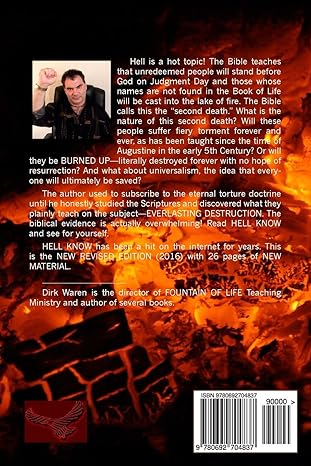
- The print book is available here for a special low price (350 pages).
- Or get the Kindle eBook for only $2.99!
Both links allow you to LOOK INSIDE the book.
Related Topics:
Hell (Human Damnation) — Questions and Answers
Hell (Lake of Fire): Eternal Torment or Everlasting Destruction?
Q&A on SHEOL / HADES, the Intermediate State of the Unsaved
Sheol / Hades: The “Intermediate State” of the Unsaved Dead
The Three Realms—Heaven, Earth and the Underworld
Eternal Life (“Heaven”): Questions & Answers
Does God Reserve All Judgment UNTIL THE END OF THE AGE?

Someone wrote me maintaining that the LORD doesn’t judge anyone during this current church age—whether non-believer, believer or nations—and cited Jesus’ Parable of the Weeds for support. Let’s read the parable in question:
Jesus told them another parable: “The kingdom of heaven is like a man who sowed good seed in his field. (25) But while everyone was sleeping, his enemy came and sowed weeds among the wheat, and went away. (26) When the wheat sprouted and formed heads, then the weeds also appeared.
(27)“The owner’s servants came to him and said, ‘Sir, didn’t you sow good seed in your field? Where then did the weeds come from?’
(28)“ ‘An enemy did this,’ he replied.
“The servants asked him, ‘Do you want us to go and pull them up?’
(29)“ ‘No,’ he answered, ‘because while you are pulling the weeds, you may uproot the wheat with them. (30) Let both grow together until the harvest. At that time I will tell the harvesters: First collect the weeds and tie them in bundles to be burned; then gather the wheat and bring it into my barn.’ ”
Matthew 13:24-30
Here’s Jesus’ explanation a few verses later:
“The one who sowed the good seed is the Son of Man. (38) The field is the world, and the good seed stands for the people of the kingdom. The weeds are the people of the evil one, (39)and the enemy who sows them is the devil. The harvest is the end of the age, and the harvesters are angels.
(40) “As the weeds are pulled up and burned in the fire, so it will be at the end of the age. (41) The Son of Man will send out his angels, and they will weed out of his kingdom everything that causes sin and all who do evil. (42)They will throw them into the blazing furnace, where there will be weeping and gnashing of teeth. (43) Then the righteous will shine like the sun in the kingdom of their Father. Whoever has ears, let them hear.”
Matthew 13:37-43
In light of this parable, the brother argued:
‘So Jesus is basically telling us that Judgment (of people and nations) is withheld until the end because to judge now would hurt the wheat (the righteous). This is a fundamental principal that Jesus proclaimed.
However, I do believe in the law of sowing & sowing and, as such, see the American Civil War as the USA reaping what it sowed with respect to the horrible sins committed through slavery.’
While he’s right about the law of sowing & reaping, he’s wrong about the LORD withholding all judgments until the end of the age. His error can be traced to three hermeneutical infractions:
1. Misapplication
He made the mistake of applying this parable to the entire world when Jesus’ very opening words reveal that he was referring specifically to the Kingdom of God, hence, the church. This is substantiated by Jesus’ explanation in verse 41:
“The Son of Man will send out his angels, and they will weed out of his kingdom everything that causes sin and all who do evil (practice lawlessness).”
Matthew 13:41
Notice Jesus says that the angels will “gather OUT OF HIS KINGDOM” and not “gather out of this world.”
Moreover, the interpretation that the parable applies to the entire world—all races, nations, religions throughout history—would render the story nonsensical. For instance, those who cause sin and do evil have been around in abundance since the time of Cain or before. The field is the world where God has planted something new, His church of “called-out ones” (i.e. genuine believers). The enemy, however, didn’t waste time in planting bad seed in the church. We observe a ready example of this counterfeit seed in the New Testament itself—the churches in Galatia where the Judaizers “bewitched” the believers with their “different gospel” (Galatians 1:6-7 & 3:1-6).

Again, the parable addresses Satan’s attempts to corrupt the church by mingling his children with God’s children, in some cases making it next to impossible to distinguish the true from the false, mostly due to the mask of religiosity; that is, putting on the outward veneer of “Christian” religion without the genuine heart of true Christianity. This is how Judas Iscariot got away with being one of Christ’s twelve disciples for three years, but he inevitably revealed his character. The Pharisees and Teachers of the Law masquerading as godly followers of Judaism are another biblical example.
So the man’s mistake is one of context since the context of the parable makes it clear that Jesus was talking exclusively about THE KINGDOM OF HEAVEN (referred to as the “kingdom of God” in the other three Gospels). We must always remember the hermeneutical rule: “Context is King.”
2. Failing to Interpret Scripture With Scripture
The man also failed to interpret Scripture with Scripture, which is another hermeneutical rule. How did he fail to apply this common-sense rule? He makes the claim that, apart from the law of sowing & reaping, God is withholding all judgment until the end of this age while ignoring several New Testament passages that clearly show otherwise. Let’s look at these passages:
1. Herod Agrippa was king in Israel from 41-44 AD. God showed Herod much patience and mercy even though he was a pompous persecutor of the church, but when he imprisoned Peter and put James to death, as shown in Acts 12:1-5, Herod’s days were numbered and he was dangerously nearing the limit of God’s tolerance (see 1 Thessalonians 2:15-16 to get my drift). When Herod arrogantly accepted praise that was only due the Most High during a political speech he was swiftly wiped off the face of the planet by “an angel of the Lord” (Acts 12:23). What can we make of this? God showed this wicked political ruler much patience and mercy, but when Herod foolishly chose to spurn God’s awesome grace, time after time, the Sovereign Lord withdrew his mercy and decisively executed stern judgment. This occurred in the New Testament era, the “age of grace.”
2. Herod’s judgment & execution was in reference to a political leader, an unbeliever, but there’s also an example of God’s judgment & execution of confessing believers, Ananias and Sapphira:
Now a man named Ananias, together with his wife Sapphira, also sold a piece of property. (2) With his wife’s full knowledge he kept back part of the money for himself, but brought the rest and put it at the apostles’ feet.
(3) Then Peter said, “Ananias, how is it that Satan has so filled your heart that you have lied to the Holy Spirit and have kept for yourself some of the money you received for the land? (4) Didn’t it belong to you before it was sold? And after it was sold, wasn’t the money at your disposal? What made you think of doing such a thing? You have not lied just to human beings but to God.”
(5) When Ananias heard this, he fell down and died. And great fear seized all who heard what had happened. (6) Then some young men came forward, wrapped up his body, and carried him out and buried him.
(7) About three hours later his wife came in, not knowing what had happened. (8) Peter asked her, “Tell me, is this the price you and Ananias got for the land?”
“Yes,” she said, “that is the price.”
(9) Peter said to her, “How could you conspire to test the Spirit of the Lord? Listen! The feet of the men who buried your husband are at the door, and they will carry you out also.”
(10) At that moment she fell down at his feet and died. Then the young men came in and, finding her dead, carried her out and buried her beside her husband. (11) Great fear seized the whole church and all who heard about these events.
Acts 5:1-11
This strict judgment for lying in the midst of the assembly of God resulted in some healthy fear in the church (verse 11). “The fear of the LORD is the beginning of knowledge and wisdom.”
Bear in mind that, as Peter pointed out in verses 3-4, Ananias and Sapphira could’ve done whatever they wanted with the money they got from selling their property. It was their money to do with as they willed. Instead, they wanted people to be wowed with how generous and self-sacrificial they were by saying they were offering the entire amount to the church.
3. Then there’s the judgment that came upon a certain group of Jews who were hindering the spread of the gospel and severely persecuting the church:
For you, brothers and sisters, became imitators of God’s churches in Judea, which are in Christ Jesus: You suffered from your own people the same things those churches suffered from the Jews (15) who killed the Lord Jesus and the prophets and also drove us out. They displease God and are hostile to everyone (16) in their effort to keep us from speaking to the Gentiles so that they may be saved. In this way they always heap up their sins to the limit. The wrath of God has come upon them at last.
1 Thessalonians 2:14-16
These particular Jews displeased God greatly because of their hostile attacks on Christians; hence, Paul says they heaped up their sins “to the limit,” resulting in God’s wrath coming upon them. This suggests that there’s a limit to the LORD’s tolerance of sin, particularly of those who hostilely attack his servants with no care of repentance. Once such people exceed this limit they naturally provoke God’s judgment—in this age. This was the case with aforementioned Herod Agrippa where Herod’s pomp and unjust acts reached the limit of God’s tolerance and thus judgment fell (Acts 12:1-5, 21-23).
This is a consistent theme in Scripture. For instance, in the pre-law era God refused to take the Amorite’s land from them and give it to Abram’s descendants until the sin of the Amorites reached its full measure (Genesis 15:16). This shows that the LORD deals with all people patiently and fairly, whatever the era. Only when the Amorite’s stubbornness and immorality reached the limit of God’s tolerance did judgment fall. Then they were vomited out of the land.
Yes, God is “kind to the ungrateful and wicked,” as Jesus pointed out (Luke 6:35), meaning he is patient and merciful, giving even the worst of sinners repeated opportunities to repent. But when it comes to those who maliciously attack his servants and who refuse to repent even though the ones they attack respond humbly in peace, blessing and prayer, there’s a limit to the LORD’s tolerance. And when God’s mercy is repeatedly spurned His judgment will ultimately fall. Christians “leave room for God’s wrath” by simply walking in love toward their persecutors, which is obedience to the law of overcoming evil with good (Romans 12:19-21). This includes tough love, by the way. Hopefully, malicious individuals will come to repentance, but—if not—God’s wrath will most certainly fall when their sins reach the limit of his merciful tolerance. This was obviously the case with the Judeans in the above passage and Herod, as well as Judas Iscariot, who was “doomed to destruction” (John 17:12).
As far as Judas goes, he was “seized with remorse” after his murderous treason to the point of giving back his blood money and admitting his sin (Matthew 27:3-5), yet this did not indicate repentance. True confession/repentance unlocks God’s forgiveness and brings inner peace. Judas clearly had no such peace and therefore hanged himself. This brings to mind Paul’s contrasting of godly sorrow and worldly sorrow: “Godly sorrow brings repentance that leads to salvation and leaves no regret, but worldly sorrow brings death” (2 Corinthians 7:10). We can conclude that Judas had reached the limit of God’s tolerance; his remorse was too little too late. His heart was hardened by the “deceitfulness of sin” and he had gone beyond the proverbial point of no return. This is a sober lesson to any who would spurn God’s patient mercy and maliciously attack God’s peaceable children with no concern to repent. Keep in mind that those who oppose the church and persecute Christians are, in effect, persecuting the Lord himself (Acts 9:5), not to mention the fact that returning evil for good is a particularly heinous transgression in God’s eyes, as shown in Proverbs 17:13. I fear for such people.
4. Severe judgment came upon a supposed prophetess and her followers at the church of Thyatira. Notice Christ’s stern judgment:
“I have this against you: You tolerate that woman Jezebel, who calls herself a prophet. By her teaching she misleads my servants into sexual immorality and the eating of food sacrificed to idols. (21) I have given her time to repent of her immorality, but she is unwilling. (22) So I will cast her on a bed of suffering, and I will make those who commit adultery with her suffer intensely, unless they repent of her ways. (23) I will strike her children dead. Then all the churches will know that I am he who searches hearts and minds, and I will repay each of you according to your deeds.”
Revelation 2:20-23
Wow, so much for the idea that Jesus Christ is some effeminate milksop. This passage sends those who regard Christ as “gentle Jesus, meek and mild” and nothing more into cardiac shock, LOL.
Despite the Lord’s strict judgment we clearly observe mercy and patience in his words: (1.) He graciously gave “Jezebel” time to repent of her immorality before stern judgment fell, but she was unwilling; and (2.) those who committed adultery with her would “suffer intensely” only if they failed to repent. (“Jezebel” was obviously not her real name, by the way, but rather a symbolic one given by the Lord).
All these biblical examples took place in the New Testament era, the “age of grace,” plainly showing that the idea that God won’t make severe judgments until the end of the age is false.
A Balanced View of God
The main reason I’m sharing this teaching is balance. Some Christians over-emphasize God’s love and mercy to the point that the Almighty’s some cuddly teddy bear in the sky, while others over-emphasize God’s judgment and wrath to the point that He’s some merciless ogre who can’t wait to obliterate humanity. To lean toward one extreme or the other is wrong because God isn’t one or the other.
Observe how a BALANCED believer like Paul acknowledged both sides of God: “Consider therefore the kindness and sternness of God: sternness to those who fell, but kindness to you, provided you continue in his kindness. Otherwise you will be cut off” (Romans 11:22). The LORD was able to use Paul so mightily because he was always BALANCED with what he taught and preached about God. He never swung to one loony extreme or the other.
A General Truth, Not an Absolute Truth
The judgment & execution of Ananias and Sapphira shows that Jesus’ parable about the weeds (or tares) reveals a general truth, not an absolute truth: It’s generally true that judgment of people within the church will wait until the Judgment Seat of Christ or White Throne Judgment, but it’s not absolutely true.*
* You can read about the Judgment Seat of Christ in 2 Corinthians 5:10-11 & Romans 14:10,12, which concerns the judgment of believers; and about the White Throne Judgment in Revelation 20:10-15, which concerns unbelievers. For more on the Judgment Seat of Christ see this article.
Even though Jesus gave instructions on how to discipline unrepentant carnal people in the church (Matthew 18:15-17), some fleshly people are able to elude this due to the mask of religiosity (i.e. legalism) or favor/kinship with church leaders or, sad to say, they may even be church leaders. Hence, their judgment will be put off until the end of the age, generally speaking, which is when Jesus said his angels “will gather OUT OF HIS KINGDOM all who offend and who practice lawlessness, and they will be cast into the furnace of fire,” i.e. the lake of fire (Matthew 13:41-42 & Revelation 20:11-15).
The reason God withholds judgment and allows the “wheat” and the “weeds” to grow together in the kingdom until the end of the age, generally speaking, is to prevent collateral damage in this “present evil age,” as the parable suggests. And also no doubt due to the LORD’s great patience and mercy. “Collateral damage” is more than just loss of lives since any severe judgment has repercussions, both positive and negative.
Why did this man who wrote me ignore all this evidence of God judging gentiles, Jews and confessing believers in the New Testament? Either because he’s unaware of these examples or because they contradict his developed theology. More likely the latter because, after sharing these examples with him, he responded: “Nothing that you have written changes my mind.” My answer: Knowingly ignoring relevant and clear passages is tantamount to cutting them out of the Bible, which is a serious offense according to God’s Word (Deuteronomy 12:32, Proverbs 30:5-6 & Revelation 22:18-19).
3. Reading Too Much Into a Parable, a Symbolic Story
The man’s third error was to read too much into a parable, which is a symbolic story of (usually) mundane things used to convey spiritual truths. For instance, the Parable of the Weeds conveys truths about the establishment of the church, the righteous in Christ (the good seed), the attempts of defilement by the devil and the damning judgment of counterfeits (the weeds) at the end of the age. A simple story of a field, seeds and wheat/weeds could never explicitly convey these truths in the absolute sense, so we naturally look for the general truths the parable conveys and then look to more literal passages in the Scriptures for greater detail.
The man holds this parable and his erroneous interpretation that it refers to the entire world throughout history and not specifically to the kingdom of God during the church age as the doctrinal standard by which the whole of Scripture must submit. As such, he ignores explicit HISTORICAL truth from the New Testament that contradicts his interpretation of truth conveyed in a SYMBOLIC story!
‘I Couldn’t Disagree More’
This was what he said in his closing statement, but whether he agreed or disagreed was irrelevant. What matters is what is true based on a balanced, unbiased and thorough study of God’s Word, which is truth, i.e. reality, the way it really is (John 17:17 & 2 Timothy 3:16). Being “unbiased” includes throwing sectarian biases out the window, whatever they may be. Why is it that this is what really matters? Because it’s only THE TRUTH that can set us free. Jesus Christ, who is the truth, plainly said so (John 14:6 & 8:31-32). Erroneous interpretations based on flawed hermeneutics cannot.
Conclusion
The idea that God withholds all judgments until the Judgment Seat of Christ or White Throne Judgment is a false doctrine. This error feeds the common view that God’s just a lovable teddy bear in the sky during the current age of grace—that He would never resort to stern judgment beyond the law of sowing and reaping. The unmistakable passages covered above show otherwise.
Related Topics:
Once Saved Always Saved? — ANSWERING THE BEST ARGUMENTS

A couple of people wrote me recently in response to my article Once Saved Always Saved? to defend the popular idea that it is impossible for believers to lose their salvation, even if they walk in sin for years or decades with no concern to repent. This doctrine is known as unconditional eternal security. Since the arguments these people shared with me pretty much represent the best defenses for this position, I’m going to devote an entire article to responding to their arguments and claims, which are cited in red italics below.
Before addressing these arguments it’s necessary to emphasize a number of things, starting with this: The Bible definitely supports the doctrine of eternal security 100%. John 10:28-29 verifies this; however, the Bible clearly does NOT support the doctrine of unconditional eternal security; and this is proven by numerous passages.
I’m very familiar with the topic and my original article wasn’t written rashly. I have zero bias on the issue and am simply going by what the Scriptures teach based on an honest and balanced study. Whatever the truth is, there can be no loopholes; all the “pieces” have to fit. If someone comes up with an argument that ignores multiple biblical passages then that position is dubious at best. Their theology is askew somehow.
I realize there are loads of believers out there who are fervent about their belief in unconditional eternal security, even stubborn; off the top of my head I can think of several people who have either written me or spoken with me seriously on the topic in an attempt to correct. In none of these cases were they able to explain clear passages where the biblical writers warn believers of the “deceptiveness of sin” and the dire consequences of an unrepentant sinful lifestyle and the ensuing falling away, such as:
- Paul (Galatians 5:19-21, 6:7-8 & Romans 11:19-24),
- Peter (2 Peter 2:20-21),
- Christ (Luke 13:1-9, 8:13 & John 15:1-6);
- The writer of Hebrews (Hebrews 10:25-27).
Please look up these passages and reflect on them in your study time; they’re unmistakable. There are several other New Testament passages that illustrate the same, but this is enough for here.
Christ said it’s the truth that will set us free as we continually pursue it, honestly and thoroughly (John 8:31-32); and I’ve been set free on this issue. I’m totally at peace and there’s no temptation for me to go into “attack mode” with people who advocate unconditional eternal security. Nor do I separate from brothers or sisters over the issue, although some might separate from me, but that’s their prerogative. My only concern is what the Scriptures say on the topic and therefore arguments rooted in emotion cannot and will not sway me. You’ll observe that a couple of the arguments below are rooted in emotion rather than what the Scriptures teach. Those who embrace unconditional eternal security have to address the pertinent passages, including the ones noted above. The fact that they won’t testifies against their doctrine.
Why Are Advocates of Unconditional Eternal Security So Fervent and Stubborn About It?
Let’s consider an important question: Why are believers fervent and stubborn on this issue? Here are a few obvious reasons that I can think of:
- Someone they love who’s a confessing believer is living in known sin.
- They themselves are living in sin and are convicted about it.
- Unconditional eternal security is what they were taught in their developing years as a Christian and they’re now rigid on the issue, regardless of the myriad clear passages that contradict what they’ve been taught. Incidentally, Christians who accept or defend doctrines for this reason are decidedly STAGE TWO because they put what their pastor/church/sect advocates above what God’s Word plainly teaches.*
*If you’re not familiar with the Four Stages of spiritual growth go here for details.
Concerning #2, I’ve seen the bad fruit of the doctrine of unconditional eternal security: It naturally cultivates a pompous attitude where believers think they can do whatever fleshly activity they want with zero concern to repent and they’ll never have to answer for it. Or, even if they think they might lose some eternal rewards, their salvation from the second death will never be revoked, even if they live a lifestyle of sin year after year, decade after decade, with zero concern to repent. Frankly, this is an arrogant attitude and God literally opposes the proud (James 4:6 & 1 Peter 5:5). I’ve come across believers who embrace this theology and, without a second thought, will rip-off people hundreds of dollars or more without blinking an eye with no intention of ever making things right.
Or how about the August, 2009, case of George Sodini who walked into a women’s aerobics class near Pittsburgh, turned out the lights, and started shooting into the darkness, firing fifty rounds. Within seconds, he killed three women and wounded nine others. Then he shot and killed himself.
It turned out that he had been planning the killings and his suicide for months in advance. The previous December, he wrote in a blog of the evangelical church he had been attending for thirteen years, saying of the pastor, “This guy teaches (and convinced me) that you can commit mass murder then still go to heaven.” Just one day before his murder spree and suicide, he wrote:
Maybe soon, I will see God and Jesus. At least that is what I was told. Eternal life does NOT depend on works. If it did, we will all be in hell. Christ paid for EVERY sin, so how can I or you be judged BY GOD for a sin when the penalty was ALREADY paid. People judge, but that does not matter. I was reading the Bible and (the book) The Integrity of God beginning yesterday, because soon I will see them.
The book he mentioned, The Integrity of God, was written by an author who advocates that believers cannot forfeit their salvation no matter how much they sin without care of repentance. Apparently the author and the murderer didn’t read Galatians 6:7-8 or Revelation 22:14-15.
This is the wicked fruit of the doctrine of unconditional eternal security. Not only will this man be held thoroughly accountable for his heinous murders, and likely cast into Gehenna (1 John 3:15 settles this), the false teachers who erroneously indoctrinated him will be held accountable as well (2 Corinthians 5:10-11 & 1 Corinthians 3:5-17). Whether or not the latter will also suffer the second death is for God to determine, not me, but it’s a definite possibility in light of 1 Corinthians 3:5-17, which concerns God’s appraisal of the works of ministers. Consider, in particular, the last two verses (which are inextricably linked to the preceding verses):
Don’t you know that you yourselves are God’s temple and that God’s Spirit dwells in your midst? If anyone destroys God’s temple [i.e. the Christian], God will destroy that person; for God’s temple is sacred, and you together are that temple.
1 Corinthians 3:16-17
This is a sobering warning for all Christians, particularly ministers. Paul makes it clear that every believer is “God’s temple;” every Christian is a sacred temple in which the Holy Spirit dwells. Verse 17 solemnly declares that God will destroy any person who destroys this temple. The context is referring to pastors and teachers who destroy Christians with their “wood, hay and straw,” which, represent unbiblical doctrine and fleshly or abusive actions. Many have used verse 17 to preach against smoking and alcohol abuse but the context is plainly referring to ministers whose teachings and actions cause people to fall away from God, in effect destroying God’s temple.
We all know what Paul’s talking about here: A supposed Christian minister whose work ultimately destroys naïve believers and, as such, his (or her) work could be categorized as “wood, hay and straw.” The pastors & teachers who misled George Sodini are an excellent example. Jim Jones is a more infamous example. There are no doubt less extreme cases in your local area.
Notice what verse 17 plainly states God will do to such a pastor or teacher whose work destroys people: “God will destroy him.” This means that God will cut the abusive, hypocritical minister off from salvation and cast him into the lake of fire where he will “destroy both soul and body” (Matthew 10:28).
Speaking of these false teachers, they were around in the first century as well. Jude said: “For certain individuals whose condemnation was written about long ago have secretly slipped in among you. They are ungodly people, who pervert the grace of our God into a license for immorality and deny Jesus Christ our only Sovereign and Lord” (Jude 1:4). Since Jude says that these false grace teachers “secretly slipped in among” the believers we know that they weren’t publicly and verbally denying the Lord, but rather denying Him through their actions and teachings, which corresponds to what Paul taught when he said “They claim to know God, but by their actions they deny him” (Titus 1:16) and Christ as well (Mark 7:6).

Answering the Best Arguments
Okay, let’s address the arguments and claims that have been thrown at me by several sincere believers loved of God:
‘I often see Galatians 5:19-21 used to show that “those who do these things will not inherit the kingdom of God” (ESV).’
But isn’t that what it says? The version of the Bible quoted is the ESV. The NIV renders verse 21 like so: “those who live like this will not inherit the kingdom of God.” The NASB is even more accurate, being a word-for-word translation: “those who practice such things will not inherit the kingdom of God.” The passage is talking about those who practice sin AS A LIFESTYLE WITHOUT CARE OF REPENTANCE. We know this because 1 John 1:8-9 shows that all genuine believers miss it, but their sins are forgiven as they confess to God; that is, repent.
‘Is it the fact that they are practicing any of the sins listed the reason that they are not inheriting the kingdom?’
Again, it’s because they are practicing works of the flesh with no concern to repent and “the wages of sin is death.” Put another way, the eventual outcome of sin, if one doesn’t turn from it, is death. This explains why John the Baptist instructed people to “produce fruit in keeping with repentance”? (Matthew & Luke 3:8).
‘Or is it the fact that they are not saved to begin with, and as a result, act the way they do?’
While there are “goats” in every congregation (i.e. counterfeits), like Judas as a member of Jesus’ 12 disciples, Paul was addressing BELIEVERS in the region of Galatia (Galatians 1:2). If Paul was addressing unbelievers masquerading as believers then he would’ve qualified his words like so: “Now for those of you who say you’re saved, but are actually unbelievers…”
‘Think about it: nobody goes to hell based on what they do or do not do’
By “hell” you’re of course referring to the lake of fire where damned souls experience the “second death” (Revelation 20:11-15). Why do people have to suffer this “second death”? Because, again, that’s what the wages of sin is – DEATH (Romans 6:23). Moreover, whether people care to admit it or not, there are conditions for receiving God’s gifts of reconciliation and eternal life: (1) REPENTANCE and (2) FAITH. Acts 20:21 verifies this, as does Christ in Mark 1:15. This explains why repentance and faith are the first two basic doctrines of Christianity (Hebrews 6:1-2).* So being cast into the lake of fire and suffering the second death has everything to do with what people do or don’t do.
*For more on the six basic doctrines go here.
‘for salvation is not by works.’
True, it’s not by works; salvation comes through accepting the message of Christ—the gospel—through REPENTANCE and FAITH, which takes humility because arrogant people refuse to admit error and turn from it (i.e. repent); moreover, their arrogance won’t allow them to submit to God’s will. This is why the Bible says three times verbatim that God RESISTS or OPPOSES the proud but gives His FAVOR to the humble (James 4:6, 1 Peter 5:5 and Proverbs 3:34).
Like others who argue that believers can live in unrepentant sin for decades and still be a genuine believer, this man quotes Ephesians 2:8-9 without balancing it out with other pertinent passages. For instance, the very next verse—verse 10—says “For we are God’s handiwork, created in Christ Jesus TO DO GOOD WORKS, which God prepared in advance for us to do.” And then, of course, there’s the long passage from James 2:14-26 where the Holy Spirit says (through James): “faith by itself, if it is not accompanied by action, is dead… As the body without the spirit is dead, so faith without deeds is dead.”
Paul added an important detail when he said that believers are to please God by “bearing fruit in every good work” (Colossians 1:10). He was obviously talking about fruit of the spirit, the main fruit being agape love (Galatians 5:22-23).
What can we conclude from this biblical data? People are saved from the wages of sin—eternal death—by accepting the gospel through humble repentance and faith, not works. However, genuine faith will produce both fruit and works whereas false faith—dead faith, mere mental assent —produces neither.
‘If anyone is going to hell it is because they have not accepted Jesus and therefore have not had eternal life imparted to their spirits.’
This is obviously true, but why do they refuse to accept Jesus Christ and receive eternal life? BECAUSE THEY REFUSE TO REPENT. They don’t want to give up this or that sin and submit to the Lord usually because they erroneously think that they will find happiness through their sin, which is impossible. This includes the sin of unbelief and the worldly acceptance that goes with it. All they’ll find is fleshly satisfaction; underneath is death.
Romans 6:23 says that “the wages of sin is death, but the gift of God is eternal life in Christ Jesus our Lord.” Notice it doesn’t say “The wages of not accepting Jesus Christ is death,” which—while absolutely true (people who reject Christ as Lord will indeed suffer the second death)—it’s not what the passage says. It’s an important point if you reflect on it.
‘The Bible says that no man shall see the Lord without holiness; but that holiness is provided by Jesus in the new birth and not by our actions.’
You’re referring to this verse:
Make every effort to live in peace with everyone and to be holy; without holiness no one will see the Lord.
Hebrews 12:14
It’s obviously referring to practical holiness and “seeing the Lord” presumably refers to having a vital day-to-day relationship.
However, it is true that holiness is provided for believers in a spiritual sense via the new birth. This can be observed in Ephesians 4:22-24, which says that our “new self (is) created to be LIKE GOD in true righteousness and holiness.” This refers to the believer’s new spiritual nature. However, believers won’t walk in the righteousness and holiness of this new nature UNLESS—as the passage says—we “PUT OFF the old self (the flesh), which is corrupted by deceitful desires and… PUT ON the new self.” So, our new spiritual nature is indeed created to be like God in true holiness, but we won’t walk in this holiness UNLESS we “put off” the flesh and “put on” the new nature. It’s talking about walking in the spirit, which is what Galatians 5:19-23 is all about.
Paul, by the Holy Spirit, is saying that believers who stubbornly refuse to put off the flesh—i.e. repent of it as necessary—and put on the new self—i.e. live out of their new nature with the help of the Holy Spirit—will be flesh-ruled rather than spirit-controlled and will therefore produce the works of the flesh on a continuing basis. The problem with this is that “those who LIVE LIKE THIS will not inherit the kingdom of God” (verse 21). Why? Because death is the wages of unrepentant sin.
To “live like this” means to walk in sin without care of penitence; that is, as an ongoing lifestyle. This is why the Bible instructs us to “keep with repentance,” meaning to humbly ’fess up when we miss it, which releases God to forgive us and cleanse us from all unrighteousness (Matthew & Luke 3:8; 1 John 1:8-9). If we stubbornly refuse to confess when we miss it—i.e. repent—then God doesn’t forgive that sin, and we’re not cleansed of the corresponding unrighteousness and unholiness.
‘Which one of us could ever act holy enough in and of ourselves to merit eternal life?’
Holiness comes through spiritual rebirth, but practical holiness comes by learning to put off the flesh and put on the new nature and thus being spirit-controlled. Only then will we bear forth the fruit of the spirit.
‘And when we start to quantify and measure holiness by our actions legalism is always the result.’
As previously noted, the believer is already holy in his or her spirit (which is the only reason the HOLY Spirit can indwell us), but we won’t walk in PRACTICAL HOLINESS unless we “keep in repentance” of the flesh and put on the new self, which is “created to be like God in true righteousness and HOLINESS.”
‘Can a Christian be carnal and still be saved? The answer is “yes.” To say otherwise violates all of the prohibitions that Paul laid out in his epistles.’
Yes, you can be a carnal Christian who practices sin as a lifestyle, but for how long? Why do you think the first word of John the Baptist’s sermon was “REPENT” (Matthew 3:2) and the same with Jesus’ first sermon (Matthew 4:17)? Why did John instruct people to “produce fruit in KEEPING WITH REPENTANCE”? Why did Paul insist that repentance was integral to receiving eternal salvation (Acts 20:21)? Why did Paul write to believers and tell them that anyone who lives in the flesh as a lifestyle with no concern of penitence will not inherit the kingdom of God (Galatians 5:19-21 & 1 Corinthians 6:9-11)? Why did Paul emphasize putting off the flesh and its deceitful desires and putting on the new nature (Ephesians 4:22-24)? Why did the apostle John encourage believers to ’fess up if they sinned and receive God’s forgiveness (1 John 1:8-9)? Why did Christ insist that a dubious prophetess and those (mostly gentile) believers who were misled by her at the church in Asia Minor repent of their immorality? See Revelation 2:20-23.
To repent, by the way, literally means “to change one’s mind” for the positive. This doesn’t mean a meaningless mental exercise, but a change of mind with the corresponding actions, like the revolve to fulfill God’s will (Acts 26:20) and turn from that which is opposed to God’s will, i.e. sin (Acts 8:22 & 2 Corinthians 12:21). Repentance and faith are two sides of the same coin (see Acts 20:21 & Mark 1:15) and so for repentance to be effective it must be combined with faith, otherwise repentance is just a dead exercise. Is it any wonder that repentance and faith are the first two of the six basic doctrines of Christianity? See Hebrews 6:1-2. It is of the utmost importance to one’s spiritual health to grasp this.
‘Why tell Christians to ‘not lie to one another’? Or to flee fornication? If it were impossible for a Christian to live habitually in these things then Paul wasted his ink.’
Obviously because “the wages of sin is DEATH.” In other words, if they practice such sins as a lifestyle with no concern to repent it would eventually cut them off from salvation altogether. First sin kills a person’s fellowship with God, then their faith, and ultimately — if they let it — their relationship (Romans 8:6-7). Why else do you think “keeping in repentance” is repeatedly stressed in the New Testament in different ways, as noted above?
‘All Christians—automatically—would repent after the first time and stop doing anything habitually. The Christian life would take care of itself—automatically.’
Spiritual growth is a process as the believer learns to be spirit-controlled rather than flesh-ruled. The confess-and-receive-forgiveness dynamic is a key factor in spiritual growth. It keeps our spiritual arteries clear of the clogging-up of unconfessed sin and keeps God’s grace (favor) flowing into our lives. The LORD’s favor flows to the humble—those who keep in repentance—whereas he opposes the arrogant—those who are too proud to confess and repent.
Let me give you a real-life example from the Bible: Remember the unrepentant fornicator from the Corinth church? Because he was stubborn and refused to repent, Paul insisted that they put him out of the church (1 Corinthians 5:1-5) and he only instructed them to receive him back when the man humbly repented (2 Corinthians 2:6-11). God’s favor flows to the humble.
It was through this “producing fruit and keeping with repentance” principle that I got freed up from certain sins. It took a while but I eventually got freed-up. This principle kept God’s favor flowing in my life DESPITE regular relapses. This is an example of struggling with sin and eventually learning to walk free, which is different than STUBBORNLY LIVING IN SIN AS A LIFESTYLE. A believer in the former situation doesn’t want to sin, but falls over and over because he’s in bondage whereas the latter individual regularly sins because he wants to sin and has no concern to repent. The latter is in danger of losing his salvation. Don’t get me wrong, God is merciful and gracious, so there is a generous “grace period,” but those who go on in their sin are foolishly mocking God (Galatians 6:7-8). Paul was talking to believers in this passage where he concluded: “Whoever sows to please their flesh, from the flesh will reap DESTRUCTION; whoever sows to please the spirit, from the spirit will reap ETERNAL LIFE.”
How long is this “generous grace period”? The Parable of the Barren Fig Tree gives an idea: Luke 13:5-9, which we’ll examine below.
‘Those who deny the once-saved-always-saved message, like yourself, are calling out those who preach this message and are warning people that this message is dangerously misleading.’
It IS dangerously misleading because it deceives believers into thinking they can live a lifestyle of sin without care of repentance and still maintain their salvation year after year, decade after decade. Moreover, it indirectly encourages believers to sin by convincing them that they’re immune to the consequences of sin, something neither Christ nor Paul nor any other biblical writer would do. In fact they did the express opposite (see Mark 9:43-47 & Romans 6:15). Needless to say, the doctrine of unconditional eternal security is a lie straight from the kingdom of darkness!
‘But in trying to correct what they see as a major problem, they introduce another major problem: salvation by grace through faith and maintained by your works of holiness.’
No, salvation is by faith, which is verified by humble repentance (Mark 1:15 & Acts 20:21), and genuine faith results in fruit and works. Our salvation is “maintained” through repentance and faith. After all, if repentance and faith are necessary to turn to God for salvation (Acts 20:21) then a person who no longer “keeps with repentance” corresponding to their faith in the message of Christ has turned away from God. It’s simple.
Again, repentance and faith are the two conditions to receiving eternal salvation (Acts 20:21) and therefore believers are required to “keep with repentance” (Matthew 3:8, Luke 3:8 & 1 John 1:8-9) and persevere in faith (Colossians 1:21-23), which explains why repentance and faith are the first two basic doctrines of Christianity (Hebrews 6:1-2). All we have to do is keep with repentance and persevere in faith and there won’t be any problem; salvation is absolutely guaranteed (John 10:27-30). Those who ignore these conditions are fools and do so to their own peril. How this is “controversial” in the modern Church is a great mystery.
‘This is a greater problem than the one detailed by those who oppose unconditional eternal security. And I most definitely am not in agreement with this viewpoint on the matter.’
It’s not a matter of what people agree with or don’t agree with; it’s a matter of what God’s Word thoroughly and clearly teaches.
‘John 5:24 proves that once people are saved it’s not possible for them to lose their salvation’
In other words, you think John 5:24 is definitive support for unconditional eternal security. Let’s read the passage and see if this is true (Jesus is speaking):
“Very truly I tell you, whoever hears my word and believes him who sent me has eternal life and will not be judged but has crossed over from death to life.”
John 5:24
Jesus was saying that genuine believers who persevere in faith will not be judged at the White Throne Judgment (Revelation 20:11-15). However, other passages clearly show that all believers must face the Judgment Seat of Christ, also known as the Bema Judgment, which is where “each of us may receive what is due us for the things done while in the body, whether good or bad” (2 Corinthians 5:10-11 & Romans 14:10). *
*See this article on the Judgment Seat of Christ.
In any case, the Messiah was not saying in John 5:24 that it’s impossible for a believer to fall away because, as already detailed, there are numerous crystal clear passages which show that genuine believers can fall away and lose their salvation if they foolishly continue in sin with no care to repent, like 2 Peter 2:20-21 and Hebrews 10:25-27; not to mention what Christ himself taught (e.g. Luke 8:13). We must always be sure to “correctly handle” God’s Word — “rightly divide” it — by being balanced and allow Scripture to interpret Scripture on any given doctrine, including this one (2 Timothy 2:15).
I realize the doctrine of unconditional eternal security is ‘hip’ in Christendom right now, particularly in the Evangelical community (especially Baptists), but as a humble minister of God I’m obligated to share the “whole counsel of God” on the topic and not teach something just because it’s currently popular. After all, I’m going to be held accountable for what I teach and I want the LORD to say “Well done good and faithful servant” and not “Why did you mislead people with unbiblical and unbalanced teachings?!”
‘John said that believers who leave the Church were never believers in the first place’
Let’s read the passage:
They went out from us, but they did not really belong to us. For if they had belonged to us, they would have remained with us; but their going showed that none of them belonged to us.
John was writing his circuit of assemblies near Ephesus in the province of Asia, which today would be western Turkey. He was saying that people who decided to leave these fellowships and stuck to their guns never really belonged to them, the body of Christ. This would include two types of people:
- Those who were checking out Christianity, but weren’t really believers and therefore never experienced spiritual rebirth and the corresponding indwelling Holy Spirit. This would include those who gave the lip service that they were Christians, but their attitude & actions didn’t reflect it (Titus 1:16).
- Those who actually believed for a period of time, but they failed to persevere in faith and thus fell away.
To explain the second category of people, the LORD said in Luke 8:13 that there will be those who “believe for a while, but in the time of testing they fall away.” Notice that Christ did not say they didn’t really believe. No, they believed for a while, but eventually fell away.
What went wrong? They didn’t add patience/perseverance to their faith, as we are instructed to do in Scripture (Hebrews 6:12; 2 Peter 1:5-9). Anyone who foolishly doesn’t add perseverance to their faith will not receive what they are believing for, including salvation. This is why Paul encouraged “continuing in faith” (Colossians 1:23).
It’s also important for believers to guard their hearts as the wellspring of life (Proverbs 4:23) in order to protect it from things entering in that will “choke the Word,” such as the anxieties of this life, the deceitfulness of wealth and the desires for other things (aka various pleasures of this earthly life). The Lord detailed this in Mark 4:19 & Luke 8:14.
We must also guard our hearts from “doctrines of demons,” such as the godless drivel that is taught at LIEberal-led colleges, which naturally saps faith. I’ve seen it happen several times: A quality believer goes off to university and comes out an atheist or, at least, an agnostic. Paul describes believers who do this as people who “abandon the faith and follow deceiving spirits and things taught by demons” (1 Timothy 4:1). You can’t “abandon the faith” if you didn’t first accept the faith. If they didn’t genuinely believe the message of Christ at some point, they wouldn’t be able to abandon that belief.
‘Salvation is a gift, not something you work for’
This is true (Ephesians 2:8-9). However, consider this: You can graciously give someone a forever gift, but the receiver still has the option of throwing it back at you… and spitting in your face.
‘If our eternity isn’t secured and completed for us, then what is the good news? If I can lose my salvation, then the gospel is NOT good news, but terrible news.’
Only terrible news for the fool who chooses to develop a “sinful, unbelieving heart that turns away from the living God” (Hebrews 3:12-13). We’ll look at this passage momentarily.
The good news is that we indeed have eternal security in Christ as we “keep with repentance” and continue in faith. As already established, repentance and faith are the conditions for accepting the gospel (Mark 1:15 & Acts 20:21), which — again — correspond to the first two of the six basic doctrines of Christianity (Hebrews 6:1-2), which you can read about here.
This explains why the Bible stresses “keeping in repentance” (Matthew 3:8, Luke 3:8 & 1 John 1:8-9) and persevering in faith, as Paul pointed out:
He has now reconciled you in His fleshly body through death, in order to present you before Him holy and blameless and beyond reproach—if indeed you continue in the faith firmly established and steadfast, and not moved away from the hope of the gospel
Colossians 1:22-23
As I conveyed in my other article on this topic: If it takes faith to be saved then it naturally follows that someone can’t be saved if they no longer have faith. The Bible teaches that it’s through faith and perseverance that we inherit what is promised, including eternal salvation, not faith for a little bit and then giving up (Hebrews 6:12 & Luke 8:13).
For anyone who argues that there are no conditions to reconciling with God through the gospel then that would mean that everyone is saved or, at least, will be saved, which is universalism, a blatantly false doctrine, proven here.
The fact that some believers fall away because they refuse to keep in repentance and continue in faith does not negate the good news of the gospel for those who obediently comply with these conditions. As long as the believer keeps in repentance and perseveres in faith their salvation is guaranteed. So what’s the problem? There is no problem unless a person is living a lifestyle of sin with no care to repent or enjoying the perks of worldly acceptance that comes with unbelief. The Holy Spirit will always convict such people and move them toward penitence; unfortunately, some will resist the Spirit’s counsel, hardening their hearts further. These types naturally tend to justify their sinful lifestyles and attack those who preach keeping with repentance.
‘I believe in a God that is the author AND finisher of my faith, and I trust Him that He would never leave my salvation in mine own hands. Now THAT is the good news!’
It’s not an issue of what you or I or anyone else personally believes, it’s a matter of what the Holy Scriptures clearly teach; and, as detailed, they teach that it’s possible for believers to forfeit their salvation due to the deceptiveness of sin and/or not continuing in faith:
See to it, brothers and sisters, that none of you has a sinful, unbelieving heart that turns away from the living God. But encourage one another daily, as long as it is called “Today,” so that none of you may be hardened by sin’s deceitfulness.
Hebrews 3:12-13
Please notice that he’s talking to “brothers and sisters” in the Lord—believers, not unbelievers—and he warns them to be careful not to develop a “sinful, unbelieving heart that turns away from the living God,” which means that it’s possible for believers to develop such a condition. Sin is deceptive. As a person walks in sin it naturally hardens their heart to God and the things of God to the point that they “turn away from the living God.” It robs them of faith. I’ve seen it happen.
Also notice that a “sinful, unbelieving heart” is the opposite of the two conditions to accepting the gospel—repentance and faith, which (again) correspond to the first two doctrines of basic Christianity.
Obviously believers do have a part to play in their salvation even though Christ is the author and finisher of our faith. If they opt for a “sinful, unbelieving heart that turns away from the living God” this is to their own folly and shame. Paul said that it’s those who persevere in faith who are counted “worthy of the kingdom” (2 Thessalonians 1:4-5) and the Lord also talked about those “who are worthy of taking part in the age to come” (Luke 20:35).
While this may contradict what false grace teachers preach, it’s in accordance with what the Bible plainly teaches.
‘Colossians 2:13 says that God “forgave ALL our sins” (past tense), which includes our future sins before we even confess them (and even if we DON’T confess them).’
This argument sounds valid on the surface; that is, until you look at other clear verses on the topic. As always, “Scripture interprets Scripture” so it’s imperative that we be balanced.
Forgiveness for all sins has been made readily available for all people via Christ’s substitutionary death and resurrection. This is the gospel and explains one of the main reasons why it’s the “good news.” Yet it’s obvious that not everyone has been forgiven by God in light of the fact that multitudes of humanity will be thrown away into the lake of fire to suffer the second death (Revelation 20:11-15). What’s the difference between these people and believers? Simple: Believers procure God’s forgiveness through the conditions of repentance and faith (Acts 20:21 & Mark 1:15), which are the first two basic doctrines of Christianity (Hebrews 6:1-2).
Since God “forgave all our sins,” as pointed out in Colossians 2:13, does that mean believers don’t have to “keep with repentance” by ‘fessing up when we inevitably miss it? No, because that would render numerous other passages superfluous, like the aforementioned Matthew & Luke 3:8 and 1 John 1:8-9. Let’s read the latter passage again:
If we claim to be without sin, we deceive ourselves and the truth is not in us. 9 If we confess our sins, he is faithful and just and will forgive us our sins and purify us from all unrighteousness.
1 John 1:8-9
When people accept the gospel through repentance and faith they appropriate forgiveness for all their past sins. But this passage clearly shows that forgiveness for future sins cannot be procured until after they are committed and confessed. After all, how can you forgive someone for an offense that he or she hasn’t even committed yet?
You see, the Scriptures teach that God deals with us according to our current condition within the context of time. To understand this obvious principle, consider what the LORD Himself said on the matter:
13 “If I tell a righteous person that they will surely live, but then they trust in their righteousness and do evil, none of the righteous things that person has done will be remembered; they will die for the evil they have done. 14 And if I say to a wicked person, ‘You will surely die,’ but they then turn away from their sin and do what is just and right— 15 if they give back what they took in pledge for a loan, return what they have stolen, follow the decrees that give life, and do no evil—that person will surely live; they will not die.” 16 None of the sins that person has committed will be remembered against them. They have done what is just and right; they will surely live.
Ezekiel 33:13-16
As you can see, God holds individuals accountable to their current condition: If a righteous man becomes arrogant and commits evil without care of repentance “none of the righteous things that person has done will be remembered.” By contrast, if a wicked man turns away from evil and does what is just and right “none of the sins that person has committed will be remembered against them.”
Someone might respond: “That’s Old Testament, brother.” But we’re talking about relationship with the God and the Lord is “the same yesterday, today and forever” (Hebrews 13:8). Besides, the same simple relational principle is taught throughout the New Testament — God deals with us according to our current state. This can be observed when the Lord insisted that a dubious prophetess & those misled by her at the (mostly Gentile) church in Thyatira repent of their immorality (Revelation 2:20-23). It is perfectly exemplified in 1 John 1:8-9 above. And the LORD expects us to do the same with others. Let’s consider a few relevant passages.
Earlier we talked about the unrepentant fornicator from the Corinthian church. Because this man was stubborn and refused to repent, Paul insisted that the believers at Corinth expel him from their assembly (1 Corinthians 5:1-5). He only instructed that the man be forgiven and received back into the fellowship when he humbly changed his mind and therefore his actions (2 Corinthians 2:6-11).
Likewise, notice what Christ said to do when a brother or sister sins against you:
“If your brother or sister sins against you, rebuke them; and if they repent, forgive them. 4 Even if they sin against you seven times in a day and seven times come back to you saying ‘I repent,’ you must forgive them.”
Luke 17:3-4
You see? The Lord instructs us to deal with fellow believers according to their current state. When they repent we are to forgive them, but not before. This is precisely how God deals with us when we sin, as detailed above, and He expects us to treat others accordingly (Ephesians 4:32 & 5:1; and Colossians 3:13). See this article for more data.
I was just reading a book where a minister supported the doctrine that a believer’s future sins are already forgiven and so we don’t really need to “keep with repentance” in order for God to forgive us when we miss it. He cited this passage for support:
“Their sins and lawless acts
I will remember no more.”Hebrews 10:17
What’s audacious about quoting this particular verse to support this false doctrine is that this chapter of the New Testament goes on to warn believers of the danger of willfully sinning without care of repentance. Notice for yourself:
26 If we [believers] deliberately keep on sinning after we have received the knowledge of the truth, no sacrifice for sins is left, 27 but only a fearful expectation of judgment and of raging fire that will consume the enemies of God.
Hebrews 10:26-27
To “deliberately keep on sinning” means to willfully sin as a lifestyle without concern of humbly ‘fessing up and procuring God’s forgiveness.
Needless to say, be quick to ‘fess up when you miss it and God will forgive you and cleanse you from all unrighteousness. If the LORD forgives you then, please, make sure you forgive yourself.
What’s so difficult about this? What’s so hard to understand about it? Nothing. It’s simple as pie: When you morally fail, be honest about it with your Lord and repent. ‘Repent’ means to change your mind for the positive. It means making a 180 when you realize you’re going the wrong way. It’s a very positive thing and facilitates closeness in your relationship with God by keeping it honest and preventing your spiritual arteries from the clog-up of unconfessed sin.
How Long Can a Believer Live in Unrepentant Sin Before They’re Cut Off From Salvation?
I want to emphasize that there’s no doubt to God’s great mercy and grace in cases where believers stray into unrepentant sin, particularly in light of Jesus’ Parable of the Vineyard, but in view of the numerous crystal clear passages cited above why risk walking on thin ice by playing around with sin? Some are deceived into thinking they can flirt with the flesh—the deceptive beast within us all—but before they know it they become captive to it. This is the “deceitfulness of sin” noted in Hebrews 3:12-13 (quoted above). Sin has the power to harden a person’s heart to the point where s/he doesn’t want anything to do with God or the things of God. Why? Because “The mind governed by the flesh is hostile to God” (Romans 8:6-7).
Now let’s address the aforementioned Parable of the Vineyard, also known as the Parable of the Barren Fig Tree:
5 “…But unless you repent, you too will all perish.”
6Then he told this parable: “A man had a fig tree growing in his vineyard, and he went to look for fruit on it but did not find any. 7So he said to the man who took care of the vineyard, ‘For three years now I’ve been coming to look for fruit on this fig tree and haven’t found any. Cut it down! Why should it use up the soil?’
8“ ‘Sir,’ the man replied, ‘leave it alone for one more year, and I’ll dig around it and fertilize it. 9If it bears fruit next year, fine! If not, then cut it down.’ ”
Luke 13:5-9
Please note Jesus’ preceding statement to giving the parable in verse 5: “unless you repent, you too will all perish.” There is a condition to not perishing—not suffering eternal death—and that condition is to repent. Christ holds people responsible for adhering to this condition. God doesn’t force anyone to repent. It’s up to the individual person. God does His part, but we are obligated to do our part. Genuine penitence, by the way isn’t just confessing past sins, but also the resolve to no longer sin and to keep with repentance when we do, as already covered.
The meaning of the parable is obvious:
- The owner of the vineyard represents God;
- the fruitless fig tree represents an individual in covenant with God who’s not bearing fruit;
- and the caretaker represents Yeshua, the mediator between the owner and the fig tree.
The owner wants to cut the fig tree down because it hasn’t produced fruit in three years, but the caretaker intercedes and convinces the owner to give the tree one more year wherein the caretaker will do everything he can to get it to be fruitful. If the tree still hasn’t produced fruit by the end of the fourth year the owner and caretaker agree to cut it down and remove it from the vineyard.
What we see here is patience, mercy and grace. The owner of the vineyard and the caretaker, who represent the heavenly Father and the Son, are willing to give the tree a total of four years to be fruitful before ultimately cutting it down, if they must. The story is figurative so we can’t take it strictly literal, i.e. that God will pluck someone out of the kingdom if they’re fruitless for exactly four years. What we can get from it, however, is that God’s patience, mercy and grace are awesome and He will do everything He can to get us to be fruitful by adhering to the conditions of our covenant, i.e. repentance & faith. He’s invested in us greatly and understandably wants us to be productive.
Another thing we can get from the parable is that when the Lord’s mercy ends His judgment begins and he’ll cut off when/if necessary. Why be foolish and incur such judgment?
Closing Word
Those who rigidly advocate the “once saved always saved” doctrine argue that, if people fall away from the Lord, they were never really saved in the first place. They contend that such people merely dabbled in Christianity and their faith was never really sincere; consequently, any positive changes in their lifestyles were superficial, the result of practicing some Scriptural principles, but not actually knowing the Lord. Surely this is true, but the numerous passages cited above and many others also show that Christians can abort their salvation if they choose to neglect their faith (here are several passages that clearly support this: Galatians 5:19-21, Hebrews 10:25-27, 2 Peter 2:20-21, Romans 11:19-24, 1 Corinthians 6:9-11, Hebrews 3:6, 3:12 & 6:4-6, James 5:19-20, Jude 1:5, Matthew 10:22, Mark 13:13, Luke 8:13 & 13:5-9 and John 15:1-6).
I repeat: If it takes faith to be saved it naturally follows that people cannot be saved if they come to a point where they no longer have faith. That’s simple enough to understand, isn’t it? Let’s not make the issue more complicated than it is.
Suffice to say, don’t play foolish games with God. You can draw whatever conclusion on the matter that gives you peace and helps you sleep at night, just be careful not to play around with “the deceitfulness of sin” or encourage others to do so either. We’re all going to stand before the Lord and give an account one day where “each of us will receive what is due us for the things done while in the body, whether good or bad” (2 Corinthians 5:10-11 & Romans 14:10).
The obvious weakness of the “once saved always saved” teaching is that it can create spiritual complacency, whereas the weakness of the opposite extreme—that believers can lose their salvation at any moment—creates anxiety. Both of these positions are extremes and unscriptural.
The sensible and balanced middle position is that a believer’s salvation is secure as one walks in faith and trusts God’s Word, avoiding both complacency and insecurity. If you miss it, be quick to ‘fess up, and God will forgive you. Then keep moving forward knowing that “The path of the righteous is like the first gleam of dawn, shining ever brighter till the full light of day” (Proverbs 4:18). Such people have eternal security in Christ (John 10:27-30). Eternal security is a biblical doctrine, but unconditional eternal security is not. “Do not be deceived” (Galatians 6:7-8).
This article is also available in book form (edited) as chapter 5–6 & 2 of…


Related Topics:
Did PAUL’S MESSAGE Contradict Jesus & James’ Gospel?
HAIR LENGTH FOR MEN – How Short or How Long?

Notice what Paul said to the Corinthians about men’s hair length:
Does not the very nature of things teach you that if a man has long hair, it is a disgrace to him,
1 Corinthians 11:14
It should be understood that men’s hair length wasn’t the main issue here, but rather women covering their head during worship. Secondly, Paul doesn’t say it’s a sin for a man to have long hair; only that it’s disgraceful—shameful—for him to have long hair. Is this an across-the-board statement for men in every culture and time period? And what did he mean by the “very nature of things,” which was his criteria for shorter hair length? In answering these questions we must throw off our personal and cultural biases and strive to “rightly divide” God’s Word, meaning properly interpret it through sound hermeneutical principles, like “Context is king” and “Scripture interprets Scripture” (2 Timothy 2:15).
As far as “nature” goes, Paul obviously wasn’t referring to the nature of the animal kingdom in light of male lions having big manes while females have none. Also, consider the male and female peacock.


Nor was Paul saying that long hair for men was against God’s nature. After all, if God considered it a shame for men to have long hair He would’ve never instituted long hair as a part of the Nazarite vow of consecration unto the LORD:
“During the entire period of their Nazirite vow, no razor may be used on their head. They must be holy until the period of their dedication to the LORD is over; they must let their hair grow long.”
Numbers 6:5
If the LORD’s very nature decreed that it was disgraceful for men to have long hair then there would be no exception. Consider the example of adultery: God’s nature decrees that adultery is a sin and hence there are no exceptions. In other words, adultery is never permitted, excusable or tolerable. If the LORD hated long hair on men due to His nature, then he would’ve hated long hair on Samson, which obviously wasn’t the case because, as a Nazarite, Samson was consecrated unto the LORD (Judges 13:5). In fact, again, Samson’s uncut hair was a sign of his separation unto God. It’s the same with John the Baptist in the New Testament, who was a Nazirite from birth (Luke 1:13–17).
While Samson is commended in the New Testament for his faith (Hebrews 11:32), the Old Testament reveals that he had some serious flesh problems, like a hot temper and a severe weakness for the ladies, to the point of visiting prostitutes (you can read the account of his life in Judges 13-16). Yet these serious flaws didn’t result in the loss of God’s anointing. It’s significant to point out that Samson only lost his anointing when his hair was cut. Moreover, a Nazarite was not supposed to come in contact with anything dead (Numbers 6:6), but Samson got honey from a lion carcass and didn’t lose God’s blessing upon doing this either (Judges 14:8-9). Again, he only lost God’s blessing after his hair was cut.
So what did Paul mean by this statement that “the very nature of things” shows that it’s shameful for a man to have long hair?
He wasn’t referring to animal nature or God’s nature, but rather to the social nature—the secular customs—of that particular time period and Corinthian culture. Elsewhere in Paul’s first letter to the Corinthian believers he instructed them to not be a “stumbling block” to others through the exercising of their rights and freedoms (1 Corinthians 8:9). His point about men’s hair length must be viewed in light of this: Paul was trying to get the believers to adhere to the social customs of their time & culture to avoid creating stumbling blocks to others, which would either hinder the spread of the gospel or cause friction in the church. You see, there are only two commands in the New Testament: love God and love people (Matthew 22:36-40). Every other instruction in the New Testament was given for the purpose of fulfilling these two laws.
Also consider the fact that some biblical commands were temporal in nature, based on temporary social situations, like Paul’s insisting that women pray with veils on (1 Corinthians 11:3-15). Women showed submission to their husbands by wearing a veil in Corinthian society. Apparently, some women in the Corinthian church were discarding their veils, which was something only idolatrous temple prostitutes or other ungodly women would do. It was considered a dishonor to the husband for a woman to come to a Christian fellowship without her veil, not to mention culturally confusing. Just the same, for a man to wear a veil or otherwise have his head covered during worship was simply not appropriate in Corinth.
What we have to understand about culture is that it doesn’t remain constant; it’s ever-changing. These kinds of “laws”—actually instructions or, in the case of Paul’s word on men’s hair length, a brief statement—were simply a means to fulfilling the two New Testament commandments—love God and love people. Whereas these two laws are permanent, other instructions and lesser points were only applicable to a particular people for a particular era in a particular place. So Paul indirectly discouraged men in ancient Corinth from having long hair in keeping with the second greatest command: To love one’s neighbor as oneself. Paul made the statement because the sight of men with long hair might have offended believers in the church and unbelievers outside the church, thus hindering the message of Christ, which isn’t true in most cultures in the modern world. Long hair is no longer tied to male prostitution or any other wicked activity, as it was in Corinth. Generally speaking, social nature no longer considers it a shame for a man to have long hair in most cultures. In cultures or sub-cultures where it is considered a shame then Christian men should conform accordingly in order to not unnecessarily offend or hinder the spread of the gospel.
Also, let’s not forget that God is more concerned with what’s going on in our hearts than our physical appearance.
We conclude that Paul wasn’t referring to animal nature or the nature of God when he said that the “very nature of things teach you that if a man has long hair, it is a disgrace to him” (1 Corinthians 11:14); rather, he was referring to the social nature of the culture of Corinth in the mid first century, which doesn’t apply to all cultures today.
A Similar Position
A similar-but-alternative view is that Paul was simply appealing to biology in order to encourage the Corinthians to live according to the cultural traditions of the area. His point was that women typically have longer hair than men and the latter are prone to baldness. In short, women have a God-given “natural veil” whereas men have a natural “uncovered head.” So Paul argued that if women reject the mark of their submission in that culture—the veil—they may as well just shave their heads (1 Corinthians 11:6).
As far as men go, Paul maintained that it is unnatural for him to have long hair because men’s hair is naturally thinner and, again, prone to balding, which he relates to men not wearing a head covering during worship in that culture. So Paul was merely encouraging the believers to comply with the standard customs of male and female appearance in Corinth.
Actually, Paul’s command for men to not wear a hat is simply (and obviously) a direct contra-Jewish position.
To explain, a Hebrew who took a Nazirite vow was instructed to have long hair as a sign of his separation unto the LORD (Numbers 6). Long hair was a sign of submission and the Nazirite was to submit to God. Similarly, a wife was to submit to her husband, which is why she has long hair within Israelite society. Jewish men have always worn a hat at worship as a sign of their submission under the Law (Torah). Jewish men even today wear a kippah at synagogue. So long hair in Hebrew society was/is a sign of submission.
Paul was saying that we are no longer under the Law (which you can read further about here). Thus we don’t need to wear a kippah to church assemblies. A man’s head should be UNCOVERED when he prays because believers are free men, coheirs with Christ (Romans 8:17). We are not children under authority, we are not slaves under a master (Galatians 3:24). Thus we need not cover our head:
A man ought not to cover his head, since he is the image and glory of God.
1 Corinthians 11:7
A slave, a child, (a messenger), is not the image and glory of God. Remember the hermeneutic rule: Context is King. The passage just before 1 Corinthians 11 where it talks about hair+hat coverings is 1 Corinthians 10, which covers the freedom of the believer.
Thus Paul’s position on men not wearing a hat to Christian assembly is simply a direct contra-Jewish teaching.

Did Christ have Long Hair?
We don’t know how long Jesus’ hair was because there are no illustrations of him from that time period and photos did not exist back then, unless you consider the Shroud of Turin a legitimate impression of Christ, which indicates long hair.
In any case, many people today obviously think Christ had long hair due to numerous historical illustrations and more recent cinematic portrayals. Is this inaccurate? We can’t be categorical on the topic since the Bible says nothing about the Messiah’s hair length. However, if Jesus looked like the average Middle Eastern man in the early 1st century, any artistic and cinematic depictions of Christ as effeminate are definitely inaccurate. For proof, see this article.
Male Jews traditionally kept much shorter hair than Hebrew women, although there were no particular laws except for those reflecting the point that men should look like men and women should look like women (e.g. Deuteronomy 22:5).
On that note, long hair on men doesn’t automatically make them effeminate. Did George Armstrong Custer or Wild Bill Hickock look remotely effeminate? How about Civil War soldiers? How about American Indian warriors?
Related Topics:
Jesus Christ — Milksop or Mighty Lord?
Comparing Jesus Christ with… Superman
Demons Vs. Jesus Christ — No Contest!
Christ: “The Anointed One” — What Does it Mean? What Does “Jesus” Mean?
The Left’s Unbalanced View of Christ & Christianity
R-Rated MOVIES — Yes or No?

Now and then you’ll come across well-intentioned preachers who sternly denounce R-rated movies (and even PG-13 and PG movies) and they’ll proceed to heap condo on those who view them. The exception, of course, is The Passion of the Christ, which shows that the issue isn’t as black and white as they put forth. It also proves that not all R-rated films are moral filth, even though they may have scenes depicting various fleshly behaviors and extreme violence.
It should be noted that these same preachers encourage their listeners to regularly read/study the Bible—God’s Word—and the more the better. With this in mind, an obvious question is raised: Are there any stories in the Bible that are heavily R-rated? Obviously. David’s lust for the bathing Bathsheba and his subsequent adultery and murder of Uriah is a prime example (2 Samuel 11). Here are some additional examples:
- Lot’s daughters’ incestuous actions (Genesis 19:30-38).
- Judah having sex with his veiled daughter-in-law who was posing as a prostitute (Genesis 38).
- Phinehas, a priest, driving a spear through both a brazenly rebellious Israelite & his Midianite woman (Numbers 25:8).
- Jael (a woman) hammering a tent peg through Sisera’s temple while he slept (Judges 4: 17-21).
- Whole cities put to the sword, including women and children (Joshua 11:11-23).
- David chopping off Goliath’s head and parading it around as a trophy (1 Samuel 17:50-57).
- Eighty-five innocent priests put to the sword at King Saul’s order, as well as the men, women, children & infants of the remote town (1 Samuel 22:6-24:22).
- The witch of Endor (1 Samuel 28:3–25).
- Joab greeting Amasa as a brother, but knifing him in the gut and disemboweling him (2 Samuel 20:9-10).
- A wicked woman thrown from a window, her body trampled by horses and devoured by dogs (2 Kings 9:30-37).
- The mass slaughter of infants (Matthew 2:16-18).
- The naked demoniac (Luke 8:26-39).
- The shocking global bloodshed in Revelation (chapters 6-19).
- The monstrous “locusts” of the Tribulation, who are as horrific as any diabolical creatures you’d see in a horror flick, or worse (Revelation 9:7-11).
I could go on, but I’ll stop there. All of these accounts are obviously R-rated. Many movies have borrowed such biblical bits, like Mario Bava’s A Bay of Blood implementing Phinehas’ spear-killing episode or The Seventh Sign featuring shocking bits from the Tribulation in Revelation, such as blood-red seas.
What about the Song of Songs? It’s a beautifully poetic book, but what is it rated? Give it a fresh read and be honest.
All this shows that God’s Word obviously doesn’t whitewash human nature but rather honestly bares it with all its potential glory or shame. The Bible isn’t the “Good Book” because it Disney-fies the human experience, but because it’s brutally honest about it and provides the God-given answers for our most important dilemmas. Of course someone could argue that these hardcore Bible stories include moral themes or lessons, but so does the R-rated 3:10 to Yuma remake, which is a story of redemption with a Christ-figure. This isn’t to suggest that I’m encouraging people to view this movie because I’m not.
If I remember correctly, there was some cussing in it, which would understandably turn-off a lot of potential Christian viewers. But don’t people cuss in real life? Heck, you’ll hear people cuss while standing in line at Dairy Queen. Is it wrong for movies to reflect real life in their stories and messages? When movies depict real-life events or like real-life events should they whitewash them or depict the truth? What’s more important to you—viewing a story the way it really is or viewing a censored version because you don’t want to hear certain words that you consider profane or see scenes you find objectionable? Or maybe you don’t mind movies conveying events the way it really is, but you don’t want certain family members to be exposed to objectionable material, like tykes.
It’s your responsibility to consider these issues, honestly seek the LORD, and make up your own mind for each possible situation. Notice what Paul instructed:
So then, each of us will give an account of ourselves to God.
(13) Therefore let us stop passing judgment on one another. Instead, make up your mind not to put any stumbling block or obstacle in the way of a brother or sister. (14) I am convinced, being fully persuaded in the Lord Jesus, that nothing is unclean in itself. But if anyone regards something as unclean, then for that person it is unclean. (15) If your brother or sister is distressed because of what you eat, you are no longer acting in love. Do not by your eating destroy someone for whom Christ died. (16) Therefore do not let what you know is good be spoken of as evil. (17) For the kingdom of God is not a matter of eating and drinking, but of righteousness, peace and joy in the Holy Spirit, (18) because anyone who serves Christ in this way is pleasing to God and receives human approval.
(19) Let us therefore make every effort to do what leads to peace and to mutual edification. (20) Do not destroy the work of God for the sake of food. All food is clean, but it is wrong for a person to eat anything that causes someone else to stumble. (21) It is better not to eat meat or drink wine or to do anything else that will cause your brother or sister to fall.
(22) So whatever you believe about these things keep between yourself and God. Blessed is the one who does not condemn himself by what he approves. (23) But whoever has doubts is condemned if they eat, because their eating is not from faith; and everything that does not come from faith is sin.
Romans 14:12-23
The main issue here was eating meat sold in the marketplace that might have been sacrificed to idols. While Paul argued that it was not wrong for a believer to do this because an idol “is nothing at all in the world,” he pointed out that not all believers have this knowledge and they therefore have “weak consciences” (1 Corinthians 8:4-8). So he instructed strong believers — i.e. mature believers — who know their rights and freedoms in Christ to be careful about the exercising of their rights around believers who have weak consciences because they would view the act in question as a sin—even though it’s not—and this would wound them, whether by provoking them to do something they think is a sin or by simply seeing a brother or sister engaging in what they perceive to be sin (1 Corinthians 8:9-13).
While the main issue in Romans 14 was eating meat sacrificed to idols, Paul related the matter to other things, like eating meat as opposed to being a vegetarian:
One person’s faith allows them to eat anything, but another, whose faith is weak, eats only vegetables. (3) The one who eats everything must not treat with contempt the one who does not, and the one who does not eat everything must not judge the one who does, for God has accepted them. (4) Who are you to judge someone else’s servant? To their own master, servants stand or fall. And they will stand, for the Lord is able to make them stand.
Romans 14:2-4
He also related the matter to those who regard certain days as special—holidays—and those who view every day as the same:
One person considers one day more sacred than another; another considers every day alike. Each of them should be fully convinced in their own mind. (6) Whoever regards one day as special does so to the Lord. Whoever eats meat does so to the Lord, for they give thanks to God; and whoever abstains does so to the Lord and gives thanks to God.
Romans 14:5-6
Paul then relates the matter to drinking alcohol and any number of issues:
It is better not to eat meat or drink wine or to do anything else that will cause your brother or sister to fall.
Romans 14:21
This would include things that exist today in our culture that didn’t exist in Paul’s culture of the 1st century or that simply weren’t an issue back then. This would include watching R-rated movies (or PG-13 or PG).
On that note, not all films are moral trash and believers should have the freedom to seek out ones that are worthwhile to them for whatever reason while adhering to the principle “Above all else, guard your heart for it is the wellspring of life” (Proverbs 4:23). In other words, make it a top priority to guard what you allow to be rooted in your heart by being careful of what your eyes see, your ears hear and the atmosphere you allow, which includes the company you keep. As the Bible says: “Bad company corrupts good character” (1 Corinthians 15:33). All these items are factors in determining what will be rooted and stored-up in your heart. Notice what the Lord said about this:
“The good man out of the good treasure of his heart brings forth what is good; and the evil man out of the evil treasure brings forth what is evil; for his mouth speaks from that which fills his heart.”
Luke 6:45
While you have rights and freedoms in Christ you must be careful to not allow bad things to get rooted in your heart because, if you do, you’ll produce accordingly. Strive to store-up good treasure in your heart. Amen?
Paul closed the matter with this thought:
So whatever you believe about these things keep between yourself and God. Blessed is the one who does not condemn himself by what he approves.
Romans 14:22
A Closing Word About Movies, Their Purpose and Place in Our Culture
For better or worse, we live in a video-oriented age and movies are an important staple in our culture. Movies are the modern-day campfire tales of centuries past. They’re a regular topic at the coffee station or vending area at work. Why? Because they entertain, amuse, inspire and mentor. Generally speaking, they provide the mythology that helps the modern world cope with reality in a fallen world.
Of course, films can also be corrupt, which is why some Christians write them off as generally ungodly garbage to be avoided. This is fine and should be respected. An alternative position is this: It’s beneficial for Christian witnesses to be in tune with their culture and locate where people are; and then meet them there. Being up on movies and other elements of pop culture will help you with this principle. Just keep in mind what the Bible says:
“All things are lawful for me,” but not all things are helpful. “All things are lawful for me,” but I will not be enslaved by anything.
1 Corinthians 6:12 (ESV)
In other words, be careful not to become shackled to the thing you’re convinced you have the freedom to practice, like viewing movies. As the proverb goes: “Everything in moderation,” meaning do nothing in excess. Too much of anything is bad. This is why I periodically fast from certain things. It could be for a day or two, a week or 40 days, but doing this prevents the thing in question from becoming an “idol.”
For more on the importance of guarding your heart see this article.
Related Topics:
Can a Certain Style of ART be Evil?
FORMS OF ART IN THE BIBLE, including Music, Visual and Performance Art
Heart – Is it “Desperately Wicked”? (It Depends)
Altars & Altar Calls and how they’re Relevant