
Should “THERE IS NO ONE WHO SEEKS GOD” Be Taken Literally?

Paul was quoting two psalm texts in this particular verse, Psalm 14:1-3 and 53:1-3. Let’s read the whole passage from Romans:
10As it is written:
“There is no one righteous, not even one;
11there is no one who understands;
there is no one who seeks God.
12All have turned away,
they have together become worthless;
there is no one who does good,
not even one.”
Romans 3:10-12
This was originally written in the time of David, almost a thousand years before Christ died for our sins and was resurrected for our justification (Romans 4:25). As such, the perfect righteousness offered to people through faith in Christ was not yet available (Romans 3:22). However, the Scriptures clearly distinguish between righteous people and unrighteous people in the pre-Christ era. Here’s an example:
7and if he rescued Lot, a righteous man, who was distressed by the depraved conduct of the lawless 8(for that righteous man, living among them day after day, was tormented in his righteous soul by the lawless deeds he saw and heard)— 9if this is so, then the Lord knows how to rescue the godly from trials and to hold the unrighteous for punishment on the day of judgment.
2 Peter 2:7-9
Lot is referred to here as a “righteous man” and “godly” despite the fact that he dubiously offered his daughters to a wicked mob for sexual purposes (Genesis 19:7-8) and, later, got so drunk that he wasn’t aware his daughters had sex with him (Genesis 19:30-38). Yet it’s clear that he hated evil in a general sense and was therefore genuinely distressed by the great transgressions of the Sodomites. Keep in mind that Abraham believed in God and it was counted to him as righteousness (Genesis 15:6; Romans 4:3), so we can assume the same for Lot. In short, one’s righteousness is linked to faith in God.
So, the statement “There is no one righteous, not even one; there is no one who understands; there is no one who seeks God” must be taken as hyperbole, which is exaggeration for effect. There are further reasons to conclude this in light of the fact that there are numerous accounts of spiritually unregenerated people seeking God & truth throughout history, including:
- Enoch (Genesis 5:24)
- Noah (Genesis 6:9; 7:1)
- Job (Job 1:8; 2:3)
- Moses (Exodus 33:11; Numbers 12:3)
- Joshua (Numbers 32:11-12)
- David (1 Samuel 13:14; 2 Samuel 22:21-22)
- Hezekiah (2 Kings 18:3)
- Josiah (2 Kings 22:2)
- Anna (Luke 2:36-38)
- John the Baptist (Matthew 11:11)
(What I mean by “spiritually unregenerated” is that they hadn’t experienced spiritual rebirth since they lived before regeneration was available to humanity, as detailed in passages like Titus 3:5).
Consider David’s words here:
4One thing I ask from the Lord,
this only do I seek:
that I may dwell in the house of the Lord
all the days of my life,
to gaze on the beauty of the Lord
and to seek him in his temple…
8My heart says of you, “Seek his face!”
Your face, Lord, I will seek.
Psalm 27:4,8
If this isn’t seeking the LORD I don’t know what is.
Additionally, there are myriad directives in the Old Testament to unregenerated people about seeking the LORD, e.g. Deuteronomy 4:29 and Isaiah 45:22, including when YHWH commissioned Jonah to preach to the Gentile Ninevites; and they genuinely repented (Jonah 3).
Then there’s the fact that Abraham expected to find at least ten righteous people in Sodom almost 800 years before the Mosaic law (Genesis 18:16-33). Not to mention, the LORD agreed to not destroy this infamous city if there were that many noble souls living in it. This of course means that there had to be righteous people in other cities that did not suffer the judgment of Sodom.
Related Topics:
How to Walk FREE OF THE FLESH by being Spirit-Controlled
Why the BREASTPLATE of Righteousness Is So Vital
Is It Wrong to REPRESS Negative Desires?
Isn’t Calling a Person a “LIVING SOUL” Redundant?

This question refers to the passage in the first book of the Bible that describes precisely how God created human beings:
And the LORD God formed man of the dust of the ground, and breathed into his nostrils the breath of life; and man became a living soul (chay nephesh).
Genesis 2:7 (KJV)
The LORD God formed the man from the dust of the ground and breathed into his nostrils the breath of life and the man became a living being (chay nephesh).
Genesis 2:7 (NIV)
In this ‘creation text’ we see here that:
- God created the human body out of “the dust of the earth,”
- breathed into it the “breath of life,” aka the spirit of life,
- and so the man became a “living soul” (KJV), which — as you can see — is translated as “living being” in the New International Version.
The Hebrew word for “soul” or “being” is nephesh (neh-FESH), which is equivalent to the Greek psuche (soo-KHAY) because when this ‘creation text’ is partially quoted in 1 Corinthians 15:45, nephesh is translated by the word psuche in the original text. The Greek psuche is incidentally where we get the English words psyche, psychology and psychiatry.
This foundational passage plainly states that human beings are living souls. So, biblically, “soul” (nephesh/psuche) in its broadest sense refers to the entire human person. I am a living soul; you are a living soul. We see this clearly in such passages as this one:
All the souls (nephesh) that came with Jacob into Egypt, which came out of his loins, besides Jacob’s sons’ wives, all the souls (nephesh) were threescore and six.
Genesis 46:26a (KJV)
“Souls” in this verse simply refers to the people who accompanied Jacob to Egypt. The New International Version translates nephesh in this text as “those” and “persons” respectively. Other examples include Joshua 10:28, Genesis 12:5 and Jeremiah 52:30.
The New Testament equivalent to nephesh is psuche, which can also refer to the whole person in certain contexts, as observed here:
In it [Noah’s ark] only a few people (psuche), eight in all, were saved…
1 Peter 3:20
So, “soul” (nephesh/psuche) in its broadest sense clearly refers to the whole person, the whole human being—spirit, mind and body. When nephesh/psuche is used in this broad sense, “being” is perhaps the best translation, which is why the NIV translators decided to render nephesh as “being” in the creation text, Genesis 2:7 (quoted at the top)—the first human was a “living being.” (For biblical details, see this article).
Of course, nephesh/psuche can exclusively refer to the mind in certain contexts (1 Chronicles 28:9, Acts 14:2) or mind & spirit (Revelation 6:9-10; Revelation 20:4). It can even refer to a dead body–a corpse–in certain contexts (Leviticus 21:11; Numbers 19:11).
All of this brings us to the question we’re tackling in this article: Isn’t saying “living soul” or “living being” redundant?
No, because God’s very Word of truth (2 Timothy 2:15; 3:16-17) defines the human being as such in the very first passage that addresses the topic of human nature, which is significant in light of the hermeneutical ‘law of first mention.’ If you’re not familiar with this interpretational guideline, it suggests that the first mention of a word or topic in Holy Scripture is vital to fully grasping the concept.
As you can see above in the quoted Genesis 2:7, “living soul” (or “living being”) is chay nephesh in the original Hebrew language; or zaó psuche in the Greek (as observed by the aforenoted 1 Corinthians 15:45). The reason the soul is said to be “living” in these verses is due to God’s spiritual breath of life. Without this divine lifeforce, the human being would be a dead soul. It’s a matter of simple logic: If there’s such a thing as a living soul, there must also be such a thing as a dead soul.
To explain, without the spiritual breath of life from God, the immaterial mind has no consciousness—no life. It’s similar to the way the body dies without physical air.
Remember, God is the “fountain of life” from which all life springs (Psalm 36:9). Hence, the animating spiritual lifeforce merely returns to the Creator who gave it when an unredeemed person dies, as observed in these two passages:
3Put not your trust in princes, nor in the son of man, in whom there is no help.
4His breath (ruwach) goeth forth, he returneth to his earth; in that very day his thoughts perish.
Psalm 146:3-4 (KJV)
6Remember him—before the silver cord is severed,
and the golden bowl is broken;
before the pitcher is shattered at the spring,
and the wheel broken at the well,
7and the dust returns to the ground it came from,
and the spirit (ruwach) returns to God who gave it.
Ecclesiastes 12:6-7
Once the spiritual “breath of life” returns to God–I’m talking about the ruwach (or neshamah)–the lifeless soul is then held in Sheol, aka Hades.
These people will later be resurrected at the Great White Throne Judgment by the same animating lifeforce, God’s breath of life (ruwach/ neshamah). They will be judged, and “Anyone whose name was not found written in the book of life” is discarded like trash in the Lake of Fire to suffer the “second death” (Revelation 20:11-15).
This “second death” entails the everlasting destruction of both soul and body, as the Lord plainly declared (Matthew 10:28; Luke 19:27; Hebrews 10:26-27). When this occurs, the spiritual breath of life, once again, merely returns to God in the same way that a person’s physical breath simply returns to the oxygen in the atmosphere upon physical decease.
Related Topics:
Q&A on HUMAN NATURE: Spirit, Mind & Flesh
HUMAN NATURE — Spirit, Mind & Body
Was Samuel RAISED FROM THE DEAD to Speak to Saul?
Sheol / Hades: The “Intermediate State” of the Unsaved Dead
The Believer’s “Intermediate State” (between Physical Death and Bodily resurrection)
Hell (Human Damnation) — Questions and Answers
Why Is This World So Messed Up?
Hermeneutics — Proper Bible Interpretation
Q&A on HUMAN NATURE: Spirit, Mind & Flesh
How Does the Bible Define a Human Being?
The simplest definition for a person—a human—is a “living soul,” which is in accordance with the hermeneutical law of first mention. In other words, what does our Creator say about human beings the first time they’re defined in Holy Scripture? Here’s what Genesis says:
And the LORD God formed man of the dust of the ground, and breathed into his nostrils the breath of life; and man became a living soul (nephesh).
Genesis 2:7 (KJV)
The LORD God formed the man from the dust of the ground and breathed into his nostrils the breath of life and the man became a living being (nephesh).
Genesis 2:7 (NIV)
As you can see, the first book of the Bible describes precisely how God created human beings: The LORD formed the human body out of “the dust of the earth,”* breathed into it “the breath of life,” and so man became a “living soul” (KJV) or “living being” (NIV). Notice the three key facets of the human being. The Bible mentions other parts of human nature, of course, like the heart, which we’ll look at as we progress for a fuller understanding.
* It’s a scientific fact that the human body is made up of the same essential chemical elements that are in the soil. Humanity did not discover this until relative recent times, but the Creator revealed it here thousands of years ago.
Isn’t the Use of “Man” for Humanity Sexist?
No, the term ‘man’ in the Bible refers to both male and female, unless the context tells otherwise, as observed here:
Then God said, “Let us make mankind in our image, in our likeness, so that they may rule over the fish in the sea and the birds in the sky, over the livestock and all the wild animals, and over all the creatures that move along the ground.”
27So God created mankind in his own image,
in the image of God he created them;
male and female he created them.
Genesis 1:26-27
The Hebrew word translated “mankind” is the same word for “man” in Genesis 2:7 (quoted in the previous section). Notice in verse 27 that ‘man’ in this generic sense refers to both male and female. That said, I regularly use ‘human’ for man, and ‘humankind’ (or ‘humanity’) for mankind, so that there’s no misunderstanding and no one’s needlessly offended.
Isn’t a ‘Soul’ the Immaterial Part of a Person?
It depends on the context. To explain, we saw in Genesis 2:7 above that nephesh (neh-FESH) is the Hebrew word for “soul.” The equivalent New Testament word is the Greek psuché (soo-KHAY), which can be observed when the creation text—Genesis 2:7—is partially quoted in 1 Corinthians 15:45 where nephesh is translated by the Greek psuche. Of course, psuche is where we get the English words psyche, psychology and psychiatry.
So, nephesh and psuche are the respective Hebrew and Greek words for ‘soul’ in the Bible.
Sometimes these words are used in reference to the whole person, such as Genesis 12:5, Jeremiah 52:30 and 1 Peter 3:20. In other words, ‘soul’ (nephesh/psuche) in its broadest sense refers to the entire person—spirit, mind and body—and not just the immaterial part of the human being. This is hidden from the English reader because most translations render nephesh & psuche as “persons” or “people” in such cases.
However, ‘soul’ can also refer to one or more of the three main parts of human nature—spirit, mind and flesh. For instance, psuche—“soul”—refers specifically to the mind in this passage:
May God himself, the God of peace, sanctify you through and through. May your whole spirit, soul and body be kept blameless at the coming of our Lord Jesus Christ.
1 Thessalonians 5:23
Nephesh & psuche also refer specifically to the mind in 1 Chronicles 28:9 and Acts 14:2 respectively.
Meanwhile nephesh refers explicitly to the body in Leviticus 21:11 and Numbers 19:11. And psuche refers specifically to the human spirit in Luke 1:46-47. In the latter case, Mary was employing synthetic parallelism. She says her “soul”— psuche—glorifies the Lord in verse 46, but specifies in verse 47 that it is her spirit that rejoices in God. Thus “soul,” a broad term for the whole human being, refers specifically to the spirit on this occasion.
Nephesh & psuche can also refer to both spirit and mind in some contexts, such as Psalm 31:9 and Revelation 6:9-10.
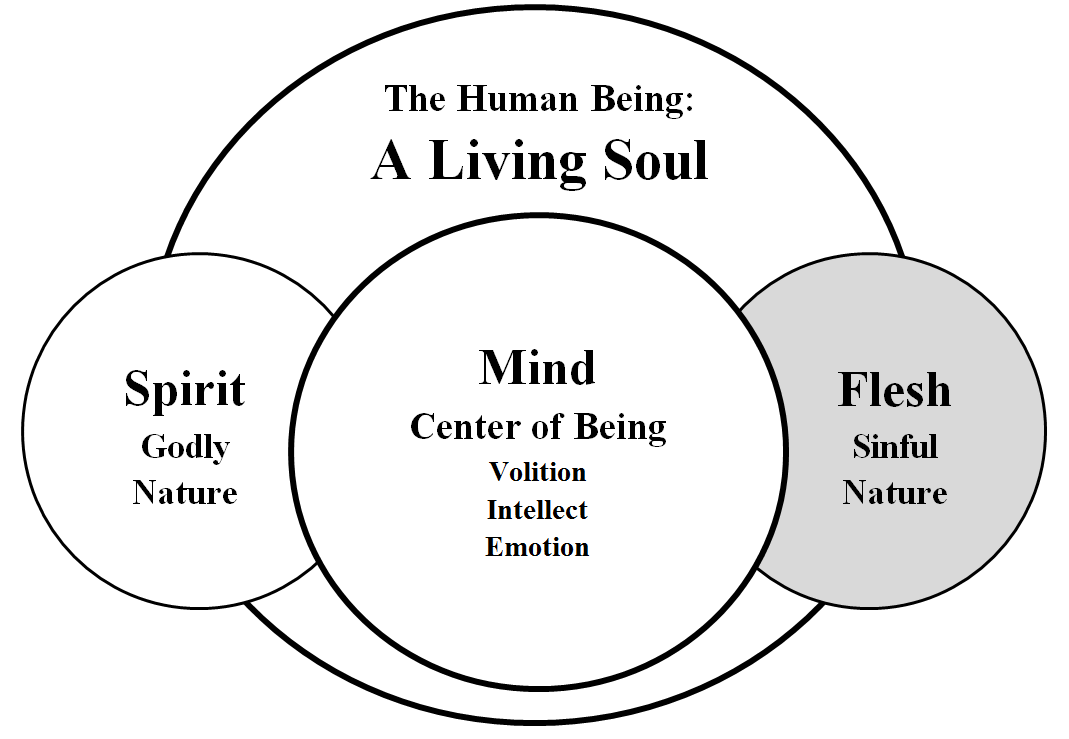
Minutia like this is tedious to most readers, but the reason it’s important is because it reveals the Bible’s definition of human beings. People are living souls comprised of spirit, mind and flesh, as illustrated here:
How Is the Mind the “Center of Being”?
First Thessalonians 5:23 (cited in the previous section) describes human nature as having three basic facets—spirit, mind and body. This can also be observed in this passage:
For I know that nothing good dwells within me, that is, in my flesh. I can will what is right, but I cannot do it. 19 For I do not do the good I want, but the evil I do not want is what I do. 20 Now if I do what I do not want, it is no longer I that do it, but sin that dwells within me.
21 So I find it to be a law that when I want to do what is good, evil lies close at hand. 22 For I delight in the law of God in my inmost self [i.e. spirit], 23 but I see in my members another law at war with the law of my mind, making me captive to the law of sin that dwells in my members.
Romans 7:18-23 (NRSV)
Paul speaks of three facets of human nature. In verse 18 he mentions his “flesh” (or “sinful nature” in the NIV) and states that “nothing good dwells within” it.
In verse 22 he mentions his “inmost self” and says that this part of his being delights in God’s law, which is a reference to his spirit.
In verse 23 he mentions his “mind” and the “war” that it is fighting. The nature of this “war” is made clearer just a few verses later (keeping in mind that Paul’s original letter to the Romans had no chapter and verse divisions; these divisions were added well over a thousand years later for convenience in scriptural study and citation):
For those who live according to the flesh set their minds on the things of the flesh, but those who live according to the spirit set their minds on the things of the spirit. 6 To set the mind on the flesh is death, but to set the mind on the spirit is life and peace.
Romans 8:5-6 (NRSV)*
* Since there is no capitalization in the biblical Greek, translators must determine if “spirit” should be capitalized, in reference to the Holy Spirit, or not capitalized, in reference to the human spirit. Many translations capitalize “spirit” in these passages and some do not (for example The New English Bible). Since these passages (and other such passages) are plainly referring to the human spirit, “spirit” should not be capitalized. A good example of this is Matthew 26:41. In a way it makes no significant difference since the believer’s reborn spirit is united with and led by the Holy Spirit (Ephesians 3:16; Romans 8:16).
These divinely inspired words reveal two truths:
- That there are three basic facets to human nature—flesh, mind and spirit.
- That the mind is caught in a struggle between the other two facets—flesh and spirit. This is the “war” Paul is talking about in verse 23.
What exactly is the mind? The mind is your center of being. The Greek for “mind” is nous (noos) meaning “The intellect, i.e. the mind (divine or human; in thought, feeling or will)” (Strong 50). This reveals the three qualities of the human mind: volition, intellect and emotion:

Since the mind is the center of volition and will, it is the mind that decides whether to live according to the flesh or according to the spirit.
What Are Flesh and Spirit?
The flesh and spirit are the opposing facets of your being. In Romans 7:18 above Paul describes the flesh as the part of his being where “nothing good dwells.” In verse 22 he describes his spirit as the side of him that delights in God’s laws. We could therefore define flesh and spirit as follows:
- The “flesh” is that part of you that veers toward what is negative, destructive and carnal.
- The “spirit” is that part of you that inclines toward what is positive, productive and godly.
These contrasting facets are repeatedly mentioned in Scripture:
“Watch and pray, lest you enter into temptation. The spirit indeed is willing, but the flesh is weak.
Matthew 26:41 & Mark 14:38 (NKJV)
I say then: Walk in the spirit, and you shall not fulfill the lust of the flesh. 17 For the flesh lusts against the spirit, and spirit against the flesh; and these are contrary to one another, so that you do not do the things that you wish.
Galatians 5:16-17 (NKJV)
It’s interesting to note that the formulator of psychoanalysis, Sigmund Freud, was able to discover these three basic facets of human nature through his research. The mind is comparable to Freud’s “ego”; likewise, the flesh coincides with his “id”; and the spirit corresponds to the “superego.” I’m obviously not an advocate of Freud, but pointing this out may help readers who are familiar with secular theories to better understand the biblical model of human nature—spirit, mind and body.
Where Does the Heart Fit Into This Model?
Many verses speak of the human “heart,” such as Mark 7:6,21. The Greek word for “heart” is kardia (kar-DEE-ah), which is where we get the English ‘cardiac.’ Like the English “heart,” kardia literally refers to the blood-pumping organ but figuratively to the core thoughts or feelings of a person’s being or mind (Strong 39). E.W. Bullinger describes the heart as “the seat and center of man’s personal life in which the distinctive character of the human manifests itself” (362). The heart could therefore be described as the core of the mind, the center of your being. It is part of the mind, but specifically the most central part, i.e. the core.
What is in a person’s heart is determined by whether your mind has decided to live by the flesh or by the spirit. Christ said, “The good man brings good things out of the good stored up in his heart, and the evil man brings evil things out of the evil stored up in his heart. For out of the overflow of the heart the mouth speaks” (Luke 6:45). If you, in your mind, decide to dwell on carnal thoughts, then carnal, negative, destructive things will naturally store-up in your heart. If, on the other hand, you choose to dwell on spiritual thoughts, then good, positive, productive things will grow in your heart. Proverbs 4:23 puts it like this (in the NCV): “Be careful what you think for your thoughts run your life.”
Here’s a visual on how the heart fits into the biblical model of human nature:
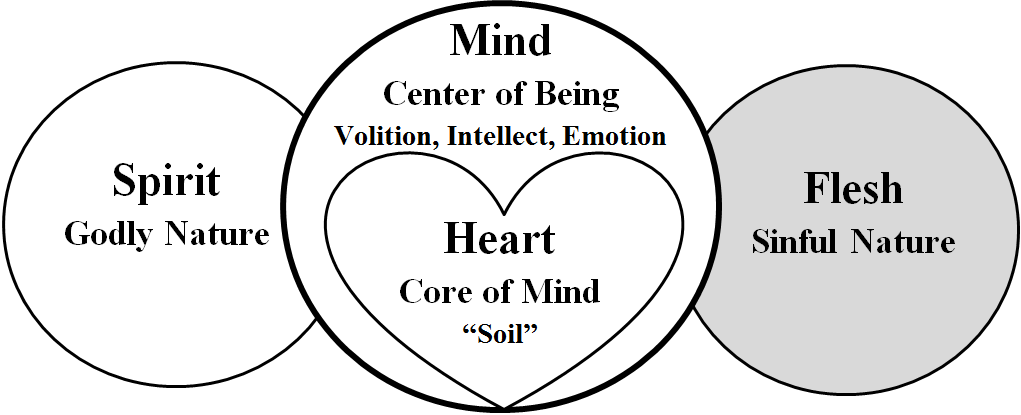
Notice that the heart is the core of your mind and is figuratively called “soil.” Why? Because the Bible likens the heart to soil (Luke 8:15). Soil in the natural realm is a neutral substance that grows whatever seed is planted in it. This is the way it is with the soil of your heart, except that it grows non-physical “seeds,” whether spiritual or unspiritual.
By “seeds” I mean thoughts, impulses, desires, images or impressions. Dwelling on these “seeds” waters them, so to speak, and thus enables them to nurture. In short, your meditation feeds them; and that is how they grow. Whatever is planted in your heart and grows there is what eventually fills your heart and produces the desires thereof. These desires of your heart then determine your character and therefore your actions, good or bad.
Has someone ever offended you and you dwelt on it so much that you made more of it than what it was? When the issue was finally resolved, you realized how you made a mountain out of a mole hill. How did this happen? Simple: You fed the offense with your thought life and thus it grew. As you kept thinking about it, the bigger the problem got. This principle goes into motion with any impulse you choose to focus on and give life to, whether it came from your spirit or the flesh.
The bottom line is that you decide what’s stored up in your heart depending on whether you’re governed by flesh or spirit.
I think it’s important to point out that carnal and crazy thoughts will at times flash through your mind; yet this doesn’t mean these thoughts are stemming from your heart. Having carnal, crazy thoughts flash through your mind is natural to the human experience; in other words, if you’re human, it happens. Sometimes you may even be bombarded with such thoughts. These thoughts may originate from the flesh, unclean spirits, ungodly people, the environment you’re exposed to, or otherwise, but just because they flash through your mind it does not mean they’re in your heart. These thoughts are not you, and are not originating from your heart; but they can become you if you allow them to get lodged in your heart by dwelling on them and giving them life.
Such thoughts should just be ignored or, if that doesn’t work, taken “captive” and made “obedient to Christ,” the Word of God (2 Corinthians 10:3-5). Otherwise, they will become a weed with the potential of growing into a big, ugly tree of destructive bad fruit (e.g. bitterness, immorality, frustration, sloth, depression, arrogance, abuse, gossip/slander, rage, etc.).
For additional insights see this video and this one.
What’s the Key to Walking Free From Sin?
The first step to freedom from the flesh is turning to the LORD in repentance & faith (Mark 1:15 & Romans 10:9-10) wherein you’ll receive spiritual regeneration (John 3:3-6 & Titus 3:5). This means you’ll acquire the spiritual hardware necessary to overcome any sin bondage, not to mention the help of the indwelling Holy Spirit (1 Corinthians 3:16).
Secondly, it’s necessary to learn how to be spirit-controlled. This just means being spirit-driven rather than flesh-ruled. In other words, your being controlled by your higher self as opposed to the lower self. To do this you simply have to learn to put off the old self and put on the new:
You were taught with regard to your former way of life, to put off your old self, which is being corrupted by its deceitful desires; 23 to be made new in the attitude of your minds; 24 and to put on the new self, created to be like God in true righteousness and holiness.
Ephesians 4:22-24
The “old self” is the flesh or sin nature and we are instructed to put it off. Why? Because the old self is corrupted by “deceitful desires.” Your flesh has desires, which means it has a ‘voice,’ but these desires are deceitful. They promise happiness but don’t deliver. They can only ultimately bring death and all that goes with it. We are told to “put off” these fleshly desires, which involves stripping off the old way of thinking in favor of a new way.
Verse 23 tells us how to do this: We need to be made new in the attitude of our minds. What is the new attitude we should have? We are to count ourselves dead to the old self and alive to God in Christ Jesus (Romans 6:11). Counting yourself alive to God includes accepting everything God says you are in Christ, that is, who you are in your new self, the spirit.
This results in what verse 24 calls “putting on the new self,” which refers to a believer living out of his/her spirit as led of the Holy Spirit. When you do this, you’ll be spirit-controlled and produce the fruit thereof. The Bible describes this in different ways. When you are spirit-controlled…
- you “live by the spirit” (Galatians 5:16),
- you “clothe yourself with the Lord Jesus Christ” (Romans 13:14),
- you “participate in the divine nature” (2 Peter 1:4), and
- you “put on the new self” (Colossians 3:10).
How can putting on the new self be described as clothing yourself with Christ or participating in the divine nature? Because the “new self” refers to your regenerated spirit, which was “created to be like God in true righteousness and holiness” (verse 24).
If there’s a true righteousness and holiness there’s also a false righteousness and holiness, which is religious legalism. True righteousness and holiness can only be attained by, first, being born-again spiritually and, second, living out of your spirit rather than the flesh. The latter is a learning process, of course, and takes time, but the more you do it, the easier it is, and the more fruit you’ll produce.
The fruits of the spirit are the fruits of God’s nature. Hence, those who live by their spirit, which is guided by the Holy Spirit, will be “like God” because the spirit naturally produces the fruits of God’s nature:
The acts of the sinful nature are obvious: sexual immorality, impurity and debauchery; 20idolatry and witchcraft; hatred, discord, jealousy, fits of rage, selfish ambition, dissensions, factions 21 and envy; drunkenness, orgies, and the like. I warn you, as I did before, that those who live like this will not inherit the kingdom of God. 22 But the fruit of the spirit is love, joy, peace, patience, kindness, goodness, faithfulness, 23 gentleness and self-control. Against such things there is no law.
Galatians 5:19-23
This list of the fruit of the spirit isn’t exhaustive any more than the list of the works of flesh is exhaustive. God has many other character traits, like righteousness (Philippians 1:11), truth (Ephesians 5:9), power (2 Timothy 1:7), righteous anger (Mark 3:1-6) and boldness (Mark 11:15-18).
The awesome news is that believers can walk free of the works of the flesh and the two ways they manifest in the Church—legalism and libertinism—simply by putting off the flesh in favor of participating in the divine nature. If this were not possible, Paul would’ve never instructed us to “be imitators of God” in Ephesians 5:1.
Christians are usually blown away by this verse. They ask, “How can I possibly imitate God?” It’s simple: Put off the flesh and learn to live out of your spirit and you’ll automatically participate in the divine nature and produce the very fruit of God’s character!
So how exactly do you walk in the spirit like this? There are three things necessary to do, all corresponding to the three parts of your nature—mind, body and spirit. These are the three keys to walking in the spirit:
- Renew your mind. Make it your mindset that you are dead to sin but alive to God in Christ Jesus. This includes making it your confession. Say: “I [state your name] am dead to sin and alive to God in Christ Jesus.” Renewing your mind effectively includes lining up your thoughts and words with who God’s Word says you already are in Christ. For instance, the Bible says that you’re dead to sin, holy, righteous and more than a conqueror in covenant with the Lord. These all describe who you are in your spirit as opposed to the flesh. You may not feel like you are these things, but you already are in your spirit. By accepting these positional truths by faith you’re being spirit-focused rather than flesh-focused. Do it.
- Offer the parts of your body to God as instruments of righteousness. This includes serving the Lord—doing what God wants you to do (both general instructions from the Scriptures and specific instructions from the Spirit)—but also praise & worship. Each of these puts into motion the law of displacement. By moving forward in the spirit, you aren’t slipping backwards in the flesh. By spending time in the light of God’s presence through regular praise & worship, darkness flees. How do you get the darkness out of a room? You simply turn on the lights!
- Pray (and sing) in the spirit regularly. This will keep you charged up and built-up in faith. It’ll produce the power you need to walk in the full life Christ came to give us (John 10:10). It’ll empower you to agape love people you don’t have warm feelings toward, including your enemies who hate you without cause. It’ll enable you to walk in tough love when necessary, including righteous radicalness, like when Paul rebuked an arrogant sorcerer and temporarily cursed him with blindness to humble him, as led of the Holy Spirit (Acts 13:8-12). It’ll provide the self-discipline necessary (2 Timothy 1:7) to overcome personal weaknesses, including lack of confidence, depression and various sin issues, like alcoholism, drugs, lying, gossip/slander and sexual lust.
Practicing these three principles is simply a matter of wisdom and love. The first and greatest command is to love God with all your heart and the second is to love people as you love yourself (Matthew 22:34-39). This is the New Covenant law of Christ or law of love (Galatians 6:2 & 1 Corinthians 9:21), which is different from the Mosaic law that believers are not under (Romans 7:6 & Galatians 5:18).
In a sense there are three commands in the law of Christ since we are commanded to love God and love others as we love ourselves, which means you have to love yourself first. I mean that in a healthy sense, of course, and not a narcissistic way. If you genuinely love yourself, you’ll put these principles into practice on a regular basis. After all, if you fail to implement them you won’t have a victorious Christian life and you won’t be intimate with God. You’ll be encumbered and limited by personal weaknesses or areas of the flesh. This will not bless you; it won’t bless those linked to you; and it won’t bless God.
Practicing these three principles is the key to walking in the spirit. It’s the key to producing the fruit of the spirit and, therefore, being spiritual rather than carnal. Simply put, it’s the key to being spirit-controlled rather than flesh-ruled. The former gives life while the latter brings death.
For additional insights see this video.
What Are “Positional Truths”?
A positional truth is a truth that reveals your position in Christ and therefore how God sees you because of this position. For instance, Colossians 1:22 declares that we are “holy in His sight, without blemish and free from accusation.” This is how God sees you because this is who you are in Christ. A good example from the Old Testament is Gideon, who viewed himself as the weakest and least, but God saw him as a “mighty warrior” (Judges 6:12-16). He had to change his thinking to fulfill his call.
Here are ten positional truths to chew on and renew your mind:
- You are holy (Colossians 1:21-22).
- You are a child of God (John 1:12-13).
- You are a new creation (2 Corinthians 5:17).
- You are the righteousness of God (2 Corinthians 5:21).
- You are dead to sin (Romans 6:11,14,18).
- You are more than a conqueror (Romans 8:37).
- You are a temple of the Holy Spirit (1 Corinthians 6:19-20).
- You are rich (2 Corinthians 8:9).
- You are healed (1 Peter 2:24).
- You are a royal priest of the Most High God (1 Peter 2:9).
For additional insights see this video.
What Does It Mean to be Created in the Image of God?
Here’s the first reference to being created in God’s image and likeness:
Then God said, “Let us make mankind in our image, in our likeness, so that they may rule over the fish in the sea and the birds in the sky, over the livestock and all the wild animals, and over all the creatures that move along the ground.”
27 So God created mankind in his own image,
in the image of God he created them;
male and female he created them.
Genesis 1:26-27
The LORD—Father, Son & Holy Spirit—decided to make humankind in ‘their’ image and likeness and then did so. The Hebrew word for “likeness” is demuth (dem-OOTH), which means likeness or similitude—that is, something that resembles another; it’s something that is a match or counterpart to another. As such, human beings resemble the Almighty; you could say that we’re God’s counterpart in the physical realm.
The Hebrew for “image” is tselem (SEH-lem), which simply means representation, copy or duplicate. For instance, the LORD instructed Moses to drive out the inhabitants of the Promised Land and “destroy all their carved images (tselem) and their cast idols” (Numbers 33:52). Also, the false god Baal was perceived as a man with the head and horns of a bull; hence, the carved images of the Canaanites depicted this—the carving (idol) was a physical image of the mental concept.
So, humankind—male and female—is the physical image of God. This shows that, while “God is spirit,” as Christ said (John 4:24), the LORD is not some amorphous cloud entity in the spiritual realm. God has a shape, similar to people, with a head, torso, arms and legs. It has been argued that God has no physical body, which is obvious, but the Creator certainly has a spiritual form or “body.” For instance, the Bible repeatedly says that the LORD sits enthroned in Heaven (Psalm 47:8, 103:19 & Isaiah 40:22). Does this refer to a shapeless cloud-being sitting on a throne in Heaven? No, the Creator has a central presence and spiritual form, parallel to the body of human beings, who were created in God’s image and likeness.
Consider Ezekiel’s awesome vision of an incredible craft in which God sits on a throne that rests on a sparkling ice-like platform propelled by four cherubim with the aid of four giant wheels within intersecting wheels:
Above the expanse over their heads was what looked like a throne of lapis lazuli, and high above on the throne was a figure like that of a man. 27 I saw that from what appeared to be his waist up he looked like glowing metal, as if full of fire, and that from there down he looked like fire; and brilliant light surrounded him. 28 Like the appearance of a rainbow in the clouds on a rainy day, so was the radiance around him.
This was the appearance of the likeness of the glory of the LORD. When I saw it, I fell facedown, and I heard the voice of one speaking.
Ezekiel 1:26-28
I realize this is a vision, but it’s describing God’s form—“the appearance of the likeness of the glory of the LORD”—which is chronicled as “a figure like that of a man.” This is how the God-breathed Scriptures describe the Creator’s appearance and it is the Scriptures that we are to use to formulate accurate doctrine; they’re the basis for correcting error (2 Timothy 3:16-17). Sure, the references to “glowing metal” from the waist up and “fire” from there down are figurative, but Ezekiel was simply using items he was familiar with to describe the indescribable—God.
Genesis 1:26 (cited above) provides further insight on what it means to be created in God’s image and likeness: It means to possess authority of some sort, like that which humankind holds over the Earth and its creatures. This explains why people have zoos for animals and not vice versa.
Being created in God’s likeness further means to possess volition, which is the power to consciously choose. It also means to distinguish good and evil. People have a conscience, an inward moral compass. Only those who harden their hearts are bereft of this sense (1 Timothy 4:2). Animals, by contrast, are instinctual and do not comprehend such concepts.
Being created in the LORD’s image moreover means having the ability to create in a sophisticated sense, like the Creator. Hence, human beings create cities, vehicles, highways, languages, literature, art, music, movies, computer systems and so on. Animals, of course, lack such aptitude.
While the same Hebrew & Greek words for ‘soul’—nephesh/psuche—are used in reference to animals (e.g. Genesis 1:20,24 and Revelation 8:9 & 16:3) and animals are animated by a “breath [spirit] of life” from the Creator (Genesis 7:15), they are not created in God’s image and therefore lack these human attributes.
For additional insights on human nature see…

- The print book is available here for only $6.49 (92 pages)
- The Kindle eBook is available here for just 99¢!
Both links allow you to “look inside” the book.
Related Topics:
SANCTIFICATION: Spirit, Mind & Body
Spirituality — How to be Spirit-Controlled Rather than Flesh-Ruled
Human Nature — Spirit, Mind & Body
Demonic Spirits — How to Deflect Them
How to Renew Your Mind (video)
Does REVELATION 14:10-11 Support Eternal Roasting Torture?

Adherents of never-ending fiery torment naturally view this passage as their ‘ace card’ on the topic:
“If anyone worships the beast and his image and receives his mark on the forehead or on the hand, 10he, too, will drink of the wine of God’s fury, which has been poured out full strength into the cup of his wrath. He will be tormented with burning sulfur in the presence of the holy angels and of the lamb [Jesus]. 11And the smoke of their torment rises forever and ever. There is no rest day or night for those who worship the beast or his image, or anyone who receives the mark of his name.”
Revelation 14:9-ll
As you can see, the text refers to impenitent people during the future seven-year Tribulation who received the mark of the beast and will be damned. Being “tormented with burning sulfur” refers to being cast into the lake of fire and suffering the “second death” (Revelation 20:11-15). Notice it says that “the smoke of their torment rises forever,” which suggests that they will be burned up, while “torment” would refer to the anguish experienced while being destroyed. This coincides with what the Holy Spirit inspired David to write in Psalm 37:20: “But the wicked shall perish… Into smoke they shall vanish away” (NKJV).
Secondly, this passage has a ‘sister text’ in the Old Testament, which uses the same terminology, but clearly refers to literal everlasting destruction and not never-ending conscious torment:
9Edom’s streams will be turned into pitch,
her dust into burning sulfur;
her land will become blazing pitch!
10It will not be quenched night or day;
its smoke will rise forever.
Isaiah 34:9-10a
This gives the impression that the kingdom of Edom will burn forever and ever without end, but the rest of the chapter renders this interpretation impossible. The remainder of the chapter shows that Edom would become a desolate desert inhabited by owls, jackals and hyenas. Verses 5-6 state that the people of Edom will be “totally destroyed” and slaughtered, and Obadiah 1:10 & 1:18 back this up, stating that Edom will “be destroyed forever”—consumed by the fire of God’s judgment and wrath.
Notice how Isaiah 34:10 plainly declares that Edom will burn and “not be quenched night and day.” This shows that the phrase “night and day” or “day or night” does not refer to an unending amount of time. The burning sulfur which destroyed Edom was not quenched “night and day” until the entire kingdom was destroyed. Likewise, the wicked people spoken of in Revelation 14:10-11 will have no rest from their torment “day or night” until the burning sulfur totally destroys them.
“Burning sulfur” is simply another name for the lake of fire (Revelation 21:8); so being “tormented with burning sulfur” is a reference to the second death. For further proof, Paul said that he worked and prayed “night and day” (1 Thessalonians 2:9; 3:10), but he did neither non-stop; and working ceased when he passed away. Acts 9:24 and Revelation 12:10 give additional support that this phrase refers to a temporary period of time.
There are other passages in the book of Revelation that use the terminology of Revelation 14:10-11, but like Isaiah 34:9-10, these passages distinctly refer to complete destruction by fire: Chapter 18 of Revelation deals with the fall of Babylon, which is the result of God’s judgment. “Babylon” refers to a city that will be the governmental center of the antichrist’s kingdom on Earth. Chapter 18 speaks of “the smoke of her burning” (verses 9 & 18) and of “her torment” (verses 10 & 15), and 19:3 says, “The smoke from her goes up forever and ever.” This terminology gives the impression that “Babylon” will be eternally tormented and burn forever and ever, but Revelation 18:8 makes it clear that “She will be consumed by fire”—completely destroyed—just as this entire present Earth will also be destroyed (2 Peter 3:10-11). Hence, the statement “the smoke from her goes up forever and ever” refers to complete and final destruction.
These passages use the terminology of smoke rising forever and coincide with God’s total destruction of Sodom & Gomorrah, which is a biblical “example of what is going to happen to the ungodly” at the second death (2 Peter 2:6). In the Genesis account of Sodom & Gomorrah’s destruction, Abraham saw “dense smoke rising from the land, like smoke from a furnace” (19:28).
So, following the hermeneutical rule that “Scripture interprets Scripture,” it’s clear that Revelation 14:10-11 refers to literal everlasting destruction and not never-ending roasting torment. Adherents of eternal conscious torture who claim that the passage is their ‘ace card’ on the topic are guilty of being superficial in their studies and not rightly-dividing the Word of Truth (2 Timothy 2:15).
For details on the nature of human damnation, see this article.
This article was edited from chapter 14 of…

- The print book is available here for only $11.99 (299 pages)
- The Kindle eBook is available here for just 99¢!
Both links allow you to “look inside” the book.
Related Topics:
HELL (Human Damnation) — Questions and Answers
RICH MAN & LAZARUS: Fantastical Parable or Literal Account?
ETERNAL LIFE (“Heaven”): Questions & Answers
HERMENEUTICS — Prober Bible Interpretation
Should MUSIC MINISTERS Be Paid?
Ideally, servant-leaders in the Church who effectively preach and teach the Holy Scriptures should be well paid (1 Corinthians 9:14; 2 Timothy 2:6). The Bible says they are “worthy of double honor” (1 Timothy 5:17) wherein the Greek word for ‘honor’ is a financial term, shown here. So, if a music minister or praise & worship leader is preaching and teaching the Word of Truth (2 Timothy 2:15; 2 Timothy 3:16) then, ideally, they should be paid.
Musicians who assist the praise & worship leader would fall under the category of “helps ministry,” meaning the ministry of deaconship. Leading in praise & worship, however, is typically not considered a deacon position, particularly if the minister is serving in teaching and preaching.
Keep in mind that the primary function of praise & worship ministry is focused on leading the congregation in praise/worship through music and additional ministry (giving a word between songs or a prophecy, etc.). As such, it’s considered a core part of the church service.
I was part of a large assembly for a decade from 1986-1996 and the praise & worship leader was a graduate of a quality Bible college. Besides leading in praise & worship, he also ministered the word on a fairly regular basis (Acts 6:1-4) and composed the majority of songs used in the praise/worship service. I’d say he deserved his pay and very much so.
Should Christian Musicians Be Paid?
It depends on if the believer is using the gift as a side-service for the LORD or if they’re a music minister in an occupational sense. If the latter, they’d have to make money serving in this manner in order to pay the bills and eat, similar to the pastor of an assembly. Payment could be on a donation basis or a set amount, either/or. Ron Kenoly is a good example. Should effective music ministers like him be paid? Obviously.
Is It Okay for Christians to Make a Living From the Arts, Including Music?
People tend to sneer at the idea of making a living from the arts, but consider the first reference in the Scriptures of art relating to human beings and even as an industry. (By ‘industry’ I mean the production of a good or service for people in the community to utilize). Here’s the first mention in Scripture:
20Adah gave birth to Jabal; he was the father of those who live in tents and raise livestock. 21His brother’s name was Jubal; he was the father of all who play stringed instruments and pipes. 22Zillah also had a son, Tubal-Cain, who forged all kinds of tools out of bronze and iron. Tubal-Cain’s sister was Naamah.
Genesis 4:20-22
As you can see, three major industries are noted at this very early stage of humanity:
- LIVESTOCK, which concerns human sustenance.
- MUSIC, which relates to art as a craft and the corresponding human appreciation or entertainment (in the positive sense).
- TOOL MANUFACTURING, which involves technology and human convenience or advancement.
Thus art — and music specifically — is noted in the same breath as two other industries vital to human existence.
Related Topics:
The Fivefold Ministry Gifts — Apostle, Prophet, Evangelist, Pastor and Teacher
OFFICIAL Prophets (Ministers) and INDEPENDENT Prophets (Ministers)
Who Should You Receive from—Official Ministers or Independent Ones?
Should Ministers Officiate Weddings and Funerals?
What Does “Women Will Be SAVED THROUGH CHILDBEARING” Mean?

Let’s read the passage:
But women will be saved through childbearing—if they continue in faith, love and holiness with propriety.
More literally, women will be saved through the childbearing, a reference to the incarnation of Christ — the birth of Yeshua into this world. Recall what the LORD prophesied over satan during the Genesis curse:
And I will put enmity
between you [satan] and the woman,
and between your offspring and hers [Christ];
he [Christ] will crush your head,
and you will strike his heel.”
The mighty Messiah crushed satan’s head through his birth, death and resurrection. As it is written: “The reason the Son of God appeared was to destroy the devil’s work” (1 John 3:8).
This is the obvious translation of the verse since the idea that women are saved through merely bearing children doesn’t even make sense. What about they myriad believing women who don’t have children for one reason or another? Not to mention, the idea that women are saved through the act of childbearing would mean that salvation is attained through works, which doesn’t mesh with the fact that the Scriptures plainly teach we are saved by God’s graciousness through faith in Christ, not by works, although genuine faith always results in works (Ephesians 2:8-9 & James 2:14-26).
Paul’s additional statement that women will be saved through the childbearing of Christ “if they continue in faith, love and holiness with propriety” merely points to the necessity of persevering in faith, which he stressed elsewhere to all believers, not just women (Colossians 1:22-23 & 1 Corinthians 15:2). After all, if it takes faith to be saved, it naturally follows that someone cannot be saved if they come to a point where they no longer believe due to neglecting the feeding of their faith. See this article for details.
Related Topics:
Did PAUL’S MESSAGE Contradict Jesus & James’ Gospel?
Women of the Bible / Women in Ministry
Why Were WITCHES / SORCERERS Executed According to the Mosaic Law?
Once Saved Always Saved? — Answering the Best Arguments
Is It Wrong to REPRESS Negative Desires?
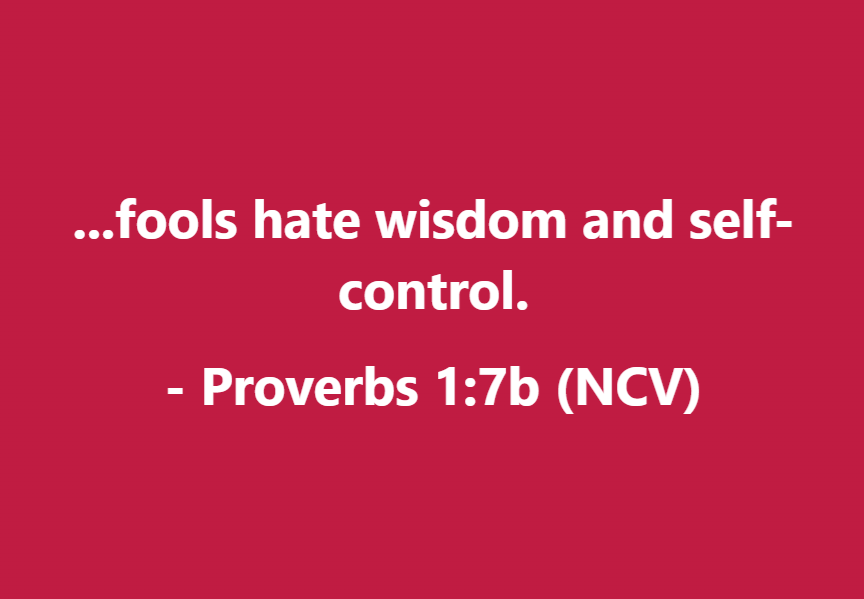
Libertines are hedonists who embrace the “if it feels good, do it” philosophy. I bring them up because you’ll occasionally come across people who mock “repressive values.” My immediate response is: As opposed to what — hedonistic non-values?
The core question here is this: Is repressing a desire inherently wrong? Is it unhealthy?
To answer, let’s start with the definition of ‘repress’…
To ‘repress’ means to restrain. Pertaining to our topic, it means to prevent oneself from giving way to a strong urge or emotion, presumably a destructive one. For instance, eleven years ago my wife’s boss (at the time) tried to kiss her on the lips at work. She instinctively backed away from him while flashing the sign of the cross, saying, “Woman of God here; woman of God!” Although he was supposedly a Christian teacher, he was upset about her reaction and forced her out of the company by the end of the summer. When Carol told me what happened, I naturally wanted to march into that office and wring the guy’s neck, literally. Good thing I repressed that desire or he’d be dead or seriously injured and I’d be in prison.
Anytime someone argues against “repressive values” — restraining an unwholesome emotion or impulse — they’re basically advocating hedonism or licentiousness. But this is folly since any spiritual or philosophical belief system of actual value includes the idea of self-discipline. After all, just because a thought/desire occurs to you or me, it doesn’t mean it should be ‘fed’ and acted on. For instance, I like vanilla ice cream. If the thought occurs to me to eat a whole gallon of ice cream every day, this doesn’t automatically mean I should submit to that desire and practice it (even under the argument that “I was born that way”). If I did, I’d eventually become overweight and it would be destructive to my health and standard of living. If I refuse to cave-in to that desire, would it mean I’m “repressed”? If so, then repression in this case is obviously a positive thing.
This principle can be applied to any thought/desire, including sexual ones. For example, say a seasoned adult man finds a shapely 14-15 years-old girl alluring and thoughts of sexual desire flash through his mind (this happens every day, all over the world). Should he feed those thoughts and, ultimately, act on them? Of course not. It would lead to a prison sentence and, when he got out, he’d have to register as a sexual predator. His reputation would be destroyed in the community as a “pedo” (even though, in this case, he’d more accurately be guilty of hebephilia or ephebophilia, not pedophilia, the latter of which concerns prepubescent children). If the guy was married or had kids, his actions could very likely destroy his family.
So, obviously, repressing unwholesome impulses is a healthy thing, not unhealthy.
This explains why genuine Christianity plainly teaches:
5Put to death, therefore, whatever belongs to your earthly nature: sexual immorality, impurity, lust, evil desires and greed, which is idolatry. 6Because of these, the wrath of God is coming.7You used to walk in these ways, in the life you once lived. 8But now you must also rid yourselves of all such things as these: anger, rage, malice, slander, and filthy language from your lips. 9Do not lie to each other, since you have taken off your old self with its practices 10and have put on the new self, which is being renewed in knowledge in the image of its Creator.
Colossians 3:5-10
12Therefore do not let sin reign in your mortal body so that you obey its evil desires. 13Do not offer any part of yourself to sin as an instrument of wickedness, but rather offer yourselves to God as those who have been brought from death to life; and offer every part of yourself to him as an instrument of righteousness. 14For sin shall no longer be your master, because you are not under the law, but under grace.
Romans 6:12-14
3But among you there must not be even a hint of sexual immorality, or of any kind of impurity, or of greed, because these are improper for God’s holy people. 4Nor should there be obscenity, foolish talk or coarse joking, which are out of place, but rather thanksgiving. 5For of this you can be sure: No immoral, impure or greedy person—such a person is an idolater—has any inheritance in the kingdom of Christ and of God. a 6Let no one deceive you with empty words, for because of such things God’s wrath comes on those who are disobedient. 7Therefore do not be partners with them.
Ephesians 5:3-6
9Or do you not know that wrongdoers will not inherit the kingdom of God? Do not be deceived: Neither the sexually immoral nor idolaters nor adulterers nor men who have sex with men a 10nor thieves nor the greedy nor drunkards nor slanderers nor swindlers will inherit the kingdom of God. 11And that is what some of you were. But you were washed, you were sanctified, you were justified in the name of the Lord Jesus Christ and by the Spirit of our God.
1 Corinthians 6:9-11
Clearly, the Word of Truth (2 Timothy 2:15 & 3:16) teaches us to not flirt with negative emotions or desires by feeding them with our thought life and eventually acting on them. No, we’re to put them off…
6Seek the Lord while he may be found;
call on him while he is near.
7Let the wicked forsake their ways
and the unrighteous their thoughts.
Let them turn to the Lord, and he will have mercy on them,
and to our God, for he will freely pardon.
8“For my thoughts are not your thoughts,
neither are your ways my ways,”
declares the Lord.
Isaiah 55:6-8
As always, turning to God is the answer to any flesh issue or temptation…
13Let us behave decently, as in the daytime, not in carousing and drunkenness, not in sexual immorality and debauchery, not in dissension and jealousy. 14Rather, clothe yourselves with the Lord Jesus Christ, and do not think about how to gratify the desires of the flesh. c
Romans 13:13-14
But what does it mean to “clothe yourself with the Lord Jesus Christ”? This is a figurative reference to walking in the spirit:
So I say, walk by the Spirit, and you will not gratify the desires of the flesh.
Walking in the spirit and thus being spirit-controlled is the answer to the bondage of being flesh-ruled. See this article for details or this video.
Related Topics:
How to Walk FREE OF THE FLESH by being Spirit-Controlled
How to TAKE CAPTIVE Thoughts (Noémas—Mindsets, Ideologies)
Demonic Spirits — How to Deflect Them
The Seven Keys to SPIRITUAL GROWTH
Understanding Christ’s LORDSHIP in the Believer’s Life
What Are THE BASICS of Christianity?
“Do Not Touch My ANOINTED ONES; Do My PROPHETS No Harm”

We’ve all heard this verse, but how do we properly interpret it? Who are God’s “anointed ones”? To answer, let’s go to the passage, which appears twice in Scripture verbatim:
“Do not touch my anointed ones;
do my prophets no harm.”
“Do not touch my anointed ones;
do my prophets no harm.”
These are examples of synonymous parallelism in Hebraic poetry wherein the first part of the verse is repeated in the second part in different words. As such, “anointed ones” and “prophets” are spoken as one-and-the-same. Both verses are contextually referring to the Israelites, God’s chosen nation in that era. So do not touch God’s people; do God’s people no harm.
Notice what the previous verse in each text says:
He allowed no one to oppress them;
for their sake he rebuked kings:
This reveals the core message of our text: Don’t unjustly persecute God’s people or it will draw the wrath of the Almighty. Does this only apply to the Hebrews under the Old Covenant or does it also apply to God’s people today, those under the New Covenant? It does apply to God’s people today because…
- All genuine believers are “a chosen people, a royal priesthood, a holy nation, God’s special possession, that you may declare the praises of him who called you out of darkness into his wonderful light” (1 Peter 2:9).
- All the promises God made to the Israelites are ‘yes’ for those in Christ? (2 Corinthians 1:20).
We’ll look at this further in a moment. First, let’s return to our main text…
“Do not touch my anointed ones;
do my prophets no harm.”
So, “my anointed ones” and “my prophets” are synonymous concepts in this text. Yet there’s an obvious distinction: All believing Hebrews could be classified as “anointed ones” (see the difference between believing Israelites and unbelieving Israelites in this article). But not all Hebrews were prophets in the technical sense, that is, inspired people who were called to speak for the LORD to the people (the word is nabi in the Hebrew and prophétés in the Greek). ‘Prophets’ would only apply to all believing Israelites in a generic sense, that is, people who (are supposed to) represent the LORD and therefore speak for the Almighty.
In a more technical sense, “prophet” here would refer to to Old Covenant prophets; the genuine ones, of course, not false prophets.
Old Covenant Prophets
During the Old Covenant era, a genuine prophet or prophetess spoke for God. In light of this, what a prophet said was equal to the Word of the LORD and kings made extremely important decisions at their word, like going to war. The primary purpose of the Old Testament prophet was to lead and guide Israel through the spoken Word of the LORD and, in fact, a lot of their words became Holy Scripture and are included in what we know today as the Old Testament, such as the books featured from Isaiah to Malachi.
For this reason, the words of a prophet had to be 100% accurate. If their words were proven to be false, they were to no longer be regarded as prophets and were even to be executed (Deuteronomy 18:20-22). If an Old Testament prophet missed it just once, they were done (which explains the need for a more immediate application to their far-flung prophecies, explained here). This, of course, didn’t happen in cases where the king and other leaders were corrupt and actually wanted false prophets to comfort them with lies, which occurred all too often in Israel and Judah. A good example is the 400 false prophets of King Ahab noted in 1 Kings 22:5-9.
The Messiah — “The Anointed One” — Was the Last Old Testament Prophet
Jesus Christ was the last person to operate in the anointing of an Old Testament prophet (Hebrews 1:1-2) and, in fact, he was The Prophet, which the Hebrews had anticipated for almost 1500 years (Deuteronomy 18:15; John 6:14 & 7:40). For those not in the know, ‘the Christ’ and ‘the Messiah’ both mean “the Anointed One” (they are Christos in the Greek and Mashiyach in Hebrew).
New Covenant Believers Are “Chips Off the Ol’ Block” of The Anointed One
Genuine Christ-ians (Acts 11:26) are born of the seed of the Christ — the Anointed One — as observed in 1 John 3:9 and 1 Peter 1:23 (‘seed’ is sperma in the first passage, which is the Greek word for sperm). As such, New Covenant believers are little anointed ones or the spiritual offspring of the Anointed One; who (super)naturally have the same spirit.
In light of this, in the New Testament era, Psalm 105:15 & 1 Chronicles 16:22 (our main text, at the top) could apply to any genuine believer who’s walking in the spirit and producing the fruit thereof, as opposed to works of the flesh (Galatians 5:19-23). I distinguish this because any ‘believer’ who’s walking in the flesh and producing works of the flesh on a regular basis with no care of repentance (1 John 1:8-9) would certainly not be God’s “anointed one.” As the Lord plainly said, “By their fruit you will recognize them,” aka false prophets, that is, false people who (supposedly) speak for God (Matthew 7:15-23). As Paul put it, “They claim to know God, but by their actions they deny him” (Titus 1:16).
For instance, if there’s a Christian brother or sister who habitually engages in hateful gossip & slander, including (or especially) concerning blameless brothers & sisters in the LORD and even fivefold ministers (Ephesians 4:11-13), this exposes them as false believers. Keep in mind that ‘devil’ — diabolos in the Greek — literally means “slanderer” or “accuser” (Revelation 12:10). In other words, such false believers are acting like their father, the devil.
To elaborate, the New Testament plainly says that all genuine believers “have an anointing from the Holy One” (1 John 2:20). Those who are humble and come near to God, as observed in James 4:6 & 4:8, would be closer to the LORD and consequently have more favor — grace — compared to arrogant, carnal ones who are distant from the Almighty (Psalm 138:6).
To bring this home: If you’re a New Covenant believer who’s walking in the spirit as opposed to the flesh, and “keeping with repentance” when you miss it (Matthew 3:8 & Luke 3:8), you are an anointed one of God, called to speak for the Almighty as an ambassador of Christ (2 Corinthians 5:20; 1 Peter 4:11). And the LORD has your back based on the promise of our main text.
Related Topics:
What Are THE BASICS of Christianity?
Christ: “The Anointed One” — What Does it Mean? What Does “Jesus” Mean?
Distinguishing ATHEISTS, AGNOSTICS and BELIEVERS

People can be grouped into three general categories when it comes to the topic of God:
- Those who embrace atheism.
- Those who claim agnosticism.
- Those who believe in an Intelligent Creator of all things.
Let’s look at all three, as well as consider the individuals who crossover to one degree or another:
Atheists
An atheist is a person who believes there is no God, aka intelligent Creator of the Earth, Universe and all living things. The Bible flat out calls such people “fools” (Psalm 14:1 & 53:1), which is the Hebrew word nabal, meaning a stupid, senseless or wicked person.
Why would the Holy Scriptures brazenly call atheists fools, especially seeing as how a lot of really smart people are atheists, such as professors at universities? However bright and educated they might be, the Bible calls them fools because belief in God is simply a part of human make-up; it’s in our spiritual DNA. Creation itself inspires belief in a Creator and basically screams out God’s existence, as observed in these passages:
1The heavens declare the glory of God;
the skies proclaim the work of his hands.
2Day after day they pour forth speech;
night after night they reveal knowledge.
3They have no speech, they use no words;
no sound is heard from them.
4Yet their voice b goes out into all the earth,
their words to the ends of the world.
In the heavens God has pitched a tent for the sun.
Psalm 19:1-4
18The wrath of God is being revealed from heaven against all the godlessness and wickedness of people, who suppress the truth by their wickedness, 19since what may be known about God is plain to them, because God has made it plain to them. 20For since the creation of the world God’s invisible qualities—his eternal power and divine nature—have been clearly seen, being understood from what has been made, so that people are without excuse.
Romans 1:18-20
So, belief in an Intelligent Creator comes natural to people born into this messed up world and is expected in light of the glaring evidence. They basically have to be “talked out of it” to become an atheist, which is what atheistic professors love to do in our secular universities (You can learn about this here).
But, please understand, that the LORD has compassion — sympathetic understanding — concerning our plight in this fallen world. In other words, God knows how godless our societies are and how we are brainwashed in many cases to not believe, sometimes from childhood. As it is written: “The LORD is good to all; he has compassion on all he has made” (Psalm 145:9).
Elsewhere, Christ said, “Everything is possible for one who believes” (Mark 9:23) to which the father of an ill son exclaimed: “I do believe; help me overcome my unbelief!” (9:24). This reveals that doubt can coexist with belief and that seeking God for help in overcoming unbelief is a valid action.
Agnostics
The Greek word for ‘agnostic’ is agnostos (ag-NOHS-toss), which means “unknown or unknowable.” So, an agnostic is someone who admits to not knowing the nature of ultimate reality. In short, they claim ignorance on the topic — they don’t know if there is a God or not; and, even if there is, this Creator is apparently unknowable. If you remember Ozzy Osbourne’s song from the early 80s “I don’t Know,” that’s what he was saying.
Agnostics are a step up from atheists because they’re not arrogant enough to insist that there is no God or an intelligent design behind creation. This takes humility, which is good because humility attracts God’s favor (James 4:6, 1 Peter 5:5 & Proverbs 3:34).
Before I turned to the LORD at the age of 20, I was an agnostic. I simply didn’t know what the truth was concerning ultimate reality and refused to arrogantly say “There is no God.”
It should be pointed out that there is sometimes a fine line between atheism and agnosticism. For instance, someone may technically be an agnostic, but be an atheist in attitude and practice.
Believers
The Greek word for ‘believer’ is pisteuó (pist-YOO-oh), which naturally means “to believe, have faith or trust.” Hence believers refer to those who believe in an Almighty Creator with the ideal of having an actual agreement (covenant, contract) with the LORD.
When the New Testament speaks of believers, it’s talking about New Covenant believers, whether of Hebraic stock or Gentile. This refers to people who have accepted the Good News of the message of Christ:
…the message concerning faith that we proclaim: 9 If you declare with your mouth, “Jesus is Lord,” and believe in your heart that God raised him from the dead, you will be saved. 10 For it is with your heart that you believe and are justified, and it is with your mouth that you profess your faith and are saved.
“For God so loved the world that he gave his one and only Son, that whoever believes in him shall not perish but have eternal life.”
Whoever believes in the Son has eternal life, but whoever rejects the Son will not see life, for God’s wrath remains on them.
Whoever confesses Jesus Christ as Lord and believes in their heart will experience spiritual regeneration— that is, rebirth within (John 3:3, 3:6 & Titus 3:5).
A good verse that distinguishes between believers and unbelievers (whether atheistic or agnostic) can be observed here:
Tongues, then, are a sign, not for believers but for unbelievers; prophecy, however, is not for unbelievers but for believers.
To be expected, there are other types of believers, including semi-believers and false believers (who obviously aren’t really believers)…
Abram Believed in Pre-Judeo-Christian Circumstances
Before there was an Old Covenant that the LORD had with the Israelites and the New Covenant that God has with believers, Abram (aka Abraham) was a believer and Yahweh acknowledged it (Genesis 15:6).
Since the holy LORD only works with fallen humans through covenants, God made an agreement with Abram (Genesis 15) and Abram complied as he received additional revelation from the Great I AM (e.g. Genesis 17:9–14 & Genesis 17:23–27).
Hebrews Who Don’t Really Believe
The Israelites in the Old Testament may have all been of Hebraic stock and had a covenant with the Great I AM, but they weren’t all believers. For instance, Numbers 13-14 details how Moses sent twelve Hebrews from each tribe into the Promised Land in preparation to take it, but ten came back with a spirit of fear, discouraging the masses, while two had a spirit of faith — Joshua and Caleb — in other words, they believed and so were true believers (Numbers 14:6-9). The ten doubters were dyed-in-the-wool Hebrews, physically, but they weren’t children of Abraham in the spiritual sense because they didn’t have a spirit of faith, aka a spirit of belief. Joshua and Caleb, by contrast, were Abraham’s true offspring, not just in flesh, but in spirit as well. For more details see this article.
Proselytes
A proselyte in the Scriptures refers to a Gentile who believes in the God of Israel to the extent of undergoing circumcision (Acts 13:43).
God-Fearers
A God-fearer likewise refers to a Gentile who believes in Yahweh and therefore observes some of the Mosaic Law, but hadn’t yet submitted to circumcision. Cornelius is a good example of a God-fearer in the Scriptures (Acts 10:2).
Those “Not Far From the Kingdom of God”
This is how the Lord described a Teacher of the Law who answered a question wisely (Mark 12:34). It shows that someone may not be a believer in the message of Christ (yet), but they’re closer to salvation than others. See this article for more insights on this.
False Believers
This refers to people who say they’re believers and do things typical of believers — like go to assembly, speak Christianese, and carry a Bible — but they actually don’t believe and therefore aren’t walking with the LORD at all. Paul made several references to such bogus believers (2 Corinthians 11:13-15, 2 Corinthians 11:26 & Galatians 2:4) with this notable insight:
They claim to know God, but by their actions they deny him.
The Lord also noted false ministers (Revelation 2:2) and elaborated on the topic here:
15“Watch out for false prophets. They come to you in sheep’s clothing, but inwardly they are ferocious wolves. 16By their fruit you will recognize them. Do people pick grapes from thornbushes, or figs from thistles? 17Likewise, every good tree bears good fruit, but a bad tree bears bad fruit. 18A good tree cannot bear bad fruit, and a bad tree cannot bear good fruit. 19Every tree that does not bear good fruit is cut down and thrown into the fire. 20Thus, by their fruit you will recognize them.
21“Not everyone who says to me, ‘Lord, Lord,’ will enter the kingdom of heaven, but only the one who does the will of my Father who is in heaven. 22Many will say to me on that day, ‘Lord, Lord, did we not prophesy in your name and in your name drive out demons and in your name perform many miracles?’ 23Then I will tell them plainly, ‘I never knew you. Away from me, you evildoers!’
Matthew 7:15-23
Since people like this aren’t really believers, they’re either atheists or agnostics masquerading as believers because it’s in their best interest to do so or they’re doing it for carnal reasons. Such false believers can be recognized by their fruit — they don’t produce fruit of the spirit on a consistent basis, but rather works of the flesh (Galatians 5:19-23). For instance, a ‘brother’ who constantly engages in gossip/slander concerning blameless believers and even fivefold ministers is acting like satan (Revelation 12:10) since devil — diabolos in the Greek — literally means slanderer or accuser. Such impenitent people are guilty of the sin of false testimony!
A good example of a false prophet today would be that pro-sodomite “bishop” who spoke at President Trump’s Inaugural Prayer service, which you can see here. A real bishop, by contrast, would boldly call those who foolishly engage in sexual immorality & perversion to repentance, not play their advocate (e.g. Matthew 4:17 & Luke 13:5).
Related Topics:
The Seven Keys to SPIRITUAL GROWTH