
Is ORAL SEX Permissible?
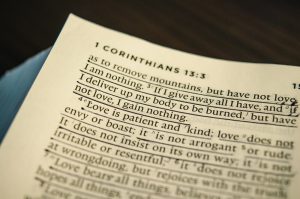
I’m addressing this tricky question because someone wrote me wanting an honest answer based on Scriptural truth. If one person is asking this question, others are too (they just prefer to remain silent because it’s a TMI sort of topic).
The Bible doesn’t specifically mention oral sex, but arguably implies it in a figurative sense; particularly in the Song of Songs, which features sensuous song lyrics filled with suggestive imagery that applauds sexuality as a normal part of marital life between a biological man and woman. Obviously sexual activity outside of the marriage covenant is not sanctioned by the LORD.
The Song of Songs is only eight short chapters so, if you’re not familiar with it, I encourage you to read it.
Here’s an example of what I’m talking about from Song of Songs with the woman speaking about her man:
3 Like an apple tree among the trees of the forest
is my beloved among the young men.
I delight to sit in his shade,
and his fruit is sweet to my taste.
4 Let him lead me to the banquet hall,
and let his banner over me be love.
5 Strengthen me with raisins,
refresh me with apples,
for I am faint with love.
6 His left arm is under my head,
and his right arm embraces me.Song of Songs 2:3-6
And here’s an example of the man speaking of his beloved:
6 How beautiful you are and how pleasing,
my love, with your delights!
7 Your stature is like that of the palm,
and your breasts like clusters of fruit.
8 I said, “I will climb the palm tree;
I will take hold of its fruit.”
May your breasts be like clusters of grapes on the vine,
the fragrance of your breath like apples,
9 and your mouth like the best wine.Song of Songs 7:6-9
Some Christians find such frank romantic sensuality in the Bible surprising, which compels some religionists to interpret the passages in a strictly symbolic sense relating to the LORD’s love for Israel or Christ’s love for his bride, the Church. While I’ve no doubt that these verses can be interpreted on such a level, it doesn’t change the fact that we must first regard them from a purely straightforward standpoint: They’re a beautiful testimony to the romantic love enjoyed by a man and wife.
So can spouses partake of oral sex with their mates or not? It’s entirely up to the individual and what they believe. If the husband & wife have no qualms, what’s it to me? If they do have qualms or simply don’t want to do it, then obviously they shouldn’t. The Bible puts it this way: “everything that does not come from faith [belief] is sin” (Romans 14:23). The Scriptures also say “To the pure, all things are pure, but to those who are corrupted and do not believe, nothing is pure” (Titus 1:15).
At the end of the day it’s a private issue between husbands & wives.
This article is also available in book form as a chapter in…


- The print book is available here for only $7.26 (171 pages)
- The Kindle eBook is available here for just 99¢!
Both links allow you to LOOK INSIDE the book.
Related Topics:
Beauty, Objectification and Lust
The Four Types of LOVE in the Bible
What IS Marriage? (and Related Topics)
Q&A on Solomon’s SONG OF SONGS
What Are the BASICS OF CHRISTIANITY?

The Bible is voluminous and so it’s easy to go into detail on many subjects, which can get complicated, especially for those who are new to Christianity or those seeking to see if Christianity provides legitimate answers to the questions of life. As such, it’s important to stress the basics now & then so people aren’t lost in doctrinal complexities and run away screaming.
The nine basics of Christianity are as follows:
1. There is a God
There are two basic options concerning how human life originated and life in general, not to mention the Earth & Universe: They’re either the result of mindless, nonliving matter or there is a Creator. Which one is more logical and scientific? The reason you can read a book or hear a song is because someone created them. The reason you can live in your abode is because someone designed it and someone built it.
The Bible teaches that everything you see and experience—living and un-living—did not just accidently manifest. There is an Intelligent Designer of all that exists. Belief in God is simply a part of the make-up of human beings; it’s in our spiritual DNA because we were made in God’s image and likeness.
The Earth & Universe and all living things inspires belief in a Creator; more than that, creation screams out God’s existence (Psalm 19:1-4 & Romans 1:18-20). To suggest that everything in the Universe came about through accident and that there’s no Intelligent Designer behind it all is like expecting a Boeing 747 to emerge out of a metal scrapyard after millions of years. It’s absurd. The hypothetical scrapyard can’t even produce a simple table or chair let alone a jet airplane!
Furthermore, the scientific axiom of biogenesis notes that life only proceeds from life. In other words, living things cannot manifest from something un-living. Only conscious life can produce conscious life. It’s a scientific fact, not to mention obvious to a simpleton. Thus there is some kind of God — a Creator — from which all conscious life proceeds.
So the question is not if there is a God, but rather who is God?
2. God is the Great I AM
The very first verse of Holy Scripture authoritatively states that “In the beginning God created the heavens and the earth” (Genesis 1:1). The original Hebrew word for ‘god’ is Elohim (el-oh-HEEM), which is a generic term for God or supernatural beings or even a human authority. However the next chapter more precisely reveals what Genesis 1:1 means by ‘God’:
This is the account of the heavens and the earth when they were created, when the LORD God made the earth and the heavens.
Genesis 2:4
The Hebrew word for “LORD” is YHWH (transliterated), which is pronounced YAH-way (or YAH-hoo-way for devout Hebrews). Some English speakers say Jehovah. In any case, God is Yahweh.
When God was revealed to Moses in the burning bush and said “I AM WHO I AM,” the LORD was giving the translation of what Yahweh means (Exodus 3:13-15). In other words, God’s proper name, Yahweh, was formed from “I AM WHO I AM.” The LORD was saying in effect, “My name is the fact that I exist.” Now, isn’t that a perfectly fitting name for the Almighty Creator — I AM? This explains why the religious Hebrews wanted to stone Christ to death when he said “Very truly I tell you, before Abraham was born, I Am” (John 8:58) — he was making himself equivalent with Yahweh, the Great I AM, which explains why Christ said “I and the Father are one” (John 10:30).
3. We are created in God’s image and likeness
The Bible offers details about the LORD’s creation of human beings:
Then God said, “Let us make mankind in our image, in our likeness, so that they may rule over the fish in the sea and the birds in the sky, over the livestock and all the wild animals, and over all the creatures that move along the ground.”
27 So God created mankind in his own image,
in the image of God he created them;
male and female he created them.
Genesis 1:26-27
As you can see, the LORD — Father/Son/Holy Spirit — decided to make humankind in their image/likeness and then did so. The Hebrew for ‘image’ is tselem (SEH-lem), which simply means image, representation, copy or duplicate whereas the Hebrew word for ‘likeness’ is demuth (dem-OOTH), which means similitude, that is, something that resembles another; it’s something that is a, match or counterpart to another. As such, human beings resemble the Almighty; you could say that we’re God’s counterpart in the physical realm. Whereas the LORD is triune in the sense of Father/Son/Holy Spirit we are also triune in the sense of spirit, mind & body.
Despite this, the Scriptures stress the difference between the Creator and those Created in God’s image:
Know that the LORD is God. It is he who made us, and we are his; we are his people, the sheep of his pasture.
Psalm 100:3
While the LORD’s way is perfect and God’s word is flawless (Psalm 18:30) this is not the case with people, which brings us to our fourth basic principle of Christianity…
4. Humanity is guilty of sin, which has separated us from our Creator and given birth to religion
The Scriptures are frank about the fact that “all have sinned and fallen short of the glory of God” (Romans 3:23) and “There is no one righteous, not even one… All have turned away” (Romans 3:10-12). Turned away from whom? Our Creator, which is why the Bible puts it like this: “your iniquities have separated you from your God; your sins have hidden his face from you, so that he will not hear” (Isaiah 59:2). To ‘sin’ means to “miss the mark” in the sense of morally failing (you can observe the Greek word here). The penalty for sin is death (Romans 6:23) and the first thing sin kills is communion with God.
Humanity inherently knows there’s a Creator God because we’re created in the LORD’s image, but also senses that a separation of sorts exists, which has given birth to religion. The Latin root word for ‘religion’ is re-ligare. Ligare means “to bind” or to “connect” and so adding re before ligare brings about the thought of “re-binding” or “re-connecting.” Thus religion is the human attempt to reconnect with God, which usually involves things like good works, certain rituals or adherence to the supposedly correct doctrine.
However, Christ pointed out the failure of religion when his disciples asked him who could be saved:
“With man this is impossible, but not with God; all things are possible with God.”
Mark 10:27
In other words, salvation through the flesh — through religion — is impossible. But with God salvation is not only possible, it’s available to all, regardless of race, culture or social status. This is Christianity — real Christianity, not the counterfeit legalism, which is religious “Christianity.”
For more on the difference between religion and Christianity see this video:
5. God has made a way for forgiveness of our sins and reconciliation
Humanity’s problem is that we have a sin nature, which separates us from our holy Creator and puts us on a collision course with eternal death. God’s conundrum is that the LORD is love and thus loves humanity (1 John 4:8 & John 3:16), but God is also just and must therefore issue out the just wage of sin, which is death (Romans 6:23 & Matthew 10:28). God is willing to forgive sin, but the LORD cannot ignore sin. Thus the Almighty came up with an ingenious plan to save humanity from eternal death by providing a way to forgive a person’s sin by providing someone without sin willing to die in his/her place (2 Corinthians 5:21, Hebrews 4:15 & 1 John 3:5).
Consider this little parable: An entomologist lived by some woods where he studied the various insects. There was a huge ant hill of which he became particularly fond. When news came that the nearby road was going to be extended through the woods and it was on a collision course with the ant hill the entomologist longed to save his beloved ants, but it was impossible to communicate the dangers to them. The only way he could do so would be to become an ant!
This is the Christian message in a nutshell: God become a human being in the form of Jesus Christ to warn us to repent or perish (Luke 13:1-9) and, more than that, sacrifice himself for us by dying in our place (Philippians 2:5-11, 1 Peter 3:18 & Hebrews 9:14, 9:26). Think about it, God could’ve just kicked back in Heaven and destroyed us all for our sin, which would’ve been a just act. Instead, God was born into this humbling, brutal planet and suffered & died for us.
Yet it doesn’t end there, Christ was raised from the dead for our justification (Romans 4:25).
Thus the penalty of sin, death, is paid for and those who believe & repent are saved from eternal death (Mark 1:15 & Acts 20:21) and reconciled to their Creator (Romans 5:10 & 5:11). Belief, by the way, simply means you believe the message and repentance means to “change your mind” in response to that particular truth, which naturally has an impact on your actions or lifestyle.
6. God gives us the spiritual “software” to escape bondage to sin
‘Gospel’ literally means “good news.” The good news of the message of Christ isn’t just that we escape the penalty of eternal death, but that we escape the power of sin through spiritual regeneration (Titus 3:5 & 1 Peter 1:3) and the ensuing renewing of the mind (Romans 12:2).
Along with spiritual rebirth, believers receive the indwelling Holy Spirit, who is our Helper, teacher and advocate (2 Timothy 1:14 & John 14:26).
On top of all of this, the LORD has provided believers with the baptism of the Holy Spirit and the benefits that come with this awesome gift, which you can read about here (shh, Christians aren’t supposed to talk about spiritual gifts these days).
If you’re struggling with some kind of life-dominating sin — whether it’s something sexual, or drugs, alcohol or whatever — I understand; freedom is available for you through Christ and the benefits of the gospel. To walk free of any sin bondage simply put into practice the 3-point plan revealed in this article and corresponding video:
Freedom may not take place overnight because it involves the transforming of your mind — your thinking and identity — but I guarantee you that it will occur as you apply yourself and you’ll one day laugh at your current struggles.
7. Believers can know and walk with their Creator on a 24/7 basis
While atheists like to make fun of Christians for having a relationship with their “invisible friend,” people were created to have a relationship with their Creator. In other words, fellowship with God is perfectly normal and is actually the first order of life. This explains Christ’s statement “seek first God’s kingdom and his righteousness” (Matthew 6:33). (Please notice that it says seek first and not seek only).
As far as personal relationship goes,
- Adam communed with God in the Garden of Eden, even after his fall (Genesis 3:8-13);
- Enoch “walked with God” and they were so close that the LORD simply “took him away,” presumably so they could be together in Heaven (Genesis 5:22-24), but also as a type of the future Rapture;
- Moses communed with God in the Tent of Meeting wherein the LORD dwelt on the mercy seat of the Ark of the Covenant between the two gold-sculptured cherubim (Exodus 33:11);
- Asaph walked with his Creator so closely that they figuratively held hands (Psalm 73:23-25); and…
- David, of course, was “a man after God’s own heart” (1 Samuel 13:14 & Acts 13:22).
All of these people from the Old Testament had a relationship with the LORD despite the fact that they had an inferior covenant with God. Today a vastly superior covenant is available to all people through Jesus Christ (Hebrews 8:6-7). This is the awesome message of the gospel — we can reconcile with our Creator, be forgiven of sin, have a relationship and receive eternal life & immortality (2 Timothy 1:10).
So how do you develop a relationship with God? We have to get away from this erroneous idea that we only encounter the LORD when we go to church gatherings once or twice a week. The Bible speaks of “praying without ceasing” (1 Thessalonians 5:17 KJV) and the “fellowship of the Holy Spirit” (2 Corinthians 13:14), which suggests developing a 24/7 rapport with God. You can have conversations with your Creator throughout the day, every day — when you wake up in bed, when you’re in the shower, when you’re driving, when you’re walking down the hall, in the evening, etc.
Just remember prayer protocol. You pray:
- To the Father (Matthew 6:9)
- in the name of Jesus Christ (John 16:23)
- by the Holy Spirit (John 16:13)
As far as more ‘official’ personal prayer sessions go, start with “Be still, and know that I am God” (Psalm 46:10). Turn off the gadgets and get away from the noise of the crowd. Instead of glancing at God while gazing at your needs learn to gaze at God while glancing at your needs.
There’s a difference between the 24/7 fellowship noted above and personal prayer sessions. Christ said “when you pray, go into your room, close the door and pray to your Father, who is unseen. Then your Father, who sees what is done in secret, will reward you” (Matthew 6:6). Jesus was simply talking about finding a solitary place for prayer sessions, known only to you and the LORD. This is in contrast to religious hypocrites who love to pray in front of others, which really isn’t communion with God, but rather putting on a show to impress people, which is fakeness (Matthew 6:5). ‘Hypocrite’ literally means “actor.” This isn’t to say, by the way, that it’s wrong to pray with other believers, as is shown in the Bible (Acts 12:12), just that’ it’s wrong to pray in front of others for the purpose of impressing them with one’s supposed devoutness.
When the Messiah said to “go into your room, close the door and pray” he was simply talking about finding a solitary place where it’s just you and the LORD. It’s interesting that Jesus “as was his habit” often went to solitary places in the wilderness to pray, as shown in Mark 1:35, Matthew 14:23 and Luke 22:39-41. Why did he do this? Because there’s something about nature that’s conducive to encountering the Creator.
I think this is why people are attracted to outdoor activities — like hiking, kayaking, fishing, hunting and so on — because on some primal level they encounter God who is revealed in creation (Psalm 19:1-4, 97:6 & Romans 1:20). Paul & his ministry companions understood this:
On the Sabbath we went outside the city gate to the river, where we expected to find a place of prayer.
Acts 16:13
For more on relationship with God see this article and this video:
8. God has assignments — objectives/works — for you to fulfill in each season of life
While salvation from eternal death and relationship with God are core to Christianity, something naturally proceeds from that salvation & relationship, as noted here:
For it is by grace you have been saved, through faith—and this is not from yourselves, it is the gift of God — 9not by works, so that no one can boast. 10 For we are God’s handiwork, created in Christ Jesus to do good works, which God prepared in advance for us to do.
Ephesians 2:8-10
The LORD has works for you to do regardless of which season in life you are in, as well as an ultimate calling. For instance Jesus Christ was called to be a fulltime minister for 3.5 years and ultimately lay his life down for the salvation of humanity but, before that, he had regular assignments while earning a living as a carpenter up to the age of 30, such as drawing close to God, growing in knowledge/understanding/wisdom, learning how to minister and serving particular people in various ways.
Christians tend to think that if they’re not called to be a pastor they’re of no value to God. This is a lie straight from the enemy. The LORD is very interested in your life. In fact, you’re God’s child through spiritual rebirth (1 John 5:1 & 3:9). Any normal, healthy parent is intensely interested in the life of his/her son or daughter; how much more so your heavenly Father? You must get a hold of the fact that God has strategic purposes for every believer, including YOU.
Keep in mind that any work you do for the LORD must proceed from your relationship and not be a substitute for your relationship. For instance, when Christ came to Martha & Mary’s abode Martha focused on running around in a frenzy trying to work for the Lord whereas Mary focused on relationship, quietly receiving from the Lord. Martha was so misled that she arrogantly barked orders at the mighty Christ. Naturally Mary’s actions where commended by the Lord rather than Martha’s works (Luke 10:38-42).
So focus on relationship with the LORD and seek to discern your purpose in each season of life, as well as specific works within that context. Then use the mind God gave you to plan your way and act according to that plan with the leading of the Holy Spirit. This will give you a sense of purpose in life and will build invigorating momentum. As Jesus said, “My food [sustenance, energy] is to do the will of him who sent me and to finish his work” (John 4:34). This video details a simple 3-point strategy to do this and it’s easy as pie:
9. God promises the redeemed eternal life
Lastly, Christianity at its core is the answer to humanity’s ultimate quest. Think about it, what is humanity’s greatest desire — a greater desire than wealth, fame, true love or sexual gratification? From the ancient epic of Gilgamesh to Ponce De Leon’s obsessive search for the fountain of youth to our modern-day compulsion to be youthful-looking as long as possible, humanity is obsessed with the idea of immortality, the idea of living forever. The answer is revealed clearly in the Holy Scriptures and this is further reason why the message of Jesus Christ is the “good news”! Religionists may have obscured this truth over the centuries with their tangled web of life-stifling half-truths and lies, but the truth is still there, it cannot be quenched: “The wages of sin is death, but the gift of God is eternal life in Christ Jesus our Lord” (Romans 6:23).
In other words, Christianity is about receiving immortality & eternal life (2 Timothy 1:10) and enjoying a purposeful life in a wondrous new universe without the curse of sin & death, which the Scriptures call the new heavens and new earth in the Bible:
But in keeping with his promise we are looking forward to a new heaven and a new earth, where righteousness dwells.
Unfortunately, most believers aren’t looking forward to their eternal life beyond this fallen earth. Why? Because most ministers rarely teach/preach on this amazing topic and, if they do, they pretty much limit it to “spending eternity in heaven,” which naturally gives the impression of sitting on a cloud playing a harp forever and seems fantastical. Needless to say, it’s hardly invigorating.
What exactly are the “new heaven and new earth”?
The “new heaven” does not refer to the spiritual abode where God’s throne is located — heaven (Psalm 103:19 & 11:4) — because heaven is already perfect and therefore doesn’t need restored. After all, how can you restore perfection? Understand that the term ‘heaven’ or ‘the heavens’ can also refer to the physical universe and everything in it. For example, Psalm 19:1 states: “The heavens declare the glory of God; the skies proclaim the work of His hands.” This is an example of Hebrew poetry known as synonymous parallelism where the second part of the verse simply repeats the first part in different words. In this case “the heavens” in the first part is confirmed as “the skies” in the second.
So the “new heaven” refers to a divinely renovated physical universe. Likewise, “new earth” refers to a renovated earth. The preceding verses of the above passage elaborate on this restoration:
The heavens will disappear with a roar; the elements will be destroyed by fire, and the earth and everything done in it will be laid bare.
11 Since everything will be destroyed in this way, what kind of people ought you to be? You ought to live holy and godly lives 12 as you look forward to the day of God and speed its coming. That day will bring about the destruction of the heavens by fire, and the elements will melt in the heat. 13 But in keeping with his promise we are looking forward to a new heaven and a new earth, where righteousness dwells.
2 Peter 3:10-13
This is where the redeemed will spend eternity. The apostle John elaborated on this in his vision:
Then I saw “a new heaven and a new earth,” for the first heaven and the first earth had passed away, and there was no longer any sea. 2 I saw the Holy City, the new Jerusalem, coming down out of heaven from God, prepared as a bride beautifully dressed for her husband. 3 And I heard a loud voice from the throne saying, “Look! God’s dwelling place is now among the people, and he will dwell with them. They will be his people, and God himself will be with them and be their God. 4 ‘He will wipe every tear from their eyes. There will be no more death’ or mourning or crying or pain, for the old order of things has passed away.”
5 He who was seated on the throne said, “I am making everything new!”
Revelation 21:1-5
Imagine life on earth and in a universe where God is overtly manifest and there’s no more death, grieving or pain! Even more, imagine this life with new imperishable, glorified, powerful and spiritual bodies (1 Corinthians 15:42-44) rather than the aging, weak vessels we currently have.
Since believers are going to receive the same type of glorified body Christ did, we can get an idea of what life will be like with our new glorified bodies by simply observing what the Bible says about Jesus after his resurrection and before his ascension. For instance, we’ll be able to walk through solid objects (John 20:26), instantly appear out of nowhere and disappear (Luke 24:31 & 24:36-37); in other words, we’ll be able to teleport at will. With this understanding, we’ll no doubt be able to take “quantum leaps” to anywhere on the new earth, moon, Mars or universe—distances and space will no longer limit us.
For anyone who argues that Christ is deity and therefore our glorified bodies may not have the same capacity as his, the Bible blatantly says that we are “co-heirs with Christ,” which means ‘joint heirs’ or ‘joint participants’ (Romans 8:17). Furthermore, why would the LORD reveal to us the incredible abilities of the glorified body through Jesus’ actions after his resurrection if God didn’t intend for us to have the same incredible capacity when we’re bodily resurrected?
But there’s more, way more. See this article (and the follow-up one too) for amazing answers about what eternal life will be like for children of God (that means you). As we have seen, the Bible encourages us to “look forward to the new heavens and new earth,” which you won’t likely do without relevant scriptural revelation to whet your appetite.
Close
The basics of Christianity detailed in this article are a great starting point for believers, but the Bible itself notes The SIX BASIC DOCTRINES of Christianity, which I encourage you to check out and master (the nine points in this article fit somewhere into these six basic doctrines).
Of equal importance are The Seven Keys to SPIRITUAL GROWTH chronicled in the epistle of 2 Peter. These “keys” will keep you productive and moving forward in your faith and relationship with God.
Lastly, as you grow in the Lord it’s important to grasp the Four Stages of Spiritual Development, not to mention what it means to be a disciple of Christ, which all believers are called to be, from the newest believer to the most seasoned fivefold minister.
This article is also available in book form as the first chapter of…

- The print book is available here for only $11.99 (299 pages)
- The Kindle eBook is available here for just 99¢!
Both links allow you to LOOK INSIDE the book.
Related Topics:
Why Is This World So Messed Up?
REDEMPTION — God’s Plan of Liberation for Humanity & Creation
What Is CONSCIENCE?

Conscience is the God-given sense in people that distinguishes right and wrong. In other words, it’s an inner signal of universal morality. You could call it an intrinsic moral compass. Our Creator gave humanity conscience to steer us away from what’s morally wrong and toward what’s right. When a person ignores this built-in signal and commits the immoral deed in question he or she will experience guilt, which motivates repentance. Repentance means to change your mind and therefore change your actions.
Here’s an example from when I was seven years old: I stopped at a friend’s house before walking to elementary school together. His mother asked him if he had brushed his teeth wherein he replied he did, but she knew he was lying and made him do so before leaving. The next morning I was preparing for school and my mom asked if I brushed my teeth; negatively influenced by my friend’s behavior, I lied and said I did. My mom trusted my word, however, and I went off to school. Naturally, I felt bad about needlessly lying to my dear mother. What was going on? I was only seven years old, but my conscience signaled to me that lying in this manner was wrong. I needed to stop it or I’d end up becoming a pathetic liar.
‘Conscience’ in the Bible
The Greek word translated as ‘conscience’ in the New Testament is suneidésis (soon-AHY-day-sis), which refers to an innate discernment of morality, a “joint-knowing… which joins moral and spiritual consciousness as part of being created in the divine image. Accordingly, all people have this God-given capacity to know right from wrong” (HELPS Word-studies).
Paul said “I speak the truth in Christ—I am not lying, my conscience (suneidésis) confirms it through the Holy Spirit” (Romans 9:1). This shows that the conscience “works with” the Holy Spirit in the believer’s life, which makes sense since the Holy Spirit indwells the believer’s human spirit, as observed in Ephesians 3:16. The only reason the Holy Spirit can do this is because our reborn spirit was “created to be like God in true righteousness and holiness,” as shown in Ephesians 4:24.
While unredeemed people don’t have the Holy Spirit living in them since they lack spiritual regeneration (Titus 3:5), they do have a conscience, which distinguishes right from wrong, whether they care to admit it or not. This explains why their conscience will be a “witness” when they stand before God on Judgment Day, as observed here:
(Indeed, when Gentiles, who do not have the law, do by nature things required by the law, they are a law for themselves, even though they do not have the law. 15They show that the requirements of the law are written on their hearts, their consciences also bearing witness, and their thoughts sometimes accusing them and at other times even defending them.) 16This will take place on the day when God judges people’s secrets through Jesus Christ, as my gospel declares.
Romans 2:14-16
This shows that…
Conscience Stems From the Human Spirit, the Person’s “Good Side”
Where does conscience originate? It proceeds from your spirit, which is your “good side” or godly nature and is contrasted by your flesh or sinful nature, as observed here:
For the flesh desires what is contrary to the spirit, and the spirit what is contrary to the flesh. They are in conflict with each other…
Galatians 5:17
Of course the human spirit (from which your conscience stems) is not a separate person inside of you, but rather is simply your spiritual proclivity, just as your sinful nature — your flesh — is not a separate person, but rather your carnal proclivity. Your conscience informs you what is good and bad while your spirit compels you to do the right thing. At the same time, your sinful nature compels you to choose the bad because it’s only interested in appeasing the immediate desires of the flesh and not concerned with the underlying long-term consequences.
Both of these contrasting natures — spirit and flesh — constantly send thoughts/desires/images to your mind and you then have the choice to accept them or not. You have this choice because you possess the power of volition, like all human beings. Whatever thoughts you decide to dwell on will increase desire and lead to the act in question, whether good or bad (James 1:13-15).
Here’s a diagram of human nature that helps visualize these things (click to enlarge):
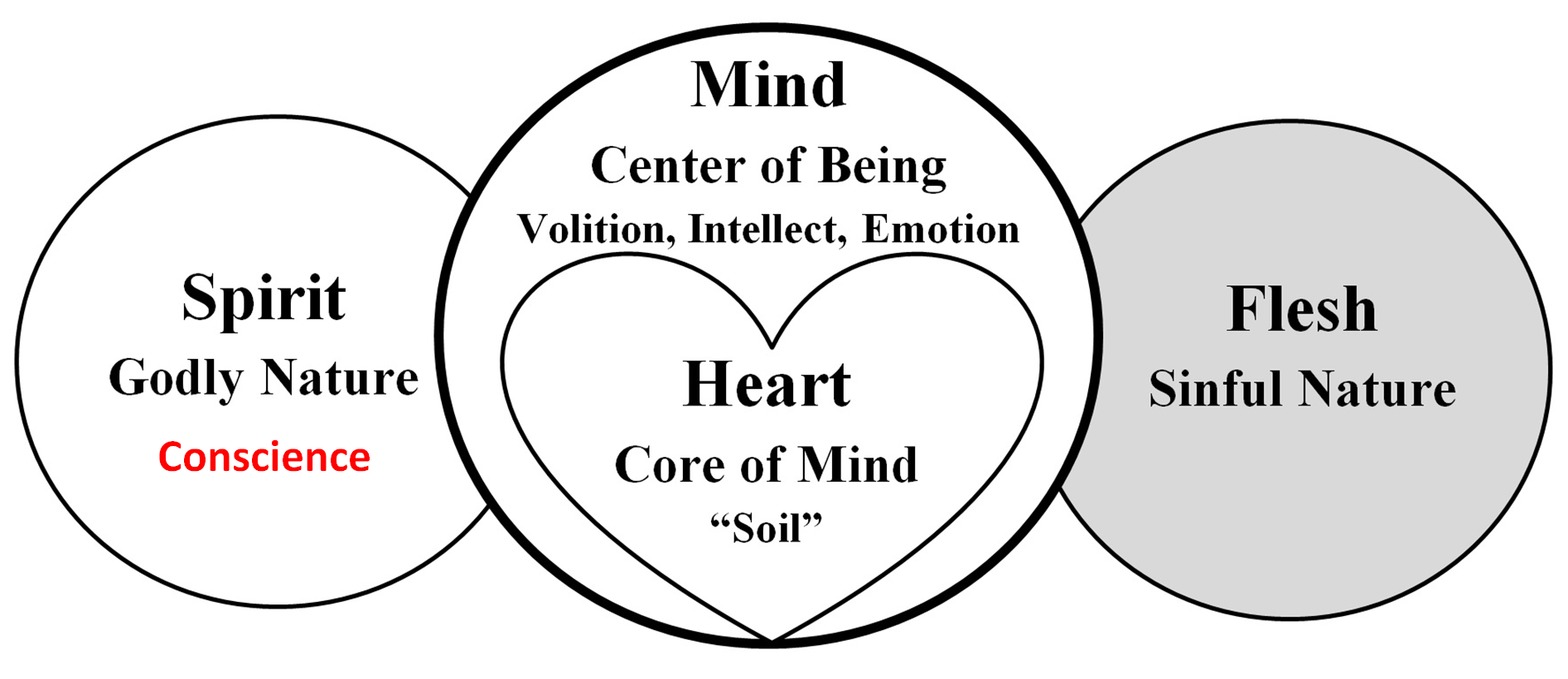
(For important details on the inner conflict of spirit and flesh, as well as human nature in general, see this article).
The Bible speaks of three different kinds of consciences; let’s look at all three:
A “Good Conscience” or “Clear Conscience”
There are several references to a good conscience or clear conscience in the New Testament (1 Timothy 1:5, 1:19, 3:9; 1 Peter 3:16, 3:21; Hebrews 13:18; Acts 24:16). Having a good conscience or clear conscience simply means that the person in question respects this God-given inner-signal and walks accordingly. If they miss it, they readily repent (1 John 1:8-9), which the Bible calls “keeping with repentance,” something we all should do (Matthew 3:8 & Luke 3:8). Confession of a mistake or sin takes humility, which naturally attracts God’s grace (favor) and stops prosecution (James 4:6 & 1 Peter 5:5).
Even unbelievers can maintain a clear conscience by being honest about their mistakes and not continuing with the transgression in question. In other words, they admit they screwed up because their conscience bugged them and they refuse to live the misdeed as a lifestyle. This is repentance.
A Seared Conscience
Paul spoke of “hypocritical liars, whose consciences have been seared as with a hot iron” (1 Timothy 4:2). People with a seared conscious have ignored the warning of their conscience so often that they are now hardened to it and therefore utterly ignore it with zero qualms, which can be observed in Ephesians 4:19. This is one-and-the-same as what the Bible calls “hardening the heart” (Acts 28:27; Hebrews 3:7-8).
A Weak Conscience
A weak conscience is an unhealthy conscience that’s no longer strong and therefore is unreliable in some ways (1 Corinthians 8), but not all ways. The Greek word for ‘weak’ is detailed here. A weak conscience develops through misinformation or false doctrine wherein the believer with this condition usually has personal issues with the behavior in question and has little sense of moderation.
A good modern example would be the drinking of alcoholic beverages. While being a drunkard is a sin (Galatians 5:19-21; 1 Corinthians 6:9-11), drinking a sip of alcohol is not (1 Timothy 5:23; Deuteronomy 14:26), although it would arguably be a sin for an alcoholic, as well as those who cause others to fall (Romans 14:21). The believer with the weak conscience is the one who sees another believer drinking an alcoholic beverage and automatically assumes s/he is in sin and it may even harm their faith.
Believers with weak consciences are either spiritually immature and need to grow or are developing a legalistic spirit. Regardless, mature believers with healthy consciences must be considerate of those with weak consciences; it’s simply a matter of walking in love toward others. You can read scriptural details here.
Related Topics:
Q&A on HUMAN NATURE: Spirit, Mind & Flesh
Spiritual Growth — The Four Stages
Does the Bible Support a JUSTIFIABLE LIE?
Christianity — Does it Weaken People or Empower?
Legalism — Understanding its Many Forms
What Are THE BASICS of Christianity?
FORMS OF ART IN THE BIBLE, Including Music, Visual and Performance Art

God’s imaginative creation of the Universe & Earth and all living things (chronicled in Genesis 1-2) can be described as art; after all, a lot of our art appreciation involves marveling at awesome displays of nature, amazing animals or attractive, charismatic people. This shows that art began with the LORD, the creator of the heavens & earth and all living creatures (Psalm 146:6), and we are to be “imitators of God” (Ephesians 5:1).
But what about the first mention of art relating to human beings and even as an industry? (By ‘industry’ I mean the production of a good or service for people in the community to utilize). Here’s the first mention in Scripture:
Adah gave birth to Jabal; he was the father of those who live in tents and raise livestock. 21 His brother’s name was Jubal; he was the father of all who play stringed instruments and pipes. 22 Zillah also had a son, Tubal-Cain, who forged all kinds of tools out of bronze and iron.
Genesis 4:20-22
As you can see, three major industries are noted:
- Livestock, which relates to human sustenance.
- Music, which relates to art as a craft and human appreciation or entertainment (in the positive sense).
- Tool manufacturing, which relates to technology and human convenience or advancement.
Thus art is noted in the same breath as two other industries vital to human existence.
Furthermore, tool manufacturing and the corresponding technology includes an element of art since various tools and the items created from tools are typically made with aesthetics in mind and are themselves art in a sense. For instance, chairs, tables, desks, shelves, utensils and weapons, like swords. (For anyone who doubts that a chair or table relates to technology, technology is defined as the application of scientific knowledge for practical purposes, so designing and building a wooden chair or table would be an application of technology). Consider vehicles in the modern era, which are a tool to travel from point A to point B: They can be created solely with utilitarian concerns in mind, but that’s usually not the case; manufacturers are also concerned with aesthetics, which explains the existence of car shows.
All three of these industries were birthed at the same time in human history. In other words, people are not to just eat and use tools for one purpose or another, they can also create and appreciate art, whether music or otherwise.
Various Forms of Art Noted in the Bible
Several art forms can be observed in Holy Scripture:
- Music, as noted in the Psalms and Solomon’s Song of Songs. These songs feature a wide range of expression from praise & worship and historical commentary to emotional venting and (gasp!) romantic expression.
- Poetry, such as the book of Job, Ecclesiastes and the poetry used throughout the prophetic books.
- Fictional stories, like Christ’s parables and Jotham’s fantastical tale (Judges 9:8-15).
- Visual arts, including graphical, sculptural, crafts, décor and architectural (1 Kings 6). This would include the aesthetic appeal of the Ark of the Covenant and the Tent Tabernacle (Exodus 25-26).
- The aesthetic element in tools, weapons, armor and so on would fall within the parameters of visual art.
- Performance art, as observed with Isaiah walking around partially nude and barefoot for three years (Isaiah 20), Jeremiah creating and wearing a yoke, which was destroyed by another prophet to symbolize the breaking of the yoke of king of Babylon (Jeremiah 27-28) and Ezekiel “sieging Jerusalem” and lying on his side for long periods of time, etc. (Ezekiel 4-5). Obviously art can be used as a tool to minister truth to others.
- Dance would be a form of performance art. Ecclesiastes 3:4 says there is “a time to weep and a time to laugh, a time to mourn and a time to dance” while the Psalms encourage us to praise the LORD with dancing and music (Psalm 149:3 & 150:4). David danced before the LORD with all his heart, which some naturally took in the wrong spirit (2 Samuel 6:14-23). Aren’t there always those types who take offense to an artist despite perfectly noble intentions?
All of these art forms separate human beings from animals. Beasts do not create or perform with aesthetics in mind, even if what they create for practical purposes can be deemed as artistic by people, like a spider’s web. As noted above, art is as intrinsic to the human experience as food and technology.
Lifeless Legalists Tend to Sneer at Art and Those Involved in the Arts
To be expected, those with a Pharisaical spirit — legalists — tend to look down on some forms & genres of art because it brings pleasure and heightens the appreciation of life whereas legalists are by nature life-stifling and growth-stultifying. But, as you can see from the Scriptures, art is inherent to God’s nature and, as such, many forms of it can be seen throughout the Bible. Moreover, we are created in God’s image and expected to imitate our Creator.
Speaking of which…
God’s “Art” Declares the Glory of the Creator
It was pointed out earlier that God’s physical creation — the Universe, Earth and all living things — is the LORD’s art and it is on display to humanity every day, testifying to the Creator’s existence and glory despite the creation’s fallen state (Romans 1:20; Psalm 19:1-4). Have you ever heard a great song or seen it performed and felt an awe of the artist who composed/performed it? The same principle is at play when you gaze into the starry panorama or feast your eyes on a magnificent vista or marvel at a stunning person or a fascinating animal. All of these things declare the glory of the Creator and inspire awe.
The art you or I create can also inspire awe and “speak” of innumerable worthy things or issues, but the most important one is declaring God’s glory or simply truth (reality) in one way or another, covertly or overtly. By doing this we are imitating God as we are called to do.
But, in order for art to be effective…
Artists Must “Understand the Times”
The Bible points out that the men of Issachar “understood the times and knew what Israel should do” (1 Chronicles 12:32), which shows that they comprehended the historical context of the current culture and what to do or not do from a godly perspective. Just so, Christian artists in the modern era have to grasp what’s happening in their culture or subculture in order to effectively engage people with their art, whatever form that might be.
For instance, it’s unlikely that Christians are going to effectively reach lost or searching youths ingrained in Goth rock, hip-hop or extreme metal subcultures with traditional gospel music, like The Gaithers. Not that there’s anything wrong with traditional gospel — I love it (and I love The Gaithers) — but you have to know your audience and what’s trending to successfully reach people and communicate with your art. What’s “hip” in one decade is usually not “hip” in the next one.
Creating Art is Work
Artists are typically looked-down upon by more utilitarian types. They don’t view the creation or performance of art to be “real work” nor do they think the art industry — any form — is essential to life on Earth. But, as noted above, the very beginning of the book of Genesis shows that art was one of the three main industries in the beginning stages of humanity (Genesis 4:20-22).
Furthermore, God’s creation of the Universe & Earth and all living things is the most imaginative, awe-inspiring piece of art ever created. Notice what the Bible says about this masterwork:
Thus the heavens and the earth were completed in all their vast array.
2By the seventh day God had finished the work he had been doing; so on the seventh day he rested from all his work. 3Then God blessed the seventh day and made it holy, because on it he rested from all the work of creating that he had done.
Genesis 2:1-3
The Scriptures refer to the LORD’s creation of the greatest piece of art as “work,” which took six days to complete. We marvel at innumerable parts of this “piece” every day one way or another. For instance, we regularly gaze in awe at photographs, paintings, books or movies showcasing magnificent vistas, amazing animals or stunning people — or we appreciate them firsthand — either way, we’re blessed by God’s art on a daily basis.
The point is that creating great art is work. It was work even before creation was cursed due to sin (Genesis 3:14-20). Now it’s even more work because of the Genesis Curse; and Adam’s descendants have worked within the context of this negative legacy ever since, which includes you and me. But there’s good news…
Christ worked as a carpenter up until the age of 30; his former neighbors in Nazareth recognized him by his prior occupation (Mark 6:3 & Matthew 13:55). The Greek word for ‘carpenter’ is tektón (TEK-tohn), which refers to a craftsman, carpenter or artisan. Tektón is where we get the words tectonic and architect. In 1st Century Israel a tektón was a general craftsman who worked with wood, stone or metal in building projects, small or large. In other words, Christ did more than make tables & chairs.
Quality carpenters/builders/architects today make good money, as do people of any profession that takes skill and is in demand, including proficient artists (Proverbs 22:29). As noted earlier, there’s a creative element to carpentry and architecture. Imagine how skilled the Messiah was as a builder since he created the Universe, Earth & all living things (Colossians 1:16-17)!
Jesus then worked as a fulltime minister for three and a half years before he was crucified and he was the greatest minister that’s ever walked the Earth. Anyone who says effective ministry isn’t work doesn’t know what they’re talking about. Moreover, there’s a creative element to ministry, including the imagination necessary to come up with original teachings and parables, not to mention ministering via performance art as Jeremiah and Ezekiel did, noted earlier. In short, ministry includes an artistic aspect.
Whatever work you do, including artistic work, Colossians 3:23 instructs us to:
- Work as if working for the Lord, which is also reflected in Ephesians 6:7.
- Do it with all your heart, which is also reflected in Ecclesiastes 9:10. Look at the opening photo of this article and note how the band is performing wholeheartedly. The lesson? Give it your all; don’t just go through the motions or wing it.
In addition, Proverbs 12:24 says that “diligent hands will rule” and Proverbs 22:29 illustrates that those who perfect their craft will be successful within that context; in other words, your work will be in demand however large or small your niche audience.
Apply these principles in your work & artistic endeavors and you’ll be blessed despite the Genesis Curse while looking forward to the new heavens and new earth, the eternal home of righteousness where there will be “no more curse” (2 Peter 3:13; Revelation 22:3).
This article is also available in book form as a chapter in…
- The print book is available here for only $7.26 (171 pages)
- The Kindle eBook is available here for just 99¢!
Both links allow you to LOOK INSIDE the book.
Related Topics:
Can a Certain Style of ART Be Evil?
Q&A on Solomon’s SONG OF SONGS
What Are THE BASICS of Christianity?
Why You Shouldn’t Put Men or Women IN A BOX (Marriages too)

Please be careful to not put people in a box, either gender; marriages too. For instance, Jacob was renamed Israel and became the progenitor of God’s nation on Earth, but he was a Momma’s boy who favored hanging around the tents while his half-brother, Esau, was a hairy manly man who preferred the outdoors and hunting (Genesis 25:27, 27:11 & 27:22-23). In short, Jacob was stereotypically Liberal whereas Esau was stereotypically Rightwing. Obviously God had no problem using a so-called “Momma’s boy” as an instrumental figure in the divine plan for humanity’s redemption.
In the New Testament Christ reveals his loving gentleness at times (Matthew 11:29) — a supposedly Liberal trait — while at other times he was a veritable holy terror (Mark 11:15-18). As Solomon said, “It is good to grasp the one and not let go of the other. Whoever fears God will avoid all extremes” (Ecclesiastes 7:16-18). Meanwhile the Lord pointed out the glaring contrasts of those who live off the grid in the wilderness, like John the Baptist who wore garments made of camel hair and ate locusts & wild honey, as opposed to those who live in palaces, wearing fine apparel and dining on exquisite cuisines (Matthew 3:1-6 & 11:7-8).
Regarding women, the Bible features the all-encompassing national leadership of Deborah for four decades (Judges 4:4-9) as well as the meek purity of Mother Mary (Luke 1:26-56). Then there’s mighty Jael (yah-AYL) who had no qualms about smashing a tent peg through the temple of a Canaanite commander (Judges 4: 17-21). Meanwhile sisters Martha & Mary were like night and day (Luke 10:38-42).
As far as marriages go, they all feature different dynamics based on two unique people and their corresponding social stratum. In today’s society, women aren’t necessarily preoccupied with raising kids for about 30 years from the start of their early marriages, as was normally the case in biblical times. They may likely work outside the home and have careers while husbands may have unconventional occupations, working from or at the home.
Allow Christian couples to make their own decisions about these matters and who does what or why, working within scriptural guidelines as led of the Holy Spirit. Don’t nose into other people’s business. How God works in other believers’ lives is none of our concern; our concern is to follow the Lord and fulfill the responsibilities of our distinctive callings (John 21:21-22).
Paul expressed it perfectly when he asked, “Who are you to judge someone else’s servant?” (Romans 14:4). He was referring to judging other believers on any type of disputable matter, like what food to eat and what holiday to celebrate. By stressing “someone else’s servant,” Paul meant God’s servant, that is, other believers. Simply put, other believers are God’s servant, not your servant or my servant. Even in cases where a believer functions within a pastor’s “flock,” the pastor is merely the under-shepherd, not the Chief Shepherd; Christ is the Chief Shepherd (1 Peter 5:1-4). This is why the text instructs pastors to not lord it over believers, but rather be humble, godly examples (if they can’t do that then they have no business being pastors).
This article was edited from…

Both links allow you to LOOK INSIDE the book.
Related Topics:
Nosiness and Manipulation (NOT Spiritual)
Legalism — Understanding its Many Forms
Understanding “the Right” and “the Left” from a Biblical Perspective
Women of the Bible / Women in Ministry
Ministerial Pitfalls and Abuses
WOMEN of the Bible / WOMEN in Ministry

The reason this article combines the topics of women of the Bible and women in ministry is because the noble women of the Bible also functioned in God’s service in one capacity or another. In short, the two subjects go hand-in-hand.
Of course the main question we want to tackle is whether or not women can serve in positions of ministry in the body of Christ, including the fivefold ministry, that is, serve as apostles, prophets, evangelists, pastors or teachers (Ephesians 4:11-13). Please keep in mind that ‘ministry’ means “service” and ‘minister’ means “servant” (Matthew 20:25-28).
An understandable response is: Why can’t woman serve in ministry and be ministers? After all, were Aimee Semple McPherson (pictured above) and Kathryn Kuhlman in gross sin by serving as healing evangelists, reaching millions in the 20th century? (That’s a rhetorical question).
The reason this article is important is because there are sincere believers in the body of Christ who question the legitimacy of women in ministry and base their disapproval (or, at least, agnosticism) mostly on a couple verses in the New Testament. We’ll honestly examine those verses, but we’re going to first set some vital groundwork on the topic and examine myriad notable women in the Bible, both New Testament and Old Testament. However, if you want to go straight to the two supposed “hard sayings” on women in the New Testament, just scroll down to the sections 1 Corinthians 14:34-35 and 1 Timothy 2:11-15.
Now let’s start with some foundational passages on the topic…
Understanding the “Genesis Curse”
Christ came to set people free from the bondage of sin & death, which includes its expression in human relationships. For instance, Paul taught by the Spirit: “There is neither Jew nor Greek, there is neither slave nor free, there is no male and female, for you are all one in Christ Jesus.” (Galatians 3:28 ESV). We’ll look at this text closer in the next section; let’s first go back to the very beginning of humanity after Adam & Eve sinned to establish some fundamental points…
14So the LORD God said to the serpent:
“Because you have done this,
cursed are you above all livestock
and every beast of the field!
On your belly will you go,
and dust you will eat,
all the days of your life.
15And I will put enmity between you and the woman,
and between your seed and her seed.
He will crush your head,
and you will strike his heel.”
16To the woman He said:
“I will sharply increase your pain in childbirth;
in pain you will bring forth children.
Your desire will be for your husband,
and he will rule over you.”
17And to Adam He said:
“Because you have listened to the voice of your wife
and have eaten from the tree
of which I commanded you not to eat,
cursed is the ground because of you;
through toil you will eat of it
all the days of your life.
18Both thorns and thistles it will yield for you,
and you will eat the plants of the field.
19By the sweat of your brow
you will eat your bread,
until you return to the ground—
because out of it were you taken.
For dust you are,
and to dust you shall return.”
20And Adam named his wife Eve, because she would be the mother of all the living.
Genesis 3:14-20
When God pronounced to Eve that “Your desire will be for your husband, and he will rule over you” (verse 16) the Creator was issuing a warning to Eve, not giving a command to Adam! In other words, God was not giving Adam (and men in general) permission to be tyrants over the women in their lives. The LORD was basically saying: “Beware, Eve, man is now going to try to dominate you and your female descendants.” This tendency is in the flesh of all males. You can even see it in boys who naturally try to dominate their mothers (which they don’t do with their fathers, generally speaking, and wisely so). I know because I myself did this when I was a kid. Don’t get me wrong, the masculine spirit is good — God called it “very good” along with everything else that was created (Genesis 1:31) — but the flesh, the sinful nature, perverts all good things.
We must understand that this section of Scripture — Genesis 3:14-19 — is a divine proclamation concerning the result of humanity now being fallen. In other words it was a prophetic curse due to transgression — not a blessing or a command — which is why this section of Scripture is called “the Genesis curse.” Nothing in this proclamation is a moral law like “You shall not commit adultery” or “You shall not steal” (Exodus 20:14-15), rather it’s a divine judgment — a curse — on the serpent/satan for deception and on Adam & Eve for their sin. The only sense that any proclamation in Genesis 3:14-19 is “Law” is that it’s contained in the section of Scripture known as the Law or Pentateuch, aka the first five books of the Bible. The fact that some ministers refer to Genesis 3:16 as “Law” or a “blessing” is laughable. I can’t help but suspect they have issues with misogyny.
We’re going to focus on the LORD’s proclamation to Adam & Eve since humanity has the potential for redemption whereas satan is incorrigible (you can read details here). God was conveying the general way it will be for them & their progeny — humanity — in a fallen world, not the way it should be or has to be. For instance…
- The LORD said to Eve that he would “sharply increase your pain in childbirth,” but this doesn’t mean that a woman and those who are assisting her medically shouldn’t do everything in their power to ease her pain during childbirth.
- The LORD said “in pain you will bring forth children,” but this doesn’t mean that a woman has to have children or will have children. What about women who can’t find a husband? What about women who have no interest in having sex with men? What about women who want to forsake marriage & children in order to devote their lives to God à la 1 Corinthians 7:34? What about women who can’t have children for one reason or another? What about women who simply have no desire to bear & raise children?
- The LORD said “Your desire will be for your husband,” but this clearly doesn’t mean every woman will desire a husband.
- The LORD said “and he will rule over you,” but this doesn’t mean he ought to rule over her (more on this momentarily).
- The LORD said to Adam “cursed is the ground because of you; through toil you will eat of it all the days of your life,” but this doesn’t mean that we shouldn’t improve agriculture quality and production, nor does it mean that people since that time have to limit their diet to fruits & vegetables.
- The LORD said “through toil you will eat,” but this doesn’t mean that we shouldn’t reduce the amount of needless toil in our work in order to make a living. The biblical book of wisdom says “The blessing of the LORD brings wealth, without painful toil for it” (Proverbs 10:22).
- The LORD said “By the sweat of your brow you will eat your bread,” but this doesn’t mean that we shouldn’t find ways to reduce the amount of sweat it takes to earn a living.
- Lastly, the LORD said in the latter part of verse 19 that death is now a reality for humanity obviously because “the wages of sin is death,” but this doesn’t mean that there aren’t exceptions to suffering physical death, like Enoch (Genesis 5:21-24), Elijah (2 Kings 2:11) and those who will be raptured (1 Thessalonians 4:13-18). Nor does it mean we shouldn’t reconcile with God through the message of Christ to escape eternal death (Romans 6:23 & John 3:16).
In short, these statements are general truths about the way life will be in a fallen world due to Adam & Eve’s sin — called “original sin” by theologians — but they are not absolutes nor are they moral laws or blessings. They warn of the way it will generally be in this cursed physical reality, but not the way it should be or has to be or will always be. Are you following?
There are two elements of the Genesis Curse that apply to our topic:
- The statement in verse 16 that the husband will “rule over” the wife reveals that tyrannical gender hierarchy is a result of the corruption of sin in a fallen world. God was warning that the male will have a fleshly tendency to dominate his female mate, which can be attributed to his generally larger mass & muscle, as well as a typically more aggressive mentality (which happened to be a good thing back in the day when barbarians threatened the country or homestead). In other words, because the male is generally bigger, stronger and more aggressive he will be inclined to carnally control the female in their relationship; that is, “rule over” her.
- The other is God’s statement to the devil (who possessed the serpent in order to deceive Eve): “I will put enmity between you and the woman” (Genesis 3:15). This shows that there is enmity between satan and women because the Messiah, the destroyer of the devil’s work, would ultimately come through a woman (Hebrews 2:14 & 1 John 3:8). Satan hates all humankind, of course, but he especially hates women for this reason; in short, satan is the ultimate misogynist. This explains why throughout history he has moved upon males to subjugate women, which can be observed in societies ever since. Look no further than Muslim countries today and the underground slave market. Even in liberated Western countries, like the USA, women didn’t even get the right to vote until 1920!
But God does not want the male to “rule over” his mate nor males in general to “rule over” women in any type of abusively domineering sense. This is clearly observed in both the Old and New Testaments. For instance, Ephesians 5:25 shows that the leadership of the husband in the marriage is to be loving and self-sacrificial in nature, not domineering; in fact, husbands are to love their wives in the sense of Christ loving the Church and giving up his life for it. The Greek word for ‘love’ in this verse refers to practical love, not a feeling. It is defined in the famous love passage 1 Corinthians 13:4-7. If husbands make it a point to practice this kind of love with their spouses 99% of wives would gladly acquiesce if there’s a disagreement. You could say that Ephesians 5:25 counteracts the curse of Genesis 3:16. Other New Testament verses do the same thing, like Ephesians 5:28, Colossians 3:19 and 1 Peter 3:7.
Another vital point to keep in mind is that the husband having headship in the marriage does not mean inequality because 1 Corinthians 11:3 parallels the husband’s headship over the wife with God’s headship over Christ. Are the Father and Son equal? Of course they are. Jesus said “I and the Father are one” (John 10:30). Similarly, husbands and wives are supposed to be one ideally (Matthew 19:4-6 & Ephesians 5:31).
Whilst Father and Son are equally the LORD, Yahweh (Genesis 1:26), there is subordination in an economical, relational sense. For instance, the Scriptures very clearly show that the Father is the head over the Son and this is explicitly stated (1 Corinthians 11:3 & 15:27-28). While the Father and Son are equal in being, the Son is subordinate to the Father in function or relationship. This is paralleled to the relationship of husbands and wives.
Furthermore, God gave both Adam & Eve the commission to subdue or govern the Earth, not just Adam (Genesis 1:28). This suggests equality and teamwork, not one being superior to the other.
It should be noted that the same Greek word for ‘submit’ used in the context of wives submitting to their husbands (Colossians 3:18) is also used in reference to believers submitting “to one another out of reverence for Christ,” which illustrates a spirit of mutual submission (Ephesians 5:21-25). This means we should strive to get along and give preference to one another. I’m pointing this out so you plainly see that submitting to others in a spirit of humility is a universal concept in the body of Christ — for males and females — and not just something wives are to exclusively do with their husbands.
In regards to the Old Testament, notice what the LORD commanded concerning newlyweds:
If a man has recently married, he must not be sent to war or have any other duty laid on him. For one year he is to be free to stay at home and bring happiness to the wife he has married.
Deuteronomy 24:5
God is so concerned about marriages being healthy and starting off on the right foot that newlywed husbands in Israel were not permitted to go to war for a full year or be burdened by any other duty so that they could stay home and bring happiness to their wives! Does this remotely sound like the LORD wants the husband to “rule over” the wife? Obviously not. God wants husbands to bring happiness to their wives!
Or consider Abraham, the progenitor of the Israelites and the biblical “father of faith” (Romans 4), did he “rule over” his wife Sarah (who was originally named Sarai)? It was Sarah who made the decision to give her servant, Hagar, to Abraham so that he could have children through her since Sarah couldn’t bear offspring at the time (Genesis 16). It was also Sarah’s decision to exile Hagar & Ishmael (the latter being Abraham & Hagar’s child) after she became jealous. While these decisions may have been dubious, Abraham complied with both (Genesis 21). This shows that Sarah had the freedom in their relationship to make life-changing decisions in the domestic realm and Abraham willingly abided by them. Clearly, Abraham didn’t “rule over” Sarah.
This corresponds to Paul’s instructions in 1 Timothy 5:14 where he said wives are “to manage their homes.” This phrase is one compound word in the Greek, oikodespoteó (oy-kod-es-pot-EH-oh), which means “to rule the household.” This suggests that, while the husband is the head of the marriage, the wife is the domestic head.
For irrefutable proof that the Genesis curse did not mean males were to rule over women in general, the LORD chose & anointed Deborah to lead Israel spiritually, legally and militarily for 40 years (Judges 4:4-9). God selected Deborah to fulfill this great leadership position in a generally patriarchal region of the globe. Why? Obviously because she was qualified for the job above any male. Barak, the most qualified man, wouldn’t even go to battle without her presence! We’ll look at Deborah in more detail shortly.
Christianity Destroys the Worldly Idea that People are Inferior Due to Race, Social Status or Gender
The message of Christ is the ‘gospel’ — literally the “Good News” — because those who believe are spiritually regenerated (Titus 3:5) and become “new creations” (2 Corinthians 5:17) free from bondage to sin & death, which would include its expression in human relationships — discrimination due to race, social status or gender:
So in Christ Jesus you are all children of God through faith, 27 for all of you who were baptized into Christ have clothed yourselves with Christ. 28 There is neither Jew nor Gentile, neither slave nor free, nor is there male and female, for you are all one in Christ Jesus.
Galatians 3:26-28
Paul’s letter to the Galatian assemblies is one of the earliest epistles of the New Covenant and establishes something foundational: “There is neither Jew nor Greek, there is neither slave nor free, there is no male and female, for you are all one in Christ Jesus” (ESV). This passage does not deny the existence in this fallen world of different races, social statuses or the two genders, but rather points out that in Christ Jesus — that is, in covenant (contract) with God thru Christ — we are all one body. While all believers are at different levels of spiritual growth and have different gifting or offices, we “are all one in Christ Jesus.” This explains why the Messiah taught against the practice of titles in the Church and emphasized the equalitarian nature of leadership (Matthew 23:7-11). Certainly the Scriptures acknowledge servant-oriented leadership in the kingdom of God — that is, leadership positions or offices and the gifting necessary for such (Ephesians 4:11-13) — but personal titles are a different story. Christ emphasized that believers “are all brothers and sisters.”
There is no male or female in Christ. As such, women are free to learn in the assemblies and serve in ministry; that is, participate in God’s service. While this is true, Christians have to be sensitive to the customs of the region in which they are ministering if they want to effectively reach the people there. If they introduce ideas that are too radical to the people’s established mores it’ll give Christianity & the gospel a bad rap and hinder the chances of reaching them. This is why it’s necessary to “become all things to all people so that by all possible means [we] might save some,” as Paul put it (1 Corinthians 9:19-23).
We’ll look at some of these things in greater detail as we continue, let’s now consider…
Women in the New Testament who were used by the Lord in service of God’s Kingdom
Priscilla
Priscilla and her husband, Aquila, came from Italy to Corinth after the Emperor Claudius expelled Hebrews from Rome via executive order. They were tentmakers who met Paul in Corinth (Acts 18:2) and eventually traveled with him to Ephesus, which is where Paul’s protégé, Timothy, later served as a Pastor (Acts 18:18-19 & 2 Timothy 4:19). A small church — a Christian assembly — regularly met in Priscilla & Aquila’s house (1 Corinthians 16:19).
Notice what Paul says about this couple in his letter to Roman believers:
Greet Priscilla and Aquila, my co-workers in Christ Jesus. 4 They risked their lives for me. Not only I but all the churches of the Gentiles are grateful to them.
5Greet also the church that meets at their house.
Romans 16:3-5
This shows that Priscilla & Aquila served the Gentile churches. Note how Paul mentions Priscilla before Aquila and acknowledges both as “my co-workers in Christ Jesus.” While Paul was obviously in charge as he was the most prominent apostle of the New Testament, he referred to these two fellow servants in an equalitarian sense even though they were technically under him in the Church. This corresponds to what was noted above — believers “are all one in Christ Jesus,” whether Jew or Gentile, slave or free, male or female (Galatians 3:28) and servant-leadership in the Church is equalitarian in nature (Matthew 23:7-11).
Notice what took place in Ephesus after Priscilla & Aquila heard a mighty man of God speak at the local synagogue:
Meanwhile, a Jew named Apollos, a native of Alexandria, came to Ephesus. He was a learned man, with a thorough knowledge of the Scriptures. 25 He had been instructed in the way of the Lord, and he spoke with great fervor and taught about Jesus accurately, though he knew only the baptism of John. 26 He began to speak boldly in the synagogue. When Priscilla and Aquila heard him, they invited him to their home and explained to him the way of God more adequately.
Acts 18:24-26
Once again, Priscilla is mentioned before Aquila, and this time it was chronicled by Luke via the Holy Spirit. Upon hearing Apollos speak at the synagogue, they discerned that he was yet ignorant of the full message of Christ despite being a “learned man with a thorough knowledge of the [Old Testament] Scriptures.” So they invited him to their home to “explain to him the way of God more adequately” or “more accurately,” as some translations put it (Acts 18:26).
Think about it, Priscilla — along with her husband — taught this scriptural scholar & mighty speaker New Covenant truths. They did this at their home, which is where most assemblies met back then, in the homes of believers (Romans 16:3-5 & 1 Corinthians 16:19). In essence, the three of them were “having church.” Did not Christ say “where two or three gather in my name, there am I with them” (Matthew 18:20). We have to get away from this erroneous idea that believers can only “have church” when they meet at an official Church facility.
Please notice that nothing is said in these passages about how Priscilla, being a woman, should be silent in the church or that she shouldn’t teach men, especially someone of Apollos’ stature. Nor is anything said about Apollos having a problem receiving from Priscilla. Keep in mind that Apollos was later mentioned in the same breath as Paul and Peter (1 Corinthians 1:12 & 3:22) and Paul placed Apollos on the same spiritual level as himself (1 Corinthians 4:6).
Women who ministered through the Prophetic Word
Philip the evangelist “had four unmarried daughters who prophesied” (Acts 21:9). Meanwhile the apostle Paul clearly expected women with the prophetic gift to prophesy to others and not keep silent, not to mention pray in public (1 Corinthians 11:4-5); the context implies that men were present. Both passages illustrate the fulfillment of the prophet Joel’s word from the LORD: “I will pour out my Spirit on all people. Your sons and daughters will prophesy” (Joel 2:28 & Acts 2:16-18).
Are these verses referring to the body gift of the prophetic word (Romans 12:6-8) or to the fivefold ministry gift (Ephesians 4:11-13)? If you’re unaware, those with the body gift lack the anointing of the fivefold ministry gift. Naturally believers with the body gift, like teaching or prophecy, may eventually be called to serve as fivefold ministers. I’m a good example of this: Before I entered the fivefold ministry I functioned in the Church as a teacher with the body gift. But not all those with a body gift will necessarily go on to serve in the fivefold ministry.
In any case, neither verse distinguishes whether these women should use their gift solely in terms of the body gift or also in fivefold ministry, presumably because both apply depending on the individual and her calling. But the main point rings clear: Women are expected to have ministry gifts and serve accordingly. Read that again; proclaim it from the rooftops.
The female prophet, Anna, is noted when Joseph & Mary brought the child Jesus to the Temple for purification rites. She “spoke about the child to all [men and women] who were looking forward to the redemption of Jerusalem” (Luke 2:36-38). Obviously she was a prophet in the Old Testament sense (you can read about the difference between the two here); nevertheless, she’s mentioned in the New Testament as a prophet and nothing is said about how she should be silent at the Temple and men shouldn’t listen to her because she’s a female. Actually, the passage goes out of its way to point out how devout Anna was and deserving of respect as a godly prophet, not to mention “all” listened to her and not just other women.
Speaking of Mary, she & Elizabeth also served in the prophetic, which we’ll look at momentarily.
Additional Women involved in Ministry in the New Testament
Junia
Junia is mentioned along with Andronicus (who may or may not be her husband) as “fellow Jews” who had been in prison with Paul, which shows that they were persecuted for serving the Lord; Paul noted that they were “outstanding among the apostles” and accepted the message of Christ before he did (Romans 16:7). The verse could be interpreted to mean that the two were apostles, although it’s also interpreted to mean that the apostles held them in high regard due to their devotion to the Lord & ministry.
Phoebe
Phoebe was a deacon (Greek: diakonos) at the church in Cenchrea, which means she was involved in helps ministry, assisting the fivefold ministers (Romans 16:1). Deacons today include ushers, greeters, secretaries, custodians and sound operators.
Euodia and Syntyche
These two women “contended at [Paul’s] side in the cause of the gospel,” which shows that they also functioned in helps ministry as deacons (Philippians 4:2-3).
Lydia
Lydia was a “worshipper of God” from Thyatira that Paul met outside of Philippi. She accepted the message of Christ and invited Paul & his companions to stay at her home with her family (Acts 16:12-15). After Paul & Silas suffered persecution in Philippi they returned to Lydia’s house “where they met with the brothers and sisters and encouraged them” (Acts 16:40). Since she actively helped Paul’s world-changing ministry she was in essence a deacon.
Lois and Eunice
These women were the grandmother & mother of Timothy respectively; Paul noted their “living faith” that was now living in the young pastor of Ephesus (2 Timothy 1:5). While someone might respond “Whoop-de-do,” think about: There is no ministry work more important than raising a child to be an anointed, faithful man or woman of God, especially a powerful fivefold minister, like Timothy, who would reach multitudes (Proverbs 22:6).
The “Chosen Lady” of 2 John
This refers to the noble woman that John addressed in his second epistle (2 John 1:1 & 1:5). She was at least a respected believer known by the apostle who opened her home to intenerate ministers (verse 10). It’s also possible that an assembly met at her house and the believers thereof are the “children” that John noted. It’s even possible that she was the leader of this fellowship; after all, why would the great apostle write some insignificant female homeowner concerning key issues involving the local Church? If that’s all the “chosen lady” was, why would this letter end up a part of the God-breathed Scriptures (2 Timothy 3:16)? For details, go here.
Mary, the Mother of Jesus
Mary was “highly favored” of the LORD (Luke 1:28) and her relative Elizabeth, a descendent of Aaron, called her “the mother of my Lord” (Luke 1:43). Moreover Mary’s inspired song says that future generations would call her blessed (Luke 1:48). Elizabeth’s divine insight and Mary’s biblical song places them both in the prophetic office.
Mary was also listed with the great leaders of the early Church after the ascension of Christ when the Holy Spirit was about to fall on the Church:
Then the apostles returned to Jerusalem from the hill called the Mount of Olives, a Sabbath day’s walk from the city. 13When they arrived, they went upstairs to the room where they were staying. Those present were Peter, John, James and Andrew; Philip and Thomas, Bartholomew and Matthew; James son of Alphaeus and Simon the Zealot, and Judas son of James. 14They all joined together constantly in prayer, along with the women and Mary the mother of Jesus, and with his brothers.
Acts 1:12-14
You can read more about Mary here.
Mary, the sister of Martha & Lazarus
This Mary wisely sat at the Lord’s feet feeding on his ministry when Jesus visited their house (Luke 10:38-42). Christ publicly commended Mary for choosing “what is better” as opposed to Martha who was running around in a distraught whirlwind of preparations. This shows that relationship with the Lord takes precedence over working for God. Why? Because our work for the Lord should always be a natural outgrowth of our relationship with God. If it’s not, we’ll fall into the pitfall of legalism, which is counterfeit spirituality. For details see this article.
The Women at Christ’s Tomb after his Resurrection
The first persons to discover that Christ was resurrected were Mary Magdalene, Mary the mother of James-the-less and Salome (Mark 16:1), but also Joanna & others in the periphery (Luke 24:10). An angel at the tomb told these women to give instructions to Christ’s disciples, who would soon be apostles. As they hurried to fulfill their assignment the resurrected Lord suddenly met them and gave them similar instructions (Matthew 28:1-10 & Mark 16:7). These women were the first evangelists! Evidently the angel at the tomb and Christ Himself never got the memo that women in the Kingdom of God are to remain absolutely silent and never instruct a male. Why? Because it’s a false doctrine.
Unnamed Women noted in the Book of Acts
Luke spoke of the “prominent women” of Thessalonica and Berea who believed the message of Christ that Paul shared (Acts 17:4 & 17:12). Then there’s “the God-fearing women of high standing and the leading men” of Pisidian Antioch (Acts 13:50). While the latter women weren’t Christians (yet), Luke speaks of them in noble terms and cites them before the leading men of the city. They were open to the gospel of Christ until the legalist Jews stirred up persecution against the ministry of Paul and Barnabas.
In none of these cases are these women spoken of as second-class citizens in the kingdom of God. Nowhere do these verses suggest that women should remain silent at assemblies or that men shouldn’t receive from them. Why? Because there is no male or female in Christ (Galatians 3:26-28).
Women who Led or Served God in the Old Testament
The Middle East & nearby regions were generally patriarchal in nature, but there are numerous examples of female leaders in the Old Testament, great and small, as well as those who simply served God in one capacity or another. Let’s start with…
Deborah
Deborah is one the most notable woman of the Old Testament. For twenty years circa 1200 BC, Israel was oppressed by Jabin, king of Canaan. Thus the Lord raised up Deborah:
Now Deborah, a prophet, the wife of Lappidoth, was leading Israel at that time. 5 She held court under the Palm of Deborah between Ramah and Bethel in the hill country of Ephraim, and the Israelites went up to her to have their disputes decided. 6 She sent for Barak son of Abinoam from Kedesh in Naphtali and said to him, “The Lord, the God of Israel, commands you: ‘Go, take with you ten thousand men of Naphtali and Zebulun and lead them up to Mount Tabor. 7 I will lead Sisera, the commander of Jabin’s army, with his chariots and his troops to the Kishon River and give him into your hands.’ ”
8 Barak said to her, “If you go with me, I will go; but if you don’t go with me, I won’t go.”
9 “Certainly I will go with you,” said Deborah. “But because of the course you are taking, the honor will not be yours, for the Lord will deliver Sisera into the hands of a woman.”
Judges 4:4-9
Deborah was married and no doubt submitted to her husband as the head of the family (Ephesians 5:21-25), but as far as the nation of Israel was concerned — male and female — she was (1) a respected prophet, (2) a judge who settled legal disputes and (3) a military leader. She was such a mighty woman of God that Barak, a subordinate military leader, refused to face the enemy with 10,000 Israelite troops without her presence, even though the LORD promised to give the Canaanites into Barak’s hands (verse 7).
Think about it, God had no problem with a woman leading the Israelites spiritually, legally or militarily for 40 years during this challenging time in Hebraic history. Female leaders may not have been the norm since the entire region of the globe was patriarchal in nature, but two chapters of the Holy Scriptures — God’s Word — are devoted to this amazing woman, illustrating that the Israelites submitted to Deborah spiritually, legally and militarily for four decades!
If this was the way it was when Israel was under the Mosaic Law, a thoroughly inferior covenant, how do you think it is for God’s people under the superior New Covenant of grace through Christ (Hebrews 8:6, 8:13 & 2 Corinthians 3:6)?
One popular minister, who disdains the idea of female leaders — especially spiritual leaders — essentially dismissed the account of Deborah by saying that (paraphrasing) “Deborah’s rise to leadership was the exception in the book of Judges because of Barak’s failure to show the oomph to lead courageously.” Assuming this is so, why didn’t the LORD just choose a devout man other than Barak to take this supreme position if male leadership is so important and female leadership is unacceptable? I’ll tell you why: Because Deborah was the most qualified person for the position and God had zero issue with it; the fact that this was a generally patriarchal culture was irrelevant.
Another critic argued that, since “Everyone did what was right in his own eyes” during that time period (Judges 17:6), the Israelites set up Deborah as a leader without the LORD’s blessing. But 1. both the Old Testament and the New Testament plainly say that God rose up the judges (Judges 2:16 & Acts 13:20) and 2. the LORD used Deborah as a prophet to speak to the people; in other words, God spoke through Deborah (Judges 4).
Jael
Jael (yaw-AYL) was the wife of Heber and is noted in the same chronicling of Deborah and the defeat of the Canaanite forces. Sisera, the commander of the Canaanites, escaped the slaughter of his troops and found refuge in Jael’s tent because the Canaanites were on friendly terms with Heber’s clan. But Jael was on the side of Israel & Deborah and so brutally drove a tent peg through Sisera’s temple into the ground while he slept (Judges 4: 17-21). (She had experience driving tent pegs into the ground and was obviously quite good at it).
Jael is praised in Scripture for her bold actions and called “most blessed of women” (Judges 5:24-27). The very time period was even named after her, i.e. “the days of Jael” (Judges 5:6).
Needless to say, this is a serious R-rated story and Jael is clearly a mighty warrior-ess of God. I can’t help but think of the unnamed woman at Thebez that threw a millstone from the tower, cracking the skull of the fraudulent “king” Abimelech (Judges 9:52-53).
Huldah
This was a respected prophet whom King Josiah contacted via the priests of Jerusalem when the book of the Law was found in the Temple after 55 years of Manasseh’s wicked reign. While God pronounced impending judgment upon idolatrous Judah for blatantly forsaking the LORD, righteous Josiah would not see it, but rather live and die in peace (2 Kings 22:14-20).
Noadiah
Noadiah was a prophet in Israel after the exiles returned. She and other prophets were evidently in league with Nehemiah’s nemesis Sanballat and thus tried to discourage Nehemiah & his team from rebuilding the wall in Jerusalem. Nehemiah prayed that the LORD would help them overcome opposition from such religious leaders (Nehemiah 6:14). It’s assumed that God changed the minds of these misguided prophets, particularly after they witnessed the miraculous rebuilding of the walls in 52 days, which resulted in the Great Revival (Nehemiah 8-10). Repentance, by the way, literally means to change one’s mind.
Miriam
This was the sister of Moses and Aaron, who assumed the role of prophet during the exodus from Egypt and led in praise & worship (Exodus 15:20-21). While her reputation is soiled by an episode of insubordination and her leprous exile for seven days (Numbers 12 & Deuteronomy 24:9), she was humbled and repented. Is there anyone reading this who hasn’t made a huge mistake and repented after being humbled by the LORD? Later prophets identified Miriam as a leader sent by God, spoken in the same breath as Moses and Aaron (Micah 6:4).
The Queen of Sheba
The queen of Sheba is nameless in the Bible but known as Makeda (ma-KAY-dah) in Ethiopian tradition. She came to Jerusalem with a great caravan of gifts for King Solomon wherein she was overwhelmed by Solomon’s wisdom and the grandeur of his kingdom (1 Kings 10:1-13). Another Ethiopian queen is noted a thousand years later in Acts 8:27. In neither case is anything mentioned about how a woman should not be a political leader.
Think about it, Solomon was the wisest person on the face of the Earth wherein people from distant lands regularly came to hear his great knowledge, understanding and wisdom (1 Kings 4:29-34). And, yet, nowhere does he say anything about it being intrinsically wrong for a woman to lead other people, including men, whether politically, spiritually, legally or militarily. He doesn’t inform the queen of Sheba that she should step down and remain silent in the presence of men. Why not? For one thing, he’d be contradicting God’s will when it came to Deborah who led Israel spiritually, legally and militarily a hundred years earlier for forty years.
A critic argued that it’s wrong for me to bring up the Queen of Sheba in this article because she was a pagan, but 1. the title of this section includes women who led in the Old Testament and not just women who served God and 2. the point about the wisest man on Earth at the time not rebuking the Queen for the supposedly gross transgression of leading a nation is a key point.
Abigail
The wise discernment of Abigail saved the lives of all the adult males on her huge ranch after her thankless husband, Nabal, showed gross contempt toward the noble David & his warriors. Abigail took the initiative and made the wise decision without Nabal’s approval to assuage David’s righteous anger in order to save the men on her ranch & more (1 Samuel 25). After Nabal’s sudden death David sent word to Abigail, asking for her hand in marriage. His Momma didn’t raise no fool.
Queen Mothers in Israel
‘Queen mother’ refers to the mother of a reigning monarch and were given the title Gebirah (gheb-ee-RAW), aka “Great Lady,” which was an official position in Israel & Judah (1 Kings 15:11-13). Great care was taken to preserve the name of the Queen Mother (e.g. 1 Kings 14:21), although they could be deposed for rebellion against the LORD, as righteous Asa did with his grandmother Maacah (1 Kings 15:13). Nathan the prophet enlisted Bathsheba rather than king David or Solomon in his plan to have Solomon confirmed as king (1 Kings 1:11-40). Wives of kings never ruled Israel or Judah, although the daughters of great allies enjoyed special privileges (1 Kings 7:8) or influence (1 Kings 16:32-33, 18:19 & 21:7-14). However, wicked Queen Mother Athaliah usurped power and became queen of Judah for about seven years after the death of her son, Ahaziah, by murdering her grandsons, the legitimate heirs; although Joash was able to escape via the aid of Jehosheba (2 Kings 11:1-3).
Unnamed Wise Women during David’s Monarchy
A wise woman was specifically sent for by Israel’s military commander, Joab, in order to successfully bear a message to the king (2 Samuel 14:1-21). Later, another wise woman spoke directly to Joab, whose forces were curiously assaulting her righteous city, and she proceeded to advise her fellow citizens on how to end the assault, which they readily heeded (2 Samuel 20:14-22).
Both cases illustrate that these wise women were valued counselors and thus leaders. After all, if people listen to your counsel, you’re a leader.
Wisdom is Personified as a Female, Plus the Books of Ruth and Esther
On top of all these examples of notable women in the Bible, I think it’s significant to add that wisdom is figuratively personified as a woman in the Old Testament (Proverbs 1:20-33 & Proverbs 8:1-9:12) and two whole books of the Hebraic Scriptures are named after mighty women of God, Ruth and Esther.
You can look for other notable women in the Old Testament & New Testament in your studies, I just wanted to establish several occasions in the Bible where women served God, led others, or showed shrewdness in one capacity or another.
Now let’s get back to the Church Age…
Can Women Serve as Fivefold Ministers?
We’ve established that female believers can serve in the Kingdom of God and are expected to. But can they serve in what is known as the fivefold ministry, which consists of five different offices:
So Christ himself gave the apostles, the prophets, the evangelists, the pastors and teachers, 12 to equip his people for works of service, so that the body of Christ may be built up 13 until we all reach unity in the faith and in the knowledge of the Son of God and become mature, attaining to the whole measure of the fullness of Christ.
Ephesians 4:11-13
To understand each of these five callings in the body of Christ see this article.
The question we want to address is: Can women serve in any of these five positions? We know that Philip the evangelist’s four daughters operated in the prophetic (Acts 21:9) and that Priscilla taught Apollos, along with her husband (Acts 18:26), did these women serve with the “body gifts” of teaching and prophecy (Romans 12:6-8) or were they fivefold ministers? I’m assuming the former, but the Bible doesn’t distinguish. Furthermore, notice that nowhere in Ephesians 4:11-13 (above) does it specify that fivefold ministers must be males. Why? Obviously because “there is no male and female, for you are all one in Christ Jesus” (Galatians 3:28).
Can Women Serve as Pastors?
An objection to women serving as pastors specifically is based on Paul’s instructions to Timothy in Ephesus and Titus in Crete; Paul said that those qualified for the position of pastor must be “faithful to his wife” or “the husband of one wife” (1 Timothy 3:2 & Titus 1:6). Both statements obviously suggest that the pastor is male. But this is easily explained by the fact that these were patriarchal areas, generally speaking, and so Paul simply phrased his statements accordingly.
I served under one female pastor for seven years and it sure seemed to me that God was using her in service of the kingdom. This is different than saying that she was a perfect minister; such a person has never existed beyond Jesus Christ (Hebrews 4:15).
For proof that Paul was not excluding the possibility of female pastors in a universal sense throughout the Church Age, he addressed the position of deacons in the very same context with similar instructions: “A deacon must be faithful to his wife and must manage his children and his household well” (1 Timothy 3:12). The Greek word for deacon is diakonos (dee-AK-on-os), which refers to the position of someone in helps ministry, such as an usher, secretary, sound operator or custodian. We saw earlier that Phoebe was a deacon at the church in Cenchrea (Romans 16:1) and Euodia & Syntyche were deacons as well (Philippians 4:2-3). As such, Paul’s words cannot be interpreted to mean that all deacons must be male during the Church Age. It’s an unbiblical position. Since this was the case with deacons, why would it not also be so with pastors?
That said, if you or anyone else is convinced that women should not serve as pastors the answer is simple: Don’t go to an assembly with a female pastor; only attend fellowships with male pastors. Problem solved.
As for me & my wife, if the Spirit leads us to serve at an assembly with a female pastor, we’re going to follow. People who have qualms about it need not attend.
The Feminine Nature of our Teacher, the Holy Spirit
At this point I think it’s important to point out something of which most Christians are not familiar. In the New Covenant, who is the believer’s spiritual teacher, that is, their non-human teacher? Answer: The Holy Spirit is our teacher, as verified by several verses (John 14:26, Luke 12:12, 1 John 2:20, 2:27 & Nehemiah 9:20). What’s interesting is that the Scriptures clearly reveal that the Holy Spirit is feminine in nature. Simply consider the evidence…
The creation account of human beings says:
So God created man in his own image, in the image of God he created him; male and female he created them.
Genesis 1:27
The word “man” in the Hebrew is adam, which is how Adam got his name. However, we see in this text that “man” in the generic sense refers to humankind in general, both male and female. And notice that “man” — male and female — was created in the image of God. This shows that the feminine nature originated with God.
Furthermore, God has a “feminine” side in that Scripture gives evidence of his softer traits (feminine), as well as his sterner side (masculine). Some good examples include Psalm 103:8, 1 John 4:8 and Matthew 11:28-30.
Also consider this verse:
As the eyes of slaves look to the hand of their master,
as the eyes of a female slave look to the hand of her mistress,
so our eyes look to the LORD our God,
till he shows us his mercy.Psalm 123:2
As you can see, the LORD is compared with both a master (male) and a mistress (female). And the Creator has no problem including such a passage in the God-breathed Scriptures (2 Timothy 3:16-17). Think about that.
Yet when it comes to Father, Son and Holy Spirit, which one especially suggests the feminine nature? (Please understand that this is not a question of sexuality, but of nature). Obviously not the Father or Son because, after all, they’re the Father and Son — both clearly masculine.
I would offer that the Holy Spirit generally reflects the feminine nature. For instance the symbol for the Holy Spirit is a dove, which suggests beauty, gentleness and harmlessness (Luke 3:22). Also, the Holy Spirit is referred to as a “Helper” of believers in John 14:16, 26 (also translated as “Comforter” and “Counselor”) and one of Eve’s main purposes was to be Adam’s “helper” (Genesis 2:18, 20). This same Hebrew word, ezer (AY-zer), is used of God helping believers sixteen times in the Old Testament (e.g. Psalm 115:9-11 & 146:5). In addition, the Holy Spirit is shown to be sensitive — easily grieved — in Ephesians 4:30 and Hebrews 10:29.
Yet the most glaring evidence of the Holy Spirit’s feminine nature can be observed in John 3:6 where the Messiah pointed out that “Flesh gives birth to flesh, but the Spirit gives birth to spirit.” Christ was comparing human birth with spiritual regeneration. Just as a woman gives birth to a child (“flesh gives birth to flesh”) so the Holy Spirit gives rebirth to a person’s spirit when he or she turns to God thru Christ. Giving birth clearly bespeaks of the feminine nature. By contrast, in 1 Peter 1:23 believers are said to be “born again” of the imperishable seed of the living Word of God, who is Jesus Christ. This is also conveyed in 1 John 3:9 where “Seed” in the Greek is sperma, the Greek word for sperm. You see, believers are born-again of the sperm of Christ, but given spiritual rebirth by the Holy Spirit (Titus 3:5). Giving birth is obviously a feminine quality, not masculine.
Furthermore, this may spur chuckles, but when the Messiah said, “Anyone who speaks a word against the Son of Man will be forgiven, but anyone who speaks against the Holy Spirit will not be forgiven, either in this age or in the age to come” (Matthew 12:32), I can’t help but think of the way men get irate when someone says something insulting about their Momma.
In regards to being sure not to grieve the Holy Spirit (Ephesians 4:30 & Hebrews 10:29), I can’t help but think of the saying: “If Momma ain’t happy, no one’s happy.”
It is true that the Holy Spirit is referred to by the pronoun “he” in Scripture (e.g. John 16:13) and Mary was inseminated by the Holy Spirit (Matthew 1:18-20), but that seed was the seed of the Word of God, which is Jesus Christ; and the thrust of Scripture points to the Holy Spirit’s feminine nature, as detailed above. Besides, God transcends quaint masculine and feminine associations and there is neither male nor female in Christ (Galatians 3:28). Also, Jesus is the wisdom of God, as seen in 1 Corinthians 1:30, but wisdom is personified as a woman in Proverbs 8-9 and referred to with a feminine pronoun (e.g. Matthew 11:19).
The bottom line is that the believer’s spiritual teacher is the Holy Spirit (John 14:26 & 1 John 2:20, 2:27) and the Holy Spirit is feminine in nature. Chew on that.
‘But isn’t the woman created to be man’s helper?’
More specifically, Eve was created to be Adam’s helper because God saw that it wasn’t good for Adam to be alone, which happened to be the first thing the LORD said was not good in creation (Genesis 2:18). This shows that men need help from women! Furthermore, this doesn’t mean that women are inferior since — as noted above — God is also described as our helper in the Old Testament sixteen times using the same Hebrew word, ezer (AY-zer), such as Psalm 124:8. Obviously the LORD is not inferior to human beings; nor is the wife inferior to her husband. This proves, incidentally, that being someone’s helper in the sense of ezer doesn’t mean being a lowly servant girl. After all, is the LORD our servant girl?
So this statement was in reference to wives helping husbands, but what of the multitudes of women today and throughout history who never marry, as Paul encouraged the female believers of troubled Corinth in 1 Corinthians 7:34? What about women who are widowed or divorced and have no interest in marrying again? Does the fact that they have no husband to assist mean that they have no purpose in life? Obviously not. They would use their help-skills to serve the Lord in the Kingdom of God, like Anna did (Luke 2:36-38).
‘But isn’t Man the Head of Woman?’
This question is based on this verse:
But I want you to realize that the head of every man is Christ, and the head of the woman is man, and the head of Christ is God.
The koine Greek word for ‘woman’ is guné (goo-NAY), which is also the same word used for wife/wives. In other words, this verse is referring to husbands being the head of the wife, which is stated more specifically in this passage where the Greek for wives/wife is also guné:
21Submit to one another out of reverence for Christ.
22Wives, submit yourselves to your own husbands as you do to the Lord. 23For the husband is the head of the wife as Christ is the head of the church, his body, of which he is the Savior. 24Now as the church submits to Christ, so also wives should submit to their husbands in everything.
25Husbands, love your wives, just as Christ loved the church and gave himself up for her
Ephesians 5:21-25
I’m including the bracketing verses because it helps to see the fuller context. Paul starts out by saying that believers are to “submit to one another out of reverence for Christ,” which illustrates a spirit of mutual submission. We’re all instructed to make an effort to “get along” and give preference to others in a Christ-like spirit of servanthood. As noted earlier, the Greek word for ‘submit’ is the same word used for wives submitting to their husbands (Colossians 3:18). This spirit of mutual submission is stressed in other epistles as well; for instance: “serve one another humbly in love” (Galatians 5:13), “in humility value others above yourselves” (Philippians 2:3) and Peter put it like this: “All of you, clothe yourselves with humility toward one another, because, ‘God opposes the proud but shows favor to the humble’” (1 Peter 5:5). I’m pointing this out so you clearly see that submitting to others in a spirit of humility is a universal concept in the body of Christ and not just something wives are to do with their husbands. Chew on that.
As pointed out at the beginning of this article, in the covenant of marriage the husband is the head in the relationship, but this does not mean that the two are not equal since 1 Corinthians 11:3 (quoted above) parallels the husband’s headship over the wife with God’s headship over Christ. Are not the Father and Son equal? Of course they are. Jesus said “I and the Father are one” (John 10:30). Similarly, husbands and wives are ideally supposed to be one (Matthew 19:4-6 & Ephesians 5:31).
Speaking of Ephesians 5, verse 25 instructs husbands to “love your wives, just as Christ loved the Church and gave himself up for her,” which shows that husbands are to love their wives in a self-sacrificial manner. The Greek word for ‘love’ in this verse is the verb form of agapé, which is defined in the famous love passage 1 Corinthians 13:1-7. If the husband walks in love like this, the wife will gladly submit to his headship. But, again, this does not mean they are not equal. Obviously important issues are discussed at length with much prayer, but someone has to have the final word if the two disagree. After all, when there are two visions there will be di-vision.
The LORD does not want husbands to lead in an authoritarian sense. This needs stressed because some people automatically equate one person submitting to another with carnal domination. Keep in mind that the devil naturally tries to pervert whatever God creates, commands or blesses. The husband’s headship over the wife is paralleled to Father God’s headship over Christ (1 Corinthians 11:3), which means it is leadership based on LOVE because “God is love” (1 John 4:7-8,16). This helps make sense of this proverb:
Love and faithfulness keep a king safe; through love his throne is made secure.
Proverbs 20:28
A “king” refers to an authority figure. In our day and age it would apply to anyone who has authority in any given environment, male or female: a father or mother, a teacher or professor, an employer or supervisor, a president or governor, a pastor or apostle, a police officer or guard, etc. This proverb reveals the godly way of keeping one’s position of authority — one’s “throne” — safe and secure: Through love and faithfulness. So, when the Bible talks about leadership and the corresponding submission it’s talking about leading in love and faithfulness, not being an abusive tyrant. Are you following?
‘But isn’t Man to “Rule Over” the Woman?’
This question refers to the Genesis curse, which the LORD proclaimed after the fall of Adam & Eve. This was answered in detail earlier, but to briefly reiterate: The Genesis curse was God’s judgment on the serpent/satan, Adam & Eve and creation itself, which has negatively affected life on Earth ever since. The Creator’s proclamation that the husband would “rule over” the wife in Genesis 3:16 was not a command to Adam, but rather a warning to Eve (and women in general)! It revealed the male’s fleshly proclivity to dominate his mate due to normally superior mass & strength, augmented by satan’s hatred of women, as noted in verse 15. This was the result of sin, not a command or blessing from God!
Make no mistake the masculine spirit is a positive thing and instrumental to a healthy society. The LORD called it “very good” along with everything else that was created (Genesis 1:31). Unfortunately the flesh — the sinful nature — perverts and ruins all good things.
The previous section reveals how God wants males to function as the head in their marriages, which is the furthest thing from being a domineering tyrant. You could say that Ephesians 5:25 and similar verses* counteract the curse of Genesis 3:16.
* Ephesians 5:28, Colossians 3:19 and 1 Peter 3:7.
As for the erroneous idea that males should “rule over” females in general, if this were the case then the LORD wouldn’t have chosen Deborah to lead Israel spiritually, legally and militarily for 40 years in a largely patriarchal region of the globe (Judges 4:4-9).
The Two “Hard Sayings” regarding Women in the New Testament
This brings us to two statements by Paul in the New Testament that seem to contradict everything we’ve been seeing in the Scriptures up to this point about women in God’s service. However, the Bible is “God-breathed” (2 Timothy 3:16-17) and does not contradict itself when properly understood through the use of common sense hermeneutical guidelines, like “Scripture interprets Scripture” and “Context is King.”
So let’s examine both passages and consider reasonable interpretations that gel with the context of the passage and what the rest of Scripture says about women in the LORD’s service.
1 Corinthians 14:34-35
Establishing Order in the Corinthian Assemblies so that the Believers would be Edified
The topic in this section of Scripture is maintaining order when the troubled church in Corinth assembled. This is important to know because “Context is King” and thus understanding the context will naturally help us to properly interpret the passage in question. Here’s how the section opens:
What then shall we say, brothers and sisters? When you come together, each of you has a hymn, or a word of instruction, a revelation, a tongue or an interpretation. Everything must be done so that the church may be built up.
First, notice that Paul is addressing both males and females in the assembly, which can also be verified by Paul’s greeting at the beginning of this letter:
To the church of God in Corinth, to those sanctified in Christ Jesus and called to be his holy people, together with all those everywhere who call on the name of our Lord Jesus Christ—their Lord and ours:
1 Corinthians 1:2
The Greek word for “brothers and sisters” in verse 26 is adelphos (ad-el-FOS), which is a masculine noun, but is gender neutral in actual usage, similar to the English ‘guys.’ I’ve done sermons where I’ve addressed the congregants as “guys,” but I was obviously referring to both males and females. That’s the case here. For scriptural proof, look no further than Romans 16:1-17 where Paul is clearly addressing males and females in the Church and then refers to them collectively as adelphos in verse 17. This explains why some translations, such as the NIV and NASB, translate adelphos as “brothers and sisters” here and not just “brothers.” It’s simply more accurate since Paul was addressing both men and women.
Now notice that Paul says, “When you come together, each of you has a hymn, or a word of instruction, a revelation, a tongue or an interpretation. Everything must be done so that the church may be built up” (verse 26). The Greek word for “each of you” is hekastos (HEK-as-tos), which comprises both genders, not just males. Each of the believers would have something to give, male and female, but Paul was concerned about maintaining a sense of order. Paul’s goal was that the church be built up when assembled. “The church” refers to the people, not the building. So the goal was for believers to be built-up.
Three Sets of People at the Corinthian Church were instructed to Keep Quiet
Paul then proceeds to give instructions on public tongues & interpretation, as well as prophecies. If you’ve never been to a Christian assembly that believes in charismatic gifts you might be unfamiliar with them, but 1st Century fellowships regularly flowed in these gifts as evident in Paul’s letter. It’s a shame that the false doctrine of cessationism and the corresponding unbelief have all but eliminated these wonderful gifts from our assemblies.
A Side Note: The gift of public tongues is not the same as private glossolalia, which is synonymous with praying in the spirit. The former is a gift of the Spirit (1 Corinthians 12:4-11) wherein God speaks to people thru the gift of tongues manifesting in a believer as the Spirit wills whereas praying in the spirit is the believer using the gift of glossolalia to pray to God by the Spirit (1 Corinthians 14:14-15). One is God speaking to believers while the other is the believer praying to God bypassing the limitations of his/her mind. You can read details here.
Paul defends order for the mutual good of all the believers present. He wants those with spiritual gifts and those who disrupt the service to respect others present. Here are the three sets of people he instructs to keep quiet:
- Those openly speaking in tongues who don’t have an interpretation or interpreter (verse 28). These people were basically pretending like they have the gift of the Spirit of public tongues, but they didn’t, which explains why there was no interpretation. Hence Paul instructs them to keep quiet and speak in tongues to God privately without disturbing the congregation.
- Those ministering in prophecy when the Spirit then moves upon someone else to prophesy (verse 30). Such believers were obviously hogging the stage, so to speak. These kinds of people are basically arrogant loudmouths — the opposite of humility — and God opposes arrogance (see this article for details).
- Wives who were blurting out during the service and thus disrupting the ministry (verse 34).
The Greek word for keeping quiet in all three verses is sigaó (see-GAH-oh), which means to keep silent or keep a secret. In short, all three sets of people were to keep unedifying things to themselves during the service. Yet none of these three prohibitions against speaking was absolute:
- Those speaking in tongues should only keep quiet if they didn’t have the gift of the Spirit to edify the congregation, but this didn’t mean they wouldn’t use their gift of glossolalia to pray to God privately by the Spirit, as Paul himself did (1 Corinthians 14:13-19).
- Those prophesying should only keep silent when the Spirit gives a prophetic word to another believer, but this didn’t mean they should never prophesy in the assembly.
- Just the same, wives who were disrupting the service by blurting out questions and other things should keep quiet at this time, but this didn’t mean they should never speak at the assembly.
The apostle points out: “For God is not a God of disorder but of peace — as in all the congregations of the Lord’s people” (verse 33). So, again, Paul was concerned about establishing a sense of order in the assemblies at Corinth and eliminating selfishness so that believers would leave the meeting built up and not frustratingly unedified. Obviously the Corinthian fellowships had an issue with disorder when they met, which is plainly indicated in earlier verses of the epistle (1 Corinthians 1:10-17 & 3:1-5).
The Passage in Question
This is when Paul says:
Women should remain silent in the churches. They are not allowed to speak, but must be in submission, as the law says. 35If they want to inquire about something, they should ask their own husbands at home; for it is disgraceful for a woman to speak in the church.
36Or did the word of God originate with you? Or are you the only people it has reached? 37If anyone thinks they are a prophet or otherwise gifted by the Spirit, let them acknowledge that what I am writing to you is the Lord’s command. 38But if anyone ignores this, they will themselves be ignored.
1 Corinthians 14:34-38
Again, Paul didn’t mean that women should remain silent in assemblies in an absolute sense. After all, he stated earlier that women with the prophetic gift are expected to prophesy to others and not keep silent, not to mention pray in public (1 Corinthians 11:4-5). Furthermore, as noted above, he said that each of them — male and female — would have a hymn, or a word of instruction, a revelation, a tongue or an interpretation when they assembled, which naturally involves speaking during the assembly (verse 26).
“Wives [who Disrupt the Services] should remain Silent during the Church Service”
Secondly, the phrase “Women should remain silent in the churches” would more accurately be translated as “wives should remain silent when the church assembles” for these two reasons:
- The koine Greek word for “women” is guné (goo-NAY), which is also the same word used for wife/wives, as observed in verses like Matthew 1:20,24.
- Paul follows up this statement with “If they want to inquire about something, they should ask their own husbands at home.” Since not every single woman had a husband, verse 34 must be referring to wives.
Keep in mind that the topic was keeping a sense of order when the believers gathered for a service, which is why Paul concludes with “be eager to prophesy, and do not forbid speaking in tongues. But everything should be done in a fitting and orderly way” (verses 39-40). Apparently wives were blurting out questions and perhaps other things during the service, which wasn’t helped by the possibility that women and men were seated in different areas. This inclination may have been due to their newfound sense of freedom in Christ or the negative influence of Dionysian worship and Gnosticism in the area (which we’ll look at shortly). Whatever the case, their selfish outbursts naturally created an atmosphere of disorder and Paul wanted to put a stop to it.
A good modern example would be this woman at one assembly where I frequently taught years ago. She would occasionally blurt out questions during the sermon, which disrupted the ministry of the word. One day my wife happened to be sitting behind her at a service when she uttered a question; Carol tapped her shoulder and kindly whispered “Jessie, why don’t you save your questions till after the service, Dirk’s trying to minister the word and it’s being recorded.” This restored order.
Being Sensitive to the Customs of the Culture in order to Effectively Minister there
About ten years after Paul wrote this letter to the Corinthian believers he wrote to Titus who was pastoring on the island of Crete:
3Likewise, teach the older women to be reverent in the way they live, not to be slanderers or addicted to much wine, but to teach what is good. 4Then they can urge the younger women to love their husbands and children, 5to be self-controlled and pure, to be busy at home, to be kind, and to be subject to their husbands, so that no one will malign the word of God.
Titus 2:3-5
Seasoned, reverent Christian women on Crete were instructed and expected to “teach what is good.” While this likely refers to the body gift of teaching (Romans 12:6-8) and not the fivefold ministry gift (Ephesians 4:11-13), it’s not technically distinguished. Paul adds that these women should be subject to their husbands at home “so that no one will malign the word of God.” This shows that Paul was sensitive to the positive image of Christianity in a rigidly patriarchal culture obviously so that the spread of the word of God would not be hindered.
To explain, while Paul plainly declared by the Spirit in his earliest epistle that “there is no male and female, for you are all one in Christ Jesus” (Galatians 3:28), he was also conscious of the male-dominated cultures of which Titus and other pastors ministered and he didn’t want the word of God to be “maligned” — written off — because it alienated citizens since it didn’t align with the ethos of their societies. The Greek word ethos (EE-thaws) originally meant “accustomed place” and refers to customs of a particular culture, equivalent to the Latin word mores.
The Middle Eastern custom of men being the rulers of their households can be observed in the king of Persia’s edict after Queen Vashti disobeyed him (Esther 1:20-22). This was not Old Testament law, but rather a Persian edict. It illustrates the general patriarchal air of the region.
A good parallel in the modern world would be a ministry trying to pioneer assemblies in a strict Muslim nation once the government finally permitted an openly Christian fellowship. For such a mission to succeed they’d have to work within the cultural framework of that region; they’d have to be considerate of that area’s established mores. As such, they obviously wouldn’t send a woman to pastor an assembly nor female evangelists to conduct services, like Amie Semple McPherson or Kathryn Kulman.
Think about it in terms of the USA, a generally liberal “first world” country, which is where I live: Women didn’t even get the right to vote until 1920. Since then ladies have made much progress in walking free of the curse of Genesis 3:16 but, before that, we were very much a patriarchal society and women in ministry were few and far between. Even today female ministers are by far the minority and they still catch flak for openly serving in God’s kingdom, especially if they function as pastors.
Since the USA and Western nations in general — including Western-influenced countries — are no longer rigidly patriarchal there’s no reason women cannot serve in the fivefold ministry when called. Of course, ministers have to be led of the Spirit to serve effectively in whatever pocket of the country they’re assigned.
Paul’s sensitivity to cultural mores so as not to “hinder the gospel” can be observed earlier in his epistle to the Corinthians when he discussed the wearing of hats during prayer and men’s hair length (1 Corinthians 11:2-16). Neither of these have anything to do with Christian morality, but rather respect for the customs of the culture in question so as not to impede the spread of the message of Christ. Just the same, he was sensitive to the patriarchal nature of the areas where his subordinates ministered. It’s the principle of “becoming all things to all people so that by all possible means [we] might save some,” which Paul stressed earlier in his letter (1 Corinthians 9:19-23).
In America today there’s cultural diversity and therefore respect or tolerance for different styles & customs of a culture or subculture. Despite this, a friend of mine who’s a fulltime evangelist informed me that “older viewers” might be turned off by the “head piece” I wore in my video Four Rules of Bible Interpretation. I didn’t take him in the wrong spirit because he was just concerned about reaching people and not unnecessarily turning some off. Paul had a similar concern in the mid-1st Century with the churches he oversaw in regards to the customs of the area in question. Nevertheless, I didn’t change the video because it reflects America’s modern subcultural diversity. If anyone is offended by what I wear on my head they don’t have to watch it.
Bacchus/Dionysus Worship in Corinth
The situation in 1st Century Corinth may be better grasped when you understand that the female-dominated worship of Bacchus was prevalent. Bacchus is better known as Dionysus, the Greco-Roman deity of the grape harvest & winemaking, as well as fertility, ritual madness and religious ecstasy. Ancient writers described Dionysian celebrants as engaging in excessive behavior, like drunkenness, revelry, sexual promiscuity and degrees of undress. It was all about the instinctual, the spontaneous and the emotional at the expense of moderation. Is it any wonder that Jim Morrison of The Doors was heavily into Dionysus? Imagine the activity at one of that group’s more wild concerts in the late 60s and that’s Dionysian worship in essence.
Female devotees were called maenads (MAY-nids), literally “mad women” or “raving ones.” When they worked themselves into a frenzy during their pagan gatherings they would cry out or offer a high pitched chant accompanied by clanging cymbals. They were occasionally known to tear animals limb from limb, consuming them bloody raw as part of their perverted worship. There are even legends of them tearing men limb from limb, e.g. Pentheus and Orpheus. Is it any wonder that Alexander the Great reportedly incorporated these fierce maenads into his army to assist in conquering lands?
Just as new believers today tend to retain elements of their subcultures (e.g. punk rockers, rappers and Goths), so ex-worshipers of Dionysus at the assemblies in Corinth no doubt retained a residue of their former lifestyles, particularly the more recent female converts. This is hinted at in several of Paul’s statements in his letter:
- Believers with weak consciences being uncomfortable with the idea of other believers eating meat sacrificed to idols (1 Corinthians 8:1-13).
- Paul’s condemnation of partaking of sacrificial meals in pagan temples (1 Corinthians 10: 14-22).
- Believers getting drunk during Holy Communion (1 Corinthians 11:21). Talk about disorder!
- Paul’s critical reference to the noise of a resounding gong or clanging cymbal (1 Corinthians 13:1)
The point is that women in Corinth were negatively swayed by the Dionysian culture of their area and this understandably affected order in the relatively new Christian services. Paul was just trying to get the pandemonium under control.
The Proper Understanding of 1 Corinthians 14:34-35
Based on what we now know from the above facts, let’s reread the text in question juxtaposed with a paraphrased rendition:
Women should remain silent in the churches. They are not allowed to speak, but must be in submission, as the law says. 35If they want to inquire about something, they should ask their own husbands at home; for it is disgraceful for a woman to speak in the church.
1 Corinthians 14:34-35
Wives [who tend to blurt out things] should remain silent when the church assembles. They are not allowed to speak, but must be in submission [to their husbands], as the law says. 35If they want to inquire about something, they should ask their own husbands at home; for it is disgraceful for a [selfish, disrupting] wife to blurt out things during the service.
1 Corinthians 14:34-35 (paraphrased)
This is the proper reading of the passage since it doesn’t contradict the rest of Scripture.
‘What about the Statement They “Must be in Submission, as the Law Says”?’
Paul’s issue was wives blurting out questions and other things during the service at the Corinth assemblies, which interrupted the ministry of the word. This is why he followed up with “If they want to inquire about something, they should ask their own husbands at home.” So, as far as submission goes, Paul was specifically talking about wives being submissive to their husbands. In a previous section we saw that Paul actually taught that all believers are to be submitted to one another with a humble, servant’s heart, which he stated before he instructed wives to submit to their husbands (Ephesians 5:21-25). So the attitude of submission is a universal thing in the body of Christ and not just something for wives to do with their husbands. Furthermore, Paul paralleled the husband’s headship over the wife to Christ’s headship over the Church. Does the Lord lead believers in a carnally controlling way? Of course not. Yeshua leads by laying down his life for his beloved. Husbands are instructed to lead in the same manner, not “rule over” their wives in a fleshly tyrannical way. When Paul elsewhere instructed wives to submit to their husbands “as is fitting in the Lord” he immediately followed it up with “Husbands, love your wives and do not be harsh with them” (Colossians 3:18-19). So the idea of men “ruling over” their wives in a fleshly way is completely out of the picture.
As for Paul’s statement that wives must be in submission “as the Law says,” this was not a reference to the curse of Genesis 3:16 since that was a curse, a punishment for disobedience, not a moral command or blessing. Since there is no specific statement in the Old Testament Scriptures about wives submitting to their husbands, he must have been referring to the gist of the Law, as observed in Numbers 30 and Genesis 2:18.
Keep in mind, however, that there are several passages in the Old Testament that reveal how valuable a noble wife is, such as:
A wife of noble character is her husband’s crown, but a disgraceful wife is like decay in his bones.
The wise woman builds her house, but with her own hands the foolish one tears hers down.
He who finds a wife finds what is good and receives favor from the LORD.
10 A wife of noble character who can find?
She is worth far more than rubies.
11 Her husband has full confidence in her
and lacks nothing of value.
12 She brings him good, not harm,
all the days of her life.
13 She selects wool and flax
and works with eager hands.
14 She is like the merchant ships,
bringing her food from afar.
15 She gets up while it is still night;
she provides food for her family
and portions for her female servants.16She considers a field and buys it;
out of her earnings she plants a vineyard.
Proverbs 31:10-15
I encourage you to read the remaining verses of Proverbs 31 for further insights on how the Old Testament hails noble women.
1 Timothy 2:11-15
Let’s now look at the other seeming “hard saying” regarding women in the New Testament:
A woman should learn in quietness and full submission. 12I do not permit a woman to teach or to assume authority over a man; she must be quiet. 13For Adam was formed first, then Eve. 14And Adam was not the one deceived; it was the woman who was deceived and became a sinner. 15But women will be saved through childbearing—if they continue in faith, love and holiness with propriety.
1 Timothy 2:11-15
Here Paul is writing his protégé Timothy who was pastoring in Ephesus, located in what is today western Turkey. When he says that “women should learn in quietness and full submission” he was obviously referring to wives submitting to their husbands since he goes on to reference the first husband and wife of humanity, Adam and Eve. Remember, as earlier noted, the koine Greek word for “women,” guné (goo-NAY), can refer to either women or wives depending on the context. For instance, in Matthew 19:9 it clearly refers to a wife.
This is further reinforced by the fact that Paul taught elsewhere in the New Testament that wives were to submit to their husbands (Ephesians 5:21-25 & Colossians 3:18-19), as did Peter (1 Peter 3:1), because the husband has headship in the marriage, which is likened to Father God’s headship in relation to the Son (1 Corinthians 11:3 & 15:27-28). Again, this does not indicate inequality as the Scriptures clearly state that God is one and thus Father & Son are one (Deuteronomy 6:4, John 10:30 & John 1:1-4). Ideally, husbands & wives are to be one as well with the wife submitting to the husband just as the Son submits to the Father.
So when Paul says “I do not permit a woman to teach or to assume authority over a man; she must be quiet” he was referring to wives submitting to their husbands as the head in the marriage. Obviously there was an issue with wives disrespecting their husbands in the Ephesian assemblies or disrupting the services in some way, similar to the situation ten years earlier in Corinth. The Greek word for “assume authority” is authenteó (aw-then-TEH-oh), which is used this sole time in Scripture. In the Greek literature of that era the term had a radical connotation as in exercising authority in a domineering manner, even resorting to murder. Paul was led of the Spirit to use this more extreme term for exercising authority above a more common one, which points to the nature of the problem in Ephesus.
In regards to cultural context, pertinent background info reveals the zeitgeist of that area, which had an impact on the believers at Ephesus…
The Cult of Artemis at Ephesus and the Philosophy/Religion of Gnosticism
The worship of the goddess Artemis (ART-uh-mis) was big in Ephesus where its Temple of Artemis was one of the Seven Wonders of the Ancient World. Paul spent three and a half years establishing the church in Ephesus and, at one point, caused a riot because the message of Christ was turning so many people away from the idolatry of Artemis and craftsmen were losing business making idols (Acts 19: 23-41).
Artemis worship was a female-dominated cult that believed Artemis was born before her male twin Apollo and thus women were superior to men and could dominate them. So Paul was countering this belief with his instructions in 1 Timothy 2:11-15 and this explains his point that “Adam was formed first, then Eve.”
Paul went on to stress that “Adam was not the one deceived; it was the woman who was deceived and became a sinner.” In other words, Eve was the first to sin, then Adam, which would taint the human race within their loins. Again, Paul was counteracting false beliefs promoted by the Artemis cult. But there’s something obvious that needs added to his commentary for balance: Eve was deceived into sinning whereas Adam sinned without being deceived, likely because feminine beauty was his weakness and so he just went along with Eve’s transgression.
The apostle was simultaneously counteracting the false religion/philosophy of Gnosticism (NOSS-tuh-sism) prevalent in the region, which taught that the woman was the originator of man and that the serpent in the Eden story was good — merely trying to get Eve to eat of the Tree of Gnosis, aka the Tree of Knowledge, in an effort to enlighten Adam.
So Paul was “killing two birds with one stone” with his instructions in 1 Timothy 2:11-14.
What does “Women will be Saved through Childbearing” Mean?
This brings us to Paul’s curious statement in verse 15:
But women will be saved through childbearing—if they continue in faith, love and holiness with propriety.
1 Timothy 2:15
More literally, women will be saved through the childbearing, a reference to the incarnation of Christ — the birth of Jesus into this world. Recall what the LORD prophesied over satan during the Genesis curse:
And I will put enmity
between you [satan] and the woman,
and between your offspring and hers [Christ];
he [Christ] will crush your head,
and you will strike his heel.”Genesis 3:15
The mighty Messiah crushed satan’s head through his birth, death and resurrection. As it is written: “The reason the Son of God appeared was to destroy the devil’s work” (1 John 3:8).
This is the obvious translation of the verse since the idea that women are saved through merely bearing children doesn’t even make sense. The Scriptures plainly teach that we are saved by God’s graciousness through faith in Christ, not by works, although genuine faith always results in works (Ephesians 2:8-9 & James 2:14-26).
Paul’s additional statement that women will be saved through the childbearing of Christ “if they continue in faith, love and holiness with propriety” merely points to the necessity of persevering in faith, which he stressed elsewhere to all believers, not just women (Colossians 1:22-23). After all, if it takes faith to be saved it naturally follows that someone cannot be saved if they come to a point where they no longer believe due to neglecting the feeding of their faith. See this article for details.
How Do We Know that Paul wasn’t saying All Women should Submit to All Men in General?
Some people have gone to extremes with Paul’s statement: “A woman should learn in quietness and full submission. I do not permit a woman to teach or to assume authority over a man; she must be quiet” (1 Timothy 2:11-12), suggesting that women should submit to men in general. But such a radical interpretation can be dismissed for a dozen glaring reasons:
- As already covered, Paul was talking about wives submitting to husbands as the head in the marriage in the same manner that the Son submits to the Father as head.
- Suggesting that all women should submit to all men in general would contradict the LORD’s choosing of Deborah to lead Israel for 40 years spiritually, legally and militarily (Judges 4:4-9).
- It would contradict God’s usage of several notable women in the Old Testament who taught males, like the prophet Huldah (2 Kings 22:14-20).
- It would contradict the instructions of the angel at Christ’s tomb and the Messiah Himself that were given to several women who went to the empty tomb. They were instructed to educate men — Jesus’ disciples & imminent apostles — and thus these women became the first evangelists (Mark 16:1, Luke 24:10, Matthew 28:1-10 & Mark 16:7).
- It would contradict Priscilla’s teaching of the mighty scholar Apollos “more accurately” at her home along with her husband (Acts 18:24-26). By the way, a portion of the church in Ephesus — the town in which Timothy ministered — met in Priscilla & Aquila’s abode there (1 Corinthians 16:19).
- It would contradict Paul’s commendation of Timothy’s grandmother & mother — Lois and Eunice — for being responsible for Timothy’s “living faith” (2 Timothy 1:5 & Proverbs 22:6).
- Moreover, Timothy traveled & ministered with Paul as his protégé in the past (1 Corinthians 4:17). If Paul had a universal rule against women teaching men Timothy would’ve already known about it.
- In 1 Corinthians 14:26 Paul addresses believers with the Greek word adelphos (ad-el-FOS), which refers to males and females in practice, similar to how we use the English ‘guys.’ This is verified by his usage of the word in Romans 16:17 where he was clearly referring to men and women; moreover Paul goes on to say “When you come together, each of you has a hymn, or a word of instruction, a revelation, a tongue or an interpretation.” The Greek word for “each of you” is hekastos (HEK-as-tos), which is gender neutral and can refer to males and/or females. In other words, when believers come together women can have a word of instruction — a teaching — and are expected to voice it, not just men.
- Paul lists the body gifts that are available to all believers in 1 Corinthians 12:4-11, which includes the gift of teaching. In Ephesians 4:11-13 he lists the fivefold ministry gifts, which also includes the gift of teaching. Nowhere in either context does Paul stipulate that only males can have these gifts and use them. Why not? Obviously because they’re available to men and women and both are expected to walk in them.
- Paul admonished the believers in Colosse to “teach and admonish one another with all wisdom through psalms, hymns, and songs from the Spirit” (Colossians 3:16). The opening of that epistle shows that Paul was writing the “saints” in Colosse and referred to them with the aforementioned Greek word hekastos (Colossians 1:2) which, again, refers to males and females, as proven by Romans 16:17. Once more, he doesn’t stipulate that only males should be teaching and admonishing others.
- In his second letter to Timothy, Paul instructs his protégé to “entrust to reliable people” what he has taught him “who will also be qualified to teach others” (2 Timothy 2:2). The word ‘people’ is anthrópos (ANTH-ro-pos), which refers to human beings in general, not just males. It’s where we get the English word anthropology.
- Christ rebukes the believers at Thyatira for tolerating the teachings of “Jezebel” in Revelation 2:20-23. Nowhere does the Lord suggest that it’s wrong for a woman to teach; the issue was what this particular woman taught, which misled Christians into sexual immorality and idolatry. It’s actually implied that it’s perfectly appropriate for a woman to teach and that believers would listen, including males.
The Proper Understanding of 1 Timothy 2:11-15
So Paul was talking about wives submitting to their husbands in 1 Timothy 2:11-15, not all women submitting to every man on Earth, which would be absurd, then or now. The passage should be read thusly:
A wife should learn in quietness and full submission. 12 I do not permit a wife to teach or to [radically] assume authority over her husband; she must be quiet [and respect her husband in the assembly]. 13 For Adam was formed first, then Eve. 14 And Adam was not the one deceived; it was his wife who was deceived and became a sinner. 15But she will be saved through the childbearing [i.e. Christ’s incarnation, death and resurrection] — if she continues in faith, love and holiness with propriety.
1 Timothy 2:11-15 (paraphrased)
Paul was led of the Spirit to stress this because there was a spirit of misandry in Ephesus due to the influence of Artemis worship and Gnosticism. This was manifesting in marriages in the Ephesian church and it was a glaring enough issue that word traveled to Paul about it, whether through Timothy or others.
If you didn’t know, misandry (mis-ANN-dree) is the opposite of misogyny. The latter is the devaluing, disrespect or abuse of women while the former is contempt for men. There’s a growing spirit of misandry in the USA today and Western nations in general, which can be observed in the popular phrase “toxic masculinity” and the emergence of ‘soy boys.’ I’m not saying there isn’t such a thing as negative masculinity. Obviously there is, but let’s not mistakenly turn to misandry to purge it. Let’s also not cultivate a spirit of toxic femininity, which is just as damaging as toxic masculinity.
Speaking of toxic femininity and the corresponding misandry, this was obviously a serious enough problem in Ephesus due to Artemis worship and Gnosticism for Paul to address it so overtly.
Properly Understanding the Husband’s Headship in the Marriage
Just as there cannot be a healthy marriage if a spirit of misogyny is prevalent, the same is true if there’s a spirit of misandry. The Holy Spirit, working through Paul, wanted to ensure that there were healthy marriages in the assemblies in Ephesus.
We’ve already gone over the fact that a husband being the head in the family does not mean there’s inequality between the husband and wife since the Father is head of the Son and yet they are equal (1 Corinthians 11:3, Genesis 1:26, John 10:30 & 1 Corinthians 3:23). In other words, headship don’t not mean better. God gave both Adam & Eve the commission to subdue or govern the Earth, not just Adam (Genesis 1:28). Nor is headship an excuse for abuse since husbands are plainly exhorted to love their wives in the self-sacrificial sense of Christ loving the Church; and they are not be harsh with them (Ephesians 5:25 & Colossians 3:19).
Another thing that needs to be understood is that the husband is the head of the marriage & family in the sense of the chain of authority, but…
- The wife is the domestic head as observed later in Paul’s letter to Timothy where he instructed younger widows “to manage their homes” (1 Timothy 5:14). This phrase is one compound word in the Greek, oikodespoteó (oy-kod-es-pot-EH-oh) meaning “to rule the household.” This explains why our great father of Faith, Abraham, complied with Sarah’s important domestic decisions (Genesis 21). (This also explains an interpretation of a statement in 1 Corinthians 11:10 where Paul said “It is for this reason that a woman [wife] ought to have authority over her own head, because of the angels,” meaning authority over her marital head, the husband. In short, the wife has authority in the household, even over her husband. This reading is supported by the phasing of the verse in several translations, e.g. NIV, ISV, Douay-Rheims and Aramaic Bible. Of course the more popular interpretation is that Paul was talking about a symbol of authority on her head; in other words, a head covering, aka hat. The problem with this reading is that the Greek word for “authority” just means authority or power and not “a symbol of authority” or “a sign of authority.”).
- The husband is not the spiritual head because Christ is the spiritual head since he’s the head of the worldwide Church, the body of Christ (Ephesians 1:22, 4:15, 5:23 & Colossians 1:18); thus the Lord is the spiritual head of every female believer, including wives. If this were not the case it would mean that an unbelieving husband would be the spiritual head of a believing wife, which is obviously not the case (1 Corinthians 7:13-16). That said, a husband can be the subordinate spiritual head of the marriage & family — subordinate to Christ, of course — if he proves himself faithful and devoted to the Lord.
I say “if” because some Christian husbands don’t prove themselves worthy of subordinate spiritual headship in the marriage. For instance, I know a couple who used to attend an assembly I taught at in the 2000s where the husband would often lead in worship, playing piano and singing. He was a gifted worship leader, but in the years to come it became clear that he struggled with his relationship with the Lord and would fall out of fellowship for periods of time. I remained distant friends with him regardless and we’d discuss biblical topics now and then on Facebook. Then, suddenly, he started going on curious rants about how the devil wrote the Scriptures and so they’re not a reliable source of truth, blah, blah, blah. I was hoping this was just a phase, but he has continued with this erroneous attitude for months now and has been very vocal about these new beliefs. Carol & I couldn’t help wonder how his godly wife was handling the situation. Obviously her husband’s actions disqualified him of being a subordinate spiritual head in the marriage.
So Paul’s goal — led of the Spirit — was for believers to have healthy marriages in Ephesus. He wanted wives to respect their husbands as the head of the marriage & family rather than treat them with contempt with an arrogant attitude bolstered by Artemis worship and Gnosticism. This was likewise the case in the Corinthian situation ten years prior, except that the negative influence there was Dionysian worship (and likely Gnosticism as well). Of course the apostle elsewhere stressed how husbands were to love their wives as Christ loved the Church and gave himself up for her. Paul’s aim was to have healthy marriages & families in the church. It’s a noble goal — a good thing, not a bad thing. When wives refuse to give their husbands the respect due them it’ll naturally suck the life out of the husband and the marriage will eventually fall apart. I’ve unfortunately seen this happen with friends!
Honor the One Who Wears Your Ring
So, please, whether you’re the husband or wife, honor the one who wears your ring. Honor & love him/her even when you see someone of the opposite sex that might attract you or shows a modicum of interest. Honor & love your spouse by not even giving your thought life over to dwelling on another person (Job 31:1, 31:9-10 & Matthew 5:28). Are you following? This doesn’t mean you won’t find certain people of the opposite sex attractive on occasion, it just means you honor your spouse & marriage by not daydreaming about them. For anyone who says that a truly godly person wouldn’t experience such a temptation in the first place, wrong. It happened to Job and he was the most righteous person on the face of the Earth at the time (Job 1:8) and thus was compelled to make a “covenant with his eyes” so as not to look at a woman in the wrong spirit, both outer eye and inner eye (Job 31:1).
By the way, when I suggest that spouses should honor the one who wears their ring, I don’t mean that we should condone sin. Intercede for your spouse when you see sin issues, confront as led of the Spirit and forgive when s/he humbly repents (Luke 17:3-4). Furthermore, as clichéd as it may sound: The family that prays together stays together. Carol & I pray together on a daily basis. I encourage couples to do the same. It keeps you tight and in sync with God.
Close
I hope you were blessed by this study and that the scriptural truths have increased your understanding of women from a biblical perspective and women in God’s service, as well as the dynamics of husband & wife in marriage.
This article is now available in book form with loads of additional material!
Both links allow you to LOOK INSIDE the book.
Related Topics:
WOMEN — Were They Considered Just Property in Bible Times?
What IS Marriage? (and Related Topics)
Bible—Is it Full of Contradictions? Does it Promote Slavery, Tyranny and Discrimination?
Does God Have a Feminine side?
Q&A on Solomon’s SONG OF SONGS
Is the HOLY SPIRIT God or a Divine Force?

Scripture reveals that God is One (Deuteronomy 6:4 & Isaiah 45:5-6,18) but also that there’s a tri-unity within that Oneness, as proven by several plain-as-day passages shown here.
The most popular verse in the Bible clearly shows the distinction of God and the Son (John 3:16) with Philippians 2:11 more plainly distinguishing the former as God the Father. Both the Father and Son are the LORD, aka YaHWeH (for proof see this article).
But the Holy Spirit is the LORD too, as observed when Christ gave the Great Commission: “Therefore go and make disciples of all nations, baptizing them in the name of the Father and of the Son and of the Holy Spirit” (Matthew 28:19).
The fact that the Holy Spirit is part of the divine tri-unity is also observed in Matthew 3:16-17 (and the parallel Mark 1:10–11), as well as the fact that Peter said Ananias “lied to the Holy Spirit” followed by “You have not lied just to human beings but to God” (Acts 5:3-4). Bear in mind that Christ plainly distinguished the Spirit from both the Father and Himself (John 16:7).
For those who argue that the Holy Ghost is merely the “force from God” and not a person, the Holy Spirit…
- is referenced with personalized pronouns (John 16:13),
- has a will (1 Corinthians 12:4-7),
- an intellect (1 Corinthians 2:10-13),
- personally guides/directs (John 16:13 & Acts 16:6),
- speaks (Acts 13:2)
- and can be grieved (Ephesians 4:30).
For those who argue that the Holy Spirit is simply the spirit of the Son or the spirit of the Father, Christ said “Anyone who speaks a word against the Son of Man will be forgiven, but anyone who speaks against the Holy Spirit will not be forgiven, either in this age or in the age to come” (Matthew 12:32) and something similar in Luke 12:10. This obviously distinguishes the Son from the Holy Spirit as separate persons within the divine oneness or Godhead.
Father God is also clearly distinguished from the Holy Spirit, like when Christ said: “But the Advocate, the Holy Spirit, whom the Father will send in my name, will teach you all things and will remind you of everything I have said to you” (John 14:26). The Father sends the Holy Spirit to teach believers, not himself. Notice, by the way, the tri-unity of God detailed in the verse — Holy Spirit, the Father and Christ (“my name”).
Now observe how Paul differentiates Father God and the Spirit: “And he [our Heavenly Father] who searches our hearts knows the mind of the Spirit, because the Spirit intercedes for God’s people in accordance with the will of God” (Romans 8:27). The Holy Spirit has a mind — thoughts, purposes (Greek: phronéma) — and intercedes for believers, both of these bespeak of a person, albeit a divine person.
Now consider Paul’s blessing that he spoke over believers: “May the grace of the Lord Jesus Christ, and the love of God, and the fellowship of the Holy Spirit be with you all” (2 Corinthians 13:14). This plainly bespeaks of a divine tri-unity. Observe the stress on the “fellowship of” the Holy Spirit. One does not fellowship with a force or radar, but rather a person or entity.
Hence, the Holy Spirit is not merely a force, but a divine person, coequal with the Father & Son and revealed in the opening verses of Scripture (Genesis 1:1-2). Of course one could argue that the Holy Spirit is both a person within the tri-unity of God as well as a divine force. For instance, we say “So & so is a force to be reckoned with,” which means that the person is powerful and influential. It’s the same with Holy Spirit except to the nth degree.
Whilst Father/Son/Holy Spirit are equally the LORD, Yahweh, there is subordination in an economical or relational sense. For instance, the Scriptures very clearly show that the Father is the head over the Son and this is explicitly stated (1 Corinthians 11:3 & 15:27-28). While the Father and Son are equal in being, the Son is subordinate to the Father in function or relationship. Hence, Christ would never contradict the Father; in fact, he can’t contradict the Father because, as he said, “I and the Father are one” (John 10:30) (see also John 14:9, 8:19 & 12:45). Meanwhile the Holy Spirit is the third person of the tri-unity of God.
I have no doubt that sincere believers who don’t embrace the tri-unity of God are genuinely saved and therefore brothers & sisters in the LORD. After all, you don’t have to properly understand someone’s nature in order to have a relationship with him/her. For instance, does a person have to properly grasp my physical/psychological/spiritual make-up to have close fellowship with me? Of course not. Just the same, you don’t have to have a perfect understanding of our Creator’s nature to have a genuine relationship.
Furthermore, no passage on salvation thru Christ, like John 3:16 or Romans 10:9-10, includes a clause about how the believer must embrace the tri-unity of God in order to be saved. In other words, while the nature of the LORD is an important topic in the Scriptures, it’s not essential to salvation. Put another way, to be a genuine Christian — a sincere learner of the Anointed One — you don’t have to have a perfect understanding of God’s nature.
Related Topics:
Trinity — Father/Son/Holy Spirit — Yes or No?
What Is ONENESS Theology—aka “JESUS ONLY”—and Is It Biblical?
Does God have a Feminine side?
THE Angel of the LORD — Mighty Angel or Pre-Incarnate Christ?
(Pseudo) SCIENCE Is the “New God” and Dubious SCIENTISTS Are the “New Gods”

Whenever there’s a debate, each side will base their position on (1) their reasoning and (2) the authority or authoritative knowledge they accept, whoever or whatever either may be. For instance, when Christians debate a topic they’ll utilize the Holy Scriptures as their authority for doctrine & practice (1 Corinthians 4:6).
Since those of us in Western nations (or Western-influenced nations) live in a post-Christian society, people no longer respect the Judeo-Christian Scriptures as authoritative, generally speaking. Those who embrace a genuinely biblical worldview are considered backwards and uneducated (keeping in mind that ‘educated’ to Liberal elites really means “indoctrinated by Leftwing ideology”). The authority that people in the modern era ascribe to is science or, more accurately, what is said to be science and whoever the scientific authority may be on the topic at hand.
For instance, when I was 19 years-old I had a discussion with a homosexual man who was in his mid-20s. He was a friendly guy who never actually said he was a homosexual, but it wasn’t difficult to draw this conclusion. For one thing, when the subject of homosexuality came up, he sprang to its defense. I wasn’t a Christian yet but I pointed out the obvious illogicality of homosexuality in that the sex organs don’t line up with such a union (by contrast, in genuine sexuality tab ‘A’ naturally fits into slot ‘B.’ Are you following?). But he ignored this and appealed to Sigmund Freud to support his position.
What was he doing? He was using Freud as an authority figure to defend his chosen lifestyle. Keep in mind that Freud is the guy who came up with the creative concept of “penis envy.” Another psychoanalyst wittily countered this odd theory by pointing out how males are perhaps adversely affected by their inability to bear children, which would be “womb envy.” See how easy it is to concoct pseudo-scientific gobbledygook?
More recently, I’ve had discussions with people on a couple of relevant topics. In both cases the opponent referenced “science” to defend his/her position. The problem was, real science didn’t back up their claims.
The woman I was dialoguing with on abortion insisted that a baby is a “fetus” until it is born. To her, a fetus was an un-living thing and not a human being with a beating heart, which made it perfectly okay to slaughter at whim. Disregarding the fact that the term ‘fetus’ literally means “an unborn human baby,” I pointed out the obvious problem with her reasoning: A baby doesn’t become a baby — a living human being — the split second it emerges from the birth canal; it was already a baby before it came out.
This is just common sense, of course, but she denied it on the grounds that “Science says differently.” She kept repeating this and I’m sure she knew of a few Liberal scientists who supported her position. Of course true science does not deny this but, nevertheless, she used what she deemed “science” as her authority in the argument and so it was a closed case.
On another recent occasion I was conversing with a guy about biological males competing in women’s sports as transsexuals. I pointed out how absurd this was and how unfair to the females competing in the sport: Just because a biological male has his genitals mutilated by a surgeon and takes feminine hormones, it doesn’t make him a female. His DNA would still be male. In other words, he’s a male masquerading as a female.
The guy responded “Science says otherwise,” which isn’t accurate. Like the woman in the other debate, he kept referring to what he thought was “science” to defend his position and I’m sure he knew of a couple scientists that backed up this position, obviously bought by the Left. There was no talking with him. His god — “science” — spoke and that was the final word on the matter.
When New Gods Replace the Old Gods
If you study world history you’ll note that the religion of a people in a certain location will morph over decades/centuries with a new god or new gods replacing the old one(s). Here are several examples:
- Islam surfaced in Arabia during the 7th Century and thus the worship of Allah — the Arabian moon god — eventually took over whole swaths of the Middle East, Southern Asia and Northern Africa as Zoroastrianism, Hinduism, Buddhism & other religions were replaced.
- Scandinavian kingdoms embraced polytheistic Old Norse religion with Odin, Thor, Loki, etc. but this slowly changed as Christianity spread through the region between the 8th and the 12th centuries, along with other Nordic and Baltic areas. The one, true God, Yahweh (Psalm 96:4-5), replaced the fantastical Norse gods and others.
- Meanwhile the rest of Europe was already Christianized, generally speaking: The mythical gods of the Greco-Roman world were supplanted by the worship of the LORD; same thing with Druidic religion in Gaul (France) & the British Isles.
- Centuries later, after the New World was discovered, the Americas slowly became Christianized as European settlers & their descendants multiplied across the landscape. The diversified spiritual practices of the AmerIndians* could be labeled henotheistic, monotheistic, polytheistic, shamanistic, animistic, pantheistic or any blend thereof, but biblical truth slowly spread and the worship of the LORD became predominant across the two continents. Not all AmerIndians became believers, of course, but many did.
* Speaking as part-Abenaki, it’s trendy to refer to AmerIndians as “Native Americans,” but they’re actually not native to the Americas. Their ancestors originally emigrated from East Asia via Beringia, which means they’re just as much settlers to the Western Hemisphere as later peoples from Europe & other regions. AmerIndians are just older Americans whereas settlers from Europe & other areas are newer Americans.
But Christianity has long since been replaced as the predominant belief/worldview in the Americas and Europe, as well as all nations influenced by Western Civilization. What overthrew Christian beliefs which had reigned in these places for centuries? The answer is science or, more accurately, what people say is science, aka pseudoscience.
This mass societal transformation began in the 18th century and was executed via…
Thought Bombs
An atomic bomb leaves massive destruction in its wake that lasts for decades, but “thought bombs” can be even more damaging to societies, not to mention enduring. Several influential thinkers in the generations leading up to the 20th & 21st Centuries drastically changed modern thought in Western Civilization and reshaped our worldview, ousting Christianity as the foundational belief system:
Two German philosophers, Immanuel Kant (1724-1804) & his disciple G.W.F. Hegel (1770-1831), destroyed the idea of thinking in terms of absolutes — God, truth, morality — and promoted relativistic thinking. Danish philosopher Søren Kierkegaard (1813-1855) then applied these ideas to Christianity and set the foundation for the existentialist movement of the 20th century; thus relativistic, existential thinking spread throughout the Church.
Notable colleges like Harvard originally trained Christian ministers whereas now they indoctrinate students with loony Leftwing ideology, which is more accurately idiotology. Look no further than BU graduate AOC, who supports Marxism and insists the Earth is going to be destroyed by 2031 (a mere decade from now) without mass acceptance of her absurd Green New Deal, an expensive political proposal that claims with a straight face cow farts are destroying the Earth. It’s ironic that Boston University began as a Methodist theological college named the Newbury Biblical Institute.
Karl Marx (1818-1883) built upon this foundation, which included Hegel’s glorification of the State, and became the father of Communism, a God-hating philosophy that could be viewed as a religion since the State itself becomes ‘god’ with its enemies being capitalism, private property and religion, especially Christianity (which isn’t really a religion, as noted here). Marxism promises a godless utopia of a classless society and the guaranteed universal provisions thereof, but has yet to work in practice. Hitler admitted that “the whole of [his] National Socialism” was based on Marxist theories.
A contemporary of Kierkegaard & Marx, Charles Darwin (1809-1882) concocted the theory of evolution, which postulates that life on Earth originated with single-celled life-forms and evolved into higher life-forms thru the chance process of random mutation coupled with natural selection, which weeds out the “less fit.” Darwin’s model includes the origin of human beings, which he said in The Descent of Man have a common ancestor with apes. This theory explained life in non-biblical terms and essentially excluded the need for a Creator God. Without an intentional beginning human beings have no special purpose. We’re just animals created in a cold and meaningless evolutionary system.
It comes as no surprise that the atheistic father of psychoanalysis, Sigmund Freud (1856-1939), didn’t believe humankind had a purpose on Earth. Since there was no Creator God, all was permissible. Morality was an illusion in his thinking and sexual morality “repressive”; everything was relative.
This was incidentally the conclusion I came to as an unbeliever at the age of 19: If there was no God — no Intelligent Designer behind everything — then life on Earth was an accident of the Universe and therefore there was no such thing as right and wrong. I wasn’t even a Christian yet, but I rejected this conclusion because I instinctively knew there was right and wrong, good and evil. For instance, rape, murder, theft, slander, sexual unfaithfulness and lying for selfish reasons were clearly wrong. It’s just common sense and can be attributed to the God-given human conscience (Romans 2:14-16).
I cited these six particular thinkers because they were arguably the most influential in swaying Western Civilization away from the biblical paradigm of our formerly Judeo-Christian-based societies. If these notable thinkers never existed, “the god of this world” — Satan (2 Corinthians 4:4) — would’ve easily raised-up six others. I should add that, while the Bible plainly says that people who don’t believe in God are “fools” (Psalm 14:1 & 53:1), there’s no doubt that these thinkers were brilliant in their secular perspectives. And, to be fair, a couple of them technically believed in God, like Kierkegaard, but — remember — “even the demons believe—and shudder!” (James 2:19).
Where We Are Now: What Liberalism Says Is Science Is “god” and Secular Humanism Is the ‘in’ Religion
These “thought bombs” ultimately toppled Western Civilization from its Christian foundations. We now live in a post-Christian society where our schools promote secular humanism and despise Christianity. Believers in Christ & the Bible are held in contempt as “backwards,” “bigoted” and “uneducated.” As noted earlier, ‘education’ to secularists really means “indoctrinated by Liberal ideology.”
Thus the more “educated” by secular institutions a person is the less likely s/he will believe in absolutes, like God, truth and morality. I attended a state university as a strong believer from 1990-1995 and I could feel the anti-Christ spirit that permeated the classrooms and halls. My faith was challenged on every side, but I (1) maintained my relationship with the Lord and (2) kept anchored in my biblical studies, feeding from God’s Word (Matthew 4:4).
Yet I could readily see how the faith of Christian students could be weakened in such a godless environment, even to the point of falling away from the faith (Hebrews 6:4-9 & 2 Peter 2:21). I’ve known several solid believers who went off to college and left as agnostics or atheists. And yet Christian parents continue to blithefully send their kids off to God-hating Universities and are shocked when they come back as unbelievers. Gee, go figure. (For anyone who says it’s impossible for a believer to lose his/her salvation, see this article).
Secular humanism is now the religion of Western Civilization and is essentially one-in-the-same as “liberalism” or “progressivism.” How is it a religion? It has all the earmarks of one:
- An irrefutable “god” (science or what Liberalism says is science, aka pseudoscience).
- Its own “scripture” (Lib-approved journals & textbooks; pseudoscientific works, like Rachel Carson’s Silent Spring; and basically whatever a hip ‘authority’ says on the topic at hand).
- Its own faith-based cosmology (the big bang theory).
- Its own miracles (e.g. the idea that everything originally sprang from nothing, which violates the scientific axiom of biogenesis — that life only proceeds from life).
- Its own beliefs in the supernatural; even many of those who consider themselves strict atheists acknowledge what they call extrasensory perception or paranormal activity (studies have shown that Liberals are more likely to believe in paranormal phenomena compared to Conservatives, whether ghosts, talking with the dead, fortunetelling or astrology. Let me put it this way: Is a New Ager or fortune-teller more likely to be a Liberal or a Conservative?).
- Its own “churches” (public schools & colleges).
- Its own “high priests” (godless ‘scientists,’ professors & teachers).
- Its own “saints” (corrupt politicians, immoral celebrities and thugs).
- Its own sacrifices (abortion & infanticide and fake suicides of its own people when necessary, e.g. Jeffrey Epstein).
- Tithing (to teachers’ unions, tuition, donations/taxes for sacred Leftist causes, like the ambiguous “Climate Change” & the corresponding Paris Agreement/UNFCCC).
- Obeisance for their hallowed leaders, institutions and activist organizations (Obama, Harvard, NOW, Greenpeace, etc.).
- Its applauded virtues (recycling, sexual perversions, mask-wearing, etc.).
- Its loathed practices or “sins” (chastity, reading/believing the Bible, etc.).
- Its own faith-based explanation of life itself (the theory of evolution — after over 160 years of desperate searching they have yet to prove that random mutation & natural selection lead to the creation of a new species).
- Its revered “ancestors” (apes or ape-like beings).
- Its faith-based insistence that humans are created in the likeness of apes rather than the image of God.
This should not be interpreted to mean that all scientists, professors, public school teachers, etc. are godless and dripping with evil because this isn’t true in the least. For instance, one of my English teachers at state college was a devout Christian man (unfortunately, he was contrasted by a lesbian English teacher who readily attacked anything Christian or traditionally moral).
I’m of course speaking in generalities in this article. But let me ask you a relevant question: Can a genuine believer openly espouse their beliefs in an academic environment without being seriously penalized in some way, even losing their job (and I’m not even talking about proselytizing)? We all know the answer. Liberals are only tolerant of their own ideology and those who bend to it, although they’ll exempt anyone who’ll jump in bed with them in their fight against biblical truth, like Muslims. In other words, although Liberalism and Islam are opposing belief systems, they are united in their vehement opposition to Judeo-Christianity.
It doesn’t help that the State religion of Liberalism (so-called “Progressivism”) is riddled with glaring contradictions:
- homosexuals are “born that way” while child-molesters can be rehabilitated;
- saving a tree or plant is virtuous, but slaughtering babies by the millions is okay, including ones that survive abortion;
- we should eat organic foods and must wear masks to hinder the spread of ailments, but the possibility of spreading a gross disease via casual sex or perverse sex is an unalienable right;
- sexual activity is merely genetic & all-for-fun and has zero sacred purpose or moral consequence, but the slightest hint of sexual harassment is diabolical (speaking as someone who’s totally against sexual harassment);
- Druid-like reverence of the Earth is praiseworthy and progressive, but biblical worship of the Almighty is superstitious and backwards;
- Liberalism claims to wholly support feminism, but curiously advocates & commends biologically male transsexuals competing (and winning) against biological females in women’s sports;
- it’s perfectly okay if primitive peoples from Asia settle in the Americas and constantly fight rival tribes, i.e. AmerIndians, but not technologically advanced people from Europe.
Need I go on?
It comes as little surprise that, without an intentional origin or divine purpose, people in the modern era lack a moral compass. Seeing themselves as little more than animals, they tend to veer toward hedonism or some form of immorality to find fulfillment and even identity. Others glorify the State — or its corresponding ideals — and serve accordingly to find purpose. Others succumb to a disillusioned life of “quiet desperation,” as Henry David Thoreau put it, and are usually assuaged by an excess of “meds.”
Christ said “You will know them by their fruits,” referring to people who falsely speak for God (Matthew 7:15-23). This would include people who claim to understand and represent the truth or ultimate reality (Remember, Christ said he was “the truth” in John 14:6 and ‘truth’ in the Greek is alétheia, which means “reality” or “the way it really is”). What is the fruit of the Liberal intelligentsia who in essence worship (pseudo)science and their religion is secular humanism? Answer: Things like godless Marxism (Socialism/Communism), slander, voting fraud, arrogance, condescension, hypocrisy and sexual immorality & perversion.
Why is hedonism and sexual immorality rampant on campuses? Why is it that whenever you visit a college town you’ll see overt evidence of homosexuality, but hardly ever in other areas? Answer: Because that’s what is preached & commended at these schools of supposed higher learning despite the facts that the practice of homosexuality results in a much higher rate of STDs, mental illness, drug use and suicide or suicide attempts.
Of course those who choose the homosexual lifestyle are to be tolerated and respected as fellow human beings who have the right to make choices about their lives, whether positive or negative, just as we tolerate overeaters, smokers, drinkers and so on. However, this doesn’t mean that homosexuality should be promoted and celebrated since it would be asinine in light of the facts that support its all-around unhealthiness.
Are Christians “Anti-Science”?
No, Christians are pro-common sense and anti-false science (again, I’m speaking in generalities; admittedly, there are people who claim to be Christians who are severely corrupted by legalism). For instance, the scientific principle that only life can create life — biogenesis — obviously points to a Creator. Believers in Christ naturally question questionable “science” regardless of how popular it might be in Liberal circles.
The sneering scientific sophistication of Liberals is merely a pretense. They actually hate real science and flee from it screaming like vampires responding to holy water. Here are some examples of genuine science: unborn babies are sentient human beings with a beating heart; males who foolishly have their penis chopped off and take female hormones are not females; the AIDS virus does discriminate; there is such a thing as IQ; the sexes have differing abilities in different areas (e.g. math, science and gymnastics); only life can create life; and nuclear power is actually not very dangerous.
When it comes to science, some good questions include: What specific topic is being addressed? And is the ‘science’ thereof reliable or dubious? For instance, climate alarmists have a long history of false predictions supposedly based on ‘science.’ The current “Climate Change” hysteria is actually a Leftwing agenda and politically motivated. As such, the scientists they use to support their position are basically ‘yes men’ and ‘yes women’ because their jobs and funding depend on agreeing with the false narrative and backing it up with supposed evidence. See these videos for insights: My Gift To Climate Alarmists, Are We Doomed? And Climate Scam No Longer Needed.
We must understand that the Bible is a theological work and not a scientific one. It shares some info that’s applicable to the sciences in a general sense, but often requires further study on part of the one seeking knowledge. For instance, the Bible is not an astronomy book, but it does support the basic idea that the Earth is a spherical body suspended in the empty space of the Universe, which disproves the idea of a flat Earth (Isaiah 40:22 & Job 26:7). The Scriptures teach that the Universe constantly “pours forth speech” and “displays knowledge” to “all the Earth” (Psalm 19:1-4); Paul backed this up by the Spirit in different words (Romans 1:19-20). So the LORD knew we’d acquire important details through our astronomical observations and studies.
Or consider the human brain. The Bible tells us a lot about the human mind, but it doesn’t give us details about the physical brain or brain surgery. We naturally obtain knowledge of the latter through specific studies.
Here are a few other biblical tidbits relating to scientific topics:
- What scientists call the big bang theory — the idea that the Universe began suddenly and inflated over the next 13.8 billion years to the cosmos we know today — is explained in the Bible simply as God speaking the Universe into existence (Hebrews 11:3 & Psalm 33:6).
- Speaking of the great age of the Universe, believers who embrace the young-Earth theory — the idea that the Earth is about 6000 years old — agree that the Earth looks billions of years old, but suggest that God created the Earth & Universe with the appearance of age since, in the same creation account (Genesis 1-2), the LORD created Adam as an adult male. While Adam looked to be about 30 years-old he was actually freshly created and thus merely had the appearance of 30-years of age. The same argument could be applied to the Universe & Earth since their creation appears in the same context. It could be argued that the Creator simply accelerated their creation/growth in a condensed amount of time. In other words, they really are the age they appear, it’s just that the time period was greatly condensed. Keep in mind that God is the Almighty who can do practically anything (except violate divine word or force beings with freewill to do something or not do something), including create the Universe & Earth in moments or days by merely speaking it into existence by faith. For details see this article.
- Secular science theorizes that dinosaurs existed 245-66 million years ago and therefore are much older than human beings, who they say have only been around for 200,000 years; and thus the two never existed at the same time. If this is so, why does practically every culture on Earth have legends about slaying the dragon, aka dinosaurs? In other words, there’s an alternative biblical take on dinosaurs, which you can read about here.
Scientists & Pseudoscientists Are NOT the “New Gods”
We have to get away from this modern-day notion that scientists are infallible gods. Just because they say something is so doesn’t necessarily mean it is. Christ said to be “wise as serpents” not gullible as idiots (Matthew 10:16). For one thing, scientists are not God. For another, scientists disagree all the time based on the data they acknowledge and the agenda behind their work. Thirdly, scientists are perfectly capable of presenting data in a skewed way to back-up their case for decidedly selfish reasons, like apprehending funding or keeping their job. This explains the saying: 97% of “scientists” agree with whoever funds them. After all, being a scientist doesn’t make one immune to being a liar. As for those scientists who say there is no God, however smart they might be, the Bible says they’re fools in no uncertain terms (Psalm 53:1 & Psalm 10:4).
By the way, I’m not telling you what to believe on any of these scientific subjects. They’re peripheral issues not crucial to salvation. As it is said, “In essentials unity, in non-essentials liberty, in all things charity.” Honestly seek out the topic in question and draw your own likely conclusion without concern for being ‘hip.’
Close
I’m not being “mean” in this article, I’m just sharing common sense data & truths in a concerned, honest manner. It’s called tough love. Christ did the same and the world hated him for it (John 7:7 & John 3:20).
Anyone reading this who has been caught in the web of Secular Humanism and the pseudoscience thereof, the LORD is calling you out of darkness and bondage, just as God called me & millions of others out of darkness and bondage. As Paul exhorted: “We implore you on Christ’s behalf: Be reconciled to God” (2 Corinthians 5:17-21). Here’s how to reconcile…
16For God so loved the world that He gave His one and only Son, that everyone who believes in Him shall not perish but have eternal life… 36Whoever believes in the Son has eternal life. Whoever rejects the Son will not see life. Instead, the wrath of God remains on him.
John 3:16,36 (BSB)
9…if you confess with your mouth, “Jesus is Lord,” and believe in your heart that God raised Him from the dead, you will be saved. 10For with your heart you believe and are justified, and with your mouth you confess and are saved.
Romans 10:9-10 (BSB)
You can read details about what’s really going on with this crazy world and God’s gracious plan of liberation for humanity & creation here.
Bottom line: True science is the study of God’s creation. When people worship science above God it becomes an ‘idol’ and devolves into pseudoscience. In the end, are you trusting in science (the creation) or God (the Creator) to give your life meaning and salvation?
Related Topics:
Understanding “the Right” and “the Left” from a Biblical Perspective
The Left’s Unbalanced View of Christ & Christianity
Understanding the Religion of LIEberalism
What Form of GOVERNMENT Is Best?
MOTHER EARTH — What’s the Bible Say?
DRUG OBSESSION (Idolatry) Is of the Flesh
DRUG OBSESSION (Idolatry) Is of the Flesh

Like any other earthly obsession, drug obsession becomes a form of idolatry wherein the person essentially worships drugs, illegal or legal. I personally experienced this curious practice growing up as a lost boy in the drug culture of the late ’70s.
Before we get into that, let’s start by looking at the New Testament’s list of works of the flesh:
The acts of the flesh are obvious: sexual immorality, impurity and debauchery; 20 idolatry and witchcraft (pharmakeia); hatred, discord, jealousy, fits of rage, selfish ambition, dissensions, factions 21 and envy; drunkenness, orgies, and the like. I warn you, as I did before, that those who live like this will not inherit the kingdom of God.
Galatians 5:19-21
While this isn’t an exhaustive list, it’s an effective all-around description of what the flesh — the sinful nature — produces (see Proverbs 6:16-19 for another list).
You’ll note in verse 20 that idolatry is a work of the flesh, which refers to the adoration or glorification of something above God. Then witchcraft is listed. The original Greek word for ‘witchcraft’ is pharmakeia (far-mak-EYE-ah), which literally means “the use of medicine, drugs or spells.” Pharmakeia is where we get the English words pharmacy and pharmaceuticals. It refers to an obsession with drugs. Since witches or sorcerers in the 1st Century used drugs in their black magic, most English translations usually render pharmakeia as “witchcraft” or “sorcery,” but it could also be translated as “drug use,” which is how it’s rendered in GOD’S WORD® Translation. Since the moderate use of a drug for legitimate reasons isn’t a work of the flesh, a better translation would be “drug obsession,” which refers to the idolatry of drugs, whether illegal or legal. This relates to a preoccupation with buying/using drugs as well as trafficking.
“Drug obsession” is the more applicable translation of pharmakeia since it’s unlikely that people reading this know a single witch or sorcerer who uses drugs in their incantations. I’m not saying they don’t exist, but they’re extremely rare in developed nations.
My Experience With the “Drug Culture” and the Curious Drug Worship Thereof
The household I grew up in was relatively dysfunctional because my mother had a severe mental illness, but she was a loving Christian with a pure heart. Yet she didn’t teach us much of anything about Christianity or make us go to assembly (although I went with her on rare occasions); she wasn’t a Bible reader and just lived the life of a simple, loving Christian woman, but our household wasn’t a Christian home by any stretch. My father was an angry agnostic and atrocious verbal abuser, although he was a great provider and made sure the kids had plenty of clothes and toys, including go-carts, mini-bikes and motorcycles. While I had no relationship with him and he constantly cursed me, I’m thankful he regularly took the family on outings (hiking, swimming, skiing, camping, movies, etc.) and annual long-distance vacations. Despite his scary fits of rage, my mother brought warmth to the home and the siblings got along and were generally close.
In 1976 I was 12 years-old and took pride in my health and athleticism (I won trophies for running and long jump). By the time I was 4-5 months shy of 13 all my friends were regular smokers. I refused to start because I didn’t want to harm my body for no ostensible reason beyond looking ‘cool.’
Then my sister’s boyfriend, who was 17, encouraged me to try marijuana. I declined because I didn’t want to pollute my lungs and mar my health & athleticism. But he insisted that pot didn’t harm the body like smoking cigarettes. So I gave in. This was the gateway into drugs & drink for me and I lived the “party” lifestyle for the next several years.
The main goal of the gang of youths I regularly hanged out with was to “party” and “get f***ed up.” This was our purpose for living, generally speaking, and it was my introduction to life on this Earth as a 13-15 year-old teenager. Naturally, I just assumed that this was the way life was — you lived to get high or drunk or both. It was the purpose of life (!).
Friends would wear shirts or belt buckles with the marijuana leaf. We would use the iconic leaf in our crude art and graffiti. Our message was obvious: “We belong to the drug culture.” I didn’t know it then, but I know it now: We figuratively worshipped drugs and the misuse of foreign substances in general, which would include alcohol (for those not in the know, alcohol is ethanol, a psychoactive drug). Drugs were our ‘god.’
This is pharmakeia — drug worship.
Of course not everyone involved in the drug culture back then (or now) was guilty of drug obsession. Some people just drank and/or smoked pot, etc. at parties/gatherings and that was pretty much the extent of their involvement. But all of my immediate friends lived for “partying.” We did it before school, in school and after school; and then all summer.
So how did I escape the drug culture and obsession thereof? My involvement lasted close to 4 years from the time I was almost 13 to almost 17. While I didn’t turn to God and become a Christian until I was 20 years-old in 1984, the LORD allowed several misfortunes in my life over the course of those four years in order to progressively humble me and wake me up.


For instance, when I was 13 I got hit by a car while walking to school by a showoff motorhead, an older student; I landed on my head and nearly died from a head concussion. When I was 15 I fell off a 36’ cliff and ended up in a body cast for several months (yes, I said body cast); I spent my 16th birthday bedridden in that cast (shown above) and, once it was removed, I was on crutches for a few months (also shown). At one point I was suspended for smoking pot in gym class while, on another, I got expelled for possession of narcotics when a teacher happened to catch me with pills in my hand that another student was letting me check out. Since our group had a no-narc policy, I refused to say where I got the drugs from and so took the fall. I personally never trafficked drugs, although a couple of my friends did (whom I was no longer close to when they started doing it).
These mishaps allowed me to break away from the influence of my gang and provided periods of time to be sober. I was able to think clearly for the first time as a semi-adult and found myself enjoying it. I did a lot of reflection and read books. I questioned everything. Slowly, I started to see the error in the thinking of my drug-obsessed subculture. For instance, we would call anyone who wasn’t involved in drugs a “redneck.” It dawned on me that, if this were actually true, then great people like George Washington and Abraham Lincoln must’ve also been “rednecks” (rolling my eyes). In short, I started to see the absurdity of it all.
When I would reenter the gang after these breaks I engaged in drug activity less and less. For instance, if someone passed me a joint I would say “No thanks” and would get flak for doing so, which surprised me. I thought the counterculture was all about personal liberty? Apparently not, I discovered. It was more about being a socially manipulated sheep and developing negative habits/addictions. Why were we so obsessed with getting high/drunk anyway? What’s so bad about living in reality? By the time I was almost 17 years-old drugs were no longer an obsessive daily activity for me, although I would occasionally go to parties on weekends and, then, only drink, with just a couple exceptions.
In short, I was no longer a drug worshipper. I was no longer in bondage to pharmakeia. I was now on the road to finding the truth and powerfully found the Lord a few years later (John 14:6).
Legal Drugs
It’s important to point out that obsession with legal drugs — medications — is just as much pharmakeia. Just because a doctor prescribes the drug doesn’t make it necessary or right. I’m not talking about the moderate usage of a drug for legitimate reasons, like treating diabetes. I’m talking about taking myriad drugs (“meds”) on a regular basis and blowing the time & moolah to do so. The doctor keeps prescribing more and more “medication” because physicians are often linked to Big Pharma and the medical field is a business, which needs customers to exist and thrive. They’ll even prescribe drugs for kids just for being kids, like Ritalin, aka methylphenidate. Sometimes there’s a side effect to the previous drug the doctor prescribed and so the next one supposedly counteracts it. On and on it goes. They’re pill happy. It’s pharmakeia, obsession with drugs, aka drug idolatry.
Twenty years before the “drug culture” began to emerge, healing evangelist Aimee Semple McPherson was in the habit of taking sedatives, including the barbiturate Seconal, to help with winding down when she prematurely died at the age of 53 in 1944. Just think, without this “medication,” we could’ve had this mighty woman of God for another 25 years or more!
The potent film Requiem for a Dream effectively illustrates the negative consequences of drug addiction, whether illegal or legal. But, be forewarned, it’s rated R and not a fun experience whatsoever, although it’s certainly artistic.
What About the Occasional Recreational Use of a Drug (Which Includes Alcohol)?
Despite what lifeless legalists might say, the Bible plainly says: “There’s a time to weep and a time to laugh, a time to mourn and a time to dance” (Ecclesiastes 3:4). So some measure of recreation is healthy (it’s when we do things to excess that it can become an “idol” in our lives). For instance, in the New Testament we see Christ at a wedding celebration turning water into fine wine (John 2:1-11), not to mention the father of the prodigal son — a type of Father God — excitedly throwing a party for his repentant son (Luke 15:11-32) (you can read some great insights on this powerful story here). Meanwhile the LORD permitted the Israelites to partake of “wine and strong drink” at certain festivals (Deuteronomy 14:26), but this obviously wasn’t an excuse to be an out-of-control drunkard in light of other clear passages (Proverbs 20:1, Proverbs 23:20, Ephesians 5:18, Romans 13:13, 1 Corinthians 5:11 & 1 Corinthians 6:9-11). Remember the hermeneutical rule: Scripture interprets Scripture.
Whether it’s okay or not for a believer to use a drug — including alcohol — for recreational purposes on a particular occasion depends on several things:
- Is the drug legal in the location? The Bible exhorts believers to obey the laws of the land; not complying with these laws tends to ruin your witness for Christ.
- Can the believer engage in this activity while remaining in a state of self-control, which is a fruit of the Spirit? See Galatians 5:22-23 and 1 Peter 4:7. In other words, out-of-control excess must be avoided.
- If a believer’s recreational usage of the drug in question — including alcohol — is likely to cause another believer to fall, then they shouldn’t do it. Paul said “It is better not to eat meat or drink wine or to do anything else that will cause your brother or sister to fall. So whatever you believe about these things keep between yourself and God. Blessed is the one who does not condemn himself by what he approves” (Romans 14:21-22). The basis for this instruction is love for others — selfless concern for the welfare of other people — which corresponds to the second greatest command (Matthew 22:39). This is the New Covenant law of Christ, which is the law of love. Living according to this simple law fulfills all the moral laws of the Old Testament.
- Where is the believer at on his/her spiritual journey? What is his/her calling in the kingdom of God? What has the Holy Spirit specifically instructed him/her on this matter? Only the individual believer can answer these questions. Christ said: “From everyone who has been given much, much will be demanded; and from the one who has been entrusted with much, much more will be asked” (Luke 12:48).
- Expounding on that previous point, one minister friend told me he occasionally drinks a glass of wine on his front porch while communing with the LORD, praying about this or that. Another minister said he was on a ski vacation in Colorado and sat in the Jacuzzi alone while drinking a glass of wine; he proceeded to have a prayer session where he interceded & conducted spiritual warfare, but the Spirit later rebuked him for conducting serious prayer while drinking wine (alcohol). In neither case were they getting drunk, but rather praying while enjoying “the fruit of the vine” (Psalm 104:14-15 & Mark 14:25). The first minister had zero qualms about doing this while the latter said God told him to cease doing it. Who’s right and who’s wrong? They’re both right because they were both convinced about the Lord’s leading in their lives on this matter at that particular time. Paul put it like this: “One person considers one day more sacred than another; another considers every day alike. Each of them should be fully convinced in their own mind” (Romans 14:5). I carefully worded the statement “the Lord’s leading in their lives on this matter at that particular time” because — who knows? — the Spirit might one day instruct the minister differently.
I debated on whether or not to include this final section because this kind of honest material will naturally draw flak from legalists or immature believers who tend to see everything as black and white. But Fountain of Life is not for stiff-necked legalists or immature believers intent on staying ignorant; nor is it for Christians who blindly submit to authoritarian pastors who tell them what to do and not do, what to believe and not believe. This teaching ministry is for people who want to spiritual journey in their relationship with the Lord and increase their understanding of the Holy Scriptures, even when it comes to “controversial” topics. I say this with zero arrogance, but rather as a humble servant of the LORD.
Related Topics:
How to Walk FREE OF THE FLESH by being Spirit-Controlled
Can Christians Drink Alcoholic Beverages?
The Issue of Eating Meat Sacrificed to Idols