
Did MOSES & ELIJAH Really Appear to Christ on the Mount?

The “transfiguration” refers to the occasion where Jesus took Peter, James and John up a high mountain whereupon the Lord was gloriously transfigured before them. Moses and Elijah then appeared and talked to Christ. Let’s read the passage:
Six days later Jesus took with Him Peter and James and John his brother, and led them up on a high mountain by themselves. 2 And He was transfigured before them; and His face shone like the sun, and His garments became as white as light. 3 And behold, Moses and Elijah appeared to them, talking with Him. 4 Peter said to Jesus, “Lord, it is good for us to be here; if You wish, I will make three tabernacles here, one for You, and one for Moses, and one for Elijah.” 5 While he was still speaking, a bright cloud overshadowed them, and behold, a voice out of the cloud said, “This is My beloved Son, with whom I am well-pleased; listen to Him!” 6 When the disciples heard this, they fell face down to the ground and were terrified. 7 And Jesus came to them and touched them and said, “Get up, and do not be afraid.” 8 And lifting up their eyes, they saw no one except Jesus Himself alone.
9 As they were coming down from the mountain, Jesus commanded them, saying, “Tell the vision to no one until the Son of Man has risen from the dead.”
Matthew 17:1-9 (NRSV)
Did Moses and Elijah actually appear to Christ on the mountain and talk to him? If so, how was this possible? There are two general explanations:
1. After his spectacular transfiguration, Jesus said to his disciples, “Tell the vision to no man” (Matthew 17:9). The Lord referred to what they saw as a vision. A vision is not a material reality, but a supernatural picture seen in the mind or eyes. This same Greek word for “vision” was used in reference to Peter’s vision of the unclean beasts being made clean (Acts 10:3,17,19 &11:5). This leads to the possibility that Elijah and Moses were not real but a supernatural picture. If this was the case, the transfiguration was perhaps a prophetic vision of that which would take place in the distant future. Peter, James and John saw the Son of Man glorified in the Kingdom and communing with Moses & Elijah in this vision.
Although this seems like a plausible explanation since the Messiah himself specifically called it a vision, it’s weak in that Christ was seen talking to Moses and Elijah. If these two figures were, in fact, a vision why would Jesus—who is real in this situation, not a vision—talk with “them”? It makes no sense.
There’s a better explanation:
2. Elijah & Moses literally came “down” from Heaven and visited Jesus on the mountain. The evidence for this position is that Elijah escaped death and Sheol altogether and was spectacularly translated to heaven (2 Kings 2:11). This is apparently what happened to Enoch as well (Genesis 5:24). As for Moses, we know he wasn’t translated to heaven like Elijah because the Bible shows that he died and the LORD kept his gravesite hidden, but there’s evidence that he was resurrected from Sheol and went to heaven.
To explain, in the Old Testament period people’s souls went to Sheol at the point of physical death and the animating breath of life returned to the Almighty (Psalm 146:4 & Ecclesiastes 12:7). Elijah and Enoch were exceptions. They bypassed death — Sheol — and were supernaturally translated to Heaven in the same manner that believers will be during the Rapture of the Church. God is the all-knowing, all-powerful Sovereign Creator of the universe who occasionally chooses to treat some differently; and he chose to spare these two from death — Sheol. What was God’s purpose in making these exceptions? To offer Old Testament examples of the resurrection of New Testament believers, specifically translation to Heaven, which is what will happen when the Rapture occurs. Believers who die before the Rapture are translated as well, it’s just that their souls are translated to Heaven first — when they physically die — and subsequently experience a bodily resurrection at the time of the Rapture where they receive new glorified bodies.
Since Elijah was already alive in Heaven it wouldn’t be a problem for him to appear to Jesus on the mountain and speak with him. The Scriptures also offer evidence that Moses was in Heaven, along with Elijah and Enoch; in other words, although Moses certainly died and his body was buried, he too was resurrected to Heaven after a brief time in Sheol. What proof is there of this?
Deuteronomy 34:5-6 shows that Moses physically died and his body was buried in Moab, but no one knows exactly where because the LORD—who buried him—intentionally wanted it kept hidden, likely to keep his gravesite from becoming an idolatrous shrine, which would’ve been a stumbling block to the Israelites. With this understanding, there’s a curious passage about Moses’ body in the New Testament:
But even the archangel Michael, when he was disputing with the devil about the body of Moses, did not himself dare to condemn him for slander but said, “The Lord rebuke you!”
Jude 1:9
This passage leaves you scratching your head. Why would Michael be arguing with Satan over Moses’ body after his death? Obviously the LORD did something extraordinary with Moses.
As you can see in the verse, Michael is described as an “archangel,” literally meaning an angel of the highest ranking. The Greek word for “archangel” is only used twice in the New Testament — here and 1 Thessalonians 4:16 — the latter addressing the bodily resurrection of believers. Michael is also associated with the resurrection of the dead in Daniel 12:1-2. This offers evidence that Michael is God’s chief servant in the process of the resurrection of the dead. With this in mind, Jude 1:9 shows Michael arguing with the devil about Moses’ body, which suggests that Moses was resurrected from the dead at some point after his death.
The Scriptures are like a puzzle when it comes to topics like this and we have to put the pieces together based on the evidence God provides in his Word. From this evidence — even if it’s scant — we can draw possible conclusions; and the evidence at hand points to Moses being bodily resurrected sometime after his death and going to Heaven. Before this resurrection his soul was dead in Sheol for a time, as shown in this article in the section “Gathered to His People” (scroll down to it).
After Christ’s transfiguration, Jesus told his three closest disciples not to mention the supernatural event to anyone else until he was resurrected from the dead (Matthew 17:9 & Mark 9:9). Why? Because they didn’t yet understand the resurrection unto eternal life, which includes three general types:
- Believers going straight to heaven when they die and their later bodily resurrection at the time of the Rapture of the church (1 Thessalonians 4:13-18); this type of resurrection also includes people who become believers during the Tribulation and die (Revelation 20:4-6), as well as mortal believers during the Millennium; the latter will be similar to the time of the Rapture in which dead believers will be resurrected and living believers will be transformed from mortal to immortal.
- The translation of physically living believers at the Rapture, which includes the miraculous transformation of their bodies from mortal to immortal (1 Corinthians 15:51-54 & 1 Thessalonians 4:13-18). This will take place at the end of the Millennium as well.
- The resurrection of the righteous from periods preceding the resurrection of Christ, which will take place at the time of Christ’s Second Coming after the Tribulation and before the millennial reign (Daniel 12:1-2 & Matthew 19:28-30).
What Peter, James and John saw on the mountain when Jesus was transfigured were examples of these three types of resurrections. Think about it: Elijah was supernaturally translated to Heaven while Moses and Jesus were resurrected sometime after their physical decease. As such, Elijah represents the “type 2” resurrection specifically and “type 1” generally (as does Enoch); and Moses and Jesus represent “type 3.”
Another reason Moses & Elijah appeared to Jesus is that they represent the law and prophets respectively. Jesus was The Prophet who fulfilled the law and implemented a superior covenant (Hebrews 8:6). Again, Enoch, Moses and Elijah were types of the first resurrection, which is the resurrection of the righteous (covered here). Perhaps the LORD wanted types from each era of history: Enoch represented the righteous populace before the flood; Moses the deliverance of the Hebrews from Egypt and establishment of the theocracy of Israel; and Elijah the kingdom of Israel.
Related Topics:
Is CHRIST’S BODY After Resurrection PHYSICAL or SPIRITUAL (or Both)?
Was Samuel RAISED FROM THE DEAD to Speak to Saul?

Samuel was the last of the judges and the first of the major prophets (1 Samuel 3:19-21). After Samuel died, ungodly King Saul was desperate for counsel and so went to a medium to get word from the dead prophet, which was a wicked act strictly forbidden by the LORD (Deuteronomy 18:10-13). The question is, was it really Samuel who appeared on this occasion or was it an evil spirit masquerading as the prophet?
For answers, let’s read the passage:
3 Now Samuel was dead, and all Israel had mourned for him and buried him in his own town of Ramah. Saul had expelled the mediums and spiritists from the land.
4 The Philistines assembled and came and set up camp at Shunem, while Saul gathered all Israel and set up camp at Gilboa. 5 When Saul saw the Philistine army, he was afraid; terror filled his heart. 6 He inquired of the Lord, but the Lord did not answer him by dreams or Urim or prophets. 7 Saul then said to his attendants, “Find me a woman who is a medium, so I may go and inquire of her.”
“There is one in Endor,” they said.
8 So Saul disguised himself, putting on other clothes, and at night he and two men went to the woman. “Consult a spirit for me,” he said, “and bring up for me the one I name.”
9 But the woman said to him, “Surely you know what Saul has done. He has cut off the mediums and spiritists from the land. Why have you set a trap for my life to bring about my death?”
10 Saul swore to her by the Lord, “As surely as the Lord lives, you will not be punished for this.”
11 Then the woman asked, “Whom shall I bring up for you?”
“Bring up Samuel,” he said.
12 When the woman saw Samuel, she cried out at the top of her voice and said to Saul, “Why have you deceived me? You are Saul!”
13 The king said to her, “Don’t be afraid. What do you see?”
The woman said, “I see a ghostly figure [a “spirit” or “god” in the Hebrew] coming up out of the earth.”
14 “What does he look like?” he asked.
“An old man wearing a robe is coming up,” she said.
Then Saul knew it was Samuel, and he bowed down and prostrated himself with his face to the ground.
15 Samuel said to Saul, “Why have you disturbed me by bringing me up?”
“I am in great distress,” Saul said. “The Philistines are fighting against me, and God has departed from me. He no longer answers me, either by prophets or by dreams. So I have called on you to tell me what to do.”
16 Samuel said, “Why do you consult me, now that the Lord has departed from you and become your enemy? 17 The Lord has done what he predicted through me. The Lord has torn the kingdom out of your hands and given it to one of your neighbors—to David. 18 Because you did not obey the Lord or carry out his fierce wrath against the Amalekites, the Lord has done this to you today. 19 The Lord will deliver both Israel and you into the hands of the Philistines, and tomorrow you and your sons will be with me. The Lord will also give the army of Israel into the hands of the Philistines.”
20 Immediately Saul fell full length on the ground, filled with fear because of Samuel’s words. His strength was gone, for he had eaten nothing all that day and all that night.
1 Samuel 28:3-20
Was Samuel’s appearance after his death an illusion, an evil spirit masquerading as Samuel or Samuel himself coming back from the dead, that is, coming back from Sheol/Hades? How scholars can be divided on the issue is bewildering because the evidence clearly shows that it was indeed Samuel in disembodied form. Verses 12, 14, 15, 16, 17 and 20 prove this and a couple verses state point blank that it was Samuel; for example, verse 15 says “Samuel said to Saul” and verse 16 that “Samuel said.” Notice that these verses don’t say “A spirit masquerading as Samuel said.” No, “Samuel said.”
God chose to allow Samuel to be resurrected from Sheol to ‘witness’ to the witch and prophesy to King Saul. Further proof that this was actually Samuel can be observed in that the witch cries out in fear when she sees the prophet coming up out of the earth; in other words, she wasn’t used to such real manifestations! Lastly, notice that what Samuel says is in line with God’s Word, and what he predicted came to pass — Saul and his sons were dead the next day (1 Samuel 31).
This was edited from chapter 6 of…

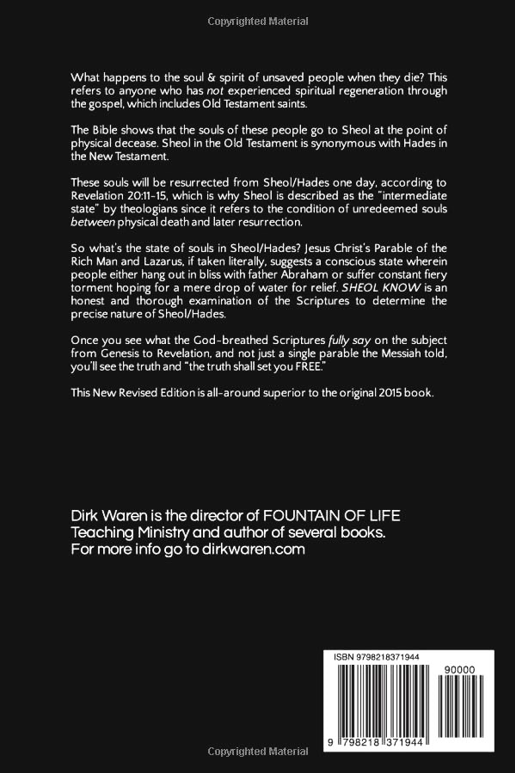
- The print book is available here for just over $10 (257 pages)
- The eBook is available here for just 99¢
- The more affordable Condensed Version is available here for only about $6 (153 pages); or get the eBook for just 99¢.
Related Topics:
Sheol / Hades: The “Intermediate State” of the Unsaved Dead
Q&A on HUMAN NATURE: Spirit, Mind & Flesh
RESURRECTIONS: Firstfruits, Harvest & Gleanings
The Believer’s INTERMEDIATE STATE (Between Physical Death and Bodily Resurrection)
HELL (Human Damnation) — Questions and Answers
The Three Realms—Heaven, Earth and the Underworld
ETERNAL LIFE (“Heaven”): Questions & Answers
Did the Crucified Thief Go to Paradise THAT DAY?
What Scripture Passages Disprove CALVINISM?

The Scriptures that disprove Calvinism are as follows: Genesis 1:1 – Revelation 22:21.
Yes, I’m being amusing, but also serious. For respectful details, see David Servant’s excellent Calvinism’s Five Points Considered.
Related Topics:
Human FREEWILL and God’s SOVEREIGNTY
God’s Perfect Will vs. God’s Permissive Will
Hermeneutics — Proper Bible Interpretation
BEREAN SPIRIT — What Is It? How Do You Cultivate It?
What Are the GREATER WORKS Christ Said Believers Will Do?
The Lord said “Very truly I tell you, whoever believes in me will do the works I have been doing, and they will do even greater things than these, because I am going to the Father” (John 14:12). What are these “greater works” that believers are supposed to be doing?
- Since one could hardly do greater works than Christ when he ministered on Earth, such as raising the dead, he was possibly referring to volume of works, particularly since he notes that he would be going to the Father and proceeds to emphasize that the Holy Spirit would come down and live inside believers as their Helper (John 14:16). When this occurs it wouldn’t be just one man doing the awesome works of Christ in one location, but rather believers all over the world because the spirit of Christ is in all of them (Romans 8:9).
- The “greater things” Jesus was referring to would certainly include evangelizing people wherein they receive spiritual regeneration by the Spirit (Titus 3:5), which was not available during Christ’s earthly ministry until after he died for our sins and was raised to life for our justification (1 Corinthians 15:1-4 & Romans 4:25). This would be raising the dead in a spiritual sense (Ephesians 2:4-5) and would definitely be a greater work than what Christ did during his 3.5 years of earthly ministry. Another “greater work” would be laying hands on converts and their receiving the baptism of the Holy Spirit & and benefits thereof.
This article is also available in book form (with more details) in chapter 8 of…

- The print book is available here for only $12.50 (303 pages)
- The Kindle eBook is available here for just 99¢!
Both links allow you to “look inside” the book.
Related Topics:
Does Christianity Weaken People or EMPOWER?
Dunamis (Dynamite) POWER — Is Within YOU!
Are Christians Commissioned to RAISE THE DEAD?

Christ raised three people from the dead during his earthly ministry:
- The widow’s son at Nain (Luke 7:11-17)
- Jairus’ daughter (Matthew 9:18-26, Mark 5:21-43 & Luke 8:40-56)
- Lazarus (John 11:1-44)
Because the Lord said “Very truly I tell you, whoever believes in me will do the works I have been doing, and they will do even greater things than these, because I am going to the Father” (John 14:12), some understandably argue that believers should be raising the dead as well. Here are two things to keep in mind on this:
- Since one could hardly do greater works than Christ when he ministered on Earth, such as raising the dead, he was possibly referring to volume of works, particularly since he notes that he would be going to the Father and proceeds to emphasize that the Holy Spirit would come down and live inside believers as their Helper (John 14:16). When this occurs it wouldn’t be just one man doing the awesome works of Christ in one location, but rather believers all over the world because the spirit of Christ is in all of them (Romans 8:9).
- The “greater things” Jesus was referring to would certainly include evangelizing people wherein they receive spiritual regeneration by the Spirit (Titus 3:5), which was not available during Christ’s earthly ministry until after he died for our sins and was raised to life for our justification (1 Corinthians 15:1-4; Romans 4:25). This would be raising the dead in a spiritual sense (Ephesians 2:4-5) and would definitely be a greater work than what Christ did during his 3.5 years of earthly ministry. Another “greater work” would be laying hands on converts and their receiving the baptism of the Holy Spirit & and benefits thereof.
After Christ’s death & resurrection, there are two cases where believers prayed for dead people and they were brought back; and one instance of a mortally-wounded person being fully healed:
- Tabitha, who died after falling ill, but was raised from death after Peter prayed for her (Acts 9:36-42).
- The boy, Eutychus (YOO-too-kus), who fell from a window and died while Paul was preaching, but was raised to life via Paul’s Holy Spirit-led service (Acts 20:7-12).
- Paul was mortally wounded after being stoned by religious zealots in Lystra and left for dead, but the believers gathered around him in prayer and he was fully healed (Acts 14:19-20).
While these believers were led of the Spirit to pray for the dead or dying and they were miraculously raised up, believers are not technically commissioned to raise the dead, as observed in the two passages that relay the Great Commission and the corresponding signs:
15 He said to them, “Go into all the world and preach the gospel to all creation. 16 Whoever believes and is baptized will be saved, but whoever does not believe will be condemned. 17 And these signs will accompany those who believe: In my name they will drive out demons; they will speak in new tongues; 18 they will pick up snakes with their hands; and when they drink deadly poison, it will not hurt them at all; they will place their hands on sick people, and they will get well.”
19 After the Lord Jesus had spoken to them, he was taken up into heaven and he sat at the right hand of God. 20 Then the disciples went out and preached everywhere, and the Lord worked with them and confirmed his word by the signs that accompanied it.
Mark 16:15-20
18Then Jesus came to them and said, “All authority in heaven and on earth has been given to me. 19Therefore go and make disciples of all nations, baptizing them in the name of the Father and of the Son and of the Holy Spirit, 20and teaching them to obey everything I have commanded you. And surely I am with you always, to the very end of the age.”
Matthew 28:18-20
The Great Commission involves going out and making disciples from all over the world, baptizing them, and teaching them the New Covenant truths of Holy Scripture. In the passage from Mark 16 Christ also lists the signs that will accompany believers carrying out this commission, which includes exorcizing demons and laying hands on people to heal them. Yet notice that nothing is said about raising the dead nor are there any instructions in the epistles concerning believers going out to raise the dead. Instead, this is what is taught:
14 Is anyone among you sick? Let them call the elders of the church to pray over them and anoint them with oil in the name of the Lord. 15 And the prayer offered in faith will make the sick person well; the Lord will raise them up. If they have sinned, they will be forgiven.
James 5:14-15
This corresponds to one of the signs Christ said would accompany believers — they will place their hands on sick people and they will get well. But please note the key element in releasing God’s power to heal the sick in verse 15 — FAITH. This is what the believers did when they gathered around the near-dead Paul in prayer and he miraculously received a full healing (Acts 14:19-20). You can learn more about healing by faith here.
So, believers are not commissioned to run around laying hands on dead people in the hope of raising them to life. Can you imagine the awkwardness and embarrassment of a zealous believer trying to raise someone from the dead at a funeral and nothing happens, not to mention the serious legal ramifications?
That said, if you are led of the Spirit to lay hands on the freshly dead in a tragic situation, like Peter did with Tabitha and Paul with Eutychus, do as you are guided; the same if you’re dealing with someone near-death, like Paul after being stoned and left for dead. Since raising someone from the dead or healing someone who is mortally wounded are great works, you’ll at least have to be a great man/woman of faith to be effective; and you’ll likely need one of the gifts of the Spirit to be flowing in you at the moment, like special faith, healing or working of miracles (1 Corinthians 12:4-11).
I stress being led of the Spirit because God does not automatically want someone brought back from physical death. For instance, when my father passed away at the hospital after suffering a series of strokes for several years and slowly deteriorating, including his leg being amputated on his final visit, I had zero leading to lay hands on him and pray for him to be brought back. Why? Because God was done with him on Earth and it was time for him to go.
Tabitha, by contrast, needed to be brought back so that she could continue her notable ministry to the poor and Eutychus was brought back because he was just a boy with a whole life in front of him. Meanwhile Paul was fully healed after being left for dead because he had years of world-reaching service to conduct, including two more missionary journeys.
This article is available in book form as part of chapter 8 of….
- The print book is available here for only $12.50 (303 pages)
- The Kindle eBook is available here for just 99¢!
Both links allow you to “look inside” the book.
Related Topics:
Dunamis (Dynamite) POWER — Is Within YOU!
Should You Get the Surgery or BELIEVE FOR HEALING?
Can the Power/Anointing of God Rest on an Object?
Q&A on Solomon’s SONG OF SONGS

This article mines the Song of Songs and related resources for insights by addressing myriad key questions concerning this unique book of the Bible. Whenever the answer is uncertain, the best possible ones are supplied.
What is the Song of Songs?
The Song of Songs is a poetic book of the Hebraic Scriptures — aka the Old Testament — that involves the lyrics to a love song in eight chapters. It follows the books of Proverbs and Ecclesiastes; and precedes the prophetic books, which begin with Isaiah.
The Song of Songs is relatively short at eight chapters in poetic form, which can be cursorily read in 15-20 minutes. It’s available online here for you to read or reference.
The fact that there are multiple speaking parts, including choruses of people, suggest that it was acted out as a musical, possibly as part of a wedding festival. Keep in mind that poetry, songs and stories were entertainment in ancient times, just as concerts, movies and shows are to us today.
Who wrote the Song of Songs?
The very first verse plainly states: “Solomon’s Song of Songs” with the literal Hebrew reading “The Song of Songs that [is] of Solomon,” thus it was written by Solomon. This corresponds to the fact that Solomon “spoke three thousand proverbs and his songs numbered a thousand and five” (1 Kings 4:32).
This incidentally explains why the book is often listed in some translations as the Song of Solomon, as it is in the King James Version and New King James Version.
When was it written?
Since the cities noted in the song involve both northern and southern Israel, the events of the story and the time of composition indicate any time during Solomon’s reign from 971-931 BC, which was before the kingdom was divided into Israel (north) and Judah (south) after Solomon’s reign (1 Kings 11:41-12:33).
Why is it called the “Song of Songs”?
Of the 1005 songs that Solomon wrote this was obviously his greatest song, his ‘magnum opus,’ and no doubt his longest. Thus he dubbed it accordingly, inspired by the Holy Spirit (2 Peter 1:21). It literally means the “best of songs.” Similar wording can be observed in other biblical phrases like Lord of Lords, King of Kings, and Holy of Holies. You could say it was Solomon’s “greatest hit” or “triple-platinum record.”
Is it an anthology of love poems?
The reality that the Song of Songs is Solomon’s greatest song and that it’s “God-breathed,” as is all Scripture (2 Timothy 3:16), rules out the theory of modern scholars that it is simply an ancient collection of secular love poems from Mesopotamia, Egypt and Greece. This “anthology” interpretation is also invalidated by the glaring literary unity of the song, as observed by repeated phrases and ideas, such as “the daughters of Jerusalem/Zion” (1:5, 2:7, 3:5, 3:10-11, 5:8, 5:16 & 8:4).
The fact that this book of the Bible is an epic love song explains the challenge of discerning a coherent story. The nature of song lyrics & poetry is to convey emotions and spur intrigue, images, ideas and morals above a point-by-point saga. As art, the Song of Song inspires people one way or another and is written in such a way to leave room for interpretation. A good modern example would be the popular song Stairway to Heaven. Has anyone yet been able to conclusively figure out what this classic song is about or what it means? Ask ten different people and you’ll get ten different answers. That’s part of the appeal of art appreciation — putting the pieces of the puzzle together, finding the meaning(s), gleaning from it and allowing it to enhance your life one way or another.
That’s what the Song of Songs is all about with the obvious distinction that it’s not just human art, but Holy Spirit-inspired Scripture.
Why has it been considered “controversial” by some?
Because it’s a love song filled with overtly romantic statements between two lovers, including references to potential sex or actual sex (e.g. Song of Songs 7:6-9), as well as other passionate proclamations (e.g. 2:3-6).
Those who have questioned the book’s inclusion in the biblical canon obviously felt that human romance/sexuality is an inappropriate topic for Holy Scripture. Yet isn’t romantic love and everything that goes with it a significant part of life on the Earth? Wouldn’t the very Creator of men & women and sex have something helpful to say on such an important topic in God’s instruction manual for humankind?
We have to remember in these days of gross sexual immorality that sex itself is not evil; it’s sexual immorality that is evil. The LORD created sex while the devil — “the god of this world” (2 Corinthians 4:4) — perverts it.
How was the Song of Songs determined to be part of the canon of Scripture?
From the earliest times the book formed a part of the Hebrew canon of Scripture and read annually at Passover.
However, due to its supposedly controversial content, the Song of Songs place in the Hebraic canon was still debated as late as 90 AD at the Council of Jamnia where it was affirmed by Jewish rabbis, including Akiva.
Should this book be taken at face value as a love story or as an allegory?
Since the LORD’s relationship with Israel is depicted as a marriage (Isaiah 50:1, Jeremiah 2:2, Ezekiel 23 & Hosea 2:2) and the Church is the “bride of Christ” (2 Corinthians 11:2 & Revelation 19:7-9), the Song of Songs could be taken in an allegorical sense of God’s Love for Israel or Christ’s love for his Church. I’ve heard a couple of effective sermons by Mike Bickle that interpreted the book this way.
However, the traditional idea from hymnology that Christ is the “rose of Sharon” or “lily of the valleys” based on Song of Songs 2:1 is erroneous since the woman in the story is speaking, not the man. Meanwhile there are issues that arise when interpreting the book in a strictly allegorical sense; for instance, the image of Christ resting between the breasts of the Church based on 1:13. The motivation for this allegorical interpretation seems rooted in embarrassment over the overt sexual references.
As such, the Song of Songs should first and foremost be taken as an amazing love story between a biological man and biological woman with numerous lessons on romantic love and marriage. We’ll look at these myriad insights momentarily.
Where do the events of the song take place?
The love story combines rural and urban locations. Jerusalem is the city where Solomon’s palace was located while the rural areas would be the hill country north of Jerusalem where Solomon’s vineyards, herds and flocks were located, not to mention where the maiden hailed from in Shunem (6:13).
How long do the events entail?
Assuming it’s a chronological account without gaps, the story occurs over the course of a year and some weeks/months, but no more than two years. This is based on the first spring being mentioned in Song of Songs 2:11-13 and the second spring near the end of the book in 7:12.
Who is the woman in the story?
Since she is referred to as a Shulammite in Song of Songs 6:13, she was a maiden from Shunem, which was/is a village located 3 miles north of Jezreel in southern Galilee, roughly 55 miles north of Jerusalem. (Shulem and Shunem are synonymous, by the way, as observed by 1 Kings 1:3, 2 Kings 4:8 and Joshua 19:18). This precludes the theory that she was Pharaoh’s daughter, one of Solomon’s early wives, as detailed in 1 Kings 3:1.
While Shunem is is about 30 miles south of the border of Lebanon, it’s squarely in Israel. I point this out because I’ve heard one or two commentators refer to the maiden as Lebanese, likely because the land of Lebanon is mentioned seven times in the song (e.g. 4:8). No, the text plainly calls her a “Shulammite” (6:13), aka an Israelite from the village of Shunem, which — again — is just 55 miles north of the capitol city.
Since she was a Shulammite, some favor the idea that she was Abishag (ab-ee-SHAG), the virgin who was enlisted to take care of the elderly King David and keep him warm in bed, but had no sexual relations with him (1 Kings 1:1-4, 15). The fact that the Bible describes Abishag as “very beautiful” in 1 Kings 1:4 corresponds to the description of the maiden in Song of Songs as flawless and the “most beautiful of women” (1:8 , 4:7 & 6:1). However, the fact that Solomon neglected to call her Abishag in the Song of Songs and failed to mention how she cared for his elderly father — and this was, in fact, how he met her — makes this theory questionable.
I’ve read one or two commentaries where the author refers to the maiden by the name Shulamith, obviously based on the fact that she’s called a Shulammite in 6:13. This is odd since the term identifies where she’s from, not her personal name. It’d be like calling me Mecca because I hail from Mecca, Ohio.
This leaves us with the woman simply being an unnamed maiden from Shunem whose family was possibly employed by King Solomon in the hill country north of Jerusalem wherein he had vineyards, as wells as herds and flocks (Song of Songs 8:11 & Ecclesiastes 2:4-7). Another possibility is that her family simply owned vineyards/animals near Solomon’s fields.
A further consideration is that the Shulammite woman is simply a character in a fictional love story that Solomon was inspired by the Holy Spirit to write, sort of like an ancient-epic spiritual version of John Cougar Mellencamp’s ditty about Jack & Diane.
Who is the man in the love story?
Solomon is the knee-jerk answer since the king is referred to numerous times in the book (1:1, 1:5, 3:7, 3:9, 3:11, 8:11 & 8:12), but there’s also a shepherd lover who may or may not be one-and-the-same as Solomon. It depends on what interpretation one embraces, which brings up the question…
What are the main interpretations of the love story?
There are several interpretations because it’s not always clear who’s speaking in any given verse or verses. Most versions of the Bible add headings to identify who is speaking, obviously to help readers understand the story, but these headings are not a part of the original text; they were added by the translators of the version in question. This explains why the King James Version doesn’t include headings.
Here are the five chief interpretations:
Interpretation #1: A historical account of Solomon and his first love, his first wife
According to this position, Solomon meets the woman from Shunem when he’s visiting his vineyards north of Jerusalem and is profoundly smitten by her. She is Solomon’s first true love and becomes his first wife. In his older, more experienced years Solomon advocated one wife in Ecclesiastes 9:9, and I’m sure — assuming this interpretation is the correct one — that he intended for this nubile woman from Shunem to be his one-and-only. But, as noted earlier, the events in the Song of Songs only cover a year and some weeks/months; Solomon went on to marry hundreds of foreign women for political reasons, as he did with Pharaoh’s daughter, which the LORD had instructed his people not to do (1 Kings 3:1, 11:1-4, Deuteronomy 17:17 & Exodus 34:15-16). In other words, Solomon sinned by marrying these myriad foreign wives; not only did they take his attention away from his first love (the Shulammite maiden), even worse, they led him astray from pure devotion to the LORD and into idolatry.
So, this view of the Song of Songs depicts Solomon’s relationship with his first love before he transgressed by marrying multiple foreign women, which brought about his downfall. If this reading is true, obviously God thinks this relationship in its short context is a fitting example from which to learn about romance, love and marriage despite Solomon’s ensuing moral failure in years to come.
Let me offer a real-life example to defend this position (even though I personally don’t favor it): I worked with a guy for several years three decades ago who was the best possible worker you could imagine. He was exceptional, but went on to work for another company in the same basic position. As the years progressed, he grew weary of his occupation and started to engage in unethical practices even though he still “got the job done.” For instance, he’d be on the clock while not present at work. I’d have no problem citing this man as a prime example of the ideal worker when he was younger, but not in his later years. The same principle applies to the Solomon depicted in the Song of Songs vs. the polygamous, idolatrous Solomon of 1 Kings 11:1-4 or the disillusioned Solomon of Ecclesiastes.
For those who object to Solomon being the sole male lover in the Song of Songs on the grounds that the King of Israel would be too busy with royal duties and would not have time for lowly activities like shepherding flocks (1:7), we know from other passages that King Solomon had vineyards in the hill country north of Jerusalem, as wells as herds and flocks (Song of Songs 8:11 & Ecclesiastes 2:4-7). Would he not get “out” and personally check on them from time to time? In regards to shepherding flocks, isn’t it possible that his father, David, informed him about how instrumental shepherding sheep was to becoming an effective, noble leader of God’s people (2 Samuel 7:8).
Thus young Solomon would theoretically get away from the hubbub of political big city life and spend a few nights here and there in retreat, overseeing his herds and flocks. This would cultivate intimacy with the LORD, especially at night under the quiet starry panorama, as well as keep him in touch with the common people of Israel. I’m in fulltime ministry and I regularly take the time to go primitive camping or hiking, gazing at the stars at night seeking the LORD.
For those interested, the basic outline for this interpretation is as follows (based on John MacArthur’s take):
I. The Wooing: “Leaving” (1:2-3:5)
A. The Couple’s Reminiscences (1:2-2:7)
B. The Couple’s Expression of Mutual Love (2:8-3:5)
II. The Marriage Ceremony: “Cleaving” (3:6-5:1)
A. The Regal Bridegroom (3:6-11)
B. The Wedding and Consummation (4:1-5:1a)
C. The LORD’s Approval (5:1b)
III. The Marital Covenant: “Weaving” (5:2-8:14)
A. The Initial Disagreement (5:2-6:3)
B. The Mending (6:4-8:4)
C. Developing in Grace (8:5-14)
Here’s another outline for this reading, a simpler variation by Don Anderson:
I. Courtship (1:1-2:17)
II. Commitment (3:1-5:1)
III. Challenge (5:2-6:13)
IV. Communion (7:1-8:14)
Interpretation #2: A historical account of Solomon when he already had 60 wives and 80 concubines
This position is the same as above except that King Solomon already has 60 wives and 80 concubines by the time he meets the Shulammite maiden. Here’s the passage that supports this reading wherein the man is speaking:
8Sixty queens there may be,
and eighty concubines,
and virgins beyond number;
9but my dove, my perfect one, is unique,
the only daughter of her mother,
the favorite of the one who bore her.
The young women saw her and called her blessed;
the queens and concubines praised her.
The obvious problem with this interpretation is that the Shulammite maiden is clearly head-over-heals in love with her beloved, but would she be this excited if she knew she had to share him with no less than 140 women, not to mention the likelihood of hundreds more in the years to come? (As noted earlier, Solomon’s harem eventually grew to 700 wives and 300 concubines according to 1 Kings 11:3).
Then there’s additional problem of the Shulammite’s repeated statement that “My beloved is mine” (2:16 & 6:3). If Solomon had 60 other wives at this time (to say nothing of the 80 concubines) he’d also be the possession of these myriad other spouses, which of course makes such a statement wholly untrue.
Do the math, if Solomon acquired 700 wives during his 40-year reign, which is 480 months (or 2080 weeks), that means there’d be on average a wedding festival at the palace about every 3 weeks! Keep in mind that these wedding feasts would last days, even up to a week or more (see Jesus’ Parable of the Wedding Banquet in Matthew 22:1-14). Imagine being Solomon’s wife and having to celebrate your husband marrying a new spouse that regularly! Even if you were his ‘favorite’ — his “queen of queens”— you definitely couldn’t call him “yours.” He’d be “yours” only in an extremely fractional sense.
In light of these glaring issues, the male protagonist in the story is likely just describing his Shulammite lover as “one in a million” when distinguishing her from “sixty queens,” “eighty concubines” and “virgins beyond number.” He basically says as much in 2:2 with his words “Like a lily among thorns is my darling among the young women.” This corresponds to his earlier exaggerated statement that there was “no flaw” in her (4:7); and is also supported by the fact that Solomon doesn’t include any language in his song about ownership or relationship with these “sixty queens,” “eighty concubines” and “virgins beyond number.” Furthermore, the numerical progression from sixty to eighty to “beyond number” points to poetic hyperbole rather than literalism.
Interpretation #3: Solomon wrote the epic song as a largely fictional love story involving a monogamous version of his self
In this reading the love story is fictional, a work of art, albeit spiced with elements from Solomon’s real-life experiences, much as modern writers and composers create stories/lyrics with bits taken from real life, including characters. As these writers have a message to convey with their art, so did Solomon, albeit he was inspired by the Holy Spirit (2 Peter 1:21 & 2 Timothy 3:16).
For those who have an issue with Solomon using an idealized version of himself as the male protagonist in the story, artists do this all the time in their works. For instance, M. Night Shyamalan cast himself as an author in his movie Lady in the Water whose writings would be the seed to changing the world (while I didn’t have a problem with this, some critics understandably knocked Shyamalan for being pretentious). Another example is William Shatner. When asked how he approached the iconic character of Captain Kirk on Star Trek, he said he simply played himself, just a more heroic version. Likewise, Solomon is playing himself in this epic love song, just an idealized version.
No one knows the exact date that Solomon wrote the Song of Songs in the 10th century BC but, assuming he wrote it in his later years and assuming this interpretation is valid, he would’ve regretted his moral failures concerning his vast harem & idolatries and so wrote this magnum opus to, in effect, right those wrongs by offering a positive message to the public concerning romantic love & marriage and everything that goes with it.
Think about it like this, have you ever shared a story from your past, but downplayed your flaws and transgressions? Most of us have. Even the Bible itself does this concerning King David: When 1 Chronicles 20:1-3 details the era in David’s reign involving his adultery with Bathsheba and murder of her husband (detailed in 2 Samuel 11:1–12:23), it omits these transgressions altogether, choosing instead to focus on David’s victories over the Ammonites. Why? Because the historical books of Samuel & Kings focused on telling the good, the bad and the ugly of Israel, which informed the Hebrews how they ended up in exile; Chronicles, by contrast, was originally written to the Jews returning to the Promised Land after 70 years of exile who needed to know if they still fit into God’s plan. In other words, they didn’t need to know the sordid details of their national history at that particular time. They needed encouraged about their national identity and history, not ashamed and deflated.
Interpretation #4: A commoner becomes “king for the day” at his wedding feast
In this interpretation the male is not really Solomon, but rather a commoner who is entertained for a week, along with his bride, as “king and queen” during their wedding feast. In short, the two lovers are engaging in fantasy, using imagery of royalty to reflect their affection for one another.
The reasoning behind this interpretation is twofold: Solomon would’ve been too busy with his national duties to have time for a pastoral romance, not to mention the man in the love story is depicted as a shepherd in 1:7 and it’s difficult to imagine the king of Israel spending his time tending sheep. This perspective also resolves the conundrum of God using Solomon — who notoriously had 700 wives and 300 concubines during his reign (1 Kings 11:3) — as the key character in a biblical book conveying truths on ideal love and marriage.
The problem with this interpretation is that it’s just too vague and fails to explain the distinct references to King Solomon, his carriage, his 60 warrior escorts, Jerusalem and so forth.
Interpretation #5: A love triangle involving Solomon, the Shulammite and her beloved shepherd
In this reading there are three characters in the love story wherein King Solomon falls in love with the beautiful Shulammite maiden upon meeting her while visiting his vineyards north of Jerusalem. He whisks her away to his palace in the big city hoping to win her heart so that she’ll be his queen of queens, but she only has eyes for a young shepherd from her own community to whom she has been promised. She proves herself faithful to him and so Solomon eventually releases her to marry the shepherd with his sanction and that of her family.
While this narrative requires the reader to disregard most of the typical headings added to the text by well-meaning translators (and therefore are not God-breathed Scripture) and read-in-between-the-lines, it resolves several problematic points:
- The issue of the king of Israel being depicted as a lowly shepherd (1:7, 2:16 & 6:2-3) by insisting that there are two male protagonists — King Solomon and a young shepherd.
- The issue of the LORD dubiously using Solomon for biblical lessons on romantic love and marriage.
- The issue of the “daughters of Jerusalem” requiring a description of the man the Shulammite maiden loves (5:9-6:3), which makes no sense if the man is King Solomon since they’d already be well familiar with the top celebrity of Israel.
- The issue of the guardsmen of the city not seeming to know that the Shulammite lass is their boss’ desired woman or vice versa (3:1-4 & 5:2-7). It’s true that the first sequence might be a dream and the second one definitely is a nightmare wherein the watchmen beat her up and steal her cloak, but would King Solomon likely write in his greatest song such a fantasy tale of gross insubordination against the king of Israel? In other words, the more fitting interpretation is that the lover she was searching for was not King Solomon, the boss of the watchmen, but rather some nondescript shepherd from the sticks.
My corresponding book provides an outline for this “three-character view” or “shepherd hypothesis,” which you’ll need in order to grasp this interpretation when reading this epic love song since you’ll have to disregard the typical headings added by translators in most Bibles.
Who are the peripheral characters in the story?
While Solomon and the Shulammite maiden are the dominant characters in the story, and perhaps her Shepherd lover (if the “shepherd hypothesis” is valid), there are some minor characters with speaking parts as follows:
- The daughters of Jerusalem (1:4, 1:11, 5:9 & 6:1).
- The citizens of the city (3:6-11).
- The male protagonist’s friends (6:13).
- A relative (8:5).
- The Shulammite maiden’s brothers (8:8-9).
- The LORD is presumably speaking the words “Eat, friends, and drink; drink your fill of love” in 5:1 since it’s highly unlikely that ‘friends’ were eavesdropping on the couple’s lovemaking.
Again, the headings supplied in many English Bibles, which delineate the character(s) speaking (and whom they’re speaking to), are not included in the original Hebrew text. This explains why the KJV omits such headings. These headings are educated guesses by the translators of the version in question. Most of the above characters and corresponding citation links are from the NKJV. The NIV simply refers to all of the peripheral characters as “friends” without specifying their identity further.
Why is God not mentioned in the Song of Songs?
Because the LORD doesn’t have to be mentioned in a love song. God isn’t directly referenced in the book of Esther either. Yet this doesn’t mean the Creator is utterly absent from these biblical books as “All Scripture is God-breathed” (2 Timothy 3:16) and the Almighty works in the lives of His people to fulfill Divine will, as it is written: “for it is God who works in you to will and to act in order to fulfill his good purpose” (Philippians 2:13). Martin Luther put it like this: “God himself will milk the cows through him whose vocation that is. He who engages in the lowliness of his work performs God’s work.”
Thus in Esther we see the LORD working through the titular woman, Mordecai and ordinary people to deliver the Hebrews exiled in Persia from a satanic plot of genocide. On a more pleasant note in the Song of Songs, God is involved behind the scenes in the loving relationship of the Shulammite maiden and the shepherd lover (regardless of whether or not the shepherd is a nondescript young Hebrew or the King of Israel). How do we know this beyond the Song of Songs being a part of the Hebraic Scriptures? Because the events take place in Israel at the height of its united kingdom after the righteous reign of David, “a man after God’s own heart” (Acts 13:22). As such, both the Shulammite maiden and the shepherd would’ve sought the LORD about something as important as a lifelong mate and God arranged their meeting behind the scenes (we’ll look at this notion further in the section on arranged marriages).
This offers a lesson for believers: Not every work of art we create or every story we tell or every service we provide has to explicitly mention the Lord in order to effectively bless people. Often the subtle approach is the route to take rather than smashing people over the head with overt Christian verbiage.
What are some key insights readers can get from the Song of Songs?
Here are twelve to chew on…
Romantic love & the corresponding marriage/sex are pure and beautiful, not evil or embarrassing
There’s this false idea that God is anti-sex, but the LORD created both the sex organs and the pleasure of sexual intimacy, not to mention romantic attraction. Romance and eventual consummation are God’s gifts to be enjoyed within the context of a committed relationship. The devil didn’t create any of this, he just perverts it. God is pro-sex, but anti-sexual immorality.
When the couple finally consummate their marriage the LORD says “Eat, friends, and drink; drink your fill of love” in 5:1, which is basically the Creator’s seal of approval. (Again, it’s highly unlikely that ‘friends’ are speaking this line since they’d be eavesdropping on the couple’s private lovemaking; the LORD, by contrast, is omnipresent and sees all). God was basically saying to them: “Drink up, my children, and enjoy; lovemaking is my gift to you.” The Creator desires for spouses to delight in each other.
Sensual stimulation and simple encouragement is enhanced through sincere words of adoration
Learning to focus on your mate’s attributes and creatively praising him/her will enhance your relationship and marriage. This is something that should continue as the decades pass and your spouse is no longer in his/her physical prime.
Of course, this doesn’t mean that there isn’t a time and place for constructive criticism (Proverbs 9:8-9), which is a form of tough love.
True love heightens self-image and therefore confidence
This goes hand-and-hand with the previous. Like the lovers in the song, speak grandly of your mate, as if she’s the most amazing woman on Earth (6:8-9) and he can leap over mountains (5:10-16). Needless to say, this will have a positive effect on his/her self-image and will enhance your relationship and intimacy. Anyone who constantly puts down their spouse — whether privately or publicly — will spoil or even utterly destroy the relationship.
Speaking of which, Patti Roberts told the tragic story of her first lovemaking experience with her husband in her book Ashes to Gold: As he was lying on the bed and she removed her remaining garments he cluelessly observed, “You know, you look fatter with your clothes off.” She was naturally devastated and experienced this sinking feeling that, while they would have sex that night, they would not be lovers. It’s a miracle the marriage lasted ten years.
In Solomon’s song, by contrast, we observe the lovers freely communicating during their lovemaking in a mutually encouraging manner (4:1-5:1). They speak unreservedly to each other, which of course doesn’t mean you have to speak during sex. Yet it shows that we shouldn’t allow awkwardness or prudishness to inhibit our verbal communion during lovemaking.
The love-at-first-sight phenomenon
This phenomenon could more accurately be described as wholesale-attraction-at-first-sight, which can ideally develop into deep love and a long-lasting relationship. We observe this with the Shepherd’s observation about the Shulammite maiden:
You have stolen my heart, my sister, my bride;
With one glance of your eyes
With one jewel of your necklace
Song of Songs 4:9
This isn’t to say that all marriages begin with the love-at-first-sight phenomenon. For instance, my mother said she found my dad “egotistical” when she first met him and therefore wasn’t attracted to him. My father, however, said he was crazy about my mom the second he laid eyes on her. As he pursued her he eventually won her over and they were together till death did them part. The love-at-first sight phenomenon was obviously one-sided in this case, but it was still key to bringing the two together, without which I wouldn’t be here writing this.
Do not arouse love prematurely
Over and over the Shulammite maiden says “Do not arouse or awaken love until it so desires” (e.g. 8:4). In other words, don’t be so quick to jump into an intimate romantic relationship. Patiently wait until you’re mature enough to wisely discern the worthy soul your heart truly loves and can be committed to for life. Solomon elsewhere wrote “There is a time for everything, and a season for every activity under the heavens” (Ecclesiastes 3:1). The time for a man and woman to enjoy sexual union is marriage, which occurs after they’ve found the worthy one who has genuinely awakened their love.
In short, love must wait for the right soulmate to come along. Don’t rush getting married for the sake of getting married. Don’t be more enchanted with the idea of a wedding and marriage than the person you’re marrying. Anyone who does so is setting themselves up for great heartbreak.
This truth is especially apropos in our modern LIEberal-influenced culture where teens are pressured by peers and entertainment media to have sex as early as possible and as often as possible (and, sometimes, as perverse as possible), which — needless to say — is a recipe for all kinds of unnecessary troubles.
Eros love is defined
The Bible reveals that there are four types of love in the human experience. Whereas the great love passage, 1 Corinthians 13:4-8, defines agape love, aka practical love, the Song of Songs has a verse that expounds on eros (ee-ROSS) love:
6 Place me like a seal over your heart,
like a seal on your arm;
for love is as strong as death,
its jealousy unyielding as the grave.
It burns like blazing fire,
like a mighty flame.
7 Many waters cannot quench love;
rivers cannot sweep it away.
If one were to give
all the wealth of one’s house for love,
it would be utterly scorned.Song of Songs 8:6-7
Four qualities of eros love are noted:
- It is as strong and unyielding as death and the grave. In other words, love seals two souls together even as the grave seals the dead.
- It is like a blazing fire within the person.
- Figuratively speaking, it’s such a mighty inferno that not even rivers of water can quench it.
- No amount of money can purchase it; it is priceless and can only be given away. Remember the classic song Can’t Buy Me Love?
Beware of the “little foxes” that can slowly destroy eros love and the corresponding relationship
This can be observed in 2:15. Both partners must be on guard against little things that can build-up over time and eventually hinder or even ruin one’s relationship with God and his/her spouse. This could be any number of “little” things — sloth, lust/favoritism for others, lust/favoritism for other things, doubt, a thankless spirit, bitterness, frustration, hatred, porn, materialism, etc.
Keep weeds like this out of your garden, so to speak, and continue to cultivate faith and relationship with God, which naturally has a positive impact on your marriage, especially as the years and decades proceed. See this video and this one for further insights.
Arranged marriages are not the ideal
Back then arranged marriages were customary in biblical regions and they were organized by the families of the bridegroom and bride in question. Sometimes they were the result of political alliances, such as Solomon’s marriage to Pharaoh’s daughter (1 Kings 3:1). The obvious problem with such arrangements is that the individual is not choosing his/her spouse and so there’s a good chance that he/she won’t find him/her a fitting or desirable mate-for-life. This is a potential recipe for unhappiness and dissatisfaction, to say the least.
I’m not saying that arranged marriages can’t work. The best scenario in an arranged marriage is that the two spouses develop love for each other. But shouldn’t the beginning step for a happy marriage be that the man or woman is attracted to the spouse and enjoys spending time with him/her and vice versa? I’m not talking about mere physical lust here, but rather all-around physical/mental/spiritual allure. For instance, I may find Lady Gaga physically attractive, but — if I were single — I wouldn’t even want to go on a date with her let alone entertain the idea of marrying her. Why? Because I don’t find her inwardly appealing and we’re on different planets ideologically.
Another defense for arranged marriages is that one’s father & mother are the best possible people to choose a life-partner for you. Yet I know (and you know) many fathers and mothers who are the last persons on Earth to entrust such an important decision. Personally, I wouldn’t want anyone else choosing my wife for me, except God. Speaking of which…
Ideally, all Christian marriages should be arranged marriages in the sense that the man and woman have diligently sought their Creator on whom to marry and the Spirit leads them to their future spouse. In essence, God arranges the marriage. A good example of this in the Bible is when the LORD orchestrated the marriage of Isaac & Rebekah in Genesis 24.
However, that’s not what we’re talking about here. We’re talking about marriages being contractually arranged by families or leaders of nations wherein romantic desire isn’t a factor in the negotiation (which, again, isn’t to say that such feelings can’t come later). In these kinds of marriages neither the young woman nor the man pursued each other prior to the arrangement and, often, didn’t even know what the other looked like, particularly in cultures were the woman wore a veil.
Yet this is not what we observe in the Song of Songs, which is God’s biblical model for romantic love and marriage. The two lovers — who will go on to wed and consummate — are clearly head-over-heels in love with each other. For instance, observe how aggressively the Shulammite woman pursues her shepherd lover in 3:1-4. Even if this sequence is a dream (which I don’t believe it is) it reveals her great longing for “the one [her] heart loves.” Likewise, the man describes the Shulammite in terms of being intoxicated by her all-encompassing beauty and love (4:10).
This kind of intense all-around attraction forms the basis for a lasting marriage. We call it the “honeymoon stage.” Sure, this stage doesn’t last forever, but it’s the foundation upon which a lasting marriage is set.
For anyone who argues that the relationship of the Shulammite and her shepherd was orchestrated by their families and is therefore an arranged marriage: (1) The two were already well familiar with each other, (2) they totally adored each other and (3) they wanted to spend the rest of their lives together as a couple, all of which indicates that their committed relationship wasn’t an “arranged marriage” in the sense that we’re talking here.
Since the topic of wearing veils was breached above, this is a good place to point out that the Shulammite maiden didn’t wear a veil when out amidst the flocks in the Shunem region, which can be observed in 1:7. This explains how the shepherd lover knew her beauty so explicitly. When she asks “Why should I be like a veiled woman beside the flocks of your friends?” it indicates that prostitutes wearing veils wandered from flock to flock looking for shepherds interested in their services (e.g. Genesis 38:15). As a young woman looking for the one man she dearly loved, she didn’t want to be mistaken for a loose woman.
Monogamy is the way to go, not polygamy
The Song of Songs supports the idea that God’s best for marriage is monogamy, as clearly detailed in the beginning (Matthew 19:4-6). While the LORD allowed Hebrew men to marry multiple wives for a couple reasons, polygamy is not God’s ideal. Polygamous marriages chronicled in Scripture suffered contention with the inevitable rivalry of the wives (e.g. 1 Samuel 1:1-8).
Solomon’s accumulated wives were his undoing (1 Kings 11:1-4). While Solomon was certainly wise in his early reign (1 Kings 4:29) and he officially advocated monogamy as the ideal (Proverbs 5:18, Ecclesiastes 9:9 & Song of Songs), he foolishly ignored God’s scriptural instructions by taking multiple foreign wives (Deuteronomy 17:17 & Exodus 34:15-16).
In the New Covenant the Scriptures instruct that leaders in the Church should have but one spouse (1 Timothy 3:2, 3:12 & Titus 1:6), which was to be an example to the believers under them (1 Timothy 4:12 & 1 Peter 5:3). So, while the New Testament doesn’t outright forbid polygamy, it definitely encourages God’s ideal as originally stated in Genesis — one husband, one wife, till death do them part.
But why did the LORD allow polygamy in the Old Testament? A couple reasons come to mind: The world at the time generally consisted of patriarchal societies where females relied on their fathers, brothers and husbands for provision & protection. Thus marriage, even if it was polygamous, protected women from a life of poverty, prostitution or slavery.
Polygamy also facilitated God’s Genesis directive to “be fruitful and multiply, and fill the earth” (Genesis 1:28, 9:1 & 9:7) seeing as how husbands could impregnate other wives while one was pregnant/giving birth. This allowed men to have several children per year, as opposed to just one, and this was conducive to the increase & spread of humanity on Earth.
Take care of your appearance (even after you’ve won your bride or husband)
The shepherd’s description of his Shulammite maiden (6:8-9) and her descriptions of him (5:10-16) show that they were careful to look, smell and sound their best for their partner. While this is easy to do during the honeymoon stage of a relationship — which these two were in at the time — it’s important to strive to look/smell/sound your best for your partner as the decades progress. I include “sound” because the maiden describes the mouth of her lover as “sweetness itself” (5:16). Was she describing his literal maw or the sweet, encouraging words that proceeded from it? I believe the latter.
Of course everyone is going to be disheveled & sweaty after doing serious yard work or what have you but, even then, a relatively solid body and a healthy attitude go a long way in keeping one attractive whatever his/her age or body type. The Shulammite says of her lover: “His arms are rods of gold set with topaz. His body is like polished ivory decorated with lapis lazuli” (5:14). Men, don’t give up on the battle of the bulge. I realize it’s tough to keep fit today, especially if you have a sit-down job, but few woman want an unsightly slob, even if you’re in your 50s-60s!
Please don’t take this as insensitive to those struggling with weight issues. If a person or couple is okay with being heavy, what’s that to me? It’s none of my business. I’m just throwing in bit o’ humor while encouraging us to look our best for our spouses, whatever our age or body type. Amen?
Procreation is not the main purpose of sex
While procreation is certainly important, it’s not the main purpose of sex in light of the fact that its never mentioned as the reason for the couple’s physical relationship in the Creator’s one book on romance, sex and marriage in the God-breathed Scriptures (2 Timothy 3:16). In short, the LORD sanctioned and blessed their romance & sexual intimacy in and of itself.
Your mate needs you as a best friend, not just a physical lover
The Shulamite maiden plainly speaks of her lover as her beloved and her friend (5:16). She certainly wants him for sexual intimacy — and overtly so (7:12-14) (note the reference to mandrakes, an ancient aphrodisiac) — but she also desires her husband to be a brother to her (8:1-4). In other words, she wants them to be playmates. She feels so comfortable with her committed lover that she can be imaginative & playful — spinning tales — and knows that he will not laugh at her. Wives want their man to open his heart to them, to not just be a caring physical lover — as good as that may be — but a playful sibling and a communicative, imaginative, honest best friend. Take heed because truer words have never been spoken.
This is just a sampling of the great insights about romantic love & marriage contained in the Song of Songs. I’ll leave you to discover more for yourself.
What is the interpretation you favor?
I prefer the three-character version — Interpretation #5 — because it’s the best explanation for the lowly young shepherd in the story, who seems to be a different character from the formidable king of Israel. For instance, this interpretation explains why the ladies of the Jerusalem court required a description of him, which obviously wouldn’t be the case if he were King Solomon. Furthermore, it resolves the issue of God using polygamous Solomon as the key character in a biblical story involving lessons on love and marriage.
Song of Songs 8:5b-7 is key in validating this interpretation. These verses in the culminating chapter convey the conclusion of the love story and point to the purpose for which it was created by Solomon under the moving of the Holy Spirit. The female protagonist is addressing her beloved as the one she had met under the apple tree many months prior, the one who had initially awakened her love, whereupon she appeals to be placed as a seal on a cord about his neck (a mark of ownership) and as a signet ring on his arm, to be his spouse forever. In the interim Solomon had met her in the field and was so ‘wowed’ he naturally wanted to add her to his growing harem and so whisks her off to Jerusalem to dazzle her and win her heart. She declines despite the great pressure, including the women of the court who insisted that she now “had it made.” Yet she could not forget or forsake her shepherd lover to whom she was pledged, the one her heart loved.
Thus King Solomon, a so-called “lady’s man,” learns a valuable lesson about true love, i.e. committed love between a man and a woman, which is the way the Creator originally intended it (Genesis 2:24 & Matthew 19:4-6). Solomon’s Song of Songs — his “greatest hit” — is thus a lesson to all those who have heard the song, seen the performance or read the poem ever since!
For those who argue that it takes too much imagination to read the Song of Songs this way — in other words, they view it as a narrative forced into the text — every interpretation of this poetic book requires the reader to figure out what character or characters are speaking and to whom. Remember, the headings you’ll find in most versions of the Bible are not in the original text and were placed there by translators for readers’ convenience. In short, it’s up to us to make educated guesses about who is speaking and to whom, not to mention what’s taking place in the setting in question.
A Proposed Synopsis of the Love Triangle Interpretation
While visiting areas north of Jerusalem and viewing his vineyards, King Solomon is enraptured by an exceptional maiden from Shulem, aka Shunem. The damsel is brought into the king’s royal tents where she soliloquizes about her beloved shepherd (1:2-3), beseeching him to come to her rescue (1:4). She counters the disdain of the women of Solomon’s court (1:6) imploring her shepherd lover to reveal where she might find him (1:7). The ladies respond in irony (1:8) while the king enters conveying his praise to win her heart, but fails (1:9-11).
Dismissed from Solomon’s presence at the table, the Shulammite dialogues with her shepherd lover (1:12-2:6). She then addresses the court women and charges them not to arouse love until it so desires, citing her beloved shepherd as a praiseworthy example (2:7-14). She also conveys her brothers’ hindrances (2:15) and how she waited for her lover to come back in the evening, as well as eventually finding him (2:16-3:5).
Solomon’s procession returns from Shunem back to Jerusalem (3:6). His goal is to impress the Shulammite maiden with his royal glory amidst the splendor of the city & palace (3:1-11). But he is not successful as the shepherd lover has followed her there and arranged a meeting (4:1-5) wherein she reveals that she is anxious to leave the flashy environment and go back to her pastoral abode up north (4:6) to which the shepherd commends her faithfulness (4:7-16).
The maiden dialogues with the ladies of the court, informing them of a dream she had about her beloved (5:2-8) as well as describing his attributes to them when pressed (5:9-16). Several of the court women then inquire about the whereabouts of her lover to which she answers (6:1-3).
Still determined to win her heart, Solomon continues one last time with his flatteries and gaudy attractions to persuade her (6:4-7:9). He promises to make her his queen of queens with all the privileges thereof, but she declines his proposal due to her love for another and being promised to him (7:10-8:4).
Finally convinced, the king dismisses her and she returns to her abode up north with her beloved shepherd (8:5-14). They stop at the tree where they initially met and renew their vows to one another (8:5-7). Returning home, her brothers reward her for her honorable conduct, according to their promise (8:8-9).
This is based on Dake’s reading and is just one variation of the three-character interpretation. It’s not set-in-stone so feel free to tweak it if you so feel led.
Additional lessons if the love triangle theory is valid
- Not all women are materialistic and can be seduced by wealth, social status and charming flatteries.
- Some women are faithful to the one their heart loves above the lure of wealth and status.
- Some women understand and value the truths of Proverbs 15:17 & Proverbs 17:1.
- Just because a woman is extraordinarily beautiful, it doesn’t automatically mean she will allow it to spoil her by making her conceited.
Closing Words
Although I favor the three-character interpretation for the reasons stated, I know respectable people, even scholars, who embrace the Solomon’s-first-wife view or the Solomon-already-with-a-harem-of-140-women reading. Meanwhile the fictional love story account shouldn’t be ruled out. By contrast, the “king for a day” perspective doesn’t have much credibility.
I supplied these five main interpretations of this epic love song for you to consider in your studies because it helps to appraise all of them before drawing a plausible conclusion. Whatever perspective is true, we can all agree that the Song of Songs is an amazing, beautiful and unique book of the Bible with several relevant lessons on romance & marriage from which to glean. You don’t even have to be cognizant of a rigid interpretation in order to appreciate it and receive from it.
Lastly, this article is not intended to be a substitute for reading the Song of Songs and being blessed by the genius and beauty of the song itself; it’s just an educational supplement.
This article is available in book form with loads of additional material!

- The print book is available here for only $7.26 (171 pages)
- The Kindle eBook is available here for just 99¢!
Both links allow you to LOOK INSIDE the book.
Related Topics:
What IS Marriage? (and Related Topics)
Why LOYALTY (Faithfulness) Is Important
What’s the Secret of a SUCCESSFUL MARRIAGE?
Beauty, Objectification and Lust
Does the Bible Support MONOGAMY or POLYGAMY?

While the LORD allowed Hebrew men to marry multiple wives for a couple reasons, polygamy is not God’s best for marriage, as clearly detailed in the beginning (Matthew 19:4-6). Polygamous marriages chronicled in Scripture suffered contention with the inevitable rivalry of the wives (e.g. 1 Samuel 1:1-8).
Meanwhile Solomon’s myriad wives were his undoing (1 Kings 11:1-4). While Solomon was certainly wise in his early reign (1 Kings 4:29) and he advocated monogamy as the ideal (Ecclesiastes 9:9 & Song of Songs), he foolishly ignored God’s scriptural instructions by taking multiple foreign wives (Deuteronomy 17:17 & Exodus 34:15-16).
In the New Covenant, the Scriptures instruct that leaders in the Church should have but one spouse (1 Timothy 3:2, 3:12 & Titus 1:6), which was to be an example to the believers under them (1 Timothy 4:12 & 1 Peter 5:3). So, while the New Testament doesn’t outright forbid polygamy, it definitely encourages God’s ideal as originally stated in Genesis – one husband, one wife, till death do them part.
But why did the LORD allow polygamy in the Old Testament? A couple reasons come to mind: The world at the time generally consisted of patriarchal societies where females relied on their fathers, brothers and husbands for provision & protection. Thus marriage, even if it was polygamous, protected women from a life of poverty, prostitution or slavery.
Polygamy also facilitated God’s Genesis directive to “be fruitful and multiply, and fill the earth” (Genesis 1:28, 9:1 & 9:7) seeing as how husbands could impregnate other wives while one was pregnant/giving birth. This allowed men to have several children per year, as opposed to just one, and this was conducive to the increase & spread of humanity on Earth.
Related Topics:
What IS Marriage? (and Related Topics)
Beauty, Objectification and Lust
Why You Shouldn’t Put Men or Women in a Box (Marriages too)
Q&A on Sex, Romance and Marriage
Q&A on Solomon’s SONG OF SONGS
Women of the Bible / Women in Ministry
What’s the Diff Between MILK and SOLID FOOD (“Meat”)?
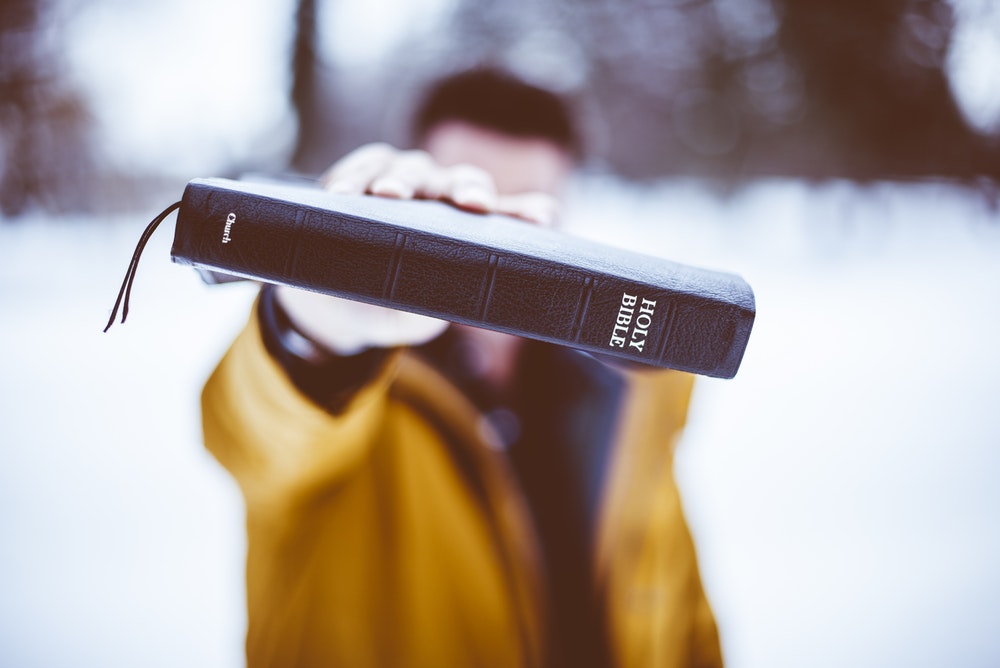
Both the Old Testament and New Testament say that “Man shall not live on bread alone, but on every word that comes from the mouth of God” (Deuteronomy 8:3 & Matthew 4:4). This suggests that God’s word is spiritual food for people. The way you partake of this spiritual food is by exposing yourself to it, “chewing” on it – that is, meditating on it – and then “swallowing” it by living it (if it’s a practical truth) or living in light of it (if it’s a revelational or positional truth).*
* You can learn more about the differences of these kinds of truth here.
Interestingly, the New Testament differentiates spiritual food into two forms – milk and solid food – as observed here:
Brothers and sisters, I could not address you as people who live by the Spirit but as people who are still worldly—mere infants in Christ. 2 I gave you milk, not solid food, for you were not yet ready for it. Indeed, you are still not ready. 3You are still worldly. For since there is jealousy and quarreling among you, are you not worldly? Are you not acting like mere humans? 4For when one says, “I follow Paul,” and another, “I follow Apollos,” are you not mere human beings?
1 Corinthians 3:1-4
Just like infants in the natural, immature or young believers need to be fed the “milk” of God’s word before they can handle the “solid food” or “meat.” Let me give an example from my own life: When I was a young believer in my early 20s I was growing in the Lord on a daily basis, but I was mostly drinking the “milk” of God’s word while trying out some “solid food” here and there. On one occasion I had a book by an anointed minister that addressed the topic of demons & exorcism and it was just too heavy for me at the time. So I put it on back burner, so to speak, until I could handle such things.
Does the Bible specifically delineate what the difference between “milk” and “solid food” is? Yes, it does:
We have much to say about this, but it is hard to make it clear to you because you no longer try to understand. 12In fact, though by this time you ought to be teachers, you need someone to teach you the elementary truths of God’s word all over again. You need milk, not solid food! 13Anyone who lives on milk, being still an infant, is not acquainted with the teaching about righteousness. 14But solid food is for the mature, who by constant use have trained themselves to distinguish good from evil.
1Therefore let us move beyond the elementary teachings about Christ and be taken forward to maturity, not laying again the foundation of repentance from acts that lead to death, a and of faith in God, 2instruction about cleansing rites, b the laying on of hands, the resurrection of the dead, and eternal judgment.
Hebrews 5:11-14 & 6:1-2
The six basic doctrines of Christianity detailed in verses 1-2 are called “elementary” and are said to be the “foundation” of the believer, which suggests that these six doctrines are “milk.” The “solid food” or “meat” would be any doctrine that can be built on this basic foundation and would take the believer deeper into knowing the LORD and being effective in God’s service, like discerning the difference between flesh & spirit and walking free of sin by living according to the spirit, functioning in the forms of prayer on a regular basis, legalism vs. libertinism, spiritual warfare, demonology / angelology and so on. For a detailed examination of the six basic doctrines go here.
Notice how verse 14 shows that mature believers are able to distinguish good and evil, which means that they understand the differences between the fruit of the spirit and the works of the flesh (Galatians 5:19-23). Furthermore, it’s implied that they are able to live free of the flesh by daily walking in the spirit.
Immature believers, by contrast, are still struggling with flesh issues, which can be observed in the first passage showcased above, 1 Corinthians 3:1-4, wherein Paul calls the believers in Corinth “infants” who could only handle “milk,” not “solid food.” What evidence does he offer of this? He says that the Corinthian believers were still “worldly” – that is, walking according to the flesh – because their assemblies were characterized by constant jealousies and quarrels, not to mention juvenile sectarianism (verses 3-4). While every assembly in the worldwide Church will experience jealousies, quarrels and sectarianism due to the influx of immature believers, it’s clear that the elders in Corinth were functioning like this, which is why Paul corrected them.
Of course even mature believers miss it now and then, which is explained in 1 John 1:8-9, but there’s a difference between a believer living out of his/her flesh on a regular basis – like the Corinthians were doing – and a believer who has learned to walk in the spirit on a 24/7 basis. The former are stuck in Stage Two of spiritual growth whereas the latter are in Stage Four or, at least, Stage Three. You can learn more about the stages of spiritual growth here.
To close, the six basic doctrines in their simplest form would be “milk” for the believer whereas everything else lain on top of this foundation would be “solid food” or “meat.”
Related Topics:
What Are the Sources of TRUTH (Reality)?
Hermeneutics — Proper Bible Interpretation
BEREAN SPIRIT — What Is It? How Do You Cultivate It?
What’s the Difference Between TEACHING and PREACHING?
What Did Paul Mean by ACCORDING TO THE SCRIPTURES?

Speaking of Christ’s death, burial and resurrection, Paul made this statement by the Holy Spirit:
For what I received I passed on to you as of first importance: that Christ died for our sins according to the Scriptures, 4 that he was buried, that he was raised on the third day according to the Scriptures,
1 Corinthians 15:3-4
What Scriptures was Paul referring to? Since the book of James and three of Paul’s earlier epistles (the two Thessalonian letters and Galatians) were the only New Testament Scriptures at this point in time,* it would be a reference to the Old Testament Scriptures since they clearly spoke of the sufferings, death & resurrection of Christ, e.g. Psalm 16:8-11, Psalm 22 & Isaiah 53. Also see Luke 24:25-27 and Acts 2:25-31.
Paul made another interesting reference to the existing Scriptures of that time earlier in the same epistle, in 1 Corinthians 4:6, which you can read about here.
* For a listing of the chronological order of the New Testament books go here.
Related Topics:
What Does “Do Not Go Beyond What is Written” Mean in 1 Corinthians 4:6?
What Are the Sources of TRUTH (Reality)?
Hermeneutics—Proper Bible Interpretation
BEREAN SPIRIT — What Is It? How Do You Cultivate It?
Who Wrote the New Testament Books? Who Authorized them as Scripture Canon?