
What Does It Mean to Be BAPTIZED WITH FIRE?

What did John the Baptist mean when he said regarding Christ: “He will baptize you with the Holy Spirit and fire”? Let’s read the statement in its fuller context as that will reveal its meaning:
7But when he saw many of the Pharisees and Sadducees coming to where he was baptizing, he said to them: “You brood of vipers! Who warned you to flee from the coming wrath? 8Produce fruit in keeping with repentance. 9And do not think you can say to yourselves, ‘We have Abraham as our father.’ I tell you that out of these stones God can raise up children for Abraham. 10The ax is already at the root of the trees, and every tree that does not produce good fruit will be cut down and thrown into the fire.
11“I baptize you with water for repentance. But after me comes one who is more powerful than I, whose sandals I am not worthy to carry. He will baptize you with the Holy Spirit and fire. 12His winnowing fork is in his hand, and he will clear his threshing floor, gathering his wheat into the barn and burning up the chaff with unquenchable fire.”
Matthew 3:7-12
The corrupt religious leaders of Israel went out to observe John’s ministry of baptizing repentant people in the Jordan River. When the fiery prophet saw them he frankly called them “vipers” and encouraged them to “produce fruit in keeping with repentance” ( Verses 7-8). He followed this up with: “every tree that does not produce good fruit will be cut down and thrown into the fire” (verse 10), which is an obvious reference to human damnation (Matthew 13:40).
John then explained that, while he baptized people with water for repentance, the Messiah “will baptize you with the Holy Spirit and fire” (verse 11) followed by: “His winnowing fork is in his hand, and he will clear his threshing floor, gathering his wheat into the barn and burning up the chaff with unquenchable fire” (verse 12).
This shows that the Lord will do one of two things with people when they ultimately stand before him to be evaluated or judged:
- Gather them into his “barn” like a valuable crop of wheat, which is a reference to eternal life in the New Heavens and New Earth (Revelation 21:1-4).
- Burn them up like chaff in fire, which is a reference to being cast into the lake of fire and suffering the “second death” (Revelation 20:11-15, Matthew 10:28 & Hebrews 10:26-27,31).
The Greek word for ‘baptize’ means “to immerse.” Thus those judged to be worthless chaff will be immersed in fire when they’re cast into the lake of fire wherein they’ll suffer “everlasting destruction” (2 Thessalonians 1:9). The fact that the LORD will do one of two things with people based on their wise or foolish choices is crystal clear in James’ simple proclamation:
There is only one Lawgiver and Judge, the One who is able to save and destroy.
This reveals the good news for the humbly penitent and the bad news for the incorrigibly corrupt (John 3:16 & Romans 6:23). Make sure you’re amongst the former and not the latter. And be encouraged: No matter how far a person is from God, it’s only one step to reconciliation and eternal life through the awesome gospel of Christ.
By the way, did you notice that John plainly said the chaff would be burned up in the fire? The Greek word used is katakaió (kat-ah-KAH-ee-oh), a compound word meaning “burn up, consume entirely,” which corresponds to this crystal clear passage:
26 If we deliberately keep on sinning after we have received the knowledge of the truth, no sacrifice for sins is left, 27 but only a fearful expectation of judgment and of raging fire that will consume the enemies of God.
For details on human damnation go here.
‘What About Believers Being Baptized With the Fire of the Holy Spirit?’
A minister could certainly make the case that believers can be imbued with the fire of God via fanning into flame the gift of the Spirit (à la 2 Timothy 1:6-7, Acts 2:3 & Hebrews 12:29); however, the context of Matthew 3:11 proves that John the Baptist on this occasion was talking about Christ baptizing (1) the “wheat” with the Holy Spirit and (2) the worthless “chaff” with the fires of Gehenna (Matthew 3:12). The former refers to believers and the latter to impenitent unbelievers. Bear in mind that the Greek word for ‘fire’ in verse 11 is the same word in verse 12, pur.
This conclusion corresponds to the common sense rules of Bible interpretation, specifically Context is King.
So Christians can preach on being anointed with the fire of the Holy Spirit all they want, but they can’t use Matthew 3:11-12 — or the parallel Luke 3:16-17 — as support texts because that’s not what they’re talking about.
Related Topics:
HELL (Human Damnation) — Questions and Answers
ETERNAL LIFE (“Heaven”): Questions & Answers
Being an HEIR TO THE KINGDOM OF GOD, Inheriting It and Seeing It

The question we want to answer is this:
What is the difference between being an heir to the kingdom of God, entering it and seeing it?
The ‘kingdom of God’ literally refers to “the rule of the LORD” or “spiritual reign of God” (and is synonymous with the kingdom of Heaven). This could apply to the reign of God in the individual believer’s life, which would be determined by how much they’re seeking God’s kingdom (Matthew 6:33 & Luke 17:21).
Yet it also relates to the worldwide Church and an assembly/sect of believers, assuming it’s genuine (Matthew 16:18-19), with the understanding that Christ is the Head of the Church (Ephesians 1:21 & 5:23) and the Church is the forerunner in this fallen world to the coming Kingdom of God.
Speaking of which, the kingdom of God ultimately applies to the eternal age of the New Heavens & New Earth (2 Peter 3:13 & Matthew 26:29).
Spiritually regenerated believers are heirs to this eternal kingdom and coheirs with Christ (Romans 8:17, Galatians 3:29, 4:7 & Ephesians 3:6).
Being an heir to the kingdom and actually inheriting it are obviously linked, but it’s possible to be an heir who ends up not inheriting the kingdom; that is, not entering it. While eternal security is true as the believer continues in faith (John 10:27-30 & Colossians 1:23), it’s possible for a believer to lose their faith and not enter the kingdom (2 Timothy 2:12 & Luke 8:13). So eternal security is true, but unconditional eternal security is not.
As for seeing the kingdom of God, this could refer to “looking forward to the New Heaven and New Earth” while serving the Lord in this mundane world (2 Peter 3:13), but it could also refer to the day one actually inherits the kingdom and sees it firsthand.
Related Topics:
How to Walk FREE OF THE FLESH by being Spirit-Controlled
ETERNAL LIFE (“Heaven”): Questions & Answers
KINGDOM OF GOD — What Does It Mean?
When Pastors Fail to CORRECT THEIR RELATIVES in the Church

Have you ever experienced a situation at an assembly where the pastor refuses to genuinely correct a carnal individual because they’re related? For instance, Carol & I were part of a ministry years ago where a pathological liar ran around the church gossiping & slandering, yet was tolerated because she was related to the pastor and favored. It goes without saying that this caused constant problems in that fellowship.
I call this the “Eli Syndrome” based on the biblical account of Eli, the priest of Shiloh, and his tolerance of his wicked sons, who served (themselves) at the Tabernacle. Accounts like this are chronicled in the Old Testament as warnings to us so that we don’t commit the same folly (1 Corinthians 10:11). Let’s read the account:
12Eli’s sons were scoundrels; they had no regard for the LORD. 13Now it was the practice of the priests that, whenever any of the people offered a sacrifice, the priest’s servant would come with a three-pronged fork in his hand while the meat was being boiled 14and would plunge the fork into the pan or kettle or caldron or pot. Whatever the fork brought up the priest would take for himself. This is how they treated all the Israelites who came to Shiloh. 15But even before the fat was burned, the priest’s servant would come and say to the person who was sacrificing, “Give the priest some meat to roast; he won’t accept boiled meat from you, but only raw.”
16If the person said to him, “Let the fat be burned first, and then take whatever you want,” the servant would answer, “No, hand it over now; if you don’t, I’ll take it by force.”
17This sin of the young men was very great in the LORD’s sight, for they were treating the LORD’s offering with contempt…
22Now Eli, who was very old, heard about everything his sons were doing to all Israel and how they slept with the women who served at the entrance to the tent of meeting. 23So he said to them, “Why do you do such things? I hear from all the people about these wicked deeds of yours. 24No, my sons; the report I hear spreading among the LORD’s people is not good. 25If one person sins against another, God may mediate for the offender; but if anyone sins against the LORD, who will intercede for them?” His sons, however, did not listen to their father’s rebuke, for it was the LORD’s will to put them to death.*
1 Samuel 2:12-17, 22-25
* Don’t stumble over the peculiar phrasing of the second part of verse 25. The punishment of Eli’s sons was due to their own rebellion. Writers in the Old Testament simply categorized events as falling under the LORD’s sovereign control, even disobedience.
Eli’s two sons were “in the ministry” but are described as wicked men who had no regard for the LORD and even fornicated with the young women who served at the Tabernacle (verses 12, 17 & 22)! Although Eli rebuked his beloved offspring at one point it’s clear that his heart wasn’t in it, so to speak, and the sons continued in their wicked ways without consequence (verses 22-25).
How do we explain this? Eli loved his sons, as any parent, but he foolishly only loved them with soft, gentle love. This was a huge mistake and ultimately resulted in God’s judgment, which entailed the premature death of both sons, as well as the capture of the Ark of the Covenant, Eli’s own death, the death of his daughter-in-law and the departure of God’s anointing from Eli’s direct bloodline. You can read this in 1 Samuel 4:11 and 4:18-22.
As far as the departure of God’s anointing goes, Eli’s orphaned grandson was given the name Ichabod, which means “no glory” or “the glory has departed” (1 Samuel 4:21). This shows that God’s glory will depart from any ministry that allows the Eli Syndrome! Needless to say, if you are a minister and don’t want God’s anointing to leave your ministry, do not permit the Eli Syndrome!
This tragedy could have been avoided if only Eli would’ve been willing to love his sons with the necessary tough love, which would involve more than just a half-hearted verbal correction. It would mean a stern public rebuke and removal from the ministry altogether until they humbly repented and proved themselves. Loving his sons solely with gentle love resulted in their deaths whereas implementing tough love would have saved them.
Are you getting this? Tough love would have literally saved their lives, not to mention Eli’s ministry. It goes without saying that tough love is sometimes necessary. It’s a good thing, not bad.
Interestingly, Eli’s protégé, Samuel, also fell prey to the “Eli Syndrome”: He foolishly appointed his two ungodly sons as judges in Israel in his old age (1 Samuel 8:1-5). Why didn’t he seek out two godly people to serve as Israel’s leaders? Because the Eli Syndrome causes otherwise God-fearing ministers to turn a blind eye to the glaring sins of their kin.
You’ll occasionally see evidence of this Eli Syndrome in today’s churches. A pastor will grant status to some undeserving kin, usually children, grandchildren or siblings, which doesn’t necessarily have to be an official position. The pastor will then tend to condone the relatives’ carnal actions, making excuses for them, etc. As long as you get along with these relatives you’ll have the pastor’s favor, but if you dare take a stand against any fleshliness you’ll be blacklisted one way or another and eventually forced to leave.
Like Eli, the pastor may offer a weak verbal correction for appearances’ sake while the relatives continue to wreak havoc, overtly or covertly. There’s only one sad end to the Eli Syndrome: The corruption of the ministry as sin works like yeast through the dough of the fellowship and the inevitable departure of God’s presence and anointing (1 Corinthians 5:6-8). If only the pastor would implement tough love!
What Was Wrong With Taking RAW Meat Rather Than BOILED Meat?
For those interested, I wanted to include an explanation of the curious transgression of Eli’s sons chronicled in 1 Samuel 2:12-15. Eli’s sons, Hophni and Phinehas, were subordinate priests at the Tabernacle in Shiloh and they committed three violations of the Law in this situation:
- They took what was not theirs. The priests were due the breast and a thigh of each fellowship offering, as observed in Leviticus 7:34 & 10:14-15, but Eli’s sons took for themselves whatever a huge 3-pronged fork would collect from the boiling pot.
- They took for themselves before they gave the LORD his portion — before the fat was burned on the altar (Leviticus 7:25 & 7:31).
- They demanded raw meat so that they could roast it slowly rather than boiling it quickly as the sacrificial law prescribed. By doing so, they mocked the LORD’s instructions at the first Passover to cook and eat food quickly before escaping Egypt (Exodus 12:11).
Eli’s sons were not only depriving God’s people of their portions of the peace offerings, worse, they were depriving the LORD of his portion of the sacrifices.
This article is also a chapter in…

- You can purchase the print book here for only $7.38 (175 pages).
- Or get the Kindle eBook here for only 99¢
Both links allow you to LOOK INSIDE the book.
Related Topics:
What is GLORY in the sense of God’s (Shekinah) GLORY?
Does Walking in AGAPE LOVE Mean You Should Be a DOORMAT to Abuse?
Turning the Cheek — What it Means and Doesn’t Mean
Can a Person SELL THEIR SOUL to the Devil?

You’ve no doubt seen a movie or read a story about a person selling his/her soul to the devil, like Ghost Rider or Faust. In these tales the individual makes a deal with the devil (or some lesser demon) by offering his/her soul in exchange for some extraordinary benefits, but there’s always a downside and a dire eternal price.
While these stories are fantastical, can a person in real-life sell his/her soul to satan? What’s the Bible say? Let’s start with the unpopular truth that…
In a Sense, the Devil ALREADY Owns the Souls (Lives) of Unbelievers
I realize that’s a pretty radical statement, but consider the biblical evidence: Some kind of lawful transference of power took place after Adam & Eve’s fall in Eden (Genesis 3) and this explains why the Bible says “the whole world is under the control of the evil one” who “leads the whole world astray” (1 John 5:19 & Revelation 12:9). How can this be? Simple: Satan possesses legal authority over physical creation. How else would he be able to tempt Christ with the offer of “all the kingdoms of the world” if they weren’t legally his to give? See Matthew 4:8-9.
The English Standard Version translates 1 John 5:19 as “the whole world lies in the power of the evil one.” The Greek word for ‘world’ in this verse is kosmos, which refers to the Earth or Universe. In short, the devil is legally in control of physical creation and therefore calls the shots, which is why the Scriptures refer to him as “the god of this world” who is able to blind the minds of those who don’t believe (2 Corinthians 4:4). Some translations render this as “the god of this age” since the Greek word for ‘age’ is not kosmos, but rather aión, which is where we get the English eon, aka an age. This shows that Satan’s dictatorship is limited to “this present evil age” and is not forever (Galatians 1:4).
Believers of course are looking forward to the eternal age of the New Heavens and New Earth where “there will be no more death’ or mourning or crying or pain” (2 Peter 3:13 & Revelation 21:1-4).
Getting back to our primordial parents, since Adam & Eve willingly believed and obeyed the word of satan over the Word of God they became slaves to a new master through the acquisition of a sinful nature, which is the satanic nature. Everyone born from the seed of Adam — meaning the entire human race — was born with that same satanic nature. This of course doesn’t mean that unredeemed people don’t have a capacity for good (since they ate of the tree of the knowledge of good and evil, not just evil); yet their spirit is dead-to-God and in dire need of regeneration in order to reconnect with the LORD and attain eternal life (John 3:3, 3:6 & 3:16). This state is what theologians call spiritual death.
This explains why Christ frankly told a group of conservative religious leaders of Israel that the devil was their spiritual father (John 8:44). It also explains why the Messiah commissioned Paul to turn unbelievers “from the power of Satan to God” (Acts 26:18).
You see? Unbelievers are already children of the devil in a spiritual sense and thus under satan’s blinding power to some degree, whether they realize it or not. The awesome message of Christ is all about transferring people from the kingdom of darkness & death to the kingdom of light & life (Colossians 1:13 & John 3:36).
While this is true…
People “Sell” their Souls (Lives) to the Devil Depending on How Much They Live Out of Their Flesh
I realize that sounds like an extreme statement, but it’s based on these factors:
- The Hebrew & Greek words for ‘soul’ refer to the person’s life.
- Since the flesh or sinful nature is the satanic nature, the more an individual lives out of their flesh the more they produce the works of the devil on Earth.
The first point can be observed in this verse where the two Greek words for ‘life’ are used:
“The man who loves his life (psuche) will lose it, while the man who hates his life (psuche) in this world will keep it for eternal life (zoe).”
We see here two kinds of “life”:
What is the difference between zoe “life” and psuche “life”? Generally speaking, psuche refers to the individual life, that is, the living being itself, whereas zoe refers to the life of that being (Vine 368). Psuche of course is where we get the English words psyche and psychology. In other words, it has to do with the unique mind, being or disposition of the individual.
Now let’s relate this to Jesus’ statement in John 12:25 above: Psuche refers to the person himself — his very soul or being — and zoe in this context refers to the perpetual life of the person in the coming age. This explains why psuche is often translated as “soul” or “being,” such as in Christ’s statement here:
“Do not be afraid of those who kill the body but cannot kill the soul. Rather, be afraid of the One who can destroy both soul and body in hell.”
The Lord was talking about what the Bible calls the “second death,” which is the everlasting destruction of soul and body in the lake of fire (Revelation 20:11-15, Hebrews 10:26-27, 10:31, Luke 19:27 & 2 Thessalonians 1:9). The point is that that psuche in this context refers to the inward life of the person — as opposed to the outer person, the body — which is the conventional understanding of ‘soul.’ *
* In some contexts psuche refers to the whole person, inner and outer, like 1 Peter 3:20 where ‘people’ is psuche in the Greek. It’s similar with the Hebrew nephesh. For details see this article on human nature.
With this understanding, the more a person chooses to live out of his or her flesh — the sinful nature — the more they’ll produce the works of that destructive, satanic nature as opposed to the fruit of the spirit (Galatians 5:19-23). Since the works of the flesh correspond to the character traits of the devil, the person who decides to live out of that nature produces the devil’s works in whatever situation they are involved. In short, they give legs to satan on Earth.
For instance, I was involved with a fellowship for several years where the granddaughter of the pastor would regularly lie about congregation members, which is gossip/slander. In essence, she gave legs to the devil in that assembly and understandably caused many needless problems. She unfortunately maintained the favor of the pastor because of her familial status, which is the foolish ‘Eli Syndrome’ (1 Samuel 2:12-25).
Closing Word
People don’t literally sell their souls to the devil in real-life, although I’m sure some satanists do so in their buffoonish goat-sucking rituals. However, people can “sell their souls” to the devil simply by living out of their sinful natures because the flesh is the satanic nature and thus people who choose to live out of this nature produce the evil works of that nature and in essence give legs to satan, creating carnal havoc in whatever situation they’re involved, whether in the neighborhood, friendship, school, marriage, work or ministry.
Eli’s sons are one example in Scripture (1 Samuel 2:12-25), but there are many others, like the so-called prophetess ‘Jezebel’ at the assembly of Thyatira (Revelation 2:20-24).
The key to not “selling your soul (your life) to the devil” in this manner is to simply walk in the spirit rather than the flesh. Those who do so will produce the fruit of the spirit, which are the character traits of God (Galatians 5:16 & 5:19-23).
Related Topics:
How to Walk FREE OF THE FLESH by being Spirit-Controlled
The Fall of Man (Humanity) and Slavery to Satan
Why Is This World So Messed Up?
Religion vs. Christianity (video)
What Is SPIRITUAL DEATH?

Spiritual death simply means that the spirit of a person is dead to God, that is, the capacity of their spirit to unite them with God is dead because they lack eternal life. The only life they have is the temporal life inherited from the perishable seed of Adam. Christianity is all about reversing this tragic condition through spiritual rebirth via the imperishable seed of Christ, the second Adam. Consider the scriptural evidence for this…
The strongest proof that the born-again believer is spiritually alive to the LORD — and, by extension, the non-believer is spiritually dead to God — can be observed here:
9You, however, are controlled not by the sinful nature but by the spirit, if the Spirit of God lives in you. And if anyone does not have the Spirit of Christ, he does not belong to Christ. 10But if Christ is in you, your body is dead because of sin, yet your spirit is alive because of righteousness.
Romans 8:9-10
This suggests that the spirit of an unbeliever is dead in some manner, which is spiritual death. Paul says in verse 10, “if Christ is in you, your body is dead because of sin.” Just as the body of a believer is not literally dead (yet) neither is the spirit of the unbeliever literally dead.
Exactly how the human spirit of the unredeemed person is dead is explained elsewhere by Paul:
But whoever is united with the Lord is one with him in spirit.
This reveals that the unbeliever is not one with the Lord in spirit. In other words, he/she is dead to God.
Being dead to God like this is due to lacking eternal life (zoe). Acts 17:25 plainly says that God gives all people life (zoe), yet this is the temporal life (zoe) given them thru Adam. Eternal life (zoe), by contrast, is only available thru Christ (John 3:16, John 3:36, 2 Timothy 1:10 & 1 Corinthians 15:22).
The unbeliever who is alive on Earth has yet to suffer physical death and the second death. The latter takes place when an unredeemed person is discarded in the lake of fire (Revelation 20:11-15). As such, he or she only has two deaths to experience — physical death and the second death. The unbeliever is already spiritually dead because this condition was passed on to them via Adam. As such, Paul described the Ephesians and Colossians as “dead in transgressions” or “dead in their sins” before their spiritual rebirth (Ephesians 2:5 & Colossians 2:13). Since they hadn’t yet experienced physical death or the second death, Paul was referring to the state of spiritual death.
Elsewhere Christ spoke of the condition of spiritual death, which is a present state in the unredeemed (John 5:24), as did John (1 John 3:14).
The concept of spiritual death is first detailed in Scripture in the book of Genesis:
16And the Lord God commanded the man, “You are free to eat from any tree in the garden; 17but you must not eat from the tree of the knowledge of good and evil, for when you eat from it you will certainly die [tamut muth]”
Genesis 2:17 (NIV)
‘Certainly die’ in verse 17 is translated from two forms of the Hebrew word for death, muth (you can read the original Hebrew text here). A more literal translation of the verse would be: “but you must not eat from the tree of the knowledge of good and evil, for when you eat of it, dying, you will die” (which is basically how the Young’s Literal Translation renders it). In other words, the very day Adam sinned part of his being died, leading to his eventual demise.
The Hebrew word muth always indicates that something has died or will die. It does not mean “separation” as some claim. If God meant to warn Adam that he would “separate” He would have used the Hebrew word badal. So what died? Adam’s immortal nature. In other words, he lost his eternal life.
So spiritual death simply means that the human spirit is dead to God because it lacks eternal life. If the human spirit is dead to God it is impossible to have a relationship with the Creator because the human spirit is the facet of human nature that “connects” with the LORD. As Jesus said: “God is spirit, and his worshipers must worship in spirit and in truth” (John 4:24). If a person is spiritually dead it is impossible to know and worship God in spirit and truth. Why? Because they’re spiritually dead to the Creator. Because they’re spiritually dead to God they are separate from him, but ‘dead’ doesn’t mean “separation”; rather separation from the LORD is the result of being spiritually dead to God. Are you following?
This can be observed in the fact that Adam & Eve hid from the LORD immediately after suffering spiritual death. This condition robbed humanity of guilt-free access into the presence of God and the precious communion thereof.
Paul also spoke of spiritual death when he said: “Once I was alive apart from the law; but when the commandment came, sin sprang to life and I died” (Romans 7:9). This alludes to the age of accountability, which is the age that the LORD holds people accountable to sin. Have you ever run into a family where the parents are heavily involved in sin, like drugs & crime or sexual immorality, but their kids are bright-eyed & bushy-tailed? Regardless of the moral degeneracy of their parents, the kids have the sparkle of life in their eyes! It’s incredible. Why is this? Because they’re spiritually alive.
The condition of spiritual death is passed on from Adam to everyone born into this world (Romans 5:12). Thus anyone past the age of accountability will only experience two deaths — physical death and the second death. Another way to put it is that spiritual death results in two inevitable deaths — physical death and the second death, which is eternal death, aka literal everlasting destruction (Matthew 10:28, Hebrews 10:26-27, 10:31, Luke 19:27 & 2 Thessalonians 1:9). Thankfully, no one has to suffer the second death and that’s what makes the gospel of Christ such good news (Romans 6:23).
“Original Sin” and Spiritual Death
To understand the condition of spiritual death it is necessary to grasp — as already noted — that it is the spiritual side of human nature that actually “connects” with God. “Original sin” is the reason this capacity does not exist with those who are spiritually dead. The doctrine of original sin of course suggests that humanity’s fallen nature — our inclination to commit sin and the corresponding alienation with our Creator — was naturally passed on to all of us by our primeval parents, Adam and Eve. You can read scriptural details about the fall of man here.
In order for a person’s spirit to unite with God he or she needs to be spiritually regenerated. This explains why Jesus taught that our spirit must be “born again” for us to “see the kingdom of God” (John 3:3 & 3:6). Other key passages on the necessity of spiritual rebirth include Titus 3:5, 1 Peter 1:3, 1 Peter 1:23, 1 John 3:9 and James 1:18. Those who are spiritually reborn “cross over from death to life” (John 5:24 & 1 John 3:14). In other words, they transfer from a state of spiritual death to a state of spiritual life.
The “second death,” by contrast, is a future event entailing the complete destruction of soul and body in the lake of fire (Revelation 20:11-15). The condition of spiritual death ultimately results in the second death, which is an absolute death (Matthew 10:28 & Hebrews 10:26-27).
I want to stress again that the awesome message of Christ is all about fixing the condition of spiritual death and its repercussions by redeeming humanity through the substitutionary death of Jesus Christ (1 Peter 2:24, Isaiah 53:6 & John 3:16).
That’s the quickie answer to the question. For those interested in technical details, we now go deeper into the Scriptures, which should clear some things up. Repetition is implemented on key points in order to hammer them home, not to annoy you.
Technical Details on Spiritual Death
The word ‘spiritual’ in this context signifies the human spirit. So ‘spiritual death’ refers to the human spirit dying in some manner.
“Death” is translated from the Greek word thanatos (THAY-nah-tohs), which simply means “death, physical or spiritual,” — the express opposite of life according to Romans 8:38-39. Contrary to what some ministers insist, thanatos does not mean “separation.” Whenever thanatos is used in Scripture, it indicates that something has died, that is, something has ceased to exist. Let’s consider the three types of death denoted in the Bible and determine what dies or ceases to exist in each case:
Physical Death
Physical death always refers to dying physically and therefore, at the very least, a person ceasing to exist in the physical realm. A good example of thanatos used in this context is Acts 23:29 wherein a Roman Commander observed that Paul hadn’t committed any offense worthy of death or imprisonment. If Paul was executed he would’ve ceased to exist in the physical realm. He’d leave behind a lifeless shell, of course, but his conscious life would no longer exist on our earthly plane (James 2:26).
The equivalent Hebrew word for death is maveth (MAW-veth). For proof, 1 Corinthians 15:54-55 combines quotes from Isaiah 25:8 and Hosea 13:14 where the Hebrew maveth is supplanted with the Greek thanatos. Notice how Maveth is used in reference to the death of animals in the Old Testament:
Man’s fate is like that of the animals; the same fate awaits them both: as one dies (maveth) so dies (maveth) the other.
Ecclesiastes 3:19
As dead (maveth) flies give perfume a bad smell, so a little folly outweighs wisdom and honor.
Ecclesiastes 10:1
Animals that experience death (thanatos/maveth) cease to exist in any kind of conscious sense, although they leave behind a lifeless shell. This is physical death.
Spiritual Death
Spiritual death means the human spirit has died in some manner. Just as life ceases to exist in a body that is dead, so eternal life ceases to exist in the human spirit that is dead to God. A person who is spiritually dead only has temporal life whereas the person who is spiritually alive has eternal life.
For plain evidence of this, the Bible says point blank that eternal life and immortality are only available to people through the message of Christ:
…our Savior, Christ Jesus, who has destroyed death and has brought life and immortality to light through the gospel.
The Greek word for “life” is zoe. Paul is speaking of eternal life (zoe) here since (1) he links it to immortality, (2) eternal life is made available through the gospel of Christ and (3) people already have temporal life apart from the gospel.
Speaking of which, the only kind of life (zoe) that unredeemed people possess is the temporal life (zoe) inherited from Adam, which God gives to all people (Acts 17:25). Read that again: God gives all people zoe. In other words, every unredeemed person on Earth is born of the perishable seed of Adam and thus has life (zoe), yet this is temporal life (zoe). To acquire eternal life (zoe) the individual must be born again of the imperishable seed of Christ, the second Adam. This is what the gospel of Christ is all about:
For as in Adam all die, so in Christ all will be made alive.
1 Corinthians 15:22
For you have been born again, not of perishable seed, but of imperishable, through the living and enduring word of God.
1 Peter 1:23
This helps us to understand why Christ said we must be “born again” to see the kingdom of God in John 3:3, 3:6. He goes on to say: “For God so loved the world that he gave his one and only Son, that whoever believes in him shall not perish but have eternal life” (3:16). Please notice that Jesus does not say “whoever believes in him shall not have eternal existence but have eternal life.” Such a reading renders the text baffling, to say the least. Rather he says “whoever believes in him shall not perish but have eternal life.”
Furthermore, John 3 goes on to say: “Whoever believes in the Son has eternal life, but whoever rejects the Son will not see life, for God’s wrath remains on them” (3:36). Whoever rejects Christ will not see any kind of life at all — not even the temporal life they currently possess.
By the way, did you notice the two polar opposite fates noted in the first passage above: “in Adam all die” but “in Christ all will be made alive”?
Eternal Death
The condition of spiritual death — if not fixed — naturally results in eternal death, which is absolute death, the destruction of soul and body (the inner and outer man) in the lake of fire, which is God’s celestial garbage dump (Matthew 10:28, Hebrews 10:26-27, 10:31, Luke 19:27 & 2 Thessalonians 1:9). The Bible calls this eternal death the “second death” because it takes place after the first death, physical death, when souls are resurrected from Hades/Sheol on Judgment Day (Revelation 20:11-15). You can read biblical details about the “second death” here.
More on Spiritual Death
Let’s return to the biblical example of a person who experienced spiritual death and the repercussions thereof. I’m referring to Adam, the first man.*
* In the Hebrew, adam (aw-DAWM) simply means “a human being (an individual or the species)” (Strong 8) or “the man” (Genesis 2:7 & 2:20).
Adam was of course spiritually alive when God created him and therefore possessed eternal life and hence could commune intimately with his Creator in the paradisal Garden of Eden. The LORD blessed this first man with the gift of eternal life when he created him; in short, Adam had immortality.
There was, however, a condition to maintaining this immortality as God clearly instructed Adam that if he sinned he would “surely die”:
And the LORD God commanded the man, “You are free to eat from any tree in the garden; 17 but you must not eat from the tree of the knowledge of good and evil, for when you eat of it you will surely die.”
The Hebrew word translated as “die” in this passage is muth (mooth) which means “to die” or “kill” (Strong 63) and is repeatedly used in the Old Testament simply in reference to physical death, including the death of animals:
The fish in the Nile will die, and the river will stink;
Exodus 7:18a
They said to Moses, “Was it because there were no graves in Egypt that you brought us to the desert to die?”
Exodus 14:11a
If Adam never sinned he would’ve never died. Yet he did sin, and the instant that he did part of him died — his immortal nature. We know this because the aging process started that very day culminating in his death many years later (Genesis 5:5). God foretold Adam’s death immediately after Adam’s fall, “For dust you are and to dust you will return” (Genesis 3:19c).
This helps us to understand why muth — “die” — is actually used twice consecutively in Genesis 2:17 (two forms of the word, anyway). As noted earlier, a more literal translation of this verse would be: “but you must not eat from the tree of the knowledge of good and evil, for when you eat of it, dying, you will die” (which is basically how the Young’s Literal Translation renders it). In other words, the very day Adam sinned part of his being died, leading to his eventual demise.
The Hebrew word muth always indicates that something has died or will die. It does not mean “separation” as some claim. If God meant to warn Adam that he would “separate” He would have used the Hebrew word badal (baw-DAL). The death of Adam’s immortal nature was the consequence of spiritual death.
Spiritual death, again, simply means that the human spirit is dead to God because it lacks eternal life. If the human spirit is dead to God it is impossible to have a relationship with the Creator because the human spirit is the facet of human nature that “connects” with the LORD. As Jesus said: “God is spirit, and his worshipers must worship in spirit and in truth” (John 4:24). If a person is spiritually dead it is impossible to know and worship God in spirit and truth. Why? Because they’re spiritually dead to the Creator. Because they’re spiritually dead to God they are separate from him, but ‘dead’ doesn’t mean “separation”; rather separation from the LORD is the result of being spiritually dead to God.
How Did Spiritually Dead Saints in the Old Testament Have a Relationship with God?
This raises a question: What about Old Testament saints, like Moses and David, who were technically spiritually dead, but obviously had a relationship with the LORD? How was this possible? The answer is that they had a covenant with God, which is a relational contract. But their covenant was an inferior one because it failed to provide spiritual rebirth wherein the person literally becomes the temple of God with the Holy Spirit living within him or her (1 Corinthians 6:19). This is not to say that the Holy Spirit didn’t come upon certain individuals in the Old Covenant and anoint them, etc.
This is one of the main reasons the New Covenant is referred to as a “superior” covenant (Hebrews 8:6) and, furthermore, explains what Jesus meant when he said that there was no one greater on Earth than John the Baptist at the time, but the least person in the kingdom of God is greater than him (Matthew 11:11). How could the least in the kingdom of heaven — the Church — possibly be greater than John the Baptist? Because of spiritual rebirth and the fact that believers are the temple of God in the New Covenant and not some structure as in the old covenant; that is, the tent Tabernacle or Temple.
Getting back to Adam, the immediate spiritual death of Adam & Eve is evident by the fact that they hid from God and were afraid of Him (Genesis 3:8-10). Their relationship with the LORD severely changed when they sinned as they were no longer “united with the Lord in spirit” and thus their pure communion died. Humanity has been hiding from God ever since. This is spiritual death — being dead to the Creator.
Like Adam & Eve, we’ve tried to cover up our sin with the fig leaves of religion in the thousands of years since, but religion can never solve the problem of spiritual death, including quasi-Christian religion. That’s why Jesus, the second Adam, taught that we need to be spiritually regenerated to have a relationship with God (John 3:3 & 3:6).
So the LORD originally created human beings with eternal life (zoe), but it was conditional. Unfortunately our primeval parents failed to live by this condition and consequently passed on the curse of sin and death to us all. Thankfully, there’s redemption through Jesus Christ (John 3:16 & 3:36).
Speaking of the Messiah, Jesus is spoken of as the “second Adam” in Scripture (1 Corinthians 15:21-22, 15:45-49 & Romans 5:12-19). Like the first Adam, he was spiritually alive, but experienced spiritual death even though, unlike Adam, he never sinned (Hebrews 4:15). When did Christ experience spiritual death? When he was “made sin” during his crucifixion wherein he suffered God’s wrath in our place, which is the aforementioned substitutionary death (2 Corinthians 5:21 & 1 Peter 2:24). This explains why the Lord yelled out “My God, my God, why have you forsaken me?” (Matthew 27:46). He was experiencing the result of spiritual death — separation from God, which is alienation.
‘But I Thought ‘Death’ Meant “Separation From God”?’
“Death” and “separation” are two completely different words in both Hebrew and Greek, just as they are in English; these words have different meanings.
The Hebrew badal (baw-DAL) and the Greek chorizo (koh-RID-zoh) are two Old and New Testament words for “separation” (see, for example, Isaiah 59:2 and Romans 8:35 & 8:39). If the wages of sin is not really death, but rather separation, then God would have used these Hebrew and Greek words to describe the ultimate wages of sin. For example, Romans 6:23 would read, “For the wages of sin is separation (chorizo)” and Ezekiel 18:4 would read, “The soul who sins will separate (badal).” But does the Bible teach this anywhere? No, “the wages of sin is death” and “the soul who sins will die” (NASB).
It is true, as previously noted, that one of the results of sin is separation from God (Isaiah 59:2). This is the consequence of spiritual death, which — as we’ve seen — simply means that one’s spirit is dead to God. Those who are spiritually dead cannot have a relationship with the LORD because God is spirit, and those who worship and know the Almighty can only do so in spirit and in truth (John 4:24). That’s why Christ taught that we need to have a spiritual rebirth in order to know God (John 3:3 & 3:6). I realize I’m being repetitive here, but repeating key points is effective in driving them home. The apostles practiced this, so I’m in good company (Philippians 3:1 & 2 Peter 1:12).
The Messiah experienced spiritual death when he bore our sins as he was crucified. He even cried out, “My God, my God, why have you forsaken me?” (Matthew 27:46). He also experienced severe suffering when he was crucified. While it was horrible for Christ to experience this separation and suffering, it ended in death. The penalty Jesus paid for our sins was separation from God, temporary suffering, followed by death. This was an example of the second death to all humanity. Those who are already separated from God due to spiritual death and reject the LORD’s offer of reconciliation thru Christ can likewise expect suffering that ends in death on Judgment Day (Revelation 20:11-15 & Matthew 10:28).
For more scriptural evidence that ‘death’ does not mean “separation” see this article.
The Human Spirit is NOT a Separate Entity
This is a peripheral matter, but it’s important enough to note because some readers might get the impression that the human spirit is a separate entity to the individual in question. This is not so. A human being is not made up of 2-3 separate entities, but rather is one person with two contrasting natures, spirit and flesh. This can be observed in many passages, like:
“Watch and pray, lest you enter into temptation. The spirit indeed is willing, but the flesh is weak.
Matthew 26:41 (NKJV)
I say then: Walk in the spirit, and you shall not fulfill the lust of the flesh. 17 For the flesh lusts against the spirit, and spirit against the flesh; and these are contrary to one another, so that you do not do the things that you wish.
Galatians 5:16-17 (NKJV)
Since there is no capitalization in the biblical Greek translators must determine if “spirit” should be capitalized in reference to the Holy Spirit or not capitalized in reference to the human spirit. In the verse from Matthew translators unanimously agree that ‘spirit’ should be uncapitalized since it’s clearly a reference to the human spirit. In the Galatians passage most translations capitalize ‘spirit,’ but some don’t, like the Douay-Rheims Bible. The latter makes sense since — as with the Matthew verse — the Galatians passage is plainly speaking of the contrast between our two natures, spirit and flesh, and therefore “spirit” should not be capitalized. (This can be observed in other such texts, like Romans 8:5-6).
In a way it makes no significant difference since the believer’s born-again human spirit is indwelt and led by the Holy Spirit (Ephesians 3:16; Romans 8:16); as such, ‘spirit’ can be capitalized or not capitalized. The exception would be the verse in Matthew (above) since the people Jesus was talking to didn’t yet have the indwelling Spirit. Are you following?
The point is that the human being consists of spirit, mind and flesh. The mind is the soul, which has the power of volition. In other words the mind is the personality caught between the two contrasting natures, spirit and flesh, which can be observed in this passage:
For those who live according to the flesh set their minds on the things of the flesh, but those who live according to the spirit set their minds on the things of the spirit. 6 To set the mind on the flesh is death, but to set the mind on the spirit is life and peace.
Romans 8:5-6 (NRSV)
As you can see, the mind of a person is the seat of disposition, which has the power of volition and therefore chooses to live according to the spiritual nature or the fleshly nature. These two conflicting natures constantly send impulses or desires to the mind and the person chooses which nature to feed and live out of. Whichever proclivity you choose will determine if you’re a spiritual person or a carnal person.
The point is that, while the human spirit and flesh are two opposite natures, they are not two separate personalities. People only possess one personality but are caught in a war between two natures.
Here is a diagram of human nature which will help you to visualize these things (click to enlarge):
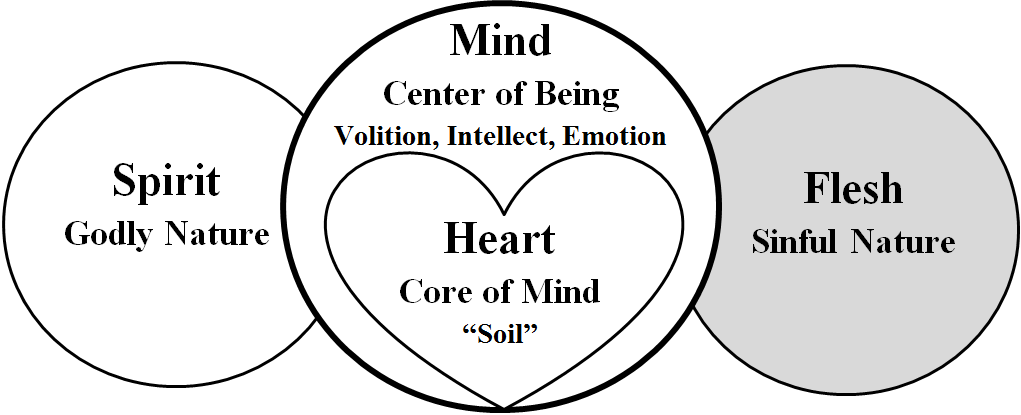
As you can see, the human spirit is a person’s “godly nature” whereas the flesh is the “sinful nature.” One’s mind & heart are caught between these two conflicting inclinations.
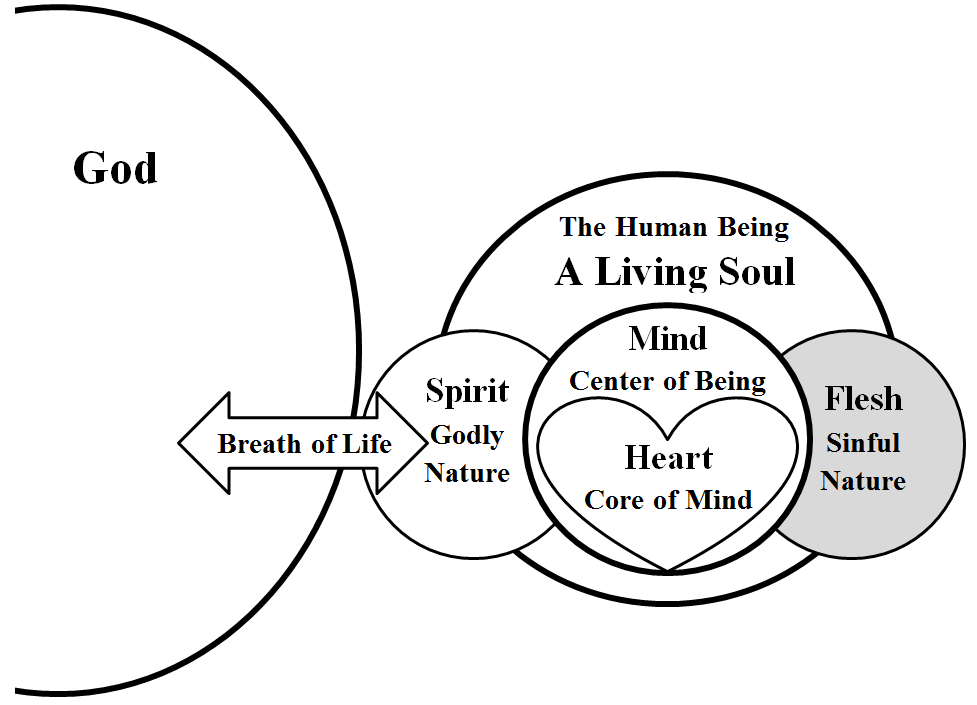
The human spirit is the individual’s “godly nature” because it relates to the spiritual breath of life that proceeds from the LORD, which animates the soul (Genesis 2:7 & Psalm 104:29b-30). The human spirit is naturally where the conscience is located because it’s the “godly nature.” The flesh, by contrast, is the sinful nature because it’s the satanic nature. You can read more about how humankind inherited a satanic nature here.
All of this helps us to understand statements like “it is the human spirit that connects the person to God.” Again, the human spirit is not a separate entity with its own will, but rather is the person’s spiritual nature, the part of him/her that inclines towards what is good, godly and productive. For scriptural details on human nature see this article.
Related Topics:
Religion vs. Christianity (video)
The Fall of Man (Humanity) and Slavery to Satan
What is the “Age of Accountability”?
Why Is This World So Messed Up?
MANNA Was a Shadow of the BREAD FROM HEAVEN, Jesus Christ

After the Hebrews escaped from slavery in Egypt circa 1446 BC, they wandered in the desert wilderness of the Sinai Peninsula for 40 years before making it to their earthly “promised land,” Canaan, which became Israel. Since there were 603,550 fighting men over the the age of 20 (Numbers 1:46), this places the total number of Hebrews at well over 2 million and possibly as many as 2.5-3 million. Modern scholars naturally consider this number fanciful since the Sinai Desert could never have supported so many people, let alone for 40 years.
However, this supposed conundrum is plainly explained in Exodus 16 and Numbers 11. The LORD miraculously rained down “bread from heaven” (Exodus 16:4), which the Hebrews called manna, derived from their understandable response to it, “What is it?” (16:14 & 16:31). This honey-tasting, vitamin-chocked flake-like food from God is what the Hebrews existed on for those four decades, along with dairy products from their herds and plentiful quail on two separate occasions (Exodus 16:13 & Numbers 11:31).
Some 1472 years later, Jesus Christ had a discussion with a crowd of Israelites who were following him around because he had just provided food for thousands of people,* which was incredible (John 6:1-15).
* The 5000 cited in 6:10 only referred to men, which means there were thousands more women & children.
Here’s the discussion:
25When they found him on the other side of the lake, they asked him, “Rabbi, when did you get here?”
26Jesus answered, “Very truly I tell you, you are looking for me, not because you saw the signs I performed but because you ate the loaves and had your fill. 27Do not work for food that spoils, but for food that endures to eternal life, which the Son of Man will give you. For on him God the Father has placed his seal of approval.”
28Then they asked him, “What must we do to do the works God requires?”
29Jesus answered, “The work of God is this: to believe in the one he has sent.”
30So they asked him, “What sign then will you give that we may see it and believe you? What will you do? 31Our ancestors ate the manna in the wilderness; as it is written: ‘He gave them bread from heaven to eat.’ ”
32Jesus said to them, “Very truly I tell you, it is not Moses who has given you the bread from heaven, but it is my Father who gives you the true bread from heaven. 33For the bread of God is the bread that comes down from heaven and gives life to the world.”
34“Sir,” they said, “always give us this bread.”
35Then Jesus declared, “I am the bread of life. Whoever comes to me will never go hungry, and whoever believes in me will never be thirsty. 36But as I told you, you have seen me and still you do not believe. 37All those the Father gives me will come to me, and whoever comes to me I will never drive away. 38For I have come down from heaven not to do my will but to do the will of him who sent me. 39And this is the will of him who sent me, that I shall lose none of all those he has given me, but raise them up at the last day. 40For my Father’s will is that everyone who looks to the Son and believes in him shall have eternal life, and I will raise them up at the last day.”
41At this the Jews there began to grumble about him because he said, “I am the bread that came down from heaven.” 42They said, “Is this not Jesus, the son of Joseph, whose father and mother we know? How can he now say, ‘I came down from heaven’?”
43“Stop grumbling among yourselves,” Jesus answered. 44“No one can come to me unless the Father who sent me draws them, and I will raise them up at the last day. 45It is written in the Prophets: ‘They will all be taught by God.’ Everyone who has heard the Father and learned from him comes to me. 46No one has seen the Father except the one who is from God; only he has seen the Father. 47Very truly I tell you, the one who believes has eternal life. 48I am the bread of life. 49Your ancestors ate the manna in the wilderness, yet they died. 50But here is the bread that comes down from heaven, which anyone may eat and not die. 51I am the living bread that came down from heaven. Whoever eats this bread will live forever. This bread is my flesh, which I will give for the life of the world.”
52Then the Jews began to argue sharply among themselves, “How can this man give us his flesh to eat?”
53Jesus said to them, “Very truly I tell you, unless you eat the flesh of the Son of Man and drink his blood, you have no life in you. 54Whoever eats my flesh and drinks my blood has eternal life, and I will raise them up at the last day. 55For my flesh is real food and my blood is real drink. 56Whoever eats my flesh and drinks my blood remains in me, and I in them. 57Just as the living Father sent me and I live because of the Father, so the one who feeds on me will live because of me. 58This is the bread that came down from heaven. Your ancestors ate manna and died, but whoever feeds on this bread will live forever.” 59He said this while teaching in the synagogue in Capernaum.
John 6:25-59
Several truths can be extracted from this discourse:
- The crowds that followed Christ were motivated by superficial desire for free food and did not grasp his true nature and purpose.
- The Messiah links the manna that the Hebrews existed on in the arid Sinai wilderness to a greater “bread from heaven” that enables those who believe to exist forever in a paradisal New Heaven & New Earth (2 Peter 3:13) as opposed to 40 years wandering around the desert in a fallen world.
- The manna that God provided for the Hebrews after they escaped slavery in Egypt was temporary and perished, a mere shadow of the true Bread from Heaven, Jesus Christ, who provides eternal life for all those who believe (John 3:16 & 3:36).
- The Hebrews wanted to know what works were required to earn everlasting life, which they felt they were able to do. The Messiah said the only ‘work’ required was faith in the One the Father sent (verse 29), which corresponds to John 3:16, 3:36 and Ephesians 2:8-9.
- The Lord referred to himself as both the “bread from heaven” (verse 32) and the “bread of life” (verses 35 & 48).
- The Lord said twice “I AM the bread of life” (verses 35 & 48), which was an acknowledgement that he was I AM, aka God (Exodus 3:14). This explains why the religious Jews, including the Pharisees, attempted to stone him to death after his “I AM” statement in John 8:58.
- There are seven times total in the book of John where Christ said “I AM” linked to specific things in a figurative sense, like “I AM the bread of life” (verses 35 & 48). The six others are: “I AM light of this world” (8:12), “I AM the gate” (10:7 & 10:9), “I AM the good shepherd” (10:11 & 10:14), “I AM the resurrection and the life” (11:25), “I AM the way, the truth and the life” (14:6) and “I AM the vine” (15:1 & 15:5).
- Jesus’ references to “eating the flesh of the Son of Man and drinking his blood” are obviously figurative and not literal (verses 53-58); after all, would God seriously want us to become cannibals to attain eternal life? Moreover, once Christ’s body was entombed, resurrected in a glorified state and ascended to the right hand of the Father in Heaven, how exactly could believers throughout the Church Age literally feed on his body and drink his blood? Obviously we couldn’t, so “eating the flesh of the Son of Man and drinking his blood” metaphorically refers to accepting Christ’s sacrificial death. The Lord used this peculiar analogy because eating & drinking are necessary for physical life in this fallen world; just so, “eating” & “drinking” the Bread from Heaven — the Bread of Life — are necessary for eternal life in the New Heaven & New Earth (2 Peter 3:13).
- These references to “eating the flesh of the Son of Man and drinking his blood” do not refer to the The Lord’s Supper / Communion / Eucharist for two reasons: (1) that particular ceremony had not yet been instituted and (2) if Christ was referring to the Lord’s Supper that would mean anyone who simply partook of this ritual would have eternal life, regardless of belief, which obviously isn’t true (John 3:16, 3:36 and Ephesians 2:8-9).
Related Topics:
ETERNAL LIFE (“Heaven”): Questions & Answers
God’s Name — YHWH (Yahweh), the Tetragrammaton
Comparing Jesus Christ With… Superman
SPIRITUAL Blessings vs. MATERIAL Blessings

Observe what the apostle Paul said about “spiritual blessings”:
Praise be to the God and Father of our Lord Jesus Christ, who has blessed us in the heavenly realms with every spiritual blessing in Christ.
“Spiritual blessing” suggests immaterial blessing in contrast to physical blessings, as distinguished in these two verses:
They were pleased to do it,* and indeed they owe it to them. For if the Gentiles have shared in the Jews’ spiritual blessings, they owe it to the Jews to share with them their material blessings.
* This refers to believers in Macedonia and Achaia giving a financial offering to the poor in Jerusalem.
If we have sown spiritual seed among you, is it too much if we reap a material harvest from you?
With this understanding, what are some examples of spiritual blessings? James cites an obvious one in his epistle:
17 Every good and perfect gift is from above, coming down from the Father of the heavenly lights, who does not change like shifting shadows. 18He chose to give us birth through the word of truth, that we might be a kind of firstfruits of all he created.
James 1:17-18
Verse 18 shows that spiritual regeneration is a gift from above, from our Heavenly Father. It is through the washing of rebirth and renewal by the Holy Spirit that we obtain eternal life and have salvation from eternal death (John3:3, 3:6, 3:36, Titus 3:5, 1 Peter 1:23 & Romans 6:23).
Spiritual rebirth and the corresponding eternal salvation pave the way for other immaterial blessings, like:
- Day-to-day relationship with the LORD by the Spirit (Ephesians 1:17 & Hebrews 8:11),
- Access to forgiveness of sin (1 John 1:8-9),
- Faith for a healing (Mark 5:34 & Mark 10:52),
- Spiritual gifts, including glossolalia, and…
- Victory over the defeated Enemy in Christ (Colossians 2:15).
Returning to our main text:
Praise be to the God and Father of our Lord Jesus Christ, who has blessed us in the heavenly realms with every spiritual blessing in Christ.
Some suggest that “every spiritual blessing in Christ” is not limited to immaterial blessings on the grounds that the source of all blessing is Father God in the spiritual realm Heaven. “God is Spirit,” they argue (John 4:24), and dwells in the heavenly domain from which all blessings originate. In fact, literally everything in the physical realm originally sprang from the spiritual realm (Hebrews 11:3). Thus it could be argued that any blessing — whether immaterial or material — is a spiritual blessing. And particularly any physical blessing provided “in Christ,” aka in covenant with the LORD through Jesus Christ.
Examples of such physical blessings would include needed finances, any material answer to prayer, shelter, clothing, food, potable water, reliable transportation, healthy bodies, the right mate and so on.
Environmental context and God’s assignment for the individual in question determine the specifics of the physical blessing. For instance, Joseph was a slave in Potiphar’s house and a prisoner in Egypt, but the Bible says that he prospered in both contexts despite the obvious limitations thereof (Genesis 39:2-6 & 39:20-23). While Joseph indeed prospered in these challenging environments, it would certainly be a different kind of prosperity than that of living on Mulholland Drive in the modern day.
Speaking of physical prosperity, let’s consider how…
Spiritual Riches Are Superior to Material Wealth
Here’s what the resurrected Lord had to say to the historical assembly in Laodicea, which was located in what is today southwestern Turkey:
16“So, because you are lukewarm—neither hot nor cold—I am about to spit you out of my mouth. 17 You say, ‘I am rich; I have acquired wealth and do not need a thing.’ But you do not realize that you are wretched, pitiful, poor, blind and naked. 18I counsel you to buy from me gold refined in the fire, so you can become rich; and white clothes to wear, so you can cover your shameful nakedness; and salve to put on your eyes, so you can see.”
19“Those whom I love I rebuke and discipline. So be earnest and repent.”
Revelation 3:16-19
Christ rebuked these believers for being “lukewarm” and threatened to spit the whole fellowship out of his mouth if they didn’t repent, meaning he would “pull the plug” on them and they’d be a church in name only.
The Lord desired that they were cold or hot rather than lukewarm. This was an allusion to nearby cold and hot springs. The cold springs were useful for refreshing while the hot springs were useful for bathing, but lukewarm water was useless. Thus this assembly was useless to the Lord.
What was their core problem? They made something other than Christ Lord of their lives; and verse 17 reveals that this ‘thing’ was material wealth. I want to stress that it’s okay to have physical wealth, but it’s not okay for physical wealth to have the person wherein it basically becomes their ‘god’ (Luke 12:15). As Jesus put it, “You cannot serve God and money” (Matthew 6:24).
Simply put, physical riches replaced Christ’s Lordship in the lives of these believers in Laodicea, which can be observed in their boasting of their great wealth and the brazen claim that they had need of nothing. So the Lord gives them a rude awakening by informing them that they were, in reality, “wretched, pitiful, poor, blind and naked” and needed to repent (verses 17 & 19).
Think about it: As materially wealthy as they were, Jesus blatantly calls them “poor” and “pitiful”! He was speaking of poverty in a spiritual sense. While they claimed to be Christians and therefore supposedly followed Christ, the Lord wasn’t even in their fellowship, which can be observed in the follow-up verse:
20Here I am! I stand at the door and knock. If anyone hears my voice and opens the door, I will come in and eat with that person, and they with me. ”
Revelation 3:20
The Messiah was outside the assembly politely asking them to let him in while threatening to spit them out of his mouth if they foolishly refused.
This shows that material blessings — viewed from a fleshly perspective — can fuel arrogance and render people spiritually poor and blind. Needless to say, let’s not be like that.
Let’s close with this insight on spiritual blessings from Peter’s second epistle:
3His divine power has given us everything we need for a godly life through our knowledge of him who called us by his own glory and goodness. 4Through these he has given us his very great and precious promises, so that through them you may participate in the divine nature, having escaped the corruption in the world caused by evil desires.
2 Peter 1:3-4
If this wets your appetite, see our linking article The Seven Keys to SPIRITUAL GROWTH
Related Topics:
What Goes On “Behind the Scenes” in the Spirit?
Spiritual Warfare — The Basics
How to Keep Yourself BLAMELESS (While Not Being SINLESS)
Does Walking in AGAPE LOVE Mean You Should Be a DOORMAT to Abuse?

A popular minister was preaching on walking in agape love wherein he quoted a verse from the great love passage:
Love bears up under anything and everything that comes,
1 Corinthians 13:7a (Amplified Bible Classic)
He then brought up a Christian brother who was dealing with a rude, abusive jerk and vented in desperation, “I just can’t take it any longer; I just can’t put up with him any longer.” The minister replied, “Love can.” The implication is that the believer who walks in agape love will perpetually put up with fleshly mistreatment in the name of agape love.
The problem with this kind of teaching is that it’s unbalanced since it disregards other pertinent passages. Being unbalanced, it puts people into religious bondage, which is never a good thing (religious bondage is a form of legalism). The ‘bondage’ in this case is the ‘doormat syndrome,’ which is the mentality that Christians must continually tolerate abuse from others in the name of love. If they don’t, they’re not walking in agape love (supposedly).
To show that this is error we’re going to look at several passages for proper balance. ‘Scripture interprets Scripture’ is a hermeneutical rule for good reason. Let’s begin with the biblical definition of agape love:
4Love suffers long and is kind; love does not envy; love does not parade itself, is not puffed up [arrogant]; 5does not behave rudely, does not seek its own, is not provoked, thinks no evil; 6does not rejoice in iniquity, but rejoices in the truth; 7bears all things, believes all things, hopes all things, endures all things.
1 Corinthians 13:4-7 (NKJV)
The Greek word for ‘love’ in this passage is agape (ah-GAH-pay), which means that this is the biblical definition of agape love. As you can see, agape love is practical in nature and doesn’t involve a feeling. In other words, agape love is practical love and is not dependent upon an emotion, like adoration, fondness or respect. This explains how believers can love their enemies in a practical sense even though they understandably may not like or respect them, which both Christ and Paul taught (Luke 6:27 & Romans 12:20-21).
Notice how the Lord phrased this instruction:
27“But to you who are listening I say: Love your enemies, do good to those who hate you, 28bless those who curse you, pray for those who mistreat you.”
Luke 6:27-28
Jesus is using the verb form of agape here. observe how he describes loving one’s enemies in terms of doing good to them regardless of how they’re unjustly treating you. In verse 28 he gives the examples of blessing them and praying for them. In other words, loving a person in the agape sense has nothing to do with affection and everything to do with doing something good for a person regardless of how you feel about him/her. There are separate Greek words for loving someone in the sense of having affection or respect, such as phileo love (e.g. John 11:35-36).
So agape love is loving a person in a practical sense and has zero to do with affection or respect. This kind of love is a fruit of the spirit as opposed to a work of the flesh (Galatians 5:19-21). In short, the more you walk in the spirit the more you’ll produce the fruit of agape love. By contrast, the more you live out of your flesh the less you’ll be able to walk in agape love.
The minister noted earlier argued that agape love “bears up under anything and everything that comes.” While this is true, it does not mean a believer who walks in agape love is obligated to perpetually tolerate rude mistreatment. Verse 4 in the Bible’s definition of agape love (quoted above) says that “love suffers long,” which is 100% true, but this doe not mean agape love suffers forever, just that it extends grace to the fool who’s doing the mistreatment. The Old Testament puts this wise principle like so:
Fools show their annoyance at once, but the prudent overlook an insult.
Christ phrased it like this: “If anyone slaps you on the right cheek, turn to them the other cheek also” (Matthew 5:39). Since he specified the right cheek, Jesus was referring to a backhanded slap to the face, which was an insult in that culture. Turning the cheek therefore signified overlooking an insult as an extension of grace to one’s persecutor. The goal of this principle is to make an effort of peace with unjustly contentious people, which is an example of agape love, aka practical love (Romans 12:18 & Hebrews 12:14). Overlooking an insult or “turning the cheek” is a refusal to feed the person’s hostility and prevents the situation from escalating into something ugly or dangerous. You’re extending grace to a person who’s walking in the flesh and preventing them from drawing you into their darkness. So you’re protecting yourself from being victimized by a fool. You can read more about this here.
However, while making a generous effort to live in peace with troublesome people is biblical and noble, it’s not wise to make an idol out of it and become a living doormat to abuse.
While agape love “endureth all things” this doesn’t mean believers should perpetually put up with rude, abusive jerks in the name of love. Agape love “suffers long” for the sake of peace with irksome people, but it doesn’t suffer perpetually. Actually…
Agape Love Confronts & Corrects When Appropriate
In the biblical definition of agape love we see that “love does not delight in evil, but rejoices in the truth” (1 Corinthians 13:4-7). So, while the believer who’s walking in the spirit and thus walking in agape love “suffers long” by forbearing with a rude, abusive person far longer than someone who’s walking in the flesh, it’s not a perpetual thing. There’s a time and place for Spirit-led confrontation and rebuke. The believer can overlook the mistreatment and pray for the abusive person in the name of peace, but also confront and correct with scriptural truth at the appropriate moment as led of the Spirit.
This is the balance of gentle love and tough love. Here are some passages that support this:
Better is open rebuke than hidden love.
As iron sharpens iron, so one person sharpens another.
“If your brother or sister sins against you, rebuke them; and if they repent, forgive them.”
15“If your brother or sister sins, go and point out their fault, just between the two of you. If they listen to you, you have won them over. 16But if they will not listen, take one or two others along, so that ‘every matter may be established by the testimony of two or three witnesses.’ 17If they still refuse to listen, tell it to the church; and if they refuse to listen even to the church, treat them as you would a pagan or a tax collector.”
Matthew 18:15-17
Someone might ask, what would Jesus do? The Messiah only put up with the corrupt religious leaders of Israel to a gracious point — wherein he interceded for them, hoping they’d repent — but then he boldly confronted them to their faces as led of the Spirit, frankly calling them “blind fools,” “hypocrites” (fakes), “snakes,” “whitewashed tombs,” “brood of vipers,” “children of Gehenna,” etc. (e.g. Matthew 23:13-33 & Luke 11:37-54).
Paul was the apostle who wrote the ‘love passage’ inspired by the Holy Spirit (1 Corinthians 13:4-7), so he strongly believed in agape love suffering long when dealing with offensive fools, but notice how he dealt with some oppressive unbelievers on this occasion in Corinth:
5When Silas and Timothy came from Macedonia, Paul devoted himself exclusively to preaching, testifying to the Jews that Jesus was the Messiah. 6But when they opposed Paul and became abusive, he shook out his clothes in protest and said to them, “Your blood be on your own heads! I am innocent of it. From now on I will go to the Gentiles.”
Acts 18:5-6
When the stubborn Hebrews became abusive Paul refused to take it, but rather openly rebuked them (Proverbs 27:5) and took his service for God elsewhere, i.e. to those who would welcome it. Needless to say, go where you’re celebrated, not where you’re abused.
Now observe how Paul handled a troublesome unbeliever on the island of Cyprus who was hindering his strategic ministry:
6They traveled through the whole island until they came to Paphos. There they met a Jewish sorcerer and false prophet named Bar-Jesus, 7who was an attendant of the proconsul, Sergius Paulus. The proconsul, an intelligent man, sent for Barnabas and Saul because he wanted to hear the word of God. 8But Elymas the sorcerer (for that is what his name means) opposed them and tried to turn the proconsul from the faith. 9Then Saul, who was also called Paul, filled with the Holy Spirit, looked straight at Elymas and said, 10“You are a child of the devil and an enemy of everything that is right! You are full of all kinds of deceit and trickery. Will you never stop perverting the right ways of the Lord? 11Now the hand of the Lord is against you. You are going to be blind for a time, not even able to see the light of the sun.”
Immediately mist and darkness came over him, and he groped about, seeking someone to lead him by the hand. 12When the proconsul saw what had happened, he believed, for he was amazed at the teaching about the Lord.
Acts 13:6-12
Elymas was a celebrity of sorts on Cyprus and so Paul & Barnabas were likely aware of him before visiting the island. They no doubt bathed the magician in prayer, as well as the proconsul, since Paul taught believers to do this very thing (1 Timothy 2:1-2).
Paul & Barnabas were sharing the message of Christ with the proconsul, but Elymas was rudely hampering their ministry and actively trying to keep the official from the faith. So Paul “filled with the Holy Spirit” openly rebuked Elymas, calling him a “child of the devil and enemy of everything that is right,” and then proceeded to curse him with temporary blindness in order to humble him. As it is written, “Pride goes before destruction, a haughty spirit before a fall” (Proverbs 16:18). Verse 12 shows that the proconsul was amazed by their ministry and accepted the gospel.
Paul & Barnabas had prayed about this situation beforehand and were walking in the spirit. They no doubt suffered long with Elymas’ abusive antics but, when enough was enough, Paul took a righteous stand against the troublesome magician and boldly humbled the man, led of the Spirit.
While this was a rare happening in the apostles’ ministries in the early Church, it wasn’t an isolated occurrence, as Peter did something similar with another sorcerer while ministering in Samaria (Acts 8:9-24). In both cases the apostles were dealing with non-Christians, so the argument that believers can only confront & rebuke fellow Christians is unbiblical.
I’m not encouraging believers to be rash when encountering offensive people (Proverbs 12:16 & Proverbs 13:3), I’m encouraging us to walk in the spirit rather than the flesh; walk in agape love, which is practical love. Agape love “suffers long” for the sake of peace, but it refuses to be a doormat to ongoing fleshly abuse. It refuses to make an idol out of niceness and peace. There’s a time & place for taking a righteous stand and boldly rebuking unreasonable fools for their evil, led of the Spirit.
Confrontation and correction are good & appropriate when negative behavior continues because it holds the offender accountable to their abusive actions, not to mention it “sharpens” them like iron sharpening iron, although incorrigible fools will likely hate you for it (Proverbs 9:8-9). If you fail to confront and correct an impenitent abuser he/she will just continue in their negative behavior and continue hurting people. That’s not agape love because “love does not rejoice in evil, but rejoices in the truth.”
Yes, agape love “bears up under anything and everything that comes,” but this includes bearing up under the challenges of life, like taking a righteous stand against wickedness and reproving someone who desperately needs reproving; it does not exclude such challenges due to an unbalanced religious understanding of love.
Related Topics:
The Four Types of LOVE in the Bible
Turning the Cheek — What it Means and Doesn’t Mean
Handling Personal Offenses vs. Handling Criminal Acts
What if You KNOW a Confrontation Will Turn UGLY?
Pacifism — Absolute Pacifism (Unbiblical) and Limited Pacifism (Biblical)
Military Service — Is it Okay for Believers to Serve in the Armed Forces?
Forgiveness—Should You Forgive EVERYONE for EVERYTHING ALL of the Time?
Why You should Always FORGIVE When the Offender Is Repentant
Judging—When SHOULD You Judge and When SHOULDN’T You Judge?
What Does It Mean to Be a LUKEWARM Christian?
The term ‘lukewarm’ can be traced to Jesus Christ’s frank words to the believers at the historical assembly in Laodicea, which was located in what is today southwestern Turkey:
16“So, because you are lukewarm—neither hot nor cold—I am about to spit you out of my mouth. 17 You say, ‘I am rich; I have acquired wealth and do not need a thing.’ But you do not realize that you are wretched, pitiful, poor, blind and naked. 18I counsel you to buy from me gold refined in the fire, so you can become rich; and white clothes to wear, so you can cover your shameful nakedness; and salve to put on your eyes, so you can see.”
19“Those whom I love I rebuke and discipline. So be earnest and repent. 20Here I am! I stand at the door and knock. If anyone hears my voice and opens the door, I will come in and eat with that person, and they with me. ”
Revelation 3:16-20
The Messiah rebuked these believers for being “lukewarm” and threatened to spit the whole fellowship out of his mouth if they didn’t repent, meaning he would “pull the plug” on them and they’d be a church in name only.
Christ desired that they were cold or hot rather than lukewarm. This was an allusion to nearby cold and hot springs. The cold springs were useful for refreshing and the hot springs for bathing, but lukewarm water was useless. Thus this assembly was useless in the eyes of the Lord.
What was their core problem? The context shows that they made something other than Christ lord of their lives; and verse 17 reveals that this ‘thing’ was material wealth. I want to stress that it’s okay to have physical wealth, but it’s not okay for physical wealth to have the person wherein it basically becomes their ‘god’ (Luke 12:15). As Jesus put it, “You cannot serve God and money” (Matthew 6:24).
Sadly, riches replaced Christ’s Lordship in the lives of these Laodicean believers, which can be observed in their boasting of their great wealth and the claim that they had need of nothing. But the Lord gives them a rude awakening by informing them that they were, in reality, “wretched, pitiful, poor, blind and naked” and needed to repent (verses 17 & 19).
Further support for the fact that material wealth was their ‘lord’ and not Christ can be observed in the fact that Jesus was outside the fellowship knocking on the door wanting to come in and commune with them. In short, the very Lord they claimed to serve wasn’t even in their fellowship — he wasn’t even in their midst! He was outside politely asking them to let him in while threatening to spit them out of his mouth if they foolishly refused. You could say that being lukewarm means falling into a rut wherein you don’t have a relationship with the LORD.
So being a lukewarm Christian is a believer who has made something other than Christ lord in his/her life and is not limited to money & material wealth. It could be any number of things, but it renders the person useless to the Lord and service in His Kingdom. It’s a form of idolatry — putting something above the LORD — which in effect renders the believer a nominal Christian.
Related Topics:
Understanding Christ’s LORDSHIP in the Believer’s Life