
Should You PUT OUT A FLEECE to Determine God’s Will?

“Putting out a fleece” refers to trying to determine God’s will in a matter through a sign in an arranged scenario. The phrase comes from Gideon’s actions in this passage:
36Gideon said to God, “If you will save Israel by my hand as you have promised— 37look, I will place a wool fleece on the threshing floor. If there is dew only on the fleece and all the ground is dry, then I will know that you will save Israel by my hand, as you said.” 38And that is what happened. Gideon rose early the next day; he squeezed the fleece and wrung out the dew—a bowlful of water.
39Then Gideon said to God, “Do not be angry with me. Let me make just one more request. Allow me one more test with the fleece, but this time make the fleece dry and let the ground be covered with dew.” 40That night God did so. Only the fleece was dry; all the ground was covered with dew.
Judges 6:36-40
The LORD called Gideon to deliver the Israelites from the oppressive Midianites (verse 14). Yet, despite the Angel of the LORD literally appearing to him in verse 12, Gideon was so humble and understandably unsure of his qualifications (verse 15) that he required further confirmation in order to carry out God’s instructions, which is why he arranges the test with the wool fleece and the dew; not once, but twice.
Since accounts chronicled in the Old Testament serve as lessons to us, the worldwide Church (Romans 15:4; 1 Corinthians 10:11), should New Covenant believers “put out a fleece” to determine God’s will in a situation? I suppose they could if, like Gideon, they are humbled in the situation and have serious doubts, keeping in mind that God deals with us according to the light we have, which corresponds to one’s level of spiritual growth (John 9:39-41, 15:22 & 15:24).
Yet I can’t recommend “putting out a fleece” in good conscience because, unlike Gideon, we believers have the Holy Spirit residing within us for the purpose of divine guidance (John 16:13; Acts 16:6). The Bible says to “let the peace of Christ rule in your hearts” (Colossians 3:15). In other words, what do you have a peace about doing or not doing in a particular situation?
Let me give a recent example. The Lord ministered to me concerning doing something, but I joked with my wife, Carol, about “putting out a fleece” on the matter. Of course I didn’t need to “put out a fleece” because the Spirit had already directed me in my spirit and I had a peace about it (Ephesians 3:16; Romans 8:16). Thus the decision was already made.
Related Topics:
ALTARS & ALTAR CALLS and How They’re Relevant
Is the Holy Spirit God or a Divine Force?
How God Sees YOU (video)
What Are THE BASICS of Christianity?
Who Should You Receive from—OFFICIAL Ministers or INDEPENDENT Ones?

I remember an occasion where I went to the hospital to visit someone. It was in the heat of the summer and so I naturally wore shorts, sandals and a t-shirt (with cut-off sleeves). By happenstance, the woman in the elevator with me was clearly a member of some religious sect in light of her apparel.
Official ministers tend to wear some outward sign that they’re a minister, like a clerical collar; not always, but more so than independent ministers. The latter tend to take the more casual approach in order to fit in à la 1 Corinthians 9:19-23. Despite our polar opposite approaches, both of us were at the hospital for the very same reason, to visit the sick and minister accordingly.
So who do you receive from — official ministers or independent ones? Why not both since the Bible includes each type in the Old and New Testaments? Learn to “eat the meat and spit out the bones,” whether you’re receiving from an official minister or an independent one. This is a modern rephrasing of something encouraged in the New Testament (1 Thessalonians 5:19-21).
Be aware of the strengths and potential weaknesses of both official and independent ministers. Reject the problematic or dubious, but receive the good. If you’re not sure something is scriptural put it on the back burner, so to speak, until you acquire more detailed information in order to draw a proper conclusion.
But don’t just blindly accept whatever your camp/sect/assembly says is true, because it might not be. Keep in mind that all fivefold ministers are human beings with individual quirks. All of them have a downside, all of them. There’s no such thing as a perfect minister, just like there’s no such thing as a perfect church/camp/sect.
However, the minister should be free of sin as a lifestyle and it’s important that they show evidence of the fruit of the spirit on a consistent basis (Matthew 7:15-23; Galatians 5:19-23). They must be completely freed-up from major sin and, when they miss it in smaller areas, they should be humble enough to admit it and spiritual enough to quickly ’fess up, receive forgiveness, and move on (1 John 1:8-9).
If you sense in a minister an abusive, accusatory or rigidly legalistic spirit with little evidence of fruit of the spirit, head to the hills, whether it’s an official minister or an independent one. This is what Christ instructed us to do (Matthew 15:14). Since pride is sin numero uno, arrogance is the worst indicator (Proverbs 16:5 & 8:13). I’m talking about a pompous, boastful, condescending spirit that refuses to ever admit they’re wrong and loves to manipulate.
The starkest evidence of arrogance is when a supposed minister insists that only he/she and their particular group is the “one true church” and every minister/assembly outside their group is false. These types are quick to call anyone a “false teacher” who happens to disagree with their conclusions on any jot or tittle of Scripture. Of course they justify such rash pomposity under the guise of “spiritual boldness.” It’s both eye-rolling and cult-ish.
Needless to say, if you come across one of these types flee for your spiritual welfare. Even if they’re right on a particular issue, so what? Everyone is right about something. Their gross arrogance tells you everything you need to know. Leave them (Matthew 15:14).
Lastly, the doctrines (teachings) a minister teaches/preaches should be as biblical as possible because the Holy Scriptures are the LORD’s blueprint for authentic Christian doctrine and practice (1 Corinthians 4:61; 2 Timothy 3:16-17). Ministers should be held accountable to what God’s Word teaches based on sound hermeneutics.
For biblical evidence to support both official ministers and independent ones see this article.
This article and much more is featured in…

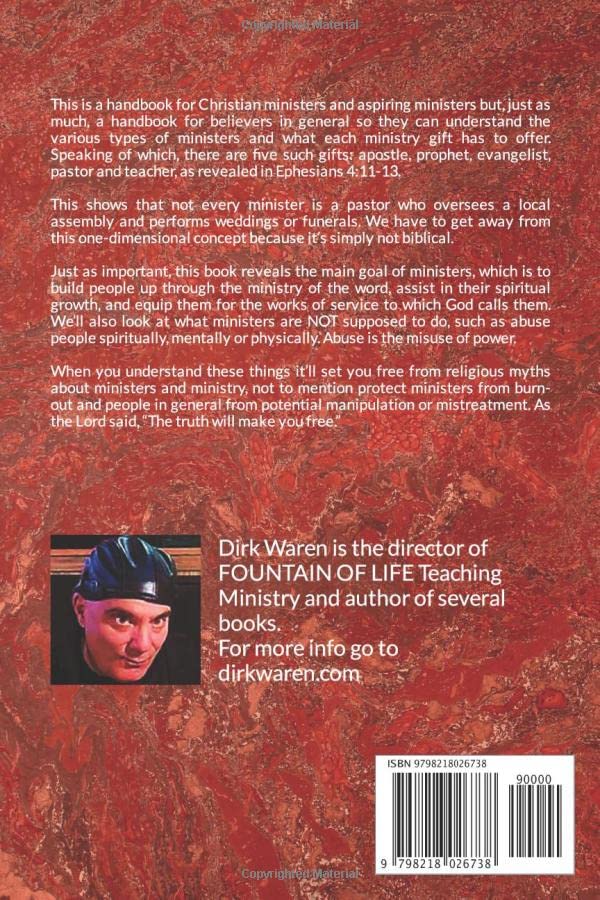
- You can purchase the print book here for only $7.38 (175 pages).
- Or get the Kindle eBook here for only 99¢
Both links allow you to LOOK INSIDE the book.
Related Topics:
Prophets — New Testament and Old Testament (There’s a Difference)
SECTARIANISM — What Is It? What’s Wrong With It?
Ministerial Abuse — The Diotrephes Spirit vs. the Davidic Spirit
Ministerial Pitfalls and Abuses
Should Ministers Be Addressed with Titles?
Legalism — Understanding its Many Forms
Kingdom of God — What Does it Mean?
Roman Catholicism – Is it the “Original Church”? (No)
Why LOYALTY (Faithfulness) Is Important

I remember a couple of old movie stars, like Kirk Douglas, making statements that they didn’t believe men can be monogamous. But this is a copout to commit adultery or live in fornication. It explains why the bride & groom vow to be faithful to one another. In other words, yes, humans — and especially males — have a predilection for successive romantic/sexual partners and this is precisely why it’s necessary for married couples to vow to be committed to one another till death do them part (Proverbs 18:21).
To be faithful is to be loyal. In other words, faithfulness is loyalty. It’s a fruit of the spirit and therefore the opposite of a work of the flesh (Galatians 5:19-23).
Loyalty is underrated these days. Honor the one who wears your ring. Write loyalty on the tablet of your heart — i.e. “love and faithfulness” (Proverbs 3:3) — and your marriage will last, assuming your partner feels the same way. Proverbs 20:28 says that love & faithfulness are crucial to the security of any “throne,” meaning any position of significance. This would include the husband or wife, the nucleus of any healthy family. Speaking of which…
Proverb 19:22 says “unfailing love” is what a person most desires in another. In other words, they want loyalty, faithfulness. Yet Proverbs 20:6 notes how hard it is to find a faithful person. In short, it’s a rare trait.
When looking for a spouse, loyalty should be high up on your list of preferences since it is one of the most priceless qualities for a secure, happy marriage. Perhaps the worst thing for a husband or wife to experience is an impenitent unfaithful spouse. Unfortunately it’s relatively common in this ignoble age.
You could say the same thing about finding a ministry associate or business partner.
Of course, loyalty or faithfulness doesn’t mean there isn’t a time and place for constructive criticism (Proverbs 9:8-9 & Proverbs 27:5-6), which is a form of tough love. Spouses should never condone godless carnality in their mates; and neither should ministry associates or business partners. It’s important to hold one another accountable, assuming it’s in a godly manner as opposed to a legalistic (Pharisaical) spirit.
For more on what the Bible says about love, romance, marriage & sex, pick up a copy of…


- The print book is available here for only $7.26 (171 pages)
- The Kindle eBook is available here for just 99¢!
Both links allow you to LOOK INSIDE the book.
Related Topics:
What’s the Secret of a Successful Marriage?
What IS Marriage? (and Related Topics)
Q&A on Solomon’s SONG OF SONGS
What Is the Secret of a SUCCESSFUL MARRIAGE?

The Bible says that “a cord of three strands is not quickly broken” (Ecclesiastes 4:12). In a marriage the three-strand cord consists of husband, wife and the LORD. As the husband and wife draw nearer to the Lord (James 4:8), they naturally come nearer to each other, as illustrated here:
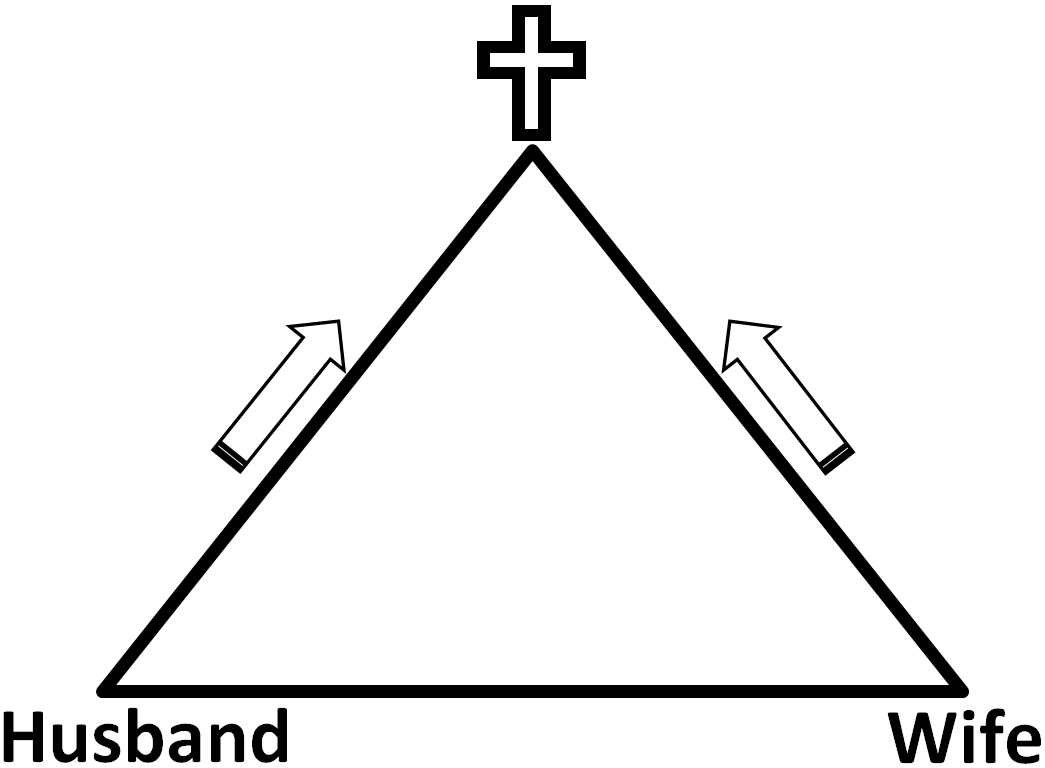
So “come near to God and he will come near to you” (James 4:8). See this video for some insights on getting tighter with the LORD.
Of course for this principle to truly work, both spouses need to be drawing closer to God (Psalm 105:4). But one spouse seeking the LORD can inspire the other to do the same, which will naturally draw them closer together.
For biblical insights on marriage and how to have a happy, satisfying one (not a perfect one) see this article.
For more on what the Bible says about love, romance, marriage & sex, pick up a copy of…
- The print book is available here for only $7.26 (171 pages)
- The Kindle eBook is available here for just 99¢!
Both links allow you to LOOK INSIDE the book.
Related Topics:
Why LOYALTY (Faithfulness) Is Important
Is Christianity a “RELATIONSHIP With God”?
The Four Types of LOVE in the Bible
What Does The SPIRIT, THE WATER AND THE BLOOD TESTIFY Mean?

Let’s read the whole passage in question with special focus on the key verses 5-9:
1Everyone who believes that Jesus is the Christ is born of God, and everyone who loves the father loves his child as well. 2This is how we know that we love the children of God: by loving God and carrying out his commands. 3In fact, this is love for God: to keep his commands. And his commands are not burdensome, 4for everyone born of God overcomes the world. This is the victory that has overcome the world, even our faith. 5Who is it that overcomes the world? Only the one who believes that Jesus is the Son of God.
6This is the one who came by water and blood—Jesus Christ. He did not come by water only, but by water and blood. And it is the Spirit who testifies, because the Spirit is the truth. 7For there are three that testify: 8the Spirit, the water and the blood; and the three are in agreement. 9We accept human testimony, but God’s testimony is greater because it is the testimony of God, which he has given about his Son. 10Whoever believes in the Son of God accepts this testimony. Whoever does not believe God has made him out to be a liar, because they have not believed the testimony God has given about his Son. 11And this is the testimony: God has given us eternal life, and this life is in his Son. 12Whoever has the Son has life; whoever does not have the Son of God does not have life.
- At the water baptism of Christ, the Father and the Holy Spirit testified about the Son (Matthew 3:16-17).
- Mary was impregnated by the Holy Spirit and, later, the wise men from the East recognized who Yeshua was as a child (Luke 1:35 & Matthew 2:11).
- The death of Jesus also testified to who Christ was (Matthew 27:54 & Hebrews 9:14).
Meanwhile the Holy Spirit witnessed throughout the Messiah’s life on Earth concerning His identity (Mark 1:12, Luke 1:35 & Acts 10:38).
NOTE: Additional verbiage was added to verses 7-8 that is not included in the most reliable Greek manuscripts dated earlier than the 10th Century. English translations that relied on the newer manuscripts include these extra words, but they’re obviously not part of the original epistle. To observe the extra verbiage compare the KJV & NKJV text with the other translations of verses 7-8 here and here.
Related Topics:
Christ: “The Anointed One” — What Does it Mean? What Does “Jesus” Mean?
THE Angel of the LORD — Mighty Angel or Pre-Incarnate Christ?
Is the Phrase HIGHER LEVELS, BIGGER DEVILS Biblical?

The phrase “Higher levels, bigger devils” was coined to illustrate that the further a believer goes in spiritual growth the more he or she will attract satanic attack. The Bible refers to the maturation process of disciples in terms of going “from strength to strength” or “glory to glory” (Psalm 84:5,7 & 2 Corinthians 3:18). This of course reveals levels of spiritual development.
While “Higher levels, bigger devils” is just a saying, it is supported by scriptural data, like Daniel’s prayers being resisted by a “prince” of demons for 21 days until Michael the archangel came to his aid (Daniel 10:12-13). Daniel was the greatest man of God of his day and his spiritual warfare was thus resisted by a high-ranking evil spirit.
Speaking of which, Ephesians 6:12 reveals a hierarchy in the spiritual realm with the devil as the wicked despot of his spiritual forces of evil with “rulers,” “authorities” and “powers” under his command. What evils spirits will the devil send to resist a great man or woman of God who’s causing much damage to the kingdom of darkness — his lower minions or the higher-ranking ones? Obviously the latter. Hence, “Higher levels, bigger devils.”
Related Topics:
ANGELS — What Are They? What’s Their Purpose?
EVIL SPIRITS (Demons) — What Are They? What’s Their Purpose?
SATAN (the Devil) — Liar, Slanderer, Thief, Murderer
What Does It Mean to WORSHIP GOD IN SPIRIT AND TRUTH?

The Lord said to the Samaritan woman at the well:
22“You Samaritans worship what you do not know; we worship what we do know, for salvation is from the Jews. 23Yet a time is coming and has now come when the true worshipers will worship the Father in the Spirit and in truth, for they are the kind of worshipers the Father seeks. 24God is spirit, and his worshipers must worship in the Spirit and in truth.”
John 4:22-24
There’s a simple way to take verse 24 and a deeper way. Let’s first consider the simple way. To worship God in spirit means that genuine worship — i.e. adoration of God — requires more than merely “going through the motions.” For instance, David praised the LORD “with all his heart” (Psalm 86:12).
To worship God in truth means to worship according to the truth revealed in the God-breathed Scriptures (2 Timothy 3:16). ‘Truth’ is alétheia in the Greek (ah-LAY-thee-ah), which means “reality; the way it really is.” In other words, we are to worship the right God, Yahweh, in the proper way as opposed to worshiping a false god in a perverse manner. For instance, some pagan religions required their worshipers to engage in sexual immorality at their temples.
This is why the Bible says “Do not go beyond what is written” (1 Corinthians 4:6). It’s why, after salvation, believers are to be “transformed by the renewing of their mind” (Romans 12:2). This is a growth process that purges out false ideas and doctrines, including perverse methods of worship.
The Deeper Sense of Worshiping God “In Spirit”
Verse 23 shows that Christ was speaking of “a time that is coming,” which was a reference to the era of the New Covenant — the new contract with God — which is superior to the Old Covenant for several reasons (Hebrews 8:6).
For one, New Covenant believers are justified in God’s sight by faith and thus we are no longer under the supervision of the Law (Galatians 3:24-25). ‘Supervision’ or ‘guardian’ is translated as “schoolmaster” in the King James Version, as observed here. The original Greek word refers to a domestic servant or slave whose business was to train and oversee male youngsters until they came of age at which point the sons took on the duties and liberties of maturity. You can look up this term here.
I’m sure you get the point: Believers are no longer under the supervision of Old Testament Law (Romans 7:6). Since we are spiritually regenerated and have the Holy Spirit we are liberated to operate in the responsibilities and freedoms of spiritual adulthood, keeping in mind that the Bible shows three basic stages of Christian growth, which you can read about here.
‘Gospel’ literally means “good news.” The good news of the message of Christ isn’t just that we escape the penalty of eternal death (Romans 6:23; Matthew 10:28), but that we escape the power of sin through spiritual regeneration (Titus 3:5; 1 Peter 1:3) and the ensuing renewing of the mind (Romans 12:2).
Along with spiritual rebirth, believers receive the indwelling Holy Spirit, who is our Helper, teacher and advocate (2 Timothy 1:14; John 14:26).
On top of all of this, the LORD has provided believers with the baptism of the Holy Spirit and the benefits that come with this awesome gift, which you can read about here (shh, Christians aren’t supposed to talk about spiritual gifts these days).
On a side note, if you’re struggling with some kind of life-dominating sin — whether it’s something sexual, or drugs, alcohol or whatever — I understand; freedom is available for you through Christ and the benefits of the gospel. To walk free of any sin bondage simply put into practice the 3-point plan revealed in this article and corresponding video.
Getting back to our topic, all of this reveals the differences between godliness and religion:
- The Greek word for godliness in the Bible is eusebeia (yoo-SEB-ee-ah), which relates to a real and vital relationship with the Almighty.
- The Greek word for religion is thréskeia (thrays-KIH-ah), which refers to the outward acts of religious works and ceremonies.
Religious works can be performed by the flesh without knowing God at all, which is why legalists make it their focus whereas godliness—having a relationship with God—requires the human spirit. Jesus said, “God is spirit, and his worshipers must worship in spirit and truth” (John 4:24). ‘Spirit’ here technically refers to the human spirit. The point being that true worship is not merely a matter of outward conformity to religious rules, ceremonies, works and places. Authentic worship springs from a regenerated spirit that’s connected with the LORD and involves communion between the individual and the indwelling Holy Spirit, who guides/helps us. This is relationship.
‘Godliness’ means to be like God and stems from this relationship since we become like those we spend time with the most. In other words, a relationship with God produces godliness. ‘Religion’ by contrast doesn’t refer to godliness, but to outward forms of devotion.
Related Topics:
Praise & Worship—What’s the Difference? Why are they Important?
What Does “Do Not Go Beyond What is Written” Mean in 1 Corinthians 4:6?
What Are the Sources of TRUTH (Reality)?
Should Ministers Officiate WEDDINGS and FUNERALS?

Interestingly, there are no references in the Bible to ministers officiating weddings or funerals, including pastors. I point this out because some people seem to think that ministry is mostly about performing one or the other. Evidently God didn’t get the memo.
This is not to say that ministers shouldn’t preside over weddings and funerals. After all, who else better to officiate these ceremonies? So for ministers who are led to oversee weddings and funerals, here are some common sense guidelines:
- Since believers are instructed in the Bible to “Rejoice with those who rejoice; mourn with those who mourn” (Romans 12:15), please rejoice with those who are celebrating a wedding, like Christ did (John 2:1-11), as well as mourn with those who grieve. Be compassionate both publicly and privately. It’s a matter of living in harmony with others (Romans 12:16).
- Since it’s the minister’s job to “preach the word…in season and out of season” (2 Timothy 4:2), use the occasion of a wedding or funeral to convey truths from the Scriptures as led of the Spirit. I’m not saying you should have an altar call, just that you can take advantage of the situation to sow God’s Word in the lives of others, like the farmer in the Parable of the Sower (Luke 8:5-15). It’s a matter of being Christ’s ambassador in both joyful settings and somber ones (2 Corinthians 5:20).
- At a funeral, if the deceased person was a believer you can emphasize the promise of eternal life (John 3:36 & 1 John 5:11-12), which will naturally encourage family & friends (1 Thessalonians 4:13), not to mention be a ‘witness’ to the unredeemed.
- In the event that the deceased was not a believer or his/her spiritual condition was uncertain, do not comment on such things for obvious reasons, but rather use the occasion to share the message of Christ with those present, as led of the Spirit.
This article was edited from…
- You can purchase the print version here for only $7.38 (175 pages).
- Or get the Kindle eBook here for only 99¢
Both links allow you to LOOK INSIDE the book.
Related Topics:
The Fivefold Ministry Gifts — Apostle, Prophet, Evangelist, Pastor and Teacher
Should MUSIC MINISTERS Be Paid?
What IS Marriage? (and Related Topics)
Should Ministers Be PAID?
The Bible plainly instructs that ministers must not pursue dishonest gain because that has to do with greed (1 Peter 5:1-4). Christian ministers cannot simultaneously be lovers of money, aka lucre-worshipers (Matthew 6:24, 1 Timothy 3:3 & Titus 1:7). Why? Because people obsessed with money and materialism will naturally take advantage of their position to manipulate others in order to acquire the object of their love, lucre. Even deacons cannot be greedy, which refers to those in helps ministry (1 Timothy 3:8).
Ideally, those effective servant-leaders in the Church who preach and teach should be well paid (1 Corinthians 9:14 & 2 Timothy 2:6). The Bible says they are “worthy of double honor” (1 Timothy 5:17). The Greek for ‘honor’ in this verse is a financial term, shown here.
However, fivefold ministers might have to take up secular work to pay the bills, which is what Paul occasionally did by making tents (Acts 18:3-5). Paul didn’t take collections from the believers in Corinth as a voluntary sacrifice on their behalf (1 Corinthians 9:12, 9:18). He was only able to do this without resorting to secular work because he was receiving finances from other assemblies under his apostleship (2 Corinthians 11:8).
What about Old Testament ministers, did they receive payment for their services? Keep in mind that the history of the Hebrews & Israel chronicled in the Old Testament serve as examples to us, the worldwide Church (Romans 15:4 & 1 Corinthians 10:11). Here are three examples of ministers being respected by people offering financial support in one form or another:
- Young Saul (before he became king) and his servant insisted on honorably paying Samuel the priest & prophet for his services (1 Samuel 9:6-8).
- The first king of the Northern Kingdom of Israel, Jeroboam, made sure his wife paid the prophet Ahijah with gifts for his services (1 Kings 14:1-3).
- The mighty prophet Elisha was rewarded for his services (2 Kings 4:42 & 5:15).
This article was edited from…
- You can purchase the print version here for only $7.38 (175 pages).
- Or get the Kindle eBook here for only 99¢
Both links allow you to LOOK INSIDE the book.
Related Topics:
The Fivefold Ministry Gifts — Apostle, Prophet, Evangelist, Pastor and Teacher