
Beware of Developing a Religious SPIRIT OF FAMILIARITY

A religious “spirit of familiarity” is when a believer develops a go-through-the-motions manner concerning God and the things of God, including things related to church & ministry.
Take, for instance, a pastor who has a “go through the motions” manner. How does a minister of God fall into such a rut? It’s something that slowly develops over the years as the pastor moves away from relationship with the LORD to working for the LORD. A spirit of familiarity settles in concerning the Almighty, the church, God’s Word, pastoring, and the things of God in general.
We see this “spirit of familiarity” with Uzzah in the Old Testament. Uzzah was involved in moving the Ark of the Covenant to a different location during the reign of King David. If you’re familiar with the Ark, you know that it was a sacred chest filled with holy articles and that the LORD’s very presence dwelled on its lid—the Mercy Seat—between two gold-sculptured angels (Psalm 99:1). Observe what happens on this unfortunate occasion:
6When they came to the threshing floor of Nakon, Uzzah reached out and took hold of the ark of God, because the oxen stumbled. 7The Lord’s anger burned against Uzzah because of his irreverent act; therefore God struck him down, and he died there beside the ark of God.
2 Samuel 6:6-7
As you can see, the oxen stumbled whereupon Uzzah reached out to grab the Ark and the LORD struck him down in righteous anger.
Why was God mad and why did He take Uzzah’s life when the man was only trying to help? Because only the Kohathites, a clan of the Levites, were permitted to carry the Ark and even they weren’t allowed to touch it at the penalty of death (Numbers 4:15). There were some 30,000 men involved with moving the Ark on this occasion and they were all ripe for judgment because they were moving the sacred chest in a manner contrary to God’s instructions. We see the LORD’s great mercy in that He only struck down one individual in the fiasco, the person who came closest to disrespecting his holiness, Uzzah.
We know Uzzah grew up in the house where the Ark was stored for many years, the house of Abinadab (1 Samuel 7:1). It’s conceivable that he became so familiar with the holy object that he no longer had a healthy reverence for it. This was a mistake that cost him his life.
Just the same, it’s possible for believers in the New Testament era who grew up in church or have pastored for many years to become so familiar with the things of God that they take them for granted. It’s easy for such people to cop a “go through the motions” attitude, especially if they’ve moved away from relationship with God to focus on performing tasks for him, which can be observed in the insightful story of Mary and Martha (Luke 10:38-42). God may not kill them, as with Uzzah, but they’ll experience death nevertheless in the form of this strain of legalism, which you can read more about here.
How does one get set free of a religious spirit of familiarity? Simple: The Basics of Christianity
This article was edited from chapter 5 of…


- The print book is available here for about $10 (291 pages)
- The eBook is available here for just $2.99!
Both links allow you to “Look inside” the book.
Related Topics:
Understanding the Religion of LIEberalism
What Is a “Spirit of STUPOR” or “Religious FOG”?
Religion and Christianity — What’s the Difference?
Godliness and Religion—What’s the Difference?
What Are the LAST DAYS?

We’ve been in “the last days” since the Church Age began, also referred to as “the end of the ages,” as observed in these two passages:
but in these last days he has spoken to us by his Son, whom he appointed heir of all things, and through whom also he made the universe.
for then he would have had to suffer repeatedly since the foundation of the world. But as it is, he [Christ] has appeared once for all at the end of the ages to put away sin by the sacrifice of himself.
Hebrews 9:26 ESV
Click here for a diagram of Earth history according to the young Earth position that helps visualize the Church Age as the “end of the ages” or “culmination of the ages” before the millennial reign of Christ and the eternal age-to-come.
Many sound ministers believe that Christ will return in about 2000 years, which you can find evidence for here. I believe this is true since we are experiencing the signs Jesus prophesied (Luke 21:10-11, 21:25-28 & Luke 21:31). As such, we are living in what could be called the last of the last days.
While we don’t know the exact day or hour of the Lord’s return (Matthew 24:36), it’s obvious that we are in the general time frame of the Second Coming. The Rapture is imminent and could take place today (1 Thessalonians 4:13-18). Yet the Lord might not come until 2050 or later, which still keeps His return in the timeframe of roughly 2000 years. Until then, the believer’s responsibility is to faithfully “keep watch.”
What About Those Who Predict the Day of Christ’s Return?
Historically, there have been a succession of people who predicted the exact day of the Second Coming and they’ve always been wrong. When this happens they inevitably set another date, which turns out to be wrong as well. A friend of mine from another state adhered to such a prediction in 2019 and excitedly anticipated Christ’s return on a particular day. When it failed to happen he became disillusioned and I’m not sure if he’s even walking with the Lord anymore.
This is why the Scriptures repeatedly instruct us not to set a date, as observed in Matthew 24:36 (paralleled in Mark 13:32), Matthew 24:42, Matthew 24:44, Matthew 25:13 (paralleled in Mark 13:33-37), Acts 1:7 and 1 Thessalonians 5:1-2. In light of such clear passages I marvel that anyone would be foolish enough to set a date!
It’s enough to know that we’re in the general timeframe of the Lord’s Second Advent. Amen?
Related Topics:
Second Coming of Christ — Rapture and Return to Earth
AMILLENNIALISM — What Is It? What’s Wrong With It?
The Five Earths of the Bible (and the Eight Ages)
Why 2000 Years Until the RETURN OF CHRIST?

The Bible promises that the Lord will return (John 14:3 & Acts 1:11). Although we cannot know the exact day or hour of this return (Matthew 24:36), Christ said there will be glaring signs that the time is nigh for those alive on the Earth (Luke 21:10-11, 21:25-28 & Luke 21:31).
Many sound ministers believe that the Lord will return about 2000 years after his crucifixion, as illustrated in this diagram (click to enlarge):
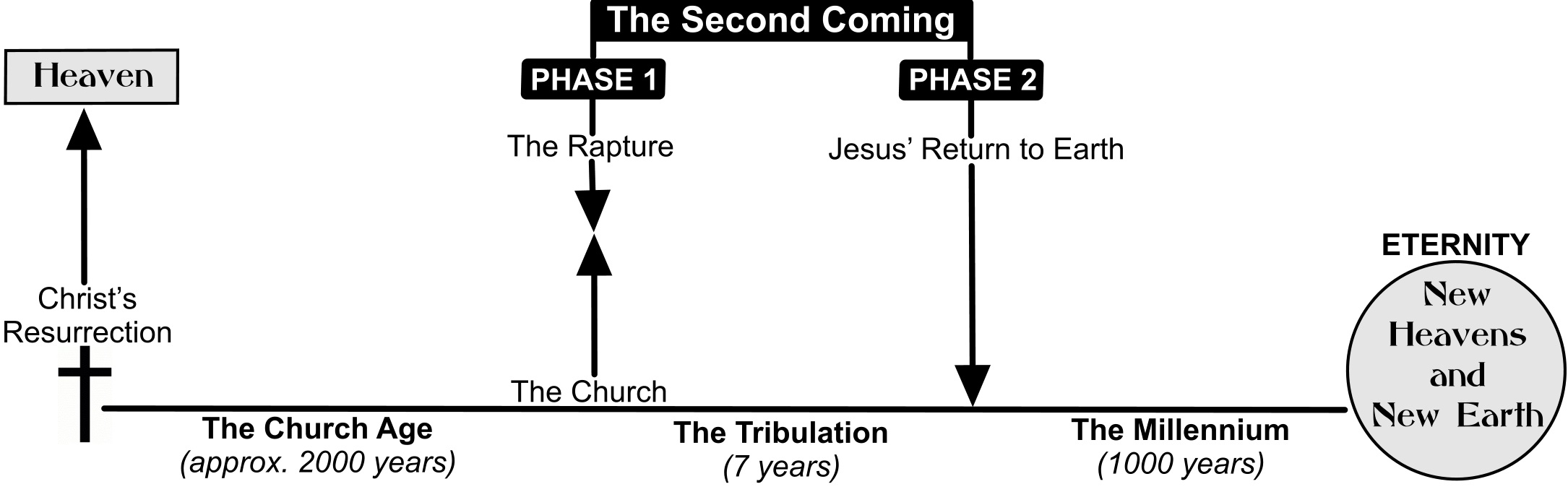
Since Christ was crucified in 33 AD, we are very close to the 2000-year mark. But why do theologians think the Lord will return in about 2000 years? What evidence is there in the Bible to support this position?
One reason that always impressed me can be observed in The Parable of the Good Samaritan:
30In reply Jesus said: “A man was going down from Jerusalem to Jericho, when he was attacked by robbers. They stripped him of his clothes, beat him and went away, leaving him half dead. 31A priest happened to be going down the same road, and when he saw the man, he passed by on the other side. 32So too, a Levite, when he came to the place and saw him, passed by on the other side. 33But a Samaritan, as he traveled, came where the man was; and when he saw him, he took pity on him. 34He went to him and bandaged his wounds, pouring on oil and wine. Then he put the man on his own donkey, brought him to an inn and took care of him. 35The next day he took out two denarii and gave them to the innkeeper. ‘Look after him,’ he said, ‘and when I return, I will reimburse you for any extra expense you may have.’ “
Luke 10:30-35
The story consists of four main characters aside from the robbers — a man, a priest, a Levite and a Samaritan. Each of these are symbolic as follows:
- The beat-up man left for dead represents fallen humanity doomed to death, which is the wages of sin (Romans 6:23).
- The priest and Levite who pass by the dying man represent useless religion, which cannot save.
- The Samaritan, however, symbolizes Christ, the compassionate one who provides the way to health and life.
After bandaging his wounds, the Samaritan takes the traveler to an inn (the Church) and gives the innkeeper (the Holy Spirit) two denarii until he comes back. Since a denarius was equal to one day’s pay in that culture, it’s implied that he’d return in two days. Thus, because “a thousand years are like a day” to the LORD (2 Peter 3:8 & Psalm 90:4), it’s assumed Christ will return in approximately two thousand years, which is two days from His perspective.
For more concrete reasons on why theologians believe Christ will return after about 2000 years see this article.
Related Topics:
Second Coming of Christ — Rapture and Return to Earth
Church of Christ — What Is It?
The Five Earths of the Bible (and the Eight Ages)
Millennial Reign of Christ — Why?
Eternal Life (“Heaven”): Questions & Answers
REDEMPTION — God’s Plan of Liberation for Humanity & Creation
Beware of RELIGIOUS FORMAL DEATH

Since legalism is a dead religious spirit that focuses on rules above relationship with God it naturally saps life, freedom, joy and spontaneity. God is the Fountain of Life from which all life flows, whether physical or spiritual, and Yeshua is “the life” who came to give us “life to the full” (John 14:6 & 10:10). As such, those who move away from The Life to focus on rules and ritual will move further and further away from the abundant life the Messiah came to give.
Think about it, if we are “made alive with Christ” then those who move away from him move toward death (Colossians 2:13). They’ll develop a sterile spirit as spiritual rigor mortis sets in. Unsurprisingly, religious gatherings of such people will have a very formal, lifeless air. Those performing the various aspects of the services—whether pastors, teachers, worship leaders, elders or deacons—will seem to be just “going through the motions.” They’ll function like religious zombies. It goes without saying that attending these services will be dreadfully boring. Why? There’s no life there.
Two Biblical Examples
We see evidence of this sterile spirit in a few of the churches that Christ addressed in Revelation 2-3. The Lord gave each of these seven assemblies a report card. Why did he pick these specific fellowships? Because they characterize the seven basic types of churches that would exist throughout the Church Age. What Jesus said to these assemblies is therefore relevant in any time period.
He had nothing good to say about two of the churches, one being the church of Laodicea. Notice what Jesus said to this group of believers:
“I know your deeds, that you are neither cold nor hot. I wish you were either one or the other! 16 So because you are lukewarm—neither hot nor cold—I am about to spit you out of my mouth. 17 You say, ‘I am rich; I have acquired wealth and do not need a thing.’ But you do not realize that you are wretched, pitiful, poor, blind and naked.”
Revelation 3:15-17
Christ rebuked these believers for being “lukewarm” and threatened to spit the whole fellowship out of his mouth if they didn’t repent, meaning he would “pull the plug” on them and they’d be a ‘church’ in name only.
The Lord wished they were cold or hot rather than lukewarm. This was an allusion to nearby cold and hot springs. The cold springs were useful for refreshing and the hot springs for bathing, but lukewarm water was useless.
Notice what Jesus goes on to say:
“Those whom I love I rebuke and discipline. So be earnest, and repent. 20 Here I am! I stand at the door and knock. If anyone hears my voice and opens the door I will come in and eat with him, and he with me.”
Revelation 3:19-20
Verse 20 has traditionally been used by evangelicals to verbally witness to the lost, which would suggest that Christ was addressing unbelievers, but this wasn’t the case. Jesus was talking to believers who had pushed him out of their fellowship. They forsook relationship with the Lord for religion and consequently became lukewarm—sterile, lifeless, useless. They were just “playing church,” just going through the motions.
There are assemblies like this in practically every community today, all over the world. Jesus is knocking on their doors wanting in, but they’re convinced everything’s fine because they have money, a nice facility, regular congregants, etc. (The Laodicean believers certainly felt this way, as observed in Revelation 3:17). But the Lord is ready to pull the plug on them altogether if they don’t repent. Some of them he already has, like the Episcopal Church (which is not to say that there aren’t any genuine believers still in the Episcopal Church; there’s usually a “remnant” faithful).
The church in Ephesus wasn’t as bad as the one in Laodicea. The Lord commended them for several things—their good deeds, their hard work, their perseverance and their refusal to tolerate false teachers. These are all good, but notice where they missed it:
Yet I hold this against you: You have forsaken your first love. 5 Remember the height from which you have fallen! Repent, and do the things you did at first. If you do not repent, I will come to you and remove your lampstand from its place.
Revelation 2:4-5
The Ephesians forsook their “first love.” They steadily moved away from relationship with the Lord toward cold, mechanical religion. They maintained orthodoxy and performed good works, which is good, but they lost intimacy with God. They were just going through the motions. They had the outward veneer of Christianity but lacked its heart. Since Christianity at its core is a relationship with God and the first and greatest command is to love the Lord with all our heart, soul, mind and strength (Mark 12:29-30), this was a grievous offense, which is why Christ said they had fallen from a great height.
Reflect on that: As far as Jesus was concerned they had fallen from a great height! In other words, it was no little transgression. They stumbled into the trap of legalism and the Lord’s message was a stern warning to repent. If they didn’t, he threatened to remove their “lampstand from its place.” The “lampstand” represented the Ephesian church itself (Revelation 1:20) and therefore its removal meant that they would no longer be Christ’s church. In short, the Lord was prepared to “pull the plug” on them if they refused to repent; in which case they’d be a ‘church’ in name only.
Both the Laodicean and Ephesian churches made the mistake of substituting sterile religiosity for personal relationship with the LORD and it resulted in a lifeless, go-through-the-motions spirit. The Laodiceans were further along on this dark road, which can be observed in their arrogant attitude and the fact that the Lord literally had nothing good to say about them, but the Ephesians were heading in this same direction.
An Example From My Own Experience of a Church With a Sterile Spirit
Years ago I went to an assembly for nine months to fulfill my formal schooling in an internship program. The first thing I detected on my initial visit was a very sterile spirit. Everything was done in such a formal, ritualistic manner and the congregants participated in drone-like fashion. I’m not saying this to be mean or to suggest that I was looking down on these dear brothers and sisters in the Lord; I’m just giving my honest appraisal of the experience.
Needless to say, my wife & I did everything in our power to give this fellowship a spark of life while we were there. After nine months with no appreciable change—not to mention enduring some gnashing of the teeth by some of the congregants—we decided to leave. I couldn’t stomach that lifeless spirit for one more service.
It dawned on me later that this sterile go-through-the-motions mindset was a form of legalism.
The pastor was a gentle soul, and—I believe—a sincere Christian man. Yet the whole time I was involved with this fellowship I saw him in the grip of some kind of quiet torture. It was as if he was just playing the role of a pastor, just going through the motions, and his sermons and ministry reflected this. The entire time I was there I didn’t hear a single moving, stimulating or life-changing teaching. It wasn’t in him. Somewhere along the line in his decades of service he was infected by legalism in the form of religious formal death. It’s a spirit of sterility.
I say this with sadness, not joy. I had zero hostility toward the pastor or any of his congregants; I just felt sad for them. They were in a rut and couldn’t get out. The only way out was to break free of their “go through the motions” spirit. Unfortunately, they probably weren’t even aware of the problem. Although they were obviously concerned that their church wasn’t growing, I doubt they were aware of how utterly dead their gatherings had become. Carol & I could see it only because we were outsiders.
How did the pastor develop a “go through the motions” manner? I’m sure it was something that slowly developed over the years as he moved away from relationship with God to working for God. A spirit of familiarity settled in concerning the Almighty, the church, God’s Word, pastoring, and the things of God in general.
What’s the answer in these types of situations? Simple: The Basics of Christianity
This article was edited from chapter 5 of…
- The print book is available here for about $10 (291 pages)
- The eBook is available here for just $2.99!
Both links allow you to “Look inside” the book.
Related Topics:
Legalism — Understanding Its Many Forms
What Is a “Spirit of STUPOR” or “Religious FOG”?
What Is a Spirit of STUPOR or Religious FOG?

I was giving a sermon at a small Assembly of God church a dozen years ago and the Word was just not getting across to the people, except a few. With all due respect, they sat there with blank faces in what seemed like some sort of religious trance. I’m not putting these people down, but rather humbly detailing what occurred. I previously taught this same teaching at a couple of other fellowships and it was received well, so the problem wasn’t likely the topic or my delivery. So what was the issue? This passage might shed some light:
As it is written: “God gave them a spirit of stupor, eyes so that they could not see and ears so that they could not hear, to this very day.”
Paul was referring to the Israelites who hardened themselves to the truths of the Messiah’s message. Since they rejected God’s grace in Christ he gave them over to a state of stupor so that they couldn’t see or hear spiritual truths. In other words, God allowed them to reap the harvest of their own spiritual stubbornness.
Please don’t misinterpret this, God will show his ways to anyone who humbly turns to him. As James put it: “Come near to God and he will come near to you” (James 4:8). But he will give a spirit of stupor to those who continually harden their hearts to his ways and truths. Why would he do this? Simple: “God resists the proud, but gives his grace to the humble” (James 4:6). God actively resists or opposes the stubborn and arrogant, but gives his favor to the humble; the teachable meek, not the weak.
What is a spirit of stupor? It’s a dazed condition of inertia and lethargy wherein the simplest of spiritual truths are unable to arouse, change or motivate. This is what I saw in that congregation; not all of them, but a lot of them. You can teach/preach the most magnificent truths of God’s Word until you’re blue in the face and it will have little or no effect on the bulk of such people due to their foggy religious stupor.
This appears to have been the problem with the Sardis church in the late 1st century. Notice what Christ said to these believers:
“I know your deeds; you have a reputation of being alive, but you are dead. 2 Wake up! Strengthen what remains and is about to die, for I have not found your deeds complete in the sight of my God. 3Remember, therefore, what you have received and heard; obey it, and repent. But if you do not wake up, I will come like a thief, and you will not know at what time I will come to you.”
Revelation 3:1-3
The assembly in Sardis was dead. They had a reputation for being alive only because of their legalistic airs, which undiscerning people confused as genuine Christianity. The Lord urged them to “Wake up!” Why? They had fallen into a religious stupor.
I experienced a similar condition in an old friend I saw several years ago. I desperately wanted to minister to him the life-changing power of the LORD and his Word, but he kept chain-smoking and drinking beer after beer while blasting secular music. As a confessing Christian, these were things he should have dealt with over 25 years earlier, but here he was still in bondage, still in the baby-stage. I’m not saying this with arrogance, but with honesty and compassion—I truly wanted to help him.
Unfortunately, although he admitted to being an alcoholic and that God was the ultimate answer to life’s problems, he talked as if everyone else was to blame for the pit he was in and nothing I said could penetrate his dazed mindset. It’s a spirit of stupor, although in this case it was a lawless stupor and not a religious one. You see, Legalism and libertinism are two sides of the same bad coin.
I didn’t give up on him at the time. I still prayed for him and tried to reach him. He admitted to feeling “lost” and expressed a desire to change, which is good. This is the most important thing because there’s no hope of change without the realization of the need to change and, of course, the desire to change. Unfortunately, he foolishly chose to continue with his addictions, which led to his premature death in early 2021.
On the other side of the spectrum, some people foolishly choose to continue with their religious fog at the expense of freedom in the LORD, like the Pharisees, the Teachers of the Law and their followers, noted in the Scriptures (Matthew 13:15, John 8:44, John 5:39-40, Galatians 5:1 & Matthew 15:14).
Needless to say, be careful of succumbing to a spirit of stupor, whether a religious stupor or a hedonistic one.
For anyone in such a fog, how do you get out? Since the Lord said it’s the truth that will set us free (John 8:31-32), a good starting point is The Basics of Christianity. Anyone who masters these basics will indeed be set free.
This article was edited from Chapter 5 of…
- The print book is available here for about $10 (291 pages)
- The eBook is available here for just $2.99!
Both links allow you to “Look inside” the book.
Related Topics:
God Exists in a State of TOTAL FREEDOM
Religion and Christianity — What’s the Difference?
Godliness and Religion—What’s the Difference?
God Exists in a State of TOTAL FREEDOM

People in the world sometimes perceive God as some old fuddy duddy in the sky who can’t stand folks having a “good time” and therefore is obsessed with removing anything “fun” from our lives. While human religion and forms of legalism might be like this, the LORD is quite different and actually operates from a state of absolute freedom. See for yourself:
Now the Lord is the Spirit, and where the Spirit of the Lord is, there is freedom.
Thus in the Scriptures you’ll find several statements like this:
Our God is in heaven;
he does whatever pleases him.
The Lord does whatever pleases him,
in the heavens and on the earth,
in the seas and all their depths.
In other words, God functions in a state of total freedom and therefore does whatever he wants.
What’s interesting is that people — male and female — are created in God’s image and likeness and so we have this same desire. We intrinsically hate captivity and the restraints thereof. We want freedom! This explains why we have an instinctive revulsion of slavery. No wonder efforts to end the slave trade in the West were spearheaded by godly people, like William Wilberforce in Britain and William Lloyd Garrison in America.
Satanic people & their godless ideologies, by contrast, love tyranny and bondage in one form or another. Communism is a good example. And this explains why citizens in socialist states East of the Iron Curtain always tried to escape to the freedom-oriented republics of the West and not vice versa.
That’s all I really wanted to stress in this article. Chew on these things and you’ll be blessed.
For those interested in additional miscellaneous insights on this topic, keep reading…
Democracies and Republics
While a king or queen rules absolute in a monarchy and an elite ruling class reigns in Marxist governments, the people rule in a democracy (the Greek word dēmos means ‘the people’ and kratia means ‘rule’). In a republic the people rule as well, except that they appoint representatives to do the political work, which frees-up the citizens to raise families and conduct the business of their livelihoods (the Latin res refers to an ‘entity concerning’ and publicus means ‘the public’).
Countries today that are called ‘democracies’ are actually republics since the people of the various regions elect representatives to carry out the political duties, like traveling to the capitol cities and speaking for them. America is a good example.
I bring up republics because they are God’s preferred form of government since they allow for people to function in the most liberty in a fallen world. While it’s true that the LORD uses flawed human governments in general as an instrument to bring order to societies by protecting innocent citizens from criminals (Romans 13:1-6), God is not a big fan of authoritarian-styled governments since they stifle human freedom (1 Samuel 8).
This explains why the first nation of millions of people to have no king (or absolute ruler, whatever the title) in the history of the world was the Hebrews after they escaped slavery in Egypt. For the next 400 years they had no human king. Instead, the LORD was their spiritual King and they had noble human representatives or intermediaries, like Moses, Joshua or Deborah, along with the priests teaching the Law and individuals being accountable to God based on conscience.
While technically a theocracy, this was a republic from a purely natural perspective. It was the beginning of the concept of equality in regards to a nation of millions with the Law supporting the premise of no respecter of person, rich or poor. Ideally, everyone was to be treated the same and by the same standard.
This Hebrew Republic was God’s original plan for the Israelites, but eventually the people wanted to be like all the nations around them (1 Samuel 8:19-20), so the LORD reluctantly gave them their first king, which was Saul, who started out good, but became corrupt.
Interestingly, the Pilgrims used the Hebrew Republic as a model for government when they arrived in Provincetown Harbor & Plymouth, Massachusetts, in 1620. They were a Puritan sect of the Church of England, known as Separatists because they considered their congregations separate from the English state church (as opposed to the non-separatist Puritans). They fled tyranny in Europe for sanctuary in the New World.
Here’s something interesting to consider: The Pilgrims in America focused on the model of pre-King Saul Israel, which was the Hebrew Republic, whereas King James I of England (and other Euro monarchs) preferred the Israel of King Saul-onward.
King James naturally favored the Saul-onward model due to the idea of “the divine right of kings” in which Kings have subjects who are subject to the king’s will, which is the final word. This is in contrast to a democracy or republic that the Pilgrims had in mind based on the pre-Saul Hebrew Republic.
This explains why the colonies in America were so successful and attracted multitudes of freedom-seeking people in the 1600s-1700s, the vast majority of them being devout believers. Towns sprung up across the landscape, all Judeo-Christian republics. A group of people with their pastor would found a settlement, a town, and the church facility would service both spiritual gatherings and political meetings, aka the townhouse.
The reason the Hebrew republic ultimately failed is because of humanity’s fallen nature and the corresponding need for a new spiritual nature. Thus Israel fell into times of moral anarchy in which “everyone did as they saw fit” (Judges 17:6 & 21:25). While this sounds good on the surface, it’s not good when people are slaves to the flesh or sinful nature and collectively lack virtue. In the American colonies, by contrast, the vast majority of the people were spiritually regenerated and hence the communities operated on the foundation of the love and fear of God and the virtue thereof.
So what hampered America’s godliness and goodness and led this formerly great nation to where it is now with all the glaring corruption and immorality? [Keep in mind that this was written during the 0Biden years]. Simple: being a free nation, godless ideologies were increasingly introduced and spread in the last century through the educational system, the media, arts & entertainment and government. I’m talking about the atheistic religion of secular humanism, aka LIEberalism.
Thus, instead of being a virtuous nation, America is now looked on as a moral joke throughout the world [at least during the 0Biden regime, when this article was originally written], which doesn’t mean that there aren’t millions upon millions of genuinely godly people in the population; it just means that the ungodly are in positions of influence and power, corrupting the youth. The Parable of the Weeds (Tares) applies (Matthew 13:24-30 & 13:36-43).
So, just like with the Hebrew Republic in Israel, the people forsaking the fear of God and giving themselves over to the sinful nature is bringing down America and similar Western republics. The problem, of course, is that hedonism, aka libertinism, is not true freedom, although it disguises itself as ‘freedom.’ It’s actually just bondage to the flesh, which brings us to…
Individual Freedom
The problem with humans functioning in a state of total freedom, like God, is that human desires are corrupted by the flesh or sinful nature. Thankfully, the LORD has provided a way for us to “escape the corruption in the world caused by evil desires” (2 Peter 1:4); it’s called “participating in the divine nature” otherwise known as walking in the spirit (Galatians 5:16). When you learn to “put on the new self” you’ll be spirit-controlled rather than flesh-ruled (Ephesians 4:22-24) and, hence, your desires will be righteous rather than corrupt. (You can learn more about living by the spirit here or see this video).
When your desires change from worldly to godly you’ll naturally find yourself no longer interested in chasing worldly things for satisfaction. For instance, is going out on the weekend to get plastered on alcohol & drugs really “fun” or is it potentially destructive? Is it really “freedom” to “let loose” in this manner or is it actually bondage, bondage to the flesh?
If believers “escape the corruption in the world caused by evil desires” by walking in the spirit, the community in question will have virtue — a spirit of goodness — which is the opposite of lawlessness. And this is one of the reasons the American settlements were so successful in the 1600s, attracting throngs of freedom-seeking people in the 1700s, the vast majority of them being believers and, often, pastors & their congregations.
A few early examples include Puritan ministers Thomas Hooker and Samuel Stone who led a group of about 100 people to establish the settlement of Hartford, Connecticut, in 1636. Hooker also founded Windsor and is unsurprisingly considered the “founding father” of Connecticut. Meanwhile theologian Roger Williams founded Providence, Rhode Island, in 1636 wherein he established the first Baptist church in America.
While all forms of government in a fallen world are flawed and have shortcomings, the republic model — often called ‘democratic’ — is the best for individual liberty and opportunity. People tend to flourish in republics whereas they languish under the gross restraints of Marxist countries or dictatorships/kingships, which explains why folks naturally try to escape communistic states and dictatorships in preference for freedom-loving republics and not the reverse.
In republics, the Word of God is freely spread and believers gather & worship at liberty whereas in communistic states or corrupt dictatorships/kingships believers have to meet secretly and, if they’re caught, they’re fined, imprisoned or worse.
Regardless of the form of human government believers exist under — whether freedom-oriented, tyrannical or somewhere in between — the individual believer can certainly function in a personal state of spiritual freedom thru living by the spirit since “where the Spirit of the Lord is, there is freedom” (2 Corinthians 3:17). In light of this you can be in a state of captivity and yet be free on a deeper level, like Paul when he wrote the prison epistles (Ephesians, Philippians, Colossians and Philemon).
Remember, the LORD functions in a state of total freedom wherein He does whatever pleases Him. You are created in God’s image and thus naturally want to do the same. If you’re spirit-controlled rather than flesh-ruled, here are some scriptural insights on how to obtain your (righteous) desires, regardless of the government you’re under or situation you’re experiencing (or see the video).
Keep in mind, off course, that every believer will face the ongoing challenge of temptations, trials and tests during their spiritual pilgrimage in this fallen world, which you can learn about here.
Related Topics:
The SEVEN FREEDOMS — Take Hold of ‘Em!
Religion and Christianity — What’s the Difference?
Godliness and Religion—What’s the Difference?
Libertinism — What’s Wrong with It and How to Walk FREE
What Form of GOVERNMENT Is Best?
How to TAKE CAPTIVE THOUGHTS (Noémas—Mindsets, Ideologies)

Notice what the Bible exhorts us to do:
We demolish arguments and every pretension that sets itself up against the knowledge of God, and we take captive every thought to make it obedient to Christ.
Christ is the living Word of God who is the truth (John 1:1 & 14:6). So we are to “take captive” thoughts and make sure that they comply with the truth. ‘Truth’ is alétheia (ah-LAY-thee-ah) in the Greek, which means “reality” or “the way it really is.” So we are to take “thoughts” and make sure that they conform to reality. If they don’t comply with the truth then they are ‘weeds’ of unreality and should be purged from the soil of your heart.
The word ‘thought’ in this passage is noéma in the Greek (NOH-ay-mah). While noéma can refer to thoughts, good or bad, it can also refer to a person’s perspective—mindset, attitude or ideology—which is the result of indoctrination, good or bad. Indoctrination is naturally determined by the doctrine—the teaching or instruction—to which you are regularly exposed.
For instance, if you sit under a secular humanist professor long enough and don’t counteract those teachings with the truth of the rightly-divided Word of God (or the truth period) you’ll naturally develop a secular humanist ideology. You’ll then start to live out of this mindset, to one degree or another. The doctrine or teaching you’re exposed to on a regular basis determines your indoctrination, which is your mindset, good or bad. Such a mindset is a noéma.
The Greek word for “doctrine” is didaskalia (did-as-ka-LEE-ah). It means teaching or instruction and can be good or bad depending on how true it is. The Bible speaks of sound doctrine (1 Timothy 4:3 & 4:6) and bad doctrine:
Now the Spirit expressly states that in later times some will abandon the faith to follow deceitful spirits and the teachings (didaskalia) of demons,
1 Timothy 4:1 (ESV)
Obviously the teachings of demons aren’t good because demons are evil spirits.
The point is that a person’s mindset or ideology — noéma — is determined by the teachings to which he or she is regularly exposed. Noémas formulate over the course of time as a person is fed information. The longer it takes for a noéma to develop the more imbedded it is in the individual’s psyche.
It is through negative noémas that the enemy “blinds the minds of unbelievers, so that they cannot see the light” (2 Corinthians 4:4). The devil has control of their minds—through demonic noémas—and the truth cannot penetrate this indoctrination.
To help you visualize this, I went to the Facebook page of a Christian friend I hadn’t seen for three decades and was surprised by his cover pic. It was a skull with a red dragon wrapped around its head. No doubt he chose this pic because he thought it looked ‘cool,’ but it’s actually an excellent illustration of how the enemy blinds people’s minds: The red dragon represents the devil and he has control of the person’s mind, which is depicted as a skull and symbolizing death, the natural result of satan’s misleading.
Notice how 2 Corinthians 10:5 (quoted above) says we are to “take captive” thoughts and mindsets. The Greek word for ‘take captive’ literally means to “take captive as a prisoner and interrogate; to subjugate and bring under control.” The Bible is saying that we should take any perspective we have and honestly & thoroughly examine it, making sure it conforms to reality (the way it really is) rather than unreality (the way it really isn’t). If we discover that the mindset does not comply with reality then we need to throw it out.
This can apply to any doctrine—teaching—you were taught during your formative years as a believer. Just because you were indoctrinated by a particular teaching in a relatively sound sect by a respected pastor doesn’t make the doctrine true. So you need to “interrogate” it in light of reality. Does it comply with the rightly-divided Word of truth and the Spirit of truth (John 17:17 & 16:13)? If not, it needs to be thrown out in favor of whatever the truth is, which is reality.
Of course, this applies to secular indoctrination as well, such as the godless humanism that’s commonly taught at our secular colleges and universities. Generally speaking, the professors thereof teach that the idea of an intelligent Creator is absurd and thus life is meaningless and you’re just an accident. There’s nothing special about human beings, they say, and we’re basically just animals. And, when ya die, that’s it.
The consequences of this kind of brainwashing are devastating—it produces moral rot and an attitude of no respect for life, including one’s own; it encourages living with a temporal perspective (noéma) rather than an eternal one (noéma). Such a hedonistic philosophy can be summed up as: “Let us eat and drink, for tomorrow we die” (1 Corinthians 15:32).
One example of secular indoctrination is homosexuality. While homosexuality was still a crime in much of the USA as of the new millennium, that’s all changed. Now homosexuality is taught to be innate and healthy in our secular culture and people are encouraged to experiment with it and embrace it as a legitimate alternative lifestyle. Our secular mentors in the mainstream media are increasingly active homosexuals, like Ellen DeGeneres, Rachel Maddow and Anderson Cooper.
Take the first two, for instance (DeGeneres and Maddow): Parents allow their children to sit under them where they’re exposed to their smooth “gay” propaganda and then wonder why some of their offspring eventually embrace the homosexual lifestyle. Notable people who publicly “come out” are commended by celebrities and governing officials alike. Those who refuse to approve of homosexuality, by contrast, are considered evil bigots and punished severely, socially speaking. The truth about homosexuality, however, is that it’s a damning sin and those who unrepentantly practice it will not inherit the kingdom of God. “Do not be deceived,” the Bible warns (1 Corinthians 6:9-11).
A believer struggling with this kind of worldly indoctrination or same-sex attraction can take this noémas (mindset) captive and interrogate it in light of the truth of Scripture and the leading of the Spirit of truth. Since these kinds of noémas don’t comply with the truth they need to be purged out of one’s mindset in favor of reality.
As you do this with every thought/impulse/attitude/mindset you purge your heart of falsity and unreality. This is “being made new in the attitude of your mind” (Ephesians 4:22-24).
One last thing, “taking captive” thoughts or mindsets does not refer to taking captive someone else’s thoughts since we don’t have authority over another person’s will. The only way we can help someone else’s thought life & beliefs is by teaching the rightly-divided truths of God’s Word and praying for the person, not to mention setting a good example.
This article was edited from chapter 17 of…
- You can purchase copies here for a special low price (345 pages).
- Or pick up the eBook version for just $2.99!
Related Topics:
What Are the Sources of TRUTH (Reality)?
Hermeneutics — Proper Bible Interpretation
Demonic Spirits — How to Deflect Them
SANCTIFICATION: Spirit, Mind & Body
Your Thoughts Run Your Life! (video)
How to Renew Your Mind (video)
Spirituality — How to be Spirit-Controlled Rather than Flesh-Ruled
Does the Bible Support INNOCENT UNTIL PROVEN GUILTY?

The revolutionary idea of “innocent until proven guilty” can be observed in God’s Law for Israel in regards to six “cities of refuge” being established for this very cause (Deuteronomy 19, Numbers 35:6-34 & Joshua 20).
To explain, these cities served as sanctuaries for those guilty of involuntary manslaughter — an unintentional killing of another person — to protect them from revenge by family members or loved ones, referred to as “the avenger of blood” in the text, which technically refers to the kinsman-redeemer, i.e. the nearest male blood relative of the one who had perished.
Here’s how this judicial process worked: If an Israelite killed another person, accidentally or otherwise, they could find immediate asylum in a city of refuge where they would await trial while living & working under the watchful eyes of the Levites. A murder conviction had to be based on more than one witness (Deuteronomy 19:15) and the judges involved were charged with investigating the case in detail, including the thorough cross-examination of witnesses and their testimonies (Deuteronomy 19:18).
The six cities of refuge were located throughout Israel with three on either side of the Jordan River, which made them accessible to any Israelite charged with possible murder. You can get a map visual from several images here.
Hebrews found guilty of murder were turned over to the avenger of blood for just execution (Deuteronomy 19:11-13). However, those determined to be innocent were guaranteed protection in the city of refuge where they would stay until at least the death of the high priest (Numbers 35:25). If they left the city before this they obviously were not assured protection.
Spiritual Application of Cities of Refuge for New Covenant Believers
The Bible stresses that the LORD is a strong, fortified tower in which the righteous can run to and be safe (Proverbs 18:10). Of course no one is righteous in themselves (Romans 3:10), but we can acquire righteousness — in-right-standing with God — through faith in Jesus Christ (Romans 3:22). In other words, any sinner can find a “city of Refuge” in Christ (Colossians 1:21-23 & John 3:16, 3:36).
For fascinating details on this figurative application, see this article.
Related Topics:
REDEMPTION — God’s Plan of Liberation for Humanity & Creation
Is Christianity a “RELATIONSHIP With God”?
Religion and Christianity — What’s the Difference?
Does Christianity Weaken People or EMPOWER?
Law (Torah) — New Testament Believers are NOT Under the Law
What Form of GOVERNMENT Is Best?

The righteous laws of human governments and corresponding enforcement of those laws are God-ordained for the purpose of punishing criminals, including the right to execute when appropriate (Romans 13:1-6). In other words, the LORD uses flawed human governments in general as an instrument to bring order to societies in this fallen world since they protect innocent citizens from the consequences of sinful human tendencies. You can read more about this here.
Unfortunately, governments can become corrupt and do more harm than good for its citizens, not to mention other nations. How can noble citizens prevent their government from becoming corrupt? Obviously they have to be involved in the political process on one level or another otherwise evil people will take the reins.
The question we want to answer in this article is, what is the best kind of government in God’s eyes and why? What’s the Bible say? Let’s start with…
The Most Prominent Form of Government
William Federer informs in his excellent book Who is the King in America? that the most “popular” or reoccurring form of government in human history is the kingship in which what the ruler says goes. Different cultures use different names for such an authoritarian ruler — king, queen, pharaoh, lord, caesar, sultan, kaizer, emperor, maharaji, khan, dictator, etc. — but they all come down to one person calling the shots for a country of people. Even tribes have their chiefs. (When the words ‘king’ or ‘kingship’ are used throughout the rest of this article they’re referring to this type of government).
Federer points out the facts of life in such an authoritarian rule:
- If you’re a friend of the king you’re more equal than other citizens.
- If you’re not a friend you’re less equal.
- If you’re an enemy you’re either a slave or dead.
A king is essentially a glorified gang leader and the gang leader naturally demands loyalty.
The best case scenario in a kingship of course is to have a good ruler. The problem with this is that the ruler will eventually perish and someone else will take over. What happens when the new person lacks the nobility of the former ruler? A good example from the Bible is the righteous kings of Judah, such as Jehoshaphat, Jotham, Hezekiah and Josiah. Judah was blessed under the noble leadership of these kings; unfortunately, all of their sons were ignoble, destructive authorities and the nation suffered accordingly.
Another problem with a kingship is: Even if you have a good king or queen, what if he/she goes bad, as was the case with Saul, Solomon, Joash, Amaziah and Uzziah, as well as Jehu in the northern kingdom?
Here’s the general top-down hierarchy in this form of government:
- Ruler
- Govt officials (including religious ones)
- Soldiers
- Scribes
- Merchants
- Artisans
- Farmers/ranchers
- Prisoners/slaves
This model is the default setting for government throughout human history. Interestingly, it wasn’t originally God’s will for Israel to be a human kingship. The LORD had in mind a bottom-up model with a decidedly spiritual kingship…
The Hebrew Republic and the Pilgrims Who Came to America
The first nation of millions of people to have no king in the history of the world was the Hebrews after they escaped slavery in Egypt. For 400 years they had no human king. Instead, the LORD was their spiritual King and they had noble human representatives, like Moses, Joshua or Deborah, with the priests teaching the Law and the people being accountable to God based on conscience.
While technically a theocracy, it was a republic from a purely natural perspective. This was the beginning of the concept of equality in regards to a nation of millions with the Law supporting the concept of no respecter of person, rich or poor. Ideally, everyone was to be treated the same and by the same standard.
The Hebrew Republic was God’s original plan for the Israelites, but eventually the people wanted to be like all the nations around them (1 Samuel 8:19-20), so the LORD reluctantly gave them their first king, which was Saul, who started out good, but became corrupt.
The Pilgrims were members of the Puritan sect of the Church of England, known as Separatists because they considered their congregations separate from the English state church (as opposed to the non-separatist Puritans). They fled tyranny in Europe on the Mayflower and used the Hebrew theocratic Republic as a model for government when they arrived in Provincetown Harbor & Plymouth, Massachusetts, in 1620 (they were heading for the Colony of Virginia, but a storm blew them off course).
- The Pilgrims in America focused on the model of pre-King Saul Israel, which was the Hebrew Republic.
- Across the Atlantic, the King of England, James I, preferred the Israel of King Saul-onward.
King James naturally favored the Saul-onward model due to the idea of “the divine right of kings” in which Kings have subjects who are subject to the king’s will. Case closed. This is in contrast to a theocratic democracy or republic that the Pilgrims had in mind based on the pre-Saul Hebrew Republic. Speaking of which…
Democracies and Republics
While a king rules absolute in a kingship, the people rule in a democracy (the Greek word dēmos means ‘the people’ and kratia means ‘rule’). The Athenian democracy in 508–507 BC is considered the first large-scale democracy in human history.
In a republic the people rule as well, except that they appoint representatives to do the political work, which frees-up the people to raise families and conduct the business of their livelihoods (the Latin res refers to an ‘entity concerning’ and publicus means ‘the public’).
Countries today that are called ‘democracies’ are actually republics since the people of the various regions elect representatives to go to the capital cities and carry out the political duties. America is a good example.
Anarchy, Republics and Kingships/Communism
The two extremes in human government are no government and total government.
- With no government there’s anarchy wherein the person or gang of people that is the strongest reigns. The “strongest” typically have the most physical prowess, manpower or superior weapons.
- With total government you have a leader who reigns supreme, which is a kingship or dictatorship. However, forms of Marxism, like Communism, also fit this category because the State becomes the supreme leader; instead of one person calling the shots, a ruling class of people do so. Some ‘kings’ are merely puppets controlled by a group of elites behind-the-scenes.
- The middle ground of these two extremes is the people-ruling republic.
In both anarchy and kingship/Marxism the leaders rule by fear: Do what they say or they’ll captivate you or execute you. In essence, the State becomes “god” because it is through the State that the citizens get their rights and they are accountable to the State. Needless to say, the saying “power corrupts and absolute power corrupts absolutely” becomes relevant.
Obviously the best option of the three possibilities is the “middle ground,” the people-ruling republic. In this form of government the individual gets his/her rights from the Creator and is ultimately accountable to their Maker. The citizens’ political leaders are merely representatives and often have term limits.
Republics Can Become Corrupt
Unfortunately, we live in a fallen world and so even a republic can become corrupt if the people don’t maintain a modicum of virtue; that is, a communal sense of nobility or honor. When the people of a community have virtue there’s little need for police. However, if the people become depraved, lawlessness results and they’ll choose corrupt representatives, which naturally results in a corrupt or ineffectual government.
Consider how America was challenged by two flooding disasters in 2005 — flooding in five Midwestern states, which caused the governors of Ohio and Indiana to declare states of emergency, and the flooding of New Orleans due to Hurricane Katrina. In the Midwest the people came together and helped each other through the crisis while in The Big Easy a dog-eat-dog scenario emerged marked by heinous criminal acts.
What can explain the diametrically opposed responses to the same kind of natural calamity in the same country? Simple: In the Midwest the communities had a spirit of virtue and goodwill whereas inner city New Orleans had developed a dangerous, depraved spirit. I’m not saying there weren’t any good people there (even Sodom had a handful of noble souls), just that the widespread atrocious acts speak for themselves.
The Hebrew Republic of the first 400 years after escaping slavery in Egypt didn’t always work but, when it did, it was because the community had virtue, which was fueled by the Mosaic Law advocated by a noble national representative, like Moses or Joshua, not to mention the service of the priests. What is ‘virture’ based on in such a scenario? The citizens embrace three basic truths:
- The Almighty sees everything.
- God insists on honesty & fairness and repentance when moral error occurs.
- Everyone is ultimately accountable to their Creator.
If a populace embraces this perspective it naturally creates societal order because the people are policed by their God-fearing conscience above law officers. This explains why the Pilgrims who came to America based their government on the brilliant Hebrew Republic and the United States was originally “one nation under God.”
Unfortunately, during Israel’s time of the “judges” — who were divinely-appointed leaders that delivered Israel from hostile neighboring nations — Israel fell into times of moral anarchy in which “everyone did as they saw fit” (Judges 17:6 & 21:25).
This illustrates why fallen people desperately need new spiritual ‘software’ and the corresponding redemption if any republic is to be successful in the long term, which is what the message of Christ and resulting spiritual regeneration is all about (2 Timothy 1:10 & Titus 3:5). And this explains…
Why the American Colonies Were So Successful
After the Pilgrims set up their New England colony in 1620, towns started springing up across the landscape, all Judeo-Christian republics. A group of people with their pastor would found a location, a town, and the church facility would service both spiritual gatherings and political meetings, aka the townhouse.
One good example is Puritan ministers Thomas Hooker and Samuel Stone who led a group of about 100 people to establish the settlement of Hartford, Connecticut, in 1636. Hooker also founded Windsor and is unsurprisingly considered to be the “founding father” of Connecticut. Meanwhile theologian Roger Williams founded Providence, Rhode Island, in 1636 wherein he established the first Baptist church in America.
These ministers & their people were naturally involved in the politics of their settlements. The word politics comes from the Greek polis, which means ‘city.’ Politics is simply the business of the city. On a national level, it’s the business of the nation.
These communities in the New World were very successful and naturally attracted increasing people from Europe who understandably grew weary with governmental tyranny and religious oppression, not to mention they desired land to farm or ranch. Whole congregations with their pastors migrated to the colonies and pioneered settlements.
In the 1700s up to the Revolutionary War a wave of 450,000 immigrants arrived mostly from Germany, Ireland, and Scotland, including throngs of Pietist Lutherans from Deutschland. Thus the population of the American colonies skyrocketed and the independent nation of the U.S.A. was born in 1776 with the Declaration of Independence.
As noted, the Puritan immigrants of the 1600s were very involved in the governance (politics) of their communities in America wherein practically everyone was a believer. Hooker, for instance, delivered his most famous sermon in 1638 on governmental power in Hartford wherein he declared “The foundation of authority is laid firstly in the free consent of the people.”
This was revolutionary in the 17th century when Europe was controlled by monarchs and oligarchs and the common people had precious little say in the running of their governments. It’s no wonder that Hooker was dubbed “the father of American democracy.”
Harvard University, incidentally, was established in 1636 by the Massachusetts Bay Colony and named after its initial benefactor, a Puritan minister. What would America’s wise, devout ancestors think of the gross Leftist propaganda and perversion that is spewed out of this once-great institution today?
Is Being Involved in Politics “Unholy”?
The Fundamental Orders of Connecticut of 1639 is considered to be the first written constitution in history and thus Connecticut was nicknamed “the Constitution State.” Unlike the Mayflower Compact, this agreement made no mention of the British monarch and it became the blueprint for the American colonies and the U.S. Constitution. The document is profoundly Christian-oriented with the eleven orders prefaced by the statement “to maintain and preserve the liberty and purity of the Gospel of our Lord Jesus which we now profess, as also, the discipline of the Churches.”
This is in contrast to the Pietist Lutheran immigrants of the 1700s, who felt that believers should focus on God’s Kingdom, the Church, and not be involved with “man’s kingdom” because it was somehow unholy. The obvious problem with this outlook, of course, is that it discourages believers from being active in the governance of their communities and encourages the less devout to take the reigns of politics.
This is a recipe for disaster since — if every believer did this — it would guarantee a society governed by unbelievers or, at best, nominal “believers.” In other words, it takes control away from noble believers to determine how they should be governed. Imagine, today, giving all governmental power over to loony Leftwingers who ludicrously believe there are hundreds of genders, that homosexuality is natural & healthy, that mentally ill males should be legally permitted to use the women’s restroom and that practicing the truths of the Bible is bigoted and hateful.
You’ve no doubt noticed that this is increasingly happening in America and other Western nations with the radical Left gaining more and more power through propaganda in schools, universities, media and art, as well as brazen voting fraud and taking control of key political positions.
This leaves two possibilities for believers:
- Government can get dirty so don’t get involved because you’ll get dirty (and, after all, God wants you to be holy).
- Government can indeed get dirty so make sure you’re involved to help clean it up.
The latter option is just common sense, particularly if you want to leave your children — physical children or spiritual children — a nation that’s noble and free; a nation where the Word of God is freely spread without hinderance, including truths that (supposedly tolerant) LIEberals don’t like and desperately want to suppress.
God’s Very Nature is FREEDOM
Our LORD naturally prefers a form of government that provides the most freedom for citizens because liberty is core to God’s very nature:
Now the Lord is the Spirit, and where the Spirit of the Lord is, there is freedom.
Thus in the Scriptures you’ll find several statements like this:
Our God is in heaven; he does whatever pleases him.
The Lord does whatever pleases him,
in the heavens and on the earth,
in the seas and all their depths.
In other words, God functions in a state of total freedom and therefore does whatever he wants. Guess what? People, male and female, are created in God’s image and likeness and so have this same desire. We intrinsically hate captivity and the restraints thereof. We want freedom!
The problem of course is that humans have a flesh or sinful nature which corrupts their desires. Thankfully, the LORD has provided a way for us to “escape the corruption in the world caused by evil desires” (2 Peter 1:4); it’s called “participating in the divine nature” otherwise known as walking in the spirit (Galatians 5:16). When you learn to “put on the new self” you’ll be spirit-controlled rather than flesh-ruled (Ephesians 4:22-24) and, hence, your desires will be righteous rather than corrupt. (You can learn more about living by the spirit here or see this video).
Think about it, if believers “escape the corruption in the world caused by evil desires” by walking in the spirit, the community in question will have virtue — a spirit of goodness — which is the opposite of lawlessness. And this is one of the reasons the American settlements were so successful in the 1600s, attracting throngs of freedom-seeking people in the 1700s, the vast majority of them being believers and, often, pastors & their congregations.
While all forms of government in a fallen world are flawed and have shortcomings, the republic model — often called ‘democratic’ — is the best for individual liberty and opportunity. People tend to flourish in republics whereas they languish in the gross restraints of communist countries or dictatorships, which explains why folks naturally try to escape communistic states and dictatorships in preference for the freedom-loving republics and not vice versa. For instance, have you ever heard of anyone trying to go through the Iron Curtain to a Communistic nation in order to escape freedom in the West? Obviously not. The concept is laughable.
In republics the Word of God is freely spread and believers gather & worship at liberty whereas in communistic states or corrupt dictatorships/kingships believers have to meet secretly and, if they’re caught, they’re fined, imprisoned or worse.
The Purpose of the American Constitution & Bill of Rights
America today is increasingly devolving into a one-party state in which the Federal government has become a monster with an installed (not elected) Resident of the White House ruling through executive orders and mandates. I’m of course referring to OBiden.
The American Constitution is the supreme law of the United States and its primary purpose is to prevent one-person rule, which is glaring in its opening statement:
We the People of the United States, in Order to form a more perfect Union, establish Justice, insure domestic Tranquility, provide for the common defence, promote the general Welfare, and secure the Blessings of Liberty to ourselves and our Posterity, do ordain and establish this Constitution for the United States of America.
The Constitution is a legal document that says what it says and doesn’t say what it doesn’t say, yet it’s also a “living document” in that it can be altered if appropriate and these additions are called amendments. There are currently 27 amendments with the first 10 referred to as the Bill of Rights, which put handcuffs on the Federal government to prevent it from becoming an oppressive monster.
Frederick Muhlenberg from Pennsylvania was the first Speaker of the House of Representatives and the first signer of the Bill of Rights in 1789, which was passed into law in 1791 after being ratified by 11 states. His brother also signed it. Their father happened to be the founder of the Lutheran Church in America and Frederick went on to become a minister, as did his sibling.
The future first Speaker of the House pastored several assemblies in Pennsylvania and one in New York City from 1770-1779, which is when he decided to enter politics, and with good reason: He was pastoring in the Big Apple when the intimidating Redcoats arrived at the onset of the Revolution and Frederick was compelled to go back to Pennsylvania.
Why do I bring up Muhlenberg? Because he & his brother were ministers in the Pietist Lutheran sect and therefore originally supported the idea of believers not being involved in governing “man’s kingdom” since politics can get dirty and God wants his people to be holy. However, as they matured their experiences convinced them that believers must get involved for reasons already noted.
These two men signed the First Amendment, which states:
Congress shall make no law respecting an establishment of religion, or prohibiting the free exercise thereof; or abridging the freedom of speech, or of the press, or the right of the people peaceably to assemble, and to petition the Government for a redress of grievances.
This is where the idea of “separation of Church and state” hails from, but this amendment certainly doesn’t suggest that believers can’t or shouldn’t be involved in the politics of their towns, cities, states or nation! There are two clauses to this amendment:
- The Establishment Clause: All this means is that the government is prohibited from establishing a state sect of religion and tyrannize the people accordingly, like Spain did with Catholicism.
- The Exercise Clause: This just means that citizens are free to exercise their spiritual beliefs as they see fit. It’s their God-given right.
The point is that two pastors signed this amendment into law along with other members of Congress. As such, they certainly wouldn’t prohibit ministers & believers in general from serving the people in politics! If that were the case, then everyone involved in government would have to be atheists, which the Bible plainly calls fools (Psalm 14:1, 53:1 & 10:4).
Related Topics:
Understanding Christ’s LORDSHIP in the Believer’s Life
Absolute Pacifism (Unbiblical) vs. Limited Pacifism (Biblical)
Understanding “the Right” and “the Left” from a Biblical Perspective