
Q&A on Sex, Romance and Marriage

Is It Okay to Be Promiscuous?
Over and over in the Bible’s Song of Songs, the Shulammite maiden advises “Do not arouse or awaken love until it so desires” (2:7, 3:5 & 8:4). The Berean Study Bible phrases this as “Do not arouse or awaken love until the time is right.” In other words, don’t be so quick to jump into an intimate romantic relationship. Patiently wait until you’re mature enough to discern the worthy soul your heart truly loves and can be committed to for life. Solomon elsewhere wrote “There is a time for everything, and a season for every activity under the heavens” (Ecclesiastes 3:1). The time for a man and woman to enjoy sexual union is marriage, which occurs after they’ve found the worthy one who has genuinely stirred their love.
In short, love must wait for the right soulmate to come along. Don’t rush getting married for the sake of getting married. Don’t be more enchanted with the idea of a wedding and marriage than the person you’re marrying. Anyone who does so is setting themselves up for great heartbreak.
This truth is especially apropos in our modern LIEberal-influenced culture where teens are pressured to have sex as early as possible and as often as possible (and, even worse, as perverse as possible), which—it goes without saying—is a recipe for all kinds of unnecessary troubles.
Is There Such a Thing as Love-at-First-Sight?
Yes, but it would more accurately be described as wholesale-attraction-at-first-sight, which can ideally develop into deep love and a life-lasting relationship. This is illustrated in the Song of Songs with the Shepherd’s observation about the Shulammite maiden:
You have stolen my heart, my sister, my bride;
you have stolen my heart
with one glance of your eyes
with one jewel of your necklace
Song of Songs 4:9
This isn’t to say that all marriages begin with love-at-first-sight. For instance, my mother said she found my dad “egotistical” when she first met him and naturally wasn’t attracted to him. My father, however, said he was crazy about Mom the second he laid eyes on her. He eventually won her over and they were together till death did they part.
The love-at-first sight phenomenon was obviously one-sided in this case, but it was still key to bringing the two together, without which I wouldn’t be writing this. I wouldn’t even exist.
Is Sex Evil?
There’s this false idea that God is anti-sex, but the LORD created both the sex organs and the pleasure of sexual intimacy, not to mention romantic attraction. Romance and eventual consummation are God’s gift to be enjoyed within the context of a committed relationship. The devil didn’t create any of this, he just perverts it as “the god of this world” (1 Corinthians 4:4). God is pro-sex, but anti-sexual immorality.
What Is Marriage?
Marriage was defined by our Creator at the very beginning of the human race as a man leaving his father and mother and being united with his wife in which they become “one flesh” (Genesis 2:24). This was corroborated by Christ during his earthly ministry (Matthew 19:4-6) and confirmed by Paul (Ephesians 5:31).
So, marriage is a lifelong-committed relationship between a biological man and a biological woman, which makes them “one flesh” in God’s eyes. It’s a covenant between a man and a woman—a vital and enduring social contract (Proverbs 2:17). We observe this in the divinely-orchestrated marriage of Isaac and Rebecca:
Isaac brought her into the tent of his mother Sarah, and he married Rebekah. So she became his wife, and he loved her; and Isaac was comforted after his mother’s death.
Genesis 24:67
There was no wedding ceremony in the conventional sense that we understand today; the marriage was official due to the agreement between the two families and, most importantly, Isaac and Rebecca. The financial arrangements were established beforehand. There was no minister or judge required to pronounce them husband & wife and no written document is mentioned. The couple and their families had a verbal contract, a financial agreement and Isaac & Rebecca’s decisive willingness (Amos 3:3).
The bottom line is that this is what a marriage is: A man and a woman agreeing to be united as man & wife—“one flesh”—as long as they live. It’s a lifelong commitment between a biological male and female (which automatically discounts the idea of same-sex marriage).
While being “one flesh” presumes sexual intercourse will occur, that is not the definition of marriage, as Joseph was married to Mary before consummation (Matthew 1:24-25). When older couples stop having sex, are they still married? Of course.
This biblical definition of marriage shows that a man and woman could legitimately marry in a remote location, such as if they were castaways on a deserted island or settlers in remote areas of the globe. Obviously, they’d want to make it legal if/when they returned to civilization.
Why Make Marriage “Legal”?
Because 1. believers are to be submitted to the righteous laws of the governing authorities (Romans 13:1-6) and 2. to avoid “all appearance of evil” (1 Thessalonians 5:22 KJV). The latter is important to being an effective ‘witness’ to others (2 Corinthians 8:21).
Another glaring reason to make one’s marriage legal is that marriage is the defining point of fornication, adultery and divorce:
- Fornication is sex before marriage
- Adultery is sex outside of marriage
- Divorce is the dissolution of marriage
When it’s not clear who is married and who is not married it leads to moral ambiguity and the corresponding lawlessness.
What Is the Purpose of Marriage?
Social chaos results from unbridled or casual pairings. So, God set up the lifetime commitment of husband & wife—the marital covenant—as the firm base for a healthy society. Show me a community where the family unit breaks down or is nonexistent due to fornication, unfaithfulness and so on and I’ll show you a lawless society with many glaring problems.
The LORD instituted marriage as the means by which a man and a woman become “one flesh” in its fullest and most satisfying sense. Casual sex may have its allure, such as temporary fleshly gratification, but it results in death in one form or another (Romans 6:23). Nothing beats the ongoing joy and peace of a healthy marriage and family!
Other purposes include intimate fellowship with another soul—spiritually, mentally and physically (Matthew 19:4-6); procreation; a legit outlet for sexual activity; the corresponding pleasure; and preventing the spread of immorality and related sexual diseases (1 Corinthians 7:2).
So, Procreation Is Not the Main Purpose of Sex?
While procreation is important, it’s not the main design of sex in light of the fact that it’s never mentioned as the reason for the couple’s physical relationship in the Song of Songs, which is the Creator’s sole book on romance, marriage and sex in the God-breathed Scriptures (2 Timothy 3:16). In short, the LORD sanctioned and blessed the lovers’ romance & sexual intimacy in and of itself.
Consider this relevant passage from the biblical book of wisdom:
18May your fountain be blessed,
and may you rejoice in the wife of your youth.
19A loving doe, a graceful deer
may her breasts satisfy you always,
may you ever be captivated by her love.
20Why be captivated, my son, by an adulteress?
Why embrace the bosom of another man’s
wife?
Proverbs 5:18-20
“Fountain” in verse 18 is figurative of a man’s wife and the intimacy they share, which is intended by our Creator to bring pleasure and “satisfy.”
Pleasure is only one of three God-given benefits of sex. The other two are intimacy and procreation. Pleasure is noted by Solomon in the above passage while intimacy is inferred. He stresses children in Psalm 127:3-5.
In contrast to a shallow one-night stand or foolish affair, the marital covenant provides the God-blessed context where physical delight, close fellowship, enjoyment, amusement and security are fully realized.
Does the Bible Support Arranged Marriages?
In Old Testament times arranged marriages were accepted in biblical regions, organized by the families of the bridegroom and bride in question. Sometimes they were the result of political alliances, such as Solomon’s marriage to Pharaoh’s daughter (1 Kings 3:1). The obvious problem with such arrangements is that the individual is not choosing his/her spouse and so there’s a good chance that he/she won’t find the person a fitting or desirable mate-for-life. This is a potential recipe for disappointment.
I’m not saying that arranged marriages can’t work. The best-case scenario is that the two spouses in an arranged marriage develop love for each other. But shouldn’t the beginning step for a happy marriage be that the man or woman is attracted to the spouse and enjoys spending time with her/him and vice versa? I’m not talking about mere physical attraction here, but rather all-around physical/mental/spiritual allure.
For instance, I may find a Leftist celeb physically attractive, but—if I were single—I wouldn’t even want to go on a date with her let alone entertain the idea of marrying her. Why? Because I don’t find her inwardly appealing and we’re on different planets ideologically.
Another defense for arranged marriages is that fathers & mothers are the best people to choose a life-partner for their children. Yet I know (and you know) many fathers and mothers who are the last persons on Earth to entrust such an important decision. Personally, I wouldn’t want anyone else choosing my wife for me, except God. Speaking of which…
Ideally, all Christian marriages should be arranged marriages in the sense that the man and woman have diligently sought their Creator on whom to marry and the Spirit leads them to their future spouse. In essence God arranges the marriage. A good example of this is when the LORD orchestrated the marriage of Isaac & Rebekah in Genesis 24.
However, that’s not what we’re talking about here. We’re talking about marriages being contractually arranged by families or regional leaders wherein romantic desire isn’t a factor in the negotiation (which, again, isn’t to say that such feelings can’t come later). In these kinds of marriages neither the young woman nor the man pursued each other prior to the arrangement and, often, didn’t even know what the other looked like, particularly in cultures where the woman wore a veil.
Yet this is not what we observe in the Song of Songs, which is God’s biblical model for romantic love and marriage. The two lovers—who would go on to wed and consummate—are clearly head-over-heels in love with each other. For instance, observe how aggressively the Shulammite woman pursues her shepherd lover in 3:1-4. Even if this sequence is a dream or daydream it reveals her great longing for “the one [her] heart loves.” Likewise, the man describes the maiden in terms of being intoxicated by her all-encompassing beauty and love (4:10).
This kind of intense all-around attraction forms the basis for a lasting marriage. We call it the “honeymoon stage.” Sure, this stage doesn’t last forever, but it’s the foundation upon which a lifelong marriage is set.
For anyone who argues that the relationship of the Shulammite and her shepherd was orchestrated by their families and is therefore an arranged marriage: 1. The two initially met under an apple tree (8:5b), 2. they became familiar with each other, 3. they totally adored one another, and 4. they wanted to spend the rest of their lives together as a couple, all of which indicates that their committed relationship wasn’t an “arranged marriage” in the sense that we’re talking.
What About Polygamy?
While God permitted Israelite men to marry several wives, polygamy is not the Creator’s ideal for marriage, as plainly observed in Matthew 19:4-6. Polygamous marriages chronicled in God’s Word suffered conflict with the predictable jealousy of the wives, such as Rachel and Leah in Genesis.
In the New Testament era, servant-leaders in the Church are instructed to have but one spouse (1 Timothy 3:2, 3:12 & Titus 1:6), which was to be an example to the believers in their midst (1 Timothy 4:12 & 1 Peter 5:3). So, while the New Covenant Scriptures don’t exactly prohibit polygamy, they definitely encourage the LORD’s ideal as established in Genesis 2:24—one husband, one wife, till death do they part.
But why did God permit polygamy in ancient times? Here are a couple of likely reasons:
- The world at the time generally consisted of patriarchal societies where females relied on their fathers, brothers and husbands for provision & protection. Thus marriage, even if it was polygamous, protected women from a life of poverty, prostitution or slavery.
- Polygamy also facilitated God’s Genesis directive to “be fruitful and multiply, and fill the earth” (Genesis 1:28, 9:1 & 9:7) seeing as how husbands could impregnate other wives while one was pregnant/giving birth. This allowed men to have several children per year, as opposed to just one, and this was conducive to the increase & spread of humanity on the planet.
What About Divorce?
The definition of marriage shows that it is meant to last until one of the spouses dies. “God hates divorce,” the Bible says (Malachi 2:16). The Law only permitted divorce because of the hardness of hearts (Matthew 19:8).
That said, Christ acknowledged that unfaithfulness is grounds for divorce (Matthew 5:32, 19:9 & Luke 16:18). However, if the guilty spouse is penitent, I encourage working it out. In other words, while divorcing due to unfaithfulness is permissible, it’s not mandated. At the end of the day, it’s up to the offended spouse in question and the leading of the Spirit.
Further grounds for divorce would be abandonment or criminal abuse:
But if the unbeliever leaves, let it be so. The brother or the sister is not bound in such circumstances; God has called us to live in peace.
1 Corinthians 7:15
Concerning abuse, the verse stresses that “God has called us to live in peace” in relation to the marriage covenant. Obviously this cannot be accomplished if a spouse is seriously abusive and unrepentant about it.
Every individual is unique and every marital situation is distinctive. So I always encourage seeking the Lord on what to do when your spouse is unfaithful or wickedly abusive. Obviously if the offender is stubbornly impenitent the marriage will not work out. “Can two walk together, unless they are agreed?” (Amos 3:3 NKJV).
Speaking of one spouse being impenitent and this leading to the break-up of the marriage, consider the LORD’s judgment on the men of Judah:
“Therefore I will give their wives to other men and their fields to new owners. From the least to the greatest, all are greedy for gain; prophets and priests alike, all practice deceit.”
Since the men of Judah were stubbornly unrepentant, God’s judgment was going to fall. (When God’s great mercy ends, judgment begins). This judgment would manifest partially in the LORD giving their wives over to other men (obviously to marry). Chew on that.
At the end of the day, you have to be led of the Spirit (Romans 8:14) and do what you have a peace about doing (Colossians 3:15 & Philippians 4:7).
What About Remarriage?
If an individual divorces for one of the legitimate reasons noted above, s/he can remain single, which has its benefits (1 Corinthians 7:7,28,32-34), or remarry if led of the Spirit to do so (see Jeremiah 8:10 in the previous section and the corresponding commentary). Obviously you don’t want to make rash decisions about marrying an individual.
If someone divorces for biblically illegitimate reasons, they’ll have to work it out with the LORD as far as staying single, remarrying their former spouse or possibly marrying someone else. It’s between them and their Maker. Do what you have the faith to do (Romans 14:23 & Titus 1:15).
Divorcing for illegitimate reasons is a sin, but nowhere does Scripture say that it’s an unforgiveable sin. As with any offense, the LORD will forgive us when we humbly confess (1 John 1:8-9) and God casts the sin into the sea of forgetfulness (Micah 7:19). Then you move on guided by the Spirit.
Anyone—including Christian servant-leaders—who imply that they never sin is a liar (Proverbs 20:9, Ecclesiastes 7:20 & 1 John 1:8).
Should a Believer Marry an Unbeliever?
No. If a believer does this s/he will get the devil as a father-in-law (John 8:44 & 1 John 3:10) and they will be unequally yoked (2 Corinthians 6:14).
That said, if a believer does foolishly marry an unbeliever there’s always hope for the situation with the LORD involved (Psalm 71:14 & 130:7). We serve a God of miracles who can do anything in response to simple faith! Look up Jeremiah 32:27 and Mark 9:23.
In cases where one of the spouses of a couple gets saved, the Scriptures instruct to continue in the marriage unless the unbelieving spouse decides to abandon the union (1 Corinthians 7:15). Obviously the other two legitimate grounds for divorce noted earlier apply as well.
What’s the Secret of a Successful Marriage?
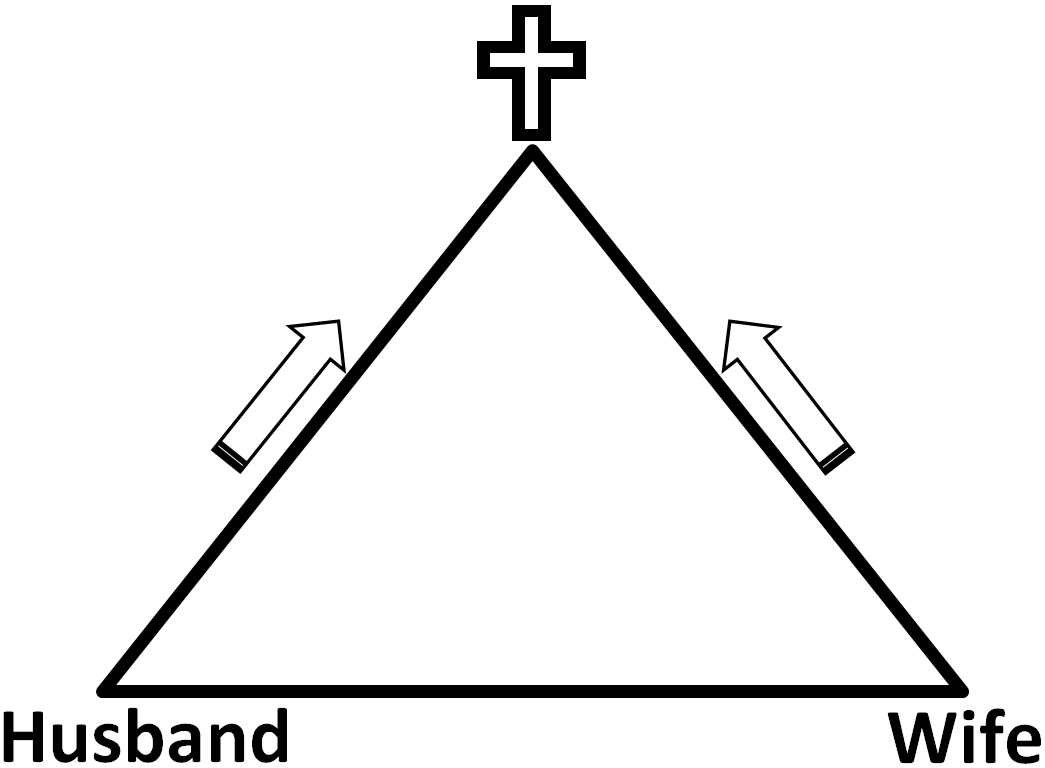
The Bible says that “a cord of three strands is not quickly broken” (Ecclesiastes 4:12). In a marriage the three-strand cord consists of husband, wife and the LORD. As the husband and wife draw nearer to the Lord (James 4:8), they naturally come nearer to each other.
Here’s an illustration:
Now consider these additional biblical insights for a successful marriage:
Speak Words of Blessing/Adoration
Learn to focus on your mate’s attributes and creatively praise him/her, which will enrich your marriage. This should continue as the decades pass and your spouse is no longer in his/her physical prime. Of course, there’s a time & place for constructive criticism (Proverbs 9:8-9), which is a form of tough love. (Spouses should never condone godless carnality in their mates).
Like the lovers in the Song of Songs, speak grandly of your mate, as if she’s the most amazing woman on Earth (4:1-5) and he can leap over mountains (5:10-16). This will have a positive effect on his/her self-image and will enhance your relationship and intimacy. Anyone who constantly puts down their spouse—whether privately or publicly—will spoil or even destroy the relationship.
Your Mate Needs You as a Best Friend, Not Just a Physical Lover
The maiden in the Song of Songs plainly speaks of her lover as her beloved and her friend (5:16). She certainly wants him for intimacy—and overtly so (7:12-14) (note the reference to mandrakes, an ancient aphrodisiac)—yet she also desires her husband to be a brother to her (8:1-4).
In other words, she wanted to be playmates. She feels so comfortable with her committed lover that she can be imaginative & playful, spinning tales, knowing that he will not laugh at her, but with her. Wives want their man to open his heart to them, to not just be a caring physical lover—as good as that may be—but a playful sibling and a communicative, imaginative, honest best friend.
Take heed because truer words have never been spoken.
Take Care of Your Appearance/Hygiene
The shepherd’s description of his Shulammite maiden (Song of Songs 4:1-5) and her descriptions of him (5:10-16) show that they were careful to look, smell and sound their best for their partner. While this is easy to do during the honeymoon stage of a relationship—which these two were in at the time—it’s important to strive to look/smell/sound your best for your partner as the decades progress.
I include “sound” because the maiden describes the mouth of her lover as “sweetness itself” (5:16). Was she describing his literal maw or the sweet, encouraging words that proceeded from it? I believe the latter.
Naturally everyone is disheveled & sweaty after doing serious yard work or what have you but, even then, a relatively solid body and a healthy attitude go a long way in keeping one attractive whatever his/her age or body type. The Shulammite says of her lover: “His arms are rods of gold set with topaz. His body is like polished ivory decorated with lapis lazuli” (5:14).
If you’re a man, don’t give up on the battle of the bulge. I realize it’s tough to keep fit today, especially if you have a stationary job, but keep yourself looking good for your honey. Also be sure to regularly bathe, so you don’t stink. Remember, God is holy, which means absolutely pure, and believers are called to be holy in all we do (1 Peter 1:15-16). This includes hygiene.
Don’t take this as being insensitive to those struggling with weight issues. If a person or couple is okay with being heavy, what’s that to me? It’s none of my business. I’m just encouraging us to look (and smell) our best for our spouses, whatever body type or age. Amen?
What Is the Most Important Quality for a Mate?
I remember a couple of old movie stars, like Kirk Douglas, making statements that they didn’t believe men can be monogamous. But this is a copout to commit adultery or live in fornication. It explains why the bride & groom vow to be faithful to one another. In other words, yes, humans—and especially males—have a predilection for successive romantic/sexual partners, but this is precisely why it’s necessary for married couples to vow to be committed to one another till death (Proverbs 18:21).
To be faithful is to be loyal. Faithfulness is loyalty. It’s a fruit of the spirit and therefore the opposite of a work of the flesh (Galatians 5:19-23).
Loyalty is underrated these days. Honor the one who wears your ring. Write loyalty on the tablet of your heart—i.e. “love and faithfulness” (Proverbs 3:3)—and your marriage will last, assuming your partner feels the same way. Proverbs 20:28 says that love & faithfulness are crucial to the security of any “throne,” meaning any position of significance. This would include the husband or wife, the nucleus of any healthy family.
Proverb 19:22 says “unfailing love” is what a person most desires in another. In other words, they want loyalty, faithfulness. Yet Proverbs 20:6 notes how hard it is to find a faithful person. It’s a rare trait.
So, when looking for a spouse, loyalty should be high on your list of preferences since it’s one of the most priceless qualities for a happy marriage. Perhaps the worst thing a husband or wife can experience is an impenitent unfaithful spouse, which is common in this ignoble age.
Of course, loyalty or faithfulness doesn’t mean there isn’t a time and place for constructive criticism (Proverbs 9:8-9 & Proverbs 27:5-6), which is a form of tough love. I repeat: Spouses should never condone godless carnality in their mates. And neither should ministry associates or business partners. It’s important to hold one another accountable, assuming it’s in a godly manner as opposed to a legalistic (pharisaical) spirit.
This article was edited from chapter 11 of…

- The print book is available here for only $11.99 (299 pages)
- The Kindle eBook is available here for just 99¢!
Both links allow you to “look inside” the book.
Related Topics:
Beauty, Objectification and Lust
What Are “MANDRAKES” Mentioned in the Bible?
Why You Shouldn’t Put Men or Women in a Box (Marriages too)
What Are THE BASICS of Christianity?
Q&A on SHEOL / HADES, the Intermediate State of the Unsaved

What Does the Bible Teach About SHEOL / HADES?
Sheol or Hades involves the intermediate state of unsaved souls between physical death and later resurrection when they’re judged (Revelation 20:11-15). It is “the world of the dead,” as scholar James Strong defined it, or “the assembly of the dead,” as Proverbs 21:16 describes it, or “the realm of the dead,” as observed in Isaiah 14:9,15, Ezekiel 31:15,17 and 32:21,27. The verses from Ezekiel feature the LORD Himself speaking.
In short, Sheol is the spiritual graveyard of dead souls located in the heart of the Earth (Matthew 12:40), albeit in the dark heavenlies or Underworld, not the physical realm. Since Sheol refers to the abode of the dead, it’s often spoken of as synonymous with death in Scripture, e.g. Proverbs 7:27 and 9:18. Here are a couple examples from Isaiah and Psalms:
“For Sheol cannot thank you,
death cannot praise you;
those who go down to the Pit
cannot hope for your faithfulness.
19 The living, the living, they thank you
as I do this day.”
Isaiah 38:18-19 (NRSV)
Who can live and never see death?
Who can escape the power of Sheol?
Psalm 89:48 (NRSV)
Consider those two questions in that last verse: Who can live and never see death? Who can escape the power of Sheol? Only those who are redeemed through Jesus Christ and thus have spiritual regeneration. Ever since Christ died for our sins and was raised to life for our justification, believers are redeemed and spiritually regenerated. Thus death & Sheol have no power over New Covenant believers who physically die. Instead, we go to be with the Lord in Heaven during the intermediate state in which we await our resurrection body, which is verified by several clear passages, like 2 Corinthians 5:6-9, Philippians 1:20-24, Hebrews 10:39, 1 Thessalonians 5:10, Revelation 6:9-11 and 7:9-17.
The souls of the unregenerated, however, go to Sheol at the point of physical decease wherein they are held until their future resurrection and judgment. This includes Old Testament saints who will be resurrected when Christ returns to the Earth at the end of the Tribulation (Matthew 19:28).
What Do Souls Experience in Sheol?
What do these dead souls experience in Sheol during the intermediate state? Are they tormented in fire the entire time, like the rich man in Jesus’ parable? Do they chum around with father Abraham, like Lazarus in that tale? No, they’re dead and therefore experience nothing. Solomon made this clear:
Whatever your hand finds to do, do with your might; for there is no work or thought or knowledge or wisdom in Sheol, to which you are going.
Ecclesiastes 9:10 (NRSV)
The language describes beyond any doubt that Sheol is a condition of unconsciousness. In Sheol:
- there’s neither good work nor bad work;
- there’s neither positive, hopeful thoughts nor anguished, hopeless thoughts;
- there’s neither knowledge of what’s good and holy nor knowledge of what’s evil and impure.
This is further verified in verse 5:
The living know that they will die, but the dead know nothing.
Ecclesiastes 9:5 (NRSV)
The obvious reason the dead “know nothing” is because they’re no longer alive and conscious—they’re dead. This coincides with this passage from the Psalms:
His breath goeth forth, he [his body] returneth to his
earth;
in that very day his thoughts perish.
Psalm 146:4 (KJV)
The Psalmist says that when an unredeemed person physically dies his/her thoughts perish. There is no mention whatsoever of a person’s thoughts continuing to live on in some devil-ruled chamber of horrors. This is obviously because a dead person is no longer conscious of anything. While some translations say “plans” rather than “thoughts,” the original Hebrew word, eshtonah (esh-toh-NAW), literally means “thoughts.”
Take another look at Ecclesiastes 9:10 above and notice that Solomon doesn’t make a distinction between righteous or unrighteous people. He plainly says that everyone would go to Sheol during that period of time, whether righteous or wicked, rich or poor, small or great. In fact, Solomon’s major point in Ecclesiastes 9 is that death or Sheol is the common destiny of all people before redemption was made available through Christ’s death and resurrection. He plainly states in verse 3 that “the same destiny overtakes all.” What destiny? The destiny of Sheol, death, where—he goes on to say—there is neither work nor thought nor knowledge nor wisdom.
When Is Sheol First Mentioned in the Bible?
Sheol first appears in Genesis 37:35, which is notable due to the hermeneutical law of first mention. This was the occasion where Jacob’s sons treacherously sold their brother Joseph into slavery and then lied to their father by telling him that Joseph was slain by a wild beast. Jacob believed the lie and was understandably heartbroken:
All his sons and daughters sought to comfort him [Jacob]; but he refused to be comforted, and said, “No, I shall go down to Sheol to my son [Joseph], mourning.” Thus his father bewailed him.
Genesis 37:35 (NRSV)
Two simple facts can be derived from Jacob’s expression of grief in this passage: 1. Jacob expected to go to Sheol when he died, and 2. Jacob believed that Joseph was already in Sheol, that he would remain there, and that he himself would join him when he eventually died.
The King James Version translates sheol in this passage as “the grave.” Why? Because the verse refers to Jacob and Joseph, both righteous men of God (righteous in the sense that they were in-right-standing with God via their covenant, not that they were unflawed individuals). This is in harmony with the King James translators’ policy of rendering sheol as “hell” when it applied to unrighteous people and as “the grave” when it applied to Hebrews in covenant with the LORD. But there’s absolutely no justification for this practice; the meaning of the word sheol does not change depending on the spiritual state of the person going there.
Whether intentionally or inadvertently, this is evidence in the very first appearance of sheol in the Bible that religious people have tried to mislead the populace about its nature and who exactly went there.
As for the KJV and other translations rendering sheol as “the grave,” Sheol never denotes the physical grave or tomb where bodies are laid to rest; there’s a separate Hebrew word for this. Sheol should only be understood as “the grave” in the sense that it is the graveyard of souls in the spiritual realm, where dead souls are held and ‘awaiting’ resurrection to be judged by God.
Getting back to Jacob’s statement in Genesis 37:35, although Jacob doesn’t say anything about the nature of Sheol, it’s obvious that he didn’t regard it as some sort of nether paradise where his son was hanging out with father Abraham. If this were the case, would Jacob be “mourning” and “bewailing” Joseph so grievously? Of course not. It might be argued that Jacob was grieving over his own personal loss and not the destination of his son’s disembodied soul. If this were so, wouldn’t Jacob likely exclaim something to the effect of, “Praise the LORD that my son is now in the blissful presence of father Abraham, and I will one day go down to this same paradise rejoicing.” Yet Jacob says nothing of the kind; in fact, his reaction is completely opposite to this.
Does Genesis Contain Further Insights on Sheol?
Yes, observe what Jacob later exclaims to his sons during a famine:
“I have heard that there is grain in Egypt. Go down there and buy some for us, so that we may live and not die.”
Genesis 42:2
Jacob’s son, Judah, makes a similar statement in the following chapter:
Then Judah said to Israel his father, “Send the boy along with me and we will go [to Egypt] at once, so that we and you and our children may live and not die.”
Genesis 43:8
Both quotes are in reference to Jacob’s sons traveling to Egypt to apprehend food so their clan “may live and not die.” Obviously, Jacob and his family were in no hurry to go to Sheol to commune with father Abraham in some nether-paradise. Please notice that there’s mysteriously no accompanying statement like, “…but—thankfully—if we die, we’ll be in bliss with our forefathers in Sheol.” Why not? Because this is an unbiblical doctrine.
This same point can be made from similar passages all over the Bible.
In both of these passages the Hebrew word for “die” is muwth (mooth), which simply means “to die” and is used in reference to the death of animals as well as humans (Exodus 7:18). It does not mean “to separate” or, more specifically, “to separate and go to either bliss or torment in Sheol.” The Hebrew term for ‘separate’ is badal (baw-DAL), which is used in Genesis 1:4: “God saw that the light was good, and he separated the light from the darkness.”
Needless to say, statements like “so we may live and not die” only make sense if Sheol is the graveyard of dead souls where souls ‘rest’ in death until their resurrection.
What Did Job Say About Sheol?
Job goes into quite a bit of detail on the nature of Sheol. Did he just dream up all this information or did he have Divine revelation on the subject? No doubt God revealed these truths to him. We can confidently draw this conclusion because what Job says about Sheol is in complete agreement with what the rest of the Bible teaches on the subject (taking the Parable of the Rich Man and Lazarus as what it is—a symbolic tale—and not a real-life accounting of life-after-death). Only if Job’s position contradicted the rest of Scripture should we question its validity.
In the book of Job, satan argues to God that Job is devout merely because the LORD blessed him so greatly and that Job will curse his Creator if his blessings were removed. God thus permits satan to attack the man to find out. As a result, Job loses his ten children, scores of his employees (with only four survivors), all of his great wealth and even his health as he is afflicted with painful sores from head to toe.
After months of suffering, three of Job’s friends go to “comfort” him, but end up judging & accusing him of some great hidden sin, which they presume brought about all his horrible suffering. Most of the book consists of Job, in great anguish, profoundly debating with these “friends.” It should be noted, however, that much of what Job says is directed at God Himself. Such is the case with this passage:
“But mortals die, and are laid low;
humans expire and where are they?
11 As waters fail from a lake,
and a river wastes away and dries up,
12 so mortals lie down and do not rise again;
until the heavens are no more, they will not
awake
or be aroused out of their sleep.
13 Oh that you [God] would hide me in Sheol,
that you would conceal me until your wrath is
past,
that you would appoint me a set time,
and remember me!
14 If mortals die, will they live again?
All of the days of my service
I would wait until my release should come.
15 You would call, and I would answer you;
you would long for the works of your hands.”
Job 14:10-15 (NRSV)
In verse 10, Job declares that “mortals die” and then asks “where are they?” He partially answers in verse 12 by likening death to “sleep” which humans will not “awake” from until “the heavens are no more” or, we could say, a very long time. What needs to be emphasized from these words is that Job describes the condition of death as “sleep” from which all humans will one day “awake” or be resurrected.
Yet he still hasn’t really answered the question of where people go after they die. The very next verse answers this: In his anguish, he cries out to God to hide him in Sheol (verse 13). Why does Job pray this? Because his suffering was so great he wanted to escape it through death; and obviously when a person died—Job believed—his/her soul would go to Sheol.
One may argue that, in verse 12, Job is perhaps referring to the body “sleeping” in the grave, but the obvious focus of his words is the death condition of the soul in Sheol because in the very same breath he prays to go specifically there: “Oh that you would hide me in Sheol, that you would conceal me until your wrath is past, that you would appoint a set time and remember me!”
Job mistakenly believed that God Himself was causing his great afflictions because he was unaware of the devil’s hand in the situation. In truth, the LORD only permitted Job’s afflictions by allowing satan to attack him. Nevertheless, the fact is that Job believed he would escape his intense suffering by dying and going to Sheol.
Yes, Job was actually hoping and praying to die and go to Sheol, a place many religious people consider “hell” and believe to be a devil-ruled torture chamber! Obviously, Job’s view of Sheol was quite different from what religious tradition has taught us. He prayed to go to Sheol because he knew that Sheol was a condition of unconsciousness, which he described as sleep. Job was understandably weary of his intense suffering and wanted it to end. He knew that in death, in Sheol, he would find relief from his misery, not an increase of it.
Regardless of the nature of Sheol, Job definitely believed that everyone would ultimately be resurrected from there. In verse 12 he makes it clear that all mortals who lie down in the “sleep” of death will one day awaken, that is, be resurrected when “the heavens are no more.” And, while Job prayed to go to Sheol in verse 13, it was not with the expectation that he would remain there forever. Job obviously believed that, if God “hid” him in Sheol, He would “appoint a set time and remember” him, which is when his “release” would come (verse 14). Release from what? From captivity to Sheol. So, God “remembering” him and “releasing” him are references to a future resurrection from Sheol, which is in harmony with what the rest of the Bible teaches.
Do “the Wicked Cease from Turmoil” in Sheol?
Job elaborates on the nature of Sheol in an earlier chapter where he curses the day of his birth because of his suffering. He was in essence wishing he were never born because then he would never have had to experience such agony. He then details what it would’ve been like if this were so:
“Why did I not perish at birth
and die as I came from the womb?
12 Why were there knees to receive me
and breasts that I might be nursed?
13 For now I would be lying down in peace;
I would be asleep and at rest
14 with kings and counselors of the earth
who built for themselves places now lying in
ruins,
15 with rulers who had gold,
who filled their houses with silver.
16 Or why was I not hidden in the ground like a
stillborn child,
like an infant who never saw the light of day?
17 There the wicked cease from turmoil,
and there the weary are at rest.
18 Captives also enjoy their ease;
they no longer hear the slave driver’s shout.
19 The small and great are there,
and the slave is freed from his master.”
Job 3:11-19
Job starts off asking why he didn’t die as an infant. In that event, he argues, he would not be enduring all the great suffering that he was experiencing. Had he died in infancy, he believed that he would be peacefully “lying down… asleep and at rest” (verse 13).
Job then explains that he would have shared this condition of sleep and rest with kings and counselors of the Earth, with the small and the great, with rulers and slaves, with captives and weary people and, yes, even with the wicked! In this state of death, Job declares in verse 17 that “there the wicked cease from turmoil, and there the weary are at rest,” and he makes it plain that there’s no “slave driver’s shout” as well (verse 18).
This coincides with what Job later says concerning the wicked:
“They [the wicked] spend their days in prosperity
and in peace they go down to Sheol.”
Job 21:13 (NRSV)
He doesn’t say the wicked go down to Sheol in torment; no, they go down to Sheol in peace. This contradicts the religious belief that the unredeemed go to some horrible devil-ruled nether realm immediately after physical death to suffer torments as they are goaded on by slave-driving demons in fiery pits with not a single drop of water for relief. Instead, Job makes it clear that there is no turmoil or torment for the wicked in Sheol.
Job is saying that, at death, kings, counselors, rulers, infants, the wicked, the weary, captives, the small, the great and slaves all share the same condition, a condition of peaceful “sleep” and “rest,” which are obvious references to unconsciousness. No wonder Job, stripped of all his possessions, forsaken by his wife, wrongly judged by his “friends,” tortured by painful sores from head to toe, mocked and made a byword by everyone, and mourning for his ten children & myriad employees, prayed to go to such a place. His understanding of Sheol was quite different from that held by many misguided people today.
Some may wonder if perhaps Job was referring to the literal grave or tomb where the body is laid to rest since there is no specific mention of Sheol in chapter 3. This idea is ruled out because Job says in verses 13-15 that, if he died, he’d be lying down asleep with kings, counselors and rulers. So, Job is referring to a common place or condition that all people shared together. Biblically speaking, this would be Sheol, the realm of dead souls, as verified in Ecclesiastes 9:10. Job would not be referring to the literal grave or tomb for the body because it is not acceptable or usual practice to bury people together in mass graves or tombs, then or now.
Keep in mind that this was well before the death and resurrection of Christ, hence spiritual rebirth and the consequent attainment of eternal life were yet to be manifested. For this reason, the souls of Old Testament saints could not be ushered into God’s presence when they physically died. The souls of both the righteous and unrighteous went to Sheol at this time because redemption was not yet available.
What Are Some Other Descriptions of Sheol?
There are literally dozens of passages in the Bible that refute the false doctrine that dead souls are conscious in Sheol, whether suffering constant roasting torment or chumming around with father Abraham.
Consider the Psalms, which are “God-breathed” (2 Timothy 3:16) since all the psalmists “spoke from God as they were carried along by the Holy Spirit” (2 Peter 1:21). For unmistakable proof of this, Jesus said in Matthew 22:43-44 that David was “speaking by the Spirit” when quoting Psalm 110:1, which of course implies all the psalms he wrote.
In other words, David’s statements in the Psalms were given by the inspiration of the Holy Spirit and the Holy Spirit is God. As such, David’s exposition on the nature of Sheol in the Psalms, as well as commentary by other psalmists, shouldn’t be considered just “their view” of Sheol. No, it’s God’s view because they were “speaking by the Spirit.”
Here are several descriptions:
Sheol Is Synonymous With Death
This can be observed in the first mention of Sheol in the book of Psalms (keeping in mind the hermeneutical law of first mention):
For in death there is no remembrance of you [God];
in Sheol who can give you praise?
Psalm 6:5 (NRSV)
This is an example of synonymous parallelism in which the second part of the verse simply repeats and reinforces the thought of the first, just in different words. With this understanding, notice how Sheol is paralleled with death, not life in roasting torment.
The verse also reveals…
Souls in Sheol Cannot Remember or Praise God
David was praying for God to save his life in Psalm 6 because his enemies were trying to kill him (as indicated in verse 10). Despite his anguish, David didn’t want to die; he was “a man after God’s own heart” (1 Samuel 13:14 & Acts 13:22) and thus wanted to live and worship God. He knew that, if he died and went to Sheol, he wouldn’t be able to do this.
This contradicts the prominent religious position on Sheol, which suggests that when Old Testament saints died their souls would go to a supposed “paradise” section of Sheol where they would be supremely comforted as they fellowshipped with father Abraham. If this were so, wouldn’t they be able to remember God? Would they not be praising their Creator and thanking God, as long as it were possible?
Yet David makes it clear that souls in Sheol do not and cannot remember God and consequently cannot praise their Creator either. This suggests that those in Sheol are unconscious—“asleep” in death until their resurrection. This is corroborated by other texts. For instance:
The dead do not praise the LORD,
nor do any that go down into silence,
18but we [the living] will bless the LORD
Psalm 115:17-18 (NRSV)
This passage shows that those who die in that era “go down into silence.” Sheol is a place of silence because those who go there are unconscious and, more accurately, dead. There’s no praising & worshipping of God nor are there horrible screams of torment. It is a condition of silence. It is the living who bless the Lord, the psalmist plainly states, not the dead.
Righteous King Hezekiah’s prayer coincides:
“For Sheol cannot thank you,
death cannot praise you;
those who go down to the Pit
cannot hope for your faithfulness.
19The living, the living, they thank you
as I do this day.”
Isaiah 38:18-19 (NRSV)
Notice, again, how Sheol and death are spoken of synonymously. Secondly, witness how Hezekiah makes it clear that those in Sheol are unable to thank or praise God, just as David and the other psalmist did.
The obvious conclusion we must draw is that, if the righteous are unable to remember God and cannot praise or thank Him, then they must not be able to do so. They must be either unconscious or dead—no longer alive. This is supported by Hezekiah’s statement in verse 19 where he stresses that only “the living, the living” can thank and praise God, not those who go to Sheol, the world of the dead.
Here’s yet another corresponding passage:
3 For my soul is full of trouble
and my life draws near the grave (sheol)…
10 Do you show your wonders to the dead?
Do those who are dead rise up and praise you?
11 Is your love declared in the grave (qeber),
your faithfulness in destruction.
12 Are your wonders known in the place of darkness,
or your righteous deeds in the land of oblivion?
Psalm 88:3,10-12
This is further proof that those in Sheol are dead and therefore unable to rise up and praise God. Sheol is likened to the literal grave (qeber) or destruction, said to be “the place of darkness” and “land of oblivion.” The psalmist plainly states that God does not show His wonders to the dead in Sheol; that the dead cannot praise Him there and that God’s love, faithfulness and righteous deeds are all unknown there. What unmistakable proof that souls in Sheol are dead and conscious of nothing!
This Psalm was written by Heman the Ezrahite when his life was in mortal danger; it’s a prayer to God for deliverance from death. Note in verse 3 that Heman clearly expected to go to Sheol when he died, just as Solomon, Jacob, Job, David and Hezekiah did. In the King James Version this is kept from the reader by the use of the word “grave” as a translation of sheol, which is likewise the case with the NIV rendering, as shown above (although the NIV provides a footnote indicating that the verse is referring to Sheol). Because of this mistranslation, the average reader is misled into believing that the psalmist is talking about the condition of the literal grave where the body is buried and not to Sheol where the soul goes. The problem with this is that it obscures the truth about the nature of Sheol to the common person and consequently perpetuates false religious ideas.
Sheol Is “The Land of Silence”
Let’s examine another enlightening Psalm text by David from two translations:
…let the wicked be put to shame
and lie silent in the grave (sheol).
18 Let their lying lips be silenced,
Psalm 31:17-18
…let the wicked be ashamed,
and let them be silent in the grave (sheol).
18 Let their lying lips be put to silence;
Psalm 31:17-18 (KJV)
Notice that this passage is solely referring to “the wicked,” i.e. people who are in rebellion against God—living according to the desires of the sinful nature. These are David’s enemies. They have rejected his God-appointed kingship and are trying to murder him. David is actually praying for their death for that is the only way their lying lips will be silenced.
Observe David’s description of the condition these wicked souls will experience if they die: They will lie silent in Sheol. The wicked do not constantly scream in torment in Sheol, but rather lie silent! This is in harmony with the view that Sheol is a condition of unconsciousness where souls lie “asleep” in death “awaiting” their resurrection.
Other passages likewise reveal that souls lie silent in Sheol, such as Psalm 115:17 from the previous section. Here’s another coinciding verse:
If the LORD had not been my help,
my soul would soon have lived in the land of silence.
Psalm 94:17 (NRSV)
The psalmist is testifying that, if the LORD had not delivered him from his wicked enemies (referred to in verse 16), they would have killed him and his soul would have gone to “the land of silence.” What is “the land of silence”? Since he’s addressing the place his soul would go to after death we know he’s referring to Sheol.
With this in mind, notice that the psalmist does not describe Sheol as “the land of shrieking in torment” or “the land of comforts with father Abraham” (religionists would have us believe Sheol is one or the other, depending on whether the soul is wicked or righteous respectively). That’s because neither of these descriptions is true. Sheol is, in reality, the land of dead souls where there’s no consciousness of anything and thus only silence.
Take another look at the King James rendition of Psalm 31:17-18 above and note that the passage deviates from the King James standard practice of rendering sheol as “hell” whenever the text referred to the wicked (and as “the grave” when it referred to saints). Why did the translators fail to render sheol as “hell” in this particular case since it clearly refers to “the wicked”? Obviously because the passage portrays the wicked in Sheol as lying in silence and this contradicted their belief that wicked souls in Sheol suffer a constant state of screeching torment.
Sheol Is “the Pit” or “Well of Souls” in the Underworld
We saw earlier in Isaiah 38:18 how Sheol/death is described as “the Pit,” which can also be observed in this Psalm:
O LORD, you brought up my soul from Sheol,
restored me to life from among those gone down to
the Pit.
Psalm 30:3 (NRSV)
David was thankful because God delivered him from death. He knew that, if he died, his soul (not his body) would go to Sheol.
Since Sheol is spoken of as synonymous with “the Pit,” we will gain insight into its nature by deciphering what “the Pit” means.
The Hebrew word for “the Pit” is bowr (borr) which literally refers to a hole or pit in the ground and is used 71 times in the Bible. The setting in which bowr appears determines what specific type of hole or pit and, consequently, which English word is used to translate it. For instance, bowr is used 26 times in reference to a ‘cistern,’ nine times in reference to a ‘well,’ five times in reference to a ‘dungeon,’ once to a ‘quarry’ and once it’s even translated as ‘death’ (Proverbs 28:17).*
* These figures are from the original New International Version.
Why “death”? Because bowr is a hole in the ground and that’s what a grave actually is. The grave signifies death, of course—the utter absence of life.
The Word of Truth (2 Timothy 2:15) is telling us that Sheol is like a vast pit or grave where unregenerated souls are held after physical death and before resurrection.
Since one of the definitions of bowr is ‘well,’ Sheol could be described as “the well of souls,” a pit where dead souls are held between physical death and resurrection. Like the subterranean chamber beneath the Dome of the Rock, Sheol is a dungeon—a dungeon where souls are held captive to death after physical decease. This explains why bowr is translated as “dungeon” in reference to Sheol in this passage from Isaiah:
21 So it will happen in that day, that the LORD will
punish
the host of heaven, on high,
and the kings of the earth, on earth.
22 And they will be gathered together
like prisoners in the dungeon (bowr),
and will be confined in prison;
and after many days they will be punished.
Isaiah 24:21-22 (NASB)
The passage is referring to the day when the LORD’s cataclysmic wrath will be poured out upon the whole Earth, which occurs just before the establishment of the millennial reign of Christ. Because of God’s judgments, billions of people will die and every unsaved soul will be confined to Sheol “like prisoners in the dungeon.” Only “after many days,” that is, after the thousand-year reign of Christ, will these souls be resurrected to face judgment and suffer the eternal punishment of the second death, covered in this article (Revelation 20:13-15).
Verse 22 plainly says that these unsaved souls will not be punished until after they are resurrected from Sheol and judged; this is further evidence disproving the view that souls are punished with roasting torment while captive in Sheol. The only punishment experienced in Sheol is death itself, the utter absence of life. This stands to reason since it is in harmony with the biblical axiom that death is the wages of sin (Romans 6:23).
Sheol is a gloomy dungeon or prison in the Underworld where souls are confined. It is not the Underworld (Philippians 2:10), but rather a pit in the Underworld. No wonder David praised and thanked God for delivering him from this death condition. Obviously, David didn’t share the view of some people today that righteous souls in Sheol are (or were) in some type of “paradise” chummin’ around with father Abraham. This is a religious myth! Sheol is a dungeon, a prison, a common pit of death where unregenerated souls are confined until their appointed resurrection.
The only soul who can escape this dungeon-like pit of death is the soul that is born-again and thus possesses eternal life (John 3:36, 5:24 & 1 John 3:14). This is only possible because “Christ Jesus… has destroyed death and has brought life and immortality to light through the gospel” (2 Timothy 1:10). The gospel or “good news” refers to all the benefits available to humankind as a result of Yeshua’s sacrificial death, burial and resurrection (1 Corinthians 15:1-4). Aside from reconciliation with God, the main benefit of this gospel is, of course, eternal life. Until Jesus’ death, burial and resurrection, eternal life or immortality was not available and that’s why in Old Testament times, before the ascension of Christ, both righteous and unrighteous souls had to go to Sheol after physical decease.
Incidentally, it’s interesting that the original definition of the English word ‘hell’—“to conceal or cover”—is in harmony with the biblical description of Sheol as “the Pit.” This is evidence that the Old English ‘hell’ was originally used as a translation of Sheol because it properly gave the image of souls consigned and concealed in a pit in the netherworld until their resurrection on Judgment Day. Unfortunately, the definition of ‘hell’ has taken on a completely different meaning since that time, i.e. perpetually writhing in roasting torment in some devil-ruled torture chamber.
Getting back to Psalm 30, David reveals the state that his soul would have been in if God had not delivered him from death:
11 You have turned my mourning into dancing;
you have taken off my sackcloth and clothed me
with joy,
12 so that my soul may praise you and not be silent.
Psalm 30:11-12 (NRSV)
David is praising God here because he knew that, had he died, his soul would have been silent in Sheol. He well knew that a person cannot praise the LORD or tell of God’s faithfulness in Sheol, as indicated in verse 9, because Sheol is a “land of silence.”
Sheol Is Distinct from the Physical Grave, Yet Paralleled With It
Although the physical grave (qeber) and the soulish grave (sheol) are indeed separate terms in the Bible they are often mentioned in the same breath. Why? Because the two go hand-in-hand—if an unredeemed person physically dies, his or her soul goes to Sheol; if his/her soul is in Sheol it’s because s/he physically died. Simple, right? Let’s look at a few examples.
In Psalm 30:3 David says, “O LORD, you brought up my soul from Sheol, restored me to life from among those gone down to the Pit” (NRSV). David was praising God for deliverance from a life-threatening situation. On this occasion David was so close to death that he considered himself as good as dead; that’s why he symbolically exclaims, “you brought up my soul from Sheol [and] restored me to life.” David obviously didn’t literally die, but he came so close that he spoke as if he did. Also notice that David makes it clear that Sheol is the condition and place that souls specifically go to after physical death, which is in contrast to the physical grave where bodies are housed. Take note as well that David describes Sheol as “the Pit,” a synonym for Sheol.
With this understanding, consider what David goes on to say in verse 9: “What profit is there in my death, if I go down to the Pit? Will the dust praise you? Will it tell of your faithfulness?” (NRSV). Observe how David mentions “the Pit,” which is a reference to Sheol, and then in the same breath asks, “Will the dust praise you?” “Dust” is definitely a reference to the physical grave (qeber) or tomb (qeburah) where the body is housed because dust is what (unpreserved) bodies revert to after death. The reason David refers to Sheol and the physical grave interchangeably is simply because the two, although distinct, go together.
We also see this in Psalm 88 where Heman prays for deliverance from a serious life-threatening situation. Starting with verse 3 Heman says, “For my soul is full of troubles and my life draws near to Sheol. I am counted among those who go down to the Pit; I am like those who have no help, like those forsaken among the dead like the slain that lie in the grave (qeber)” (NRSV). By saying his “life draws near to Sheol,” Heman is simply expressing how close he was to losing his life in this situation. Now observe what Heman declares in verses 10-12:
“Do you [God] work wonders for the dead?
Do the shades rise up to praise you?
11 Is your steadfast love declared in the grave
(qeber),
or your faithfulness in abaddon [destruction]?
12 Are your wonders known in darkness,
or your saving help in the land of
forgetfulness?”
Psalm 88:10-12 (NRSV)
Heman specifically mentions Sheol in verse 3 and refers to it as “the Pit” in verse 4. His reference to “darkness” and “the land of forgetfulness” in verse 12 are also references to Sheol, although they could arguably apply to the physical grave as well. In addition, he refers to Sheol as “regions dark and deep” in verse 6. He also mentions the literal grave, qeber, in verses 5 and 11.
The point is that Sheol and the physical grave are sometimes noted in the very same breath. Although sheol refers to the soulish grave—“gravedom”—where un-regenerated souls go, and qeber refers to the physical grave where bodies are laid to rest, both terms are parallel and signify the same condition: DEATH, the cessation of life. Qeber signifies the utter absence of life in the physical realm and Sheol denotes the utter absence of conscious life period.
Because sheol and qeber are sometimes spoken of in the same breath some theologians have mistakenly theorized that Sheol refers to the physical grave, at least in the context in question. Yet, Sheol is repeatedly described in the Scriptures as a place and condition where immaterial souls go, not bodies. So the idea that Sheol refers to the physical grave must be rejected.
Our conclusion is that sheol and qeber are distinct yet parallel terms in the Bible; they have separate definitions but naturally go together. Being parallel terms, they signify the same thing—death, the absence of life. Is there any life in a physical grave? No. Neither is there life in Sheol, the soulish grave. Is a grave meant for anything other than that which is dead? No. The same goes for Sheol. Both terms, though distinct, denote the absence of life.
This presents a problem for the religious view which teaches that Sheol/Hades is a nether realm where unrighteous souls exist in a state of constant torment desperately hoping for less than a drop of water for relief while Old Testament saints hang out in paradise with father Abraham. If this were so, sheol and qeber couldn’t possibly be sister terms. Why? Because qeber would signify the utter absence of life whereas sheol would refer to the express opposite—conscious life in a spiritual dimension, whether in misery or bliss. They wouldn’t be parallel terms at all if they represent two opposite conditions.
What Did Christ Say About the Nature of Sheol?
Jesus got word that his friend Lazarus was deathly ill and, later, discerned that he had died. Notice what the Messiah says to his disciples:
…“Our friend Lazarus has fallen asleep; but I am going there to wake him up.”
12 His disciples replied, “Lord, if he sleeps, he will get better.” 13 Jesus had been speaking of his death, but his disciples thought he meant natural sleep.
14 So then he told them plainly, “Lazarus is dead, 15and for your sake I am glad I was not there, so that you may believe. But let us go to him.”
John 11:11-15
Lazarus died and Christ describes it as falling “asleep,” which his disciples mistook for natural sleep. So the Lord plainly informed them that Lazarus was dead.
Unlike the Parable of the Rich Man and Lazarus, which is figurative, like all parables, this occasion is a historical chronicling and Jesus says nothing whatsoever about the real Lazarus going to paradise to hang out with father Abraham, which would be the case if his parable involving the fictitious Lazarus was a literal account of the nature of Sheol. How does Christ describe the real Lazarus’ condition after physically dying? He describes it in explicit terms of ‘sleeping’ in death. This doesn’t refer to literal snoozing, of course, but to the condition of non-existence in Sheol where dead souls are housed.
The Lord describes it in terms of ‘sleeping’ simply because every soul in Sheol will be ‘awakened’ one day; that is, resurrected. This is in contrast to the “second death,” which refers to being cast into the lake of fire (Revelation 20:13-15). Those who suffer the second death are never said to be ‘sleeping’ because they will never be ‘awoken’ from eternal death, which is why the Bible calls it an “everlasting destruction”—destruction that lasts forever with no hope of resurrection (2 Thessalonians 1:9).
Lazarus’ death would’ve been the ideal occasion for Christ to elaborate on Sheol having a paradisal compartment for saintly souls of the Old Testament period, but the Lord says nothing of the kind. The Bible doesn’t mention anything at all about the real-life Lazarus being in bliss with Abraham and lamenting his return to our fallen Earth after Jesus miraculously resurrects him. Why? Because it’s a false doctrine based on mistaking a fantastical parable for a literal account.
Christ also described a dead girl as being “asleep” in three accounts of the same story, as seen in Matthew 9:24, Mark 5:39: and Luke 8:52. As with the case of Lazarus, this would’ve been the perfect occasion for the Lord to elaborate on how the girl was in paradise in Sheol with Abraham, but—again—He says no such thing. Instead, He likewise describes her condition in terms of ‘sleeping’ in death.
On top of this is the astounding event of “many holy people” who were raised to life when Christ was resurrected, as shown in Matthew 27:50-53. They came out of their tombs and went into Jerusalem and were seen by many. Again, absolutely nothing is said about these righteous people being resurrected from a supposed blissful section of Sheol where living souls commune with Abraham. Instead, the passage simply says this:
The tombs were opened, and many bodies of the saints who had fallen asleep were raised;
Matthew 27:52 (NASB)
So, the Bible repeatedly describes the intermediate state of unregenerated souls in Sheol in terms of ‘sleeping’ in death, not being comforted in paradise or suffering constant fiery torment. It’s as if God is flashing the truth about Sheol in bright neon lights in His Word, but many Christians are too indoctrinated to see it. WAKE UP CHURCH!
Does This Support ‘Soul Sleep’?
More accurately, it supports soul death. When a spiritually unregenerated person dies, their body returns to the ground while the animating spirit of life returns to God who gave it (Ecclesiastes 12:7). The remains of the lifeless soul are stored in Sheol to ‘await’ resurrection for Divine judgment (Revelation 20:11-15). The soul “sleeping” is a metaphor: When they are resurrected from Sheol to be judged, they “awake.”
What About Those Who Say They’ve Visited Sheol?
This refers to people like Mary Baker and Bill Wiese, who claim to have gone to Sheol (Hades) in a vision or out-of-body experience. These people’s testimonies beg the question: Why did the LORD wait almost 2000 years after the biblical canon was completed to reveal these horrific details about Sheol? If their visions are to be believed, why aren’t there similar such descriptions of Sheol in the Bible, the Word of God?
We don’t need the dubious testimonies of these types of people to understand the nature of Sheol because everything God wants us to know about Sheol has already been revealed in the Word of Truth (2 Timothy 2:15 & 3:16). This is in line with Paul’s doctrinal rule: “Do not go beyond what is written” (1 Corinthians 4:6), which explains why this article focuses exclusively on what God’s Word says on the subject and not the dubious testimonies of people who claim to have visions or experiences that just so happen to wholly disagree with what Holy Scripture teaches.
Eliphaz argued theology based on spooky visions rather than Scripture (Job 4:12-21), but God accused him & his friends of folly in what they said (42:7-8). Those who go outside of Scripture and use sensationalism to prove doctrine are guilty of “the Eliphaz syndrome.” If what they’re saying is true, they wouldn’t have to go beyond God’s Word to prove it.
You’ll rarely hear the topic of Sheol/Hades properly taught in the body of Christ due to entire sects embracing Jesus’ Parable of the Rich Man and Lazarus as a literal accounting of life-after-death when, actually, it’s a biting satire — a figurative parable — given to rebuke the Pharisees & their ilk. It’s a case of not rightly-dividing the Holy Scriptures due to rigid sectarianism or superficiality in their studies (2 Timothy 2:15).
For even more scriptural details on the nature of Sheol, see this article.
This article was edited from chapter 15 of…
- The print book is available here for only $11.99 (299 pages)
- The Kindle eBook is available here for just 99¢!
Both links allow you to “look inside” the book.
For more on the topic of Sheol/Hades…
- The print book is available here for just over $10 (257 pages)
- The eBook is available here for just 99¢
- The more affordable Condensed Version is available here for only about $6 (153 pages); or get the eBook for just 99¢.
Related Topics:
The Believer’s “Intermediate State” (between Physical Death and Bodily resurrection)
Hell (Human Damnation) — Questions and Answers
Hell (Lake of Fire): Eternal Torment or Everlasting Destruction?
Eternal Life (“Heaven”): Questions & Answers
What Couldn’t Jesus Tell the Disciples Because They COULDN’T BEAR IT?
The Lord made this interesting statement to His disciples:
12“I have much more to say to you, more than you can now bear. 13But when he, the Spirit of truth, comes, he will guide you into all the truth. He will not speak on his own; he will speak only what he hears, and he will tell you what is yet to come.
John 16:12-13
There were some things that Christ simply could not tell the disciples because they wouldn’t be able to handle the knowledge at the time. Yet the Holy Spirit would later reveal these things to the early Church. What were these things? Here’s a list:
- The entire Mosaic system would be set aside since believers are not under the Law (Romans 7:6).
- The Sabbath and Hebrew festivals would be abolished (Colossians 2:16-17).
- Having a covenant with God and obtaining the corresponding eternal salvation would be extended to Gentile believers and they were to be equal members of the Church (Acts 9:15, 11:18, 28:28, Romans 11:11, etc.).
- The Messiah was not a political savior who would save the Hebrews from the oppression of the Roman Empire, but rather something far greater — a spiritual savior who sets people free from the bondage of satan’s dominion and sin & death (Acts 26:18, John 3:36 & 2 Timothy 1:10).
Related Topics:
Religion and Christianity — What’s the Difference?
What Does It Mean That THE SEA GAVE UP THE DEAD?

Let’s read the passage in question with focus on verse 13:
11Then I saw a great white throne and him who was seated on it. The earth and the heavens fled from his presence, and there was no place for them. 12And I saw the dead, great and small, standing before the throne, and books were opened. Another book was opened, which is the book of life. The dead were judged according to what they had done as recorded in the books. 13The sea gave up the dead that were in it, and death and Hades gave up the dead that were in them, and each person was judged according to what they had done. 14Then death and Hades were thrown into the lake of fire. The lake of fire is the second death. 15Anyone whose name was not found written in the book of life was thrown into the lake of fire.
Revelation 20:11-20
Both the bodies and souls of the unredeemed will be resurrected to stand before the LORD at the Great White Throne Judgment. There are a couple of interpretations of verse 13.
Here’s one:
- “Death… gave up the dead” would refer to all bodies resurrected from graves/tombs.
- “Hades gave up the dead” would refer to all souls resurrected from Hades, aka Sheol.
- “The sea gave up the dead that were in it” suggests this resurrection extends even to those who lost their lives in the waters of the Earth, whether oceans, seas, lakes or rivers. This would include the multitudes who perished in the global flood of Noah’s day (1 Peter 3:20 & Genesis 7:23). In other words, no unsaved person throughout history would be exempt from standing before God for judgment.
The other interpretation is this:
- “Sea” is figurative of this turbulent fallen world and therefore refers to the resurrection of all unredeemed people who died throughout history.
- Death and Sheol (Hades) are spoken of synonymously in the Scriptures, as observed in Psalm 6:5, Psalm 89:48, Proverbs 5:5, Proverbs 7:27, Proverbs 9:18, Isaiah 38:18-19 and many other passages. Why? Because, when unredeemed people suffer death, their dead soul is housed in Sheol (Hades) until resurrection on Judgment Day.
- So verse 13 is simply a way of saying every unsaved person will be resurrected to face Divine judgment, both body and soul (Matthew 10:28).
I favor the second interpretation.
Related Topics:
Sheol / Hades: The “Intermediate State” of the Unsaved Dead
IMMORTALITY — Only Available Through the Gospel
DEATH — Does It Mean “Separation” as Religionists Claim? (No)
RICH MAN & LAZARUS: Fantastical Parable or Literal Account?
The Believer’s “Intermediate State” (between Physical Death and Bodily resurrection)
Hell (Human Damnation) — Questions and Answers
Eternal Life (“Heaven”): Questions & Answers
What Does Being BORN OF WATER AND OF THE SPIRIT Mean?

Let’s read the passage in question:
3Jesus replied, “Very truly I tell you, no one can see the kingdom of God unless they are born again. ”
4“How can someone be born when they are old?” Nicodemus asked. “Surely they cannot enter a second time into their mother’s womb to be born!”
5Jesus answered, “Very truly I tell you, no one can enter the kingdom of God unless they are born of water and the Spirit. 6Flesh gives birth to flesh, but the Spirit gives birth to spirit.
John 3:3-5
Christ was talking about spiritual regeneration as observed by his explanation in verse 6 of what he meant by being “born again”: “Flesh gives birth to flesh, but the Spirit gives birth to spirit.” So why did he say in verse 5 that “no one can enter the kingdom of God unless they are born of water and the Spirit”? In short, what does being “born of water” have to do with with spiritual rebirth?
He wasn’t talking about water baptism since we know from Scripture that a believer can be spiritually born-again and receive the baptism of the Holy Spirit before undergoing the ceremony of water baptism. The first recorded Gentile believers is Exhibit A (Acts 10:43-48), as are plain passages like Romans 3:23-25, John 3:16, Acts 16:31 and Ephesians 2:8-9. Remember, being baptized in water is simply a public testimony of the believer’s baptism into Christ, which refers to spiritual regeneration, as observed by Galatians 3:26-27 and Romans 6:3.
Like Christ, Paul also linked water to spiritual rebirth and this helps us understand what the Lord meant:
He saved us, not because of righteous things we had done, but because of his mercy. He saved us through the washing of rebirth and renewal by the Holy Spirit
As you can see, inward regeneration involves 1. the “washing of (spiritual) rebirth” and the corresponding 2. “renewal by the Holy Spirit.”
A deeper interpretation is that the Lord used “water” in reference to the seed of the Word of God (Ephesians 5:25-26). In other words, being “born of water” means being born-again via the Word of God.
You see, believers are spiritually reborn of the Holy Spirit — as Jesus said “Spirit gives birth to spirit” (verse 6) — but this is only possible due to the the seed of the Living Word of God, Christ (1 Peter 1:23). In 1 John 3:9 ‘seed’ is translated from sperma, which is the Greek word for sperm. In other words, all true believers are spiritually reborn through the Holy Spirit via the sperm of Christ. Yeshua prayed to the Father, “Sanctify them by the truth; your word is truth” (John 17:17). And Christ is both the living Word of God (John 1:1) and the Truth (John 14:6).
Related Topics:
The Six Basic Doctrines of Christianity
SPIRITUAL REBIRTH: Is Being “Born Again” Biblical?
How You Can KNOW You Are Saved
What Does “the Spirit, the Water and the Blood Testify” Mean?
What Are the SEVEN SPIRITS OF GOD From Revelation?

In John’s apocalyptic vision there are several curious references to the “seven spirits of God”:
John, To the seven churches in the province of Asia: Grace and peace to you from him who is, and who was, and who is to come, and from the seven spirits before his throne,
“To the angel of the church in Sardis write: These are the words of him who holds the seven spirits of God and the seven stars. I know your deeds; you have a reputation of being alive, but you are dead.”
From the throne came flashes of lightning, rumblings and peals of thunder. In front of the throne, seven lamps were blazing. These are the seven spirits of God.
Then I saw a Lamb, looking as if it had been slain, standing at the center of the throne, encircled by the four living creatures and the elders. The Lamb had seven horns and seven eyes, which are the seven spirits of God sent out into all the earth.
This phrase is no doubt a reference to the Holy Spirit with the number seven figuratively illustrating fullness and perfection. Since the “Lamb” is a symbol of Christ, the “seven lamps” of 4:5 and the “seven horns,” “seven eyes” and “seven spirits of God” of 5:6 can only denote the fullness and power upon the Lamb and before the throne. On Earth, Christ was indwelt & anointed by the Holy Spirit before entering public ministry for 3.5 years (Matthew 3:16-17; John 1:32), speaking of which….
Literally, the Holy Spirit is described in Scripture as having seven characteristics:
1A shoot will come up from the stump of Jesse;
from his roots a Branch will bear fruit.
2The Spirit of the LORD will rest on him [Christ]—
the Spirit of wisdom and of understanding,
the Spirit of counsel and of might,
the Spirit of the knowledge and fear of the LORD—
3and he will delight in the fear of the LORD.
Isaiah 11:1-3
This refers to the Messiah being empowered by the Holy Ghost (Matthew 3:16), showing that the Spirit is:
- of the LORD
- of wisdom
- of understanding
- of counsel
- of might
- of the knowledge of the LORD
- of the fear of the LORD
Related Topics:
Is the Holy Spirit God or a Divine Force?
What Is the HOLY SPIRIT’S ROLE in Human Redemption?
What Is the UNPARDONABLE SIN (Blasphemy Against the Holy Spirit)?
Does God Have a Feminine side?
What Are THE BASICS of Christianity?
Did the Crucified Thief Go to Paradise THAT DAY?

When the Messiah was crucified, two thieves were crucified simultaneously with him:
One of the criminals who hung there hurled insults at him: “Aren’t you the Messiah? Save yourself and us!”
40 But the other criminal rebuked him. “Don’t you fear God,” he said, “since you are under the same sentence? 41 We are punished justly, for we are getting what our deeds deserve. But this man has done nothing wrong.”
42 Then he said, “Jesus, remember me when you come into your kingdom.”
43 Jesus answered him, “Truly I tell you, today you will be with me in paradise.”
Luke 23:39-43
Christ obviously discerned a repentant spirit in this thief, along with faith for salvation (Acts 20:21). As such, he was promising the former criminal paradise when he was resurrected at his Second Coming (Daniel 12:1-2 & Matthew 19:28-30). Some argue that Jesus told the man he’d be with him in paradise that very day, yet he said no such thing because Christ didn’t go to “paradise” the day he died since we know his dead soul laid in Sheol for three days until he was resurrected (Matthew 12:40). This obviously was not “paradise,” but rather the penalty of sin—death—which Jesus experienced in our place as our substitutionary death (1 Peter 2:24).
So what “paradise” was Christ referring to and when would he and this repentant thief experience it? The Greek word is only used three times in Scripture. Other than Jesus’ statement in Luke 23:43 (above), Paul referred to “paradise” as currently being in Heaven in 2 Corinthians 12:4, which is substantiated by Revelation 2:7. Since the latter verse states that the tree of life is in this paradise, it’s likely a reference to the Garden of Eden (see Genesis 2:9 and 3:22-24), which was evidently removed from this fallen earth after Adam’s banishment, to be replaced one day when God makes the Earth and Universe new—new in the sense of removing the stain of evil and death, as well as other changes, like making worthless desert landscapes blossom and bloom (Revelation 21:1-4). Again, we know Jesus didn’t go to paradise that day, but to Sheol. He was dead and resurrected three days later. Forty days after that Jesus ascended to Heaven where this paradise is located.
When Jesus was resurrected from the dead he triumphed over the powers of darkness (Colossians 2:15). Paul said of this, “he was delivered over to death for our sins and was raised to life for our justification” (Romans 4:25). The apostle was referring to the justification of all those who believe according to the new covenant, of course, but also to the holy people of the Old Testament period who had already passed away. In our new covenant believers don’t go to Sheol when they die because they’ve been born-again of the imperishable seed of Christ (1 Peter 1:3 & 1:23); as such, they bypass Sheol and go straight to Heaven to await their forthcoming bodily resurrection (Philippians 1:21-24 & 2 Corinthians 5:8). Death—Sheol—has no power over believers who are reborn of the seed of Christ by the Holy Spirit (1 Corinthians 15:55-57). For more glaring scriptural evidence go here.
Old Testament saints, on the other hand, had to go to Sheol when they physically died because Yeshua hadn’t yet died for their sins or been raised to life for their justification. This includes the repentant thief whom Jesus informed would be with him in paradise, which—as we’ve seen—is located in Heaven, not Sheol. Enoch, Elijah and Moses were the only exceptions in the Old Testament period because they were types and shadows of the resurrection of the redeemed (which you can read about here). After Christ was resurrected, righteous souls no longer had to go to Sheol because justification was made available.
All this renders Luke 23:43 nonsensical because Jesus said to the ex-thief, “Truly I tell you, today you will be with me in paradise.” The idea that Jesus went straight to paradise when he died—whether in Heaven or anywhere else—simply isn’t supported by the rest of Scripture. This violates the hermeneutical law “Scripture interprets Scripture.” The contradiction is easily solved, however, by simply placing a comma in the appropriate spot in the text. Keep in mind that there was no punctuation in the original Greek text; consequently, translators have to determine where punctuation marks go, like commas and so on. Also bear in mind that the Greek word for “today,” sémeron, literally means ‘this day’ or ‘now.’ With these facts in mind, the passage makes perfect sense simply by changing the placement of one comma in the English text like so: “Assuredly, I tell you this day, you will be with me in paradise.”
So Christ wasn’t telling the ex-thief that he’d be with him in paradise that very day; no, he was telling him that day he’d be with him in paradise, meaning the ex-thief would be with Jesus in paradise in Heaven when his soul was resurrected from Sheol, whether that occurred 43 days later when Jesus ascended (Ephesians 4:8) or — more likely — at Christ’s Second Coming (Matthew 19:28) is regardless. Keep in mind that time is of no significance when you’re dead in Sheol.
Those who disagree have to find scriptural support that the Messiah went straight to some paradise upon physical death, which they can’t do; so this is the appropriate way to read the verse. Of course, some cite Christ’s parable of the rich man and beggar, suggesting that “Abraham’s bosom” was a paradise, but the overwhelming evidence of Scripture disproves that theory.
This article was edited from chapter 9 of…
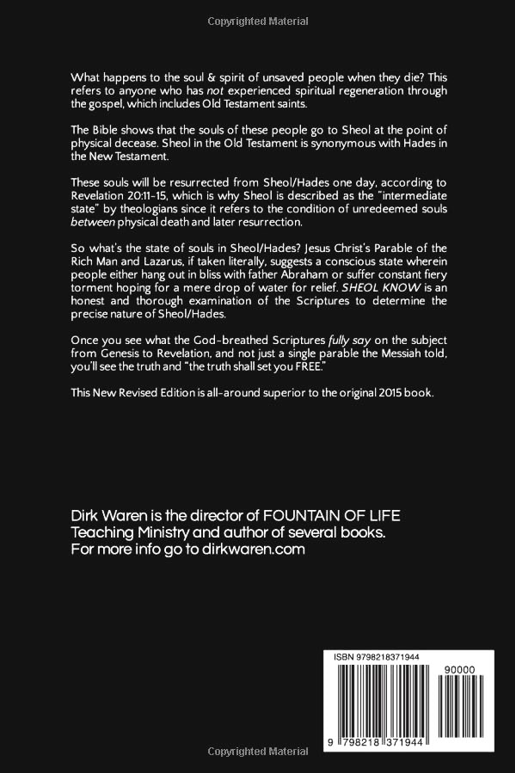
- You can purchase a print copy here for a low price, $10.49 (257 pages).
- Or get the Kindle eBook for only 99 cents!
The more affordable Condensed Version is available here for only $6.12 (153 pages); or get the eBook for just 99 cents. This version is good for people who aren’t interested in excessive details and just want the main scriptural facts. It makes a perfect gift to introduce people to the topic.
Related Topics:
Sheol / Hades: The “Intermediate State” of the Unsaved Dead
RICH MAN & LAZARUS: Fantastical Parable or Literal Account?
The Believer’s “Intermediate State” (between Physical Death and Bodily resurrection)
Hell (Human Damnation) — Questions and Answers
Hell (Lake of Fire): Eternal Torment or Everlasting Destruction?
Eternal Life (“Heaven”): Questions & Answers
Hell (Human Damnation) — Questions and Answers
Are Gentile Believers SPIRITUAL JEWS?

While Gentile believers are obviously not Jews in a physical sense, they are indeed spiritual Jews. Let’s consider the scriptural evidence for this from three angles…
“A Person Is a Jew Who Is One Inwardly“
God’s chosen nation in the Old Covenant was the Israelites, aka the Hebrews (Exodus 6:7, 19:5; Deuteronomy 7:6). While Abraham was the physical forefather of the Israelites/Jews in the inferior Old Covenant, he’s more importantly the father of all believers in the superior New Covenant (Romans 4:11; Hebrews 8:6). This can be observed here:
16Therefore, the promise comes by faith, so that it may be by grace and may be guaranteed to all Abraham’s offspring—not only to those who are of the law but also to those who have the faith of Abraham. He is the father of us all. 17As it is written: “I have made you a father of many nations.” He is our father in the sight of God, in whom he believed—the God who gives life to the dead and calls into being things that were not.
18Against all hope, Abraham in hope believed and so became the father of many nations, just as it had been said to him, “So shall your offspring be.”
Romans 4:16-18
Notice the LORD’s original intention for Abraham:
“No longer will you be called Abram; your name will be Abraham, for I have made you a father of many nations.”
The name ‘Abram‘ means “exalted father” whereas ‘Abraham‘ means “father of a multitude” or “father of many nations.” God made one nation through the loins of Abraham, Israel, but many nations through the faith of Abraham, which is one global spiritual nation regardless of sectarian tag, i.e. the Church of Jesus Christ (1 Peter 2:9).
This explains why the Scriptures say that “not all who are descended from Israel are Israel” (Romans 9:6). The same was pointed out by Christ when he told the unbelieving Jews — who prided themselves on being children of Abraham — that, if they were truly Abraham’s offspring, they’d do the things Abraham did, which they didn’t (John 8:39). Thus the Lord told them frankly that the devil was their father (John 8:44).
In short, there are two kinds of Israelites or Jews:
- The ethnic variety, meaning people physically descended from Abraham.
- The faith-oriented variety, meaning people who have the spirit of faith, i.e. those who turn to God in faith just as their father of faith did, Abraham (Romans 4:17).
There are some people of the first definition who are not of the second (Revelation 3:9). Yet there are some of the second definition who are also of the first, like Paul. Today, you’ll hear the latter people referred to as Messianic Jews.
Those of the second definition are truly “Abraham’s seed” or “Abraham’s offspring” and are thus spiritual Jews, as it is written:
If you belong to Christ, then you are Abraham’s seed, and heirs according to the promise.
In other words, it is not the children by physical descent who are God’s children, but it is the children of the promise who are regarded as Abraham’s offspring.
28A person is not a Jew who is one only outwardly, nor is circumcision merely outward and physical. 29No, a person is a Jew who is one inwardly; and circumcision is circumcision of the heart, by the Spirit, not by the written code. Such a person’s praise is not from other people, but from God.
Romans 2:28-29
This isn’t just a New Testament phenomenon as it can also be observed in the Old Testament. For instance, Numbers 13-14 details how Moses sent twelve Hebrews from each tribe into the Promised Land in preparation to take it, but ten came back with a spirit of fear, discouraging the masses, while two had a spirit of faith — Joshua and Caleb (Numbers 14:6-9). The ten doubters were dyed-in-the-wool Hebrews, physically speaking, but they weren’t children of Abraham because they didn’t have a spirit of faith. Joshua and Caleb, by contrast, were Abraham’s true offspring, not just in flesh, but in spirit as well.
All Believers — Whether Jew or Gentile — Are Spiritually Reborn of the Seed of Christ
All believers are spiritually regenerated of the seed of the Living Word of God, Christ (1 Peter 1:23). In 1 John 3:9 ‘seed’ is translated from sperma, which is the Greek word for sperm. In other words, all true believers are spiritually reborn of the sperm of Christ and, physically speaking, Yeshua was a Hebrew of the tribe of Judah (Matthew 1:1-16; Luke 3:23-38; Genesis 49:10; Isaiah 11:1). So, while Gentile believers are obviously not physical Jews, they are indeed spiritual Jews.
Consider Paul. Before he became the great apostle he was Saul, the great persecutor of the Church (e.g. Acts 8:3). Saul was a physical Jew, but not a spiritual Jew. Once Saul was born-again of the seed of Christ, however, he became a spiritual Jew, renamed Paul. If a Gentile man experiences the very same spiritual regeneration through Christ as Paul did, how would he not also be a spiritual Jew since both were reborn of the same spiritual seed? It’s as simple as 2+2=4.
Gentile Believers Are “Wild Olive Shoots” Grafted Into Israel
This can be observed here:
11Again I ask: Did they [the Hebrews] stumble so as to fall beyond recovery? Not at all! Rather, because of their transgression, salvation has come to the Gentiles to make Israel envious. 12But if their transgression means riches for the world, and their loss means riches for the Gentiles, how much greater riches will their full inclusion bring!
13I am talking to you Gentiles. Inasmuch as I am the apostle to the Gentiles, I take pride in my ministry 14in the hope that I may somehow arouse my own people to envy and save some of them. 15For if their rejection brought reconciliation to the world, what will their acceptance be but life from the dead? 16If the part of the dough offered as firstfruits is holy, then the whole batch is holy; if the root is holy, so are the branches.
17If some of the branches have been broken off, and you [Gentile believers], though a wild olive shoot, have been grafted in among the others and now share in the nourishing sap from the olive root, 18do not consider yourself to be superior to those other branches. If you do, consider this: You do not support the root, but the root supports you. 19You will say then, “Branches were broken off so that I could be grafted in.” 20Granted. But they were broken off because of unbelief, and you stand by faith. Do not be arrogant, but tremble. 21For if God did not spare the natural branches, he will not spare you either.
Romans 11:11-21
Paul was addressing believers in Rome (Romans 1:7) here wherein he relates Israel — God’s people in the Old Covenant — to an olive tree. Some of the “branches” of Israel had been broken off due to unbelief (verses 17 & 20) and Gentile believer were grafted in like wild shoots. Grafted into what? Israel. And Israel is made up of Hebrews, aka Jews. How is it that Gentiles are grafted into Israel? Through spiritual rebirth via the seed (sperm) of Christ. If Gentile believers are grafted into Israel through spiritual regeneration, that makes them Jews — not physically, of course, but spiritually.
Related Topics:
HEBREWS / ISRAELITES / JEWS — Why Did God Choose Them?
Hermeneutics — Proper Bible Interpretation
REDEMPTION — God’s Plan of Liberation for Humanity & Creation
Why Did God Allow THE BLACK DEATH and So Many to Die?

There are several examples of the Almighty bringing pestilence on certain peoples at certain times as a judgment against sin/rebellion (e.g. 2 Samuel 24:15 wherein 70,000 died). When God’s judgment falls upon the Earth during the future 7-year Tribulation there will be plagues (e.g. Revelation 6:8 & 18:8). But this doesn’t mean every outbreak in history is due to divine judgment.
The black plague — aka the bubonic plague — swept across Europe and northern Africa from 1346-1353, killing between 75-200 million people, which makes it the deadliest pandemic in human history. Was the black death a judgment from God or merely the consequence of life in a fallen world and unsanitary living practices/conditions? Or both? It’s one of those mysteries of life we can ask the LORD about when we come face to face (1 Corinthians 13:12).
One thing I know is that Europe was in the midst of the Dark Ages at the time, 164 years before the Protestant Reformation would begin. In other words, the true Church was small and completely underground at the time and a spirit of powerless religiosity with the superstitions thereof reigned across Europe. I point this out because the true gospel teaches healing by faith (e.g. Mark 5:34 & Mark 10:52) and people couldn’t very well be healed by faith during a deadly pandemic if such truths are not known or preached.
It didn’t help that the Catholic Church conveyed the Word of God in Latin at services and so the common person couldn’t even comprehend it, which you can read about here. (The absurdity of having masses in Latin wasn’t corrected until 1969). The Bible offers sound advice on sanitation, quarantining and diet, as observed in Leviticus 11-13, which was well over 3000 years before germs were discovered in recent centuries, but what good is such knowledge if people are unaware of it? As it is written, “my people are destroyed from lack of knowledge” (Hosea 4:6).
As far as the specific threat of plague goes, the Bible promises believers:
5You will not fear the terror of night,
nor the arrow that flies by day,
6nor the pestilence that stalks in the darkness,
nor the plague that destroys at midday…
9If you say, “The Lord is my refuge,”
and you make the Most High your dwelling,
10no harm will overtake you,
no disaster will come near your tent.
11For he will command his angels concerning you
to guard you in all your ways;
Psalm 91:5-6,9-11
Unfortunately, believers can’t very well appropriate such an awesome promise by faith during a pandemic if they don’t know about it or don’t know how to appropriate it in their lives on a daily basis thru simple spiritual warfare. In short, ignorance can kill you. Just as bad, the social spread of fear in such a dire situation naturally kills faith but, thankfully, faith counteracts fear for those who boldly challenge it.
Also, consider this: How is the common person dying of the black death in the 14th century much different from innocent people inadvertently being harassed by a psycho mass shooter today? It could understandably be argued that neither deserved such a fate. In his book Disappointment With God, Phillip Yancey described such things as God’s “megaphone of pain,” quoting C.S. Lewis:
We can ignore even pleasure. But pain insists upon being attended to. God whispers to us in our pleasures, speaks in our conscience, but shouts in our pains: it is his megaphone to rouse a deaf world.
In other words, the Sovereign LORD uses the various sufferings in this fallen world to get people’s attention and draw us to our Creator in humility/repentance and the salvation thereof — physical salvation as well as eternal salvation. David understood this, as observed in Psalm 119:71.
Christ addressed the topic when he ministered on Earth:
1Now there were some present at that time who told Jesus about the Galileans whose blood Pilate had mixed with their sacrifices. 2Jesus answered, “Do you think that these Galileans were worse sinners than all the other Galileans because they suffered this way? 3I tell you, no! But unless you repent, you too will all perish. 4Or those eighteen who died when the tower in Siloam fell on them—do you think they were more guilty than all the others living in Jerusalem? 5I tell you, no! But unless you repent, you too will all perish.”
Luke 13:1-5
- The Galileans spoken of in verse 2 were evidently worshippers offering a sacrifice at the Temple and unjustly murdered by Roman authorities on Pilate’s orders.
- The Tower of Siloam in verse 4 is evidently a reference to one of the towers guarding the aqueduct in lower Jerusalem (John 9:7), which accidently collapsed, killing several people.
Bottom line, the pain and calamities encountered in this fallen world should spur the fear of the LORD, which over-and-over is said to be the beginning of knowledge/understanding/wisdom in the Bible (e.g. Proverbs 9:10). Of course, such negative things can also spur the opposite in some people, resulting in bitterness and hatred toward life or the Creator and the corresponding rebellion/hedonism.
Keep in mind that, if this current world wasn’t totally messed up beyond fixing, there would be no need for a “new heavens and new earth, the home of righteousness” (2 Peter 3:13 & Revelation 21:1-4). Believers are encouraged to “look forward” to this coming eternal age wherein everything that’s glaringly wrong now will be made right. Read that again.
While it’s healthy to look forward to this new heavens and new earth, we can stay active in the meantime by doing our part to help the suffering in this fallen world one way or another, including teaching/preaching truths that will “set the captives free” and “heal the sick and brokenhearted.” Even something as small as giving someone an encouraging word or a hug is helpful. Or how about saving an animal, like a cat or dog?
Focusing on the countless great tragedies that have taken place throughout history is a dead-end street and one-way ticket to bitterness and mental illness. Instead of asking why God allowed this or that tragedy to happen, consider focusing on questions that might offer better answers, like: Why is this world so messed up? Is there a malevolent being or beings who have control to some degree and are working “behind the scenes”? What’s hindering the Almighty from legally saving people in tragic situations? How are some people effectively tapping into the power of God and miraculously being saved in deathly situations, like Paul when he was bit by a deadly viper (Acts 28:1-5)? I think we can learn something from the answers we discover.
The question “Why does a good God allow evil and suffering?” is a popular one. When talking to our neighbor a few years ago, this was the first question he asked when the conversation turned to deeper stuff beyond the weather and yardwork.
Consider this: Over and over in the Bible are statements that “the LORD is good” (e.g. Psalm 34:8). We see this verified in the opening pages of Genesis in which God creates the Earth and living things wherein Adam & Eve exist in a veritable paradise — no evil, no pain, no death, no grieving. This is likewise observed when the Creator’s plan of redemption is completed in the “new heavens and new earth” where “There will be no more death or mourning or crying or pain, for the old order of things has passed away” (Revelation 21:1-4). These bookend scenarios show the way God wants it to be on Earth — a condition in which immorality, corruption, suffering and death are nowhere to be found. Chew on that.
For more insights, see this article.
Related Topics:
How to “FEAR NOT” in Perilous Times
REDEMPTION — God’s Plan of Liberation for Humanity & Creation
Satan (the Devil) — Liar, Slanderer, Thief, Murderer